Category: Restaurant Marketing

Valuable Guest Insights You Can Gain From a Restaurant Customer Data Platform

A robust and reliable analytics platform is central to the success of your restaurant business. Restaurant customer data platform analytics can provide you with a wealth of insight into how your guests behave and spend.

In turn, it will help you generate more guests, increase sales, gain insights into customer behavior and preferences, create detailed customer profiles, measure return on investment (ROI), and maximize those valuable marketing and operations dollars.

Surprisingly, though, many restaurateurs are still in the dark when it comes to using data analytics for business growth purposes and measuring ROI.

For example, a CMO Council survey of senior marketing executives found that “more than 80% of respondents were dissatisfied with their ability to measure marketing ROI, and fewer than 20% of the respondents said their companies employed meaningful metrics,” as reported by the Harvard Business Review.

Brick-and-mortar businesses, like restaurants, have been at even more of a disadvantage because guest data collection has traditionally been difficult to collect and very expensive.

Fortunately, Bloom Intelligence now makes it very simple to do, and at pennies on the dollar compared to other data collection methods.

In our last post, we discussed the various ways to collect guest data, such as through your website, your POS, your online ordering system, and your guest WiFi.

Now that you are collecting guest data, here are some of the various insights you can glean from it.

Restaurant Guest Data: On-Premises Insights

Even if guests do not log into your WiFi, Bloom will know that their device is at your location. This can give you very detailed and accurate insights that you have simply not been able to see before. Here are a few of the most valuable.

Guest Dwell Time

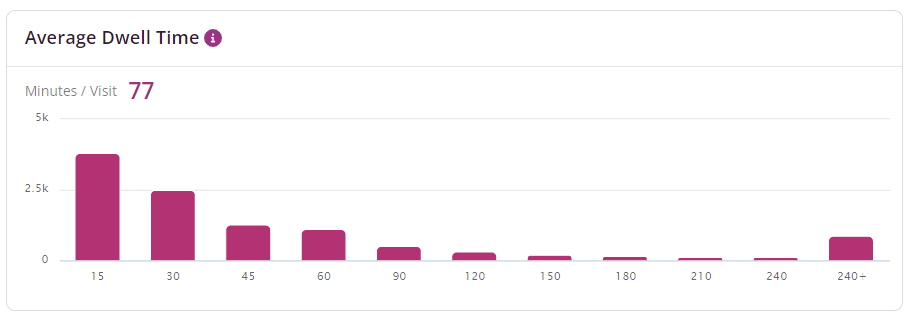
The amount of time guests spend in a location is called “dwell time” and it is a key performance indicator (KPI) for any brick-and-mortar business.

Dwell time is related to several important metrics like customer satisfaction, shopping experience, and even sales.

CDP Insights - Customer Dwell Time

According to a study by PathIntelligence, increasing dwell time by just 1 percent leads to an average 1.3 percent increase in sales. Although 1 percent may not sound like much, it can make a serious difference in your bottom line when multiplied across all of your guests and locations.

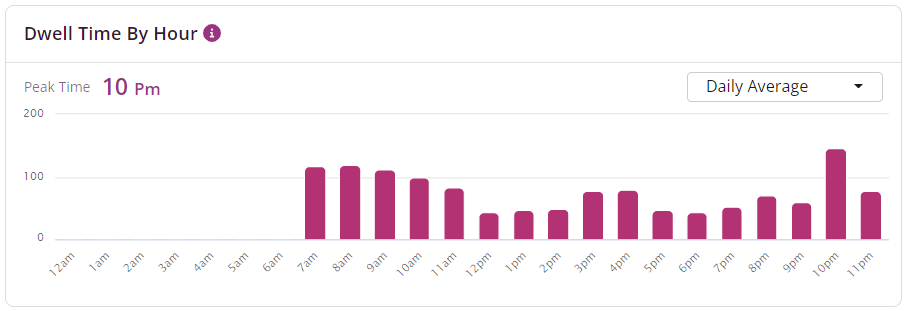
With Bloom, you will also see dwell times by the hours, letting you know how long guests stay when arriving at a specific hour of the day.

CDP Insights - Guest Dwell Time by Hour

Popular Visit Days and Times

When you’re busy running a restaurant business, it may appear at first glance that you’re always experiencing the same guest visitation rates on a daily basis. In reality, it probably varies more than you think.

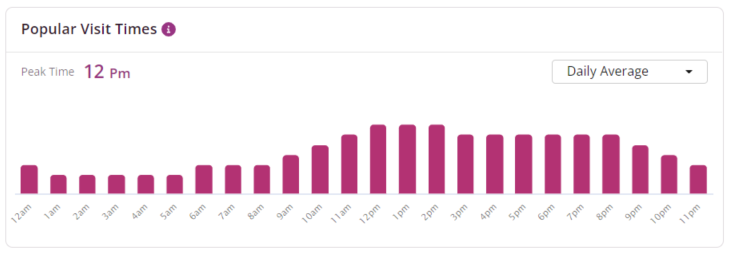
With Bloom, you’ll see accurate guest visit days and times. You’ll see daily averages, or you can drill down into specific days of the week.

CDP Insights - Popular Visit Times

A great aspect of collecting guest data is how you can use it to map out more staff efficiency.

For instance, you can know exactly how to manage staffing schedules based on when you have the highest foot traffic during any given day. Now you can save money by avoiding paying for extra help you don’t really need.

It will also help you make data-driven purchasing decisions, so you can avoid 86’ing menu items or end up with wasted inventory.

Other Guest Behavior Metrics

With the ability to sense and track individual guest devices, you’ll be able to see other valuable metrics to help you understand guest behavior and improve your business.

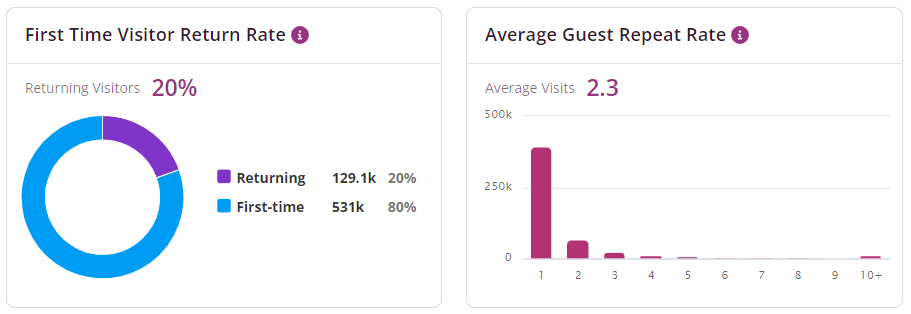
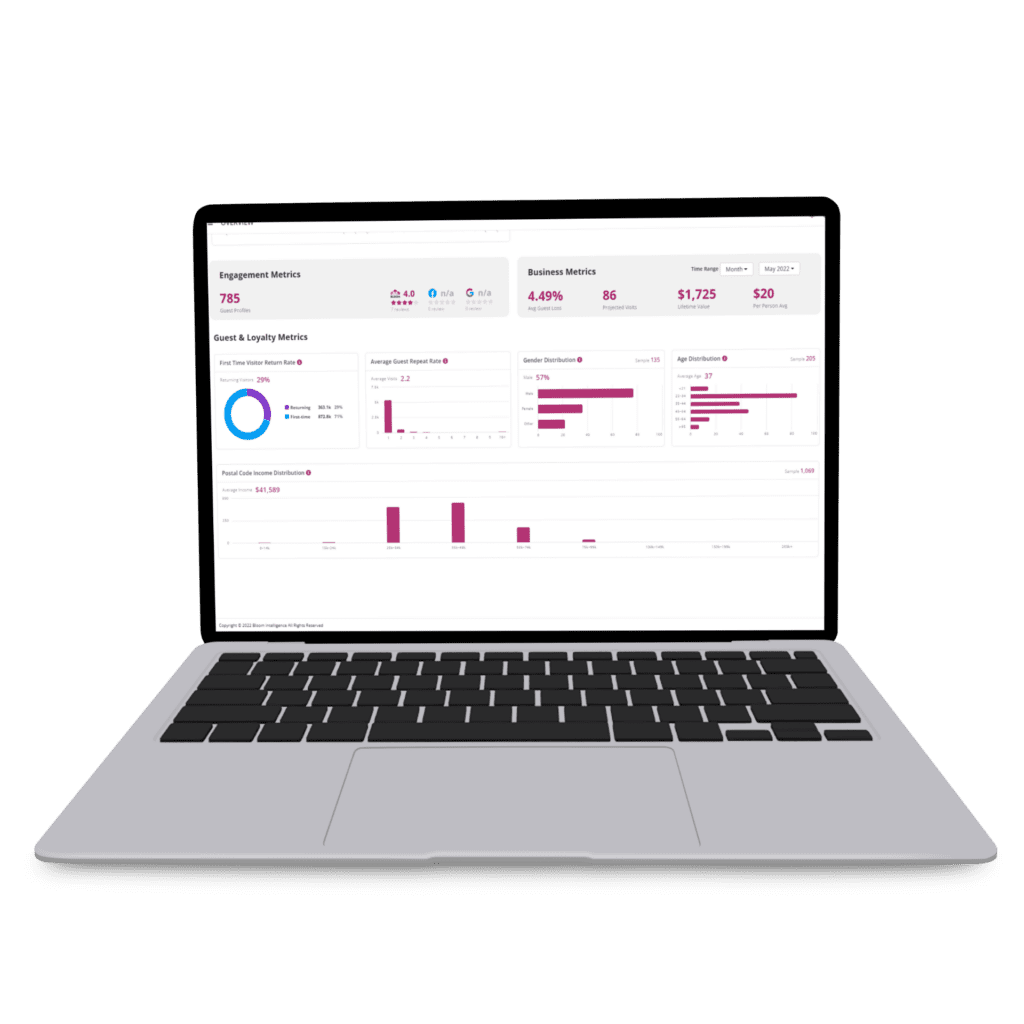
You will be able to see your first-time visitor return rate and average guest repeat rates. Repeat customers ensure long-term business success, but getting them in quantity can be difficult when you lack feedback on the effectiveness of your marketing efforts. Fortunately, such feedback is readily available with Bloom.

CDP Insights - Business Metrics

If you have a high first-time visitor return rate, it means you’re doing something or several things right. If you can maintain this return rate, retain these customers over the long term, and increase their lifetime value, your business can grow rapidly.

Other Business Metrics

Using machine learning algorithms, Bloom can give you data about your average guest loss, as well as projected visits. This can further strengthen your staffing and purchasing decisions, saving you time and money while improving overall guest satisfaction.

Integrating Bloom with your POS system can also provide you with accurate per-person averages and guest lifetime values.

Restaurant Reputation Management

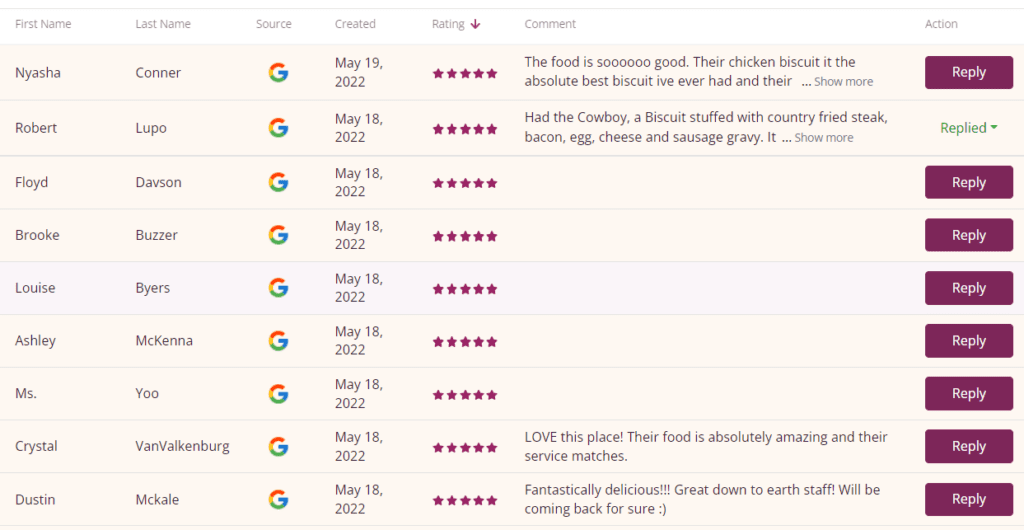
Bloom Intelligence integrates with Google and Facebook, allowing you to see and respond to all of your ratings and reviews on these platforms in one place.

With the graphical charts, you can easily spot trends over time and work to make your restaurant’s reputation better.

CDP Insights - Restaurant Reputation

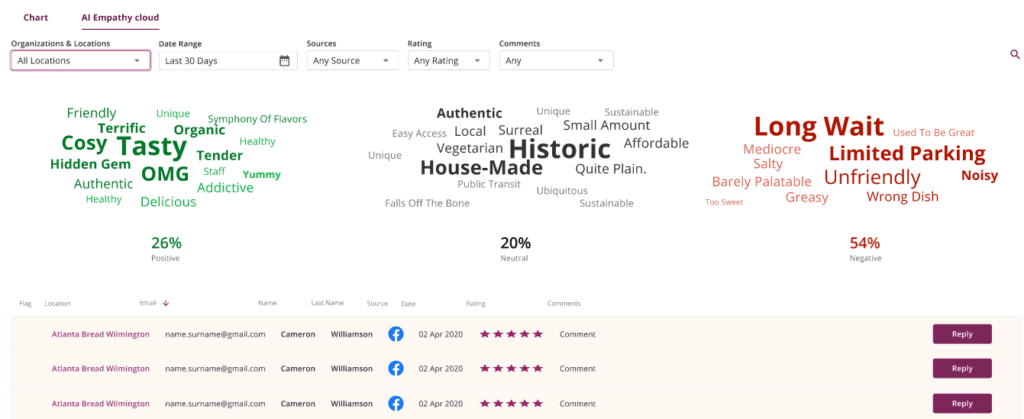
You’ll also have access to a word cloud showing your positive, neutral, and negative sentiment from all of those online reviews. This can help you better understand what you are doing great, and what might need more attention.

CDP Insights - Guest Sentiment Word Cloud

Your reputation, online or offline, can literally make or break your restaurant business. It can make the difference between having a waitlist or having a sparse dining room with too many empty seats.

This is why actively managing your restaurant’s reputation is crucial for a profitable, growing business.

Discover Bloom Intelligence – Your Guests Will Love You For It

With Bloom, you’ll have a complete 360-degree view of your guest base. Then you can use the data to improve marketing and operations, save time, and increase guest lifetime values.

If you are ready to start collecting your own first-party guest data, you need to give Bloom Intelligence a look.

Not only will you be able to automate your restaurant email marketing, but you can also use Bloom to unlock valuable guest insights, improve your ratings and reviews, identify and bring back lost guests, and so much more.

You’ll feel confident as you make solid data-driven decisions. You’ll drive company growth and build a much larger base of loyal guests.

With the amount of competition out there, Bloom can give you a strong competitive advantage and ensure lasting success.

So, click for a free demo of the Bloom Intelligence platform, or call to schedule today at 727-877-8181.

restaurant online ordering marketing demo


Restaurant Online Ordering Marketing Strategies

Online ordering has become one of the hottest trends in the food and beverage industry.

According to Zippia, online food ordering has grown 300% faster than dine-in since 2014 and now accounts for roughly 40% of total restaurant sales.

Likewise, 60% of Americans order delivery at least once per week and the average American spends $67 on takeout per week.

Quick Links:

+ Marketing Automation Campaign Strategy
+ Guest Segmentation and Personalization Strategy
+ Intelligence Online Digital Advertising Strategy

It’s easy to see that online ordering should be a focus for your restaurant business. Other benefits include:

  • Reduced wait times for guests
  • Increased order accuracy
  • Improved guest satisfaction
  • Higher average order values
  • Reduced labor costs

There is one even more powerful benefit that can supercharge your restaurant marketing – collecting guest data.

Online Ordering Marketing Strategies

Online Ordering Marketing Strategies

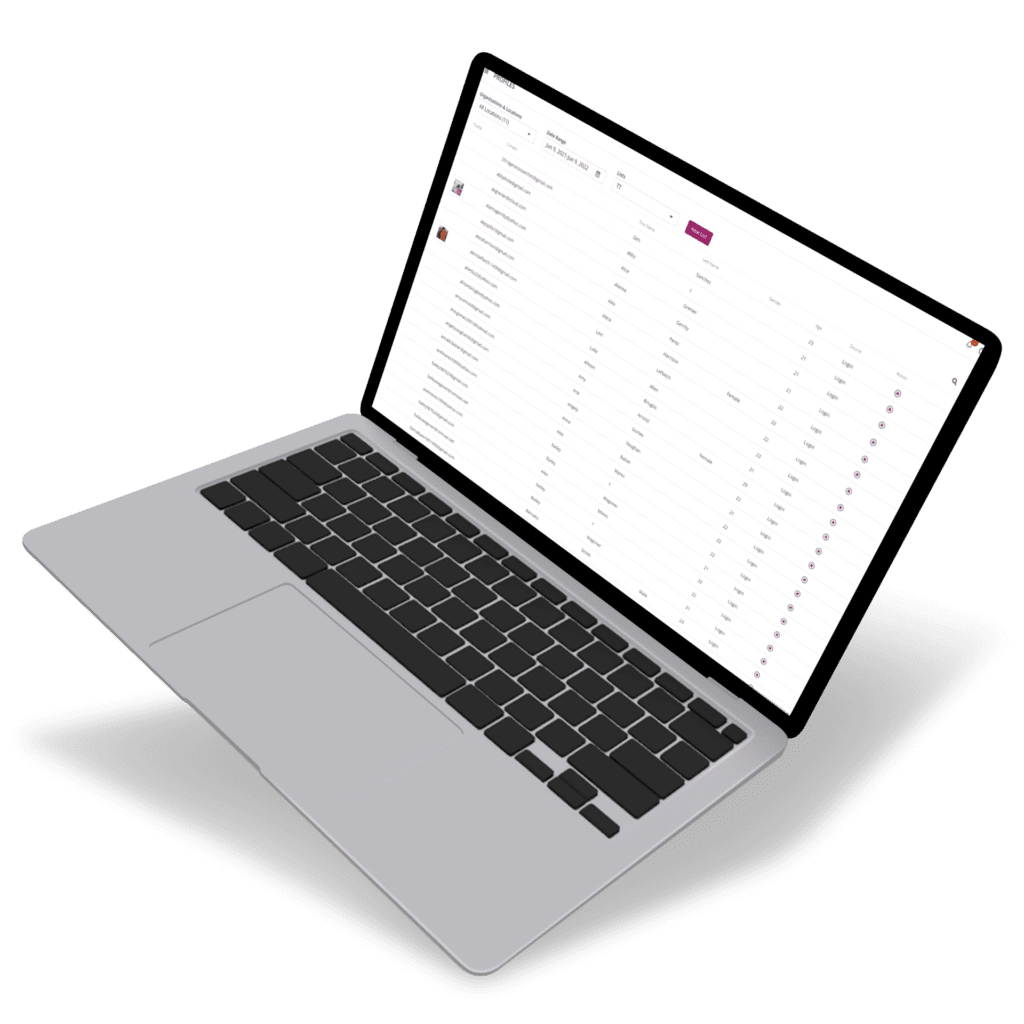
When your guests place an online order, you can collect valuable information, such as their name, postal code, food and beverage preferences, and spending habits. Most importantly, you are also collecting their contact information like their email address and/or phone number.

With this data, online ordering marketing becomes a possibility that can not only improve your marketing ROI but also increase guest loyalty and lifetime values.

With a database of guest data and contact information, you can begin using it for marketing campaigns. Here are a few online ordering marketing strategies you can use to build your restaurant business.

1. Marketing Automation Campaigns

Marketing automation is a tool that can save a great deal of time and energy. Bloom Intelligence

With marketing automation, all you have to do is configure the campaign once and it will execute behind the scenes automatically.

First, you create a message for the campaign that will be sent to your guests. Then, you configure the triggers that will cause the message to be emailed to the guest. From that point on, your marketing message will be sent to each guest who meets the triggering criteria.

Examples

There are many different triggers and combinations.

  • Happy Birthday Campaign – this is one of the most popular and successful campaigns. The message would be sent to guests a few days prior to their birthday. Typically it will include an offer they can redeem on their special day.
  • Survey Campaign – send a message to guests asking them to rate their recent experience. It can be sent at a predetermined time after they order online.
  • Ratings Campaign – send a message to guests asking them to rate you on a popular ratings website like Google or Facebook. This is a great way to have consistent ratings and spot trends and sentiment.
  • At-risk Guest Campaign – when guests have not ordered online in a given amount of time, or when they have surpassed their typical ordering time, send a message enticing them to come back.
  • Milestone Campaign – send a message with a reward for guests when they reach a particular milestone, such as the 10th time they order online.
  • Upon Registration Campaign – send a thank you message to guests when they first sign up for online ordering.
  • Upon Ordering Campaign – send any message you wish whenever guests order online. It can be configured to be sent a certain amount of time after the order, depending upon the topic of your message.

These are just a few of the marketing automation messages you can send to your guests for online ordering marketing. You can also send triggered messages based on guest demographics.

For instance, you can send a message to men over 30, or guests from a specific postal code. The combinations are nearly limitless.

marketing automation statistics for online ordering marketing strategies

2. Use Guest Segmentation

As you grow your database of guests, you can begin to identify specific guest personas and group them together, sending more targeted messaging.

Customer segmentation is an online ordering marketing strategy of “segmenting” your current and potential guests into distinct groups (market segments) and then marketing your business to them using focused, group-specific methods.

Guests are split into groups based on their demographic data– age, location, etc.– and their behavioral and psychographic data – what online content they interact with, how they behave at your place of business, and their perceived interests.

These groups are called segments, and each segment has its own persona. Different personae like to be marketed to in certain ways.

Based on marketing research, when you engage with clients with unique, individualized methods, you’re more likely to garner interest and ultimately draw leads to your website.

guest segmentation as an online ordering marketing strategy

The Goal of Guest Segmentation

The ultimate goal of guest segmentation is to adjust your messaging to appeal to different segments. Guest segmentation helps certain demographic-specific businesses find their guests among the highly populated masses online.

For instance, cosmetic companies are probably looking for young, female clients that are particularly interested in beauty products. They’ll market themselves exclusively to this relevant segment.

Similarly, a skateboarding company knows that it isn’t relevant to the population at large. They will try to find relevant clients in urban teenagers and young adults.

So, marketing their products to seniors and middle-aged business people would produce little return on investment. Therefore, these companies would be wasting their marketing budgets without using effective guest segmentation.

The restaurant industry, meanwhile, has mass appeal. You aren’t necessarily looking to narrow down your audience as much as fine-tuning the voice of your marketing strategies to speak to different restaurant guests.

The voice of your marketing messages should be very different for older business people as it is for teenage skateboarders, but the message at the root of your strategy is the same: people should come to your restaurant!

3. Intelligent Online Digital Advertising

Google and Facebook are moving away from cookie-based advertising. This means there is no way to target specific guests, or groups of guests, without uploading your own data.

With Bloom Intelligence, you can quickly build a large clean guest database to help you find new guests. 

By building your own first-party guest database from online ordering, you will open up the opportunity to remarket to those guests online using Google or Facebook/Instagram ads.

One of the most effective ways to keep current guests coming back is to execute a remarketing campaign aimed at your current and past guests. With your own first-party data, this becomes very easy to do.

According to Signifi Media, the average click-through rate (CTR) for remarketing ads is 10 times higher than regular display ads. 

The average CTR for retargeted ads is 0.7% compared to 0.07% for regular display ads. 

A CTR of 0.7% is a significantly better conversion rate compared to other digital advertising strategies, which could make a powerful difference in restaurant marketing ROI and acquiring new guests. 

Lookalike Campaigns for Google and Facebook

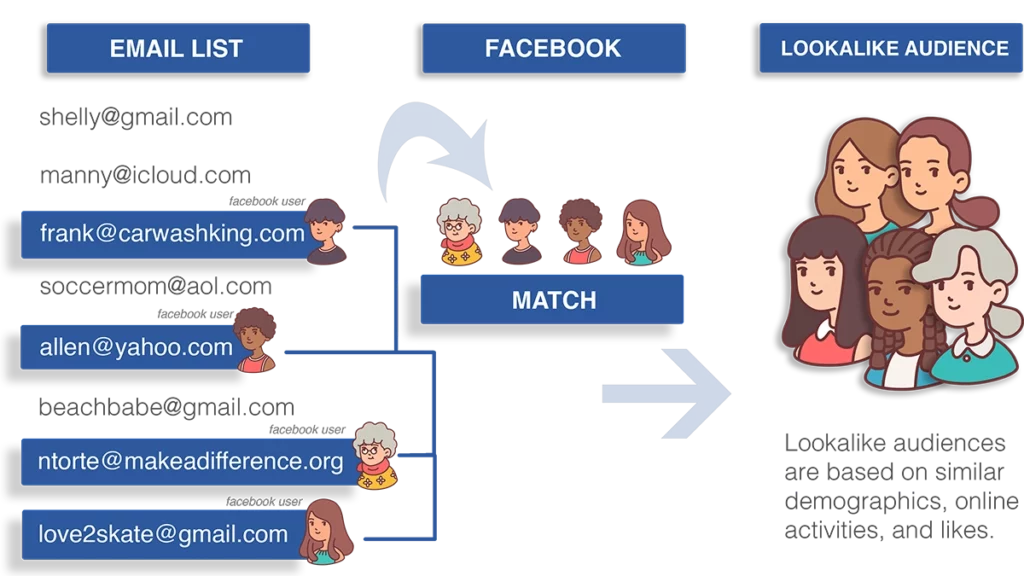
Creating lookalike campaigns on Google and Facebook is a relatively simple strategy. You export your list of guest data to Google or Facebook. Then, these platforms will begin creating a list of other people who match the characteristics of those in your list.

A lookalike campaign takes an audience of existing guests and finds a whole load of new guests in the same demographics with similar tastes. The idea is that these people are also likely to enjoy your service. Likewise, a good percentage of them will become loyal guests themselves.

online ordering marketing strategy - lookalike campaigns

Once your lookalike audience has been created with a service like Facebook or Google Ads, your targeted marketing ads will be served to this new audience. A successful lookalike campaign could unlock an entirely new market of guests similar to those who already love your restaurant.

And the key to creating a good one is to know your own guests as well as possible.

4. Discover Bloom Intelligence – Your Guests Will Love You For It

If you are ready to start building your own powerful online ordering marketing strategies, we hope these tips will help.

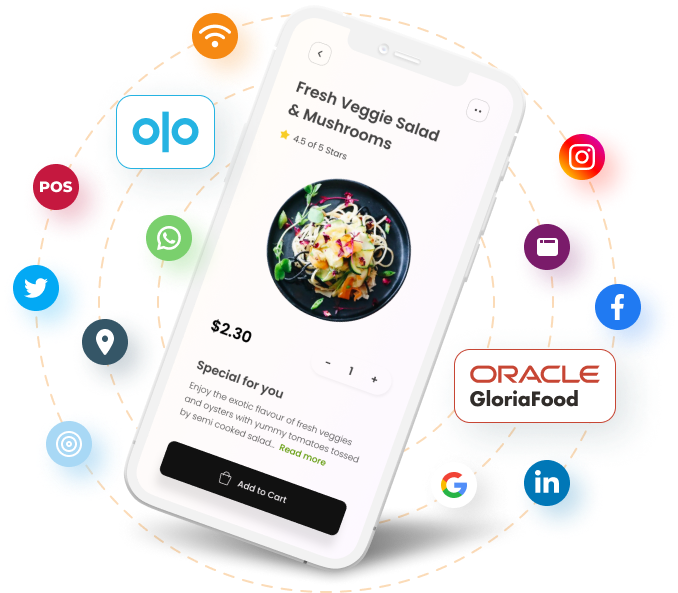
Bloom Intelligence now integrates with Olo and Oracle’s Gloriafood online ordering platforms. If you’re ready to start maximizing your marketing ROI, let us show you how.

Click here for a free demo of the product, or call us at 727-877-8181 and get ready to taste marketing success!

restaurant online ordering marketing demo


Restaurant Online Ordering Tips and Benefits

It’s no secret that the restaurant industry is a competitive one. With so many eateries to choose from, diners are more likely than ever before to take their business elsewhere if they don’t receive good service or if they have to wait too long for their food.

This is why offering online ordering can improve guest experiences and help your restaurant succeed.

Benefits of Restaurant Online Ordering

An online ordering system can streamline the process of taking and fulfilling orders. This can lead to a number of benefits for restaurant owners, including:

  • Reduced wait times for guests. Guests can place their orders in advance and schedule a time to pick up their food. So, they don’t have to wait at the restaurant.
  • Increased order accuracy. Guests can take their time to enter their orders into the system, which reduces the chances of mistakes being made.
  • Improved guest satisfaction. An online ordering system can make the ordering process more efficient and less frustrating for guests, leading to higher levels of satisfaction.
  • Higher average order values. Guests who use an online ordering system tend to spend more per order than those who place orders over the phone or in person.
  • Reduced labor costs. An online ordering system can automate many of the tasks involved in taking and fulfilling orders. These include things like collecting guest information and payments, which can lead to reduced labor costs.
  • Improved marketing and branding. A well-designed online ordering system can help to improve a restaurant’s marketing and branding. A custom-branded ordering system can make a restaurant look more professional and put its best foot forward.

There are many benefits that come with using an online ordering system for restaurants. By streamlining the process of taking and fulfilling orders, online ordering systems can lead to reduced wait times for guests, increased order accuracy, improved customer satisfaction, higher average order values, reduced labor costs, and improved marketing and branding.

When choosing an online ordering system for a restaurant, it’s important to consider the features that will be most beneficial for the business.

Restaurant Online Ordering Tips

Online Ordering Tips for Success

Ensuring a smooth online ordering process for your restaurant is key to keeping up with the competition and satisfying your guests.

By following these simple tips, you can avoid common mistakes and make the online ordering process as easy and efficient as possible.

1. Make sure the website is easy to navigate on both desktop and mobile environments. Guests should be able to find what they are looking for quickly and easily. Organize your menu items into clear categories, and make sure all of the information they need is readily available.

2. Use clear and concise language throughout the website. Avoid slang and abbreviations, and make sure all of your prices are clearly listed.

3. Offer a variety of payment options. Guests should be able to pay with their credit card, PayPal, or another method of their choice.

4. Make the checkout process as simple as possible. Ask for only the information you absolutely need and provide clear instructions at each step.

5. Provide excellent customer service. Be available to answer questions and address concerns both before and after the sale.

By following these simple tips, you can create a smooth online ordering process that will keep your guests coming back for more.

Make Online Ordering Work for your Restaurant

Online ordering is a great way to increase guest satisfaction because it allows guests to order products and services at their convenience.

In addition, online ordering makes it easy for guests to find the information they need about products and services, which can help them make better decisions about what to purchase.

Finally, online ordering can help businesses improve their customer service by making it easier for guests to contact them with questions or concerns.

Overall, online ordering is a great way to improve guest satisfaction and increase sales. If you’re not already using it, consider implementing it in your business. It could make a big difference in your bottom line.

This can free up staff time to focus on other tasks, such as providing outstanding customer service.

If you’re looking for a way to improve guest data collection and marketing ROI, restaurant online ordering is a great solution.

By using an online ordering system, you’ll be able to collect valuable customer data, reduce overhead costs, and improve marketing efficiency.

How Bloom Intelligence Can Multiply the Power of your Online Ordering Data

First, when data is captured from the ordering system, it is verified and a new customer profile is created for the guest inside the Bloom platform. If a profile has already been created, the data is added.

Over time you will have a very large database of guest profiles to engage with through email marketing.

Not only will you have massive amounts of guest data to help shape your messaging and branding, but you will also be able to take your guest list and segment it out into various guest personas. These are groups of guests with similar characteristics.

Then, you can send laser-targeted messaging to each group that they will be more likely to engage with. Segmented marketing has proven to be much more effective than marketing a single message to your entire database.

Discover Bloom Intelligence – Your Guests Will Love You For It

Bloom now integrates with Olo and Oracle’s Gloriafood online ordering platforms. If you’re ready to start maximizing your marketing ROI, let us show you how.

Click here for a free demo of the product, or call us at 727-877-8181 and get ready to taste marketing success!

restaurant online ordering marketing demo


Restaurant Online Ordering for Data Collection and Better Marketing ROI

Online ordering for restaurants has become an increasingly popular way for guests to place orders and make reservations.

Even prior to the COVID pandemic, online ordering was growing at a rapid pace. In fact, since 2014, online food ordering has grown 300% faster than dine-in.

It’s not all about the revenue, either. Restaurants that offer online ordering can collect valuable guest data that can be used to inform marketing decisions and improve the guest experience.

In addition, online ordering can help restaurants to reduce overhead costs and improve marketing efficiency.

The True Value Lies in the Data

Restaurant online ordering for data collectionIf you’re a restaurateur, then you know that customer data is key to your success. And what’s one of the best ways to collect customer data? You guessed it, restaurant online ordering.

By allowing guests to place orders online, you’ll not only be able to capture their contact information, but also their order history and preferences.

This valuable information can help you personalize future online ordering marketing campaigns and keep your guests coming back for more. So if you’re not yet using restaurant online ordering, now is the time to do it before your competition takes the lead.

There are a number of ways that online ordering can help improve guest data collection. For example, online ordering can help to track customer preferences and order history.

You can then use this information to target marketing efforts to improve the overall guest experience, building trust and loyalty.

Other Benefits of Restaurant Online Ordering

In addition, online ordering can help restaurants to improve marketing efficiency. By using an online ordering system, restaurants can send automatic confirmation and reminder emails to guests.

Online ordering can also help to identify those who are likely to be repeat guests. More importantly, it can help identify those who may be at risk of not ordering again. Fortunately, Bloom Intelligence can automate this process and trigger automatic messages. They are sent to the guest to try and bring back their business.

Another way that online ordering can help improve marketing ROI is by reducing overhead costs. Online ordering systems can automate many of the tasks that you traditionally perform manually, such as taking orders and processing payments.

This can free up staff time to focus on other tasks, such as providing outstanding customer service.

If you’re looking for a way to improve guest data collection and marketing ROI, restaurant online ordering is a great solution. By using an online ordering system, you’ll be able to collect valuable customer data, reduce overhead costs, and improve marketing efficiency.

How Bloom Intelligence Can Multiply the Power of your Online Ordering Data

First, when data is captured from the ordering system, it is verified and a new customer profile is created for the guest inside the Bloom platform. If a profile has already been created, the data is added.

Over time you will have a very large database of guest profiles to engage with through email marketing.

Not only will you have massive amounts of guest data to help shape your messaging and branding, but you will also be able to take your guest list and segment it out into various guest personas. These are groups of guests with similar characteristics.

Then, you can send laser-targeted messaging to each group that they will be more likely to engage with. Segmented marketing has proven to be much more effective than marketing a single message to your entire database.

Discover Bloom Intelligence – Your Guests Will Love You For It

Bloom now integrates with Olo and Oracle’s Gloriafood online ordering platforms. If you’re ready to start maximizing your marketing ROI, let us show you how.

Click here for a free demo of the product, or call us at 727-877-8181 and get ready to taste marketing success!

restaurant online ordering marketing demo


Turning Bad Guest Ratings and Reviews Into Satisfied Guests

In today’s consumer environment where everyone has instant access to the internet, it’s no secret that guest reviews and ratings are hugely important to any business, especially in the restaurant industry. These ratings can bring a wealth of valuable information to informed restaurant owners who understand how to respond to them.

Whether good or bad, the data you can gather from guest ratings and reviews can be put to good use, supporting the good and, more importantly, placing emphasis on resolving the bad.

Where to Find Guest Reviews and Ratings

There are several popular restaurant rating and review websites which can easily be found with a quick Google search. However, the overall ratings you find on these websites may not be entirely accurate.

personalization

According to Time.com, customer ratings are dominated by 5’s and 1’s and largely lack anything in the middle. This is due to the fact that most customers who are strongly compelled to leave a review either had an amazing experience, or a terrible one. Those who had a realistic or ordinary experience simply lack the motivation to leave any kind of review.

When it comes to making effective business decisions, it is smart to gather your customer ratings and reviews through your own channels. This is why it is so important to establish and maintain an open relationship with your customer base, through avenues like WiFi marketing, email newsletters or social media. These channels are extremely valuable to your business when it comes to gathering honest ratings you can trust. They come from those who are not simply determined to give you a 1 or a 5 based on a single experience.

What is the best part about this strategy? All you have to do is ask them for it. Then you can use the data to improve and maintain an overall positive customer experience.

According to a 2017 BrightLocal Local Consumer Review Survey, 68 percent of consumer respondents actually left a local business review when asked – with 74 percent of them having been asked. The study also showed that responding to these ratings and reviews is more important than ever.

How to Respond to Customer Ratings

A study by TNS NIPO researched over 2,000 negative online customer ratings and concluded that, overall 70 percent of complainants hope to receive a response, while just 38% receive one. According to TNS NIPO, the success of the response is determined by 3 factors:

  • The speed of the customer review response time
  • The quality of the solution provided to the customer
  • How the response is provided, and how genuine the response is perceived

In addition, the willingness of consumers to consequently recommend the brand again can be doubled (3.4 to 7.2) by combining these three factors effectively.

Based on these findings, it is important to stay on top of your customer ratings and respond to them quickly. How you respond is up to the restaurant manager or owner. But many offer a free appetizer or drink to get the customer back into the establishment. This gives them the chance to rectify any less-than-stellar experience.

Answer All Ratings Promptly and With TACT

When directly answering a poor rating or review, it is essential that the customer knows you are responding to them, and the response should convey an earnest, human message. If you succeed in opening a dialog with the customer, don’t hesitate to ask for constructive criticism and suggestions. This will deepen the engagement and can establish a stronger guest relationship.

Plus, many customers might provide great suggestions about different ways to do things, or new product ideas you could offer. By responding appropriately, customers recognize that you truly care about their business. Plus, they may become more loyal to you as a result. Through engagement with the customer, you can gather more data, ask for suggestions and actually increase customer loyalty. A negative can indeed turn into a win-win.

Restaurant managers and owners shouldn’t take negative customer reviews and ratings with a grain of salt. There’s so much you can do to turn them into satisfied, loyal customers.

Related Articles:

– Dealing with Poor Customer Reviews and Ratings

– Why Every Restaurant Should Care About Customer Ratings

– How To Get More Customer Reviews and Ratings

– Using Customer Reviews and Ratings to Improve Your Restaurant Business

10 Tips for Effective Restaurant Social Media Marketing

Restaurant social media marketing is one of the most valuable tools in any restaurant’s arsenal. It’s a way to keep your guests coming back, and it also helps you reach out to new potential diners.

But with so many different social networks to choose from (Facebook, Twitter, Instagram), it can be hard to know where and how best to invest your precious time.

Here are some tips for managing a restaurant’s social media channels that will help you make sure you’re getting the most out of your effort.

Audio summary of this page:


1. Choose your platforms wisely

Choosing the right social media platform for your business can be a challenge.

It’s not enough to just set up profiles and hope for the best, you need to be proactive and constantly check what your competitors are doing.

If you’re not sure where to start, Facebook and Instagram are probably the ideal first choices.

Restaurant Social Media Marketing Guide

2. Post Consistently

You may be thinking, “I don’t have the time to post on social media!”, but one small post per day can make a big difference.

Not only does it let your followers know that you’re there and still active, but it also helps establish a dialogue with new potential patrons.

One of the reasons why people use social media is because they want to feel connected with a brand.

Another important tip is making sure that you’re posting quality content that shows off what makes your restaurant special. Users will remember your posts more if they’re distinctive or stand out from the rest of the feed.

3. Work to Improve Your Ratings and Reviews

Keep in mind that the better your ratings, the more likely people will be to come to your restaurant. It’s actually pretty easy to get reviews these days. Simply ask your guests for feedback or offer an incentive for diners who are willing to rate and review.

Not only does having reviews and ratings help your guests make decisions about where to buy, but it’s also a way for them to share their experiences with you. This allows you to spot trends and continuously make things better.

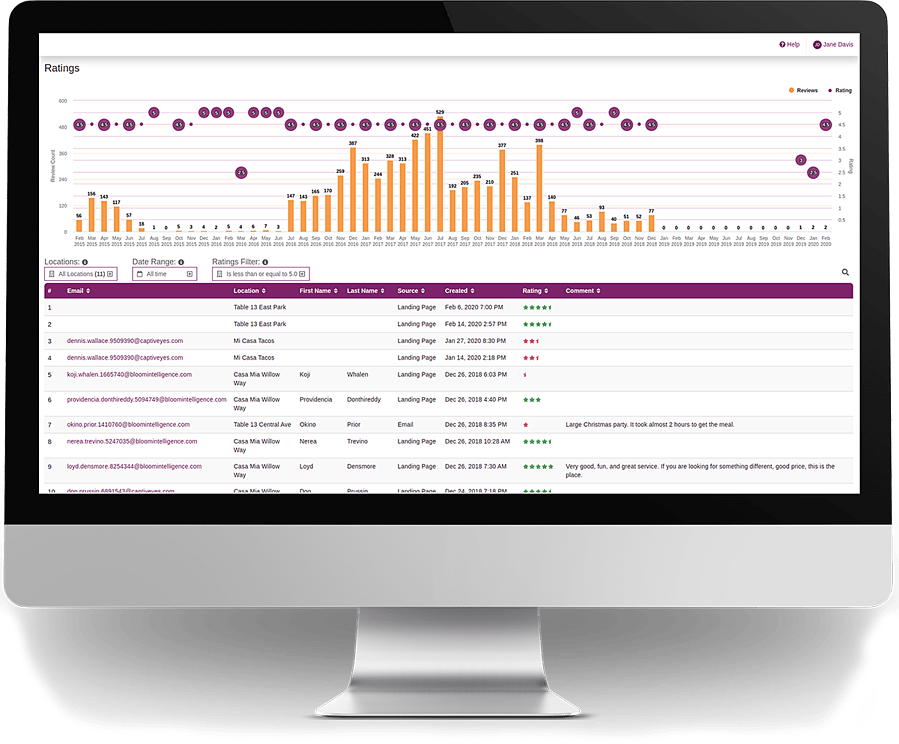
To improve online ratings and reviews, you need to spend time to read and respond to your reviews. While this can take time, Bloom Intelligence can automate email campaigns asking for ratings, and you can manage your ratings from Facebook, Google, and Bloom all in one centralized platform.

Likewise, Bloom gives you ratings reports. You’ll be able to closely track and monitor your ratings and reviews on popular ratings websites. You’ll see a graph showing you the quality and quantity of your ratings.

Improve social media marketing ratings

What Else You’ll Discover

You’ll also see a list of every rating, including which website the rating was given on. You can reply to every rating right in the platform and it will automatically be posted on the appropriate website.

This saves you a great deal of time and energy, allowing you to improve your business, save money, and improve your restaurant reputation.

  • Create stunning automated messages asking for ratings/reviews on Google, Facebook, and Bloom, or ask your guests to contact you directly if they had a bad experience.
  • Increase the quantity and consistency of ratings/reviews given.
  • See detailed reporting about who left each rating, and ratings trends over time.
  • See real-time aggregate rating reports from multiple ratings websites
  • Manage all guest feedback in a centralized platform.
  • Drive new guests to your locations through positive online reviews on Google, Facebook, and your website.

4. Show Off Your Ratings for Better Restaurant Social Media Marketing Results

With the Bloom platform, you can also embed a ratings widget on your website. As you improve your online reputation, you can showcase your effort in a small, unobtrusive pop-up on your website pages.

This provides all-important social proof to your website visitors. When they see a good aggregate rating, they will be more likely to choose your restaurant when looking for a place to dine.

Improve Your Restaurant Social Media Marketing

5. Add Your Menu and Pictures

Customers who visit your social media pages are obviously interested in your restaurant, so it’s important to give them everything they might be looking for.

This includes your menus. If you have more than one menu, include all of them: breakfast, lunch, dinner, late-night, drinks, specials, etc. As user are engaging with your social media account, they can view your menu as well.

You should also include high-resolution images of your food, drinks, and atmosphere. Show them images of people having a great time at your restaurant. This will further pique the visitor’s attention and show them the type of experience they can expect from your place of business.

6. Use #Hashtags

Hashtags are an essential part of social media.  They allow you to categorize your posts and make them easier for people to find.  However, it’s not enough just to use hashtags – you need to use them correctly.

Use hashtags that have high search volume but low competition; this will maximize exposure and minimize the risk of being overlooked by users with similar interests. Use current events as inspiration for relevant hashtags; people love finding content related to what is happening in their world today!

Hashtags can also be used to spread the word about your restaurant and its specials. Use #FridayEvents to post pictures of a special weekly event, or #HappyHour with a picture of discounted drinks. If you’re going to use hashtags like these, make sure that they’re understandable even without the context.

7. Restaurant Social Media Marketing: Post Videos

Social video is so popular that it generates 1200% more shares than text and images combined. That means to make sure you have a restaurant social media marketing strategy in place with videos incorporated into your plan, or else risk being left behind.

Use current events as inspiration. For example, if a sports event is approaching or a new movie is coming out, use that as an excuse to create relevant video content for your social media accounts.

You can also create testimonial videos from guests who are having a great experience at your place of business. Other ideas include introducing new menu items, upcoming events, and current specials.

Restaurant social media marketing to improve customer loyalty

8. Create a Contest

Social media contests create loyalty and rapport with your patrons. Restaurants can take advantage of this by running a contest for free dinners, gift cards, or even the chance to win other prizes such as special parties.

79% of people only like a business Facebook page for their incentives and discounts. To give them what they want – offer deals in order to increase likes on all platforms- which can also lead to guest engagement across channels such as Instagram or YouTube.

When creating social media contests, restaurants should offer things that will resonate with their followers – namely discount codes which provide incentives while soliciting engagement from others in return.

9. Cross-promote your Restaurant Social Media Marketing Channels

One of the most important keys to running a successful restaurant social media marketing campaign is cross-promotion. By engaging with your guests on more than one social media channel, you can reach new clients and keep current ones happy by providing content that they are interested in.

For instance, if Facebook has tons of likes but your Instagram has few followers then leverage what works for you first -Facebook- by creating an appealing post about something happening on your Instagram account.

This can drive traffic and followers from those engaged people who already like or follow the other account, further growing your online social media footprint.

10. Get Started Today

Running a restaurant often means juggling social media marketing on top of everything else. It’s not enough to just set up profiles and hope for the best, you need to be proactive and constantly check what your competitors are doing.

In today’s digital world, social media is a powerful tool to have in your restaurant marketing arsenal. In this post, we’ve given tips that will help make sure you’re on top of things all the time.

If you are interested in improving your ratings and reviews on Facebook or Google, click to find out how Bloom Intelligence can help you automate the entire process.

Take the next step today! Call us or schedule a free demo online to see how Bloom Intelligence can help you save time, increase customer lifetime values, and make your job easier!

Collecting Customer Data to Improve Your Restaurant Business

As a business owner, it’s important to understand who your customers really are. After all, without them, your business wouldn’t exist.

For this reason, it’s integral that you are able to meet the demands of your patrons to achieve a competitive advantage. One of the best ways to do this is by collecting customer data.

Your guests are spending an increasing amount of time online and because of that, the options of gathering customer data have advanced beyond measure. Collecting this data will not only help you build a loyal base of patrons but will assist in attracting potential new guests as well. Here’s why collecting customer data is essential to your business.

Customer data is information collected that gives you details about customers, such as names, contact information, buying behavior, and demographics. Gathering this kind of data should always be included in your marketing strategy because without it, you simply cannot market effectively. Collecting customer data essentially allows you to target customers with more precision.

There are various sources you can use to collect data. Some include, but are not limited to:

  • Social media
  • Your website
  • Campaigns
  • Surveys

collecting customer data - guide

How Customer Data will Improve your Business

It Leads You To Your Customers

In order to reach your guests, you have to know what platforms they utilize online, and which ones they don’t. Every individual is different and some people prefer certain platforms over others. You don’t want to spread your marketing efforts across various platforms only to see little to no results.

Instead, your guest data will point you in the direction that you need to be facing. For instance, if your customer base is relatively young, you are more likely to attract them on social media platforms such as Twitter and Instagram. However, if your customer base is older, they may prefer a well-written email.

It Helps You Keep up with Current Buyer Behavior

Customers are continuously changing, and in order to stay connected with them, you have to always be cognizant of their current behaviors.

Your guest data is real-time evidence that gives you the opportunity to identify how they currently consume information, shop, or make purchases. This allows you to leverage appropriate strategies.

For instance, does your target audience prefer delivery or in-store dining? Similarly, are they more likely to purchase from you after watching an interactive video or after reading a detailed blog post? You can use your data to make changes to your business strategies that will make you more attractive to current guests while attracting new, more targeted ones.

You Can Promote Special Offers & Increase Sales

Collecting customer data is vital to every business because it gives you a higher probability of increasing your sales.

For example, if you have a local coffee shop, offering WiFi in exchange for a name and an email address gives you the opportunity to offer discounts and promote current sales.

Similarly, if you have an online store, you can give people the opportunity to subscribe to your email list that gives them access to sales, discounts, and resources in exchange for their contact information. In both cases, this puts you in front of your customers and increases your chances of making a sale, and even establishing a long-term guest.

Gathering and studying customer data allows you to cater to your customer’s needs, ultimately strengthening your restaurant’s position in the market.

Customer data will tell you where your customers are online, which is especially important as more individuals are spending more time on the internet. It is also important that you narrow down what platforms your customers use and how they choose to purchase for the most effective marketing.

Overall, gathering and researching your customer data is invaluable. When used correctly, it will strengthen your relationship with your customers and provide an increase in overall foot traffic and sales.

Growing Your Customer Database

As the world navigates the COVID-19 pandemic, restaurants are doing everything they can to stay afloat. During uncertain times like these, it is extremely important to continue communicating with your loyal customers and growing your customer database as quickly as possible.

Staying Top-Of-Mind With Your Customers

Now, more than ever, staying ahead of the competition can make or break your business. Therefore, you should take time every day to create creative, engaging marketing and social media messages, and keep your business top-of-mind with your customers. 

banner_bg

Sometimes, a little competition can be a good thing. It can inspire, motivate and encourage forward momentum for all parties involved. 

In terms of business strategy, it keeps everybody on their toes and helps companies avoid stagnation and complacency. Knowing that diners still have numerous options, restaurant owners must understand it is essential to quickly evolve and adapt to current market trends. 

Be Creative With Your Marketing

To continue building and retaining a loyal customer base, it is crucial to go above and beyond, offering something unique to the consumer. Something that really fulfills a need or goes above standard expectations. 

While this sounds obvious, there’s a catch. It’s easy to come up with general strategies and test them, but coming up with the right strategy for your specific market and your specific guests, can be a little trickier. 

It takes insight and analysis. 

Building and Growing Your Customer Database

Customer analytics for e-commerce is nothing new, but it’s something that – until now – hasn’t been fully developed for brick-and-mortar locations. 

Luckily there is a very simple way to get a true grasp on the needs and habits of your clientele. By offering visitors free WiFi access, you’re not only providing a service they will appreciate, but you’re also being handed a foolproof way to get to know them better. 

When guests log into your WiFi, they will automatically be added to your customer database. At that point, you can begin marketing to them through email.  

Side-Stepping The Data Collection issues

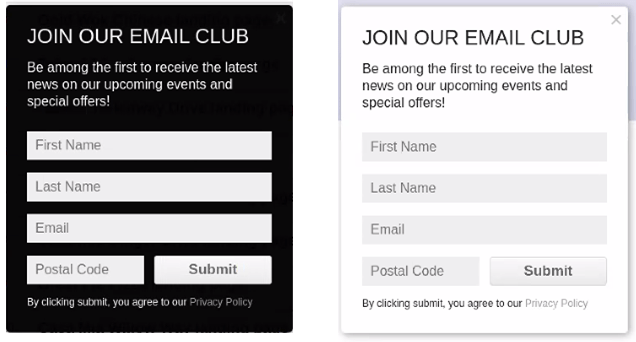
When a customer comes in for take-out, ask them to log in before they leave, and you will send them offers and promotions. If your business is mostly delivery, this will not be feasible. So, Bloom Intelligence has created a new website widget that you can place on your website. 

image-55

Now, a customer doesn’t even have to visit your place of business to be added to your customer database. When visiting your website, the form will pop up at the bottom of the screen in an unobtrusive manner.

Your website visitors can then enter their information and can be added to your marketing campaigns. 

From that point on, you will be able to track visits with accuracy, such as how often your clients are coming in and how long they stay at your location, the amount of time that passes between visits, and what times of day, or even days of the week on an individual or overall level. This information will help you target marketing and promotions to fill sales gaps and boost your bottom line. 

Targeted Marketing Is Crucial

Additionally, using the emails provided as visitors login or sign up, you can tailor messages to your clients, thanking them for repeat visits, and perhaps offering a discount once they reach certain milestones.

Or, conversely, you can automatically trigger emails to guests who haven’t ordered or visited for a while, letting them know you miss them and hope to see them again soon.  

As a bonus, you can customize your WiFi landing page to encourage customer ratings and reviews or social media follows, or even promote special offers and deals. Here’s where you can get creative with marketing, highlighting loyalty programs, or offering coupons for likes or shares. Utilize your repeat visitors to get the word out about your brand. 

Drive More Revenue Into Your Restaurant Business With Customer Data

Until now, restaurant marketing professionals have had a tough time authenticating the ROI of their online and offline marketing campaigns.

However, WiFi analytics and marketing platforms have changed the game, allowing physical locations to collect real-time tangible campaign data from actual customers. More importantly, when used properly, this data can provide a significant return on investment.

In the past, retail and restaurant managers had to pay companies large sums of money to obtain accurate and detailed customer profile data.

While this information provides a good look into customer demographics and psychographics, there are two main issues:

  • The data collected is only a snapshot in time. If you’re looking for consistent data, you’re going to have to continue purchasing it.
  • The data collected is typically from a small sample size of customers.

Fortunately, a WiFi analytics and marketing platform like Bloom can eliminate the issues. You’ll consistently receive real-time data, build accurate and detailed customer profiles, and you will see it from a very large sample size of your actual customers.

And you can do this at a fraction of the cost of purchasing data from traditional companies.

Customer profiles can allow you to make much smarter marketing decisions and engage with your customers on a more personal level, driving higher guest spending and loyalty, saving on costs, improving restaurant reputation, and boosting ROI.

Now that you know you can quickly and easily collect all the valuable data you want, let’s take a look at the actual value customer profiles can add to your bottom line.

collecting customer data - personalization guide

Turning Customer Profiles into Increased Revenue

Knowing who your guests are can make all the difference in the world when it comes to your marketing strategy and results.

By collecting detailed customer profile data, you can create marketing campaigns that will speak much more clearly to each of your audience segments.

This allows you to not only define and differentiate your most valuable guests but to speak to them in an effective way that they will understand and engage with, persuading them to keep coming back.

As you’ll see below, this can make a tremendous difference in your profitability.

You’ll be able to:

  • Identify your ideal guests in terms of value, and market to them effectively
  • Classify other audience groups you may or may not have previously identified
  • Measure ROI and optimize messaging for each audience segment
  • Develop new products, services, menu items, deals, and promotions

As you begin using your customer profile data to segment and effectively message your guests, you’ll see much more success increasing your per-person averages and customer lifetime values, filling your locations with buying guests, and increasing your bottom line.

Multiply Results with Personalized Marketing Messages

With detailed customer profiles gathered through your WiFi marketing hub, personalized campaigns not only become entirely possible, but they’re also easy to set up, maintain and measure.

You can target your messaging by profile information like age, gender, geographic location, visit times, length of stay, and several other demographic and behavior data points with messaging that speaks to that particular segment.

According to Mindfire, Inc., a marketing automation company, in a study of 650 multi-channel marketing campaigns, personalized campaigns consistently and overwhelmingly beat out static campaigns in generating a high response rate from recipients.

And according to The Direct Marketing Association, 77% of ROI comes from segmented, targeted, and triggered campaigns.

In our free guide, The Value of a Customer Profile, we go into detail about the monetary value of customer profiles, showing how a chain of 5 restaurants could increase their customer visits by an additional 480 visits a month.

Then we factor in per-person averages and the cost to acquire a customer and show how just one marketing message per month could bring in an additional $80,000 in annual revenue.

We further explain that increasing customer frequency – of just 10% of their customer profile base – could take that number and increase it dramatically, to an additional $417,600 in annual revenue.

Then we factor in personalized messaging and behavior-driven marketing, and that number increases even more.

You can download the guide here to see all the details. It’s truly an eye-opening read.

Customer Data Success Report

Save on Costs

Not only will customer profiles help you in terms of getting customers to come back more often and spend more, but they can also help save you money in costs as well.

We’ve already talked about the costs of collecting customer profiles using WiFi technology being a fraction of the cost of purchasing data from traditional companies.

You’ll also save money on advertising costs. In an Ayman Farahat and Michael Bailey study conducted on targeted advertising, they found, assuming the cost per 1000 ad impressions (CPM) is $1 USD, that:

  • The marginal cost of a brand-related search resulting from ads is $15.65 per search, but is only $1.69 per search from a targeted campaign.
  • The marginal cost of a click is 72 cents, but only 16 cents from a targeted campaign.

Targeted advertisements, no matter the channel, will typically yield higher results for lower costs, dramatically reducing your cost per guest acquisition.

By collecting customer profile data, and using WiFi analytics, you’ll be able to not only identify your high-traffic days and times, but you’ll also begin to be able to better predict them.

This will allow you to bring on the right amount of staff at the right times, avoiding overstaffing and loss of payroll dollars.

In addition, you’ll be able to make smarter purchasing decisions, keeping your items as fresh as possible and decreasing the likelihood of running out of a product – the dreaded ‘86’.

It’s Time To Get Started

The value of customer profiles can be seen from several different angles. With the emergence of WiFi technology, it has never been easier to passively collect this valuable data and act on it.

Customer profiles can be extremely valuable, giving you a greater understanding of who your best customers are, allowing you to speak to them when, where, and how they want to be spoken to.

This drives engagement, familiarity, and loyalty between you and your customers, driving solid increases in PPA and CLV and saving on costs.

With the amount of competition out there, customer profiling can be one of the easiest methods of gaining a strong competitive advantage and ensuring lasting success.

Discover Bloom Intelligence

If you are ready to start collecting your own first-party guest data, you need to give Bloom Intelligence a look.

Not only will you be able to automate your restaurant email marketing, but you can also use Bloom to unlock valuable guest insights, improve your ratings and reviews, identify and bring back lost guests, and so much more.

You’ll feel confident as you make solid data-driven decisions, drive company growth and build a much larger base of loyal customers.

With the amount of competition out there, Bloom can give you a strong competitive advantage and ensure lasting success.

So, click for a free demo of the Bloom Intelligence platform, or call to schedule today at 727-877-8181.

The Importance of Restaurant Customer Satisfaction

Learn why customer satisfaction is vital for the success of any restaurant, regardless of its size, location, demographics, or food quality.

Restaurant owners often struggle to identify the key factors that influence customer satisfaction, especially when their views differ from what customers want.

The focus should be on meeting the needs of guests, not on what restaurants feel they need. The more satisfied customers are, the more likely they are to spend more, return regularly, share positive reviews, and recommend the restaurant to others.

Restaurants must prioritize customer convenience over their own convenience. It’s not about what restaurants need to feel satisfied, it’s about what guests feel restaurants need to do to satisfy them.

It’s important not to inconvenience guests at a restaurant’s convenience.

Why is Restaurant Customer Satisfaction Important?

There are a variety of reasons customer satisfaction is important, but let’s sum it up to these powerful statistics:

    • 7 out of 10 U.S. consumers say they’ve spent more money to do business with a company that delivers great service. (American Express)
    • A moderate increase in customer experience generates an average revenue increase of $823 million over three years for a company with $1 billion in annual revenues. (Temkin Group)
    • Harvard Business School researcher found that a one-star increase in a restaurant’s Yelp rating correlated with a 5-9% increase in revenue.
    • 25 percent more people turn to consumer reviews on sites like OpenTable, Yelp, and TripAdvisor than those who rely on reviews by professional food critics. 60 percent read reviews before going out for a meal, a habit that takes precedence over getting directions to a restaurant or looking at food photos. (OpenTable)
    • Diners say that complimentary extras (69 percent) and seating preferences (65 percent) would go far in increasing customer loyalty. (OpenTable)
    • 75 percent of consumers will not visit or patronize a restaurant with negative reviews about its cleanliness. (Harris Poll for Cintas Corporation)
    • 38% of all customer complaints are on social media and review sites. Restaurants get only 14% of all complaints. (Jay Baer, Food Service Magazine)
    • 72% of customers are likely to share a positive experience with six or more people, emphasizing the importance of positive customer perceptions. (EasyEat)

restaurant customer satisfaction leading to a good rating

What Contributes to Poor Restaurant Customer Service?

Neglecting the fundamentals of running a business

It can be easy for new and old businesses alike to neglect the fundamentals of running a restaurant. Let’s get back to the basics.

Every restaurant owner should not only have a written system that works, but every employee should follow the system. Management should create checklists and ensure they follow them repetitively.

Checklists should remind team members that bathrooms need to be cleaned multiple times daily, staff should turn music on, open signs should be lit, inventory procedures have checks and balances, and internal operations should be followed daily.

Misunderstanding what customers want and need

A lot of restaurant owners assume that since they created the restaurant, and customers agree with them when they provide their own opinions, a majority of their customers feel the same way.

There is power in restaurant surveys. The ability to find out what customers want, but may not have been sharing with you, is important. When utilizing this data effectively, businesses can increase restaurant customer satisfaction easily.

Lack of cleanliness

No one likes a dirty restroom, peeking into a dirty kitchen, stepping on dirty floors, or eating on dirty tables.

Non-versatile menu options

Worldwide, allergies affect up to 30% of the population. Allergies can range from peanuts, meats, gluten, and milk. This should be enough of a cause to create menu versatility, and it doesn’t even include the limitations that restaurant-goers experience with diets due to ethical or health reasons.

It’s important to not only provide menu items that differ between diets but also to create menu versatility for guests who ask for the removal of ingredients.

restaurant customers

Underestimating the power of unhappy customers

The statistics supporting the power of an unhappy customer are staggering. 96% of unhappy customers don’t complain. 91% will leave and never come back. A dissatisfied customer shares their experience with between 9-15 people. 13% of unhappy customers tell 20 people or more.

Not creating enough reasons for customers to come back

Without loyalty programs, community involvement, a unique brand atmospheric experience, or exceptional customer service, customers will leave without coming back.

Poor food quality

Many fast-food restaurants are struggling to keep up with the desire for fresh foods. Moving away from the days when speed was everything, now it’s all about quality and brand experiences.

Lack of brand consistency

According to smallbizgenius, Consistently presented brands are 3.5 times more likely to enjoy excellent brand visibility than those with an inconsistent brand presentation. Brand consistency statistics published by Demand Metric suggest that uniformly presented brands are 3.5 times more visible to customers.

No incentives/Poor Incentives

RetailMeNot survey found that almost three-fourths of Americans say offers are a top factor when deciding where and what to buy online. Four out of five Americans say finding a great offer or discount is on their mind throughout the entire purchase journey.

High-value brands like Starbucks have learned long ago that loyalty programs bring customers back again and again. In fact, according to CNN, super-loyal customers who use Starbucks’ membership program account for about 40% of sales at the company’s US stores.

“Starbucks Rewards continues to be a powerful enabler of loyalty,” CEO Kevin Johnson said while discussing that quarter’s earnings in a call with analysts.

Slow WiFi

According to eMarketer, Free Wi-Fi is the most important restaurant tech offering among US internet users deciding where they should dine. In fact, 70% of consumers cited the availability of guest WiFi as an important factor in deciding where to dine.

According to Small Business Trends, businesses that offer WiFi marketing to increase sales had a success rate of 72 percent. 50% of guests spend more money when they stay and use guest WiFi, and this doesn’t even include the percentage of guests that come back when they receive email communications.

72% of consumers prefer email as the primary source of communication from businesses. In fact, 61% of consumers prefer to receive promotional emails weekly. 

WiFi marketing drives new traffic, increases the amount that visitors spend when they visit restaurants, and improves customer loyalty which can drive revenue up by at least 25%.

Bad customer service

Did you know that after one poor experience with a brand, 71% of guests won’t visit ever again? Losing just one customer can be costly, so it’s important to look at the bigger customer experience picture.

If one puzzle piece is missing, a restaurant could receive significant losses.

Even if a location is popular and business is booming, customer satisfaction should be taken seriously. Regardless of the food, drinks, and atmosphere, customer experience is the most important component to improve your restaurant’s customer satisfaction.

Bad environment

If a location is outdated, amplifies sound too much, has music that is too loud, or has no music at all, consumers classify it as a bad environment.

These are the top factors to improve a restaurant’s environment:

  • Updated interior design: A restaurant’s physical environment will immediately evoke positive or negative feelings about a restaurant’s brand.
  • Ambient light: While rarely mentioned, ambient lighting that is too bright or too dark has a high likelihood of becoming a deterrent and a silent brand detractor.
  • Colors: The colors of a restaurant will immediately and subconsciously showcase the quality of a brand. They also evoke specific feelings. For example, red and yellow stimulate appetites, and blue decreases appetites but increases feelings of calmness and comfort. Blue creates the appearance that time passes faster. Red restaurants create the appearance that time passes by slower for guests.
  • Music: Multiple studies show that music has a direct impact on the amount the guests spend when visiting restaurants. Music should match a brand’s image. Slow music increases a customer’s willingness to spend more money, while faster music can contribute to more alcoholic beverage sales and create a more casual environment.
  • Background noises: Restaurants should have a medium sound level. Customers in quiet restaurants spend more money and eat more of their food. But they can also contribute the low sound levels to a low-quality restaurant with high-cost food. Guests in noisy restaurants both spend and eat less. So, if traffic is high it’s important to have interior soundproofing present.
  • Aesthetics: Not only do guests prefer a positive overall brand interior appearance, but attractive restaurants are also an additional social media marketing tool.

Unreasonable pricing

It’s important to create menu pricing that matches customer expectations while providing a significant return on ingredient investments. Below is a graph that shows the average amount that guests spend (per person) at fast-food restaurants, takeout restaurants, food delivery services, and full-service restaurants according to Statista.

Lack of future planning

In the restaurant industry, you could be popular one year, and the next year, you could experience a downturn. It’s important not to dwell too much on current successes. Evaluate what competitors are doing, and utilize innovative ways to improve satisfaction and profits.

No competitive differentiation

While it’s never advisable to mirror your competition, tracking what’s working and not working for competitors provides brands with the opportunity to create positive differentiation.

Poor location

Poor future planning creates poor location decisions. When brainstorming a new location, it’s important to pay close attention to local demographics to ensure brand integrity and profitability. It’s important to remain agile if a location’s demographics change.

What’s your favorite way to increase restaurant customer satisfaction? Leave us a comment below!

For info on how to improve your restaurant customer satisfaction using Bloom, click on the banner below!


Delivering Exceptional Restaurant Customer Service

Providing excellent customer service is essential for success. Satisfied customers are more likely to become loyal patrons, leave positive reviews, and recommend your establishment to friends and family.

So, what are the keys to delivering exceptional restaurant customer service? Here are some proven strategies:

Start with a Friendly, Welcoming Atmosphere

The customer experience begins the moment guests walk through your doors. Make sure your front-of-house staff creates a warm, inviting ambiance from the start.

Greet customers with genuine smiles and a friendly, attentive demeanor. Promptly escort them to their table and ensure they feel valued and appreciated.

The physical environment also plays a big role in setting the tone. Keep your dining room clean, well-lit, and tastefully decorated. Background music should be at a comfortable volume, allowing customers to converse easily.

Small touches like fresh flowers or art on the walls can enhance the overall atmosphere.

Prioritize Quick, Efficient Service

Customers want their dining experience to be smooth and effortless. Ensure your staff is properly trained to provide prompt, attentive service.

Food and drinks should arrive at the table in a timely manner, without unnecessary delays. Keep a watchful eye on each table, anticipating needs before customers have to ask.

If an order takes longer than expected, proactively communicate the reason to the customer and offer a complimentary appetizer or drink to make up for the wait. Quick, efficient service goes a long way in keeping customers satisfied.

Anticipate and Meet Customers’ Needs

The best restaurant staff members are highly attuned to their customers’ needs and preferences. Train your team to observe body language, facial expressions, and other nonverbal cues that indicate how a customer is feeling.

Is their water glass getting low? Do they seem confused about the menu? Prompt action to address these needs, before the customer has to ask, demonstrates your commitment to their comfort and enjoyment.

Customize the service experience based on each customer’s preferences. Some may want frequent check-ins from the server, while others prefer to be left alone.

Pay attention to the little things that make a difference, like remembering a regular’s favorite drink or asking about dietary restrictions. Going the extra mile to personalize the service will make customers feel valued and appreciated.

Empower Staff to Resolve Issues Promptly

No matter how well-trained and attentive your staff is, issues and complaints can still arise. The key is to empower your team to resolve problems quickly and efficiently, without the customer having to escalate the situation.

Encourage staff to take ownership of any problems that occur during the dining experience. Give them the authority to offer complimentary items, discounts, or other gestures to make things right.

Prompt, empowered problem-solving demonstrates your commitment to customer satisfaction and can turn a negative situation into a positive one.

In the rare event that a staff member is unable to resolve an issue, ensure there is a clear process for elevating the problem to a manager or other decision-maker. Customers appreciate having their concerns addressed swiftly and professionally.

Foster a Culture of Exceptional Service

Providing great customer service should be a core part of your restaurant’s culture, embraced by every member of your team. Make it clear during the hiring process that a customer-centric attitude is a non-negotiable requirement. 3

Provide comprehensive training on service best practices and empower staff to go above and beyond for customers.

Recognize and reward employees who consistently deliver exceptional service. This could take the form of bonuses, public praise, or career advancement opportunities.

Modeling and reinforcing the behavior you want to see will inspire your team to maintain high service standards.

Additionally, solicit regular feedback from customers on their service experiences. Use this input to identify areas for improvement and ensure your team is meeting (or exceeding) customer expectations. Maintaining an open dialogue with patrons demonstrates your commitment to continuous service enhancement.

Ultimately, a restaurant’s success hinges on its ability to make customers feel valued, appreciated, and eager to return. By prioritizing exceptional service at every touchpoint, you’ll position your establishment for long-term growth and profitability.

Key Takeaways:

  • Create a friendly, welcoming atmosphere from the moment customers walk through the door.
  • Provide prompt, efficient service to keep the dining experience smooth and hassle-free.
  • Anticipate and meet customers’ needs before they have to ask.
  • Empower staff to resolve issues quickly and effectively.
  • Foster a culture of exceptional customer service throughout your organization.
  • Continuously solicit feedback and improve your service offerings.

Putting these strategies into practice will help you deliver an outstanding customer experience that keeps patrons coming back time and time again.

Discover Bloom Intelligence

Bloom Intelligence is an AI-powered restaurant marketing platform. It includes a powerful customer data platform, automated guest data collection, one-click segmentation, behavior-triggered marketing automation via email and SMS, reputation management, and reporting tools.

Data is collected from sources like WiFi logins, online reservation systems, online ordering platforms, POS systems, website forms, social media, and more. This makes it simple to analyze and segment your guest personas for your restaurant’s digital marketing and operations decisions.

Bloom makes guest data collection effortless, which allows you to quickly execute the strategies listed above, saving you time, increasing customer lifetime values, attracting new guests, improving your reputation, and boosting your bottom line.

Call us or schedule a free demo online and Bloom will show you how our restaurant marketing platform can help you save time and increase your customer lifetime values by automatically building first-party customer databases, unlocking important guest insights to trigger automated marketing at the right time and place, discover true guest sentiment, save at-risk guests, increase your current guests’ frequency, and find new guests.

Click Here to Schedule a Free Online Demo, or call 727-877-8181 to see how we can help you save time and drive tangible results for your restaurants.

Restaurant Customer Attrition: A Guide to Getting Them Back

Keeping your loyal customers coming through your doors is the lifeblood of your business. However, no matter what kind of business you manage or own, some of those loyal customers will choose not to return.

This is known as restaurant customer attrition, or customer churn, and it should be kept under close watch.

When a customer changes their habit and stops visiting your place of business, will you know? And if so, do you have the means to entice them to come back?

If you were able to identify a customer who is at risk of not returning, wouldn’t it be great to reach out, engage them, and invite them back?

Competition is fierce, especially in the hospitality industry, and it doesn’t take much to shift a loyal customer’s routine. Restaurants are in the business of becoming part of each patron’s routine.

Any change in that can quickly result in an at-risk customer becoming a “once-was” customer.

wifi-analytics-1

The simple truth is, if your customer isn’t dining at your establishment, they are dining somewhere else. But this doesn’t have to end up with you losing that customer.

There are solutions to understanding when this happens, allowing you to reconnect with the customer before it becomes an issue. One powerful, yet easy way to understand and shape customer behavior is by utilizing WiFi analytics and marketing automation.

WiFi Marketing Automation to the Rescue

Marketing automation is a tool that can make your marketing efforts much more efficient and productive.

Using behavior triggers or scheduled automation to send marketing messages, you can make strategies and tasks much easier. Automation is helpful when it’s set up correctly, especially with tasks that may slip through the cracks if we had to rely on our memory alone.

When it comes to utilizing automated marketing to engage at-risk customers, WiFi analytics can provide powerful insight. Imagine having the ability to automatically send a quick note to your at-risk customers:

“We haven’t seen you for a while and we miss you. We hope everything is well with you and look forward to seeing you soon! We’d like to offer you a free appetizer with your next meal. Hope to see you soon! Your friends at….”

The ability to identify at-risk customers and send them a quick message or email inviting them back becomes completely possible through the use of WiFi marketing and analytics. More importantly than what it says (and content does matter), is letting your customers know you value them.

It is also a great way to stay top of mind, as there is absolute truth in that proverb that states, “out of sight, out of mind.”

So that means you have to keep tabs on all of our customers? Yes, to the best of our ability. Now the need for automation begins to take on more clarity.

WiFi Analytics Help Improve Customer Retention

When it comes to retaining customers, automation can help us with doing things better and faster than we could without automation – at least realistically speaking.

With WiFi marketing systems, we have the ability to see whether our customer has been to our location recently, regardless of whether they log in or not.

So, when it comes to recognizing and retaining customers you immediately have a distinct advantage.  We only need to examine a real-case scenario to see how this applies.
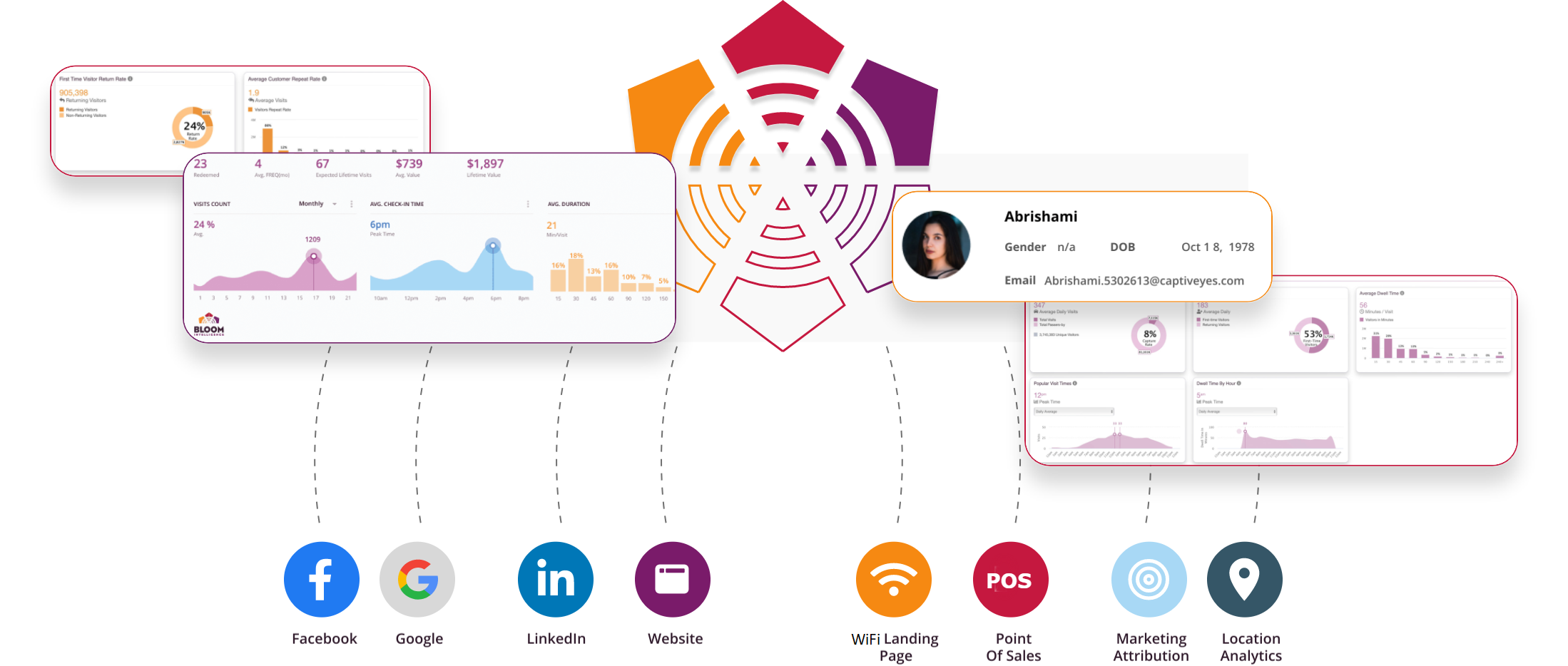
WiFi Analytics Help Guest Retention

Recognizing the At-Risk Customer

Even if you manage a single-location family-owned diner, you may believe you are “small enough” and have a volume manageable enough to recognize those at-risk patrons. But that may not truly be the case.

First, consider the lost revenue from one loyal customer, it can be significant. What is the lifetime value of a customer? How many meals will they purchase over the course of time and what does that mean to your establishment?

Further, if you are the owner or marketing director of a franchise restaurant chain, you have multiple locations, and losing customers results in substantial revenue loss. You may not have the luxury of being unaware of customer behavior when your competition is becoming more aware and proactive at enticing your loyal customers back to them.

Bloom Intelligence At-Risk Customer Trigger

Bloom Intelligence allows users to quickly create a beautiful message that they can send to their at-risk customers.

Then, a marketing campaign can be easily configured to send that message to any customer the system deems as being at risk of churning.

Bloom uses advanced algorithm sets to identify customers who are at risk of churning or not coming back to your restaurant or retail location. Users are seeing as much as 38% of their at-risk customers returning – many of whom they would have never realized were churning.

For a real-life case study, and more details about how to save your at-risk customers, download our free customer success story, or simply click on the banner below.
restaurant customer attrition report

How to Attract Repeat Business from Millennials

If you have a retail store, restaurant, or other brick-and-mortar business, you depend a great deal on repeat customers. It can be particularly challenging to motivate millennials to return consistently to your business.

Millennials move at a fast pace and grabbing their attention can be difficult in today’s hyperconnected world.

This requires a well-conceived marketing strategy that understands their behavior and preferences. Here are some of the best ways to get more repeat business from millennials. 

The Importance of Repeat Customers

Every business owner wants loyal customers who frequently return.

However, not everyone fully appreciates just how valuable such customers are. Research indicates that repeat customers typically account for most of a business’s total revenue.
Bricks and Mortar- How to Attract Repeat Business from Millennials.jpgOnce someone is in the habit of returning to your place, you no longer have to spend as much money convincing him or her to come back.

Such customers are more likely to refer their friends to your business. These are just some of the reasons that it makes sense to prioritize your returning customers.

Reach Millennials on Their Devices

The line dividing online and offline is getting thinner all the time. Today, it’s essential for brick-and-mortar businesses to have a website as well as social media pages.

If you want to attract millennials, it’s equally vital to connect with them on their smartphones with mobile apps, email, social media, and other online tactics.

Nielsen reports that 98% of millennials between 18 and 24 and 97% between 25 and 34 own smartphones. If you want to appeal to younger customers, you have to connect with them on the platforms they’re using.

Track Your Guests’ Behavior

The first step in attracting more repeat customers is to track the behavior of people who enter your business. Many businesses only know this in a casual manner, as when they recognize familiar faces.

You need a more reliable and systematic way to keep track of returning customers. One of the best ways to do this is through Wi-Fi sensor technology. Many of your customers, millennials, in particular, are likely to boot up their devices when they spend time in your space.

With wifi analytics, you can be notified whenever someone logs in using the same device more than once. This is an efficient way to measure repeat business.

Apply Triggered Marketing

Online marketers who send out emails and social media messages know the value of timing their communications. They study analytics about when people are most likely to read emails, Facebook posts, and other content.

Most marketing by brick and mortar businesses, on the other hand, doesn’t account for customers’ current locations or daily habits.

A newspaper ad, for example, is read whenever the reader happens to see it. Triggered marketing helps you increase engagement by connecting with customers at strategic moments and places.

With the help of the aforementioned Wi-Fi analytics, you can encourage your young customers to return by sending them timely offers.

For example, if someone eats dinner at your restaurant every Friday night and logs into your Wi-Fi, you can send him or her a coupon for a free entree that may entice him or her to try new dishes and return more often.

If you have a salon, you might have a customer who comes in every few weeks for hair styling. Before her next appointment, you could send a coupon promoting another service such as a manicure or massage.
Improve Guest Attrition Rates: WiFi Marketing Guide

Observe, Measure, and Improve

If you want your millennial customers to return to your business, make sure you’re constantly looking for ways to improve.

  • Analyze your data. Track all of your results, whether from your website, social media campaigns, or emails. Always look for ways to improve your results. Split test elements such as headlines, subject lines, graphics, and layouts.
  • Ask their opinion. Millennials love to tell you what they think. So ask them, whether it’s on social media or printed surveys that you hand out at your business.
  • Reward and loyalty programs. These are familiar techniques but still effective, especially if you offer people discounts on products they highly value.
  • Practice empathic design. While traditional analytics (which, as we just discussed, you should definitely study) focuses on the internet, empathic design is about observing customers in the real world and looking for ways to enhance their experience. Could you make the layout of your cafe or restaurant more comfortable? If you have several types of chairs, which do people prefer? Could you improve the atmosphere with a different type of lighting? These and other design elements can affect customers’ behavior and whether or not they return.

Don’t underestimate the value of repeat customers.

They are the bedrock of your business. Millennials are a fickle group, always looking for the latest, the best, and the hippest whether it’s coffee, beer, pizza, or fashion.

If you want to attract repeat business from this group, you have to be ready to constantly up your game. 

Marketing to Improve customer attrition

Anatomy Of A Loyal Customer: Four Metrics To Look For

Why are loyal customers important?  It seems like an easy question to answer, but not all companies understand how costly it is to lose–and have to replace–their customers.  

Plus, companies may be doing irreparable harm to their brand if they aren’t recognizing why customers aren’t loyal to their brand.  

Many marketers underestimate the importance of their loyal customers. Others recognize that importance, but struggle to find a way to track customer loyalty and reward loyal customers.

The Loyalty Landscape

Gaining and sustaining loyal customers is critical to the success of nearly every business.  

Of course, it is not always easy, especially with changing customer landscapes.  Marketers can’t deny the importance of capturing the hearts and wallets of millennials, whose purchasing power is expected to hit $1.4 trillion by 2020.  

Yet, millennials–and those following behind them–are a new and challenging type of customer to engage.

The real trick is in customer retention.  This comes down to, among others, customer service, access to information, brand recognition, and perks.  According to one digital marketing company, sixty-six percent (66%) of customers switch brands because of poor customer service.  Fifty-eight percent (58%) will never do business again with a company after a bad experience.  

On the other hand, over seventy percent (73%) of customers will fall in love with a brand just from friendly customer service representatives.  And, access to information will capture the hearts of fifty-five percent (55%) of customers.  

Then, there’s the wallet factor.  Many customers look for the best deal. If one company isn’t offering it, loyalty to that company isn’t going to keep them from shopping elsewhere. Of millennials aged 20-34, sixty-eight percent (68%) would switch brands to get more program rewards.

Brand recognition is also key.  This may be due to people wanting to feel like the brand they love is loved by their peers. In the same way millennials turn to social media for personal reinforcement (hence, the rise of status-sharing & selfie-taking), they also look for this with regard to the brands they choose.  

It’s no surprise that brand recognition is just slightly behind quality as the most important driver of brand loyalty for millennials.  

Why are Loyal Customers Important?

Loyal restaurant customers provide the foundation for a profitable and successful business. They not only help a company grow fast when times are good, but they also help companies stay afloat when times are tough.  Loyal customers are your best brand advocates.  And, they show their loyalty through their wallets, buying more and buying more often.  

A loyal customer also costs a business less.  Once acquired, the company has spent what they need to spend upfront (at least for the most part).  Losing that customer means replacing them, and spending the costs of client acquisition all over again.

Loyal customers will stay up to date on the brand, find answers to questions, and are willing to spend their social capital on the brands they love, such as sharing new products.   

Sip on this. Coffee is ubiquitous.  It’s cheap and you can find it anywhere.  To many, it “all tastes the same.”  

Yet, loyal customers not only will bypass a closer, more convenient shop, but they will bring their friends in, set up business meetings there, join the loyalty program, Instagram photos of their cup o’ joe, and put up with a long wait or a mixed-up order. They’ll even tote around your branded tumbler if they really love you.

Yet, because of the prevalence of quality coffee shops, with an instance or two of poor service, a rise in price, and the growing popularity of another nearby shop, a loyal customer may well be out the door.  

Because the lifetime value of a customer is tied to business success, monitoring customer loyalty metrics is a good way of keeping an eye on the overall health of the business.  

Here are some customer analytics metrics to which companies should pay attention.

1. Customer Return Rate

In some ways, hotels have it easy in the brick and mortar space.  Each time a customer visits, they make a reservation.  So, it’s fairly easy to know how many times a customer returns.  For a retail store or restaurant, this isn’t so easy.  However, with Wi-Fi analytics, it can be.

Every phone has a unique identifier known as a MAC address, and your Wi-Fi hotspot can use this to identify one customer from another. Every time they visit the store, those visits can be counted.  

If you find that customers are not returning very frequently, you can work to address this with your marketing.  Over time, you can also create buyer personas so that you better understand individual customer patterns and customize your marketing, accordingly.

2. Loyalty Program Sign-ups

Customer loyalty programs in retail are important to perk-driven millennials. Wouldn’t it be nice to know how many customers who are presented with the opportunity to join your customer loyalty program sign up?  If you were to introduce the program–with a seamless sign-up process–as your guests login to your free wireless internet, you could have that data.

If you find that you’re struggling to get customers to join the program, you could survey your Wi-Fi users about what they look for in a loyalty or rewards program.  All you need to do so is implement custom messaging on your Wi-Fi connection landing page.  Or, offer a discount for signing in to the internet with an email. With that email address, you can invite them to join the program, reminding them of all the benefits they will receive.

3. Churn Rate

Churn rates and customer loyalty go hand-in-hand.  If customer retention is low, it is indicative of a problem with the company’s ability to build and maintain loyal customers.  

One way to track churn rate is to track how much traffic fails to return to the location after they visit.  In tracking this metric, it is equally important to know the personas of the customers, so churn rates aren’t calculated as higher than they truly are.  Having the tools to identify and understand individual shopping habits provide more accurate data.

Marketers can employ various tactics to avoid losing customers and improve customer retention.  One way is to quickly and effectively manage feedback.  Online reviews are becoming ever more critical to solicit and digest, as they can be a key indicator of why a company’s churn rate is higher than it should be.  

Easily-deployable tools such as a Wi-Fi marketing platform can provide guests with the opportunity to give instantaneous feedback, with the capability to send negative feedback to your customer relationship management team and positive feedback to online review websites.  

4. Net Promoter Score

A net promoter score tells a business how likely its customers are to recommend its product or service to others. This is an important component of customer analytics.  If few of your customers are willing to tell others about your brand, you may lack the base of loyal customers you need.  

Tracking net promoter scores can be particularly easy if you offer free Wi-Fi at your locations.  When someone logs in, you can present the user with the question of “how likely are you to recommend our business to others?”  You could even consider requiring that customers answer this question before they connect.  With the response data, you are can start to understand one important metric of customer loyalty.  

If your net promoter score is low, you can consider what next steps you need to take to boost the experience your customers have.  Consider increasing opportunities for your customers to “bond” with the brand.  Host “limited-space” events, dedicate time to “like” and “share” photos your customers post on Instagram and Facebook, train your employees on ways to remember customers and their “usual” order.

One cannot overemphasize the importance of finding a tool that can track these key customer loyalty metrics.  Such a tool can help operators maintain a profitable and thriving business and can give marketers extra ammunition to fight brand wars. A Wi-Fi marketing and analytics platform that complements the free internet a business already offers to its guests is one tool to seriously consider.

5 Ways to Help Prevent Restaurant Customer Churn

Many restaurants and coffee shops focus mainly on increasing sales and the customers’ dining experience, giving less consideration to the importance of making sure that their customers remain their customers. Moreover, most owners and operators do not have an accurate way to measure their customer churn rate and keep it in check.

Customer churn rate refers to the overall percentage of customers who have decided to stop doing business with you. The best-case scenario for any business is to have a 0% churn rate. But this is simply not realistic – any business will experience natural attrition. There are ways, however, to keep your customer churn rate as low as possible.

Remind Your Customers You Are Giving Them the Best Product

restaurant customer churnYour customers have plenty of options, no matter your industry. There is a fair chance that you’re not the only restaurant or retailer that can give them what they want, so don’t take your customers for granted or fail to recognize that there’s competition for your customers and their dollars.

Considering this, whenever you engage with your customers, make sure to remind them of the quality you offer with your product.

You don’t have to stuff every blog post or social media post with promotional fodder, but you do want to remind your customers that any new or recent feature you are offering provides a sense of value for them.

Also, be sure to thank your customers or clients for the chance to present your product or service to them – it will make them feel valued. As a result, should they have a negative experience with a rival company, they’ll likely come back to you and your brand.

React Swiftly to PR Mistakes and Bad Decisions

This might be easier said than done. Odds are that you won’t know you’ve made a bad decision until it has had a significant impact on your company. In this case, it’s all about how you manage the issue. The fact is that bad PR is unavoidable for most companies if they are successful and grow big enough.

A good example of a PR blunder was when Netflix increased its prices. Netflix thought it would be a good idea to split its streaming service from its DVD delivery service and raise the prices on both. Their customers did not react well, and there was a significant backlash. As a result, it’s very likely that Netflix lost some customers they may never get back.

Sometimes bad PR can be the result of a system crash, computer bugs, or flaws in the business model. Two examples are the Dropbox password debacle and the negative press regarding Airbnb. In these cases, it was the job of the company, and more specifically the CEO to find a way to manage each disaster quickly and restore brand confidence.

Understand and Fortify Your Weaknesses

Are you aware of why people might not want to dine at your restaurant or shop at your store? Are you aware of what your company frequently falls short of? In most cases, deciding that your business is flawless is a massive mistake. In this case, you have failed to really listen to your customers.

Every business has its weaknesses, and you need to know yours intimately. Also, you need to know how to fix these weaknesses quickly and how to keep them from turning into bigger problems. There are many cases of companies that failed to see a weakness coming that lost significant amounts of revenue as a result. What you need to remember is that those who try to take your customers – essentially robbing you of revenue – are trying to become the market leader by taking advantage of your weaknesses. These are your competitors, and you need to stay on top of your shortcomings to make sure they don’t capitalize on your faults.

An excellent way to identify your weaknesses is by setting up an effective system for collecting customer reviews.

Deliver on Your Promises
restaurant-customer-churnCustomers will become loyal to your eatery or your product because you have provided them with a unique advantage over your competition that they can’t find elsewhere.

However, if you neglect your efforts to keep promises, your customers will leave you. If Apple phones weren’t so easy to handle people would stop buying them.

The same goes for Amazon, if they suddenly failed at prompt deliveries or at having a massive stock of goods, they would lose their loyal customer. People rely on the promises companies make regarding their brands.

It is essential to the integrity and profitability of your brand, as well as to lower your customer churn rate as much as possible, that you keep your promises.

Gaining Insights from Traffic Analytics

Using a WiFi marketing & customer intelligence hub, like Bloom Intelligence, you can determine who makes up your audience of loyal visitors. You can also account for the length of time users visit and how their behavior at your location changes over time.

With this data, you’re able to get a much deeper understanding of your customers and create targeted campaigns to ensure they remain loyal to your business.

Bloom also uses intelligent algorithm sets to monitor each customer’s frequency distribution, individually and as a whole, to understand and accurately define your customer churn rate in real-time.

By analyzing individual customer frequency, Bloom can determine when a customer is at risk of churning or has churned. Then you can use the automated marketing suite of tools to send triggered messages to your at-risk and churned customers persuading them to come back.

In most cases, a high customer churn rate comes down to neutral or poor customer experiences. While you can persuade customers to give you another chance, you will still need to take the tips above into account to help keep customers from churning in the first place and to cement their loyalty when they give your business another chance.

For info on how to reduce your restaurant customer attrition using Bloom, click on the banner below!


Learn more about improve restaurant customer attrition with Bloom

Restaurant Mobile Technology to Improve Marketing ROI

Can mobile technology help the restaurant and retail industry? Consider a 2018 Pew Research Survey showing that 94% of adults aged 18-29 in the United States own a smartphone. Also, 89% of smartphone users are 30-49 years old. 

If restaurants, cafes, or retail companies want to reach their target demographics, they must connect with them through the devices they use the most: their smartphones. 

The same survey showed that 49% of Millennials prefer a digital restaurant receipt to a paper receipt.

That age group is the most opinionated, adept, and engaged group of mobile users anywhere. 

While there are many more, here are the top eleven reasons mobile technology is worth the effort. 

mobile technology in restaurants1. Increased Visibility

Brands can use mobile technology to know when guests are in or around different locations. Marketing specials, upselling, or encouraging guests to visit again are also productive uses of mobile technology. 

2. Better Connections

The flexibility that mobile devices provide is one of the most significant benefits. Mobile ordering, for instance, can make the ordering experience more straightforward for customers, and it might even make the lines shorter and increase business efficiency. Mobile ordering also reduces human errors, another plus that can improve guest satisfaction. Hosts and servers will also spend less time on the phone. 

One restaurant using this technology for its benefit is Subway, which allows users to choose and pay for their meal before leaving their home or office and allows guests to pick it up without any wait at the restaurant. The chain now has shorter lines and wait times in its stores. Starbucks also uses mobile technology ordering and has seen results similar to Subway. In fact, as of July of 2016, mobile orders and payments account for 20% of Starbucks’ transactions or about $9 million every week.

3. Online Ordering

According to Facebook’s restaurant report, digital channel sales are on pace to reach 30% of total sales for U.S. restaurants by 2025. Additionally, 60% of U.S. consumers already order delivery or takeout once a week. Especially within the restaurant industry’s unstable pandemic climate, it’s crucial to capitalize on online orders as much as possible. Online marketing to tell guests about online ordering capabilities is paramount.

mobile technology in retail4. Increased Profits

Surveys have shown that customers who use traditional loyalty programs total about 12%, but when they had the chance to pay from a smartphone, that increased to 18-28%. When customers had the additional option to order online, that number increased to 15-35%. 

One restaurant that has used mobile technology successfully is Earl of Sandwich. Their customers spend an average of 22% more when using the restaurant’s mobile technology.

5. Improved Loyalty

One business that has used a loyalty program successfully is Chili’s. Their loyalty program is entirely digital. The chain provides personalized offers to customers based on their purchases. Chili’s offers challenges to customers so they can gain points, which allows them to try a new menu item. Additionally, Chili’s has small kiosks at tables so customers can participate in the program while dining, thus accumulating points. 

Taking virtual loyalty a step forward, Bloom Intelligence offers a loyalty program that integrates with Cisco Meraki access points. The access points ping off of guest cell phones (whether or not they connect to WiFi) track their visits on autopilot. After a custom visit duration, Bloom can automate a loyalty offer and send it directly to customers based on their customer profile contact information.

6. More Catering Orders

According to one study by Modern Restaurant Association, catering sales make up 44% of revenue, on average. $1 of catering labor equates to just 5 cents of capital investment, making catering ROI an essential focus for many restaurants. Thanks to mobile catering orders and email marketing, the service industry can continue to capitalize on these opportunities despite the pandemic.

7. Efficient Business Operations

Mobile orders create more efficiency in a variety of ways. 

  • Orders made online bring in more customers in less time than processing transactions on-site.
  • Online orders improve customer satisfaction and reduce errors and wasted products.
  • Thanks to mobile ordering online, it’s easier than ever to acquire customer data to increase their loyalty.

mobile technology for coffee shops

8. Valuable Insights

When brands understand how often customers visit a location, where they are, and what they purchase, they can follow up with targeted campaigns. Emails and SMS marketing increase customer engagement and improve loyalty. Almost 75% of email marketers optimize email for mobile devices, and many focus on subscriber personalization. 

Mobile technology allows location-based companies to connect and engage with customers through a simple tap on their smartphones.

WiFi technology allows restaurants and retail companies to collect customer data with a WiFi captive portal effortlessly. Mobile campaigns benefit businesses and their customers. Plus, by collecting customer demographic data, the information about where they live, their ages, and gender, organizations can learn about the people who will most likely want to buy certain items. 

WiFi technology is the best way to acquire data on a large customer base. This technology allows brands to create highly effective marketing campaigns to help increase customer spend and frequency.

9. Gamification

Shikatani Lacroix defines gamification as the application of gaming mechanics (such as points, goals, and rewards) to business elements.

By using gamification, Domino’s increased sales revenue by 30%. Likewise, Ford managed to do the same with its strategy (their customers bought over $8 million in vehicles). Badgeville & Kendall-Jackson were able to use gamification to increase customer engagement by around 65%.

“I think it means there are different ways to accomplish the same objective,” says Schlotsky’s CMO Mark Mears. “While the free sandwich offer might appeal to some, the game appeals to others. “It’s a chance to diversify our approach so it doesn’t get stale. We always want to be sure that we are relevant to our guests.”

10. Inventory Management

Mobile inventory management systems can help restaurants stay fully stocked. According to the National Restaurant Association State of the Industry Report 2019, consumers said they would like to see technology focus on customer service improvements. The report also stated that 37% of restaurant operators think that customer orders are the most critical area for technological development.

11. Online Subscriptions

Mobile subscriptions are the latest trend to hit the restaurant industry. Coffee shops are capitalizing on subscriptions to send recipe ingredients, including, of course, coffee. Restaurants like Panera are jumping on board with free subscriptions for unlimited coffee.

Panera’s chief brand and concept officer, Eduardo Luz, says that “we hypothesize that recurring revenue based on subscription makes a lot of sense. I believe part of our future will involve recurring revenue or subscription-based revenue, which is new to the restaurant world.”

We want to hear from you! How has mobile technology helped your business? Let us know in the comments below.

Click for a free demo of the Bloom Intelligence platform, or call to schedule today at 727-877-8181.