Category: Operations Intelligence

Restaurant Customer Satisfaction: The 2026 Data Guide

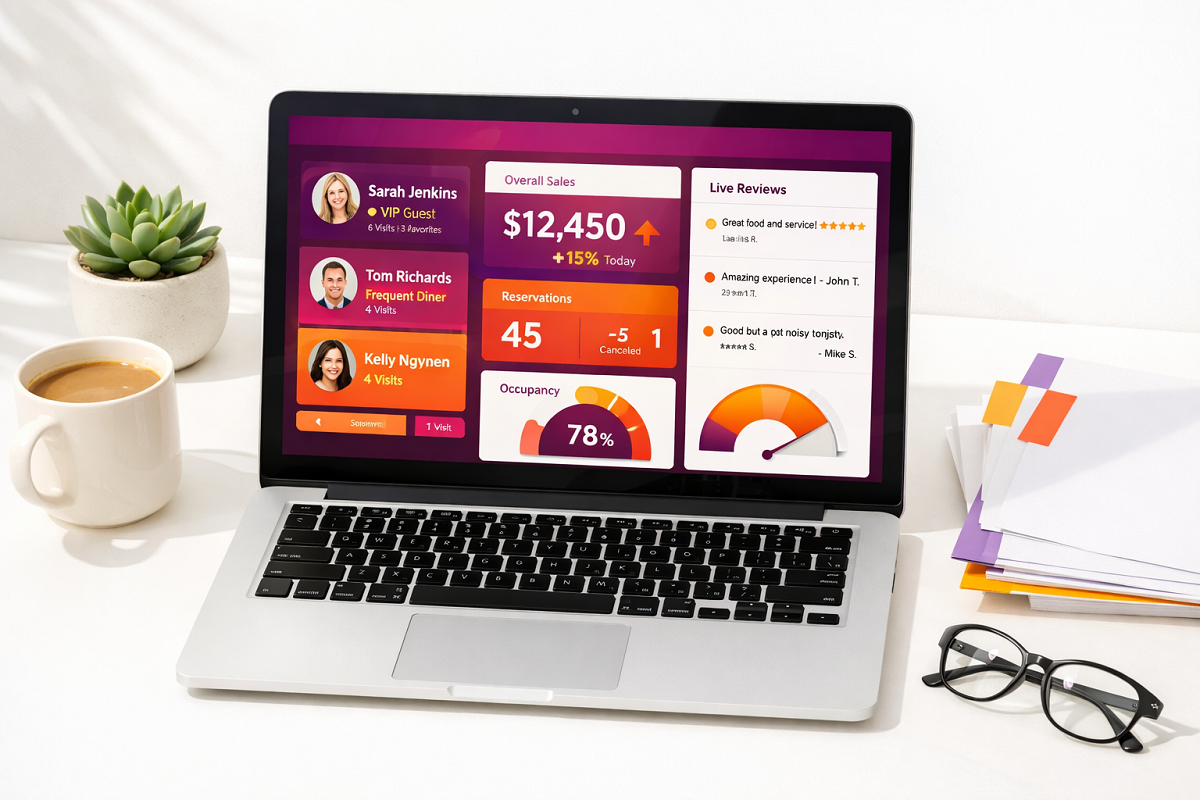
Two restaurant marketers reviewing results on a laptop
Key Takeaway

Restaurant customer satisfaction is the degree to which a guest’s experience meets or exceeds their expectations, and it is measurable, not a feeling. Across the Bloom Intelligence network of 1,000+ restaurant locations, satisfied guests show up as a 4.50 average Google rating and repeat visits, while dissatisfied guests rarely complain: more than 8 in 10 first-time guests simply never return. And when guests do speak, restaurants mostly do not answer: only 29.2% of the 67,732 reviews posted to network restaurants in 2026 received a reply. When restaurants ask directly, fewer than 1 in 200 guests answer a rating request.

Most operators believe they would know if their guests were unhappy. The dining room is full, the servers are friendly, and the comment cards (when anyone fills one out) are polite. It feels like satisfaction. It’s also the most expensive possible place to leave the question.

We analyzed guest behavior, ratings, and sentiment across the Bloom Intelligence network of more than 1,000 restaurant locations, and the pattern is consistent: dissatisfaction almost never announces itself, it shows up as absence. By the end of this post you’ll have a working definition of restaurant customer satisfaction, the numbers that tie it to revenue, the instruments that actually measure it, and a 90-day plan to turn it into repeat visits.

What Is Restaurant Customer Satisfaction?

Restaurant customer satisfaction is the degree to which a guest’s actual experience (food, service, environment, and convenience) meets or exceeds the expectations they walked in with. It is expressed in behavior: ratings left, reviews written, and above all whether the guest ever comes back.

The definition matters because it moves satisfaction from opinion to instrumentation. Expectations are set before the visit (by your Google rating, your photos, your price point) and the experience is judged against them. A $12 lunch spot and a $200 tasting menu can both earn five stars; each is graded against its own promise.

That also settles the old exam question. Satisfaction is a primary goal of every restaurant, but it’s an instrumental one: the business outcome it exists to produce is the second visit, and every visit after it.

Is customer satisfaction the primary goal of a restaurant?

Yes, customer satisfaction is a primary goal of any restaurant, because every downstream outcome depends on it. But it is a means to the true business goal: repeat visits. In Bloom Intelligence network data, more than 8 in 10 first-time guests never return, which makes satisfaction on the very first visit the most decisive moment in a guest’s lifetime value.

The Revenue Math: What Restaurant Customer Satisfaction Is Actually Worth

Customer satisfaction converts to revenue through two compounding channels: ratings that win new guests, and repeat visits that multiply existing ones. A Harvard Business School study found a one-star increase in a restaurant’s Yelp rating correlated with a 5–9% increase in revenue, and across the Bloom Intelligence network, just 8% of guests drive 53% of all visits.

The ratings channel is public and comparative. The 2026 network benchmark for restaurants on the Bloom platform is a 4.50 average Google rating, and because diners (and now AI engines) compare you against the restaurant down the street, a few tenths of a star is the difference between being recommended and being invisible.

The repeat channel is quieter and larger. Loyal guests visit more often, spend more per visit, and cost nothing to re-acquire. When a tiny share of guests produces most of your visits, protecting the satisfaction of your regulars is the highest-leverage financial decision in the building.

4.50
Average Google rating across 1,000+ Bloom network locations
5–9%
Revenue lift per one-star Yelp increase (Harvard Business School)
53%
Share of all visits driven by just 8% of guests in Bloom network data

How does customer satisfaction affect restaurant revenue?

Customer satisfaction drives restaurant revenue through higher ratings that attract new guests and higher repeat-visit rates that multiply existing ones. Harvard Business School research links a one-star Yelp increase to a 5–9% revenue lift, and in Bloom Intelligence network data just 8% of guests (the satisfied regulars) account for 53% of all visits.

How to Measure It: Surveys, Sentiment, and Ratings

Restaurants measure customer satisfaction with three instruments: guest surveys sent after the visit, AI sentiment analysis of reviews and feedback, and rating trends across Google, Yelp, and other platforms. Each instrument catches guests the other two miss.

Surveys are the only instrument that hears from guests who would never write a public review. A short, well-timed survey (delivered automatically after a visit detected via WiFi, POS, or reservation data) captures satisfaction while the experience is fresh. Our guide to restaurant survey software covers how to segment responses by guest lifecycle so a first-timer’s complaint and a regular’s complaint get different responses.

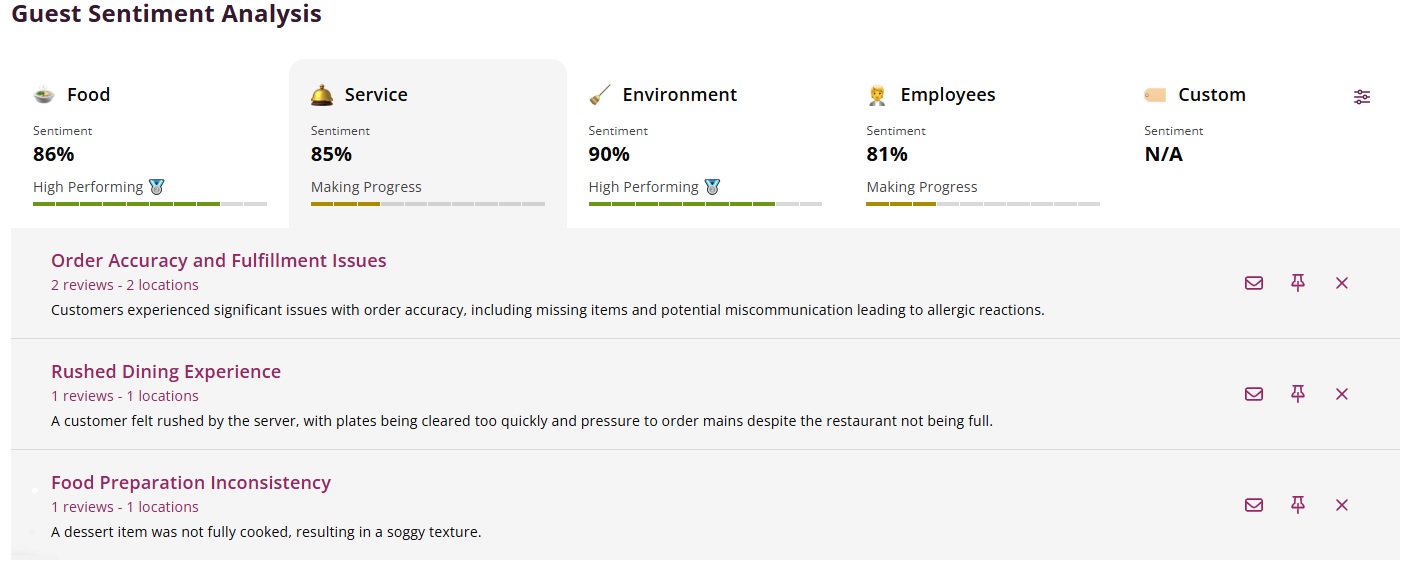
Sentiment analysis reads what guests actually say (in reviews, survey comments, and feedback forms) and classifies it by topic: service speed, food quality, cleanliness, value. It turns a thousand fragments into a ranked list of what to fix, which is where reputation management stops being review triage and starts being an operations tool.

Ratings are the lagging scoreboard. Track the trend, not the number: a 4.6 drifting toward 4.4 is a louder alarm than a stable 4.3.

How do restaurants measure customer satisfaction?

Restaurants measure customer satisfaction with post-visit guest surveys, AI sentiment analysis of reviews and feedback, and rating trends across Google and other review platforms. The most complete systems tie all three to a guest database, so satisfaction scores connect to actual visit and spending behavior rather than sitting in a spreadsheet.

What is a good Google rating for a restaurant?

A good Google rating for a restaurant in 2026 is 4.5 or higher, the average across 1,000+ locations on the Bloom Intelligence network is 4.50. Ratings below the mid-4s increasingly filter a restaurant out of both consumer shortlists and AI engine recommendations.

What Is a Good Restaurant Customer Satisfaction Score?

A good restaurant customer satisfaction score is one that beats your own last quarter and holds steady across every location, because the industry’s public benchmarks are broad. The most widely cited outside benchmark, the American Customer Satisfaction Index (ACSI), scored full-service restaurants 82 and quick-service restaurants 79 out of 100 in its 2026 study, both unchanged from the year before.

Net Promoter Score (NPS) is the satisfaction number most operators track. Guests answer one question: how likely they are to recommend you, on a 0 to 10 scale. Guests who answer 9 or 10 are promoters, 7 or 8 are passives, and 0 to 6 are detractors. Your NPS is the percentage of promoters minus the percentage of detractors, so it runs from −100 to +100.

Any score above zero means you have more promoters than detractors. Beyond that, be careful with the restaurant NPS averages quoted online. We could not find a reliable, published one, so the comparison that matters is your own: this quarter against last quarter, and each location against the others. A group whose overall score holds steady while one location slides has a problem the average hides.

Metric Reference point Source
Google rating 4.50 average Bloom network, 1,000+ locations (2026)
Average review rating, all platforms 4.56 Bloom network, 67,732 reviews (January to September 2026)
Customer satisfaction index 82 full-service, 79 quick-service (out of 100) ACSI 2026 restaurant study
Net Promoter Score Your own trend, by quarter and by location No reliable public restaurant average
Survey response rate Fewer than 1 in 200 rating requests Bloom network rating-request emails

Sources: Bloom Intelligence network data (see Methodology) and the ACSI Restaurant and Food Delivery Study 2026.

The scorecard later in this guide puts these reference points next to your own monthly numbers, so you can see which one is moving.

What is a good NPS score for a restaurant?

Any Net Promoter Score above zero means a restaurant has more promoters (guests who score it 9 or 10) than detractors (guests who score it 0 to 6). There is no reliable published NPS average for restaurants, so the best benchmark is your own score over time and across locations. For an industry reference, the 2026 American Customer Satisfaction Index scored full-service restaurants 82 and quick-service restaurants 79 out of 100.

Restaurant Customer Satisfaction Survey Questions That Actually Predict Return Visits

A restaurant customer satisfaction survey should ask about the moments that decide a second visit, not everything that happened. Ten questions, sent within a few hours of the visit and answerable in under two minutes, outperform a twenty-question form that most guests abandon.

The questions below start with the ones closest to the decision to come back. Ask the first four at minimum.

  1. How likely are you to recommend us to a friend? (0 to 10) The Net Promoter question. It is the most widely used loyalty question, and it lets you track your score over time and across locations.
  2. How likely are you to visit us again in the next 30 days? Asks the question you actually care about. Compare answers to what the guest does next: the gap between stated and actual return is your real satisfaction score.
  3. How would you rate the value for what you paid? Value perception, not price alone, decides whether a guest feels the visit was worth repeating.
  4. How would you rate the speed of service? Speed is one of the easiest problems to measure and one of the fastest to fix.
  5. How would you rate the friendliness and attentiveness of your server? Separates staff experience from kitchen experience.
  6. How would you rate the food quality and temperature? Ask about temperature specifically, because guests rarely raise it in the dining room.
  7. Was your order accurate and complete? A yes or no that flags the mistakes guests forgive once and never twice.
  8. How clean were the dining room and restrooms? Cleanliness is a silent satisfaction driver: rarely praised, often the reason a guest does not return.
  9. Did anything fall short of what you expected? Open text. Read every answer, because this is where the specific, fixable problems live.
  10. May we contact you about your feedback? Permission to recover the relationship. A personal reply turns a complaint into a second chance instead of a lost guest.

Two rules make the survey worth the effort. Send it automatically after a verified visit (a WiFi login, a reservation, or an online order), not weeks later. And route the low scores to a person the same day, because a survey that only produces a dashboard is a comment card with better fonts.

What questions should a restaurant customer satisfaction survey ask?

Ask how likely the guest is to recommend you and to return within 30 days, then rate value, speed of service, server attentiveness, food quality and temperature, order accuracy, and cleanliness, and finish with one open question about what fell short and permission to follow up. Keep it to ten questions and send it within hours of the visit.

The Satisfaction Signals Most Operators Never See

Most dissatisfied restaurant guests never complain, never leave a review, and never tell a manager, they simply don’t come back. In a Bloom Intelligence analysis of nearly a million first-time guests, more than 8 in 10 never returned, only about 1 in 7 came back even once, and roughly 1 in 32 became a frequent regular.

This is the blind spot that makes satisfaction feel fine while revenue leaks. The guests you see tonight are, by definition, the satisfied ones, the survivors. The verdicts that matter were delivered silently by everyone who tried you once and chose somewhere else for visit two.

Our State of Restaurant Guest Behavior analysis found the same lag in sentiment: by the time dissatisfaction shows up in public reviews, the behavioral damage (stretched visit gaps, quiet churn) has usually been underway for weeks. Reviews are the autopsy; visit patterns are the vital signs.

Asking guests directly does not close the gap. Bloom rating-request emails have reached 1,050,325 guests across 227 network locations. 21.7% opened the email, and 5,045 left a rating: fewer than 1 in 200. Surveys still matter, because the guests who do answer tell you exactly what to fix. But they can’t be your only instrument. Visit patterns speak for every guest, including the ones who never answer.

1,050,325
Rating-request emails delivered across 227 Bloom network locations
21.7%
Opened the rating request
<1 in 200
Left a rating (5,045 ratings, 0.48%)

How many guests answer restaurant satisfaction surveys?

Very few. Across 1,050,325 rating-request emails sent by restaurants on the Bloom Intelligence network, 21.7% were opened and 5,045 produced a rating, fewer than 1 in 200. That is why surveys work best alongside review sentiment and visit data, which capture the guests who never answer. Data comes from the Bloom network and may not be the same for all restaurants.

Why don’t dissatisfied restaurant guests complain?

Most dissatisfied restaurant guests stay silent because leaving quietly is easier than confronting staff or writing a review, the switching cost to a competitor is nearly zero. That is why churn, not complaints, is the truest satisfaction metric: in Bloom Intelligence network data, more than 8 in 10 first-time guests never return, while public complaints capture only a small fraction of dissatisfaction.

What 67,732 Reviews Say About Restaurant Customer Satisfaction in 2026

Restaurants answer fewer than 3 in 10 of their reviews, and fewer than 3 in 10 of their negative reviews. Across 67,732 reviews posted to restaurants in the Bloom Intelligence network between January 1 and September 21, 2026, the average rating was 4.56 and 78.5% were 5-star, but only 29.2% received any reply from the restaurant. Of the 4,631 one- and two-star reviews, 30.1% were answered at all and 25.8% within 24 hours. This is original research from Bloom’s own platform data, not a third-party survey.

The speed is not the problem. When restaurants do reply, 86.9% do so within 24 hours and 94.9% within 72. The problem is coverage: seven in ten guests who took the time to write a review, including seven in ten who wrote an unhappy one, heard nothing back. That silence is the satisfaction signal most operators never see, in the same category as the first-time guest who quietly never returns.

Platform Reviews (2026 YTD) Average rating Replied by restaurant
Google 41,986 4.57 33.2%
OpenTable 19,111 4.62 19.2%
Yelp 5,175 4.28 41.0%
TripAdvisor 850 4.33 2.4%
All platforms 67,732 4.56 29.2%

Source: Bloom Intelligence analysis of 67,732 reviews across Bloom network restaurant locations, January 1 to September 21, 2026.

Three things in that table matter for satisfaction strategy. Yelp guests rate the same restaurants a third of a star lower than Google guests do, so a Yelp-heavy market needs its own recovery attention. OpenTable reviews come from verified diners and are the least answered, which wastes the most trustworthy feedback channel a restaurant has. And the 23 locations in the network that reply to three-quarters or more of their reviews average 4.48 stars with 9.1% negative reviews, against 4.42 and 10.0% for locations that reply to fewer than a quarter. That is an association, not a proof of cause, but it points the same direction as everything else in this guide: satisfaction is decided by what happens after the guest speaks, not before.

Methodology: reviews imported into the Bloom Intelligence platform from Google, OpenTable, Yelp, TripAdvisor, Tock, and Facebook for network locations, January 1 to September 21, 2026. A reply is a response from the restaurant, not a follow-up from the reviewer. Location comparisons include only locations with at least 30 reviews in the period. Data was compiled in September 2026. Data comes from the Bloom network and may not be the same for all restaurants.

How is AI used to improve guest satisfaction in restaurants?

AI reads every review, survey, and message as it arrives, scores the sentiment, flags the guests who are unhappy, drafts a personal reply in the restaurant’s voice for a manager to approve, and triggers a win-back offer when a regular’s visit pattern breaks. The goal is coverage: answering all of the feedback instead of the 29% that gets answered by hand, and reaching the unhappy guest before they decide not to return.

What Drives Restaurant Customer Satisfaction, and What Quietly Kills It

The drivers of restaurant customer satisfaction are consistency across five factors: service speed and warmth, food quality, cleanliness, environment, and perceived value. Guests forgive an off night on one factor; they churn on patterns.

The killers are rarely dramatic. In sentiment data across the network, the recurring themes are waits nobody acknowledged, restrooms nobody checked, music nobody adjusted, and menus with no path for the allergic or the vegetarian at the table, the person who often holds veto power over the group’s return. Each one is small; together they compound into a guest who was “fine” and is never seen again.

The operational translation: satisfaction is a systems problem, not a heroics problem. Checklists that actually run, staff empowered to fix a problem at the table without a manager, and service pacing that respects the guest’s clock, whether it’s a 40-minute lunch or a two-hour anniversary, beat grand gestures every time.

How can restaurants improve customer satisfaction?

Restaurants improve customer satisfaction by making the fundamentals consistent (service speed, cleanliness, food quality, environment, and value) then measuring the result with surveys and sentiment analysis, and acting on dissatisfaction before the guest churns. Restaurants on the Bloom Intelligence platform that automate this measure-and-respond loop recover 38% of at-risk guests.

How can restaurants enhance guest satisfaction?

Start with the fundamentals guests notice most: speed of service, order accuracy, value for the price, and cleanliness. Then close the loop. Send a short survey after every verified visit, answer every review within a day, reach out personally to any low score, and use your guest data to recognize regulars by name and preference. Satisfaction rises fastest when guests see that their feedback changed something.

Closing the Loop: From Measurement to Recovery

Measuring satisfaction only pays when it triggers action: automated recovery campaigns that reach a dissatisfied or slipping guest before they’re gone for good. Restaurants on the Bloom Intelligence platform recover 38% of at-risk guests this way, worth an average of $53,000+ per location per year.

The loop looks like this: a customer data platform notices a regular’s visit gap stretching, or a survey score dropping, and a behavior-triggered message goes out: an acknowledgment, an invitation, sometimes an incentive. Across the network, every 1,000 automated emails delivered produce 16 tracked return visits and $318 in verified return revenue.

Negative feedback gets the same treatment in reverse: a low survey score alerts a manager for recovery the same day, the difference between reputation software that responds and reputation software that prevents.

Why is customer satisfaction important in the restaurant industry?

Customer satisfaction is important in the restaurant industry because margins depend on repeat visits, and repeat visits depend on satisfaction: in Bloom Intelligence network data, 8% of guests drive 53% of all visits, while more than 8 in 10 first-time guests never return. Satisfaction also sets a restaurant’s public ratings, which now determine visibility in both Google results and AI recommendations.

A 30/60/90-Day Restaurant Customer Satisfaction Plan

Days 1–30: instrument. Stand up automated post-visit surveys, connect your review platforms into one sentiment view, and baseline three numbers: average rating, first-time-guest return rate, and your regulars’ average visit gap.

Days 31–60: fix the loudest pattern. Take the top recurring theme from surveys and sentiment (usually service pacing or cleanliness) assign an owner, and rebuild the checklist or staffing pattern behind it. Re-measure the same theme at day 60.

Days 61–90: automate the loop. Turn on behavior-triggered recovery (the second-visit nudge for first-timers, the win-back for slipping regulars, manager alerts for low survey scores) so satisfaction management runs on data instead of memory. Judge the quarter on return rate, not compliments.

Satisfied guests leave stars. Dissatisfied guests just leave.

Put these numbers to work

Everything in this article is measurable: rating trend, first-time return rate, regulars’ visit gaps, and the revenue recovered when you act on them. Bloom builds that satisfaction loop automatically and reports the dollars it returns.

Methodology

Network statistics in this article come from previously published Bloom Intelligence analyses of guest, rating, and campaign data across 1,000+ restaurant locations, including our 2026 restaurant benchmarks (average Google rating, visit concentration) and our first-time guest return analysis of nearly one million first-time guests (return and regular-conversion rates, reported here as approximate per-1,000 figures). Email recovery figures reflect tracked return visits and verified return revenue per 1,000 automated emails delivered across network campaigns. Rating-request figures are all-time totals for Bloom rating-request email campaigns (215 campaigns across 227 network locations) as of October 29, 2026: 1,050,325 emails delivered, 227,554 opened, and 5,045 ratings submitted by email. The industry benchmark comes from the American Customer Satisfaction Index Restaurant and Food Delivery Study 2026, based on 16,464 completed surveys collected April 2025 to March 2026. External statistics are attributed inline to their original sources. Individual restaurant results vary with concept, market, and execution. Data comes from the Bloom network and may not be the same for all restaurants.
Restaurant No-Shows in 2026: Who Books and Never Arrives

Key Takeaway

Across hundreds of thousands of advance restaurant reservations in the Bloom Intelligence network since January 2025, 3.7% of parties never arrived and another 15% cancelled, meaning nearly 1 in 5 booked tables never seats a guest. The most effective fix is not deposits or blacklists. It is knowing who is booking and reaching them before the reservation, not after.

Ask any operator about no-shows and you will hear the same story: it is the big Saturday-night party that books an eight-top and vanishes, and the answer is a credit card hold. The reservation platforms have built entire deposit products around that story.

The reservation data tells a different one. We analyzed hundreds of thousands of advance reservations across roughly 50 restaurant locations in the Bloom Intelligence network and found that the guests most likely to no-show are not big parties at all. They are two-tops, booking online, for a Sunday or Monday. By the end of this post you will have the real 2026 no-show benchmarks by channel, day, and party size, a dollar figure for what empty tables cost per location, and a prevention playbook that does not punish your best guests.

About this data

Every statistic in this article comes from advance reservations (web and phone bookings, excluding walk-ins) recorded in the Bloom Intelligence network between January 2025 and August 2026. It reflects the restaurants in our network, which skews toward full-service and multi-location operators, and may not match the numbers at every restaurant. Treat these figures as directional benchmarks, not universal constants. Full details in the methodology.

What Is the Average Restaurant No-Show Rate in 2026?

In Bloom Intelligence network data, 3.7% of advance restaurant reservations end in a no-show and 15% are cancelled, so 18.7% of booked tables, nearly 1 in 5, never seat a guest. That is measured from hundreds of thousands of POS-linked reservation records since January 2025, not from surveys.

100Ks
Hundreds of thousands of advance reservations analyzed across the Bloom Intelligence network since January 2025
3.7%
Ended in an explicit no-show, more than 23,000 parties that booked and never arrived
1 in 5
Booked tables that never seat a guest once cancellations are included

You have probably seen industry no-show figures as high as 15% or 20%. Those numbers usually come from operator surveys, which blend no-shows with cancellations and rely on memory of the worst nights. Reservation-system records tell a calmer but more expensive story: the pure no-show rate is lower than the folklore, but it is relentless, it hits every day of the week, and unlike a cancellation it gives you zero chance to rebook the table. For context on what your other guest numbers should look like, see our 2026 restaurant benchmarks report.

What percentage of restaurant reservations are no-shows?

In Bloom Intelligence network data covering hundreds of thousands of advance reservations since January 2025, 3.7% of reservations ended in a no-show and another 15% were cancelled. Combined, nearly 1 in 5 booked tables never seated a guest.

What Does a No-Show Actually Cost?

The average seated reservation in the Bloom Intelligence network carries a check of roughly $165, so the more than 23,000 no-shows in our data represent about $3.9 million in vanished bookings, approaching $49,000 per location per year. That figure counts only the empty table, not the guests turned away while it sat reserved.

The margin math makes it worse. As we covered in our restaurant profit margins benchmark, full-service restaurants keep 3 to 5 cents of every revenue dollar. A no-showed $165 table does not cost you $165 of profit, but the labor was scheduled, the prep was done, and the seat inventory expired the moment service ended. Revenue that never arrives against costs already spent is the most expensive kind of loss a restaurant has, and it compounds every week of the year.

It also lands hardest on the nights you can least absorb it. A no-show on a slammed Saturday might be backfilled from the walk-in line. The same no-show on a quiet Monday is simply gone, and as the next section shows, Monday is exactly when no-shows peak.

How much does a no-show cost a restaurant?

In the Bloom Intelligence network, the average seated reservation carries a check of about $165. At observed no-show rates, that adds up to roughly $49,000 per location per year in vanished bookings, before counting guests turned away while the table sat reserved.

Web Reservations No-Show More Than Phone Reservations

Online reservations no-show at 3.9% versus 3.0% for phone reservations, and cancel at 16.3% versus 9.3%. The channel with the least booking friction is also the channel with the least commitment.

Nobody dials a restaurant, waits on hold, and gives their name to a host casually. But tapping a 7:30 slot in an app takes eleven seconds and costs nothing emotionally, so the booking is abandoned just as lightly as it was made. Two decades of the industry pushing every reservation online has been great for volume and quietly corrosive for commitment. The point is not to bring back the phone. It is that a web reservation arrives with less attachment built in, so the attachment has to be built after the booking, through confirmation and reminder touchpoints that give the guest a moment of human connection the app never did.

There is one more wrinkle: the phone reservations you do get are disproportionately valuable. Phone bookings in our data average 7.2 seats per party versus 3.3 for web. Large groups still pick up the phone, which means a single phone no-show walks out with roughly $375 of booked revenue, more than double the network-average table. Fewer phone reservations fail, but each failure hurts more.

Do online reservations have higher no-show rates than phone reservations?

Yes. In Bloom Intelligence network data, online reservations no-show at 3.9% compared to 3.0% for phone reservations, and cancel at 16.3% compared to 9.3%. Lower booking friction correlates with lower commitment to arrive.

The Party-Size Surprise: Two-Tops Are Your No-Show Problem

Parties of one or two no-show at 4.5%, while parties of seven or more no-show at just 1.8%, and over half of all no-shows in our data are two-tops or singles. The smallest parties are two and a half times more likely to vanish than the largest ones.

It makes intuitive sense once you see it. An eight-top is a birthday, an anniversary, a client dinner. It has a group chat, a guest of honor, and social pressure to show up. A two-top made on a Tuesday for the following Sunday is a loosely held plan between two people, and loosely held plans lose to a rainy evening and a couch. The day-of-week data confirms it: Sunday and Monday reservations no-show at 4.2%, the highest of the week, while Wednesday runs 3.1%. The reservations guests forget are the ones they made for the days that felt optional.

The volume math is what should change your prevention strategy. Big parties no-show rarely but expensively. Small parties no-show constantly, and because two-tops dominate reservation volume, they account for 52% of all the no-shows we measured. Any prevention system that only guards large parties is guarding the wrong door.

Why do guests no-show restaurant reservations?

Bloom Intelligence data shows no-shows concentrate where commitment is lowest: small parties, frictionless online bookings, and low-energy days like Sunday and Monday. Parties of 1 to 2 no-show at 4.5% while parties of 7 or more no-show at only 1.8%, suggesting forgetfulness and casual plan-breaking drive far more no-shows than deliberate rudeness.

Why Deposits and Blacklists Backfire

Deposits, card holds, and no-show blacklists target large parties, but Bloom Intelligence data shows parties of 7+ are the least likely group to no-show, so the industry’s default defense adds friction for the guests most likely to arrive while ignoring the two-tops driving half the problem.

Deposits do work, in the narrow sense that a guest with $25 per head on the line shows up or cancels early. But look at what they cost. They add a payment wall to the booking flow, which suppresses reservations from exactly the high-intent large parties that were already 97% reliable. They create hostile moments at the host stand when plans legitimately change. And no restaurant is going to demand a card hold from every two-top on a Monday, which is where the actual no-shows live. Blacklists are worse: they punish a guest after the revenue is already lost, and in our first-time guest research, where 8 in 10 first-time guests never return anyway, burning a bridge over one missed booking is a strange trade.

Deposits guard the eight-top that was always coming. Nobody is guarding the two-top that was always a coin flip.

Should restaurants charge no-show fees or require deposits?

Deposits reduce no-shows for large parties but add booking friction for the group that Bloom Intelligence data shows is already the most reliable, since parties of 7+ no-show at only 1.8%. Most operators get a better return from automated confirmation and reminder sequences aimed at small parties, which account for over half of all no-shows.

The Real Fix: Know Who Is Booking Before They Arrive

No-show prevention works when the reservation is connected to a guest profile, because a first-time booker, a slipping regular, and a loyal weekly guest need three different messages before the same 7:30 slot. A reservation system alone sees a name and a party size. A customer data platform sees the guest.

When reservations flow into unified guest profiles alongside WiFi visit history, POS spend, and email engagement, the no-show problem changes shape. That Sunday two-top stops being an anonymous coin flip. It is either a first-time guest whose visit deserves a warm confirmation and a reason to keep the plan, or a regular whose booking pattern just changed, which is worth knowing for entirely different reasons. Prevention becomes a personalized touchpoint instead of a blanket policy, and the same connected data then powers everything downstream, from the second-visit campaigns in our sales playbook to at-risk recovery, where Bloom recovers an average of $53,000+ per location per year.

How do restaurants reduce no-shows without charging deposits?

The most effective deposit-free approach is connecting reservations to guest profiles and automating pre-visit touchpoints: a confirmation at booking, a reminder the day before with easy modify and cancel options, and a personalized message matched to whether the guest is new or returning. Converting silent no-shows into early cancellations lets the table be rebooked.

Automating Prevention With Reservation Triggers

Bloom’s Summer 2026 release added workflow triggers for all five reservation actions, so restaurants can automatically fire the right message at booking, confirmation, seating, completion, and cancellation without anyone touching a send button.

In practice, a no-show prevention workflow looks like this. A guest books online and instantly gets a branded confirmation. The day before, a reminder goes out by SMS, the channel guests are most likely to see, with one-tap options to confirm, modify, or cancel. Because the trigger knows the guest profile, a first-time booker gets a different message than a regular. If the guest cancels, a cancellation trigger immediately invites them to rebook, converting a lost table into a future visit. And when the reservation completes, the post-visit sequence starts working on the second visit, which our data shows is the single most decisive moment in guest lifetime value. Behavior-based triggers with n’th-occurrence thresholds even let you treat the third no-show differently from the first, quietly, without a blacklist.

What are reservation triggers in restaurant marketing software?

Reservation triggers are automated workflow rules that fire marketing or operational actions when a reservation event occurs. Bloom Intelligence supports triggers on all five reservation actions, booking, confirmation, seating, completion, and cancellation, each able to launch personalized email or SMS sequences based on the guest’s full profile and history.

How to Reduce Restaurant No-Shows: The Checklist

Step 1: Measure your real baseline. Pull your no-show and cancellation rates by channel, day, and party size for the last 90 days. You cannot manage a 3.7% problem you have been guessing is 15%.

Step 2: Connect reservations to guest profiles. Route reservation data into your CDP so every booking resolves to a known guest with visit history, spend, and contact permissions.

Step 3: Automate the confirmation and reminder sequence. Instant confirmation at booking, an SMS reminder the day before with one-tap modify and cancel, and messaging that differs for new versus returning guests.

Step 4: Make cancelling effortless. Every silent no-show you convert into an early cancellation is a table you can rebook. Friction in cancelling does not save the booking, it just hides the loss until service.

Step 5: Watch Sundays, Mondays, and two-tops. Aim your reminders where the data says no-shows live, not where the folklore says they do.

Step 6: Reserve deposits for true high-stakes bookings. Holiday buyouts and large-format events justify card holds. The Tuesday four-top does not.

Restaurants do not have a no-show problem. They have a stranger problem. Nobody stands up a place that knows their name.

Run these numbers on your own restaurant

Every stat in this article came from connected reservation, POS, and guest-profile data. Bloom Intelligence builds that same intelligence layer for your locations, then puts reservation triggers, reminder sequences, and at-risk recovery on top of it, recovering an average of $53,000+ per location per year. See your own no-show math in a 30-minute demo.

Methodology

This analysis covers hundreds of thousands of advance reservations (web and phone origin) recorded across approximately 50 restaurant locations in the Bloom Intelligence network between January 1, 2025 and August 6, 2026. Walk-in records were excluded because a walk-in cannot no-show. No-show and cancellation figures use the explicit status reported by the integrated reservation systems. Average check figures come from the subset of completed reservations with linked POS transactions (more than half a million covers across the same window) and are stated as blended network averages. Earlier reservation records exist in the network but predate no-show status reporting and were excluded. These are network-level figures: the Bloom Intelligence network skews toward full-service and multi-location operators, and individual restaurants, segments, and markets will see different numbers. Nothing here is a guarantee of results for any specific restaurant.

The Multi-Concept Guest Ecosystem: How Hospitality Groups Turn Every Brand Into an Acquisition Channel for Every Other Brand

Guest Intelligence · Portfolio Strategy
FRIDAY · 8:42 PM
The Steakhouse
Dinner for two · $340
SATURDAY · 9:18 AM
The Coffee Concept
Flat white, across town
THREE WEEKS LATER
The Chef-Driven Concept
Anniversary booking for 2

Three brands. One guest. One revenue stream.

Most hospitality groups have no idea this guest exists. Her behavior is scattered across three POS systems that don’t talk, three reservation tools, three email lists, and three review profiles. The steakhouse marketer never knows the chef-driven concept has her as a regular. The coffee concept never knows she just spent $340 at the steakhouse. The chef-driven concept treats her anniversary booking as a brand-new lead.

That is the structural problem multi-concept hospitality groups operate inside today. It is also the single largest revenue opportunity hiding in their portfolios, and the reason a unified Customer Data Platform is no longer a nice-to-have for groups with multiple brands. Multi-concept restaurant marketing is the strategic discipline at the center of this shift, and it is the difference between three restaurants that happen to share an owner and a true Multi-Concept Guest Ecosystem, the architecture every modern restaurant marketing platform built for portfolios is converging around.

Definition

The Multi-Concept Guest Ecosystem

A Multi-Concept Guest Ecosystem is the unified guest data architecture that connects every brand inside a hospitality group into one shared profile system, so a guest acquired at one concept becomes a marketable, attributable, and discoverable profile across every other concept in the portfolio. Every brand becomes an acquisition channel for every other brand, and guest lifetime value compounds across the entire group rather than dead-ending at a single restaurant.

Why most hospitality groups have multiple restaurants but no ecosystem

A hospitality group is not the same thing as a guest ecosystem. Most groups own multiple concepts but operate them as data islands, each concept with its own marketing stack, its own guest database, its own attribution model. The result looks unified on the org chart but operates as three or four or six entirely separate restaurants from the guest’s perspective.

THE FRAGMENTATION PROBLEM
STEAKHOUSE
Own POSOwn CRMOwn reviewsOwn emails
COFFEE CONCEPT
Own POSOwn CRMOwn reviewsOwn emails
CHEF-DRIVEN
Own POSOwn CRMOwn reviewsOwn emails
Three databases. Three strangers. One guest paying the bill at all three.

The fragmentation is structural. Each concept typically runs its own POS instance, its own reservation platform, its own WiFi infrastructure, its own review profiles, and often its own email tool. Even when the group standardizes on a single vendor for one of those layers, same POS across every concept, for example, the data is partitioned per location. A guest who visits the steakhouse and the coffee concept generates two separate, unconnected profiles. The systems see two strangers. The accountant sees one guest, two transactions. The marketer sees nothing.

This isn’t a technology gap. The technology to unify guest data has existed for years. It’s a strategy gap. Most groups never decided whether their concepts should compete for the same guest or compound around her, and absent a decision, they default to silos.

The cost of the default is hidden because it doesn’t show up on any single concept’s P&L. It shows up in the gap between what the group could be doing across brands and what it actually does.

Specifically: every Saturday-night guest at the steakhouse who would happily visit the coffee concept on Monday morning is invisible to the marketing team. So no email goes out. No personalized offer. No second-visit nudge. The cross-concept relationship that would have happened naturally if the brands shared a guest profile system simply doesn’t happen.

Multiply that by every guest, every concept, every day. The lost revenue is enormous, and structurally invisible to operators measuring each brand in isolation.

What the data says: multi-location guests are 2.2× more valuable

Most operators sense intuitively that “cross-brand guests” are higher value. The data confirms it, at a magnitude most operators underestimate.

Across the Bloom Intelligence guest data network, millions of unified guest profiles spanning hundreds of restaurant brands across the United States and Canada, the relationship between location count and guest value follows a steep, compounding curve. The patterns documented below are aggregated, anonymized, and directional, but the magnitude of the effect is consistent across brand types, geographies, and service formats. These findings extend the broader State of Restaurant Guest Behavior research into the multi-concept portfolio context.

The cross-location value curve

Across the unified guest network, the average number of visits per guest scales sharply with the number of locations they’ve been captured at:

VISITS PER GUEST × LOCATIONS VISITED
The compounding curve of cross-location guest value
1location
1.3
Baseline
2locations
2.6
2.0×
3locations
3.6
2.8×
4locations
8.3
6.3×
7locations
11.2
8.5×
10locations
37.1
28×
Source: Bloom Intelligence guest data network. Aggregated across millions of unified guest profiles spanning hundreds of restaurant brands. Multipliers represent typical patterns; magnitudes vary by brand, format, and region.

The pattern is the finding. A guest captured at a second location of the same operator visits twice as often, in aggregate, as a guest who only visits one. A guest captured at four locations visits more than six times as often. By ten locations, the relationship is structurally different, these are no longer regular guests, they are the operator’s super-fans, and their behavior compounds dramatically.

Now extend the model: replace “locations of one brand” with “concepts of one hospitality group.” The mechanic is identical. The shared guest profile, not the shared brand, is what compounds. Multi-concept groups whose guests cross between concepts are sitting on a structurally higher-value guest base than groups whose concepts operate as data islands.

The 11.7% that drives 22.7% of visits

THE DISPROPORTIONATE VALUE OF CROSS-BRAND GUESTS
11.7%
of the unified guest base
Multi-location guests as a share of email-validated guests across the network
DELIVERS→
22.7%
of all observed visits
Nearly double their share of the population
One in nine guests delivers nearly one in four interactions.

That is the disproportionate value of the cross-brand relationship, and it is invisible to any concept that only sees its own slice of guest behavior.

The implication for multi-concept hospitality groups is direct. The single highest-leverage marketing decision a group can make is not adding another concept, not redesigning a website, not running another paid campaign. It is making the guests they already have visible to every brand in the portfolio.

SEE THIS IN YOUR PORTFOLIO

Find the cross-brand guests hiding in your data

Bloom Intelligence connects WiFi, POS, online ordering, reservations, and reviews across every concept in your portfolio, and shows you exactly who your cross-brand super-guests are, what they’re worth, and how much revenue you’re leaving on the table by not marketing to them as one ecosystem.

The architecture: how a unified CDP turns a hospitality group into a guest ecosystem

Building a Multi-Concept Guest Ecosystem is not about adding another marketing tool. It is about replacing the assumption that each concept owns its own guest data with the assumption that the group owns the data and every concept activates it.

That architectural shift requires a Customer Data Platform that does four specific things, none of which a brand-isolated marketing tool can do, regardless of how good the tool is at any single concept:

01
Identity Resolution Across Concepts

A guest who eats at the steakhouse using one email and books the coffee concept using a slightly different name needs to be recognized as the same person. The CDP unifies behavioral, transactional, and contact signals into one identity-resolved profile that follows the guest across every concept in the portfolio.

Without identity resolution, the ecosystem doesn’t exist, the group has three databases stored in the same vendor.
02
Cross-Concept Behavioral Capture

The CDP needs to ingest WiFi sessions, POS transactions, reservations, reviews, and survey responses from every concept, and stitch them all onto the same guest profile, regardless of which vendor sits at any individual location.

A guest’s behavior at the steakhouse needs to update her profile in the coffee concept’s system immediately, not three days later through a manual export.
03
Segment Portability Across Brands

A guest who is a Super Guest at the steakhouse should appear as a high-value lead in the chef-driven concept’s first-visit workflow, automatically. A guest cooling off at the coffee concept should appear as a “Bring Her Back” target across every brand.

Segments need to be evaluated against the unified profile, not against any single concept’s slice.
04
Closed-Loop Attribution

When the steakhouse runs a campaign and the recipient ends up visiting the chef-driven concept three weeks later, the system needs to attribute that revenue to the originating campaign. Most marketing tools cannot do this because they only see one concept’s data.

Closed-loop attribution is the proof point, and the budget unlock, for cross-brand programming.

The Architectural Test

Can a guest acquired at one concept become a marketable, attributable, and discoverable profile at every other concept in the portfolio, automatically, in real time, without manual exports? If the answer requires “yes, but” qualifications, the platform is brand-isolated by design, no matter what the marketing copy says.

The Discovery Compound: how every concept makes every other concept more findable

Most operators frame multi-concept guest data as a marketing problem. It is. But it is also a discovery problem, and in 2026, the discovery dimension may be the most strategically important of the two.

Restaurant discovery is now bifurcated. A guest looking for “best steakhouse for an anniversary” might type that into Google, or she might ask ChatGPT, or she might ask Siri in the car, or she might see an AI-generated overview at the top of a Perplexity result. The platforms answering her question are no longer pulling from links and keyword density alone. They are pulling from verified guest behavior, real review sentiment, structured operational data, and authoritative content grounded in actual restaurant operations.

That shift changes what makes a restaurant findable. The restaurants getting recommended by AI engines are not the ones with the most keywords on their websites. They are the ones whose data signals make them trustworthy citation sources for the AI engines making the recommendations, which is why AI-powered reputation management and AI search and voice optimization are no longer separate disciplines from your CDP strategy. They are downstream activations of the same unified data layer.

Why this compounds across concepts

THE DISCOVERY COMPOUND
Three reinforcing loops across every brand in the portfolio
1
Sentiment Authority Compounds

The aggregate review and survey volume across every concept becomes one continuous proof stream. A new chef-driven concept doesn’t launch with zero discovery authority, it inherits the trust signal generated by every other concept in the group.

2
Structured Data Feeds Every Brand

Real behavioral patterns, peak dayparts, average dwell time, repeat-visit cadence, party-size distributions, become AI-citable proof points. The discovery loop runs on real data, not generic marketing copy.

3
Response Speed Becomes a Signal

When reviews are answered in minutes, across every concept, in each concept’s brand voice, the entire group operates at a different response cadence than competitors managing reviews one brand at a time. Speed is itself a signal AI engines weight.

Every concept’s data investment is also a discoverability investment for every other concept.

What this means for the next three years

Restaurant discovery behavior is shifting fast. A meaningful share of guests now ask AI assistants for restaurant recommendations before they ever open a search engine. Voice queries to Siri, Alexa, and Google Assistant for occasion dining are growing every quarter. AI Overviews now sit above traditional Google results for most restaurant-related queries.

In that environment, the multi-concept groups that win the next three years will be the ones whose entire portfolio is feeding one verified, structured, AI-citable data layer, not the ones running per-brand SEO campaigns in isolation. The Discovery Compound is the second flywheel inside the Multi-Concept Guest Ecosystem, and it may be the more important of the two.

Case study: how HaVyn Group built a Multi-Concept Guest Ecosystem

OperatorHaVyn Group
FounderMirnes Mehic
PortfolioSteakhouses · Coffee concepts · Chef-driven
On Bloom since5+ years

HaVyn Group is a hospitality-first restaurant marketing agency overseeing sales and marketing for multiple restaurant brands across a portfolio that includes upscale steakhouses, everyday coffee shops, and independent chef-driven restaurants. Founded by Mirnes Mehic, HaVyn manages digital marketing, paid ads, reservations, guest engagement, reputation, automation, reporting, and operational sales initiatives across the full portfolio, exactly the operating model described in the Restaurant Marketing Agency Playbook.

Before Bloom Intelligence, HaVyn faced the same fragmentation every multi-concept operator faces. Reservations, POS, reviews, and online orders collected guest information independently. There was no central system tying anything together. A guest at the steakhouse never heard from the coffee shop. A regular at the chef-driven concept never received an invitation to the sister restaurant. Every concept operated as an island.

“

The biggest challenge is consolidating all of the guest and marketing data into one place where decisions can be made quickly.

Mirnes MehicFounder · HaVyn Group

HaVyn started with Bloom over five years ago, initially as a way to capture guest emails and data through WiFi. What started as a single-purpose tool slowly took over almost all of their marketing operations. Today, Bloom is HaVyn’s primary platform for:

  • Email and broadcast campaigns
  • Behavioral marketing automations
  • Guest recovery and win-back campaigns
  • AI-powered reputation management
  • RFM-based audience segmentation
  • Closed-loop revenue attribution

…across every concept in the portfolio.

“

The biggest “aha moment” was realizing we finally had a platform that connected guest behavior, marketing, and revenue together in one place.

Mirnes MehicFounder · HaVyn Group

The coffee shop that didn’t exist

The most powerful application of Bloom in HaVyn’s portfolio is what they’re currently building with a new partner: a multi-concept restaurant group whose coffee concept alone serves more than three thousand guests a week.

150,000+guest interactions per year
walking through one concept’s doors, completely invisible to the marketing operation before Bloom

Before HaVyn brought Bloom in, the group wasn’t collecting meaningful guest data at the coffee concept, wasn’t building email databases, wasn’t cross-marketing guests between brands, and had little to no tracking in place.

With Bloom, HaVyn is now building a centralized guest marketing system that ties all of the concepts together. The coffee concept now feeds the steakhouse. The steakhouse feeds the chef-driven concept. The chef-driven concept feeds both. Every concept becomes an acquisition channel for every other concept. The data layer compounds across the entire group, the same compounding mechanic at work in the Four-Loop System, now extended across brands rather than within a single brand.

“

That creates massive long-term value because restaurants stop relying only on paid ads and third-party platforms to drive traffic.

Mirnes MehicFounder · HaVyn Group

Why HaVyn saw AI discovery coming

HaVyn has watched another restaurant in their portfolio achieve top search visibility for years through Bloom’s AEO, SEO, and voice search optimization. The lesson was clear to them long before it became conventional wisdom: guest discovery behavior is changing fast, and the restaurants that adapt early will hold a structural advantage.

“

Restaurants that are not preparing for this shift will fall behind. I believe restaurants that adapt early to AI discoverability will have a major competitive advantage over the next several years.

Mirnes MehicFounder · HaVyn Group

That is the Discovery Compound in practice. HaVyn isn’t treating AI discoverability as a single-brand SEO project. They are treating it as a portfolio-level data strategy, and using their CDP investment across every concept as the foundation for being found, in AI search and voice and traditional search alike, by the guests their group is built to serve.

Why HaVyn made it a requirement

After five-plus years of testing the platform across multiple concepts, HaVyn’s verdict was unambiguous. Bloom isn’t optional anymore. Through HaVyn, the agency now requires their restaurant partners to be on Bloom Intelligence because they’ve seen firsthand how essential guest data, automation, retention marketing, discovery optimization, and tracking are to long-term growth.

It is the new bar for what a modern hospitality group’s data architecture needs to look like.

What this requires that most platforms aren’t built for

A Multi-Concept Guest Ecosystem is the output of a platform whose architecture was designed for unified, cross-brand guest intelligence from the beginning. Most of the platforms a multi-concept hospitality group will encounter were not. They are built around three architectural assumptions that prevent them from delivering an ecosystem, no matter what their marketing copy says:

ASSUMPTION 1

One POS, one source of truth

Many platforms are extensions of a single transaction system. If every concept runs the same POS, that platform can do useful things with the data. The moment any concept runs a different transaction system, normal for groups with concepts spanning service formats, dayparts, or price points, the data partitions.

The ecosystem is impossible by architecture, not by configuration.
ASSUMPTION 2

One data source is enough

Platforms built around a single capture source, only digital ordering, only loyalty enrollment, only reservations, only WiFi, see one slice of guest behavior. The coffee shop serving three thousand guests a week mostly in person never produces a digital order. The steakhouse guest who books by phone never touches a digital reservation form.

A platform that sees one source sees a fraction of the guest base, by design.
ASSUMPTION 3

One brand, one website, one database

Many platforms are architected per-brand. Each concept gets its own website, its own marketing list, its own analytics dashboard. The architecture has no concept of a guest who exists across multiple brands. The closest such a platform can come to “multi-concept” is running the same brand-isolated workflow three times in parallel.

Three websites and three databases is not an ecosystem.

What the architecture actually requires

A real Multi-Concept Guest Ecosystem requires a platform built around three opposing assumptions:

⊕
Vendor-agnostic ingestion at the source level
⊕
Multi-source unification at the guest profile level
⊕
Portfolio-native operations at the activation and attribution level

Those are not features to be enabled. They are foundational architectural choices that have to be present from the beginning, or they are not present at all. (For an example of what portfolio-native activation looks like in practice, see the Spring Release conditional workflows that let a single automation route guests across concepts based on cross-brand behavioral signals.)

The Architectural Test for Any Platform

Ask the vendor to walk through how a guest acquired at Concept A becomes a discoverable, marketable, attributable profile at Concept B, automatically, in real time, with cross-brand sentiment and behavioral signals feeding both concepts’ discovery and reputation loops simultaneously. The answer to that question, more than any feature list or pricing page, will tell you whether the platform was built for portfolios or for single brands.

The 6-question diagnostic for multi-concept hospitality groups

If you operate a multi-concept hospitality group, the following six questions will tell you whether you have a Multi-Concept Guest Ecosystem or a portfolio of disconnected restaurants:

01
IDENTITY

When a guest visits two of your concepts, does she appear as one unified profile in your marketing system, or as two separate records?

02
BEHAVIOR

Can you see a guest’s WiFi sessions, POS transactions, reservations, and reviews across every concept in one place, or do you have to log into separate dashboards per brand?

03
SEGMENTS

When you build a “Super Guests” audience, does it include guests who are super across the portfolio, or only super at one concept at a time?

04
ACTIVATION

Can a guest acquired at one concept automatically receive marketing from another concept, in real time, with the right brand voice for each concept, or does that require manual list-passing?

05
DISCOVERY

Does every concept’s sentiment, behavioral, and structured data feed one unified discovery layer that strengthens every other concept’s AI search authority, or is each concept’s SEO and AEO effort isolated?

06
ATTRIBUTION

If you run a campaign at one concept and the recipient visits a different concept three weeks later, can you attribute that revenue to the original campaign?

The Honest Answer

If the honest answer to any of those questions is “no” or “I’m not sure,” your group has multiple restaurants but does not yet have a guest ecosystem. The good news: building one is days of implementation, not months. The CDP architecture exists. The integrations exist. What’s required is the decision to operate the portfolio as an ecosystem rather than as data islands.

The portfolio is the moat

The hospitality groups that win the next decade will not be the ones with the most concepts or the largest individual brands. They will be the ones whose concepts compound around a shared guest base, whose steakhouse makes the coffee concept smarter, whose coffee concept makes the chef-driven concept smarter, whose entire portfolio operates as one Multi-Concept Guest Ecosystem rather than as a collection of disconnected restaurants.

FLYWHEEL 1
Marketing Flywheel
Every guest acquired at one concept becomes a marketable profile at every other concept.
+
FLYWHEEL 2
Discovery Flywheel
Every concept’s sentiment and behavioral data strengthens every other concept’s AI search authority.

Both compound. Neither is visible to operators measuring each brand in isolation. Both widen the gap between groups that built the ecosystem and groups that didn’t, every month the architecture runs.

The decision to build the ecosystem is not a marketing decision. It is a portfolio strategy decision, and the right one for any hospitality group operating more than one brand.

Key Takeaways

  1. Multi-concept groups operate as data islands by default. Without a unified CDP, each brand sees a guest as a stranger, even when she’s a regular across the portfolio.
  2. Multi-location guests are 2.2× more valuable. They’re 11.7% of the guest base but drive 22.7% of visits. The cross-brand relationship compounds dramatically with each additional location.
  3. The ecosystem requires four architectural pillars: identity resolution, cross-concept behavioral capture, segment portability, and closed-loop attribution.
  4. The Discovery Compound is the second flywheel. Every concept’s sentiment, behavioral, and structured data strengthens every other concept’s AI search authority, for free.
  5. Most platforms can’t deliver this. Single-POS, single-source, single-brand architectures partition data by design.
  6. Implementation is days, not months. The technology exists. What’s required is the decision to operate the portfolio as an ecosystem rather than as data islands.
TAKE THE NEXT STEP

See the multi-concept patterns hiding in your portfolio

Schedule a 30-minute Discovery Audit. Our team will show you the multi-concept guest patterns hiding in your portfolio right now, your cross-brand guests, your at-risk segments, your unclaimed cross-concept revenue, and where your portfolio’s discovery authority is leaking.

  • Cross-brand guest analysis, see who’s already crossing concepts
  • Unclaimed revenue mapping, quantify what fragmentation is costing
  • Discovery authority audit, where your portfolio is leaking AI citations
  • Architectural readiness review, what it takes to unify your stack

Or read the full HaVyn Group case study →

Restaurant Survey Software That Turns Guest Feedback Into Revenue Intelligence

Key Takeaway

Restaurant survey software that integrates with a Customer Data Platform, POS transaction data, and behavioral visit patterns transforms raw guest feedback into operational intelligence: segmenting every response by guest lifecycle, correlating satisfaction scores with revenue data, and triggering automated recovery campaigns that recover an average of 38% of at-risk guests. Restaurants using Bloom’s integrated survey intelligence recover $53,000+ per location annually.

A 12-location casual dining chain discovered something troubling last quarter: 114 of their regulars (guests who had visited at least five times) rated their experience 3.1 out of 5 stars in post-visit surveys. Behavioral data confirmed the signal: those same guests averaged 47 days since their last visit, well past the churn threshold.

Two data points. Two separate systems. One unmistakable conclusion: these regulars were about to leave.

But instead of discovering this in a quarterly report (after the revenue was already gone) their survey intelligence platform flagged the pattern in real time, identified the highest-recovery-probability window, and launched a personalized re-engagement campaign from the same screen. 38% of those guests came back within three weeks.

That is the difference between survey software that collects feedback and survey intelligence that drives revenue.

$53K+
Revenue Recovered Per Location Annually
38%
At-Risk Guest Recovery Rate
70%+
Survey Completion Rate With Behavioral Triggers

Most restaurant survey software collects guest feedback. It asks a question, stores an answer, and generates a report. That is 10% of the value guest feedback contains. The other 90%: the intelligence that connects what a guest said to who they are, what they spent, how often they visit, and whether they are about to leave, sits untouched because the survey tool has no idea who the guest actually is.

10%
Survey Collection

Ask a question. Store an answer. Generate a report. No guest identity. No behavior context. No revenue connection.

90%
Survey Intelligence

Every response enriches a living guest profile: cross-referenced with transactions, visits, segments, and sentiment.

This guide explains what AI restaurant survey software should do, how survey intelligence differs from survey collection, and why the restaurants gaining the most from guest feedback are the ones connecting it to their entire data ecosystem, from unified Customer Data Platform that powers guest intelligence to POS transactions to behavioral visit patterns to reputation management.

What Restaurant Survey Software Should Actually Do

Restaurant feedback software has existed for over a decade. The basic mechanics are well understood: build a survey, deliver it to guests via email, SMS, or QR code, collect responses, and review the results. Tools like Zonka Feedback, Guestmeter, Ovation, and SurveyStance handle these steps competently.

Competent feedback collection is no longer enough. The restaurant operators who gain lasting advantage from guest surveys are the ones whose survey data does not sit in a separate silo. Their feedback flows into the same intelligence layer that powers automated marketing campaigns triggered by guest behavior, reputation management, operational alerts, and guest discovery.

When a guest completes a survey, five things should happen simultaneously:

Enrich a Living Guest Profile

Not a static record: a unified profile that includes visit history, transaction data, sentiment from public reviews, behavioral patterns, and now direct survey feedback. This is the CDP layer.

Segment by Guest Lifecycle

A 5-star rating from a Super Guest who visits weekly means something fundamentally different than a 5-star rating from a first-time visitor. Survey data without lifecycle context is noise.

Correlate With Transaction Data

Guests who rate 1–2 stars spend significantly less per visit. Menu items with declining survey scores show declining order volume. These correlations are invisible without POS integration.

Surface AI-Powered Insights

The platform should connect a location’s low scores to its table turn rates, wait times, and open-text comment themes, surfacing a root cause and recommending a specific action.

Trigger Automated Recovery

When an at-risk guest rates their experience poorly, the system launches a personalized re-engagement campaign, not a row in a spreadsheet for someone to review next week.

This is the standard Bloom Intelligence was built to deliver. Not survey collection. Survey intelligence: where every response compounds across marketing, reputation, operations, and guest discovery.

What is restaurant survey software?

Restaurant survey software is a platform that enables operators to create, distribute, and analyze guest feedback surveys. Basic tools handle survey creation and response collection. Advanced platforms like Bloom Intelligence integrate surveys with a Customer Data Platform, POS transaction data, and behavioral analytics to transform raw feedback into operational and marketing intelligence that drives measurable revenue, recovering an average of $53,000+ per location annually.

How Bloom’s AI Restaurant Survey Builder Works

Bloom’s survey builder is designed for restaurant operators who need to launch guest feedback campaigns in minutes, not marketing technologists who enjoy configuring complex workflows. The builder combines AI-powered templates, multi-step survey logic, behavioral triggers, and a real-time mobile preview into a single interface.

Multi-Step Surveys With Multiple Question Types

Each survey supports an unlimited combination of question types within a single flow. Guests move through a clean, mobile-optimized experience that takes 60 seconds or less to complete:

Star Ratings

Overall experience, individual service dimensions, or any custom metric. Five-star scale with optional comment fields.

Emoji Scores

Visual satisfaction scale for service quality, food quality, ambiance. Intuitive for guests, rich in data for operators.

NPS (0–10)

Standard recommendation scale with automatic Promoter, Passive, and Detractor classification, cross-referenced with CDP segments.

Menu-Item Ratings

Auto-populates the specific dishes each guest ordered from POS data. No generic “how was the food”, item-level intelligence.

Custom Questions

Open-text, multiple choice, or scaled responses for any topic: cleanliness, wait times, staff, events, new menu testing.

AI-powered templates make launch fast. Operators select a template (Post-Visit Satisfaction, NPS Survey, Menu Feedback, Service Feedback, or Custom) and Bloom populates smart defaults including question selection, trigger timing, and delivery channel. Or operators describe what they need in plain language, and the AI generates the survey structure automatically.

Behavioral Triggers, Not Batch Blasts

Surveys are triggered by actual guest behavior, not calendar dates. After a completed visit (POS transaction confirmed) with a configurable delay: Bloom’s default is 24 hours post-visit, which consistently yields the highest response rates because the experience is fresh. After a WiFi connection, capturing feedback from guests who may not have completed a POS transaction. After an online order, tailored to the off-premises experience. After a reservation: capturing post-dining feedback from OpenTable, Tock, or other platforms.

Why Timing Matters

A generic survey blast sent to an entire email list on Tuesday morning captures stale, decontextualized opinions. A behaviorally triggered survey sent 24 hours after a specific visit captures precise, actionable intelligence tied to a specific location, time, and transaction, consistently driving 70%+ completion rates versus the industry average for batch-sent email surveys.

Multi-Channel Delivery: Email, SMS, and Shareable Links

Surveys deploy via email with customizable templates, sender names, subject lines, and preheader text, or via SMS with 160-character messages and auto-generated survey links. Operators can also copy a direct survey link to embed in any Bloom email campaign, third-party email tool, or printed QR code on receipts and table tents. Send-from options include business name, general manager, owner, or any team member, matching the personal touch that drives higher response rates in hospitality.

What is the best way to survey restaurant guests?

The most effective method is behaviorally triggered, multi-step surveys sent via email or SMS within 24 hours of a completed visit. Surveys should take 60 seconds or less, include a mix of question types (star ratings, NPS, menu-item ratings from POS data, and one open-text field), and be mobile-optimized. When surveys are triggered by actual guest behavior (a completed transaction, WiFi connection, or fulfilled online order) response rates consistently exceed 70%.

Survey Intelligence: Where Feedback Meets Guest Data

This is where Bloom’s restaurant survey software separates from every other tool in the market. Survey responses are not displayed in isolation. They are cross-referenced with three additional data layers: CDP guest profiles, POS transaction data, and behavioral visit patterns, to create intelligence that no standalone survey tool can generate.

Every Response Matched to the Guest

When Bloom displays survey results, each response is matched to the guest’s profile, so you can see their visit history and churn status right next to their score. That turns a flat average into a list of specific guests to thank or win back:

Guest (profile status)
Overall Rating
Likelihood to Recommend
Service Score

Super Guest, 42 visits
A VIP is thriving. Recognize and protect them.

5 / 5
10 (promoter)
5 / 5

Regular, 11 visits
Solid. Watch for early decline signals.

4 / 5
9 (promoter)
4 / 5

New guest, first visit
A good first impression, with a service gap to close.

4 / 5
8 (passive)
3 / 5

Cooling off, 38 days since last visit
Fading visits, confirmed by a fading score.

3 / 5
6 (detractor)
3 / 5

At-risk, 61 days since last visit
An active detractor. Trigger a recovery campaign now.

2 / 5
3 (detractor)
2 / 5

The hidden story: Without guest lifecycle context, this restaurant’s average survey score of 4.3 looks fine. With lifecycle context, their most valuable guests rate 4.7 while guests they’re about to lose rate 3.1, and the service dimension is the primary driver of the gap. That is the difference between data and intelligence.

POS Transaction Correlation: Survey Data Meets Revenue Data

Bloom automatically correlates survey responses with POS transaction data to the financial impact of guest satisfaction:

Avg. Ticket Size by Rating
Rated 1–2 Stars
$18.40
Rated 4–5 Stars
$34.20
86% revenue gap driven by experience quality

Avg. Wait Time by Rating
Rated 1–2 Stars
23 min
Rated 4–5 Stars
11 min
2.1× longer wait drives dissatisfaction

Bloom also tracks menu item ratings against order volume. When a specific dish trends downward in survey ratings, Bloom tracks whether orders follow. A menu item rated 3.7 stars with orders declining 12% over 30 days is a prep-line problem that survey data identified before the P&L reflected it.

Location Analysis

Survey scores are automatically broken out by location. A restaurant group with an overall 4.3-star rating may discover that its flagship scores 4.5 while its Midtown location scores 3.7, an 18% gap that correlates with doubled table turn rates and 23-minute average waits at that location. The insight is not just that Midtown is worse. The insight is why, and what to do about it.

AI-Powered Survey Insights: From Data to Action in One Screen

Bloom’s AI Insights engine analyzes survey responses alongside CDP behavioral data and POS transactions to generate specific, prioritized, actionable recommendations. These are not generic suggestions, they are intelligence derived from the intersection of multiple data sources, delivered automatically:

Midtown ratings 18% below your flagship. Midtown scores 3.7 vs. 4.5 at your flagship. Correlated with 2× table turn rate and 23-min average wait. “Rushed service” appears in 19% of open-text comments.

Review Staffing →

At-Risk guests confirmed, churn signal + survey signal aligned. 114 At-Risk guests rated 3.1 stars. Behavioral data shows 47-day avg since last visit. Both signals align, highest recovery probability window is now. 38% expected recovery rate.

Launch Recovery →

Caesar Salad, prep quality issue confirmed. Rated 3.7 stars, lowest of all menu items. “Wilted” (42 mentions) and “warm” (28 mentions) cluster in open text. Orders down 12% in 30 days.

Flag Kitchen →

NPS gap: Midtown −8 vs. flagship +56. Midtown is your only location with a negative NPS. Detractors are 3× more likely to leave a public Google review.

Detractor Flow →

Each insight includes a one-click action button that launches the recommended response directly from the survey reporting screen. This is Command Center design: intelligence, suggestion, implementation, and measurement in a single interface. The operator sees the problem, understands the root cause, and acts on it without leaving the screen.

How do AI restaurant surveys improve over time?

AI survey platforms learn from response patterns to generate increasingly precise insights. As the data set grows, the AI identifies which question types yield the most actionable data, which trigger timing produces highest response rates, which comment themes correlate most strongly with guest retention or churn, and which recovery actions most effectively convert detractors into returning guests. In a CDP-integrated platform, every response enriches the intelligence layer across all functions: marketing, reputation, operations, and discovery.

Most restaurant customer satisfaction survey tools ask generic questions about “the food.” Bloom asks guests to rate the specific items they ordered, because it knows what they ordered from POS data. This creates menu-level intelligence that no generic survey platform can match:

Item-specific ratings with volume context. The Grilled Salmon scores 4.8 stars across 284 responses. The Caesar Salad scores 3.7 across 198 responses. But the real intelligence is that Caesar Salad orders declined 12% in the last 30 days, survey data and transaction data telling the same story from different angles.

AI-extracted comment themes per menu item. Bloom’s natural language processing analyzes open-text comments about each item and extracts specific themes. For the Caesar Salad: “wilted” (42 mentions), “warm” (28 mentions), “watery” (14 mentions). This is not a sentiment score, it is a prep-line diagnosis.

Cross-location menu comparison. Multi-location operators see how the same menu item scores across different kitchens. If the Caesar Salad rates 4.5 at your Uptown location but 3.2 at Midtown, the problem is execution, not recipe. That distinction changes the response from “change the menu” to “retrain the prep team.”

Revenue Protection

Operators who catch a declining menu item early, before the sales decline becomes obvious in the P&L, save months of lost revenue and protect their reputation before negative experiences become negative public reviews that damage online ratings.

What is menu-level guest feedback and why does it matter?

Menu-level guest feedback means asking guests to rate the specific dishes they ordered rather than asking generic questions about food quality. This requires POS integration to identify what each guest ate. It matters because it identifies underperforming items before sales data shows the decline, connects quality to prep consistency across locations, and gives operators item-specific intelligence they can act on immediately: retrain a prep team, adjust a recipe, or remove a dish.

Restaurant NPS Software: Why CDP Context Changes Everything

Net Promoter Score measures how likely guests are to recommend your restaurant on a 0–10 scale. Guests scoring 9–10 are Promoters, 7–8 are Passives, and 0–6 are Detractors. Industry benchmarks place the average restaurant NPS around +34 to +40.

Bloom measures NPS with a critical advantage: CDP context. When a standalone NPS tool reports +42, that is a single number with no strategic depth. When Bloom reports +42, operators see NPS by location, NPS trend over time, and the detractor-to-review correlation that feeds directly into AI reputation management that responds to every review in your voice.

“A restaurant with +42 NPS overall but −14 among at-risk guests doesn’t have a loyalty success, it has a churn crisis the aggregate number obscures.”

Bloom’s data shows detractors are 3× more likely to leave a public Google review. NPS survey data feeds directly into reputation management intelligence, an operator can intercept a future negative review by resolving the issue through survey-triggered recovery before the guest takes it public. This is why restaurant NPS measured inside a CDP is fundamentally more valuable than NPS measured in isolation.

What is a good NPS score for a restaurant?

The average restaurant NPS ranges from +34 to +40. Above +50 is considered excellent, indicating strong guest loyalty. Above +70 is world-class. However, aggregate NPS alone has limited strategic value. The more important question is how NPS varies across your locations: a group with +42 overall but −14 at one location has a problem the aggregate number obscures. CDP-integrated platforms break NPS out by location to show where loyalty is strong and where it’s eroding.

How Surveys Feed the Revenue Flywheel

In Bloom’s platform architecture, surveys are not a standalone feature. They are a data source that compounds across four execution loops, making every other part of the platform smarter with every response collected.

Every Survey Response Compounds Across the Entire Platform
Marketing

Survey responses trigger automated campaigns. Detractors get recovery. Promoters get referral invitations. Sentiment enriches all targeting.

Reputation

Survey language trains Voice of the Guest. Detractors intercepted before negative public reviews. Sentiment feeds review responses.

Operations

Staffing issues, menu quality decline, location gaps, surfaced as specific alerts with actionable causes, not vague dashboards.

Discovery

Verified satisfaction data strengthens website optimization for AI engines, search, and voice assistants.

“Every survey response makes marketing smarter, reputation management faster, operations more precise, and discovery more authoritative. Competitors’ survey tools collect feedback. Bloom’s survey intelligence feeds a compounding flywheel where the value of each response multiplies across the entire platform.”

Restaurant Survey Software Comparison: Bloom vs. Point Solutions

The restaurant guest feedback software market includes a range of tools, from simple survey builders to specialized feedback platforms. Here is how Bloom Intelligence compares against the most commonly evaluated alternatives:

Capability Bloom Zonka Ovation BBI Birdeye
Multi-step surveys (NPS + emoji + menu + custom) ✓ ✓ Limited ✓ Limited
Menu-item ratings from POS data ✓ ✗ ✗ ✓ ✗
Integrated CDP with guest profiles ✓ ✗ ✗ ✗ ✗
POS transaction correlation ✓ ✗ ✗ Limited ✗
AI insights combining survey + CDP + POS ✓ ✗ ✗ ✗ ✗
Automated recovery campaigns ✓ ✗ Limited ✗ ✗
AI reputation management ✓ ✗ Limited ✗ ✓
Marketing automation (email/SMS) ✓ ✗ Limited ✗ Limited
Website optimization (AEO/SEO/Voice) ✓ ✗ ✗ ✗ ✗

The structural gap is clear: standalone survey tools collect feedback in isolation. Bloom connects survey intelligence to the same CDP, marketing engine, reputation system, and discovery platform that powers the rest of the restaurant’s growth strategy. Operators using Bloom replace 3–5 separate tools (survey platform, email platform, review management, analytics dashboard, and website optimizer) with one integrated system where every component makes the others smarter.

How does restaurant survey software differ from general survey tools?

Restaurant survey software is purpose-built for hospitality operations. General tools like SurveyMonkey or Google Forms lack POS integration for menu-item-specific questions, behavioral triggers based on visit events, guest lifecycle segmentation, and closed-loop attribution connecting survey responses to revenue outcomes. Restaurant-specific platforms integrate with POS systems to automatically pull ordered items into surveys, trigger sends based on dining events, and cross-reference responses with guest profiles and transaction history.

Restaurant Survey Questions That Drive Revenue, Not Just Data

The most effective restaurant guest satisfaction surveys follow a simple principle: ask the questions whose answers can trigger a specific action. Generic questions generate generic data. Action-linked questions generate revenue. Here is the structure that consistently delivers the highest response rates and the most actionable intelligence:

Overall Experience Rating Star Rating

“How would you rate your overall experience?”: Establishes baseline sentiment. Matched to each guest’s profile to show whether satisfaction varies by loyalty level.

Menu Item Ratings POS-Powered

“How would you rate each item you ordered?”: Auto-populates specific dishes from the guest’s POS transaction. Each item receives an individual rating. No generic “how was the food.”

Service Dimension Emoji Score

“How was our service today?”: Emoji scale for intuitive response. Broken out by location to identify where the experience is slipping.

Net Promoter Score NPS 0–10

“How likely are you to recommend us?”: Standard NPS methodology, broken out by location. Identifies promoters to cultivate and detractors to recover.

Open-Text Feedback AI-Analyzed

“Anything else you’d like us to know?”: AI-analyzed for theme extraction. Surfaces specific issues with mention frequency and sentiment classification.

This framework captures overall satisfaction, item-level quality intelligence, service quality by time period, recommendation likelihood by segment, and qualitative insights, all in under 60 seconds. Completion rates consistently exceed 70% because multi-step surveys with progress indicators feel quick and purposeful.

What restaurant survey questions get the best response rates?

Multi-step surveys with 3–5 questions and a progress indicator consistently achieve 70%+ completion rates. The highest-performing structure includes one overall experience rating (star scale), one service dimension score (emoji scale), one NPS question (0–10), one menu-item-specific rating section auto-populated from POS data, and one optional open-text comment. Keeping each step to a single question with a visual interface increases completion because guests see clear progress.

Flagged Responses and Automated Guest Recovery

Every survey response that falls below a configurable threshold is automatically flagged for follow-up. Bloom’s flagged response workflow gives operators three immediate options from the survey reporting screen:

Contact Guest: Open a pre-populated communication panel with AI-generated response templates. Templates are context-aware: a service recovery message for a 1-star rating differs from a follow-up for a 3-star rating. Operators choose the template, customize if needed, and send via email or SMS, directly from the survey screen. Include optional service recovery offers: complimentary appetizer, percentage discount, or any custom offer.

Create Task: Route the flagged response to a specific team member or department. A food quality complaint goes to the kitchen manager. A service complaint goes to the shift lead. Accountability is immediate and specific.

Mark Resolved: Close the flag once the issue is addressed. Resolution history is tracked for audit and training purposes.

Automation Option

For operators who want fully automated recovery, Bloom’s automation engine triggers personalized recovery campaigns based on survey responses without manual intervention. A guest who rates 1–2 stars automatically receives a service-recovery message from the general manager within hours, not days. Research consistently shows that guests whose complaints are resolved quickly become more loyal than guests who never had a problem.

Can restaurant surveys reduce negative Google reviews?

Yes. Surveys intercept guest dissatisfaction before it becomes a public review. When a guest rates their experience poorly in a private survey, the restaurant has an opportunity to resolve the issue through personalized recovery: a direct message, a service offer, or a manager follow-up. Guests whose concerns are addressed quickly and genuinely are significantly less likely to post negative public reviews. Bloom’s survey-identified detractors who receive automated recovery within 24 hours are substantially less likely to leave a 1 or 2-star public review.

Getting Started: Survey Intelligence in Days, Not Months

Bloom’s survey builder is part of the integrated platform, not a separate product requiring separate implementation. For restaurants already on Bloom, launching a survey takes minutes:

  1. Select or generate a survey template using AI. Customize questions, branding, and delivery channel. Or describe what you need in plain language and let Bloom AI build it.
  2. Configure the behavioral trigger: post-visit, post-WiFi, post-order, or post-reservation. Set the timing delay.
  3. Activate. Surveys deploy automatically to every guest who matches the trigger criteria. Responses flow into CDP profiles, populate the intelligence dashboard, and (if configured) trigger automated follow-up campaigns.

For restaurants new to Bloom, the full platform: CDP, surveys, marketing automation, reputation management, and website optimization, deploys in days with white-glove customer success support. Connect POS, WiFi, reservations, reviews, and website. Import existing guest data. Configure surveys, automations, brand voice, and brand rules. The AI starts working immediately.

Ongoing time commitment: 1–2 hours per week. The platform runs continuously on autopilot. Operators check the Command Center for AI-generated insights, review flagged survey responses, and approve or adjust campaigns. Bloom handles the execution. Operators provide the strategic direction.

How much does restaurant survey software cost?

Standalone restaurant survey tools range from free (limited features) to $200–500+/month depending on volume and capabilities. Enterprise platforms like Medallia and Qualtrics start at $25,000+ annually. Bloom Intelligence includes survey intelligence as part of its integrated platform (with CDP, marketing automation, reputation management, and website optimization included) starting at $105 per location per month billed annually. The integrated approach eliminates the cost of 3–5 separate tools while delivering intelligence standalone survey tools cannot match. See pricing and calculate your ROI.

Results: What Survey Intelligence Delivers

$53K+
Revenue Recovered Per Location Annually
38%
At-Risk Guest Recovery Rate
99.3%
Client Retention Rate
72
Bloom’s Own NPS Score
20+
Hours Saved Per Week
4.9★
Google Rating (78+ Reviews)

Named Results

Corky’s Kitchen & Bakery (18 locations): Grew marketing database by 50%, adding 60,000 new guest profiles. Achieved a 38% recovery rate of lost guests through automated campaigns. Saved thousands per month by consolidating multiple platforms into Bloom.

Beachside Hospitality Group: Saved 15–20 hours weekly on review management alone. Drove measurable revenue growth across the group through unified guest intelligence and automated win-back campaigns.

Roka Akor: Achieved top placement in AI search for their category. Measurable increases in discoverability-driven reservations and new guest acquisition powered by Bloom’s data-backed restaurant guest experience software that builds the intelligence that creates them.

Read more about how operators are using data to transform reputation management: what most reputation management software is missing. Or explore our analysis of 288,000+ restaurant reviews reveals clear revenue patterns.

Does Your Restaurant CRM Actually Know Your Guests? 6 Questions Every Operator Should Ask

Key Takeaway

Most restaurants believe they have a CRM. What they actually have is a contacts list, or an outdated platform that stores data but never acts on it. A real restaurant CRM captures guest behavior automatically across every touchpoint, builds living guest profiles, and uses that intelligence to drive marketing, reputation, and discovery. If yours can’t do all three, you’re leaving significant revenue on the table.

▶ THE ANSWER

A restaurant CRM that actually works in 2026 does six things: captures guests automatically, builds unified profiles, functions as a Customer Data Platform (CDP), automates behavior-driven marketing, feeds reputation intelligence back into operations, and powers AI discovery. The best platforms, like Bloom Intelligence, do all six. Most traditional CRMs do one or two.

When Did Your CRM Last Recover a Guest?

Not import a list. Not send a campaign blast. Actually identify a guest who was quietly slipping away. A regular whose visits had dropped from four times a month to once, and do something about it before they were gone for good.

If you can’t answer that question, you’re not alone. Most restaurant operators have some version of a CRM: a spreadsheet with guest emails, an old platform they set up years ago and mostly ignore, a loyalty app that collected sign-ups but never connected to anything else, or a POS-native contact tool that only knows about transactions. What they’re missing isn’t a tool. It’s the intelligence layer that turns guest data into action.

There are three levels of restaurant CRM maturity, and most operators are stuck at level one or two without realizing it.

The 3 Levels of Restaurant CRM Maturity
1
Contact Storage
Names, emails, maybe a phone number. A list you imported once. Marketing happens when someone remembers to send a blast. No behavioral data. No profiles. No automation.
Spreadsheets · Basic email tools · Outdated CRM platforms
↓
2
Relationship Tracking
Transaction history. Some segmentation. Scheduled campaigns by occasion. You know who bought something, but not who is about to stop coming back, or why.
POS-native tools · Basic loyalty apps · Generic CRMs adapted for restaurants
↓
3
Guest Intelligence
Living guest profiles built from every touchpoint. Behavioral segmentation that updates in real time. AI-driven marketing that acts before guests churn. Reputation data feeding back into operations. Discovery authority compounding automatically.
Bloom Intelligence · Unified CDP + CRM platform

The six questions below are a self-diagnostic. Work through them with your current platform in mind. They’ll tell you exactly where you sit, and what the gap is costing you.

Wondering where Bloom fits? See the full restaurant CRM platform →

Question 1: Does It Capture Guests Automatically, Across Every Touchpoint?

This is the foundation question. If your CRM only knows about guests who voluntarily signed up for something, a loyalty app, an email list, a reservation, it has a partial view of your actual guest base at best. Most guests will never proactively opt in to anything. That doesn’t mean they’re not valuable. It means your CRM is invisible to them.

A real restaurant CRM captures guest data passively and automatically across every channel where guests interact with your business. The integration ecosystem below shows what that looks like in practice.

The Data Sources That Feed a Real Restaurant CRM
📶
In-Venue WiFi
Passive behavioral capture: visit frequency, dwell time, new vs. returning. No opt-in required. Captures the guests who never sign up for anything.
🧾
POS Systems
Transaction intelligence: what guests order, how much they spend, which items drive return visits.
Toast · Revel · Square · Aloha
📦
Online Ordering
Off-premise guest identity and ordering behavior, recaptured from delivery platforms into first-party profiles.
Olo · Toast · GloriaFood
📅
Reservations
Booking patterns, occasion data, and return intent signals unified with in-venue behavioral history.
OpenTable · Tock · Resy
⭐
Review Platforms
Sentiment signals from every platform where guests talk about you, connected to the intelligence layer rather than siloed in a response queue.
Google · Yelp · TripAdvisor · Facebook · OpenTable · Tock
📋
Surveys & Website
Direct feedback and intent signals from guests who engage with your owned channels. First-party data at its most direct.
Custom surveys · Web forms
▸ Why WiFi capture matters most

WiFi-based guest capture is particularly powerful because it requires no guest action and no opt-in. It captures every guest who walks through your door, including the 85%+ who will never download a loyalty app. Without it, your CRM draws from a highly self-selected pool that represents a fraction of your actual guest base. Every insight your system generates is skewed toward your most engaged guests and blind to the majority who visit, spend, and leave without ever being captured.

Ask yourself: Is there a guest who visited your restaurant six times last year and never appears in your CRM? If the answer is yes, and for most operators it is, your data capture has a structural gap that no amount of campaign optimization can fix downstream.

Question 2: Does It Build a Unified Guest Profile or Just a Contact Record?

A contact record stores what you know about a guest. A unified guest profile builds what you know from what guests do. The distinction is the difference between a filing cabinet and an intelligence system.

When your CRM knows that the guest who connected to WiFi at your downtown location Tuesday is the same person who ordered delivery from your midtown location Friday, left a 4-star Google review mentioning the truffle fries, and has a birthday coming up next month, that’s a unified profile. When those four data points live in four different systems with no connection, that’s a contacts list with a storage problem.

▸ The 13x Guest Problem

Analysis of millions of guest profiles across Bloom’s platform network reveals that loyal guests, those who return consistently over time, spend 13 times more than first-time visitors. But most restaurants can’t identify who those guests are, because their data is scattered across a POS, a reservation system, and an email list that have never been unified. You can’t retain the guests you can’t see. And you can’t see them without a connected profile. The same data gap that hides your best guests also hides your most at-risk ones. The regulars quietly slipping toward permanent churn.

A real restaurant CRM automatically resolves guest identity across every data source, so one guest generates one profile regardless of how many channels they use to interact with your restaurant. That unified profile becomes the foundation for everything that follows: segmentation, churn detection, automated marketing, and lifetime value calculation.

Bloom Intelligence builds these profiles automatically, without manual data entry, across 22+ integrated data sources. When a regular’s visit frequency drops from four times a month to once, the platform detects it, flags them as at-risk, and can trigger an automated win-back campaign before they’re gone. That capability doesn’t exist in a contact record. It only exists in a unified guest profile.

Question 3: Does It Function as a CDP, Not Just a CRM?

Most operators have heard of CRMs. Fewer have heard of CDPs. The distinction matters more than the acronym.

A CRM manages the relationships you’re already aware of. A Customer Data Platform (CDP) automatically ingests, unifies, and activates data from every source, including the interactions you don’t manually track. A CDP doesn’t wait for you to import a list. It builds the list from what guests actually do.

▸ CRM vs. CDP: The practical difference

Think of a CRM as a smart Rolodex. It gets better when you update it. Think of a CDP as a system that updates itself from every guest interaction automatically, then uses those updates to predict what each guest will do next. The best restaurant marketing platforms today are both. Bloom Intelligence’s Customer Data Platform ingests behavioral, transactional, and sentiment data from every touchpoint and resolves it into living guest profiles. No manual entry, no data analyst required.

Why does this matter for restaurants specifically? Because restaurant guests don’t interact with you through a single channel. They walk in, order delivery, make a reservation, leave a review, and respond to an email, often in the same month. A CRM that only sees the channels you manually connect sees a fragment of the guest. A CDP sees the whole picture.

Bloom Intelligence is built as both: a restaurant CRM for managing guest relationships, and a CDP that automatically unifies behavioral, transactional, and sentiment data into the living guest intelligence that powers every action downstream. That architectural difference is why operators using Bloom see outcomes that generic CRMs simply cannot replicate.

Question 4: Does It Automate Marketing Based on Behavior, Not Just the Calendar?

There’s a version of restaurant email marketing most operators know well: the birthday email, the holiday promotion, the “we haven’t seen you in a while” blast that goes to everyone at once. These campaigns aren’t bad. They’re just not intelligent.

Behavior-driven marketing is different. Instead of asking “what time of year is it?”, it asks “what just happened with this specific guest?” A guest visited for the first time. Trigger a welcome series. A regular hasn’t returned in 28 days. Trigger a win-back sequence. A guest’s visit frequency has declined three months in a row. Flag them as at-risk and deploy a personalized re-engagement offer before they churn entirely.

Calendar-Based Marketing
  • Campaigns triggered by dates and occasions
  • Same message to every guest on the list
  • No connection to individual guest behavior
  • No visibility into whether a campaign drove a visit
  • Metrics: open rates and clicks, not revenue
Behavior-Driven Marketing
  • Campaigns triggered by what individual guests do
  • Personalized based on visit history and preferences
  • Automated across the full guest lifecycle
  • Revenue attributed back to the campaign that drove it
  • Metrics: closed-loop ROI, actual revenue recovered

This is what Bloom’s marketing automation delivers: behavioral triggers connected to unified guest profiles, with every campaign tracked from send through visit through POS transaction. That closed-loop attribution, something generic CRMs and standalone email platforms cannot provide, is what allows operators to see exactly which campaigns recovered which guests and what revenue they generated.

Across Bloom’s client network, automated win-back campaigns recover an average of 38% of at-risk guests. That’s not a projected benchmark. It’s a measured outcome from real campaigns running against real behavioral data on real guest profiles.

Question 5: Does It Feed Your Reputation Intelligence Back Into Operations?

Most restaurant operators think about reviews in one direction: guests leave them, you respond to them, you move on. That’s treating your review corpus as a customer service inbox. It’s the operational equivalent of having a focus group running 24 hours a day, 365 days a year, and only reading the complaint cards.

Reviews are guest data. The most direct, unfiltered, unprompted guest data available to any restaurant. When a guest writes “the service was slow during the Friday dinner rush” on Google, they’ve given you an operational intelligence signal that no survey would have generated. When twelve guests say the same thing in the same month, you have a pattern. That pattern should be triggering an operational alert, not sitting in a response queue.

▸ The reputation intelligence loop

A real restaurant CRM connects reputation management to the guest intelligence layer, so review sentiment doesn’t just get responded to, it gets analyzed. Bloom Intelligence monitors reviews across Google, Yelp, Facebook, TripAdvisor, OpenTable, and Tock, using AI to identify emerging sentiment patterns and generate brand-voiced responses at scale. The result: no review goes unanswered, sentiment trends surface as actionable operational intelligence, and review consistency builds the cross-platform signal that AI engines use to evaluate your restaurant for discovery recommendations.

If your current CRM has no connection to your review platforms, if your marketing system and your reputation management are two entirely separate workflows, you’re running the intelligence loop with a broken circuit. The data exists. It’s just not being used.

Question 6: Does It Power Your Discovery on AI Engines, Search, and Voice?

This is the question most traditional CRM evaluations never ask, and it’s the one with the highest stakes in 2026.

When someone asks ChatGPT, Google AI Overviews, or Siri for a restaurant recommendation, the restaurants that earn that recommendation have built something called Data Authority: the verified, specific, multi-source corroborated signals that AI engines use to evaluate which restaurant to recommend with confidence. A CRM that only looks inward, managing relationships with guests you already have, misses the biggest growth lever available to any restaurant right now.

The guest intelligence your CRM builds has a second job. The behavioral data, transaction patterns, sentiment signals, and verified interactions that flow through your CRM are exactly the signals that determine whether AI engines characterize your restaurant as a trustworthy, citable entity, or leave you invisible to the next wave of guests. AI engines recommend restaurants based on verified data, not marketing copy. The question is whether your CRM is generating and connecting that data to your digital presence automatically.

▸ The Discovery Test

Open ChatGPT right now and type: “What is [your restaurant name] known for?”

If the answer is generic, vague, or your restaurant doesn’t appear, that response is a direct readout of your current Data Authority. The AI is showing you exactly what it sees when it evaluates your restaurant as a recommendation candidate. A CRM that’s building rich, unified, behavioral guest profiles and connecting them to your digital presence will show up in that answer in ways a contact list never will.

The CRM at the Center of the Discovery Flywheel

Across our recent posts, we’ve written about the Restaurant Discovery Flywheel, the compounding loop in which verified guest interactions generate data, that data builds a restaurant’s digital authority, that authority drives AI recommendations, and those recommendations bring in new guests whose interactions enrich the data further. Each rotation makes the next one faster.

What powers that flywheel is a unified guest intelligence platform. A CRM that’s also a CDP, that captures every touchpoint, resolves every identity, and connects behavioral reality to digital presence. Without that engine at the center, the flywheel doesn’t turn. You generate the raw ingredients, visits, orders, reviews, reservations, and they disappear into disconnected systems that produce no lasting discovery value.

The Discovery Flywheel
Your CRM Is the Engine at the Center
1
Guest visits, orders, books, reviews
→
2
CRM + CDP captures & unifies into living guest profiles
→
3
Behavior-driven marketing retains & recovers guests
→
4
Reputation intelligence builds cross-platform discovery signals
→
5
AI engines recommend, new guests arrive, more data flows in, flywheel accelerates

This is why the six evaluation questions matter beyond immediate marketing outcomes. A platform that checks all six boxes isn’t just a better email tool. It’s the foundational infrastructure that determines whether your restaurant builds compounding discovery authority or starts from zero every quarter.

What All Six Questions Look Like in Practice

Three restaurant groups that moved from contact storage to guest intelligence, and what changed as a result.

Full-Service Chain · 18 Locations
+60,000
New unified guest profiles built
Moving from fragmented systems to unified guest intelligence gave Corky’s a real-time view of behavior across all 18 locations. Automated win-back campaigns recovered 38% of at-risk guests, guests who would have disappeared silently under the old system with no one the wiser.

Read Case Study →

Multi-Concept Hospitality Group
15–20 hrs
Saved weekly on reputation management
Connecting reputation management to the guest intelligence layer transformed their review workflow from a manual burden into an automated discovery-building operation. Consistent, brand-voiced responses across every platform, feeding both operational intelligence and AI discovery signals simultaneously.

Read Case Study →

Fine Dining · Japanese Steakhouse Group
Top Ranked
AI search for their category
A CRM that functioned as a CDP, connected reputation management to the intelligence layer, and powered discovery signals through unified behavioral data. The result wasn’t a content campaign. It was a data infrastructure that AI engines recognized as authoritative enough to recommend consistently.

Read Case Study →

Frequently Asked Questions

Restaurant CRM evaluation, answered for operators at every level

A CRM manages the guest relationships you’re already aware of, storing contact information, tracking interactions you manually record, and enabling communication with guests you’ve identified. A CDP automatically ingests, unifies, and activates data from every source, including behavioral data from guests who haven’t actively opted in. The best restaurant marketing platforms are both: capturing guests passively, building unified profiles automatically, and using that intelligence to drive marketing, reputation, and discovery without manual data management.

HubSpot, Salesforce, and similar platforms are powerful tools built primarily for B2B sales pipelines and e-commerce. They can store restaurant guest contacts and manage basic email marketing, but they have fundamental limitations for restaurant use: they can’t capture in-venue behavioral data, require manual data entry at scale, can’t unify data from POS systems and reservation platforms automatically, and have no mechanism for reputation management or AI discovery optimization. Restaurants adapting these platforms typically cover the basics but leave significant intelligence capability and revenue recovery on the table.

A fully capable restaurant CRM needs to integrate with: WiFi infrastructure for passive behavioral capture; POS systems (Toast, Revel, Square, Aloha) for transaction data; online ordering platforms (Olo, Toast, GloriaFood) for off-premise guest identity; reservation systems (OpenTable, Tock, Resy) for booking and occasion data; and review platforms (Google, Yelp, TripAdvisor, Facebook, OpenTable, Tock) for reputation intelligence. The more complete the integration set, the more accurate and actionable the guest profiles, and the more powerful the marketing, retention, and discovery outcomes.

A restaurant CRM improves guest retention by making the invisible visible: it identifies guests whose visit frequency is declining before they churn completely, segments them by risk level and behavioral profile, and triggers automated win-back campaigns calibrated to their specific history. Without behavioral tracking, most at-risk guests disappear silently, their absence indistinguishable from normal traffic variation. With unified guest intelligence, an 18-location chain can detect thousands of lapsed regulars, deploy targeted re-engagement within 48 hours, and recover 38% of them within three weeks, as Corky’s Kitchen and Bakery did using Bloom Intelligence.

Closed-loop attribution is the ability to track a marketing action, a win-back email, a birthday offer, a VIP recognition message, all the way through to a verified in-restaurant visit and POS transaction. It tells you not just whether a guest opened an email, but whether they came in as a result, what they ordered, and what revenue the campaign generated. Generic email platforms measure open rates and clicks. A restaurant CRM with closed-loop attribution measures actual revenue recovered, the only metric that matters for evaluating true marketing ROI.

A restaurant CRM that functions as a CDP generates the verified behavioral data, sentiment signals, and cross-platform consistency that AI engines like ChatGPT, Google AI Overviews, and voice assistants use to evaluate restaurant recommendations. When a CRM captures real guest visits, connects them to transaction data, and links them to reputation management across multiple platforms, it creates the kind of multi-source, verified, specific entity profile that AI engines trust enough to recommend by name. This is the Discovery Flywheel in action, where guest intelligence builds discovery authority that brings in new guests whose interactions enrich the intelligence further.

The 6-Question Audit

See What a CRM That Answers Yes to All Six Questions Actually Looks Like

Bloom Intelligence is the restaurant CRM built to check every box: automatic guest capture across 22+ sources, unified guest profiles, CDP-level intelligence, behavior-driven marketing automation, AI reputation management, and discovery optimization that compounds with every guest interaction. The flywheel starts on day one.

See the Full Platform →

99.3% client retention
108M+ guest records
22+ integrated sources

The Best Restaurant Guest Experience Software Doesn’t Manage Experiences. It Builds the Intelligence That Creates Them.

Bloom Intelligence unifies guest behavior, sentiment, and transaction history into living profiles, then deploys agentic AI to deliver personalized experiences at scale, automatically.

By Bloom Intelligence


10 min read

The best restaurant guest experience software unifies guest behavior, transaction history, sentiment, and survey feedback into living guest profiles, then deploys agentic AI across marketing, reputation, operations, and discovery to deliver personalized experiences at scale. Bloom Intelligence recovers an average of $53,000+ per location annually by acting on guest intelligence automatically, before operators ever have to ask.

What You’ll Learn

  1. The Gap Between Managing and Creating Experiences , why reactive software fails
  2. What a True Guest Intelligence Profile Contains , 5 dimensions that matter
  3. The Four Flywheels That Deliver Experience at Scale , compounding intelligence loops
  4. Brand Voice, Brand Rules & the AI That Sounds Like You , making AI feel human
  5. Surveys: The Missing Dimension , direct guest feedback at transaction level
  6. Point Solutions vs. Integrated Intelligence , an honest comparison
  7. Surprise and Delight at Scale , real scenarios, real impact
  8. Multi-Location Intelligence , consistency without micromanagement
  9. Frequently Asked Questions , voice and AI search optimized

A regular walks in on a Tuesday night. She’s been coming every two weeks for two years: salmon, glass of Chardonnay, always a corner booth. Last month, something changed. She visited once. Then went quiet for 40 days.

Your servers don’t know this. Your host stand doesn’t know this. But your guest intelligence platform does. It flagged the pattern. It triggered a personalized message that said, in your restaurant’s voice, that you missed her. She came back. Ordered the salmon. Left a five-star review.

That’s not a loyalty program. That’s hospitality powered by intelligence, and it’s the difference between a restaurant that feels like it knows you and one that treats everyone the same.

The Gap Between “Managing” and “Creating” Guest Experiences

Most platforms sold as restaurant guest experience software are actually reactive tools. They collect feedback after a bad visit. They respond to reviews after the damage is done. They send a discount after a guest has already churned. They manage the aftermath of experiences instead of shaping the experience itself.

The gap between reactive and proactive guest experience is not a feature gap. It’s a data gap. Restaurants that consistently deliver world-class experiences don’t do it through better training alone, they do it because their systems know something everyone else’s systems don’t.

They know who their guests are. Not just a name and an email address. They know how often each guest visits, what they order, what they’ve said in reviews, how satisfied they are right now, which ones are drifting away, and what it takes to bring them back. That level of contextual intelligence is what separates a transactional restaurant from a hospitality brand.

Across our restaurant network, more than three in four guests with tracked visit data have only visited once. The gap between a first visit and a loyal regular is not about food quality or ambiance alone, it’s about whether the restaurant has the intelligence to bridge it.

22+
Data Sources Unified
$53K+
Avg Revenue Recovered / Year
15–20hrs
Saved Weekly on Reviews

What a True Guest Intelligence Profile Actually Contains

A guest profile in a top-tier restaurant guest experience platform is not a contact record. It is a living, multi-dimensional identity that grows richer with every interaction. Here is what it contains, and why each dimension matters.

1
Behavioral Intelligence

Visit frequency, dwell time, time-of-day patterns, new vs. returning classification, cross-location behavior, and visit cadence trends. The foundation that tells you whether a regular is cooling off before they churn.

📡 Passive WiFi Capture, 88M+ data points
2
Transaction Intelligence

Order history, item-level preferences, average spend, delivery vs. dine-in patterns, and revenue contribution per guest. Where intelligence connects directly to your P&L.

💳 POS-connected lifetime value
3
Sentiment Intelligence

Review data aggregated from Google, OpenTable, TripAdvisor, Yelp, Facebook, and Tock. NLP-analyzed topics: food quality, service speed, ambiance, specific staff mentions. Across the Bloom network, 9 in 10 reviews are 4 stars or higher.

⭐ 6 platforms, real-time NLP
4
Survey Intelligence

NPS scores, emoji-scale sentiment, multi-question flows, and menu item ratings at the transaction level, all triggered by behavioral events and layered over the guest’s existing profile.

📝 Voice of the Guest, direct
5
Lifecycle Intelligence

Every guest sits somewhere in a lifecycle: New Guest, Regular, Super Guest, Cooling Off, At-Risk, Lost. These are not static categories, they update continuously based on real behavior. RFM segmentation + sentiment powers the classification engine, and predictive scoring assigns churn probability, health scores, and expected next visit dates to every profile. Knowing where every guest sits in their lifecycle is the prerequisite for every personalized action that follows.

🔄 RFM + Sentiment · Continuous scoring

The Four Flywheels That Deliver Guest Experience at Scale

A unified guest profile is the foundation. The flywheels are the mechanism. Unlike point solutions that handle one function in isolation, the best restaurant guest experience software operates four interconnected intelligence loops that compound over time, each one making the others smarter.

The Bloom Intelligence Engine

Four Compounding Intelligence Loops

📈
Flywheel 1
The Marketing Loop

At-risk guests get personalized win-back campaigns triggered by visit-frequency declines, not calendar schedules. New guests get welcome sequences. Super Guests get VIP recognition that makes them feel known, not marketed to.

38% At-Risk Recovery
💬
Flywheel 2
The Sentiment Loop

AI reads every review across 6 platforms, responds in your Brand Voice within minutes, and feeds language patterns back into the intelligence layer. A cluster of negative reviews about slow service on Friday nights is an operational alert, surfaced automatically.

6 Platforms · Minutes to Respond
⚙️
Flywheel 3
The Operations Loop

Watches behavioral, transactional, and sentiment data simultaneously, looking for anomalies that precede problems instead of documenting problems after they’ve already damaged the guest relationship. Early warning, not autopsy.

Proactive Alerts · Zero Manual Review
🔍
Flywheel 4
The Discovery Loop

Uses verified guest data (real transactions, real visit behavior, real sentiment) to optimize your restaurant’s website for AI engines (ChatGPT, Gemini, Perplexity), traditional search, and voice assistants. Turns a retention platform into a growth engine.

AEO · SEO · Voice Search

🔄 The Compounding Advantage

Each flywheel feeds every other. Marketing recovers at-risk guests whose return visits improve discovery rankings. Positive sentiment from review responses builds website authority. Operational fixes reduce negative reviews, improving both sentiment scores and search visibility. Survey feedback sharpens targeting precision. Every guest interaction across any loop compounds the intelligence for all the others, and the longer the platform runs, the wider the moat becomes.

Brand Voice, Brand Rules & the AI That Sounds Like You

The most common fear operators express about AI-generated guest communications is that it will feel generic. A response that sounds like it came from a chatbot. The Voice Engine (the combination of Brand Voice, Brand Rules, and Voice of the Guest analysis) is what makes the difference between AI that sounds like an AI and AI that sounds like your restaurant.

🎤
Voice of the Guest

Continuously analyzes thousands of reviews to extract the actual language guests use, the words they choose, the phrases that signal delight or frustration. This corpus becomes part of every AI output.

🎨
Brand Voice

Tone, vocabulary preferences, signature phrases, personality. Set once, applied everywhere, ensuring that Location #12 sounds identical in spirit to Location #1, and both sound human.

📋
Brand Rules

Explicit guardrails: what to always mention, what to never say, how to handle complaint types, whether to offer compensation, approval workflows. AI has freedom within boundaries the operator controls completely.

✓ The Result

AI that delivers surprise and delight at scale, not in a way that feels automated, but in a way that feels like the restaurant actually knows and cares about each guest. That’s not a feature. That’s the business of hospitality, executed intelligently.

Surveys: The Missing Dimension of World-Class Guest Experience

Most restaurant guest experience software collects passive signals: what guests do, what they order, what they say in public reviews. The highest-performing platforms also collect direct signals: what guests actually think about specific things, right after they experience them.

Bloom’s multi-step survey capability brings structured, transaction-level guest feedback directly into the intelligence platform, not as a standalone survey tool, but as a dimension that enriches every other data source already in the system.

  • 🍽️

    Menu item ratings at the transaction levelA guest who ordered the new seafood pasta and rates it 3 out of 5 is providing feedback that connects directly to that item, that visit, and that guest’s overall satisfaction trajectory, not just an anonymous aggregate score.

  • 📊

    NPS scores that compound with behavioral dataA Promoter who visits 4x per month is a Super Guest to protect. A Detractor who has only visited once is a recovery opportunity. The same NPS score means different things depending on who’s giving it, and the guest profile knows who’s who.

  • 🔔

    Multi-step question flows triggered by behavioral eventsA guest whose visit frequency just dropped gets a check-in survey. A guest who just tried a new menu item gets a targeted rating request. A first-time visitor gets a welcome survey. The trigger is behavioral; the question is contextual.

  • 😊

    Emoji-scale feedback for fast, high-response-rate signalsSimple, mobile-native formats that guests actually complete, feeding real-time sentiment data into the operations and marketing flywheels without requiring lengthy form completion.

💡 Key Insight

Surveys are not a feedback collection task. They are an intelligence-generation engine. Every survey response feeds back into the guest’s profile, enriches the sentiment flywheel, sharpens marketing targeting, and triggers operational alerts when patterns emerge.

Point Solutions vs. Integrated Guest Intelligence: An Honest Comparison

Most operators comparing restaurant guest experience software are comparing point solutions to other point solutions. The right comparison is what you currently pay and manage across all of them combined versus what an integrated intelligence platform delivers.

Capability Point Solutions Bloom Intelligence
Guest profile depth Email address + order history Behavior + transactions + sentiment + surveys + lifecycle score
Data capture method Requires guest opt-in (loyalty app, email signup) Passive WiFi capture + active integrations, no app required
Segmentation Static lists, manual segments Dynamic RFM segments updated continuously by real behavior
Campaign execution Manual send to static list Automated behavioral triggers tied to lifecycle stage and profile
Review management Monitor + manually respond AI responds in brand voice across 6 platforms in minutes
Survey feedback Standalone tool, no profile connection Transaction-level, behavioral-triggered, feeds into guest profiles
Operational intelligence Manual dashboard review Automated pattern detection + proactive alerts before problems escalate
Website + discoverability Separate SEO / AEO tool Verified CDP data auto-optimizes for AI engines, search & voice
Revenue attribution Estimated, email-only Closed-loop: campaign → return visit (WiFi) → transaction (POS) → revenue
Tools required 5–7 separate platforms One integrated platform. Everything makes everything else smarter.

Surprise and Delight at Scale: The Business of Hospitality

The phrase “surprise and delight” has been hijacked by marketers into meaning “send a coupon.” That’s not hospitality. That’s a transaction with better timing.

True surprise and delight requires intelligence. Consider what becomes possible when every flywheel runs together:

👩
The Regular

A regular who visits twice a week receives a follow-up campaign that references their loyalty and invites them to a soft launch of the new menu. The message doesn’t feel automated. It feels like the staff appreciates her.

😕
The Dissatisfied Guest

A guest who rated a new menu item a 2 in their post-visit survey is flagged in the operations loop. Their feedback connects to similar responses that week. The chef is alerted. The guest receives a personal note that acknowledges their feedback and invites them to try it again, on the house. They feel heard.

🆕
The First-Timer

A first-time visitor who came in for lunch and stayed 90 minutes is sent a welcome message 48 hours later that reflects their visit and highlights the dinner menu. Not “come back and get 10% off.” Just “we noticed you enjoyed your time with us. Here’s what’s new at dinner.”

⭐
The Super Guest

A Super Guest who’s been visiting for three years gets a handwritten-style anniversary note triggered on the month they first visited. No offer. Just acknowledgment. The kind of thing a great maître d’ would do at a high-end restaurant, delivered automatically at every location, for every qualifying guest.

💡 The Key Principle

None of these moments require a human to initiate them. They require intelligence: a unified guest profile, a Voice Engine that sounds human, Brand Rules that ensure nothing goes off-script, and four flywheels that keep the data current, the signals fresh, and the actions timely. That is hospitality at scale.

Multi-Location Intelligence: Consistent Experiences Without Micromanagement

The guest experience challenge multiplies with every location you add. A 3-location operator can manage brand consistency manually, barely. A 20-location chain cannot. Inconsistent review response quality, disconnected guest data across locations, inability to identify which sites are underperforming, these are the silent revenue drains that grow with scale.

Guest profiles exist at the network level, not the location level, so when a guest who visits your downtown location starts appearing at your suburban location, the system knows. Brand Voice, Brand Rules, and Brand Kit ensure that every review response, every campaign message, and every survey follow-up sounds like the same restaurant, whether it’s coming from Location #1 or Location #47.

Multi-Location Capabilities

🌐
Network-Level Profiles

Cross-location behavioral tracking. Know when a guest migrates between locations.

📊
Performance Benchmarking

See which locations outperform on retention, sentiment, and revenue recovery, and which need attention.

🎙️
Brand Consistency

Operator sets the parameters once. AI executes consistently everywhere. Location #47 sounds exactly like Location #1.

🎯
Coordinated Marketing

Chain-wide campaigns without cannibalization. Each location gets the right message at the right time.

⚡
Zero Oversight Required

Agentic AI handles review responses, campaigns, and alerts across all sites, no manual oversight at each location.

📈
Rollup Reporting

Chain-wide dashboard plus per-location drill-down. See the forest and the trees, simultaneously.

Bloom Intelligence

See What Your Guests Are Actually Telling You

Bloom Intelligence unifies your guest data, deploys agentic AI across every touchpoint, and starts recovering at-risk revenue from day one. Most operators are live within 48 hours.

  • $53,000+ average revenue recovered per location per year
  • 38% of at-risk guests recovered through automated win-back
  • 15 to 20 hours saved weekly on review management
  • 22+ data sources unified into living guest profiles

No commitment. See your data working in minutes.

Common Questions and Answers:

What is the best restaurant guest experience software?

The best restaurant guest experience software unifies guest behavior, transaction history, sentiment, and survey feedback into living guest profiles, then uses agentic AI to automate marketing, manage reputation, and optimize operations across all locations, delivering personalized experiences at scale without manual effort. Bloom Intelligence recovers an average of $53,000+ per location annually and maintains a 99.3% client retention rate by doing exactly this.

How does restaurant guest experience software work?

Restaurant guest experience software aggregates data from WiFi, POS, online ordering, reservations, reviews, and surveys into unified guest profiles with RFM segmentation. AI then automatically triggers personalized campaigns, responds to reviews in the brand’s voice, surfaces operational alerts, and optimizes the restaurant’s website for discoverability, creating a compounding intelligence system that gets smarter with every guest interaction.

What is the difference between restaurant guest experience software and a loyalty program?

Loyalty programs require guests to opt in, earning points through a separate app or card. Only a fraction of guests bother. Guest experience software captures data passively from WiFi, POS, and reservations without requiring any guest action, building profiles on everyone who walks through the door, not just loyalty members. The result is a complete picture of the entire guest base, not just your most digitally engaged regulars.

How does AI improve restaurant guest experience?

AI improves restaurant guest experience by continuously analyzing guest behavior, transaction patterns, review sentiment, and survey feedback, then automatically triggering personalized win-back campaigns, responding to reviews in the brand’s voice, alerting operators to service issues before they escalate, and optimizing the restaurant’s online presence to attract new guests. Every action feeds back into the intelligence layer, making every subsequent action smarter.

Can restaurant guest experience software work across multiple locations?

Yes, and multi-location capability is where integrated intelligence platforms most dramatically outperform point solutions. Guest profiles exist at the network level, enabling cross-location behavioral tracking, coordinated marketing campaigns, and benchmarking that shows which locations are outperforming and which need attention. Brand consistency is maintained automatically through the Voice Engine and Brand Rules, without requiring manual oversight at each site.

How do surveys improve restaurant guest experience?

Restaurant surveys collect direct guest feedback at the transaction level: including NPS, emoji scales, menu item ratings, and multi-step question flows. When connected to a guest intelligence platform, survey responses layer over behavioral and sentiment data to create a complete picture of what drives satisfaction, what needs fixing operationally, and which guests need immediate re-engagement. The result is a direct feedback loop from guest voice to operational action.

What data does restaurant guest experience software collect?

Top restaurant guest experience platforms collect data from WiFi login sessions, POS transactions, online ordering, reservation systems, review platforms (Google, OpenTable, TripAdvisor, Yelp, Facebook, Tock), website activity, and direct surveys: unifying all sources into a single guest profile with behavioral patterns, lifetime value scores, churn risk predictions, and real-time sentiment analysis.

How much does restaurant guest experience software cost?

Bloom Intelligence costs $105 per location per month billed annually for the AI Customer Data Platform, $160 for Marketer with full AI marketing automation, and $220 for Enterprise + with AI reputation management and website optimization. Billed monthly, the plans are $115, $175, and $235, and multi-location groups pay as little as $70 per location. Most operators recover the platform cost within weeks through automated guest recovery alone, at a platform-wide average of $53,000+ per location per year.

Key Takeaways

  1. The gap is a data gap, not a training gap. Restaurants that deliver world-class experiences do it because their systems know more: behavioral data, transaction history, sentiment, and survey feedback unified into living guest profiles.
  2. Passive WiFi capture changes the math entirely. Bloom captures 88M+ data points without any guest action required, building profiles on everyone who walks through the door, not just loyalty app users.
  3. Four flywheels compound over time. Marketing, Sentiment, Operations, and Discovery loops each make the others smarter, creating a compounding moat that widens the longer the platform runs.
  4. AI sounds like you, or it doesn’t work. The Voice Engine (Brand Voice, Brand Rules, and Voice of the Guest analysis) is what separates AI that builds loyalty from AI that destroys it.
  5. Surveys are an intelligence engine, not a feedback form. Transaction-level, behaviorally triggered surveys create a direct line from guest feedback to operational action that no passive data source can replicate.
  6. 38% of at-risk guests are recoverable, automatically. Bloom’s platform-wide win-back campaign data proves that personalized, timely, intelligence-driven outreach dramatically outperforms discounting and calendar-based sends.
  7. Multi-location operators need network-level thinking. Point solutions create data silos. Integrated intelligence creates a network effect where every guest interaction at every location makes the whole system smarter.

Ready to Start?

Turn Guest Data Into Revenue: Automatically

Join hundreds of restaurant operators who’ve replaced 5–7 point solutions with one integrated intelligence platform. Live in 48 hours. No technical expertise required.

Sources & Data

All statistics and performance benchmarks are sourced from the Bloom Intelligence platform network, including data from 88M+ guest touchpoints across multi-location restaurant operators. Platform-wide averages referenced include at-risk guest recovery rates (38%), average annual revenue recovered per location ($53,000+), and review sentiment distribution (9 in 10 reviews at 4 stars or higher). Bloom Intelligence · bloomintelligence.com · (727) 877-8181

Restaurant Marketing Platform Buyer’s Guide: 8 Features to Compare

What is the best restaurant marketing platform?
The best restaurant marketing platform combines a customer data platform (CDP), marketing automation, reputation management, and AI-powered analytics in a single unified system. Platforms like Bloom Intelligence unify guest data from WiFi, POS, reservations, websites, and online ordering to power online discoverability and personalized 24/7 campaigns. For multi-location restaurants, unified platforms consistently outperform stacks of disconnected tools by eliminating data silos and enabling true revenue attribution.

Why Platform Selection Matters Now

The restaurant industry generates $1.5 trillion annually across more than 749,000 establishments in the United States alone. Yet despite this massive scale, most restaurants operate with a fundamental problem: 8 in 10 first-time guests never come back (Bloom Intelligence, 2026).

Not because the food was bad. Not because service was slow. They simply forget you exist.

This isn’t a marketing problem in the traditional sense, it’s a systems problem. The restaurants thriving in 2026 aren’t necessarily spending more on marketing. They’re operating with unified platforms that capture guest data, trigger personalized outreach, protect their reputation, and measure actual ROI.

The 2026 Restaurant Marketing Landscape

  • 8 in 10 first-time guests never come back (Bloom Intelligence 2026 study of first-time guests)
  • 54.8% of second-time guests come back a third time (Bloom Intelligence, 3.9 million guest profiles)
  • 83% of diners check a restaurant’s website before visiting (Toast survey of 1,157 U.S. diners)
  • 0.27% versus 7% to 30%: guests brought back by one-time blasts versus triggered emails (Bloom Intelligence email data)

Why 2026 Is Different

Three fundamental shifts have changed what restaurant marketing platforms must deliver:

1. AI Transformation: Artificial intelligence has moved from buzzword to baseline requirement. In 2026, 53% of restaurants use AI for sales prediction, 33% for personalized recommendations, and 81% report that AI improved their SMS marketing success.

2. CDP Consolidation: The era of disconnected point solutions is ending. Forward-thinking operators are consolidating fragmented tools into unified customer data platforms that provide a single view of each guest across every touchpoint.

3. Third-Party Cookie Deprecation: With privacy regulations tightening and third-party tracking disappearing, first-party data collection has become mission-critical. Restaurants that can capture and unify their own guest data have a sustainable competitive advantage.

Website Optimization: The Top of Your Marketing Funnel

Your platform is only as powerful as the guests it can reach. Discovery starts with your website, and the data that makes it intelligent.

Why is website optimization critical for restaurant marketing platforms?
Your website is the entry point for your entire marketing funnel. With 83% of diners checking a restaurant’s website before visiting (Toast) and AI assistants answering a growing share of restaurant searches, an optimized website feeds your marketing platform with discoverable, convertible traffic. The best platforms use unified guest data to continuously optimize your website’s relevance signals, driving more qualified traffic from search engines, AI assistants, and voice queries.

SEO: Getting Found in Traditional Search

The fundamentals matter: 46% of Google searches have local intent, and 76% of those local searchers visit a business within 24 hours. But the restaurants winning at SEO in 2026 are going beyond the basics, using their customer data to create sustainable discovery advantages.

Transaction data reveals search intent. What do your highest-spending guests order? What occasions drive visits? This informs the content and keywords that attract similar guests.

Review sentiment surfaces language. The words guests use in reviews are the words prospects use in searches. Mining sentiment data reveals authentic keyword opportunities that no keyword tool can provide.

AEO: Getting Cited by AI Assistants

What is Answer Engine Optimization (AEO) for restaurants?
Answer Engine Optimization positions your restaurant to be cited and recommended by AI assistants like ChatGPT, Google AI Overviews, Perplexity, and Claude. Unlike traditional SEO, AEO is about authority, clarity, and relevance: AI systems recommend restaurants they trust, based on consistent data signals, genuine guest sentiment, and clear information that answers the questions diners are asking.

The restaurants appearing in AI recommendations aren’t gaming a new algorithm, they’re demonstrating authentic authority that AI systems are designed to detect. When your website content aligns with actual guest behavior, it creates consistency that AI recognizes as trustworthy.

Voice Search: Capturing Conversational Queries

How do restaurants optimize for voice search?
Voice search optimization means understanding how people speak when asking Siri, Alexa, or Google Assistant for restaurant recommendations. Voice queries are conversational, specific, and often include context like “near me,” “open now,” or “good for groups.” Restaurants that understand their guests’ language patterns can create content that matches how real people talk about dining.

The Website-to-Platform Connection

GUEST DATA (CDP)
↓
Informs website content, positioning, relevance signals
↓
OPTIMIZED WEBSITE (SEO/AEO/Voice)
↓
Attracts qualified traffic matching ideal guest profiles
↓
DATA CAPTURE (WiFi, reservations, ordering)
↓
Enriches guest profiles with behavior, transactions, sentiment
↓
[Loops back to CDP, continuously improving]

The 8 Essential Features of a Top Restaurant Marketing Platform

1. Restaurant Websites: Optimized for AEO, SEO, and Voice Search

Why is website optimization essential for restaurant marketing platforms?
Your website is the foundation of restaurant discovery. With 83% of diners checking a restaurant’s website before visiting (Toast) and AI assistants answering a growing share of restaurant searches, an unoptimized website means invisible revenue. The best restaurant marketing platforms connect your customer data platform to your website strategy: using real guest behavior, transaction patterns, and sentiment data to create the relevance signals that AI assistants, search engines, and voice assistants trust and recommend.

Discovery has fundamentally changed. Guests no longer just “search” for restaurants: they ask AI assistants for recommendations, use voice commands while driving, and expect instant, personalized answers. The restaurants appearing in these results aren’t gaming algorithms; they’re demonstrating authentic relevance that modern discovery systems are designed to detect.

The CDP-to-Discovery Connection: Traditional website optimization relies on keywords and technical fixes. Data-driven optimization goes further: using your unified guest data to understand what your best customers actually search for, what language resonates with them, and what content drives conversions. When your website content aligns with actual guest behavior, it creates consistency that AI recognizes as trustworthy.

Why This Matters for Revenue: Restaurants with optimized discovery presence capture guests at the moment of intent. Whether someone asks ChatGPT “best Italian restaurant for a date night,” searches Google for “restaurants with private dining near me,” or tells Alexa to “find a family-friendly brunch spot”, your platform should ensure you appear in these high-intent moments.

The Relevance Signal Advantage: Guest transaction data reveals your true specialties. Review sentiment surfaces the language prospects use in searches. Behavioral patterns expose content gaps. The restaurants winning at discovery in 2026 use their CDP to continuously improve website relevance: creating a flywheel where better data drives better discovery, which captures more guests, which generates more data.

2. Unified Customer Data Platform (CDP)

What is a restaurant customer data platform?
A restaurant CDP is a unified software system that collects guest data from WiFi, POS, online ordering, reservations, websites, and reviews into single customer profiles. CDPs enable personalized marketing, predictive analytics, and ROI tracking across all touchpoints. They matter most at the second visit: across 3.9 million guest profiles in the Bloom Intelligence network, a guest who makes a second visit has a 54.8% chance of making a third.

The CDP is the foundation everything else builds on. Without unified data, every other capability is compromised: marketing automation can’t personalize effectively, AI can’t make accurate predictions, and attribution can’t trace campaigns to revenue.

3. Multi-Channel Marketing Automation

What should restaurant marketing automation include?
Restaurant marketing automation should execute campaigns automatically based on guest behavior triggers across email, SMS, and push notifications. Essential workflows include welcome sequences for new guests, win-back campaigns for at-risk guests, birthday offers, post-visit review requests, and VIP recognition, all running 24/7 without manual intervention.

Automation is where the results are. In Bloom Intelligence email data, a one-time email blast brought back 0.27% of recipients, while triggered welcome, win-back, and thank-you emails brought back 7% to 30% (see the benchmarks). True automation means campaigns trigger based on guest behavior without anyone clicking “send.”

4. AI-Powered Guest Intelligence

How should a restaurant marketing platform use AI?
AI in restaurant marketing platforms should power predictive churn detection, intelligent guest segmentation, personalized offer generation, send-time optimization, sentiment analysis, and automated content creation. The best platforms use AI to make decisions and take actions, not just generate reports.

5. Reputation Management Integration

Why must reputation management be integrated with restaurant marketing?
Reputation directly impacts both revenue and discoverability. Harvard Business School research found that each additional star on Yelp is worth a 5% to 9% increase in revenue for independent restaurants, and reviews are also one of the strongest local search signals. Integrated reputation management ensures satisfied guests become reviewers and negative feedback triggers recovery workflows.

6. First-Party Data Collection (WiFi Marketing)

Why is WiFi marketing essential for restaurant marketing platforms?
With third-party cookies deprecated and privacy regulations increasing, WiFi marketing provides the most reliable method for restaurants to collect first-party guest data. Guests willingly exchange contact information for WiFi access, creating an opt-in database of real customers with verified visit behavior. In the Bloom Intelligence network, every WiFi login captures an email address, 97.1% of them valid, and about half of guests also share a birthday.

7. POS & Tech Stack Integration

Integration depth (not just count) determines whether data flows seamlessly into unified guest profiles. “We integrate with Toast” might mean a logo on a website, or it might mean real-time transaction data flowing into guest profiles. A platform with five deep integrations beats one with fifty shallow ones.

8. ROI Attribution & Analytics

How should restaurants measure marketing platform ROI?
True ROI measurement tracks campaigns to actual revenue, not just opens, clicks, or impressions. The best platforms attribute guest visits and spending back to specific campaigns, calculate customer lifetime value changes, and provide clear revenue-per-campaign reporting.

What Bloom Intelligence Customers Achieve

  • $53,000+ average revenue recovered per location in the first year
  • 38% recovery rate for at-risk guests
  • 43% increase in guest lifetime value
  • Less than 2 hours/week management time required

Leveraging AI to Amplify and Optimize Your Marketing

AI isn’t a feature, it’s the force multiplier that separates leaders from laggards.

How is AI transforming restaurant marketing platforms in 2026?
AI transforms restaurant marketing from reactive campaigns to predictive systems that anticipate guest behavior. Leading platforms use AI to automatically identify at-risk guests before they churn, generate personalized offers, optimize send times for each guest, respond to reviews in brand voice, and surface operational insights from guest feedback. The shift is from AI that assists to AI that acts.

AI for Predictive Guest Intelligence

Churn Prediction: The most valuable AI capability is identifying at-risk guests before they’re lost. By analyzing visit patterns, transaction changes, and engagement signals, AI can flag guests who are likely to lapse, often before the guest themselves realizes they’re visiting less.

Next-Best-Action Recommendations: Which guests should receive which offers? AI analyzes response patterns to recommend actions that maximize engagement probability.

Lifetime Value Forecasting: AI can predict which new guests are likely to become high-value regulars, enabling differentiated treatment from the first interaction.

AI for Marketing Execution

Automated Website Optimization: AI analyzes guest behavior, transaction patterns, and sentiment data to continuously improve your website’s relevance signals: helping you get discovered by AI assistants, search engines, and voice queries without manual SEO work.

Automated Campaign Generation: AI that creates campaigns from scratch based on objectives, guest segments, and historical performance.

Dynamic Content Personalization: Different guests see different content within the same campaign framework: subject lines, offers, and calls-to-action all optimized for individual response patterns.

Send-Time Optimization: Every guest has times when they’re more likely to engage. AI learns these patterns and delivers messages at optimal moments for each individual.

AI Impact Benchmarks

  • 40%+ higher guest recovery rates with AI-powered churn prediction
  • 25-35% increase in open rates from AI-optimized send times
  • 70%+ of review volume handled by AI-generated responses
  • 3x faster campaign creation with AI content generation

The AI Readiness Test

Is AI built-in or bolted-on? Native AI developed alongside the platform will outperform third-party AI integrations added later.

What decisions does AI make automatically? The difference between AI that suggests and AI that acts is the difference between assistance and leverage.

How does AI improve over time? AI should get smarter as more data flows through the system.

Restaurant Marketing Platform Comparison Framework

Capability Evaluation Matrix

Capability Must-Have Questions to Ask
Website Optimization (AEO/SEO/Voice) ✓ Does the platform connect CDP data to website relevance signals?
Unified CDP ✓ How many data sources does it unify into single profiles?
Email Automation ✓ What behavioral triggers are available?
SMS Marketing ✓ Is SMS integrated or a separate add-on?
Reputation Management ✓ Which review platforms does it aggregate?
WiFi Marketing ✓ Does it track visits automatically?
AI Intelligence ✓ Is AI built-in or an add-on? What decisions does it make?
POS Integration ✓ How deep is the integration? Real-time or batch?
ROI Attribution ✓ Can it track campaigns to actual revenue?

Platform Type Comparison

Type Pros Cons Best For
Point Solutions Best-in-class for single function Data silos, integration overhead Single-location
POS-Bundled Convenient, single vendor Marketing often an afterthought Basic needs only
Unified Platforms Integrated flywheel, compound ROI Higher initial investment Multi-location chains
Enterprise Suites Massive scale, customization Complex, expensive, slow 100+ locations

Compare the major platforms head-to-head

5 Critical Questions to Ask Before Choosing

Question 1: Does it unify data or create another silo?

Can you see a single guest’s complete history (WiFi visits, POS transactions, online orders, reservations, reviews, email engagement) in one view? If not, you’re dealing with another silo.

Question 2: Can it run without daily management?

Top-performing platforms require less than 2 hours per week for ongoing management. If a vendor claims more is needed, question whether you’re buying a tool or a part-time job.

Question 3: What’s the actual ROI, not projected ROI?

Ask for case studies with real revenue attribution data. What did customers recover from at-risk guests? How did lifetime value change?

Question 4: Does it scale from 2 to 100 locations?

The platform you choose today should serve you as you grow. Replatforming is expensive and disruptive.

Question 5: Is AI built-in or bolted-on?

Native AI developed alongside the platform will outperform third-party AI integrations added later. Ask: “What decisions does your AI make automatically?”

The Integrated Flywheel vs. Point Solution Debate

When Point Solutions Make Sense

  • Single-location restaurants with a specific, narrow need
  • Testing a channel before committing to broader investment
  • Tight budgets requiring prioritization of one capability

When Unified Platforms Win

  • 2+ locations: The complexity of managing disconnected tools becomes prohibitive
  • Growth-focused operators: Plans to expand require scalable platforms
  • Limited marketing bandwidth: Teams that can’t dedicate managers to each tool
  • ROI-focused operators: Anyone who needs to prove marketing is working

The Flywheel Effect

DISCOVER (Website/AEO/SEO/Voice)
→
CAPTURE (WiFi/Data Collection)
→
UNIFY (CDP)
→
ENGAGE (Email/SMS Automation)
→
RETAIN (AI/Win-Back)
→
AMPLIFY (Reviews/Reputation)
→
[Back to DISCOVER, each cycle stronger]

Each rotation makes the next one more powerful. Data gets richer. Predictions get more accurate. Campaigns get more personalized. This compounding effect is why unified platforms outperform point solutions by widening margins over time.

Why Multi-Location Restaurants Choose Bloom Intelligence

What makes Bloom Intelligence different from other restaurant marketing platforms?
Bloom Intelligence is purpose-built for multi-location restaurants as a unified AI-powered marketing flywheel. Unlike point solutions or POS-bundled tools, Bloom combines a true restaurant customer data platform, WiFi marketing, email/SMS automation, optimized restaurant website, reputation management, and AI-powered intelligence in a single system that runs 24/7.

The Bloom Difference

Capability Point Solutions POS-Bundled Bloom Intelligence
Website/AEO/SEO ✗ ✗ ✓ CDP-powered discovery
Unified CDP ✗ Partial ✓ Full unification
AI Built-In ✗ ✗ ✓ Native AI that acts
WiFi Marketing Separate tool ✗ ✓ Integrated
Reputation Mgmt Separate tool ✗ ✓ AI responses
Time Required 10-20 hrs/week 5-10 hrs/week <2 hrs/week
ROI Attribution Limited Basic ✓ Full tracking

What Bloom Intelligence Customers Achieve

  • $53,000+ average revenue recovered per location in the first year
  • 38% recovery rate for at-risk guests
  • 43% increase in guest lifetime value
  • Less than 2 hours per week management time

What’s Included

Website Optimization (AEO/SEO/Voice): CDP-powered relevance signals that help your restaurant get discovered by AI assistants, search engines, and voice queries, capturing guests at the moment of intent.

Customer Data Platform: Unifies guest data from WiFi, POS, online ordering, reservations, websites, and reviews into single guest profiles.

WiFi Marketing: Automatic guest data capture with verified visit tracking.

Email & SMS Automation: Behavior-triggered campaigns running 24/7.

AI-Powered Reputation Management: Multi-platform review aggregation with AI-generated responses.

Predictive Guest Intelligence: AI identifies at-risk guests, segments by behavior, optimizes timing and content.

Operational Intelligence: Guest feedback surfaces issues. Location benchmarking identifies outliers.

See the Flywheel in Action

Schedule a personalized demo to see how Bloom Intelligence transforms restaurant marketing from scattered tactics to a unified revenue engine.

Schedule Your Free Demo →

Key Takeaways

Choosing the Best Restaurant Marketing Platform

1. Start with discovery. Your website optimized for AEO, SEO, and voice search is the top of your marketing funnel. With 83% of diners checking a restaurant’s website before visiting and AI assistants answering a growing share of searches, platforms that connect your CDP to website relevance capture guests at the moment of intent.

2. Demand unified data. If you can’t see a complete guest history in one view, you’re dealing with another silo, not a solution.

3. Require AI that acts. Ask every vendor: “What decisions does your AI make automatically without human intervention?”

4. Measure revenue, not vanity metrics. Insist on ROI tracking that connects campaigns to transactions.

5. Calculate true cost. Unified platforms often cost less than stacks of point solutions when you account for hidden costs.

6. Build the flywheel. Integrated platforms outperform point solutions because each component amplifies the others.

7. Match platform to growth. Plan for where you’ll be in three years, not just where you are today.

Sources

Statistics sourced from: National Restaurant Association (2026 State of the Industry Report), Aberdeen Group, Fortune Business Insights, BrightLocal Consumer Review Survey, McKinsey Restaurant Technology Study, TouchBistro Industry Report, and Bloom Intelligence proprietary research (2025-2026).

Ready to Transform Your Restaurant Marketing?

Join the multi-location restaurants recovering an average of $53,000+ per location in the first year with Bloom Intelligence’s unified marketing flywheel.

Get Your Personalized Demo →

Click to schedule a Free Online Demo, or call 727-877-8181 to see how guest intelligence can transform your restaurant’s retention strategy.

Introducing Bloom AI: An AI Marketing Assistant Built Exclusively for Restaurant Intelligence

How restaurant chains are using conversational AI to unlock instant insights from their own guest data and automate personalized marketing at scale

What Is Bloom AI and Why Does It Matter for Restaurant Marketing?

Imagine asking your marketing platform a simple question: “What are my top-performing menu items this month?” and receiving an instant, data-backed answer. No spreadsheets. No analyst is required. No waiting.

This is Bloom AI.

Bloom AI is an artificial intelligence assistant purpose-built for restaurant marketing intelligence. It transforms the way restaurant operators, marketers, and executives interact with their guest data by enabling natural language conversations with your own unified guest intelligence across millions of guest data signals from profiles, orders, reviews, surveys, websites, WiFi, and guest behavior.

For restaurant chains of all sizes, this represents a fundamental shift in how marketing and operational decisions get made. Instead of spending hours pulling reports or waiting for your analytics team to surface insights, you simply ask.

How Does Bloom AI Work for Restaurants?

Bloom AI sits on top of your unified guest data collected from WiFi networks, POS systems, online ordering platforms, reservations, reviews, surveys, loyalty, and website interactions. When you ask a question, the AI instantly queries your specific data and delivers actionable answers tailored to your restaurant group.

The difference between Bloom AI and generic AI tools is profound. ChatGPT knows about restaurants in general. Bloom AI knows about your restaurants specifically. It understands your brand voice, your guest segments, your campaign history, and your operational benchmarks.

Natural Language Queries Replace Complex Analytics

Restaurant marketers can now access insights through simple questions:

Guest Intelligence Questions: “Summarize key guest behavior patterns from the past 30 days.” “What trends are emerging among first-time vs. repeat guests this month?” “Which guest segments show the highest drop-off after the second visit?”

Location Performance Questions: “Compare foot traffic across all locations for the past quarter.” “Which store had the highest guest retention rate this week?” “Summarize underperforming locations based on visit frequency.”

Marketing Campaign Questions: “Evaluate last week’s email campaign performance by segment.” “What campaign had the highest conversion among dormant guests?” “Summarize campaign results by gender and visit time.”

WiFi Analytics Questions: “Summarize new guest WiFi signups vs. returning users this week.” “What time periods saw the longest average dwell time?” “Highlight changes in peak hours based on WiFi data.”

Each question returns specific insights from your restaurant’s actual performance data, not industry averages or generic recommendations.

The AI Restaurant Marketing Command Center

Bloom AI extends far beyond simple data queries. It powers the entire marketing intelligence ecosystem that drives automated revenue growth for restaurant chains.

Brand Voice Training

Every restaurant brand has a distinct personality. Bloom AI learns your communication style, tone preferences, and messaging guidelines. When the platform generates email campaigns, SMS messages, review responses, or survey follow-ups, the output sounds authentically like your brand.

This training happens automatically as you use the platform. The AI analyzes your existing communications, approved templates, and brand rules to ensure consistency across every guest touchpoint.

Guest Sentiment Intelligence

With millions of reviews analyzed across the platform, Bloom AI understands what guests are saying about your restaurants. It identifies recurring themes in positive feedback to amplify, surfaces operational issues before they become systemic problems, and helps you understand the voice of your guest at scale.

When a guest mentions “cold food” or “slow service” in a review, the AI doesn’t just flag the negative sentiment. It connects that feedback to your operational dashboard, suggests appropriate response templates, and identifies whether this represents an isolated incident or an emerging pattern.

Expert Marketing Models

Bloom AI incorporates proven restaurant marketing models that have generated measurable results across 1,000+ partners. These aren’t theoretical frameworks; they’re battle-tested approaches refined through millions of guest interactions.

The platform knows which campaign types work best for different guest segments:

  • At-Risk Guest Recovery: Automated campaigns targeting guests whose visit frequency is declining before they become fully lost.
  • New Guest Conversion: Campaigns designed to convert first-time visitors into repeat guests during the critical window after their initial visit.
  • Super Guest Nurturing: High-touch communications that increase lifetime value among your most valuable guests.
  • Milestone Campaigns: Birthday, anniversary, and loyalty card triggers that drive incremental visits.

AI-Powered Marketing Automation That Operates 24/7

The true power of Bloom AI emerges when it connects intelligence to action. Understanding your data is valuable. Automatically acting on that understanding generates revenue.

Personalized Email and SMS Marketing

Bloom AI doesn’t just segment your audiences; it crafts personalized messages for each segment based on their specific behavior patterns, preferences, and engagement history. A super guest receives different messaging than a cooling-off guest, and both receive different treatment than a new guest on their second visit. And it ties every campaign directly to revenue attribution, so you know exactly what worked.

Intelligent Review Response Automation

Responding to reviews across Google, Yelp, Facebook, TripAdvisor, OpenTable, Tock, and surveys consumes hours of staff time weekly. Bloom AI automates this process with responses that acknowledge guest feedback, match your brand voice, and address specific points raised in each review.

The platform applies rules based on rating, location, and review content. A 5-star review might receive a quick thank-you response. A 3-star review triggers a longer response addressing concerns. Critical reviews can be flagged for human review before any automated response.

Website Optimization for AI and Search Discovery

Restaurant websites increasingly compete not just for search rankings, but for visibility in AI platforms like ChatGPT, Google’s AI Overviews, and voice assistants. Bloom AI helps optimize your web presence for both traditional SEO and emerging answer engine optimization (AEO).

The platform identifies which questions potential guests ask about restaurants like yours and helps structure your website content to provide direct answers. Smart data structure recommendations ensure search engines and AI platforms understand your menu, locations, hours, and offerings.

The Marketing Flywheel: How AI Creates Compounding Results

Restaurant marketing with Bloom AI operates as a flywheel rather than a series of disconnected campaigns. Each guest interaction generates data that improves future marketing effectiveness.

Guest Visits → Data Collection: WiFi, POS, online ordering, reviews, surveys, and reservation data flow into unified guest profiles.

Unified Profiles → AI Analysis: Bloom AI identifies patterns, segments audiences, and surfaces opportunities.

AI Analysis → Automated Action: Personalized campaigns launch automatically based on behavioral triggers and sentiment.

Campaigns → Guest Response: Guests engage, visit, purchase, and provide feedback.

Online Discovery → New Guest Response: New guests explore, discover, visit, purchase, and provide feedback.

Guest Response → More Data: New interactions enrich profiles and improve future targeting.

This flywheel accelerates over time. The more data your restaurants generate, the smarter Bloom AI becomes at identifying opportunities and personalizing outreach, and driving online discovery. Early adopters stake a claim in the AI landscape and compounding benefits as their guest intelligence matures.

Operational Excellence Through Guest Intelligence

Bloom AI isn’t limited to marketing applications. The same unified guest intelligence that powers personalized campaigns also drives operational improvements.

Staffing Optimization

By analyzing WiFi foot traffic patterns, ticket data, and visit timing data, Bloom AI identifies when your restaurants are busiest and when guest volume drops. This intelligence helps operations teams optimize staffing schedules to match actual demand rather than historical assumptions.

Menu Intelligence

Order data reveals which menu items drive revenue, which items guests frequently order together, and which items appear in orders from your highest-value guests. This intelligence informs menu engineering decisions and promotional strategies.

Location Benchmarking

Multi-location operators can compare performance across their restaurant group using standardized metrics. Bloom AI surfaces which locations outperform on guest retention, which struggle with review ratings, and which show unusual patterns that warrant investigation.

Who Benefits Most from AI Restaurant Marketing?

Bloom AI delivers the greatest impact for all businesses but is optimized for restaurant chains. While large operators have significant resources Bloom is also optimize for operators that face a unique challenge: they’re large enough that fragmented data creates real operational complexity, but lean enough that they can’t afford dedicated data science teams.

Restaurant CEOs and Founders

Executives gain instant visibility into performance across their entire restaurant group without waiting for weekly or monthly reports. Strategic questions get answered in seconds, not days.

Marketing Teams

Marketing teams gain enterprise-level capabilities without enterprise-level headcount. A single marketer with Bloom AI produces the output of a five-person department and measures precise ROI on every campaign.

Operations Leaders

Operations teams translate guest intelligence into actionable improvements. Review sentiment analysis identifies service issues. Traffic patterns inform staffing. Guest feedback guides training priorities.

Roka Akor

New Case Study: Roka Akor

#1 AI-recommended Japanese Steakhouse in Chicago, San Francisco & Scottsdale

Read Now

Getting Started with AI Restaurant Marketing

Implementing Bloom AI doesn’t require lengthy integration projects or technical expertise. The platform connects to your existing data sources through pre-built integrations with major POS systems, online ordering platforms, reservation systems, and review sites.

Most restaurant chains are fully operational within 24 hours of setup. Guest data begins flowing immediately, profiles start building automatically, and AI insights become available as soon as data populates.

The onboarding process includes configuring your brand voice settings, establishing automation rules for campaigns and review responses, and setting up the dashboard views most relevant to your role.

The Future of Restaurant Marketing Is Conversational

Restaurant marketing has evolved from mass mailers to email lists to segmented campaigns. The next evolution is conversational intelligence, where operators interact with their data through natural language and AI handles the complexity of personalization at scale.

Bloom AI represents this future, available today.

Your competitors are already adopting AI-powered marketing platforms. The question isn’t whether conversational intelligence will transform restaurant marketing. The question is whether you’ll lead that transformation or respond to it.

Ready to see Bloom AI in action?

Schedule a demo to experience how conversational AI transforms restaurant marketing intelligence.

Schedule Your Free Demo

Or call 727-877-8181 to speak with one of our restaurant marketing specialists.


Ready to give your restaurant the advantage?

See exactly how Bloom Intelligence works around the clock to grow your revenue, protect your reputation, and optimize your operations. Watch your actual guest data transform into automated marketing that never stops working.

Schedule Your Intelligence Audit | Calculate Your After-Hours Revenue

P.S. While you’ve been reading this article, Bloom-powered restaurants have responded to 47 reviews, recovered 12 lost guests, and generated $8,400 in protected revenue. The clock never stops. Neither should your marketing.

Join the restaurants that never sleep. Because your guests never do.

Let Bloom Intelligence Make It Effortless

Bloom Intelligence is the AI-powered restaurant marketing platform that automatically grows revenue, protects reputation, and optimizes operations 24/7. Our unified platform combines guest data from every touchpoint with intelligent automation to give restaurants the marketing power of major chains, without the complexity or cost.

Bloom makes guest data collection and marketing automation effortless, which allows you to quickly execute the strategies listed above, saving you time, increasing customer lifetime values, attracting new guests, improving your reputation, and boosting your bottom line.

Call us or schedule a free demo online and Bloom will show you how our restaurant marketing platform can help you save time and increase your customer lifetime values by automatically building first-party customer databases, unlocking important guest insights to trigger automated marketing at the right time and place, discover true guest sentiment, save at-risk guests, increase your current guests’ frequency, supercharge your website, and find new guests.

Click to schedule a Free Online Demo, or call 727-877-8181 to see how we can help you drive tangible results for your restaurants.


Your Restaurant’s Success Just Got Simpler: Introducing the New Bloom Command Center

Restaurant team of chefs, servers and managers around a laptop showing Bloom Intelligence AI, with marketing, review, calendar and revenue icons

Running a restaurant has never been more challenging. Between managing operations, keeping guests happy, and driving revenue growth, you’re pulled in a dozen directions every day.

What if we told you there’s now a way to see everything that matters for your restaurant’s success in one simple view—and take action on it instantly?

Meet the new Bloom Command Center: your restaurant’s mission control for smarter marketing and operations.

Bloom Intelligence Command Center

The Intelligence You Need, When You Need It

Every day, your restaurant generates valuable data from WiFi connections, POS systems, online orders, reservations, websites, and guest reviews.

But that data is scattered, making it nearly impossible to spot opportunities or address problems before they impact your bottom line.

The Command Center changes everything. It unifies all your guest intelligence into one powerful dashboard that automatically surfaces what’s working, what needs attention, and what actions to take next.

Bloom Command Center KPIs

See Your Success at a Glance

Forget digging through complex reports or switching between multiple platforms.

The Command Center displays your most critical metrics—guest lifetime value, review ratings, campaign performance, and recovered revenue—right at the top, with clear trend indicators showing whether you’re moving up or down.

But here’s what makes it truly powerful: Highlights automatically identify your two best-performing areas and flag two that need your attention.

No more guesswork about where to focus your energy.

Bloom Command Center Highlights

Your Guests, Organized and Actionable

Understanding your guests shouldn’t require a data science degree. The Command Center automatically organizes your entire customer base into smart segments:

  • Super Guests – Your highest-value customers who drive the most revenue
  • Regulars – Loyal customers who visit consistently
  • New Guests – First-time visitors with potential to become regulars
  • Needs Attention – Guests showing signs of cooling off
  • At-Risk – Previously loyal customers who may be slipping away

Each segment shows you exactly who these guests are, their potential value, and—coming soon—suggested campaigns you can launch with a single click that leverage your guest data, expert marketing models, and your brand voice.

Bloom Command Center Guest Segmentation

Turn Guest Feedback Into Operational Excellence

Your guests are constantly telling you how to improve through their reviews, behavior, and spending. The Command Center’s AI-powered customer sentiment and guest data analysis breaks down feedback into actionable categories like Food, Service, Cleanliness, and Staff performance.

You’ll see your rating in each area, how you compare to industry benchmarks, and specific actions to improve.

Spot a service issue trending downward? Pin it and send to your team to track improvement over time.

See cleanliness scores rising? Celebrate and share the success with your team.

Plus, create custom sentiment categories to track what matters most to your concept—whether that’s music, wait times, seasonal menu items, or anything else you choose. Just enter your keywords and Bloom does the rest.

Bloom Command Center Sentiment Analysis

Marketing That Practically Runs Itself

The Command Center represents our vision of marketing automation done right.

Instead of complex campaigns that take hours to set up, you’ll see tailored suggestions for each guest segment with everything pre-built using your brand voice and guest data.

Want to win back at-risk guests? Launch a personalized win-back campaign with one click.

Need to reward your super guests? Deploy a VIP offer instantly.

Every campaign ties directly back to revenue, so you’ll know exactly what’s driving results.

The Power of the Complete Platform

The Command Center showcases what makes Bloom Intelligence unique in the restaurant marketing space. While others offer point solutions, we’ve built the only platform that truly unifies guest data from every touchpoint—WiFi, POS, online ordering, websites, reservations, websites, and reviews—into actionable intelligence.

This unified approach is why our customers see results like:

  • 43% increase in guest lifetime value through personalized marketing
  • 38% recovery rate for lost guests with targeted win-back campaigns
  • Automated reputation management that responds to reviews 24/7
  • Operational insights that prevent small problems from becoming big ones

Restaurant owner seeing the results

Built for Real Restaurant Teams

We designed the Command Center for busy restaurant operators who don’t have time for complicated dashboards or steep learning curves. Everything is visual, intuitive, and action-oriented.

Log in, see what matters, take action, track results—all in minutes, not hours.

Whether you’re managing a single location or multiple restaurant brands, the Command Center gives you the marketing capabilities of a large chain with the simplicity of a single, unified platform.

Your Competitive Edge, Simplified

In today’s competitive restaurant landscape, success comes from knowing your guests better than anyone else and acting on that knowledge faster than your competition. The Command Center doesn’t just give you data—it gives you a competitive edge.

Ready to see your restaurant’s potential unleashed?

The Command Center is rolling out now to all Bloom Intelligence customers. Log in today to experience restaurant marketing and operations intelligence like never before.


Not yet using Bloom Intelligence? See how the platform can transform your guest relationships and drive revenue growth.

Schedule a Free Demo to see how we can exponentially accelerate your restaurant’s competitive advantage.

Let Bloom Intelligence Make It Effortless

Bloom Intelligence is the AI-powered restaurant marketing platform that automatically grows revenue, protects reputation, and optimizes operations 24/7. Our unified platform combines guest data from every touchpoint with intelligent automation to give restaurants the marketing power of major chains—without the complexity or cost.

Bloom makes guest data collection and marketing automation effortless, which allows you to quickly execute the strategies listed above, saving you time, increasing customer lifetime values, attracting new guests, improving your reputation, and boosting your bottom line.

Call us or schedule a free demo online and Bloom will show you how our restaurant marketing platform can help you save time and increase your customer lifetime values by automatically building first-party customer databases, unlocking important guest insights to trigger automated marketing at the right time and place, discover true guest sentiment, save at-risk guests, increase your current guests’ frequency, supercharge your website, and find new guests.

Click to schedule a Free Online Demo, or call 727-877-8181 to see how we can help you drive tangible results for your restaurants.

The Foundations of Restaurant Automation: Reclaim Time and Grow Revenue with Smart Technology

Marketing team gathered around a laptop reviewing audience data

Listen to an Audio Summary of This Page:


Standing still in today’s restaurant landscape is akin to falling behind. The industry is evolving at a relentless pace, driven by shifting guest expectations, increasing competition, and rapid advancements in technology.

Guests no longer just expect great food and service. They demand seamless, personalized experiences at every touchpoint, from their first online interaction to their final bite.

However, juggling reservations, managing online orders, engaging with your guests, and maintaining consistent service can stretch even the most dedicated restaurant owner thin.

This is where restaurant marketing automation steps in, offering a powerful solution to not only keep pace but to thrive in this dynamic environment.

Marketing automation has emerged as the secret weapon for restaurants looking to scale their operations, delight guests, and drive significant revenue growth without increasing labor costs.

By leveraging automation, restaurants can streamline repetitive tasks, engage guests with personalized experiences, and boost revenue, all while freeing up valuable time.

restaurateurs setting up automation

What Is Restaurant Marketing Automation?

Restaurant marketing automation refers to the use of technology to simplify and execute repetitive marketing tasks automatically.

From sending personalized emails to tracking guest feedback, automation allows restaurants to handle critical marketing operations with minimal manual intervention.

It’s not just about replacing human effort, it’s about augmenting your team’s capabilities, freeing them to focus on what truly matters: creating exceptional dining experiences.

Imagine a system that automatically:

  • Sends personalized birthday offers to loyal customers
  • Tracks guest preferences and dining history
  • Triggers targeted email campaigns based on customer behavior
  • Manages ratings and reviews without manual intervention
  • Collects and analyzes feedback to continuously improve service

These aren’t pipe dreams, they’re the actual capabilities of modern restaurant marketing automation.

The restaurant industry operates on razor-thin margins. According to recent industry studies, the average restaurant profit margin ranges between 3-5%. Every efficiency you can create directly impacts your bottom line.

Marketing automation isn’t just a nice-to-have, it’s becoming a strategic necessity.

By connecting various data points (such as reservations, point-of-sale (POS) transactions, online orders, online ratings, and WiFi logins) automation creates a 360-degree view of your guests that works seamlessly in the background to enhance guest experience and boost profitability.

restaurant manager looking at automation reports

How Can Automation Streamline Repetitive Tasks?

Repetitive tasks like sending emails, asking guests for feedback, and managing online reviews can consume countless hours of your day.

With marketing automation, you can configure these tasks to run automatically, ensuring they happen consistently without demanding your constant attention.

For example:

  • Email/SMS Marketing Automation: Instead of manually crafting and sending individual messages, you can set up automated campaigns. These can include welcome messages for new guests, promotional messages for seasonal offers, birthday greetings with exclusive discounts, and more. Once configured, these campaigns run on autopilot, targeting the right guests at the right time.
  • Loyalty Programs: Managing guest loyalty programs can be time-intensive, but automation makes it effortless. Guests can receive points, rewards, and personalized offers based on their purchase history, all without requiring additional staff involvement.
  • Guest Feedback Collection: Surveys and rating requests can be automated to go out after a guest dines in or places an online order. This ensures consistent follow-up and helps you gather valuable insights with no manual effort.
  • Reputation Management: Automation can collect, consolidate, and analyze guest reviews from sites like Google, Yelp, TripAdvisor, and Facebook, giving you real-time guest sentiments. It can also respond to reviews automatically using AI to craft original, appropriate responses.

These automations not only save time but also ensure that your marketing efforts remain consistent and professional, even on your busiest days.

full restaurant dining room

Why Do You Need Restaurant Marketing Automation?

The benefits of restaurant marketing automation are multifaceted, impacting everything from operational efficiency to revenue generation.

Here are some key reasons why your restaurant needs automation:

Streamlined Operations and Increased Efficiency

Manual tasks like sending marketing emails, managing reservations, and tracking guest feedback consume valuable time. Automation streamlines these processes, reducing manual effort and minimizing the risk of human error.

Personalized Guest Experiences

In today’s digital age, personalization is key. Consumers expect brands to understand their preferences and cater to their individual needs.

Automation enables you to segment your audience based on factors like dining history, order frequency, and demographics. This allows you to send targeted messages and offers, creating a more personalized and engaging experience that increases customer loyalty and repeat business.

Enhanced Email Marketing Campaigns

Restaurant email marketing remains a powerful tool for engaging with customers. Automation takes email marketing to the next level by enabling you to create targeted campaigns based on specific triggers and customer behavior.

You can automate welcome emails for new subscribers, send promotional offers to loyal customers, or re-engage inactive guests with special deals.

These automated email workflows nurture leads, drive repeat business, and ultimately boost revenue.

Boosted Loyalty Programs

Loyalty programs are crucial for retaining guests and driving repeat business. Automation simplifies the management of loyalty programs by automatically tracking visits, reservations, and online orders, rewarding guests for their loyalty, and sending personalized messaging based on their behavior.

This encourages patrons to return, incentivizes repeat visits, and fosters long-term customer relationships, increasing their lifetime value.

Improved Guest Experience and Feedback Management

Automation can significantly enhance the guest experience by simplifying processes like online ordering, reservations, and feedback collection.

Automated feedback surveys can be sent after each dining experience, providing valuable insights into customer satisfaction. This feedback can then be used to improve your offerings and address any issues promptly.

Data-Driven Decision Making

Automation tools gather valuable data about guest behavior, preferences, and spending habits. This data can be used to make informed decisions about marketing strategies, menu development, and overall business operations.

By analyzing data on things like peak dining times, dwell times, and customer demographics, you can optimize your operations and maximize profitability.

Increased ROI and Revenue

Ultimately, the goal of any business is to increase revenue and profitability.

Restaurant marketing automation directly contributes to this goal by streamlining operations, enhancing guest engagement, and driving repeat business.

By automating tasks, you free up your staff to focus on providing exceptional service, which leads to happier guests and increased sales.

Personalized marketing campaigns and targeted offers drive more traffic to your restaurant, both online and offline. Likewise, efficient management of reviews and loyalty programs can drive new business, while encouraging repeat visits and increasing customer lifetime value.

All these factors contribute to a significant return on investment (ROI) and a substantial increase in revenue.

reviewing automation reports

The ROI of Restaurant Marketing Automation

Investing in automation isn’t just about saving time, it delivers measurable financial benefits. Here’s how:

1. Increased Guest Retention

Retaining guests is far more cost-effective than acquiring new ones, and automation plays a key role in keeping your guests engaged. Automated follow-up emails, personalized rewards, and targeted promotions encourage guests to return more often. Studies show that increasing guest retention by just 5% can boost profits by 25% to 95%.

2. Higher Average Spend

Personalized marketing messages and loyalty rewards encourage guests to spend more during each visit. For example, a guest might respond to an email promoting a new wine pairing or take advantage of a discount on an appetizer.

3. Improved Online Reviews

Automation simplifies the process of requesting reviews from satisfied guests and addressing concerns from unhappy ones. By boosting your average rating, you’ll attract more diners, research indicates that a one-star increase on Yelp can lead to a 5% to 9% revenue growth.

4. Reduced Marketing Costs

While traditional marketing often relies on broad, untargeted campaigns, automation ensures every message is relevant and timely. This targeted approach improves ROI by reducing wasted effort and focusing resources where they’re most effective.

restaurant manager happy about reviewing automation reports

Your Automation Roadmap to Success

Restaurant marketing automation represents more than just a technological upgrade. It’s a strategic transformation of how you connect with guests, manage operations, and drive growth.

In an industry where competition is fierce and guest expectations are constantly evolving, automation provides the competitive edge that separates thriving restaurants from those merely surviving.

The journey of automation is not about replacing human interaction, but amplifying your team’s capabilities. By intelligently leveraging technology, you create space for what truly matters,  crafting memorable dining experiences and building genuine connections with your guests.

Consider automation your digital sous chef: working silently in the background, optimizing processes, personalizing interactions, and helping you serve up success one automated interaction at a time.

The restaurants that embrace this technology won’t just survive the digital transformation, they’ll lead it. We encourage you to continue this journey with us and discover how to transform your restaurant into a well-oiled, customer-centric, and highly profitable machine.

restaurant marketing automation can fill your seats


Discover Bloom Intelligence

Bloom Intelligence is an AI-powered restaurant marketing platform. It includes a powerful customer data platform, automated guest data collection, one-click segmentation, marketing automation, and reputation management tools.

Data is collected from sources like WiFi logins, online reservation systems, online ordering platforms, POS systems, website forms, social media, and more. This makes it simple to analyze and segment your guest personas for your restaurant’s digital marketing and operations decisions.

Bloom makes guest data collection effortless, which allows you to quickly execute the strategies listed above, saving you time, increasing customer lifetime values, attracting new guests, improving your reputation, and boosting your bottom line.

Call us or schedule a free demo online and Bloom will show you how our restaurant marketing platform can help you save time and increase your customer lifetime values by automatically building first-party customer databases, unlocking important guest insights to trigger automated marketing at the right time and place, discover true guest sentiment, save at-risk guests, increase your current guests’ frequency, and find new guests.

Click Here to Schedule a Free Online Demo, or call 727-877-8181 to see how we can help you save time and drive tangible results for your restaurants.