

Restaurant Benchmarks 2026: Ratings, Review Replies and Retention From 1,000+ Locations
Restaurant benchmarks for 2026, measured across 1,000+ locations on the Bloom Intelligence network: the average Google review is 4.57 stars, but the median location rates 4.46, so only 43.2% of locations clear 4.5.
Most restaurant benchmark reports cover the cost side: food, labor, prime cost. This one covers the guest side, the numbers that decide whether a guest picks you, comes back, and tells anyone. Every figure below was recomputed in September 2026 from live activity across 1,000+ restaurant locations on the Bloom Intelligence network, for the trailing 12 months unless a section says otherwise.
The headline for multi-location operators: the average review flatters the average location. Locations with the most reviews tend to rate higher, which pulls the review-weighted average up to 4.57. The typical location sits at 4.46. If you judge your portfolio by the blended number, you will miss the half of your locations that guests see as below the line. Two more headline numbers: top-quartile locations reply to at least 66.1% of Google reviews, and guests with 4 or more visits are 8.26% of guests but drive 52.91% of all visits.
The 2026 restaurant benchmarks at a glance
In the 12 months to September 2026, the benchmark restaurant location on the Bloom network rates 4.46 on Google, sees 78.12% of guests visit only once, earns 7.0 visits from each guest who returns, and sees 42.3% of one-time returners come back within 30 days.
| Benchmark | 2026 network figure |
|---|---|
| Average Google review | 4.57 |
| Google rating of the median location | 4.46 |
| Locations at 4.5 or higher on Google | 43.2% |
| Share of all reviews that are 5-star | 78.5% |
| Share of all reviews that are 1 or 2 stars | 6.8% |
| Google reviews with an owner reply | 33.1% |
| Reply coverage, top-quartile location (Google) | 66.1% or more |
| Google replies posted within 24 hours | 90.3% |
| Guests who visit only once (lifetime) | 78.12% |
| Visits per returning guest | 7.0 |
| Share of visits from guests with 4+ visits | 52.91% (from 8.26% of guests) |
| One-time returners back within 30 days | 42.3% |
| Median WiFi session length | 17.7 min |
| At-risk guests recovered by automated win-back | 38% average |
| Revenue recovered | $53,000+ average per location |
Restaurant rating benchmarks by platform and by location
Across the network in the trailing 12 months, the average review is 4.57 on Google, 4.63 on OpenTable, 4.83 on Tock, 4.31 on TripAdvisor and 4.24 on Yelp. At the location level, the median location rates 4.46 on Google and the top 10% rate 4.81 or higher.
| Platform | Average review | 5-star share | 1 to 2 star share |
|---|---|---|---|
| Tock | 4.83 | 90.2% | 1.8% |
| OpenTable | 4.63 | 77.0% | 3.5% |
| 4.57 | 80.6% | 7.4% | |
| TripAdvisor | 4.31 | 71.6% | 12.7% |
| Yelp | 4.24 | 66.2% | 13.8% |
Two patterns matter for operators. First, judge each location against its platform. Yelp runs a third of a star below Google for the same restaurants, and Yelp reviews are almost twice as likely to be negative (13.8% against 7.4%). Reservation platforms run higher, likely because every reviewer booked and dined.
Second, look at locations, not reviews. When we score each location with 30 or more Google reviews in the year, the picture shifts.
- Top 10% of locations: 4.81 or higher
- Top quarter: 4.61 or higher
- Median location: 4.46
- Bottom quarter: 4.29 or lower
- The 4.5 line: cleared by 43.2% of locations
A 4.5 puts a location in the top half of the network. The middle half of locations sits between 4.29 and 4.61, and 56.8% of locations are below 4.5. That matters because 4.5 is the number guests and AI assistants read as the floor. We explain why in why AI engines recommend some restaurants and ignore others.
Which review platform rates restaurants lowest?
Yelp. Across the Bloom network the average Yelp review is 4.24 stars against 4.57 on Google, and 13.8% of Yelp reviews are 1 or 2 stars against 7.4% on Google. Judge each location against its own platform benchmark.
Review reply benchmarks: coverage and speed
Across the network, 33.1% of Google reviews carry an owner reply, and top-quartile locations reply to 66.1% or more. When a reply is posted, 90.3% land within 24 hours. The gap is coverage, not speed, and 3-star reviews are the ones most often left unanswered.
The 3-star review is the most persuadable guest you have, and the least answered. A 3-star reviewer came back with mixed feelings and told you so in public. Those reviews get the lowest reply share of any star level (23.2%) and the slowest reply, a median of 3.7 hours against about an hour for every other level. A reply that names what went well and fixes what did not is the cheapest second chance in the business.
Speed is set by automation. The median Google reply on the network posts in 50 minutes, which is the pace of an auto-response rule, not a manager working through a queue. Bloom’s reply automation answers new Google, Facebook, OpenTable, Yelp and Tock reviews by rules each location sets, on a fixed or randomized delay, from templates that can be rephrased by AI in the brand’s voice.
For a named example, Beachside Hospitality Group saves 15 to 20 hours a week on review management with Bloom.
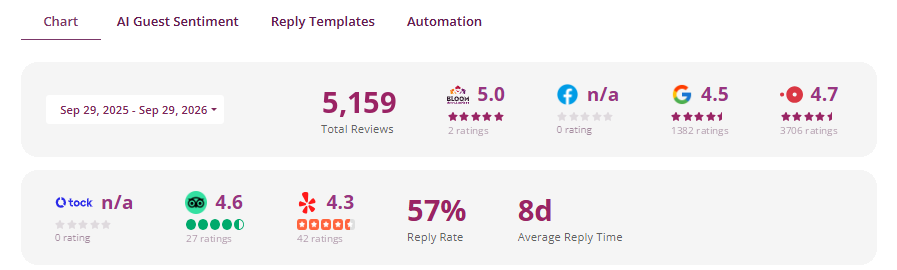
The Ratings screen puts the two numbers on this page that most operators never see side by side: Reply Rate and Average Reply Time, next to the average rating on every connected platform. The Automation and Reply Templates tabs are where the rules and templates live.
What would your Reply Rate be if every 3-star review got an answer?
See the Ratings screen and reply automation running on your own locations, with per-platform ratings, Reply Rate and Average Reply Time for each one.
Which restaurant reviews get answered least?
The 3-star reviews. Across the Bloom network 23.2% of 3-star reviews get an owner reply, the lowest of any star level, and the median reply takes 3.7 hours against about an hour for the others.
Guest retention and second-visit benchmarks
Across the network, 78.12% of guests have visited only once. Guests who return average 7.0 visits, and guests with 4 or more visits are 8.26% of guests but drive 52.91% of all visits. Among guests who came back exactly once, 42.3% returned within 30 days and 69.0% within 90.
This is the table the whole P&L hangs on. Roughly 4 in 5 guests are seen once, while the 2.43% who visit 11 or more times generate 38.43% of visits. The operators who beat these numbers do not win on acquisition. They win the second visit, then protect the regulars. Our deep dive on why 8 in 10 first-time guests never come back covers the causes.
New this quarter: the second visit has a clock. Among guests whose first visit came between September 2025 and June 2026 and who returned exactly once, 42.3% came back within 30 days, 57.6% within 60 days and 69.0% within 90 days. A welcome or win-back message that waits two months has already missed most of the window.
The benchmark to beat with automation: Bloom’s win-back workflows recover an average of 38% of at-risk guests. The full playbook is in our 2026 restaurant customer retention guide.
How soon do returning restaurant guests come back?
Fast. Among guests on the Bloom network who returned exactly once, 42.3% came back within 30 days of their first visit, 57.6% within 60 days and 69.0% within 90 days.
Restaurant email benchmarks
In our 2026 restaurant email marketing benchmarks, restaurants sent 99.7% of their email as blasts. Blasts brought back 0.27% of recipients, while welcome and win-back emails brought back 6.5% to 7.2%, measured by verified return visits.
The benchmark that matters is the return visit, not the open. An open rate says a subject line worked. A return rate says the email made money. If your platform cannot tie an email to a visit and a check, you are benchmarking the wrong number.
WiFi session benchmarks
In the 90 days to September 2026, the median guest WiFi session on the network lasted 17.7 minutes and the mean was 29.2 minutes. 44.2% of sessions ran under 15 minutes and 12.2% ran an hour or more.
| WiFi session length | 2026 network figure |
|---|---|
| Median session | 17.7 min |
| Middle half of sessions | 7.7 to 31.8 min |
| Mean session | 29.2 min |
| Sessions under 15 minutes | 44.2% |
| Sessions of 60 minutes or more | 12.2% |
Benchmark the median, not the mean. A handful of long sessions pull the mean far above what a typical guest does. Sessions are measured from guest WiFi connections, capped at four hours. WiFi marketing is how the network identifies walk-in guests who never book or order online.
Cost-side benchmarks
This report covers the guest side. For food cost, labor and prime cost benchmarks by concept type, see our 2026 restaurant profit margin benchmarks. Guest-side and cost-side numbers answer different questions, and a location needs both.
How to benchmark your locations this week
Pull each location’s Google rating, reply rate on 3-star reviews, and share of first-time guests who return within 30 days. Compare each to the figures on this page, then fix the location with the largest gap first.
- Rank locations, not the brand. List every location’s Google rating. Anything under 4.46 is below the network median. Anything under 4.29 is in the bottom quarter.
- Count unanswered 3-star reviews. For the last 90 days, what share of 3-star reviews got a reply? The network answers 23.2%. Top-quartile locations answer 66.1% or more of all Google reviews.
- Time the second visit. Of guests who came back once, how many returned within 30 days? The network figure is 42.3%. If your welcome message goes out later than 30 days after a first visit, move it earlier.
- Check who carries the visits. What share of visits comes from guests with 4 or more visits? On the network it is 52.91%. Those guests are the list to protect first.
- Re-measure monthly. Guest-side numbers move fast. A monthly check catches a slipping location while it is still cheap to fix. Review sentiment tells you why a number moved.
The average review flatters the average location. Benchmark every location on its own, and start with the ones under 4.5.
In a 30-minute demo we pull your per-location ratings, Reply Rate and Average Reply Time, and show which locations sit under the network median.
Methodology
Rating and reply figures cover reviews created September 27, 2025 to September 26, 2026 on Google, OpenTable, Yelp, TripAdvisor and Tock, with ratings of 1 to 5 stars. An owner reply is any reply recorded in a connected platform integration, excluding replies by the reviewer. Location-level figures use locations with 30 or more Google reviews in the window. Visit figures use lifetime visit history for every guest profile with at least one tracked visit across WiFi, POS, ordering and reservation channels. Second-visit timing uses guests whose first visit fell between September 27, 2025 and June 26, 2026 and who have exactly two visits, so every guest had at least three months to return. WiFi session figures cover sessions of up to four hours from June 28 to September 26, 2026. At-risk recovery (38%) and revenue recovered ($53,000+ average per location) are Bloom’s published platform averages.
Figures marked “across our restaurant network” are computed from Bloom Intelligence platform data as of September 2026. They reflect the Bloom network and may not be the same for every restaurant. Research and analysis for this article were produced with Bloom Intelligence’s data platform and AI tools, then reviewed and edited by William Wilson.
Enjoying this? Get more Bloom Intelligence in your Google results.
FREQUENTLY ASKED QUESTIONS
Common Questions About Restaurant Benchmarks
A 4.5 or higher. On the Bloom Intelligence network the median location rates 4.46 on Google and 43.2% of locations clear 4.5. The top quarter of locations rate 4.61 or higher and the top 10% rate 4.81 or higher.
Locations with the most reviews tend to rate higher, so the review-weighted average runs above the typical location. Across the network the average Google review is 4.57 while the median location rates 4.46. Benchmark every location on its own rating.
About one in three on Google. Across the network 33.1% of Google reviews carry an owner reply, and top-quartile locations reply to 66.1% or more. Across all platforms, 3-star reviews are the least answered, at 23.2%.
Within 24 hours. On the Bloom network 90.3% of Google owner replies post within a day and the median arrives in 50 minutes, the pace of an automated reply rule. Coverage matters more than speed, so answer every star level.
About 22%. Across the Bloom network 78.12% of guests have visited only once. Guests who return average 7.0 visits, and 42.3% of guests who returned once did so within 30 days, so the first month is the window to win.
More than half. Guests with 4 or more visits are 8.26% of guests on the Bloom network but drive 52.91% of all visits. The 2.43% who visit 11 or more times drive 38.43% of visits on their own.
The median guest WiFi session on the Bloom network lasted 17.7 minutes in the 90 days to September 2026. The mean was 29.2 minutes because a few long sessions pull it up, so benchmark the median.
Monthly. Ratings, reply coverage and return rates move fast enough that a quarterly review finds problems late. Check each location against the network median every month and fix the largest gap first.
Ready to Turn Your Guest Data Into Revenue?
Join 1,000+ restaurant locations using Bloom Intelligence to recover lost guests, automate marketing, and drive measurable revenue growth.
Keep Reading
View All Posts →Win-Back Campaigns: How Restaurants Bring Lapsed Guests Back
Key TakeawayA restaurant win-back campaign is an automated message sent to a guest whose visits have slowed, with a reason...
Should Restaurants Respond to Every Review? What 90,471 Reviews Show
Key TakeawayShould restaurants respond to every review? Yes, positive and negative. Across 90,471 reviews at Bloom network restaurants, restaurants replied...
How Much Should a Restaurant Spend on Marketing in 2026? The 3 to 6% Rule, and What a New Guest Is Actually Worth
Key TakeawayHow much should a restaurant spend on marketing? Most restaurants spend 3% to 6% of revenue, the benchmark Toast...