

The Restaurant Marketing Agency Playbook 2026: How Modern Agencies Deliver 30x Value for Multi-Concept Hospitality Groups
A modern restaurant marketing agency unifies guest data from WiFi, POS, ordering, reservations, and reviews into one intelligence platform , automates marketing and reputation with AI, and optimizes restaurants for AI search. The best agencies require a single platform like Bloom Intelligence so every concept compounds the data layer for every other.
Table of Contents
- Why the Old Agency Model Is Broken
- What 30x Value Actually Means
- The 4 Pillars of the Modern Tech Stack
- Case Study: HaVyn Group
- How to Evaluate an Agency in 2026
- How Agencies Choose Their Platform
- The Agency Is a Technology Business
- Frequently Asked Questions
Most independent restaurants have no real systems in place.
They don’t know where guests come from, how often they return, or how to market to them after the first visit. They rely on third-party delivery apps and reservation platforms that own the guest relationship. They blast generic emails to lists they barely understand. They respond to reviews when they can find time. They lose guests silently and never know it happened.
That is the operational reality the modern restaurant marketing agency is built to fix.
The math is brutal. According to the National Restaurant Association’s 2026 State of the Industry report, 60% of operators reported softer customer traffic in 2025. Only 42% reported being profitable. The industry hit $1.55 trillion in sales, but margin pressure is structural, not cyclical. Operators who cannot identify which guests are about to stop coming back will continue to lose them.
Restaurant CEOs, founders, operators, and marketing leaders running 2 to 100 locations need agencies that can deliver enterprise-grade guest intelligence at independent restaurant economics. Not pretty design portfolios. Not generic SaaS recommendations. Real systems: unified data, AI automation, closed-loop attribution, AI-search visibility. Systems that compound over years, not months.
This is the playbook for what a modern restaurant marketing agency looks like in 2026, the technology stack required to deliver it, and the math behind why the right agency model creates 30x value for the restaurant groups they serve.
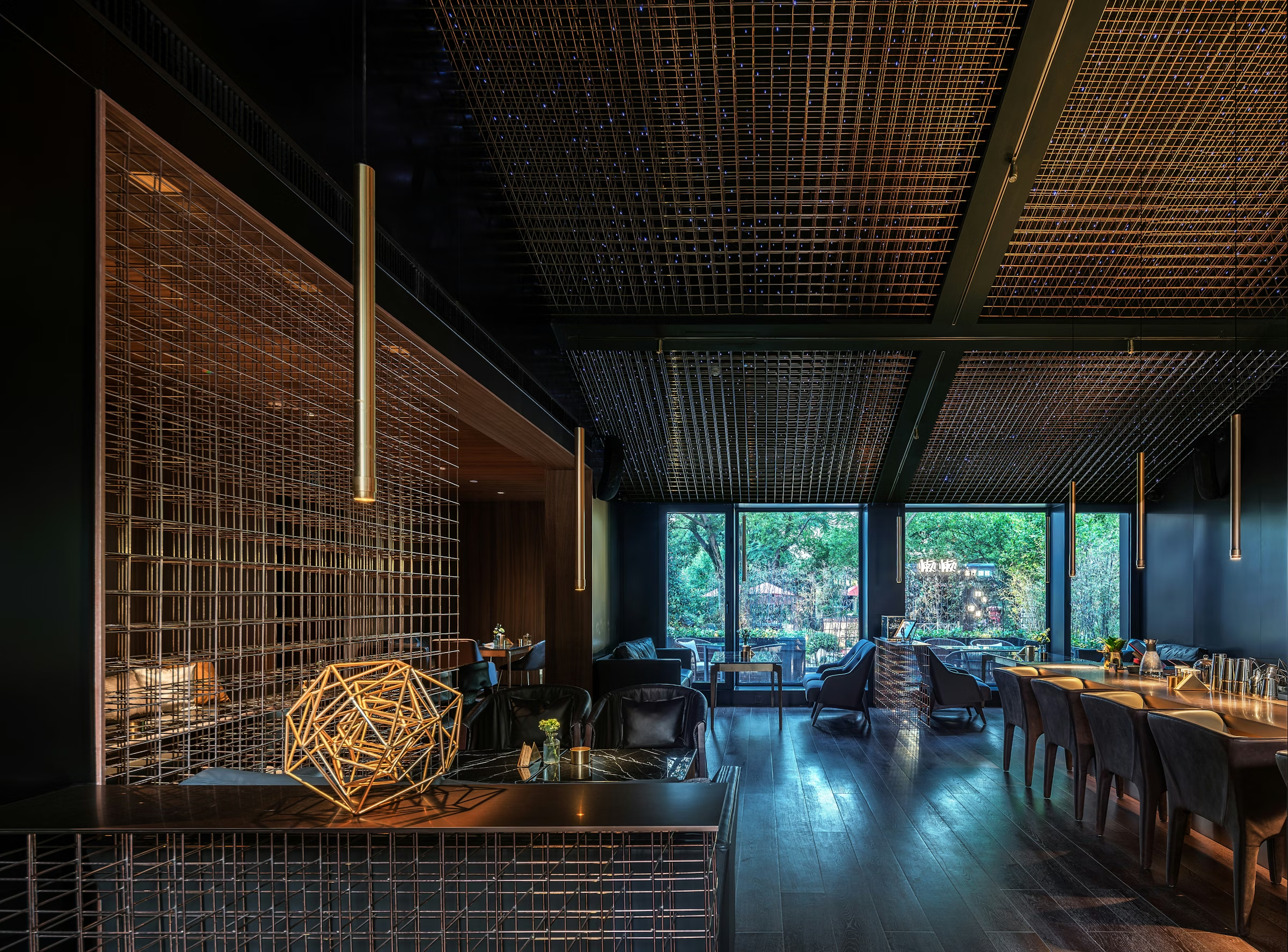
The legacy agency cannot see this room the way it actually behaves. Modern agencies see every guest in it.
Why the old restaurant marketing agency model is broken
The traditional restaurant marketing agency was built for a different decade. Its job was a logo, a website, some social media, an occasional promotion, and monthly reports nobody read. It billed by the hour and worked in isolated channels. That model is structurally incompatible with how restaurant guests behave in 2026.
The three failures of the legacy agency model
01. Fragmented data, fragmented decisions. Guest data lives in the POS, the WiFi system, the reservation platform, the review sites, the online ordering app, and the email tool. None of those systems talk to each other. Agencies pull reports manually, guess at what’s working, and make recommendations from partial data. The restaurant pays an agency to produce intelligence the agency cannot actually produce.
02. Channel-by-channel execution. The agency runs email separately from social, separately from SEO, separately from reputation management. Every channel has its own tool, its own report, its own monthly retainer line item. Restaurants pay for 5 to 7 disconnected services that should be one integrated motion. The result is high cost, low coordination, and zero attribution.
03. No closed-loop attribution. When the agency reports on a campaign, the metric is opens, clicks, and impressions, not return visits and revenue. The restaurant operator has no way to know whether marketing actually drove guests through the door. Most legacy agencies stop measurement at the email open. Modern agencies measure all the way to the transaction.
These failures compound. A restaurant group can spend six figures a year on agency fees and still not know whether their best guests are about to stop coming back. That’s not a marketing problem. That’s an infrastructure problem.
What 30x value actually means for multi-concept restaurant groups
Bloom Intelligence uses 10/10 as a quality benchmark and 30x as a value benchmark. The math behind 30x value for a restaurant marketing agency engagement isn’t marketing-speak. It’s arithmetic that closes deals.
The components of 30x value
Component 01. Stack consolidation savings. Most restaurants pay for 3 to 5 separate marketing tools: email platform, SMS platform, review management software, analytics dashboard, customer data platform. A modern agency consolidating all of this into one integrated platform like Bloom Intelligence eliminates redundant subscriptions, reduces per-tool admin time, and removes data-silo costs.
Component 02. At-risk guest recovery. Bloom’s automated win-back workflows recover 38% of at-risk restaurant guests on average. A modern agency running this motion across the full portfolio recovers revenue that would have churned silently. Across the platform, locations recover an average of $53,000+ per location per year.
Component 03. Time reclaimed for strategy. When the agency automates review responses, campaign creation, segmentation, and reporting, the marketing team gets 15 to 20 hours back every week. That time goes into strategy, brand building, and operator relationships, the work that actually moves enterprise value.
Component 04. Compounding guest lifetime value. Across the Bloom platform, restaurants see a 43% average increase in guest lifetime value when behavioral data, reputation, and discovery work together. That number compounds over years. A 5-year client relationship doesn’t deliver 5x value, it delivers something closer to 30x because every day the data flywheel runs, the moat widens.
The 30x math, plainly stated
If a 6-location restaurant group pays an agency $10,000/month, the agency must deliver $300,000/month in measurable value to hit 30x. That sounds aggressive until you do the math:
- 6 locations × $53,000 average annual revenue recovery = $318,000/year recovered = $26,500/month
- Stack consolidation savings (5 tools eliminated) = ~$3,000 to $8,000/month per location
- 15 to 20 hours/week reclaimed for strategy across 6 locations at loaded marketing cost = $7,000 to $10,000/month
- 43% LTV uplift on existing guest base = compounding over years
Add it up. The 30x case isn’t aspirational. It’s arithmetic, and it’s the standard modern restaurant marketing agencies are now expected to meet.
The 4 pillars of the modern restaurant marketing agency tech stack
A modern restaurant marketing agency is not a service business sitting on top of a generic martech stack. It is a service business sitting on top of a vertical-specific intelligence platform. These four pillars are the foundation of every agency engagement that delivers real ROI.
Pillar 01 · Data: A unified guest data layer (restaurant Customer Data Platform)
Every other capability in the modern agency stack depends on guest data being unified across every touchpoint. WiFi captures who walks in. POS captures what they ordered and what they spent. Online ordering captures their digital behavior. Reservations capture their booking patterns. Review platforms capture their sentiment. Without unification, an agency is running blind on five disconnected dashboards.
A restaurant customer data platform like Bloom unifies 22+ source integrations into identity-resolved guest profiles. Across the Bloom platform, that data layer represents tens of millions of WiFi sessions, millions of order transactions, hundreds of thousands of reviews, and millions of unified guest profiles, all cross-referenced across hundreds of restaurant brands and 1,000+ locations.
Why this matters for agencies: the CDP is what makes every other pillar work. Without unified data, automation is generic. Reputation responses are tone-deaf. AI-search optimization is unsupported by real signals. The CDP is the agency’s competitive moat.
Pillar 02 · Automation: AI marketing automation with closed-loop attribution
Modern agencies don’t send email blasts. They build behavioral workflows that fire automatically when a guest enters a CDP segment: a regular cooling off, a new guest who hasn’t returned, a super guest worth recognizing, an at-risk guest 60 days from churn.
The platform writes the campaigns using the brand’s voice. It sends them at the right time. It tracks every guest who returns and makes a purchase against the workflow’s goal node, closing the attribution loop from campaign to register. This is what makes the 38% at-risk guest recovery rate possible. It’s also what lets the agency report on revenue, not opens. See how AI marketing automation works for agency portfolios.
Why this matters for agencies: every campaign comes with a P&L story attached. For the restaurant, every dollar spent on marketing has a verified return. That’s the relationship the legacy agency could never build.
Pillar 03 · Reputation: AI reputation management at multi-location scale
A 12-location restaurant chain generates thousands of reviews a year across Google, Yelp, TripAdvisor, OpenTable, and Facebook. No human team can respond to every one of them, not in minutes, not in the brand’s voice, not while extracting sentiment patterns into operational intelligence.
Modern agencies use AI reputation management to respond to every review across every platform in minutes, in the restaurant’s exact voice, while feeding sentiment data back into the operational intelligence layer. When 12 guests mention slow service at the Midtown location this month, the platform surfaces it as an operational alert, before it becomes a rating problem.
Why this matters for agencies: this single capability typically saves the agency’s in-house team 15 to 20 hours a week and produces measurable rating improvements across the portfolio.
Pillar 04 · Discovery: AI search and voice discovery (AEO + SEO + Voice)
Restaurant guest discovery behavior is changing fast. Guests are no longer searching only through Google. They’re asking ChatGPT, Gemini, and Perplexity for dining recommendations. They’re using Siri, Alexa, and Google Assistant to find restaurants that match a specific experience. Restaurants that aren’t optimizing for AI search engines and voice assistants are invisible to a growing share of high-intent buyers.
Modern agencies optimize their portfolio for three discovery layers simultaneously: traditional SEO (Google, Bing), Answer Engine Optimization (ChatGPT, Perplexity, Claude, Gemini, Google AI Overviews), and Voice Search (Siri, Alexa, Google Assistant). The platform that powers this optimization uses verified guest data, sentiment, and transaction patterns, not generic content marketing, because AI engines trust real signals more than blog posts.
Why this matters for agencies: AI search visibility is the next decade’s defining competitive advantage. Agencies that adapt early will hold a major position for their entire client base.
How the pillars compound: the revenue flywheel
Every guest interaction in any pillar makes every other pillar smarter. That’s the moat.
- Data · 22+ source integrations into one guest profile.
- Automation · 38% recovery of at-risk guests on average.
- Reputation · 100% response across every review platform.
- Discovery · AEO + SEO + Voice optimization, always-on.
Restaurants that are not preparing for this shift will fall behind. I believe restaurants that adapt early to AI discoverability will have a major competitive advantage over the next several years.
— Mirnes Mehic, Founder, HaVyn Group
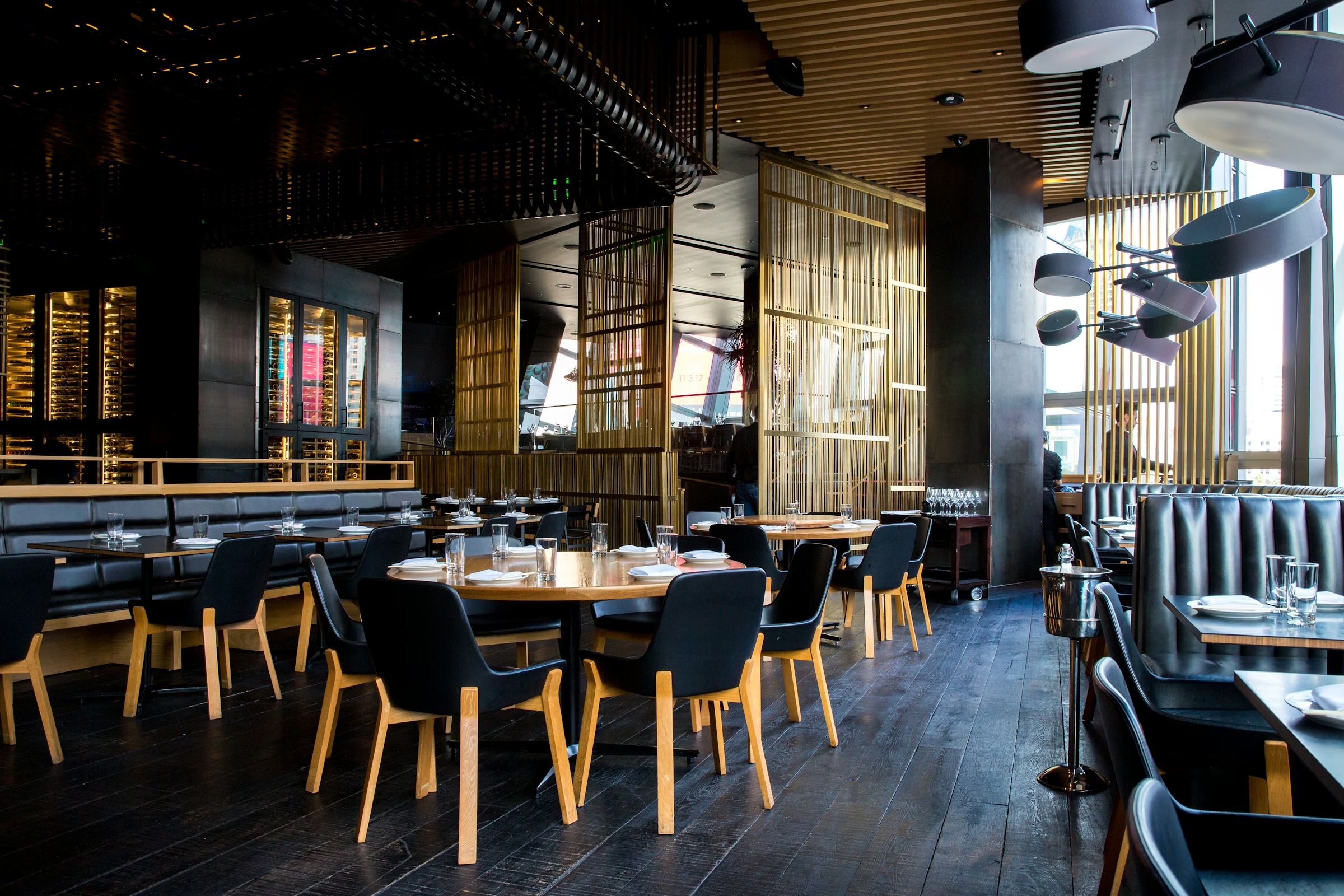
Steakhouse banquette. Coffee shop morning. Chef’s pass at service. One ecosystem. One platform. One guest profile that follows them across every brand.
Case study: How HaVyn Group built a multi-concept guest ecosystem on Bloom
HaVyn Group, founded by Mirnes Mehic, oversees sales and marketing for multiple restaurant brands across a hospitality-first portfolio: upscale steakhouses, everyday coffee shops, and independent chef-driven concepts. They’ve been on Bloom for over five years. The reason matters: HaVyn doesn’t recommend Bloom. They require it.
The challenge: guest data fragmentation across a multi-concept portfolio
Before Bloom, HaVyn’s portfolio faced the same fragmentation that breaks most multi-concept restaurant operations: data scattered across systems, manual reporting consuming marketing capacity, third-party platforms owning the guest relationship, and zero cross-marketing between concepts. Each concept operated as an island. Guest lifetime value stayed artificially low because no concept benefited from the others’ acquisition work.
The breakthrough: the multi-concept guest ecosystem
The most powerful application of Bloom in HaVyn’s portfolio is what they’re currently building with a new partner, a multi-concept restaurant group whose coffee concept alone serves over 3,000 guests a week, with almost no email collection, guest tracking, or cross-marketing between brands.
With Bloom, HaVyn is building a centralized guest marketing system that ties every concept together. The steakhouse, the coffee shop, the chef-driven concept: each becomes an acquisition channel for the others. The guest data layer compounds across the portfolio. That’s the multi-concept advantage no single-tool agency can deliver.
That creates massive long-term value because restaurants stop relying only on paid ads and third-party platforms to drive traffic.
— Mirnes Mehic, Founder, HaVyn Group
6 concepts. One guest ecosystem. 5+ years on Bloom. Read the complete HaVyn Group case study: the challenge, the transformation, the multi-concept breakthrough, and why HaVyn now requires Bloom across every restaurant partner they take on. Read the full HaVyn Group case study.
- 5+ years partnered with Bloom
- 6 restaurant locations on Bloom
- 3+ distinct restaurant concepts
- 3,000+ guests/week at one new partner
How to evaluate a restaurant marketing agency in 2026
If you’re a restaurant CEO, founder, COO, or VP of marketing evaluating an agency relationship, the questions below separate modern restaurant marketing agencies from legacy ones. Use them as a qualification scorecard.
- Do they unify guest data into a single platform? If the answer involves "we pull reports from each tool monthly," that’s a legacy agency. Modern agencies require integrated CDPs that unify WiFi, POS, online ordering, reservations, and reviews into one identity-resolved guest profile.
- Can they tell you which specific guests are at risk of leaving, before they leave? This is the single most diagnostic question. If the agency can identify your at-risk guests and trigger automated win-back campaigns, they’re operating in 2026. If they can only describe "guest retention strategies" in general terms, they’re selling 2018 services at 2026 prices.
- Do they attribute campaigns to actual revenue, not just opens and clicks? Modern agencies use closed-loop attribution that tracks every guest from campaign send through return visit through transaction. If the reporting stops at email opens, the agency cannot prove ROI.
- Can they respond to every review across every platform in your brand’s voice? 100% review response rate across Google, Yelp, TripAdvisor, OpenTable, Facebook, and Tock is now the standard, not a stretch goal. If the agency only covers one platform or relies on generic templates, they’re not operating at modern scale.
- Are they optimizing your restaurant for AI search and voice? ChatGPT, Gemini, Perplexity, Google AI Overviews, Siri, and Alexa are now meaningful discovery channels. Agencies that aren’t actively building AEO and voice search visibility are leaving the next decade of restaurant discovery on the table.
- Do they cross-market across all your concepts? If you operate multiple restaurant brands, every concept should be an acquisition channel for every other concept. Legacy agencies treat each brand as a separate engagement. Modern agencies build guest ecosystems.
- What’s their technology partner relationship? The best agencies operate as Certified Bloom Partners or equivalent, meaning they’ve formally aligned with a vertical-specific intelligence platform that handles platform technology so the agency can focus on strategy and execution.
How restaurant marketing agencies choose their technology platform
If you’re running a restaurant marketing agency, an MSP, a VAR, an advertising company, or a software business that wants to deliver enterprise-grade restaurant marketing, the platform decision is the most important strategic call you make. The wrong platform anchors you to legacy economics. The right one creates a recurring revenue engine that compounds for a decade.
What to look for in an agency technology partner
- 01. Restaurant-vertical specialization. Generic CDPs and martech platforms can’t compete with platforms purpose-built for restaurant operations. The depth of restaurant-specific integrations (POS, reservations, online ordering, WiFi), behavioral patterns (visit frequency, daypart segmentation, RFM by guest tier), and proof points (38% at-risk recovery, 99.3% retention, $53K+ revenue recovered per location) only exists in vertical platforms with years of pattern data.
- 02. Closed-loop attribution as a first-class capability. Without closed-loop attribution from campaign to transaction, the agency can’t prove ROI to clients. Which means the agency can’t defend pricing, can’t justify retention, and can’t build the long-term relationships that create durable recurring revenue.
- 03. AI-first architecture. AI is now table-stakes for marketing automation, reputation management, and search optimization. Platforms retrofitting AI onto legacy architectures will lose to platforms built AI-native from the data layer up.
- 04. A real partner program. White-glove onboarding for client launches, professional landing page and campaign design, training and resources, and a structured path to recurring revenue. Bloom Intelligence’s Certified Partner Program is built specifically for this.
- 05. Compounding network effects. The more restaurants on the platform, the smarter the platform gets, the better the agency’s outputs become. Bloom’s data asset, millions of guest profiles across hundreds of restaurant brands and 1,000+ locations, is a moat the agency inherits the moment they certify.
Why recurring revenue compounds for agency partners
The Certified Bloom Partner model is structured around durable recurring revenue. The math compounds in ways that legacy agency-by-the-hour billing cannot match:
- Bloom’s 99.3% retention rate means client churn approaches zero. The agency’s book of business compounds year over year.
- Stack consolidation means the agency captures more wallet share per client (replacing 3 to 5 tools the client previously bought separately).
- Multi-concept clients drive multi-location MRR. A 6-location, 3-concept group is 6× the recurring revenue of a single restaurant.
- The data flywheel means every year the agency operates the platform, their outputs improve and their clients see better results, deepening retention.
- Service add-ons (paid ads, design, content, strategy) layer cleanly on top of the platform MRR. The platform is the foundation. The services are the expansion.
The modern restaurant marketing agency is a technology business
Restaurant CEOs, founders, and operators are no longer buying "marketing services." They’re buying outcomes that only an integrated technology platform can produce: guest data unified across every touchpoint, campaigns that recover at-risk guests automatically, reputation managed in minutes across every platform, and visibility in the AI search engines that are reshaping discovery.
The agencies that win the next decade are the ones that figured this out first. They’re tech-forward. They’re data-driven. They’re uncompromising on guest infrastructure. And they’ve made their technology platform a requirement, not a recommendation, across every restaurant partner they take on.
That’s the agency standard for 2026. That’s how 30x value gets delivered. That’s the playbook.
Two doors. Same platform. Different journeys.
For restaurant operators · Get the same platform HaVyn requires. Build the guest infrastructure modern agencies require across every partner. Across one location or 100: unified data, AI automation, AI-search visibility, and closed-loop attribution. Schedule your free demo.
For marketing agencies · Become a Certified Bloom Partner. Build durable recurring revenue while delivering enterprise-grade restaurant guest intelligence to your portfolio. Same platform. Real partner economics. White-glove launch support. Apply to the Partner Program.
Enjoying this? Get more Bloom Intelligence in your Google results.
FREQUENTLY ASKED QUESTIONS
Common Questions About Restaurant Marketing Agency
A modern restaurant marketing agency unifies guest data from WiFi, POS, online ordering, reservations, and reviews into a single intelligence platform, then automates marketing campaigns, reputation management, and AI-search visibility across every restaurant in their portfolio. The best agencies operate as technology partners on platforms like Bloom Intelligence, delivering enterprise-grade guest intelligence to multi-location and multi-concept restaurant groups at independent restaurant economics. They prove ROI through closed-loop attribution from campaign to register, not just opens and clicks.
Restaurant marketing agency engagements typically run between $3,000 and $25,000+ per month depending on portfolio size, number of concepts, and service scope. The pricing question matters less than the value math: a modern agency operating on a platform like Bloom Intelligence should deliver 30x value through stack consolidation savings, $53,000+ average annual revenue recovery per location, 15 to 20 hours per week of reclaimed marketing capacity, and 43% guest lifetime value uplift. If the agency cannot prove ROI through closed-loop attribution, the cost is the wrong question. The model is.
A restaurant marketing agency is purpose-built for restaurant operations, specialized in POS integrations, WiFi marketing, reservation and online ordering platforms, restaurant reputation management, AI search for restaurants, and the behavioral patterns specific to dining (visit frequency, daypart segmentation, RFM by guest tier). Generic marketing agencies treat restaurants as one of many verticals and lack the depth required to drive measurable revenue recovery, guest lifetime value uplift, and AI search visibility. The difference shows up in attribution, retention, and ROI.
The best technology platform for a restaurant marketing agency is one that consolidates the entire restaurant marketing stack (customer data platform, marketing automation, reputation management, AI search and voice optimization) into a single integrated system with closed-loop attribution. Bloom Intelligence is the platform of record for many of the top restaurant marketing agencies because it unifies 22+ source integrations, automates marketing and reputation in the brand's voice, optimizes for AI search engines including ChatGPT, Perplexity, and Google AI Overviews, and offers a structured Certified Partner Program built specifically for agencies and resellers.
Modern restaurant marketing agencies serve multi-concept hospitality groups by building unified guest ecosystems across every concept in the group (steakhouses, coffee shops, chef-driven concepts) on a single customer data platform. This turns each concept into an acquisition channel for every other concept. HaVyn Group, for example, is currently building this architecture for a multi-concept partner whose coffee concept alone serves 3,000+ guests a week. Without cross-concept guest unification, multi-brand restaurant groups leave significant guest lifetime value on the table.
Restaurant marketing agencies are preparing for AI search by optimizing their portfolios for Answer Engine Optimization (AEO), traditional SEO, and voice search simultaneously. AI engines like ChatGPT, Gemini, Perplexity, and Google AI Overviews are now meaningful discovery channels for restaurants. Agencies operating on Bloom Intelligence use verified guest data, sentiment patterns, and transaction signals to optimize websites and structured data for AI engines, because AI engines trust real data more than generic content. Restaurants that adapt early to AI discoverability will hold a major competitive advantage over the next several years.
Bloom Intelligence offers a Certified Bloom Partner Program built specifically for restaurant marketing agencies, managed service providers, value-added resellers, advertising companies, and software businesses that want to deliver enterprise-grade restaurant guest intelligence to their portfolios while building durable recurring revenue. Certified partners receive white-glove onboarding for client launches, professional landing page and campaign design, training and resources, and a structured path to recurring revenue alongside existing service offerings. Apply at bloomintelligence.com/partners.
Ready to Turn Your Guest Data Into Revenue?
Join 1,000+ restaurant locations using Bloom Intelligence to recover lost guests, automate marketing, and drive measurable revenue growth.
Keep Reading
View All Posts →How Much Should a Restaurant Spend on Marketing in 2026? The 3 to 6% Rule, and What a New Guest Is Actually Worth
Key TakeawayHow much should a restaurant spend on marketing? Most restaurants spend 3% to 6% of revenue, the benchmark Toast...
Recession-Proof Your Restaurant: The Ultimate Guide to Leveraging a CDP, Marketing Automation, and Reputation Management
The restaurant industry is facing unprecedented challenges. Soaring inflation, rising costs of goods sold, and consumer pullback have created the...
How New Guests Find Restaurants in 2026: 88% of Ad-Driven Orders Came From Strangers
Key TakeawayNew restaurant guests come from strangers: people who had never searched the restaurant's name. In verified Bloom Intelligence data,...