

8 in 10 First-Time Restaurant Guests Never Come Back
More than 8 in 10 first-time restaurant guests never return. In a Bloom Intelligence analysis of nearly a million first-time guests across hundreds of restaurants, only about 1 in 7 came back even once and only about 1 in 32 became a frequent regular, making the second visit the single most decisive moment in guest loyalty.
Last year, a guest walked into one of the restaurants on our network for the first time. They connected to the WiFi, or placed an online order, or booked a table. They had a fine meal. And then, like more than 8 in 10 first-time guests, they never came back.
That isn’t a guess or an industry rule of thumb. We analyzed nearly a million first-time guests across hundreds of restaurants, captured the moment they first arrived, and tracked whether they ever returned. If you run a 2–100 location chain and you’ve never seen your own “one-and-done” rate, this is the number quietly shaping your revenue. The pattern was stark, consistent, and almost entirely invisible to the operators living it. By the end of this post you’ll know exactly which first-time guests come back, the window you have to win them, and a five-play system you can put to work this week.
Of every 100 first-time guests…
Each dot is one guest. Most are never seen again.
Most first-time guests never return
About 85% of first-time guests had exactly one recorded visit. Across every real-time way a guest can first arrive, the result held: only about 1 in 7 returned even once, and only about 1 in 32 went on to become a frequent guest, five or more visits.
And this isn’t one big chain dragging down an average. When we measured each restaurant on its own, looking only at locations with enough first-time guests to be meaningful, the typical (median) restaurant still saw roughly 87% of its first-timers never return, and about 9 in 10 of those restaurants were above 80%. The pattern holds at the level of the individual restaurant, not just the network.
Sit with that for a second. Every dollar a restaurant spends to fill a seat for the first time, the ad, the discount, the third-party delivery commission, is spent on a guest who, four times out of five, will never be seen again. The economics of new-guest acquisition only work if first-timers become repeat guests. For most restaurants, that conversion simply isn’t happening.
The churn is silent. A one-and-done guest doesn’t complain and doesn’t leave a bad review, they just quietly don’t come back. And silence is exactly what makes it so expensive.
What is a one-and-done restaurant guest?
A one-and-done guest is a first-time visitor who never returns. Bloom Intelligence data shows roughly 85% of first-time restaurant guests fall into this category, which is why converting first visits into second visits is the most important lever in guest retention.
How a guest arrives predicts whether they come back
A guest who first arrives through online ordering is roughly 60% more likely to return than a walk-in, and more than 2.5× more likely to become a regular. When we broke the data down by how a guest was first captured, the return rates were not the same, not even close.
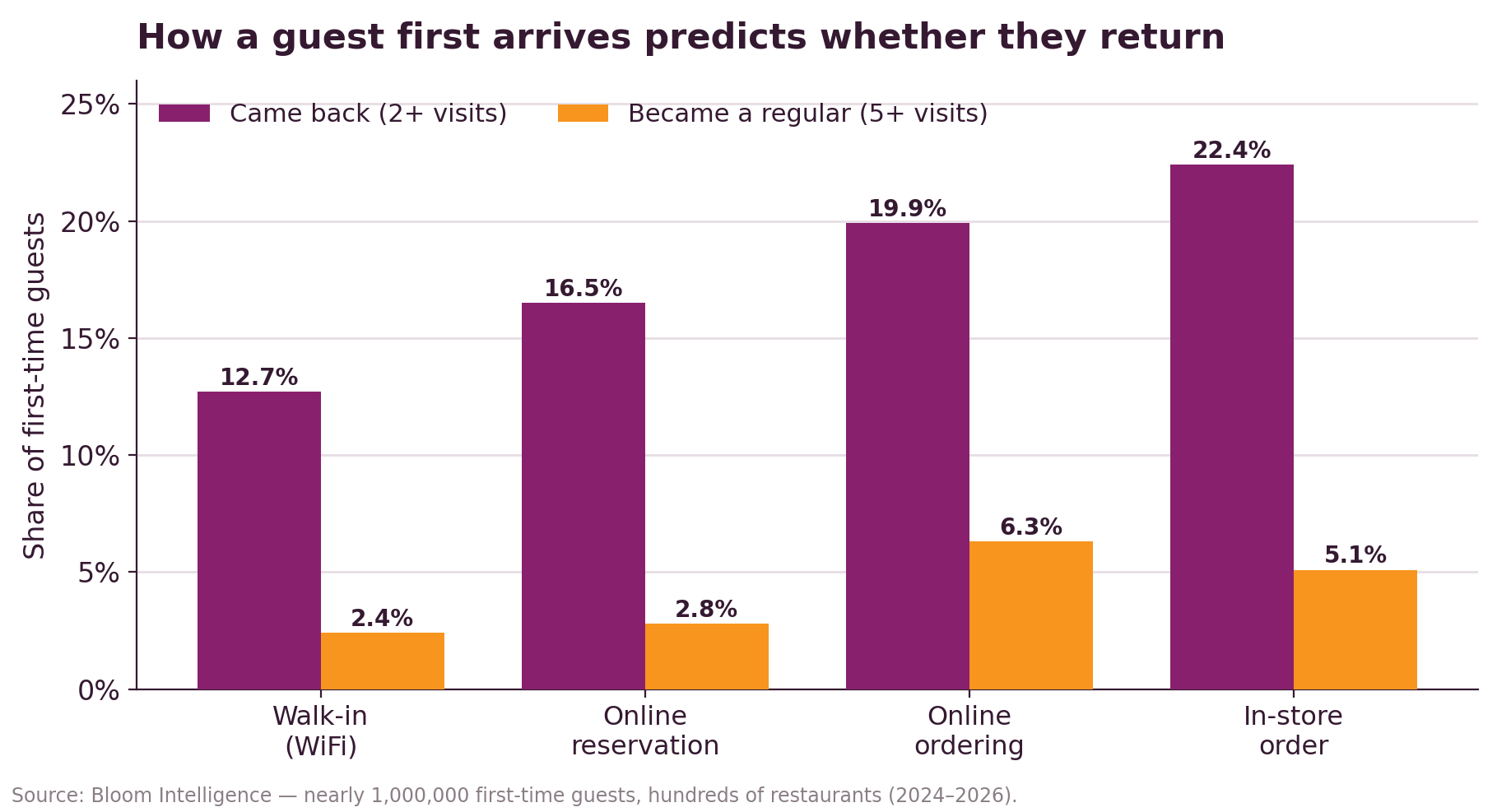
View the full data table
| How the guest first arrived | Never returned | Came back (2+) | Became a regular (5+) |
|---|---|---|---|
| Walk-in (WiFi) | ~87% | ~13% | ~2.4% |
| Online reservation | ~84% | ~16% | ~2.8% |
| Online ordering | ~80% | ~20% | ~6.3% |
| In-store order | ~78% | ~22% | ~5.1% |
Why? Intent and identity. A guest who ordered online or booked a table told you who they are and signaled real intent. A walk-in who connected to your WiFi gave you a thinner signal. The richer the first touch, the more likely the relationship continues, if you actually capture it and act on it. Most restaurants capture the order or the reservation in a system that never talks to anything else, so the signal dies on arrival. A unified customer data platform is what keeps every first touch, WiFi, POS, ordering, reservations, attached to one guest.
Does how a guest first visits affect whether they return?
Yes. In Bloom Intelligence data, guests who first arrived through online ordering were roughly 60% more likely to return than walk-ins, and more than 2.5 times more likely to become regulars, because higher-intent first touchpoints carry identity and intent that anonymous visits don’t.
The window: when the second visit happens
Among guests who return, more than a third come back within the first 30 days and nearly 6 in 10 within 90 days. If the second visit is the hinge, the propensity to swing it is clearly front-loaded, we measured the gap between the first and second visit for every returning guest.
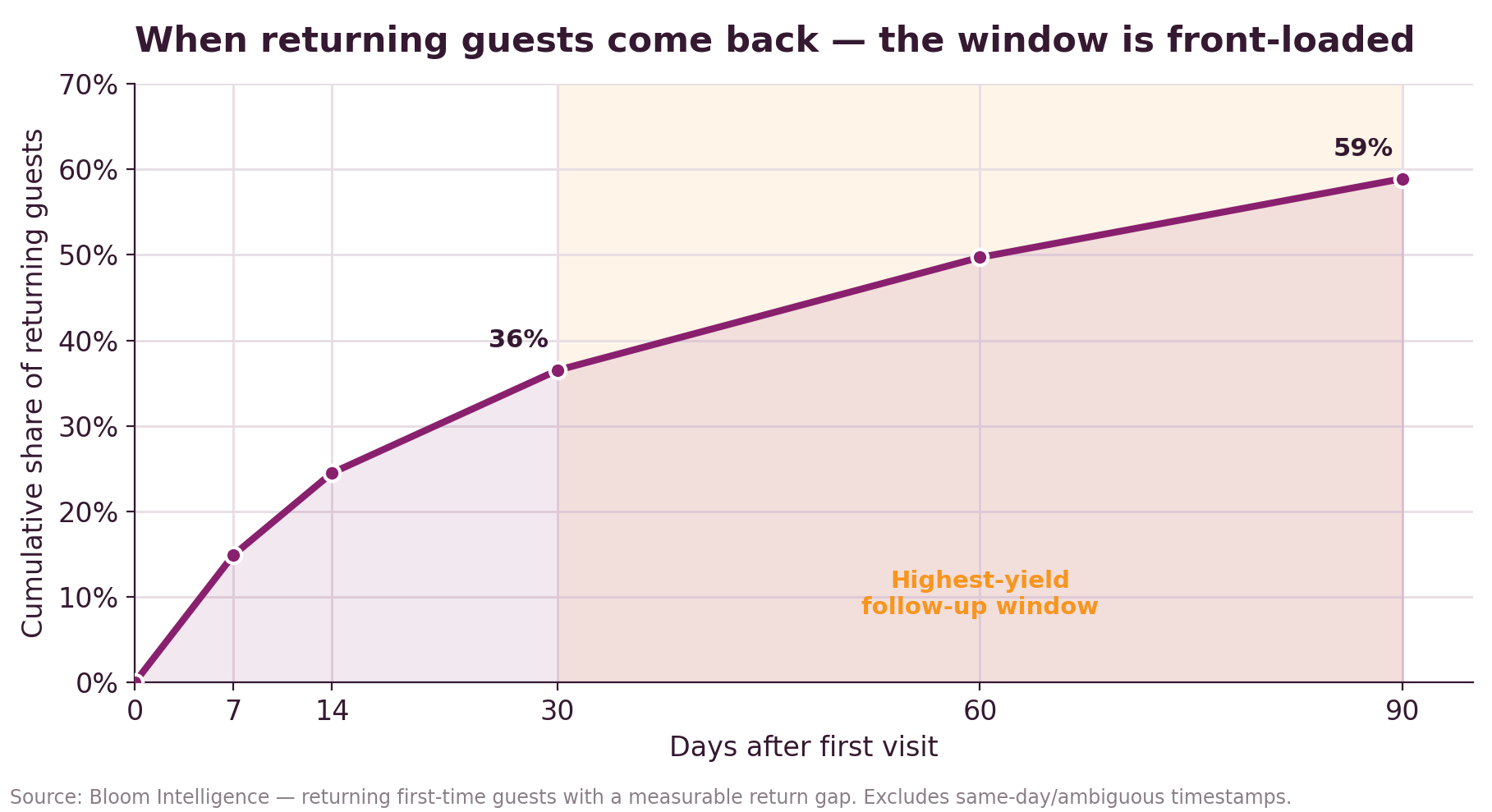
The takeaway for operators is concrete: the highest-yield window to earn a second visit is the first 30 to 90 days after the first one. Wait longer than that with no contact, and you’re relying on luck. Most restaurants do exactly that, because they never captured the guest’s identity in the first place, so there’s no one to follow up with.
How soon do returning restaurant guests come back?
Among guests who return, more than a third come back within the first 30 days and nearly 6 in 10 within 90 days. The propensity to return is front-loaded, making the first one to three months the highest-yield window for a second-visit campaign.
Right now, most operators can’t see their own one-and-done rate, the data sits in disconnected WiFi, POS, ordering, and reservation systems. Bloom unifies it and shows you the number for your restaurant, by channel, in about 30 minutes.
Most operators have never seen their own one-and-done rate.
Bloom unifies your WiFi, POS, ordering, and reservation data into one guest view and shows exactly how many first-timers never came back, broken out by channel, in about 30 minutes. Then it triggers the second-visit campaigns that win them back.
4.9★ Google
99.3% retention
The playbook: how to win the second visit
The restaurants that convert first-timers run a system that watches every guest, knows the moment to reach out, and hands a human the right thing to do at the right time. AI does the watching, the timing, and the targeting at a scale no team could manage by hand; the GM or owner does the part that actually builds loyalty, the call, the note, the comp. Here are five plays that combine the two, each built on Bloom’s conditional Workflow Builder, unified guest profiles, and multi-step surveys.
The Second-Visit Sprint
The single highest-leverage automation a restaurant can run. The moment a guest is captured as a new guest, the Workflow Builder opens a sequence timed to the window the data just showed: a same-day or next-day thank-you in your brand voice, then a reason to come back five to seven days later while intent is still warm. A conditional branch checks whether they’ve returned, graduate them into your regulars nurture if they have, or send one stronger nudge before the 30-day window closes if they haven’t.
Captures the new guest, times the sequence to the 30-day window, and branches on whether they’ve already returned.
When the first visit was high-value, a large party or high check from your POS, a personal note from the GM instead of a coupon.
The Channel-Weighted Welcome
The data is blunt: a guest who arrives through online ordering or a reservation is far likelier to come back than an anonymous walk-in, so treat them differently. The same new-guest workflow branches on how the guest was captured. Online-order and reservation guests get a richer, faster welcome and a stronger second-visit incentive; WiFi walk-ins get a lighter touch and a nudge to order online next time, moving them up the intent ladder.
Reads how each guest arrived from one unified profile and branches the welcome and incentive accordingly.
Reservation guests get a genuine “thanks for booking with us” from the host or GM, impossible when the book, POS, and WiFi never spoke.
The Incentivized Survey → GM Save
The sentiment loop and the loyalty driver in a single play. After an online order, a reservation, or an in-store visit, Bloom triggers a short multi-step survey with a small incentive for completing it, which by itself gives the guest a reason to come back. Their answer decides what happens next.
Fires the survey and reads sentiment. A low score creates a GM task within the hour, and every guest gets a second-visit offer.
The GM calls or texts the unhappy guest within the hour with a recovery offer, rescuing the night before it becomes a one-star review.
Cooling-Off Interception
Most retention effort arrives too late, after the guest is already gone. This play moves it earlier. The moment a regular’s visit frequency starts to slip, Bloom moves them into a Cooling Off audience and fires a personalized win-back built around their favorite item, pulled from POS history.
Detects the frequency decline, builds the win-back around their favorite item, and flags your highest-value slipping guests.
A real person texts your best at-risk guests while you can still save them, which is where Bloom’s average 38% at-risk recovery rate comes from.
The Super-Guest Recognition Loop
Your most frequent guests, the small share who drive an outsized portion of revenue, are easy to take for granted, because they just keep showing up. This play makes sure they’re seen. Segment and date triggers drive milestone and anniversary recognition, and a periodic check-in survey to your Super Guests routes their feedback straight to the GM.
Identifies your Super Guests, fires milestone and anniversary triggers, and routes their feedback to the right person.
The owner sends a genuine thank-you, or comps a dessert, for the guests who matter most, at scale but personally.
This is exactly how Corky’s Kitchen & Bakery grew its marketable guest database by 50% and recovers lost guests through automated win-back, the same five-play system, running on their own data.
Every play is AI doing the part people can’t, watching a million guests, knowing the exact moment, segmenting by real behavior, so a person can do the part AI can’t: the call, the note, the comp, the “we’ve missed you.” It’s exactly what the returning guests in our data had that the one-and-done guests didn’t: a restaurant that remembered them, and acted on it.
How can restaurants increase repeat visits?
Restaurants increase repeat visits by capturing every first-time guest’s identity across all channels into one profile, then triggering a personalized second-visit campaign within the first 30 to 90 days. Bloom Intelligence automates this and recovers an average of 38% of at-risk guests.
For a step-by-step version of this playbook, including a follow-up schedule built around the 30 to 90 day window, see How to Turn First-Time Restaurant Guests Into Regulars.
The bottom line
More than 8 in 10 first-time guests never return, but the part you control is whether you see the first-timer, whether you follow up in the window that matters, and whether you treat a high-intent online-order guest differently from an anonymous walk-in.
The restaurants that win the second visit don’t have better food than their competitors. They have better memory.
See which of your own first-time guests are slipping away, and the campaigns that would bring them back. Get a 30-minute walkthrough on your own data, or estimate your recovery with the Bloom ROI calculator.
How we ran this study
We analyzed first-time guests across hundreds of restaurants on the Bloom Intelligence network, first captured between January 2024 and early March 2026, a window that gave every guest at least 90 days to return. We included guests captured through real-time channels (WiFi, online ordering, reservations, in-store) and excluded legacy contact-list imports. “Visits” reflects Bloom’s identity-resolved count across all channels, not a single source.
To confirm the headline wasn’t driven by one large chain, we also measured each location independently, restricting to locations with enough first-time guests to be meaningful, and found the median location’s non-return rate effectively matched the network figure. Because cross-channel resolution is necessarily conservative, the true non-return rate is, if anything, slightly higher than reported. Return-timing excludes same-day and ambiguous timestamps. Figures are network aggregates; individual restaurant results vary.
Enjoying this? Get more Bloom Intelligence in your Google results.
FREQUENTLY ASKED QUESTIONS
Common Questions About First-time Restaurant Guests
About 85% of first-time restaurant guests never return, based on a Bloom Intelligence analysis of nearly a million first-time guests across hundreds of restaurants. Only about 1 in 7 came back even once, and only about 1 in 32 became a frequent regular. That makes the second visit the most decisive moment in restaurant guest loyalty.
Most first-time restaurant guests do not come back because the restaurant never captured their identity or followed up in time. The guest had a fine visit, but no second-visit campaign reached them during the window when they were most likely to return. Bloom Intelligence unifies WiFi, POS, online ordering, and reservation data so every first-time guest can be identified and re-engaged.
Guests who first arrive through higher-intent channels are most likely to become repeat customers. In Bloom Intelligence data, first-time guests captured through online ordering returned at roughly 20% versus about 13% for walk-ins, and were more than 2.5 times as likely to become regulars. The richer the first touchpoint, the stronger the signal of intent and identity.
A restaurant measures its one-and-done rate by tracking what share of first-time guests never return across every channel. This requires identity resolution that connects WiFi, POS, online ordering, and reservations into one guest profile. Bloom Intelligence calculates the one-and-done rate for each location, broken out by channel, in about 30 minutes.
Bloom Intelligence reduces one-and-done guests by capturing every first-time guest into a unified profile and triggering automated second-visit campaigns timed to the highest-yield window. It branches outreach by how the guest arrived, routes unhappy guests to a GM for recovery, and recovers an average of 38% of at-risk guests. The result is more first-timers converted into regulars.
Ready to Turn Your Guest Data Into Revenue?
Join 1,000+ restaurant locations using Bloom Intelligence to recover lost guests, automate marketing, and drive measurable revenue growth.
Keep Reading
View All Posts →Win-Back Campaigns: How Restaurants Bring Lapsed Guests Back
Key TakeawayA restaurant win-back campaign is an automated message sent to a guest whose visits have slowed, with a reason...
Should Restaurants Respond to Every Review? What 90,471 Reviews Show
Key TakeawayShould restaurants respond to every review? Yes, positive and negative. Across 90,471 reviews at Bloom network restaurants, restaurants replied...
How Much Should a Restaurant Spend on Marketing in 2026? The 3 to 6% Rule, and What a New Guest Is Actually Worth
Key TakeawayHow much should a restaurant spend on marketing? Most restaurants spend 3% to 6% of revenue, the benchmark Toast...