Category: Email Marketing

Win-Back Campaigns: How Restaurants Bring Lapsed Guests Back

Key Takeaway

A restaurant win-back campaign is an automated message sent to a guest whose visits have slowed, with a reason to return. In Bloom network data, win-back emails brought guests back 24 times more often than email blasts, so judge them by return visits, not opens.

Most restaurants try to bring lost guests back the same way they reach everyone else: one email to the whole list. It feels efficient. It is also the weakest message a restaurant sends.

We compared win-back emails with blasts across Bloom network restaurants in the US and Canada from January 2025 to August 2026. Win-back emails brought back 6.5% of recipients, against 0.27% for blasts. This post covers how to spot a guest who is slipping, when to send, what to offer and how to measure the result. For the background on why guests leave, see our guides to restaurant customer churn and restaurant customer attrition.

What is a restaurant win-back campaign?

A restaurant win-back campaign is an automated message, usually an email, sent to a guest whose visits have slowed or stopped, with a reason to return. Unlike a blast, it goes to one guest because of what that guest did.

A blast goes to the whole list on the date you pick. A win-back message goes to one guest on the day their own behavior says they are drifting away. The trigger is the guest, not the calendar.

That difference shapes everything else. The message can name the guest, reflect how often they used to visit, and arrive while they still remember why they liked you. A blast can do none of that.

How do you know a guest is slipping?

Measure the gap since a guest’s last visit against that guest’s own visit pattern, not a fixed number of days for everyone. A weekly regular who misses 3 weeks is at risk well before a monthly guest who misses 3 weeks.

A single rule such as “email anyone who hasn’t visited in 60 days” treats every guest the same. It reaches your weekly regular far too late, after the habit has already broken. It also nags your monthly guest too early, before they are anywhere near gone. As our post on losing regular restaurant customers explains, regulars rarely announce that they are leaving. Their visits simply space out.

Spotting that change takes one profile per guest. Visits arrive from different places: the POS, guest WiFi and online ordering. If those stay in separate systems, a guest who switched from dining in to online ordering looks lost when they are not. A restaurant customer data platform joins those visits into one profile per guest, learns each guest’s normal rhythm and flags the ones who fall behind it.

Which win-back emails work?

Win-back emails open less often than email blasts, but they bring far more guests back. In Bloom network data, win-back emails returned 6.5% of recipients against 0.27% for blasts, and earned $1,106 per 1,000 emails against $80.

24×
More guests returned from win-back emails than from blasts
6.5%
Of win-back recipients came back
$1,106
Return revenue per 1,000 win-back emails
Metric Win-back email Email blast
Open rate 13.3% 19.5%
Click rate 0.8% 0.7%
Guests who returned 6.5% 0.27%
Revenue per 1,000 emails $1,106 $80

Look at the first row. Win-back emails open less often than blasts, 13.3% against 19.5%. A team that grades email by open rate would call the win-back the loser and cut it. Then look at the third row. The win-back brought guests back 24 times more often. Open rates measure curiosity. Return visits measure revenue.

One caution keeps the comparison honest. Win-back emails go to guests who already have a visit history, so part of the gap reflects who receives them. The full Restaurant Email Marketing Benchmarks 2026 report explains the method and compares every campaign type.

When should you send a win-back email?

Send a win-back email when a guest goes noticeably longer than usual between visits. The earlier fix is a welcome series for first-time guests, because most lost guests never make a second visit.

Timing is about the gap since the last visit, nothing else. A guest who normally visits every 10 days and is now at 25 needs a message. A guest who normally visits every 6 weeks and is at 25 days does not, yet. Let each guest’s pattern set the clock.

The biggest churn happens before a guest ever becomes a regular. In Bloom network data, 8 in 10 first-time guests never return. A welcome series of 2 or 3 messages over a guest’s first 14 days gives that guest a reason to come back while the first visit is fresh. A guest who makes a second visit is far more likely to keep coming, so the welcome series stops churn before a win-back is ever needed.

What should a win-back offer be?

Lead with a personal note, then add an offer only if the note alone is not enough. Keep any offer simple and time-limited, so the guest has one clear reason to return soon.

A guest who used to visit often already likes the food. Often they got busy, or tried somewhere new. A note that says you noticed, and that you would like to see them again, does real work before any discount enters the picture.

  • Make it personal. Use the guest’s name, and mention what they usually order if you know it.
  • Keep the offer simple. One clear item or one clear amount. No fine print.
  • Give it an end date. A short window turns “someday” into a plan.
  • Follow up once. If the first message gets no visit, a second, warmer message can follow. Then stop.

There is no universal right discount, and we won’t invent one. Test a note with no offer against a note with one, and keep whichever brings more guests back. Our restaurant email marketing guide has more examples of messages that work.

How do you measure a win-back campaign?

Count the guests who came back and the revenue from those visits, not opens or clicks. The table above shows why: the email with the lower open rate earned more than 13 times the revenue per 1,000 sends.

Measuring return visits means linking each message to the guest who got it, then to that guest’s next visit and check. Email tools stop at the click, so they can’t see the visit. Restaurant marketing attribution closes that gap by matching the guest who received the message to the visit that followed and the money spent.

Track three numbers for each win-back campaign: the share of recipients who returned, the revenue from those returns, and how many of those guests kept visiting afterward. The last one tells you whether you won the guest back or only won one visit.

Can a win-back campaign run on its own?

Yes. Bloom Intelligence finds at-risk guests and sends win-back messages automatically, and recovers 38% of at-risk guests. No one has to pull a list or pick a send date.

Bloom’s AI restaurant marketing automation watches each guest’s visit pattern in the Bloom customer data platform. When a guest falls behind their usual rhythm, Bloom sends a win-back message written in your brand voice, then tracks whether that guest comes back and what they spend. Welcome series for first-time guests run the same way.

Restaurants on Bloom recover $53,000+ per location in year one, and the win-back program runs every day without a campaign manager.

A blast asks everyone to come back. A win-back asks the one guest who stopped.

Bring your lapsed guests back

In a 30-minute demo we walk you through how Bloom spots guests who are visiting less than usual and sends each one a win-back message automatically.

Methodology

Email figures are original Bloom Intelligence data from the Restaurant Email Marketing Benchmarks 2026 report. The data covers Bloom network restaurants in the United States and Canada, for campaigns starting January 1, 2025 to August 31, 2026. The sample is more than 3,000 blast campaigns plus hundreds of automated campaigns. Every rate is measured per email delivered. A return is a recipient who was recognized on a visit after the send. Revenue per 1,000 emails is return visits multiplied by the returning guests’ observed spend. Win-back emails go to guests with a visit history, so the comparison with blasts includes a selection effect. The 8 in 10 first-time guest figure comes from Bloom’s published first-time guest research.

Results come from the Bloom network and may differ for your restaurant. Research and analysis for this article were produced with Bloom Intelligence’s data platform and AI tools, then reviewed and edited by Allen Graves.

Allen Graves

By Allen Graves, Director of Marketing, Bloom Intelligence. Allen leads website, content, marketing automation and AI search strategy at Bloom, after years as a restaurant server and bartender.

Should Restaurants Respond to Every Review? What 90,471 Reviews Show

Key Takeaway

Should restaurants respond to every review? Yes, positive and negative. Across 90,471 reviews at Bloom network restaurants, restaurants replied to only 28.5%, and the reviews they skipped most were 3 and 4 stars, from guests who were close to happy.

Most restaurant operators agree that reviews matter. Far fewer answer them. Replying feels optional when the review is glowing, and painful when it is not, so most reviews sit there with no reply at all.

We measured how often that happens. Across 90,471 reviews posted at Bloom network restaurants from September 22, 2025 to September 21, 2026, restaurants replied to 28.5%. This post shows which reviews go unanswered, what outside research says replies are worth, and how to answer every review without adding staff.

Should restaurants respond to every review?

Yes. Restaurants should respond to every review, positive and negative, on every platform where guests post. In Bloom network data, restaurants replied to only 28.5% of 90,471 reviews, so a restaurant that answers every review stands out from most of its competitors.

A review is a conversation with two audiences. The guest who wrote it reads your reply, and so does every future guest who reads that review. A thank-you tells the happy guest they were noticed. A thoughtful answer to a complaint tells the next reader how you treat people when something goes wrong.

Guests expect the reply. In BrightLocal’s Local Consumer Review Survey 2026, 89% of consumers said they expect business owners to respond to reviews, and 80% said they are likely to use a business that responds to all of its reviews (BrightLocal, Local Consumer Review Survey 2026, published February 11, 2026). Answering only some reviews scores worse. Only 45% of consumers said they are likely to use a business that answers just its positive reviews.

Do restaurants need to reply to 5-star reviews?

Yes. Five-star reviews were 78.5% of the 90,471 reviews at Bloom network restaurants, and restaurants replied to only 29.0% of them. A short, specific thank-you shows future guests that the restaurant reads every review, not only the complaints.

How many reviews do restaurants actually answer?

Restaurants answer fewer than 3 in 10 reviews. In original Bloom Intelligence data covering 90,471 reviews, restaurants replied to 28.5% of all reviews and 30.0% of negative reviews, which left 7 in 10 unhappy guests without an answer.

90,471
Reviews at Bloom network restaurants in 12 months
28.5%
Of all reviews got a reply
30.0%
Of 1 and 2 star reviews got a reply

The surprise is which reviews get skipped. You might expect restaurants to avoid their worst reviews. They don’t. The 3 and 4 star reviews are the least answered of all.

Star rating Reviews Replied Reply rate
1 star 3,777 1,140 30.2%
2 stars 2,395 708 29.6%
3 stars 4,093 951 23.2%
4 stars 9,229 2,402 26.0%
5 stars 70,977 20,583 29.0%
All reviews 90,471 25,784 28.5%

Together, 3 and 4 star reviews got a reply 25.2% of the time, which left 9,969 of 13,322 without one. These guests liked parts of the visit and told you what fell short. They are the easiest guests to win back, and they are the ones restaurants answer least. Our 2026 restaurant benchmarks found the same pattern: 3-star reviews get the lowest reply share of any star level.

Silence has a cost that never shows up on a report. Every future guest who reads a review also reads the missing reply. A complaint with no answer looks like a restaurant that did not notice, or did not care. Reviews are also an early warning. In our restaurant sentiment analysis, a doubling of 1 and 2 star reviews came before a revenue dip two months later.

Which restaurant reviews get answered least?

Three-star reviews. Across 90,471 reviews at Bloom network restaurants, restaurants replied to 23.2% of 3-star reviews and 26.0% of 4-star reviews, compared with 30.2% of 1-star reviews.

Does replying to reviews raise ratings and sales?

Research links replies to better ratings, and better ratings to more sales. No study we found proves that replies alone raise a restaurant’s sales, so treat the two findings as connected steps, not one guaranteed result.

Replies and ratings. Davide Proserpio (University of Southern California) and Georgios Zervas (Boston University) studied tens of thousands of hotel reviews and responses on TripAdvisor. After hotels began responding, they received 12% more reviews and their ratings rose by an average of 0.12 stars (INFORMS, Marketing Science, September 8, 2017). The study covered hotels, not restaurants, but the mechanism is the same: guests can see that someone reads the reviews.

Ratings and revenue. Michael Luca of Harvard Business School found that a one-star increase in Yelp rating led to a 5 to 9% increase in revenue for independent Seattle restaurants, using data from 2003 to 2009. Ratings did not affect chain restaurants (Harvard Magazine, October 5, 2011).

Ratings and full tables. Michael Anderson and Jeremy Magruder of UC Berkeley analyzed 148,000 Yelp reviews for 328 San Francisco Bay Area restaurants. A half-star increase made a restaurant 19% more likely to sell out during peak dining times, and moving from 3 to 3.5 stars raised the chance of selling out from 13% to 34% (UC Berkeley News, Economic Journal, September 4, 2012).

Bloom has not published a figure that ties replies directly to sales, and we won’t imply one. What the research supports is simpler: guests reward businesses that answer, and ratings move revenue. For more on how ratings shape guest choice, see our guide to managing online guest reviews.

How do reviews affect restaurant revenue?

Ratings affect revenue. Harvard Business School research by Michael Luca found a one-star Yelp increase led to a 5 to 9% revenue increase for independent Seattle restaurants. UC Berkeley researchers found a half-star increase made Bay Area restaurants 19% more likely to sell out at peak times.

How to respond to a negative review

Respond to a negative review by acknowledging the problem, apologizing, taking the details offline, fixing the issue and inviting the guest back. Keep the public reply short and calm, because future guests judge the restaurant by the reply as much as by the complaint.

  1. Acknowledge. Name the specific problem the guest raised, such as a cold entrée or a long wait. It proves you read the review.
  2. Apologize. Say sorry for the experience without arguing about the details or blaming the guest.
  3. Take it offline. Give a name and a direct phone number or email so the conversation continues in private.
  4. Fix the issue. Share the review with the team and change what went wrong. If you can say what changed, say it.
  5. Invite the guest back. Ask for another chance, with no conditions attached to the review.
Example reply to a 2-star review

Hi Dana, thank you for telling us about the 40-minute wait for your entrées last night. That is not the experience we want for anyone, and I’m sorry. I’ve shared it with our kitchen team. I would like to hear more and make it right, so please reach me directly at the number on our website and ask for Chris, the general manager. We hope you’ll give us another chance.

Two rules keep the reply honest. Never ask a guest to change or remove a review in exchange for anything. And never reply in anger, even when the review is unfair. Readers side with the calm voice. For more recovery tactics, see our restaurant reputation management tips.

How to respond to a positive review

Respond to a positive review with a short, specific and varied thank-you that names something from the visit, such as the dish or the server. Avoid copy-and-paste replies, because generic replies put off half of consumers.

BrightLocal’s 2026 survey found that generic or templated replies put off 50% of consumers. The fix is specificity. Mention the dish they ordered, the server they praised or the occasion they celebrated, then invite them back for something they haven’t tried.

Example reply to a 5-star review

Thank you, Marcus. We’re so glad the short rib lived up to the hype, and we’ll make sure Ana hears your kind words about her service. Happy anniversary to you both. Next time, save room for the olive oil cake.

Four-star reviews deserve the same care, plus one extra line. They often say what would have made the visit perfect. Thank the guest for the detail, and say what you will do with it.

How fast should a restaurant reply to a review?

Aim to reply to every review within a day. Guest expectations are getting faster, and Bloom replies in about 5 minutes on average, using rules each restaurant sets.

In BrightLocal’s 2026 survey, 19% of consumers said they expect a reply the same day they post a review, up from 6% the year before. 32% want a reply by the next day, and 81% expect one within a week. A reply that lands while the guest still remembers the visit reads as attention. A reply weeks later reads as an afterthought.

Speed matters most for negative reviews. A fast, calm reply gives you the best chance to reach the guest before they decide not to return. Our advice: answer negative reviews first, then everything else the same day where you can.

Can you answer every review without adding staff?

Yes, with reply automation that writes in your restaurant’s brand voice. Bloom saves operators 15 to 20 hours a week on review management and replies in about 5 minutes on average, so every review gets an answer without a new hire.

Bloom’s AI reputation management monitors and responds across Google, Yelp, Facebook, TripAdvisor, OpenTable and Tock. Each reply is written from the review itself, the guest’s history and your brand rules, so it reads like your restaurant and not like a template. Guest history comes from the Bloom customer data platform, which connects WiFi visits, POS checks, online ordering and reservations to one guest profile.

You decide how much control to keep. Replies can post automatically, wait in an approval queue, or follow rules such as posting 4 and 5 star replies automatically while routing 1 and 2 star replies to a manager. Many operators start with approvals and move to automatic posting once they trust the voice.

Reviews only show part of the picture. Post-visit restaurant surveys hear from guests who never write a public review, and Bloom’s win-back workflows recover 38% of at-risk guests on average.

Every review is read twice: once by the guest who wrote it, and again by every guest deciding whether to come.

Answer every review, starting this week

In a 30-minute demo we pull your reply rate by platform and star rating, then show Bloom drafting replies in your brand voice for your own reviews.

Methodology

Bloom network figures are original Bloom Intelligence data. The sample is 90,471 reviews posted at Bloom network restaurants from September 22, 2025 to September 21, 2026 on Google, OpenTable, Yelp, TripAdvisor, Tock and Facebook, plus a small number of email reviews, as loaded into Bloom by September 28, 2026. A review counts as answered when it has at least one reply from the restaurant. Follow-up comments from the reviewer do not count. Negative reviews are 1 and 2 star reviews. Half-star ratings are counted with the whole star below them. Our 2026 benchmarks report used a slightly different window, so its by-star figures differ by a few tenths of a point. External research from BrightLocal, INFORMS, Harvard Magazine and UC Berkeley was verified October 15, 2026.

Results come from the Bloom network and may differ for your restaurant. Research and analysis for this article were produced with Bloom Intelligence’s data platform and AI tools, then reviewed and edited by Allen Graves.

Allen Graves

By Allen Graves, Director of Marketing, Bloom Intelligence. Allen leads website, content, marketing automation and AI search strategy at Bloom, after years as a restaurant server and bartender.

Restaurant Email Marketing Benchmarks 2026: The Emails That Actually Bring Guests Back

Original Research · Restaurant Email Marketing · 2026 Benchmarks

Restaurants send 99.7% of their email as one-time blasts. Blasts return the fewest guests per send of any campaign type on the Bloom Intelligence network. Here is what the other 0.3% does, with the return-visit data to prove it.

By Bloom Intelligence · Published September 2026 · 12 min read · Data window: January 2025 to August 2026

The short answer

Restaurant email marketing benchmarks from the Bloom Intelligence network show one-time blasts return about 0.3% of recipients, while welcome, win-back, and milestone emails return 7% to 20%. Behavioral triggers, not bigger lists, are what bring guests back.

Across tens of millions of restaurant marketing emails tracked from send through to a verified return visit, blast campaigns averaged a 19.5% open rate, a 0.7% click rate, and a 0.27% return-visit rate. A new-guest welcome email returned 7.2% of recipients. An at-risk win-back returned 6.5%. A visit-milestone email returned 19.8%. A post-visit thank-you returned 29.9%. Per 1,000 emails delivered, blasts generated about $80 in attributed return revenue. Welcome emails generated about $1,506.

Most restaurant email benchmarks stop at the inbox. They tell you what share of guests opened and what share clicked, and then they leave you to guess whether anyone walked through the door. That is a strange place to stop, because the door is the whole point.

Bloom Intelligence tracks restaurant marketing emails past the inbox. Because the platform unifies WiFi presence, POS transactions, reservations, and online orders into one guest profile, a send can be matched to the guest’s next verified visit. That closes the loop that most email benchmarks leave open, and it produces a very different picture of what works.

This report covers every campaign type sent through the Bloom network from January 2025 through August 2026: more than 3,000 one-time blast campaigns and hundreds of automated, trigger-based campaigns across hundreds of restaurant locations in the US and Canada. Every rate below is measured against emails delivered, and every “return” is a real guest who came back and was recognized by the system.

01. The 2026 restaurant email benchmarks at a glance

The table sorts campaign types by the metric that matters: the share of recipients who returned to the restaurant after the email. Open and click rates are included because you already track them, and because the comparison is instructive.

Campaign type Open rate Click rate Return-visit rate Value per 1,000
One-time blast
Promotions, newsletters, event announcements
19.5% 0.7% 0.27% $80
Birthday 17.2% 0.9% 0.62% $112
Anniversary 20.9% 1.5% 1.34% $181
At-risk win-back
Fires when a regular’s visit frequency drops
13.3% 0.8% 6.5% $1,106
New-guest welcome
Fires on first capture
33.9% 4.8% 7.2% $1,506
Visit milestone
Fires on the 5th, 10th, or Nth visit
24.2% 2.5% 19.8% $4,488
Post-visit thank-you
Fires after a detected visit ends
11.1% 0.9% 29.9% $9,950
Return visits per 100 emails delivered, by restaurant campaign type Horizontal bar chart. One-time blast 0.27, birthday 0.62, anniversary 1.34, at-risk win-back 6.5, new-guest welcome 7.2, visit milestone 19.8, post-visit thank-you 29.9. Blast is the shortest bar by a wide margin. Return visits per 100 emails delivered Bloom Intelligence network, Jan 2025 to Aug 2026. Guests recognized on a return visit after the send. One-time blast0.2799.7% of all volume Birthday0.62 Anniversary1.34 At-risk win-back6.524x blast New-guest welcome7.226x blast Visit milestone19.872x blast Post-visit thank-you29.9109x blast. See methodology on selection effects.
Figure 1. Return visits per 100 emails delivered. Blasts return 0.27 guests per 100 emails. A new-guest welcome returns 7.2. A visit-milestone email returns 19.8. Post-visit emails return 29.9, though that figure is inflated by who receives them (see methodology).

Two things stand out immediately. First, the gap between blasts and everything else is not a matter of degree. A welcome email returns 26 times more guests per send than a blast. Second, open rate and return rate are nearly unrelated. The campaign type with the lowest open rate on the network, the post-visit thank-you at 11.1%, produced the highest return rate. The campaign type with the highest open rate, the welcome at 33.9%, was fourth. If you have been optimizing subject lines to lift opens, you have been tuning the wrong dial.

02. The 99.7% problem

Here is the distribution nobody talks about. Of all restaurant marketing emails sent through the network in the study window, 99.7% were one-time blasts: the monthly newsletter, the Tuesday special, the holiday menu. Automated behavioral triggers, the campaigns that fire because a specific guest did a specific thing, made up 0.3% of volume.

Share of emails sent versus share of return visits, blasts and triggered campaigns Two stacked bars. Share of emails sent: blasts 99.7 percent, triggered 0.3 percent. Share of return visits: blasts 95.2 percent, triggered 4.8 percent. Triggered emails over-index 16 to 1. 0.3% of the volume. 4.8% of the return visits. Blasts still win on total returns because of sheer volume. Per email, they lose by a mile. Share of emails sent One-time blasts · 99.7% Share of return visits One-time blasts · 95.2% Triggered · 4.8% Triggered emails produced 16 times their share of return visits. If the 0.3% became 3%, the network would add tens of thousands of return visits at the same send volume.
Figure 2. Blasts are 99.7% of emails sent and 95.2% of attributed return visits. Triggered campaigns are 0.3% of emails sent and 4.8% of return visits, a 16-to-1 over-index.

Blasts are not useless. They generated the majority of total return visits in absolute terms, because 99.7% of anything is a lot of anything. The problem is what they cost per result. Every blast goes to every address. A guest who visited yesterday gets the same email as a guest who has not been in for eight months. The message cannot be relevant to both, so it is relevant to neither, and 99.7 out of every 100 recipients do nothing.

Triggered campaigns invert the logic. Instead of asking “what do we want to say this week,” they ask “what just happened to this guest, and what should happen next.” The audience is small by design. The relevance is total by design. And the return rates follow.

The endowment you already own. If your restaurant captures guest WiFi logins, online orders, or reservations, you already have the events that fire these triggers. The data is sitting in your systems right now. What is missing is the automation that acts on it. Read how a restaurant customer data platform turns those events into campaigns.

03. Why open rate lies to you

Every email report leads with open rate. Every restaurant marketer has a number in their head that counts as “good.” On this network, the blast average was 19.5%, close to the 21% Bloom reported across all campaign types in the 2026 restaurant benchmarks. That number is fine. It is also nearly useless as a predictor of revenue.

Open rate compared with return-visit rate for each campaign type Dumbbell chart. For each campaign type a grey dot marks open rate and a purple dot marks return rate on a scale from 0 to 35 percent. Blast: open 19.5, return 0.27. Birthday: 17.2 and 0.62. Anniversary: 20.9 and 1.34. At-risk: 13.3 and 6.5. Welcome: 33.9 and 7.2. Milestone: 24.2 and 19.8. Post-visit: 11.1 and 29.9. The two dots move independently. Open rate does not predict who comes back Grey dot: open rate. Purple dot: return-visit rate. Both as a percent of emails delivered. 0%10%20%30% One-time blast Birthday Anniversary At-risk win-back New-guest welcome Visit milestone Post-visit thank-you Post-visit is the only type where the purple dot sits to the right of the grey one: guests came back without opening.
Figure 3. Open rate (grey) and return-visit rate (purple) by campaign type. The highest open rate, welcome at 33.9%, ranks fourth on returns. The lowest open rate, post-visit at 11.1%, ranks first.

Why does this happen? Because an open measures curiosity about a subject line, and a return measures a decision to spend an evening and a check at your restaurant. Those are governed by different things. The subject line governs the first. The guest’s relationship with you, and the timing of the message inside that relationship, governs the second.

The post-visit thank-you is the clearest example. It arrives in the inbox of someone who was in your dining room hours ago. Many never open it. It does not matter. The email is one touch in a relationship that is already warm, and the return happens because the relationship is warm, not because the email was clever. The blast, by contrast, arrives in the inbox of someone who may not remember you. A great subject line can get it opened. It cannot make the relationship warm.

The practical conclusion: measure returns and revenue per send, not opens. If your platform cannot connect a send to a visit, you cannot see this, and you will keep rewarding the campaigns that perform worst.

04. Return value per 1,000 emails delivered

Return-visit rate tells you how many guests came back. Return value tells you what those visits were worth, using the transaction and check data attached to each returning guest’s profile. Normalized to 1,000 emails delivered, the spread is stark.

Attributed return revenue per 1,000 emails delivered, by campaign type Horizontal bar chart in dollars. One-time blast 80. Birthday 112. Anniversary 181. At-risk win-back 1,106. New-guest welcome 1,506. Visit milestone 4,488. Post-visit thank-you 9,950. Attributed return revenue per 1,000 emails Return visits multiplied by the returning guests’ observed spend. Network averages, US dollars. One-time blast$80 Birthday$112 Anniversary$181 At-risk win-back$1,106 New-guest welcome$1,50619x blast Visit milestone$4,48856x blast Post-visit thank-you$9,950 Bars scaled to $10,000. Blast, birthday, and anniversary are drawn at minimum visible width.
Figure 4. Attributed return revenue per 1,000 emails delivered. A blast produces about $80. A welcome email produces about $1,506. A milestone email produces about $4,488.

Read the welcome and at-risk rows carefully, because they are the ones you can act on without any selection-effect caveat. A welcome email goes to a guest who has visited exactly once, the moment in the relationship when more than 8 in 10 guests are about to disappear for good. An at-risk win-back goes to a regular whose frequency has dropped, the moment before a known relationship goes quiet. Both fire at the moment of highest impact, and both return guests at 24 to 26 times the rate of a blast.

See these campaigns running on your guest data. A 30-minute walkthrough with your real locations, nothing to install.

Get a Free Demo →

05. The five triggers, ranked by what to build first

Return rate alone does not tell you what to build first. Audience size, selection effects, and setup effort all matter. This is the order Bloom recommends for a restaurant starting from blasts only.

The guest lifecycle and the email trigger that fires at each stage Flow diagram of five stages connected by orange arrows: First visit fires the welcome email at 7.2 percent return. Return visits fire the post-visit thank-you at 29.9 percent. Fifth or tenth visit fires the milestone email at 19.8 percent. Frequency drops fires the at-risk win-back at 6.5 percent. Birthday or anniversary fires the celebration email at 0.6 to 1.3 percent. A loop arrow returns from win-back to return visits. One lifecycle. Five triggers. Zero blasts required. Each email fires because one guest did one thing. The audience is always exactly the right size. 1 · FIRST VISIT Welcome series 7.2% 2 · EACH VISIT Post-visit thank-you 29.9% 3 · 5TH, 10TH VISIT Milestone recognition 19.8% 4 · FREQUENCY DROPS At-risk win-back 6.5% 5 · DATE PROPERTY Birthday and anniversary 0.6 to 1.3% Recovered guests re-enter the loop at stage 2. Build order: welcome, then at-risk win-back, then milestone, then post-visit, then birthday. Ordered by return rate, audience size, and how clean the attribution is. Reasoning below.
The guest lifecycle and the email trigger that fires at each stage Stacked flow of five stages: first visit fires the welcome series at 7.2 percent return, each visit fires the post-visit thank-you at 29.9 percent, the fifth or tenth visit fires milestone recognition at 19.8 percent, a frequency drop fires the at-risk win-back at 6.5 percent, and a date property fires birthday and anniversary emails at 0.6 to 1.3 percent. Recovered guests re-enter the loop at stage two. One lifecycle. Five triggers. Zero blasts required. 1 · FIRST VISIT Welcome series 7.2% 2 · EACH VISIT Post-visit thank-you 29.9% 3 · 5TH, 10TH VISIT Milestone recognition 19.8% 4 · FREQUENCY DROPS At-risk win-back 6.5% 5 · DATE PROPERTY Birthday & anniversary 0.6 to 1.3% Recovered guests re-enter the loop at stage 2. Build order: welcome, then at-risk win-back, then milestone, then post-visit, then birthday.
Figure 5. The guest lifecycle and the trigger that fires at each stage, with the network return-visit rate for each. Recovered at-risk guests re-enter the loop.
  1. New-guest welcome. Build this first. Return rate 7.2%, open rate 33.9%, click rate 4.8%, the highest engagement of any type. It fires on the first capture (WiFi login, first online order, first reservation), which is also the moment the guest is most likely to be lost. Every location has a steady flow of first-timers, so the audience never runs dry. Attribution is clean: these guests have visited once, so any second visit is a real change in behavior. The best welcome series is two or three messages over 14 days, and the second visit is the only goal.
  2. At-risk win-back. Build this second. Return rate 6.5% per email delivered. This is the trigger that fires when a known regular’s visit frequency drops below their own baseline, before they are gone. Bloom’s published recovery figure, 38% of at-risk guests recovered, is measured per guest across a full recovery sequence, not per email; the two numbers describe the same campaign from different angles. The audience is smaller than welcome, the attribution is equally clean, and the guests being recovered are your most valuable ones. In Bloom network data, guests with 10 or more visits are 2.7% of the guestbook and generate 39.5% of all visits, per the 2026 guest segmentation research.
  3. Visit milestone. Build this third. Return rate 19.8%. It fires when a guest hits a visit count you define: the 5th visit, the 10th, the 25th. The recipients are already frequent, which inflates the rate (they were likely to return anyway), so treat the 19.8% as a ceiling, not a lift. What the milestone email does is convert a habit into a relationship. The guest learns that you noticed. That is worth more than a discount, and it costs nothing.
  4. Post-visit thank-you. Build this fourth. Return rate 29.9%, the highest on the network, and the most inflated by selection: it goes to guests who were just in the building, many of whom are regulars mid-habit. Its open rate is the lowest of any type (11.1%) and it does not matter. The value of this email is the survey link, the review request, and the signal that you are paying attention. Pair it with a one-question survey and it becomes the earliest warning system you have.
  5. Birthday and anniversary. Build these last. Return rates of 0.62% and 1.34%. Better than a blast, but not by the margin most operators assume, and they depend on a date field that most guest profiles do not have. Collect the date in the welcome series, then let the trigger run. Do not expect it to carry your retention program.
26x
Welcome vs blast, return rate
24x
At-risk win-back vs blast
0.3%
Share of email that is triggered today

06. When guests show up, and when to send

Trigger timing is set by the guest’s behavior, not by your calendar, but the calendar still tells you something useful about who is in the building. Across WiFi-detected visits on the network in summer 2026, the share of guests who were first-timers swung by day of week.

Share of restaurant visits from first-time guests by day of week Column chart. Monday 28.6 percent, Tuesday 29.8, Wednesday 30.1, Thursday 30.7, Friday 33.5, Saturday 37.1, Sunday 33.9. Saturday is highest, Monday lowest. Weekends bring strangers. Weekdays bring regulars. Share of detected visits from first-time guests, June to August 2026, hundreds of locations. 28.6%Mon 29.8%Tue 30.1%Wed 30.7%Thu 33.5%Fri 37.1%Sat 33.9%Sun Bars start at 20% to make the spread legible. Absolute traffic by day was nearly flat.
Figure 6. Share of visits from first-time guests by day of week, June to August 2026. Saturday 37.1%, Monday 28.6%. Total visits by day varied by less than 20%; the mix of who was visiting varied more.

Two implications for your email program. First, your welcome-series volume peaks on Sunday and Monday mornings, because Saturday is when the most strangers walked in. If a human reviews welcome copy, that is when to look. Second, your weekday dining room is disproportionately regulars, which means a weekday dip is a retention signal, not an acquisition one. When Tuesday is slow, the at-risk list is where the answer lives, not the ad budget.

07. The math for one location

Here is what the benchmarks imply for a single restaurant, using network averages and round assumptions. Your numbers will differ. The shape will not.

Program Emails per month Return visits Attributed value
Two blasts to a 10,000-address list 20,000 54 $1,600
Welcome series to 300 new guests (two emails each) 600 43 $904
At-risk win-back to 250 slipping regulars (two emails each) 500 33 $553
Milestone to 120 guests hitting a visit count 120 24 $539

Read the two sides. The blasts send 20,000 emails to produce 54 return visits. The three triggers send 1,220 emails to produce 100. The triggers deliver nearly twice the return visits on 6% of the volume, and they do it without a single manual send once the automation is live. This illustration deliberately excludes the post-visit email, whose 29.9% is inflated by who receives it, and uses network-average per-1,000 values from Figure 4. Substitute your own list size and monthly first-timer count and the ratio holds.

There is a second-order effect the table cannot show. Every guest recovered by a win-back re-enters the lifecycle. Every first-timer converted by a welcome series becomes a candidate for a milestone email. The triggered program compounds. The blast program does not; next month’s blast starts from the same list, with the same 0.27%.

I have been working with Bloom for a very long time. I have experienced wins time and time again. It is why I still use the platform after all these years.Jefferson’s, multi-location restaurant group

08. Methodology, and what these numbers are not

Bloom publishes network benchmarks so operators can calibrate. That only works if the definitions are explicit.

  • Source. Campaign statistics from the Bloom Intelligence marketing automation platform, campaigns starting between January 1, 2025 and August 31, 2026. Restaurant locations in the United States and Canada. Email channel only; SMS volume was too small in most trigger types to benchmark.
  • Denominator. Every rate is per email delivered, not per email sent. About 3.5% of blast emails were not delivered (bounces and blocks).
  • Return visit. A recipient who was recognized at the restaurant after the send, through WiFi presence, a POS transaction linked to their profile, an online order, or a reservation, within the campaign’s attribution window. Attributed value is the observed spend of those returning guests.
  • Selection effects. These are observed return rates by campaign type, not causal lift. Triggered campaigns reach guests at specific lifecycle moments; those guests have different baseline return probabilities than a blast list. The post-visit and milestone figures are the most affected, because they reach guests who were recently or frequently in the building. Welcome and at-risk figures are the least affected, because those guests were, by definition, not returning at the time the email fired.
  • What is excluded. Campaign types with fewer than 100 emails delivered in the window. Custom multi-step workflows are excluded from the trigger comparison because they combine several trigger types; they averaged a 2.9% return rate.
  • At-risk, two ways. The 6.5% figure here is per email delivered. Bloom’s published 38% at-risk recovery rate is per guest, across the full recovery sequence, and remains the correct figure for describing program outcomes.
  • Scale language. Bloom generalizes network volumes in public research. “Tens of millions of emails” and “hundreds of locations” are accurate ranges, not rounded exact figures.

These benchmarks reflect data from the Bloom network and may not be the same for all restaurants.

09. How Bloom runs this automatically

Every trigger in this report is a standard campaign type in the Bloom Intelligence platform. The reason so few restaurants run them is not that the ideas are obscure. It is that running them requires three things most restaurant marketing stacks do not have.

First, a unified guest profile, so the platform knows that the WiFi login on Saturday, the online order on Wednesday, and the reservation on Friday are the same person. Bloom’s Customer Data Platform builds that profile from 22+ integrations. Second, behavioral segmentation that updates continuously, so “first visit,” “fifth visit,” and “frequency dropped” are live states, not monthly exports. Third, closed-loop attribution through a Goal node, so every return visit is matched to the send that preceded it and every benchmark in this report can be reproduced for your own locations.

The AI Workflow Builder handles the rest. Describe the campaign in plain English (“re-engage guests who have not visited in 60 days”), and Bloom generates the trigger, the delays, the messages in your Brand Voice, the branch logic, and the goal. Across 1,000+ locations, restaurants running these programs recover an average of $53,000+ per location per year in attributed revenue, with a 38% at-risk guest recovery rate and 99.3% client retention. Corky’s Kitchen & Bakery, an 18-location group, grew its marketing database by 50%, adding 60,000 guest profiles, by capturing and activating the events described here.

If your current platform can only send blasts, start by asking it one question: can it tell you which recipients came back? If it cannot, you are optimizing a number that does not predict revenue. For a fuller comparison of what a restaurant CRM stores versus what a CDP acts on, read Restaurant CDP vs CRM.

See your own return rates, not the network’s.

Bloom connects your WiFi, POS, ordering, and reservation data in days, then shows you which of your emails brought guests back. Bring your real locations to a 30-minute demo.

Get a Free Demo →
Read the five sales levers →

Restaurant Email Marketing: Why Guest Data Beats Templates

Key Takeaway:

In Bloom Intelligence’s email data, triggered welcome, win-back, and thank-you emails brought back 7% to 30% of recipients, against 0.27% for one-time blasts, but most restaurant chains capture fewer than 15% of guest emails and send undifferentiated blasts to stale lists. The gap between average and exceptional email marketing isn’t about templates or subject lines: it’s about the guest data infrastructure underneath. Chains that connect email automation to real behavioral data from WiFi, POS, and online ordering can attribute exact visit and revenue lift to every campaign, while those relying on general-purpose tools are quietly hemorrhaging thousands of dollars per month in preventable guest attrition.

There’s a number you’ve never calculated. It’s the revenue your restaurant loses every single month from guests who walked in, enjoyed a meal, paid their bill, and disappeared forever, not because the food was bad, not because the service was slow, but because nobody followed up.

No welcome email. No birthday offer. No “we miss you” message when they hadn’t been back in 60 days. Nothing.

That number isn’t small. And once you see it, you can’t unsee it.

7–30%

Triggered welcome, win-back, and thank-you emails bring back 7% to 30% of recipients, against 0.27% for a one-time blast, in Bloom Intelligence’s email data.

Yet most restaurant chains aren’t doing it. Or they’re doing it badly, one generic blast a month to a stale list they uploaded years ago, wondering why open rates are declining and nobody’s clicking.

This post isn’t another “top 10 email platforms” listicle. It’s a breakdown of what restaurant email marketing actually costs you when you’re doing it wrong, what it looks like when you’re doing it right, and why the platform you choose matters far less than the data behind it.

The Math Nobody Wants You to Do

The revenue you’re missing from email isn’t the $50 or $200 you’d spend on a platform subscription: it’s the compounding loss from guests you never captured, never segmented, never messaged, and never brought back.

📝 Napkin Math: Run This Now
Monthly guest count
×
% without an email on file
×
Average per-person spend
×
Probability of 1 return visit in 90 days

For a multi-location chain doing a few thousand covers per location per month, this number lands somewhere between several thousand and tens of thousands of dollars. Every month. Quietly.

Now ask yourself honestly: what percentage of your monthly guests do you have an email address for? If you’re being honest, it’s probably somewhere between 5% and 15%. That’s the gap. That’s the number that should keep operators up at night, not open rates, not unsubscribe rates, not template designs.

Q: What is the ROI of email marketing for restaurants?

In Bloom Intelligence’s email data, triggered welcome, win-back, and thank-you emails brought back 7% to 30% of recipients, against 0.27% for one-time blasts. Email works especially well for restaurants because repeat visitors already know and trust the brand, lowering the cost of conversion compared to acquiring a new guest through paid advertising. The key driver of email ROI in restaurants is data quality, chains that connect email automation to real POS and behavioral data consistently outperform those using general-purpose tools with manual list management.

7–30%
Guests brought back by triggered emails

<15%
Typical guest email capture rate

30×
More revenue from automated vs. blast campaigns

Why Most Restaurant Email Marketing Fails Before It Starts

The standard advice goes like this: sign up for an email marketing platform, upload your customer list, design a template, write a subject line, hit send. Repeat monthly. This advice treats restaurants like e-commerce stores, and it’s wrong in three fundamental ways.

The List Problem

E-commerce businesses capture emails at checkout automatically. Every single customer. Restaurants don’t. Your guests pay and leave. Unless you have systems that passively capture guest information (from WiFi logins, POS transactions, online orders, reservations, or website interactions) your email list grows slowly, manually, and unreliably. Most restaurants that sign up for Mailchimp or Constant Contact discover the same thing within 60 days: they have a tool but no list worth emailing.

The Data Problem

A generic email marketing platform knows that someone opened your last email. It doesn’t know that this guest has visited your downtown location three times in the last month, that their average check is above your restaurant’s mean, or that their visit frequency is starting to decline. Without this behavioral data, every email is a guess. With it, every email is a conversation.

The Labor Problem

Restaurant marketers (especially at chains with 2 to 50 locations) are rarely dedicated email specialists. They’re managing social media, local store marketing, menus, seasonal promotions, and sometimes operations. They don’t have time to manually segment lists, build automation flows from scratch, or export POS data into a spreadsheet every week to figure out who’s at risk of churning. A tool that requires that level of manual work isn’t a solution. It’s another job.

“A tool that requires hours of weekly data maintenance isn’t a marketing solution, it’s another job description. And most restaurant marketing teams are already out of job descriptions to fill.”

These three problems explain why so many restaurants try email marketing, see mediocre results, and quietly abandon it, concluding that “email doesn’t work for restaurants.” It does. Spectacularly. But only when the data infrastructure exists to make it work.

Q: Why doesn’t email marketing work for restaurants?

Email marketing underperforms for most restaurants because of three structural problems: poor list capture (restaurants don’t automatically collect guest emails the way e-commerce stores do), absent behavioral data (generic email tools can’t see actual visit frequency, spending, or POS activity), and unsustainable labor requirements (manual list management and segmentation consume more time than most lean restaurant marketing teams have). When these three problems are solved with a restaurant-specific data platform, email marketing consistently delivers exceptional ROI.

The Three Tiers of Restaurant Email Marketing Maturity

Nearly every restaurant’s email marketing falls into one of three tiers. Understanding where you are today (and what’s required to level up) is worth more than any platform comparison chart.

⚠ Tier 1

Spray and Pray: Where ~80% of Chains Operate

A monthly newsletter goes to the entire list with no segmentation. The same message about the new seasonal menu goes to a guest who visits twice a week and the guest who came in once 18 months ago. Open rates are declining. Unsubscribe rates are climbing. Nobody tracks whether email recipients actually visit afterward because there’s no connection between the email platform and the POS.

  • List built from a website form, a fishbowl at the register, and a one-time POS export
  • Marketing manager reports open rates and click-through rates, that’s all the platform offers
  • No way to prove email drives revenue. Resources consumed, results unmeasurable.

⚡ Tier 2

Basic Automation: Better, But Still Blind

Welcome emails go out to new subscribers. Birthday emails fire on the right date. There may be a lapsed-customer email after 90 days of inactivity. Automated emails generate significantly more revenue, some studies indicate up to 30× the return of one-off blasts. But the automations are built on incomplete data.

  • Welcome email goes to form-fillers, not actual first-time visitors
  • Birthday emails only reach guests who manually provided their date of birth
  • Lapsed triggers fire based on email engagement date, not last in-store visit
  • Feels productive. Looks professional. Still disconnected from actual guest behavior.

✓ Tier 3

Intelligence-Driven: What Best Looks Like

Guest profiles are built automatically from every touchpoint: WiFi, POS, online orders, reservations, website, and review sites. Segmentation is based on actual behavior. Automations trigger based on what guests do, not what they click. Results are measured in revenue, not open rates.

  • Guests enter the system the moment they interact with your restaurant in any way
  • Segments update continuously: super guests, regulars, new, cooling off, at-risk
  • A guest whose visit frequency drops gets a different message than a first-timer
  • Email platform connected to POS, every campaign measured in actual visits and dollars

The gap between Tier 2 and Tier 3 isn’t about email copywriting or template design. It’s about the data infrastructure underneath. Most chains don’t realize they’re at Tier 1 or Tier 2 because the results look plausible, until you see what Tier 3 actually delivers.

Find Out Where You Stand

Which Tier Is Your Email Marketing Actually In?

Most operators think they’re at Tier 2. A Bloom Intelligence demo will show you exactly what’s being left on the table, with real numbers from restaurants like yours.

1,000+ locations
4.9★ Google
99.3% retention

Get Your Free Demo

The Comparison Most “Best Restaurant Email Marketing” Articles Won’t Make

Every comparison post about restaurant email marketing evaluates the same criteria: template design, ease of use, pricing per contact, A/B testing, and automation features. These matter, but they’re table stakes. The question that actually determines your email marketing ROI is this: does the platform know who your guests are, how they behave, and what they’re worth?

Q: What’s the best email marketing platform for restaurant chains?

The best email marketing platform for restaurant chains is one that connects directly to guest behavioral data (including POS transactions, WiFi logins, online orders, and reservation systems) rather than relying on manual list imports. General-purpose platforms like Mailchimp are designed for e-commerce and require restaurants to bring their own data infrastructure. Restaurant-specific customer data platforms like Bloom Intelligence automatically aggregate guest data from every touchpoint, enabling behavioral segmentation and POS-attributed revenue reporting that general-purpose tools cannot provide.

Capability General-Purpose Tools Restaurant Point Solutions Bloom Intelligence
Automatic guest capture from WiFi & POS ✗ Manual imports only ◑ Own channel only ✓ All touchpoints
Behavioral segmentation (visit frequency, recency, spend) ✗ Email engagement only ◑ Partial data ✓ Full behavioral model
Lifecycle stages (new, regular, at-risk, churned) ✗ Manual tagging ◑ Loyalty members only ✓ Auto-updated continuously
POS-attributed revenue tracking per campaign ✗ Open/click only ◑ Limited ✓ Actual visits & revenue
Review site data feeds email automation ✗ No integration ✗ Typically separate ✓ Native reputation loop
Multi-location behavioral targeting ◑ Tag-based, manual ◑ Varies ✓ Per-location visit history
List building requires ongoing staff time ✗ Yes, weekly work ◑ Moderate ✓ Fully automated
Platform capability comparison across the three most common categories restaurant chains consider. The differentiating factor is always the underlying guest data model, not the email editor or template library.

General-purpose email platforms are excellent at sending emails. But for restaurants, they require you to bring your own data, which means manual imports, disconnected systems, and constant maintenance. Restaurant-specific point solutions handle one piece of the puzzle but only see data from their own silo. A restaurant customer data platform with integrated marketing automation takes a fundamentally different approach: it starts with data and makes email one of several automated outputs.

What the Data Infrastructure Actually Changes

When your email marketing platform is connected to real guest behavior data, five specific things change, and they compound on each other in ways that fundamentally alter your email program’s effectiveness.

Your List Grows Without Anyone Lifting a Finger

Guests are captured from WiFi logins, POS transactions, online orders, reservations, and website interactions. Across restaurant chains on the Bloom platform, WiFi is consistently the largest source of guest capture: it’s passive, it’s automatic, and it happens every time a guest connects. Online ordering, reservations, and website widgets each add substantial incremental volume. The result: your email list grows proportionally to your foot traffic without consuming any marketing team time.

Email Validation Rates Go Through the Roof

Because guests provide their email through authenticated systems rather than a scribbled signup card, the data quality is fundamentally higher. Bloom validates email addresses automatically, maintaining list hygiene without manual scrubbing. Across the platform, more than 80% of captured guest emails are validated and deliverable: because poor list quality tanks your sender reputation, which tanks your deliverability, which means even your best emails don’t reach anyone.

Segmentation Reflects What Guests Actually Do

Instead of segmenting by “opened last email” or “clicked a link,” you’re segmenting by visit frequency, recency, spending patterns, and location. You can identify your highest-value guests (those with five, ten, or fifty-plus tracked visits) and treat them differently than a first-time visitor. You can catch guests whose visit frequency is declining before they churn, not after. For multi-unit chains, you can target by location, sending a message about your downtown location’s jazz night only to guests who actually visit downtown.

Your Reputation Data Feeds Your Marketing

Bloom aggregates reviews from Google, OpenTable, Tripadvisor, Yelp, Facebook, and other platforms. When a guest leaves a five-star review, that’s a signal to send a loyalty or referral email. When a guest leaves a critical review, that’s a signal to send a service recovery message, not a promotional blast. This loop between reputation management and email marketing is invisible to general-purpose email tools. They don’t even know the review exists.

Results Are Measured in Dollars, Not Percentages

Because Bloom connects to your POS, you can attribute actual visits and revenue to specific email campaigns. Not “this email had a 22% open rate.” Instead: “This campaign drove 340 return visits and $10,200 in attributed revenue across 12 locations last month.” That’s the number your CFO cares about. That’s the number that justifies your marketing spend. And that’s the number most restaurant email platforms simply cannot provide.

“The most important email marketing metric for restaurant operators isn’t open rate or click rate, it’s attributed revenue per campaign. That number requires a POS connection. Most tools don’t have it.”


Weekly Intelligence Brief

Get Restaurant Intelligence Delivered Weekly

Join 30,000+ restaurant operators receiving data-driven insights, AI marketing strategies, and guest retention tactics every week. No fluff, just actionable intelligence.


No spam. Unsubscribe anytime. Read our privacy policy.

The True Cost of “Cheap” Email Marketing

A general-purpose email tool might cost $50 to $300 per month depending on list size. That looks affordable. But the total cost of ownership includes everything it takes to make that tool actually work for a restaurant, and those hidden costs frequently exceed the subscription price.

What You See
The Visible Costs
  • Platform subscription: $50–$300/mo
  • Email template design (one-time or periodic)
  • Basic A/B testing setup
What You Don’t
The Hidden Costs
  • Staff time for weekly POS data exports and list cleaning
  • Manual segmentation creation and ongoing maintenance
  • Integration development to connect POS, reservations, and review platforms
  • Revenue lost from guests never captured into the list
  • Campaigns run without revenue attribution, no ROI proof

Staff time for list management alone (exporting POS data, cleaning it, de-duplicating it, formatting it, and importing it) can consume several hours per week at a multi-location chain. At a marketing coordinator’s loaded salary, that’s often more than the platform subscription itself. Integration costs to connect a general-purpose tool to your POS, reservation system, and review platforms typically require custom development or third-party middleware that needs ongoing maintenance as systems update.

But the biggest line item is the one that’s completely invisible: every guest who walks into your restaurant, pays, and leaves without being captured represents a missed opportunity for future revenue. That opportunity compounds every month it goes unaddressed.

Q: What is the true cost of restaurant email marketing tools?

The true cost of a restaurant email marketing tool is significantly higher than the monthly subscription price. Hidden costs include staff time for weekly list management and manual segmentation (often several hours per week at multi-location chains), integration development costs to connect the platform to POS, reservation, and review systems, and (most significantly) the ongoing revenue loss from guests who are never captured into the email list at all. A platform that automates guest capture and list building can eliminate these hidden costs entirely.

Who Should Use What: An Honest Assessment

Not every restaurant needs the same solution. Here’s an honest breakdown based on where you are in your growth journey.

Single Location · Under 500 Contacts
Start with the basics, but don’t stay there

If you’re a single-location independent restaurant just getting started with email, a general-purpose platform is a reasonable place to begin. You need to learn the fundamentals (what to send, how often, what works) and the free or low-cost tiers of popular email tools are adequate for that. Your data volume is low enough that manual processes are manageable. But start planning your data infrastructure now, before growth makes the switch painful.

2–5 Locations · Growing Chain
You’re at the inflection point, manual breaks here

This is where manual processes that worked at one location break at three. Your marketing person is already stretched thin. You need a platform that captures guest data automatically, segments by behavior, and runs lifecycle automations without requiring hours of weekly maintenance. This is where a restaurant-specific marketing automation platform starts to deliver outsized value, because the data aggregation and automation aren’t add-ons, they’re the core product.

6–100+ Locations · Established Chain
Every month without this is revenue you won’t recover

If you’re operating at this scale and your email marketing is still built on a general-purpose tool with manual data imports, you’re almost certainly leaving significant revenue on the table. At this scale, the compounding effect of automated guest capture, behavioral segmentation, and POS-attributed revenue tracking is transformative. The question isn’t whether you can afford a purpose-built platform, it’s whether you can afford not to have one. Every month without it is another month of guest attrition you could have prevented.

Built for Your Growth Stage

Your Guests Are Already Visiting. Start Capturing Them.

Whether you’re running 2 locations or 50, Bloom Intelligence scales with you: automating guest capture, segmentation, and lifecycle marketing from day one. See exactly what your current list is missing in a free demo.

1,000+ locations
4.9★ Google
99.3% retention

Get Your Free Demo

What Bloom Intelligence Does Differently

Bloom Intelligence isn’t an email marketing platform that bolted on a restaurant integration. It’s a restaurant customer data platform where AI-powered marketing automation (email and SMS) is one of several intelligence outputs.

The platform aggregates guest data from every major touchpoint: WiFi networks, POS systems, online ordering platforms, reservation systems, website interactions, and third-party review sites. It builds a unified profile for every guest, validates contact information, and continuously updates behavioral segmentation based on actual visit patterns, spending, and engagement.


Guest Intelligence Platform

Bloom Intelligence Data Flow

Data Sources


WiFi
Networks


POS
Systems


Online
Ordering


Reservation
Systems


Website
Interactions


Review
Sites

Auto-captured · Validated

Core Engine
Unified Guest Profile
Contact validated · Visit history · Spend data · Behavioral model

80%+
valid emails

360°
guest view

Lifecycle Segmentation: Auto-Updated Continuously

New Guests

Regulars

Super Guests

Cooling Off

At-Risk

Churned

Behavior-triggered automations

Automated Email
Lifecycle campaigns

→ Welcome series
→ Loyalty recognition
→ Re-engagement
→ Win-back / recovery
→ Birthday offers

Automated SMS
Targeted messaging

→ Flash promotions
→ Reservation reminders
→ Review requests
→ Lapsed guest nudges
→ Event announcements

POS Revenue Attribution Loop
Closed Loop

Campaign results measured in actual POS visits & revenue, not just open rates. Every email and SMS campaign is attributed to real dollars.

7–30%
guests
brought back

30×
vs. blast
campaigns


Revenue data feeds back into guest profiles, continuously refining segmentation and improving future campaign targeting

Bloom Intelligence aggregates guest data from all touchpoints into unified profiles, then uses behavioral segmentation to trigger automated lifecycle marketing, with revenue results attributed back to specific campaigns via POS integration.

That guest data fuels automated lifecycle marketing: welcome sequences for new guests, recognition for your most loyal regulars, re-engagement for guests whose visit frequency is declining, and recovery for those at risk of churning. It also fuels reputation management, with sentiment analysis across hundreds of thousands of reviews, automated response workflows, and the ability to close the loop between what guests say about you online and how you communicate with them directly.

Q: How does Bloom Intelligence differ from Mailchimp or Constant Contact for restaurants?

Bloom Intelligence differs from general-purpose email tools like Mailchimp or Constant Contact in its foundational approach: instead of starting with an email editor and asking restaurants to add data, Bloom starts with a restaurant customer data platform and makes email one of several automated outputs. Bloom automatically captures guest data from WiFi, POS, online ordering, and reservations; segments guests by actual behavioral data (visit frequency, spending, lifecycle stage); and attributes email campaign results to actual POS revenue, none of which Mailchimp or Constant Contact can do natively for restaurants.

For restaurant CEOs, founders, and operators managing the complexity of multi-location growth (often with a lean marketing team wearing multiple hats) Bloom provides the intelligence and automation that would otherwise require a dedicated data team, a dedicated email marketing specialist, and a dedicated reputation manager. It’s the marketing department in a box, powered by guest data that grows smarter with every transaction.

“This isn’t about replacing your team. It’s about giving your one-person marketer or small team the capabilities that only large chains with big budgets and dedicated engineers have traditionally been able to afford.”

The Revenue You’re Not Capturing Today

Go back to that napkin. Every guest who visits your restaurant and isn’t captured in your system is a lost future email, a lost future visit, and lost future revenue. Every email you send without behavioral data behind it is a shot in the dark. Every month you operate without connecting your email campaigns to POS revenue is a month you can’t prove (or improve) your marketing ROI.

The restaurant industry is approaching $1.5 trillion in U.S. sales. The chains that win in this environment won’t be the ones with the best email templates or the catchiest subject lines. They’ll be the ones who know their guests, who communicate with them based on what they actually do, and who can measure the revenue impact of every message they send.

Q: How much revenue are restaurants losing by not capturing guest emails?

Restaurants that capture fewer than 15% of guest email addresses are losing significant compounding revenue each month. For a multi-location chain running several thousand covers per location monthly, the calculation is straightforward: multiply uncaptured guests by average per-person spend by the probability of even one return visit within 90 days. For most chains, this represents thousands to tens of thousands of dollars in preventable revenue loss every month: driven entirely by the absence of passive guest capture infrastructure, not by anything related to the quality of food, service, or experience.

That’s not a technology problem. It’s a data problem. And for restaurants, it’s a solved one. Schedule a free demo to see what your guest data is worth, and what it’s been costing you to leave it on the table.


Click to schedule a Free Online Demo, or call 727-877-8181 to see how guest intelligence can transform your restaurant’s retention strategy.

St. Patrick’s Day Promotion Ideas For Your Restaurant Business

St. Patrick’s Day represents a significant revenue opportunity for restaurants and bars, consistently ranking as one of the highest-grossing days of the year for on-premise establishments. According to NielsenIQ analysis, St. Patrick’s Day is the highest grossing day of the year for U.S. bars and restaurants. In 2018, compared with the average day, beer sales grew 174% on St. Patrick’s Day, and spirits sales rose 153%.

St. Patrick’s Day Sales Performance vs. Average Day
Beer Sales
+174%
Spirits Sales
+153%
Bar/Pub Revenue
+57%

Source: NielsenIQ

The 2025 National Retail Federation survey shows that 61% of consumers plan to celebrate St. Patrick’s Day, with an average spend of $43.64 per person. With St. Patrick’s Day 2026 falling on Tuesday, March 17th, restaurants have the opportunity to extend celebrations throughout the weekend and capture multiple days of increased traffic.

No matter what type of restaurant you’re operating, St. Patrick’s Day can provide a major boost for spring sales. Here are proven strategies to help you maximize revenue on St. Patrick’s Day 2026 at your restaurant.

Overall Consumer Spending Trends

St. Patrick’s Day Consumer Spending 2024
$7.2B
Total U.S. Spending
$44.40
Average Per Person
61%
Participation Rate
27%
Dine at Bar/Restaurant

Source: National Retail Federation / Statista

In 2024, U.S. consumers planned to spend a total of approximately $7.2 billion to celebrate St. Patrick’s Day, representing a 4.3% increase from 2023. The average American spent $44.40 on St. Patrick’s Day celebrations in 2024, with 62% of the population participating in the festivities.

According to Prosper Insights & Analytics’ February 2025 survey, 61.8% of adults plan to celebrate St. Patrick’s Day, with average planned spending of $48.04 for those celebrating, showing consistent growth in participation.

Maximize Beer and Beverage Sales

St. Patrick’s Day is synonymous with beverage sales, particularly beer. Pubs and bars see uplifts of 57% compared with dining locations, which see an uplift of 7%. National stout sales rise significantly, up 141% versus the previous weekend.

Guinness Performance on St. Patrick’s Day Weekend 2025
Volume Share Increase
+117%
Pints Poured vs 30-Day Avg
+122%
Brand Ranking Jump
#13 to #9

Source: BeerBoard 2025 Report

Guinness performs exceptionally well during St. Patrick’s Day weekend. During the 2025 holiday weekend, Guinness Draught climbed from the #13 brand year-to-date to the #9 position. The brand’s volume share increased from 1.44% to 3.12%, surpassing its year-to-date share by 117%. Bars poured an average of 122% more Guinness pints during these four days than the daily average for the 30 days prior.

Beverage Strategy Recommendations:

  • Feature Guinness prominently with special pricing or promotions
  • Offer green beer using food coloring for visual appeal
  • Create Irish-themed cocktails featuring Irish whiskey
  • Don’t forget alternatives like Murphy’s Stout, Smithwick’s Irish Ale, or Harp Lager
  • Include green mocktails for non-drinkers and families
  • Consider whiskey tastings as upscale offerings
  • Bundle drink specials with food items

Create Irish-Themed Menu Specials

While St. Patrick’s Day is known for drinking, food plays a crucial role in the celebration. According to the National Retail Federation, 29% of celebrators plan to cook a special dinner, creating opportunities for both dine-in and takeout offerings.

Extend Celebrations Throughout the Weekend

St. Patrick’s Day 2026 falls on Tuesday, March 17th, but smart restaurants start celebrations early. Consider extending your promotions from Friday, March 14th through the weekend and into the actual holiday.

BeerBoard’s 2025 St. Patrick’s Day Report analyzed the holiday weekend (Friday-Monday, March 14-17), showing that celebrations span multiple days. This multi-day approach allows you to:

  • Maximize capacity across several nights
  • Capture different customer segments (weekend partiers vs. Tuesday traditionalists)
  • Smooth out staffing and inventory management
  • Market “practice” or “warm-up” events before the main day

Host Irish-Themed Events and Entertainment

Events drive traffic and create memorable experiences that encourage social media sharing and word-of-mouth marketing.

🎵 Live Irish Music

Traditional Irish bands or folk musicians create authentic atmosphere

💃 Irish Dance Performances

Professional dancers or dance competitions

🧠 Trivia Nights

Test customers’ knowledge of St. Patrick’s Day, Irish culture, or “all things green”

👗 Costume Contests

Prizes for best leprechaun, most creative green outfit, or best Irish-themed costume

🔍 Scavenger Hunts

Hide four-leaf clovers or gold coins throughout the venue with prizes

🍀 Four-Leaf Clover Hunt

Tape paper clovers under random bar stools, lucky seat winners get free items

🥮 Coin Toss Games

Guests throw plastic gold coins into leprechaun pots for points and prizes

🎤 Karaoke

Irish songs and pub favorites

Decorate for Maximum Impact

Nearly a quarter of consumers (approximately 24%) decorate their homes or workplaces for St. Patrick’s Day, showing the importance of visual ambiance.

Decoration Essentials:

  • Green, white, and orange decorations (Irish flag colors)
  • Shamrocks and four-leaf clovers throughout the venue
  • Rainbow and pot-of-gold displays
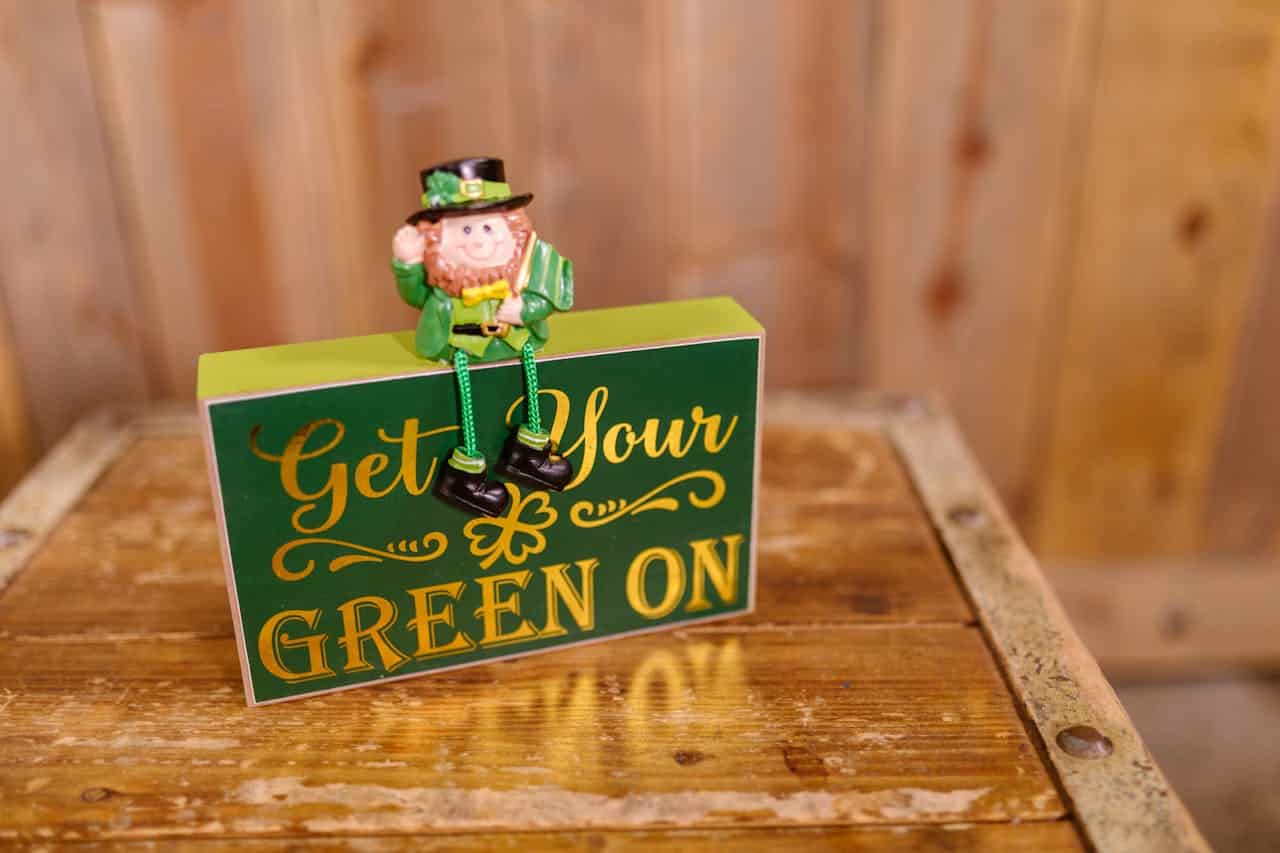
  • Leprechaun figurines and themed signage
  • Green lighting or uplighting for evening atmosphere
  • Irish flags and banners
  • Themed table centerpieces with shamrocks or mini pots of gold
  • Photo-worthy backdrop areas for social media sharing

Offer Family-Friendly Options

Family Appeal Strategies:

  • Green-themed kids’ menu items (green pancakes, green mac and cheese)
  • Non-alcoholic “mocktails” in festive green colors
  • Face painting station with shamrocks and Irish flags
  • Leprechaun treasure hunts for children
  • Coloring sheets and activities
  • Special kids’ meal deals
  • Early dining hours for families before evening crowds

Leverage Digital Marketing and Social Media

Wearing green is the leading St. Patrick’s Day activity at 79.4%, making visual content especially shareable.

Marketing Strategy:

  • Start promoting 3-4 weeks in advance
  • Create Instagram-worthy moments with themed decorations and drinks
  • Use hashtags: #StPatricksDay, #StPaddysDay, #LuckOfTheIrish, #GoGreen
  • Run social media contests (best green outfit, most festive photo)
  • Email past St. Patrick’s Day customers with early reservation offers
  • Post daily countdown content leading up to March 17th
  • Share menu sneak peeks and drink specials
  • Partner with local food bloggers or influencers
  • Create Facebook events for special programming

Manage Reservations and Capacity

With St. Patrick’s Day being one of the busiest days for restaurants, proper reservation management is critical.

Reservation Best Practices:

  • Open reservations 3-4 weeks in advance
  • Consider prepayment or deposit requirements to reduce no-shows
  • Implement time limits for table turns during peak hours
  • Use waitlist technology for walk-in overflow
  • Send confirmation reminders 24-48 hours before reservations
  • Overstaff for expected volume increase
  • Pre-batch popular cocktails to speed service
  • Prepare mise en place for high-volume menu items

Don’t Forget Takeout and Delivery

Not everyone wants to brave crowded restaurants and bars on St. Patrick’s Day. Offering takeout and delivery options expands your revenue potential.

Takeout Strategies:

  • “Meal for Two” or “Family Feast” Irish dinner packages
  • Pre-order systems to manage kitchen capacity
  • Special packaging that keeps food hot and fresh
  • Include reheating instructions for best quality
  • Bundle drinks (growlers of green beer, Irish whiskey bottles)
  • Offer pickup discounts to incentivize direct orders
  • Market through third-party delivery platforms
  • Create “St. Patrick’s Day Party Kits” with food, drinks, and decorations

Create Loyalty Through Post-Holiday Marketing

St. Patrick’s Day provides an opportunity to capture new customers and turn them into regulars.

Turn St. Patrick’s Day Visitors Into Loyal Customers

With Bloom’s restaurant marketing platform, you can:

– Automatically capture customer data from St. Patrick’s Day visitors

– Track who came in during the celebration and what they ordered

– Send automated follow-up campaigns in the following weeks

– Offer “come back” promotions for April to maintain momentum

– Segment customers by spending patterns and preferences

– Measure the true ROI of your St. Patrick’s Day promotions

– Build your customer database for future holiday marketing

The best part? Bloom automates these processes, allowing you to focus on delivering great experiences while the platform handles customer engagement and retention.

Click Here to Schedule a Free Online Demo, or call 727-877-8181 to see how we can help you save time and drive tangible results for your restaurants.


Holiday Restaurant Marketing That Turns Seasonal Guests Into Year-Round Revenue

The holiday season represents the single biggest revenue opportunity of the year for restaurants. Family visits, office parties, and gift card shoppers bring more first-time guests through the door than any other stretch of the year.

Yet most restaurants treat holiday marketing like a one-time event. They push promotions in December that disappear with the Christmas decorations. The result? They capture short-term revenue but lose the long-term value.

Those holiday guests who could become regulars simply vanish after New Year’s.

Here are the stakes:

  • The holidays bring a wave of first-time guests to most restaurants
  • About 8 in 10 first-time restaurant guests never come back (Bloom Intelligence 2026 study)
  • Every guest who never returns takes all of their future visits with them
  • For a multi-location group, that loss repeats at every location

The restaurants that win don’t just market for the holidays. They utilize the holiday season as a strategic period for data collection and relationship building. With the right guest intelligence infrastructure, every holiday visitor becomes an opportunity for 365-day revenue growth.

holiday season restaurant guests

The Foundation: Building Your Holiday Guest Intelligence System

Why the Holidays Are Perfect for Data Collection

Holiday guests are more receptive to engagement. They stay longer for celebrations, which means higher WiFi connection rates. They book more reservations, capturing data at the point of booking. They order more catering and takeout online. They engage more on social media and leave more reviews.

This creates the perfect environment to collect the data you need to market to them throughout the year.

What to Collect:

Your holiday data collection should focus on four categories:

Essential contact data includes name, email, phone number, and contact preferences. This is your foundation. Without it, you can’t reach guests after they leave.

Behavioral intelligence reveals visit timing, dwell time, spend patterns, and dining occasion. This tells you who they are as diners.

Holiday-specific signals capture party size, special occasion indicators, and gift card purchases. This context helps you understand their relationship with your restaurant.

Digital engagement tracks email opens, SMS responses, and online ordering behavior. This shows you how they prefer to communicate.
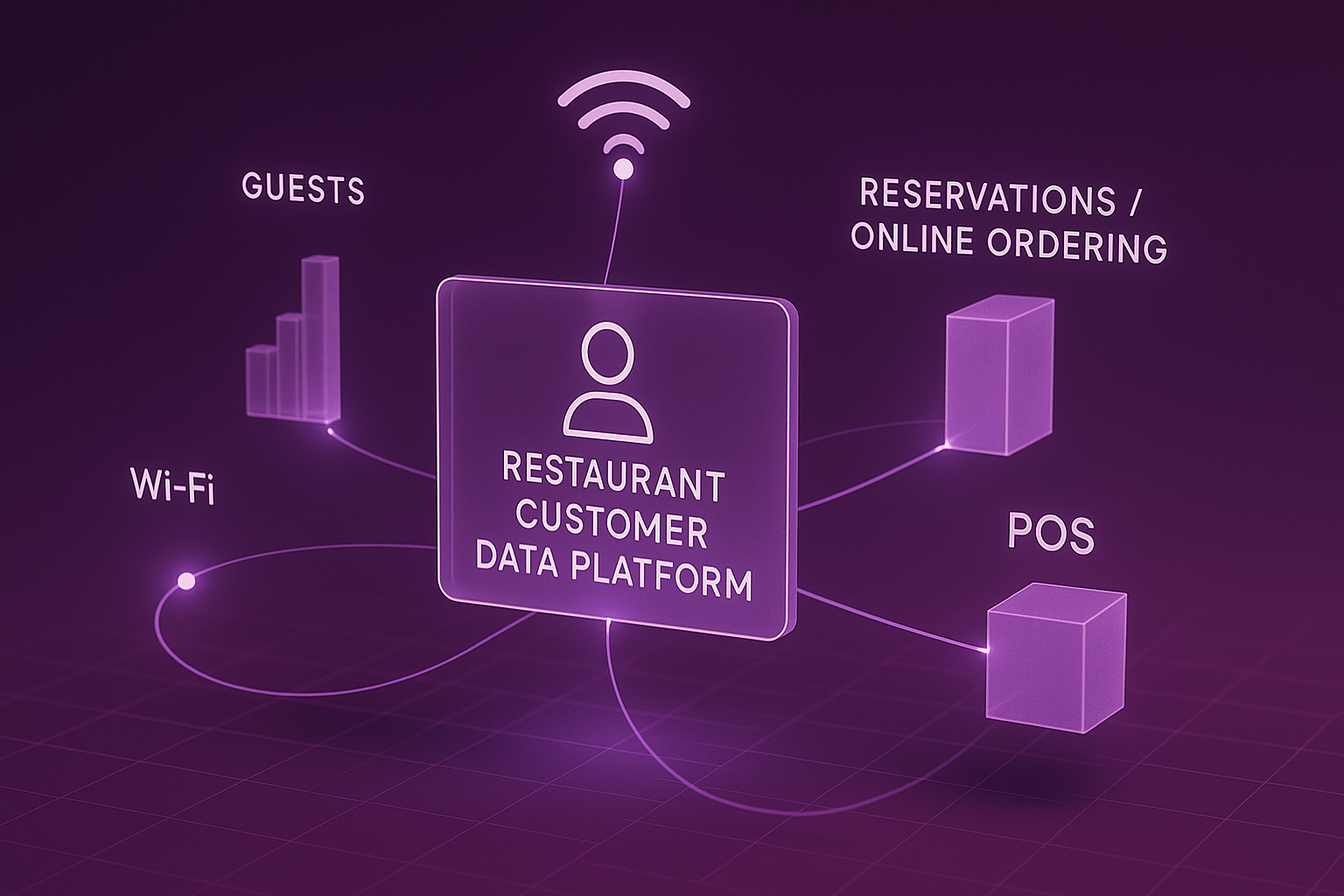
holiday guest data collection sources

The Customer Data Platform (CDP) Advantage

A restaurant CDP doesn’t just collect data. It creates comprehensive guest profiles that unify information from every touchpoint.

WiFi marketing captures first-time visitors at the door. POS integration tracks ordering behavior and spend. Reservation systems provide booking patterns and party size. Online ordering reveals convenience preferences. Review platforms surface sentiment and satisfaction.

This creates a unified intelligence hub where every piece of data works together to build a complete picture of each guest.

Real-Time Profile Building:

From first contact, your CDP begins building intelligence. The Thompson family books a table for 8 on December 23rd, orders three bottles of wine, connects to WiFi, and stays for 2.5 hours. Your system knows this isn’t a quick casual meal. They’re celebrating something important.

Sarah orders holiday catering for 20 people, picks up during lunch rush, and joins your email list. Your system identifies her as a potential corporate client or frequent entertainer.

Marcus visits alone twice in one week during the lunch rush, always orders the same burger, and leaves 5-star reviews. Your system recognizes him as a convenience-focused regular in the making.

Without a CDP, these are just transactions. With one, they’re opportunities for targeted, personalized marketing that dramatically increases return rates.

AI-Powered Segmentation: Turning Data Into Actionable Audiences

Manual segmentation based on gut feelings doesn’t work at scale. You need AI-powered segmentation that automatically groups guests based on their behavior, not your assumptions.

The Five Critical Holiday Segments:

First-Time Holiday Guests represent your biggest opportunity. These visitors discovered you during the holiday rush. Without intervention, most will never return. About 8 in 10 first-time guests never come back. They’re prime candidates for post-holiday nurture campaigns.

Returning Holiday Guests are building momentum. They’ve made their second or third visit during the holidays. They’re in the critical conversion window where they could become regulars or churn. They need frequency-building campaigns in Q1.

Regular Guests form your steady base. They visit monthly or more often throughout the year. Use holidays as an upsell opportunity for private parties and catering. Reward their loyalty with VIP experiences.

Churning Guests haven’t visited in 60+ days but could be recovered. Holiday nostalgia is a powerful trigger.

Super Guests are your VIPs. In Bloom data, 30% of guests drive 52% of revenue. Holidays are their celebration season. Give them early access, special experiences, and recognition to deepen loyalty.
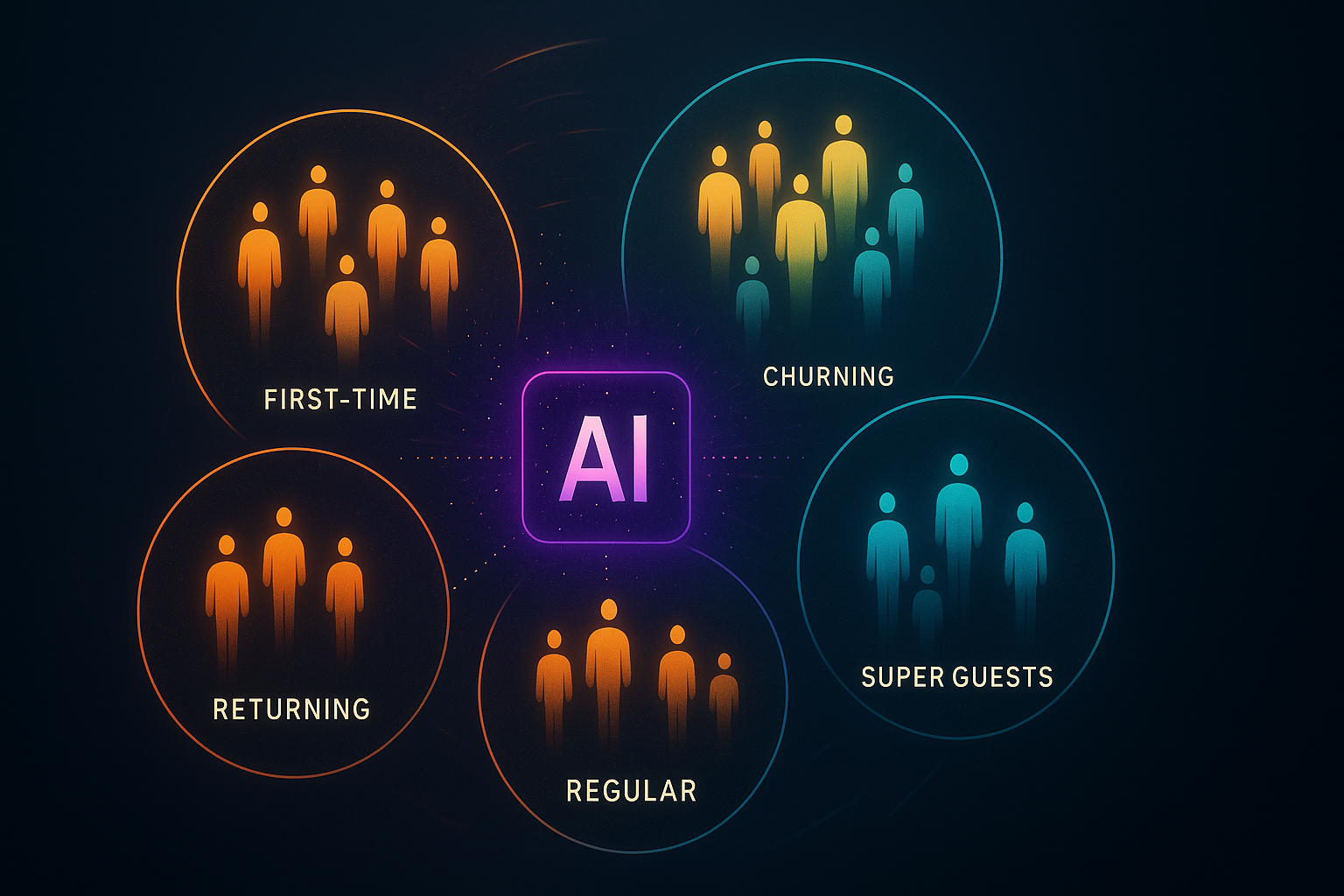
AI powered guest segmentation

Why Manual Segmentation Fails:

Without a CDP, you’re guessing at segments based on incomplete data. You might know Sarah ordered catering, but you don’t know she’s also dined in twice, left a 4-star review, and hasn’t opened your last three emails. That context changes everything about how you market to her.

Strategic Holiday Marketing By Guest Segment

First-Time Holiday Guests: The 72-Hour Recovery Window

These guests came for the holidays. Family was in town. Office parties needed venues. Special occasions required celebration. Post-January, they have no reason to return unless you give them one.

The window to influence a new guest’s return decision is incredibly short. Within 72 hours, they’ve either planned their next visit or moved on to other dining options. That’s why timing matters more than perfect targeting.

The Strategy:

Immediate Welcome (Within 24 hours):

Send an automated thank-you message acknowledging their first visit. Keep the tone warm and appreciative, not salesy. Include a link to join your loyalty program, follow you on social media, or leave a review.

This isn’t about pushing them to return immediately. It’s about establishing the relationship while your restaurant is fresh in their mind.

The Hook Campaign (Days 3 to 7):

Deploy personalized messaging based on visit behavior. The high-spend table service guest gets menu recommendations and information about upcoming special events. The quick casual lunch visitor gets convenience messaging about online ordering. The large party booking gets private dining and catering options.

You’re matching your message to how they already use your restaurant.

The January Bridge (Weeks 2 to 4):

Combat the post-holiday dining slump with compelling reasons to return. Launch “New Year, New Menu” items. Offer resolution-friendly options without being preachy. Create value-focused offers that don’t train discount behavior.

January is when most restaurants lose first-time holiday guests. Your goal is to keep the conversation alive.

The Conversion Play (Month 2 to 3):

Segment by engagement level. Guests who opened emails get more content, recipe features, and behind-the-scenes stories. Guests who didn’t engage get an SMS touchpoint with a time-sensitive offer. Your goal is to secure the second visit before the 90-day window closes.

After 90 days without contact, recovery rates plummet.

Real Results:

Bloom’s data shows why the second visit matters most: a guest who makes a second visit has a 54.8% chance of making a third. (https://bloomintelligence.com/blog/why-first-time-guests-never-return/)

Returning Holiday Guests: Building Frequency Before Q1 Slump

These guests have visited two or three times total. They’re in the critical “on-the-fence” phase where they could become regulars or disappear forever. Research shows that guests who visit four or more times in the first six months are five times more likely to become long-term regulars.

Your goal is to push returning guests past this threshold before spring.

The Strategy:

Momentum Campaigns (January to February):

Leverage recency while you have it. Send messages like “Since you loved the lamb chops, you have to try our new rosemary ribeye.” Create frequency incentives such as “Visit three times in January, get a complimentary appetizer.”

You’re creating habit formation during the slow season when you have capacity and guests have fewer competing options.

Preference Learning:

Use early visits to understand their patterns. Does this guest always order wine? Send them wine pairing events and new bottle launches. Do they bring kids every time? Send family night promotions. Are they weekend brunch regulars? Send weekend-specific campaigns.

Every interaction teaches you how to market to them more effectively.

Relationship Deepening:

Invite them to join your loyalty program with an immediate benefit. Survey them about their preferences and actually use the data. Capture birthdays and anniversaries for future campaigns.

The goal isn’t just to get them back. It’s to learn enough about them that you can market to them intelligently for years.

Regular Guests: Holiday Upsell and VIP Recognition

Your regulars are already coming. Don’t lose them in the holiday chaos or take them for granted. They represent your most valuable asset, and the holidays create unique opportunities to deepen these relationships and increase their value.

holiday season VIP restaurant guests

The Strategy:

Pre-Holiday VIP Access:

Give regulars early reservation booking for popular holiday dates. Holiday tables book early: in our holiday reservations data, Thanksgiving bookings were made about 3 weeks ahead on average. Offer them a first look at your holiday menu or special offerings. Allow private event booking before public announcement.

This makes them feel valued and ensures they don’t get frustrated trying to book during peak times when availability is limited.

Upsell Opportunities:

The holidays create natural upsell moments. Market catering for their holiday parties. Promote gift card purchases with incentives like “Spend $100, get a $20 bonus card.” Offer wine bottle sales for holiday entertaining. Push takeout and delivery options for busy holiday hosts.

Your regulars already trust you. They’re the easiest audience for upsells because they know your quality.

Recognition and Appreciation:

Send personalized holiday greetings from management, not automated corporate messages. Surprise and delight them with an unexpected appetizer, upgrade, or discount. Host an exclusive “regulars only” event in January to combat the post-holiday slump.

These gestures cost little but build enormous loyalty.

The Retention Insurance:

During busy holiday periods, service can slip and waits can increase. Proactive communication with regulars prevents frustration. A simple message like “We know it’s busier than usual. Your patience means everything to us, and we’ve saved your favorite table” acknowledges reality and shows respect.

This prevents the service degradation that drives away even loyal guests during peak periods.

Churning Guests: The Holiday Win-Back Window

These guests haven’t visited in 60 to 90+ days. They’re nearly lost, but the holidays create a unique emotional opening. People are more nostalgic, more social, and more willing to try places they used to love.

The Strategy:

Nostalgia Triggers:

Lead with “We miss seeing you” messaging with a genuine, personal tone. Reference their past favorites: “Your usual table is ready” or “Remember that short rib you loved?” Use their name, their history, and their preferences to make it personal.

Generic “We want you back” messages get ignored. Personal messages that show you actually remember them get responses.

Holiday-Specific Hooks:

Position your restaurant as perfect for situations where they need one. “Hosting out-of-town guests this year?” creates urgency. “Our cranberry pork tenderloin is only here through January” adds scarcity. “We’ve added online ordering” or “We now take reservations” removes barriers that might have caused them to leave.

The holidays give you multiple angles to reach churning guests.

The Right Incentive:

Avoid generic discounts. They train price sensitivity and attract the wrong behavior. Instead, use personalized offers based on past behavior.

High spenders get a complimentary appetizer or dessert, not 20% off. Price-sensitive guests get targeted value offers like “Lunch special: $12 for your choice of entree and drink.” Guests who loved specific items get “Chef’s bringing back your favorite dish for a limited time.”

The incentive should remove friction, not become the primary reason to visit.

Segmented Urgency:

Guests who lapsed for 60 days get a soft, friendly check-in. Guests who lapsed for 90 days get a stronger incentive and clearer ask. Guests who lapsed for 120+ days get a last-chance campaign before you archive them.

Different levels of churn require different intensities of effort.

Win-Back Success Rate:

Across Bloom Intelligence restaurants, automated win-back campaigns recover 38% of at-risk guests. (https://bloomintelligence.com/blog/why-first-time-guests-never-return/)

Super Guests: Deepening the Most Valuable Relationships

In Bloom data, 30% of guests drive 52% of revenue. Losing even one super guest takes a large share of your future revenue with them. The holidays are your chance to strengthen these relationships so they never consider going anywhere else.
The Strategy:

White Glove Treatment:

Make personal phone calls, not send emails, for holiday reservation assistance. Guarantee seating even on the busiest nights. Offer menu customization for dietary needs or special requests. Provide a dedicated point of contact like a manager or owner direct line.

Super guests should never wonder if they’ll get a table or if you’ll accommodate their needs.

Exclusive Experiences:

Host chef’s table events with limited seating. Offer first taste of new menu items before public launch. Provide behind-the-scenes kitchen tours or cooking classes. Give private dining room access with custom menus.

These experiences can’t be bought. They’re reserved for your most valuable guests, which makes them even more valuable.

Strategic Gifting:

End the year with appreciation gifts, not discounts. Send personalized wine bottles, a cookbook from your chef, or branded merchandise. Mail holiday cards signed by the owner or GM with a personal note. Make surprise deliveries: “We know you love our braised lamb, so we brought it to you.”

These gestures cost less than the discount campaigns you’d run for other segments, and they build far more loyalty.

Investment in Relationship:

Conduct quarterly check-ins from ownership. Solicit feedback and actually implement it. Name a dish after them, even jokingly on a special occasion menu. Introduce them to other super guests to create community.

Super guests don’t just want good food and service. They want to feel like insiders, like they’re part of something special.

White-glove holiday experiences give your best guests every reason to stay.

That’s a massive ROI for relatively small investments in relationship building.
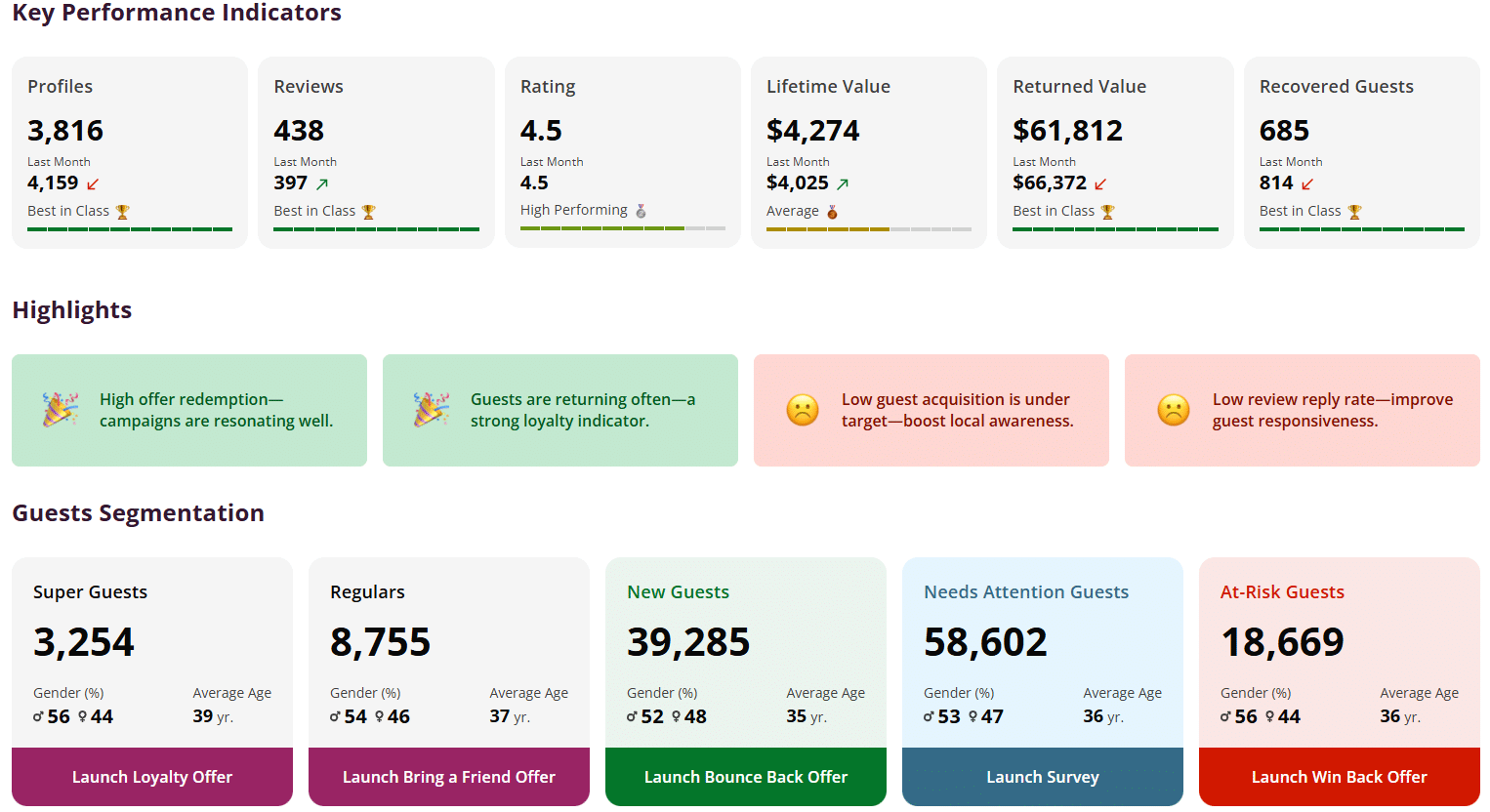
Bloom Intelligence Dashboard

Automation: The Secret to Executing at Scale

Even with perfect segmentation, most restaurants can’t execute these strategies. They require constant monitoring of guest behavior, precise timing of message deployment, personalization at scale across hundreds of guests, coordination across email, SMS, and in-restaurant touchpoints, and performance tracking and optimization.

You’d need a full-time marketing team. Or you need automation.

Triggered Campaigns That Launch Automatically

No Calendar Management Required:

First-time guest welcome series trigger within 24 hours of a visit. Frequency-building campaigns launch when returning guests hit specific visit counts. Win-back campaigns deploy when a regular’s visit frequency declines. Super guest VIP communications send at predetermined touchpoints.

You set the rules once. The system executes forever.

Behavioral Triggers, Not Calendar Dates:

Sarah books a large party. A catering offer triggers automatically. Marcus hasn’t visited in 45 days. A “We miss you” campaign launches. The Thompson family leaves a 5-star review. A “Thank you plus refer a friend” message sends.

The system responds to what guests do, not what date it is.

Dynamic Personalization Without Manual Work

AI Writes the Message:

The system pulls guest name, visit history, order preferences, and sentiment. It generates personalized subject lines and message content. It adapts tone based on guest segment, whether VIP, churning, or new. It tests variations and optimizes based on response rates.

You’re not writing hundreds of individual emails. AI does it for you based on the data you’ve collected.

Channel Intelligence:

The system automatically selects email versus SMS based on past engagement. It determines optimal send time based on when a guest typically opens messages. It applies frequency capping to prevent over-communication.

Guests get messages through the channel they prefer, at the time they’re most likely to engage.

Reputation Management at Scale

Automated Review Generation:

Post-visit rating requests go out with smart timing, not too immediate and not too late. AI-powered response suggestions appear for every review. Trend identification alerts you when you’re getting negative mentions of wait times or specific dishes.

You stay on top of your reputation without manually monitoring six different review sites.

Performance Intelligence You Can Actually Use

Real-Time Dashboards:

See campaign performance by segment. Track guest lifetime value trending. Monitor visit frequency and spend patterns. View attribution showing which campaigns drive actual visits and revenue.

You know what’s working and what’s not, so you can double down on success.

Actionable Alerts:

The system tells you when 10 regulars haven’t visited in 60 days. It warns you when negative sentiment increases around a specific issue.

You’re not digging through data to find problems. Problems surface themselves so you can fix them.

The Holiday-to-365 Transformation

The difference between restaurants that simply have a good holiday season and those that transform holiday success into year-round growth comes down to one thing: data infrastructure and automation.

The Traditional Cycle (Reactive):

You run a busy November and December with promotions and holiday menus. Revenue spikes in Q4. January brings a slump as holiday guests disappear. You scramble in February and March to drive traffic. You repeat this next year.

The Guest Intelligence Cycle (Proactive):

You run a strategic holiday season focused on data collection and relationship building. Automated nurture campaigns launch in January. First-time holiday guests get a personalized second-visit offer within days. Returning guests hit the four-visit threshold and become regulars. Q1 revenue stays strong as holiday guests remain engaged. Year-round frequency increases drive compound growth. (https://bloomintelligence.com/blog/guest-intelligence-flywheel/)
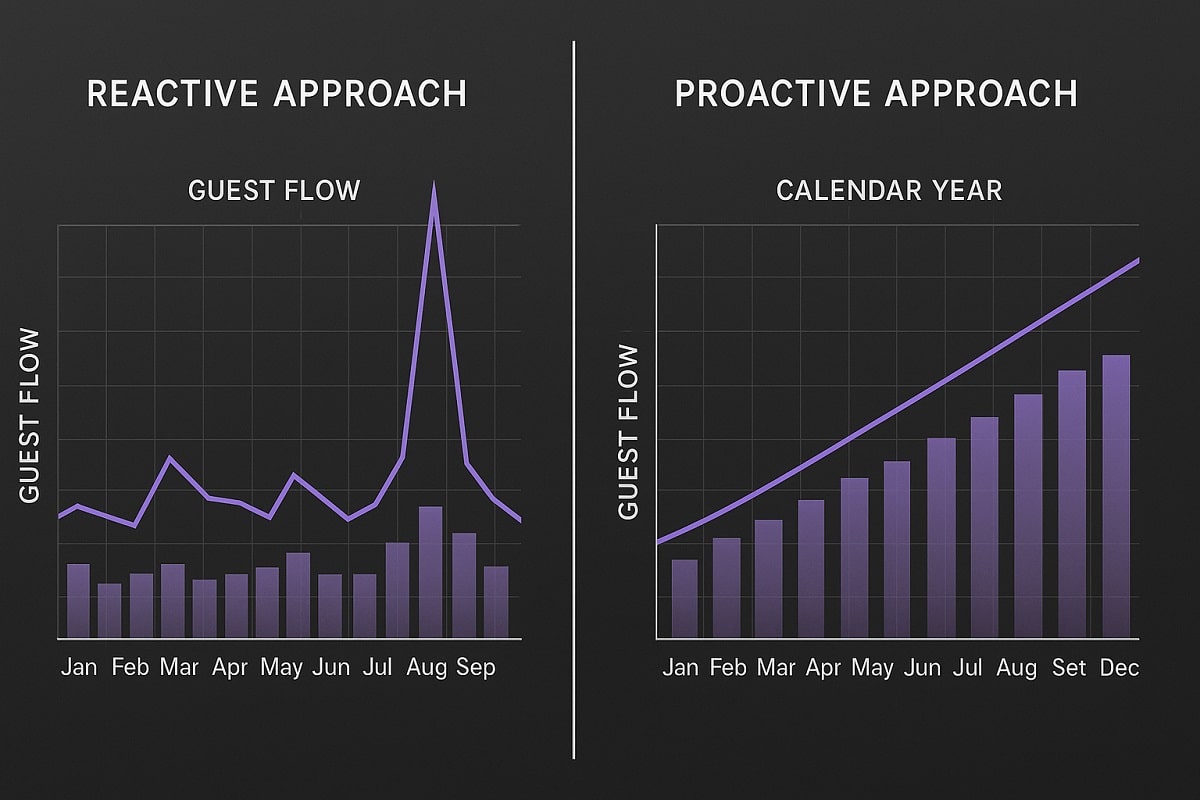
turning holiday traffic into lifelong regulars

The Numbers:

Across Bloom Intelligence restaurants, the average location recovers $53,000+ in revenue in the first year, and automated win-back campaigns bring back 38% of at-risk guests.

Let Bloom Intelligence Automate Your Holiday Success

You now understand the strategy. You see the opportunity. You know the value of recovering first-time guests, building frequency with returning visitors, and creating VIP experiences for super guests.

But here’s the truth: executing this manually is nearly impossible.

You’d need a CDP to unify guest data from WiFi, POS, reservations, reviews, and ordering. You’d need marketing automation to segment audiences and trigger personalized campaigns. You’d need reputation management to monitor sentiment and respond to reviews. You’d need analytics to track performance and optimize results. You’d need a marketing team to manage all of it.

Or you need Bloom Intelligence.

What Bloom Does Automatically

Instant Guest Intelligence:

Bloom captures guest data from the first WiFi connection, reservation, or online order. It creates comprehensive profiles with behavioral and preference data. AI-powered segmentation identifies first-time, returning, regular, churning, and super guests. Real-time updates occur as guests interact with your restaurant.

You don’t build profiles manually. The system builds them automatically from day one.

Campaign Automation That Works While You Sleep:

Bloom includes pre-built holiday campaigns for every guest segment. Behavioral triggers launch personalized messages at optimal times. Dynamic content adapts to each guest’s history and preferences. Multi-channel delivery uses email and SMS based on engagement patterns.

You set your strategy once. The system executes it 24/7 without your involvement.

Reputation Protection on Autopilot:

Bloom sends automated review requests with sentiment routing. It provides AI-generated review response suggestions. It identifies trends and sends operational alerts. Every review gets a response in your brand voice.

Your reputation improves without you manually monitoring review sites every day.

Results You Can Measure:

Bloom users recover $53,000+ in revenue per location in the first year. They achieve a 38% recovery rate for at-risk guests. They increase guest lifetime value by 43%. They save 15 to 20 hours a week on review management. They stay, too: Bloom has 99.3% client retention. (https://bloomintelligence.com/blog/guest-intelligence-flywheel/)
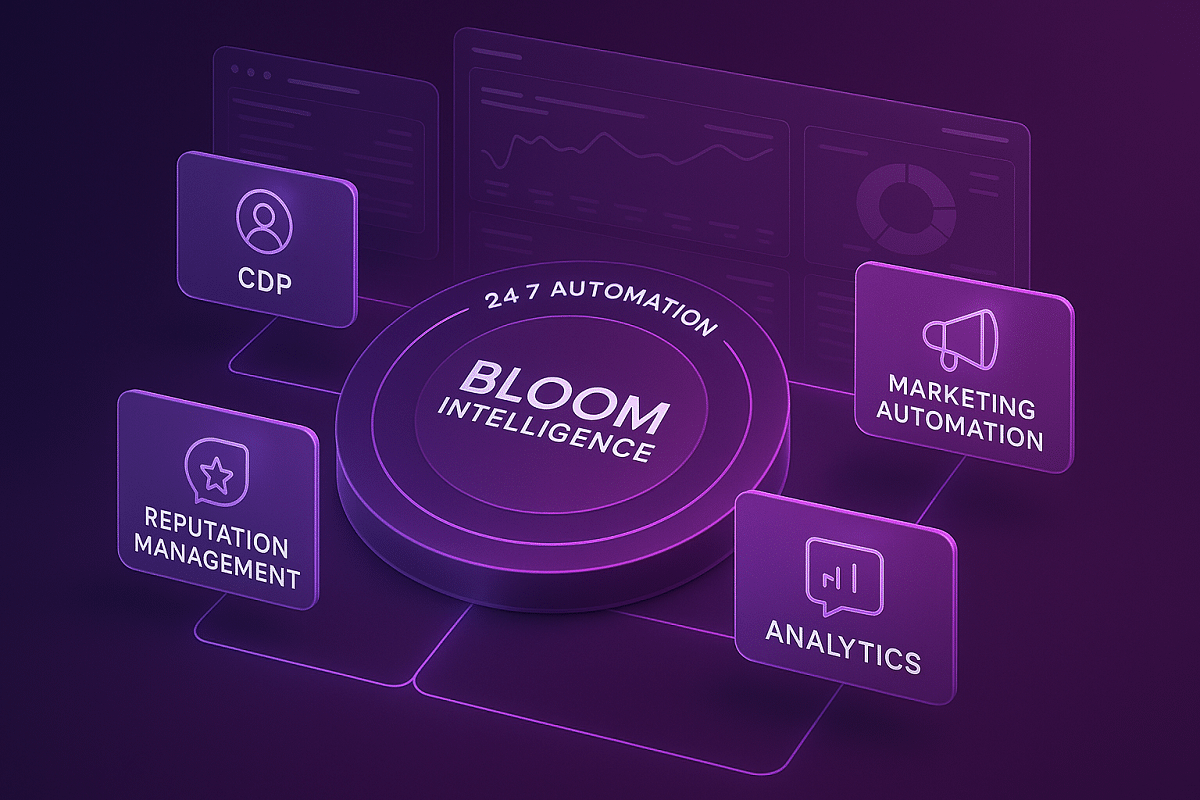
Bloom Intelligence features

Don’t Forget AI Search and Voice – How Guests Are Finding Restaurants This Holiday Season

The way guests discover restaurants is changing fast. Traditional search engines like Google are still important, but now AI-based tools like ChatGPT, Google’s AI Overviews, and Perplexity.ai are influencing how guests get recommendations, especially during the holidays when people ask questions like:

  • “What’s the best place for a holiday dinner near me?”

  • “Where can I buy a restaurant gift card for my boss?”

  • “Which restaurants offer holiday catering in [city]?”

At the same time, voice search through assistants like Siri, Alexa, and Google Assistant is rising. Many guests now speak their searches, especially when driving or multitasking. These queries are often more conversational and specific, which means your restaurant’s online presence needs to align with how real people talk and search.

If your website isn’t structured and optimized correctly, you risk missing out: even if your food, service, and atmosphere are exceptional.

How Bloom Helps Restaurants Get Found by AI and Voice Search

Bloom Intelligence doesn’t just help you personalize marketing and automate retention. It also optimizes your website content and structure to ensure that modern AI search tools can understand and recommend your restaurant. With Bloom, your site content is:

  • Structured for voice and AI-friendly questions like “best date-night restaurant with gluten-free options”

  • Optimized with schema and metadata that search engines use to categorize your restaurant properly

  • Built to surface location, menus, hours, and promotions clearly so voice assistants and AI bots can access it quickly

  • Regularly updated to reflect your holiday events, menus, and booking availability, so AI tools can share current, accurate info with guests

This isn’t just SEO, it’s guest discovery optimization for how people search today. And it matters more during the holidays when guests make fast decisions about where to dine, celebrate, or gift.

The Bloom Advantage

Single Platform. Zero Complexity. Immediate Results.

While competitors piece together separate vendors for CDP, marketing automation, and reputation management, Bloom gives you everything in one unified platform. You see week one campaigns driving measurable engagement. You experience month one optimization showing improved satisfaction and revenue. You work with an expert support team that acts as your marketing partner.

This Holiday Season, Stop Losing Guests Forever

The technology exists. The results are proven. The only question is: how much more revenue are you willing to lose to indecision?

Transform your holiday season from a temporary spike into a sustainable growth engine. Turn seasonal guests into year-round regulars. Recover the guests who walk out your door and never come back.

Schedule a free demo and see how Bloom Intelligence can turn your guest data into automatic revenue growth this holiday season.

Schedule Your Free Demo

Or call 727-877-8181 to speak with one of our restaurant marketing specialists.


Ready to give your restaurant the advantage?

See exactly how Bloom Intelligence works around the clock to grow your revenue, protect your reputation, and optimize your operations. Watch your actual guest data transform into automated marketing that never stops working.

Schedule Your Intelligence Audit | Calculate Your After-Hours Revenue

P.S. The clock never stops. Neither should your marketing.

Join the restaurants that never sleep. Because your guests never do.
Let Bloom Intelligence Make It Effortless

Bloom Intelligence is the AI-powered restaurant marketing platform that automatically grows revenue, protects reputation, and optimizes operations 24/7. Our unified platform combines guest data from every touchpoint with intelligent automation to give restaurants the marketing power of major chains, without the complexity or cost.

Bloom makes guest data collection and marketing automation effortless, which allows you to quickly execute the strategies listed above, saving you time, increasing customer lifetime values, attracting new guests, improving your reputation, and boosting your bottom line.

Call us or schedule a free demo online and Bloom will show you how our restaurant marketing platform can help you save time and increase your customer lifetime values by automatically building first-party customer databases, unlocking important guest insights to trigger automated marketing at the right time and place, discover true guest sentiment, save at-risk guests, increase your current guests’ frequency, supercharge your website, and find new guests.

Click to schedule a Free Online Demo, or call 727-877-8181 to see how we can help you drive tangible results for your restaurants.
Announcement: New Wedding Anniversary Marketing Trigger for Restaurants

Bloom Intelligence is thrilled to introduce another powerful new feature: the ability to collect and utilize wedding anniversary data in your email and SMS marketing campaigns.

This innovative tool will allow restaurants to capture anniversary dates when guests log into WiFi, complete a website form, or through Bloom’s integration partners. The data is automatically added to guest profiles, enabling restaurants to trigger automated personalized email and SMS marketing messages that celebrate these special moments.

With this feature, live to all users the week of February 10, 2025, Bloom helps restaurants create deeper emotional connections with their guests, driving loyalty and increasing customer lifetime value (CLV).

Effortless Setup, Powerful Results

One of the standout aspects of this new feature is how simple it is to implement. Restaurants can activate the wedding anniversary field in their WiFi login pages or website forms with just a few clicks.

  • To add the anniversary date field to your website form, locate your form in the Bloom Dashboard, open it, and simply drag and drop the Anniversary block into your form.
  • To add the anniversary date field to your WiFi landing page, call your customer success representative at 727-877-8181.

Alternatively, Bloom can pull this data directly from its integration partners, ensuring a seamless experience for both the restaurant and the guest.

Once the data is collected, Bloom’s platform takes care of the rest, automating personalized messages that make guests feel valued and appreciated.

For example, imagine a guest receiving a thoughtful email or SMS on their wedding anniversary, inviting them to celebrate with a complimentary glass of champagne or a discount on their next visit.

These small gestures can have a big impact, fostering a sense of connection and loyalty that keeps guests coming back.

The Link Between Emotional Connection and Customer Lifetime Value

Happy, emotionally connected guests are not just one-time visitors—they become loyal patrons who return again and again.

Personalization plays a critical role in building these connections. According to a study by Epsilon, 80% of consumers are more likely to make a purchase when brands offer personalized experiences.

By leveraging wedding anniversary data, restaurants can create moments that resonate deeply with guests, turning ordinary interactions into memorable experiences.

This emotional connection directly translates into increased customer lifetime value. Research shows that increasing customer retention rates by just 5% can boost profits by 25% to 95% (Source: Harvard Business Review).

When guests feel a personal connection to your restaurant, they’re more likely to return, spend more, and recommend your establishment to others.

In fact, 77% of consumers have chosen, recommended, or paid more for a brand that provides a personalized service or experience (Source: Forbes).

Launching an anniversary marketing campaign feeds directly into this type of emotional connection.

Driving Revenue Through Personalization

Personalized marketing isn’t just about making guests feel good—it’s also a powerful revenue driver. Bloom’s new feature allows restaurants to send timely, relevant messages that encourage repeat visits and higher spending.

For instance, a personalized anniversary offer can bring guests in during slower periods, increase average check sizes, and create opportunities for upselling.

Studies show that personalized emails deliver 6x higher transaction rates (Source: Experian), while SMS marketing boasts a 98% open rate (Source: MobileSquared).

These statistics highlight the potential of personalized communication through your restaurant marketing to drive measurable revenue growth.

Restaurants leveraging anniversary-triggered marketing can expect:

  • Higher customer loyalty
  • Increased repeat visits
  • More valuable word-of-mouth referrals

A Competitive Edge in a Crowded Market

In today’s competitive restaurant industry, standing out requires more than just great food and service. It’s about creating an experience that guests can’t find anywhere else.

By celebrating milestones like birthdays, ordering milestones, and wedding anniversaries, restaurants can better differentiate themselves and build a more loyal customer base.

Happy guests are also more likely to share their experiences with friends and family (word-of-mouth advertising), further amplifying your restaurant’s reach and bottom line. In fact, 92% of consumers trust recommendations from friends and family over other forms of advertising, according to Nielsen.

Get Started Today

Bloom Intelligence’s wedding anniversary data feature is designed to be easy to set up and even easier to use. In just a few simple steps, restaurants can start collecting this valuable data and automating personalized messages that delight guests.

By investing in these meaningful connections, restaurants can enhance the guest experience, increase customer lifetime value, and drive long-term revenue growth.

The future of restaurant marketing is personal, and Bloom Intelligence is here to help you make every guest feel special. Ready to transform your marketing strategy and build lasting relationships with your guests?

Contact Bloom Intelligence today to learn more about this exciting new feature and start creating even more unforgettable experiences for your guests.

Discover Bloom Intelligence

Bloom Intelligence is an AI-powered restaurant marketing platform. It includes a powerful customer data platform, automated guest data collection, one-click segmentation, behavior-triggered marketing automation via email and SMS, reputation management, and reporting tools.

Data is collected from sources like WiFi logins, online reservation systems, online ordering platforms, POS systems, website forms, social media, and more. This makes it simple to analyze and segment your guest personas for your restaurant’s digital marketing and operations decisions.

Bloom makes guest data collection effortless, which allows you to quickly execute the strategies listed above, saving you time, increasing customer lifetime values, attracting new guests, improving your reputation, and boosting your bottom line.

Call us or schedule a free demo online and Bloom will show you how our restaurant marketing platform can help you save time and increase your customer lifetime values by automatically building first-party customer databases, unlocking important guest insights to trigger automated marketing at the right time and place, discover true guest sentiment, save at-risk guests, increase your current guests’ frequency, and find new guests.

Click Here to Schedule a Free Online Demo, or call 727-877-8181 to see how we can help you save time and drive tangible results for your restaurants.

Restaurant Ideas for New Year’s: Boost Revenue and Delight Guests

Guests toasting with champagne and sparklers on New Year's Eve

New Year’s Eve and New Year’s Day present exceptional opportunities for restaurants to increase revenue and build stronger connections with their guests.

As people look for ways to celebrate fresh beginnings, they seek venues offering memorable experiences, delicious meals, and a festive atmosphere.

According to the National Restaurant Association, 57% of consumers plan to go out to eat at a restaurant, while 32% of Americans plan to order delivery or pickup for New Year’s. Furthermore, OpenTable data reveals that reservations on New Year’s Eve increase by up to 200% compared to an average night.

This demand creates a golden opportunity for restaurants to captivate guests with creative concepts that elevate their celebrations. By focusing on both increased revenue and improved guest sentiment, restaurants can kick off the new year on a high note.

Here are several innovative strategies to maximize your restaurant’s potential during the New Year’s celebration period while enhancing guest satisfaction.

1. Offer Exclusive Prix Fixe Menus

Design a curated prix fixe menu specifically for New Year’s Eve. Offering a multi-course meal with a set price simplifies decision-making for guests while maximizing per-person revenue. Include popular celebratory dishes such as seafood, premium meats, and decadent desserts. Pairing these with wine or cocktail options adds to the appeal and increases revenue.

Premium prix fixe menus allow you to:

  • Control food costs through limited, carefully planned offerings
  • Increase per-head revenue (restaurants typically see 40-50% higher check averages with holiday prix fixe menus)
  • Streamline kitchen operations during high-volume service
  • Create an air of exclusivity that justifies premium pricing

Create different tiers for your prix fixe menu to cater to various budgets. For example:

  • Silver Tier: Three courses with basic wine pairing.
  • Gold Tier: Five courses with premium wine or champagne pairing.
  • Platinum Tier: Seven courses with exclusive pairings and a keepsake for guests.

Include a vegetarian option and consider wine pairings to boost beverage sales.

Promote these options in advance on your website, through email marketing campaigns, and across social media platforms to encourage reservations.

Round restaurant table set for a New Year's Eve dinner

2. Multi-Phase Celebration Packages

Instead of treating New Year’s Eve as a single dinner service, segment your evening into distinct experiences to maximize revenue potential:

Early Family Celebration (5:00-7:30 PM):

  • Family-friendly pricing and menu options
  • Special kids’ entertainment or menu items
  • Perfect for families with younger children who won’t stay until midnight
  • Allows for table turnover before peak hours

Main Celebration (8:00 PM-12:30 AM):

  • Premium pricing with champagne toast included
  • Live entertainment or music
  • Countdown Celebration
  • Party favors and festive decorations

After-Party Experience (12:30 AM-2:00 AM):

  • Late-night small plates menu
  • Specialty cocktails
  • Relaxed atmosphere for guests to continue their celebration

3. Host a Countdown Party

Transform your restaurant into a New Year’s Eve party destination by hosting a countdown event.

Decorate the space with a festive theme, whether it’s classic elegance or a roaring ’20s party. Include live music, a DJ, or other entertainment to keep guests engaged throughout the evening.

Sell tickets to the event that include access to a buffet or seated dinner, party favors, and a complimentary champagne toast at midnight.

Offering a VIP section with additional perks, such as bottle service or priority seating, can appeal to guests looking for an elevated experience.

Guests toasting with champagne and sparklers on New Year's Eve

4. Create a Themed Brunch for New Year’s Day

Capitalize on the New Year’s Day brunch trend by offering a themed menu that caters to guests recovering from late-night celebrations.

According to Toast, brunch sales increase significantly on New Year’s Day, with items like mimosas, Bloody Marys, and comfort foods taking center stage.

Craft a menu that balances indulgence with health-focused options to appeal to a wide audience. Feature dishes like:

  • Gourmet omelets
  • Avocado toast with premium toppings
  • Fresh fruit bowls
  • Recovery smoothies

Add a “hair of the dog” drink menu with creative spins on classic cocktails to enhance the experience.

5. Introduce Limited-Time Offers and Specials

Create limited-time offers and exclusive promotions tied to New Year’s celebrations. Examples include:

  • Countdown Cocktails: A menu of festive drinks named after New Year’s Eve themes, such as “Midnight Sparkle” or “The Resolution.”
  • Celebration Packages: Bundled offers that include a meal, drinks, and party favors for groups of four or more.
  • Loyalty Bonuses: Reward returning guests or loyalty program members with discounts on their New Year’s reservation or a free appetizer.

Promote these specials in advance to generate buzz and secure bookings early.

6. Collaborate with Local Vendors

Partner with local businesses to enhance your New Year’s offerings. For instance, work with a florist to create stunning table arrangements or a bakery to provide specialty desserts.

Collaborations can also include photographers offering professional pictures of guests or local entertainers performing live.

These partnerships can reduce costs and add unique value to the guest experience, encouraging word-of-mouth referrals and repeat business.

Friends raising wine glasses in a toast over dinner

7. Leverage Pre-Orders and Takeout Options

Not all guests want to celebrate in a crowded venue. Offer pre-order options for takeout or delivery that include complete New Year’s Eve or Day meal packages. Highlight family-sized portions and feature your most popular dishes alongside champagne or wine pairings.

For example, you could offer packages like:

  • “Cozy at Home Feast” with appetizers, mains, sides, and desserts.
  • “Sparkling Celebration Kit” featuring a meal for two and a bottle of champagne.

Make the ordering process seamless on your website and promote these options on social media to reach stay-at-home celebrants.

8. Encourage Social Media Sharing

Create share-worthy moments for your guests and encourage them to post their experiences online. Set up an Instagram-worthy photo booth with New Year’s props or host a social media contest.

For example, offer a free meal or gift card to guests who tag your restaurant and share their photos.

This strategy boosts online visibility and attracts potential new guests who want to join the celebration.

9. Focus on Exceptional Service and Personalization

New Year’s celebrations are a time for creating lasting memories. Train your staff to deliver exceptional service and personalize the guest experience whenever possible.

Simple touches, like addressing guests by name, offering recommendations based on preferences, or providing a small take-home treat, can make a significant impact.

Happy guests are more likely to leave positive reviews, share their experiences with friends, and return for future visits – increasing customer lifetime value.

Server bringing drinks to a table of regular guests

10. Promote Reservations and Prepayment

Ensure a full house by encouraging guests to make reservations early.

Use online reservation platforms to streamline the process and collect prepayments or deposits to secure bookings. Offering incentives, like discounted early bird reservations, can motivate guests to plan ahead.

11. Collect Guest Data for Year-Round Marketing

Use the holiday season to gather valuable guest data that can fuel your marketing efforts throughout the year. Implement strategies such as:

  • Adding opt-in forms for newsletters or loyalty programs on your website, or during reservations.
  • Encouraging WiFi logins to collect their email address and other data for future promotions.
  • Running a contest that requires guests to provide their contact information for a chance to win a free meal or gift card.

Use this data to create personalized campaigns, such as birthday offers, anniversary discounts, or promotions targeting specific dining habits. By building detailed guest profiles, you can foster stronger relationships and drive repeat visits.

All of these and much more can be executed with an all-in-one AI-powered restaurant marketing platform like Bloom Intelligence.

Marketing team gathered around a laptop reviewing audience data

Summing It Up

New Year’s Eve represents more than just another busy service night, it’s an opportunity to showcase your restaurant’s capabilities and create lasting impressions that generate repeat business throughout the coming year.

By offering curated menus, memorable events, and exceptional service, you can create a festive experience that leaves guests eager to return.

The key is to plan ahead, market effectively, and focus on the details that make your restaurant stand out.

Seize this chance to kick off the new year with a boost in sales and strengthened guest relationships. With the right approach, your restaurant can become the go-to destination for New Year’s festivities year after year.

Discover Bloom Intelligence

Bloom Intelligence is an AI-powered restaurant marketing platform. It includes a powerful customer data platform, automated guest data collection, one-click segmentation, marketing automation, and reputation management tools.

Data is collected from sources like WiFi logins, online reservation systems, online ordering platforms, POS systems, website forms, social media, and more. This makes it simple to analyze and segment your guest personas for your restaurant’s digital marketing and operations decisions.

Bloom makes guest data collection effortless, which allows you to quickly execute the strategies listed above, saving you time, increasing customer lifetime values, attracting new guests, improving your reputation, and boosting your bottom line.

Call us or schedule a free demo online and Bloom will show you how our restaurant marketing platform can help you save time and increase your customer lifetime values by automatically building first-party customer databases, unlocking important guest insights to trigger automated marketing at the right time and place, discover true guest sentiment, save at-risk guests, increase your current guests’ frequency, and find new guests.

Click Here to Schedule a Free Online Demo, or call 727-877-8181 to see how we can help you save time and drive tangible results for your restaurants.


How Restaurants Can Use Gift Card Sales to Boost Revenue During the Holiday Season

Every restaurant owner knows the holiday season can make or break annual profitability. What if you could unlock a revenue strategy that generates immediate cash, attracts new guests, and creates lasting loyalty, all without increasing your operational costs?

Gift cards are not just another holiday marketing gimmick. They’re a powerful financial tool that can inject thousands of dollars directly into your restaurant’s bottom line.

According to the National Restaurant Association, restaurants that strategically implement gift card programs see an average revenue boost of 15-25% during the holiday season.

This isn’t about selling pieces of plastic: it’s about creating a strategic approach that drives immediate revenue, fills seats during slow periods, and builds a sustainable customer acquisition pipeline.

During November and December, gift card sales can account for nearly half of a restaurant’s annual total, underscoring their significance in holiday revenue strategies. Moreover, the global gift card market is projected to reach $3.09 trillion by 2030, indicating a robust growth trajectory.

By strategically leveraging gift card sales and effective marketing during the holiday season, restaurants can enhance immediate profits and cultivate a loyal customer base that extends well beyond the holidays.

Here, you’ll discover a blueprint for transforming gift cards from a simple transaction into a powerful marketing and revenue generation tool.

Audio discussion and summary of this article:


woman buying a gift card from a restaurant


The Value of Gift Cards in Restaurant Marketing

Gift cards are more than just convenient holiday gifts. They are a versatile and powerful tool in restaurant marketing. Their ability to drive revenue, attract new guests, and foster loyalty makes them an essential part of any restaurant’s strategy, especially during the holiday season.

Guests choose restaurant gift cards during the holidays for two primary reasons: convenience and flexibility.

A 2024 National Retail Federation survey revealed that 44% of holiday shoppers prefer gift cards as their go-to present, citing their universal appeal and ease of selection.

For gift-givers, restaurant gift cards solve multiple gifting challenges:

  • Eliminate guesswork about personal food preferences
  • Provide a memorable experience instead of physical items
  • Offer flexibility for recipients to choose their dining time

Recipients appreciate gift cards because they:

  • Control when and how they’ll use the gift
  • Can explore new dining experiences
  • Feel empowered to treat themselves without direct expense

Here’s why gift cards hold such significant value for your business.

1. Immediate Revenue Boost

When a guest purchases a gift card, your restaurant receives immediate cash flow, often at a time when operational costs are higher due to increased demand. The best part? Many gift cards go unredeemed or are only partially used, allowing you to retain a portion of the revenue without incurring additional costs. Even when redeemed, guests typically spend more than the card’s value, resulting in increased ticket sizes.

2. Expanding Your Guest Base

Gift cards serve as invitations for new guests to try your restaurant. They are often gifted by loyal patrons who want to share their favorite dining experience with friends, family, or colleagues. This word-of-mouth recommendation helps you reach a wider audience, introducing your restaurant to potential regulars and super-guests who might not have otherwise visited.

3. Encouraging Repeat Visits and Loyalty

For existing guests, gift cards act as a reason to return. When recipients have a positive experience, they are more likely to come back, turning one-time visits into recurring revenue. Integrating gift card redemptions with your loyalty program can amplify this effect, encouraging repeat visits and deeper engagement with your brand.

4. Low-Cost Marketing Tool

Compared to traditional advertising, gift cards are a cost-effective way to keep your restaurant top of mind. They act as physical reminders of your brand, offering sustained visibility until they are redeemed. The distribution of gift cards during peak seasons like the holidays ensures that your restaurant remains relevant throughout the year.

5. Versatility Across Multiple Channels

Gift cards can be sold and redeemed through various channels, including in-store, online, and even via mobile apps. This flexibility makes it easy for guests to purchase and use them, enhancing the overall convenience and accessibility of your restaurant. Moreover, digital gift cards allow for seamless integration with your marketing automation systems, enabling you to track usage patterns and tailor future campaigns accordingly.

Incorporating gift cards into your restaurant marketing strategy during the holiday season is a smart move. They not only provide a quick revenue boost but also help you attract new guests, encourage repeat visits, and enhance loyalty.

With their low cost and high return on investment, gift cards are an invaluable asset for driving sustained business growth.

gift card sales can fill your seats


Gift Cards as a Strategic Marketing Tool

Gift cards are more than just a convenient payment method, they are a dynamic marketing tool that can significantly impact your restaurant’s growth.

By incorporating gift cards into your marketing strategy, you can leverage them to attract new guests, drive repeat visits, and even increase average check sizes.

Here’s how gift cards can elevate your restaurant’s marketing efforts.

1. Attracting New Guests

Gift cards act as powerful endorsements, often introducing your restaurant to first-time guests. When loyal patrons purchase gift cards as gifts, they essentially invite their friends, family, or colleagues to experience your restaurant. This word-of-mouth promotion can bring in new guests who may not have otherwise considered your establishment, giving you the chance to turn them into regulars. A 2023 restaurant industry report found that 65% of gift card recipients visit a restaurant for the first time through a gift card, expanding your potential customer base.

2. Driving Repeat Business

Once a guest redeems a gift card, their journey with your restaurant doesn’t end there. A positive experience increases the likelihood that they’ll return, even after the gift card balance is used. Pairing gift card promotions with loyalty programs can further encourage repeat visits, providing additional incentives for guests to keep coming back.

3. Increasing Average Spend

Gift cards often lead to higher check sizes and customer lifetime values. Research shows that guests redeeming gift cards typically spend more than the card’s value, particularly when dining with others. This upselling opportunity can significantly boost your revenue, especially during peak holiday seasons when guests are more inclined to indulge.

4. Enhancing Seasonal Promotions

During the holiday season, strategic gift card promotions can amplify your marketing efforts. Offering limited-time deals such as “Buy a $50 gift card, get a $10 bonus” creates a sense of urgency and encourages higher spending. These promotions not only drive immediate sales but also set the stage for increased guest traffic when the cards are redeemed.

5. Strengthening Brand Visibility and Engagement

Gift cards keep your brand top of mind, serving as physical or digital reminders for guests to visit your restaurant. They also provide an opportunity to engage with guests across multiple touchpoints. For example, digital gift cards can be customized with personalized messages, making the experience more memorable for both the giver and the recipient.

6. Supporting Multi-Channel Marketing

Gift cards are highly versatile, making them ideal for both in-store and online promotions. They can be seamlessly integrated into your marketing automation platforms, enabling targeted campaigns that reach specific guest segments. Whether promoting through email, social media, or your website, gift cards offer a consistent and effective way to engage with your audience.

Gift cards are a strategic asset that can drive both short-term revenue and long-term guest engagement. By using them to attract new guests, encourage repeat visits, and enhance your marketing efforts, you can create a cycle of sustained growth.

When integrated with your broader restaurant marketing strategy, gift cards become a powerful tool for building a loyal guest base and maximizing your restaurant’s potential.

man choosing a gift card from a restaurant


Holiday Promotions and Campaigns for Gift Cards

The holiday season is the perfect time to launch creative and enticing gift card promotions. With increased demand for thoughtful and convenient gifts, restaurants can capitalize on this opportunity to boost sales and attract new guests.

By designing strategic holiday campaigns, you can maximize the potential of gift card sales and drive revenue throughout the festive season and beyond.

Here are some effective holiday promotions and campaign ideas.

Bonus Card Promotions

A classic and highly effective tactic is offering bonus cards with gift card purchases. For example, “Buy a $50 gift card, get a $10 bonus card.” This promotion encourages higher spending while rewarding the buyer, creating value for both the purchaser and the recipient. Bonus cards typically come with a shorter redemption period, driving traffic during traditionally slower months like January and February.

Limited-Time Holiday Packages

Bundle your gift cards with exclusive holiday-themed offers. For instance, pair a $100 gift card with a complimentary bottle of wine or a holiday dessert. These packages add a festive touch and make your gift cards stand out from generic options. You can also create premium bundles for corporate clients, offering catering discounts or exclusive dining experiences. Data from the National Restaurant Association shows that limited-time offers can increase gift card sales by up to 35% during the holiday season.

Digital Gift Card Discounts

Offer a discount for guests purchasing digital gift cards online, such as 10% off or free delivery for physical cards ordered through your website. Digital cards are convenient and easy to purchase, especially for last-minute shoppers. Promoting these options through email campaigns and social media can significantly boost online sales.

Social Media Giveaways

Leverage the power of social media by hosting gift card giveaways. Encourage followers to participate by tagging friends, sharing posts, or submitting their favorite holiday dining memories. This not only increases engagement but also broadens your restaurant’s reach, attracting potential new guests who may not be familiar with your brand.

“12 Days of Giveaways” Campaign

Run a festive “12 Days of Giveaways” campaign, offering daily prizes such as small gift cards, free appetizers, or discounts on larger gift card purchases. Each day’s promotion can be announced on your social media platforms, keeping your audience engaged and excited throughout the holiday season.

Corporate Gift Card Packages

Target local businesses looking for employee or client gifts. Offer bulk purchase discounts or customizable gift cards featuring the company’s logo or a personalized message. Position your restaurant as a hassle-free solution for corporate gifting, and you’ll tap into an entirely new revenue stream.

Loyalty Program Integration

Reward your most loyal guests by offering exclusive deals on gift card purchases. For instance, provide double loyalty points for every gift card bought during the holiday season. This not only incentivizes gift card sales but also strengthens your relationship with existing guests.

Holiday promotions and campaigns for gift cards can drive significant revenue and guest engagement during the festive season.

By offering a variety of creative incentives and leveraging multiple marketing channels, you can capture the attention of holiday shoppers and position your restaurant as the go-to destination for thoughtful, easy gifting.

These strategies not only boost immediate sales but also pave the way for long-term guest loyalty.


Marketing Channels to Promote Gift Cards

To maximize gift card sales during the holiday season, it’s essential to leverage multiple marketing channels.

A well-rounded promotional strategy ensures your message reaches a wide audience, driving both in-store and online purchases.

Here’s how to make the most of key marketing channels to boost your gift card sales.

In-Store Promotions

Capitalize on foot traffic by prominently displaying gift card promotions in your restaurant. Use eye-catching signage near the entrance, at the host stand, and on tables. Train your staff to mention gift card deals during interactions with guests, such as when presenting the check or suggesting dessert.

For added impact, offer incentives like bonus cards or holiday-themed packaging to encourage on-the-spot purchases.

Website and Online Ordering Platforms

Your website and online ordering platform are powerful tools for promoting gift cards. Ensure gift card options are easy to find, with a dedicated page that highlights holiday promotions.

Use banners and pop-ups to grab attention, and integrate the purchase process seamlessly with online ordering. For digital gift cards, emphasize the convenience of instant delivery, perfect for last-minute shoppers.

Email Marketing

Leverage your restaurant’s guest list to promote gift card offers directly to your most loyal guests. Send personalized emails highlighting holiday deals, limited-time bonus cards, and easy online purchasing options.

Use a platform like Bloom Intelligence to automate your guest segmentation and email sending, freeing up time and saving marketing budget dollars.

Schedule follow-ups to remind guests of the promotions as the holidays approach, and use segmentation to target specific groups, such as past gift card buyers or frequent diners.

Social Media

Social media platforms like Instagram, Facebook, and TikTok provide excellent opportunities to showcase your gift cards. Use festive visuals and engaging captions to capture attention and drive engagement.

Promote special offers through posts, stories, and reels, and consider using targeted ads to reach new audiences. Encourage followers to share your posts, further amplifying your reach.

Paid Advertising

Invest in digital advertising to expand your reach during the holiday season. Use Google Ads to target users searching for gift ideas, and run social media ads to promote your offers to a broader audience.

Retarget previous guests with ads highlighting your holiday gift card deals, reminding them of their interest in your restaurant.

Partnerships with Local Businesses

Collaborate with nearby businesses to cross-promote your gift cards. For example, partner with local boutiques, gyms, or spas to create bundled holiday packages that include your gift cards. This strategy helps you tap into their customer base and provides added value to your mutual guests.

SMS Marketing

Text messaging is a direct and effective way to promote time-sensitive offers. Use SMS marketing for your restaurant to alert guests about special holiday deals or flash sales on gift cards.

Keep messages short and include a link to purchase digital gift cards, making it easy for recipients to act immediately.

Loyalty Programs and Mobile Apps

If your restaurant has a loyalty program or mobile app, use these platforms to promote gift card sales. Send push notifications or in-app messages highlighting exclusive deals for loyalty members, such as bonus points or discounts on gift card purchases. This approach not only boosts gift card sales but also strengthens guest loyalty.

An integrated marketing strategy across multiple channels is essential to maximizing gift card sales during the holiday season.

By promoting your gift cards both online and offline, you can reach a diverse audience, drive revenue, and ensure your restaurant remains top of mind for holiday shoppers.

restaurant marketing team choosing channels for gift card marketing


Post-Holiday Strategies for Maximizing Gift Card Impact

The holiday season may end, but the value of your gift card sales doesn’t stop there. In fact, the post-holiday period offers a unique opportunity to build on the momentum generated by holiday gift card promotions.

By strategically encouraging gift card redemptions and driving guest loyalty, you can turn seasonal success into sustained growth.

Here are some effective post-holiday strategies to maximize the impact of your gift card campaigns.

Encourage Gift Card Redemptions During Slow Periods

January and February often bring a lull in restaurant traffic, but gift cards can help fill those empty seats. Our holiday reservations data also shows that guests who first visit in the last week of December come back 28% less often than usual, so a January reason to return matters. Encourage guests to redeem their cards during these slower months by offering special promotions. For example, provide a complimentary appetizer or dessert when guests use a gift card, or offer limited-time menu items to create excitement and urgency.

Track and Target Non-Redeemers

Not all gift cards are redeemed promptly, which presents an opportunity to re-engage guests. Use your customer data platform (CDP) to identify gift card recipients who haven’t redeemed their cards. Send targeted reminders through email or SMS, offering incentives like a discount on their next visit if they use their card within a specific timeframe.

Integrate with Loyalty Programs

Turn one-time gift card recipients into regular guests by integrating their redemptions with your loyalty program. When guests redeem a card, encourage them to sign up for your loyalty program to earn points on their purchases. This not only increases their likelihood of returning but also provides valuable data for future marketing efforts.

Upsell and Cross-Sell During Redemptions

Gift card redemptions often lead to higher ticket sizes, as guests tend to spend beyond the card’s value. Train your staff to upsell by suggesting premium menu items, drink pairings, or desserts. Additionally, consider offering special add-ons, such as “upgrade your entrée for $5,” to boost revenue further.

Leverage Post-Holiday Email Campaigns

Send follow-up emails to both gift card purchasers and recipients. For buyers, express appreciation and share information about upcoming events or promotions to encourage another visit.

For recipients, welcome them with a personalized message and a small incentive, like a discount on their next visit, to build a lasting relationship.

Analyze Data for Future Campaigns

Review the performance of your holiday gift card campaign to understand what worked and what can be improved. Analyze metrics such as total sales, redemption rates, and average spend per redemption.

Use this data to refine your strategy for future holiday seasons, ensuring even greater success.

Run “New Year, New Experience” Campaigns

Position the post-holiday period as a time for guests to try something new. Promote unique dining experiences or events, such as chef’s tasting menus, wine pairings, or themed nights. Encourage guests to use their gift cards to explore these offerings, enhancing their connection to your brand.

The post-holiday season is a crucial time to maximize the impact of your holiday gift card sales.

By encouraging timely redemptions, leveraging data-driven marketing, and integrating with loyalty programs, you can drive traffic, boost revenue, and turn holiday shoppers into loyal guests.

With these strategies in place, your holiday success will extend well into the new year.


Summing It Up

Gift cards are more than just a seasonal revenue boost, they are a powerful restaurant marketing tool that can drive guest acquisition, increase loyalty, and sustain your restaurant’s growth well beyond the holiday season.

From strategic holiday promotions to post-holiday engagement, gift cards provide a unique opportunity to fill seats, boost check sizes, and build lasting relationships with your guests.

By leveraging the right marketing channels, offering enticing incentives, and utilizing data-driven strategies, you can maximize the impact of your gift card program.

With the potential to increase revenue during the holiday season and generate ongoing customer engagement, gift card programs represent a critical investment in your restaurant’s financial future.

Don’t let another holiday season pass without maximizing your gift card potential. Start planning, implementing, and optimizing your strategy today.

crowded restaurant during the holiday season


Discover Bloom Intelligence

Bloom Intelligence is an AI-powered restaurant marketing platform. It includes a powerful customer data platform, automated guest data collection, one-click segmentation, marketing automation, and reputation management tools.

Data is collected from sources like WiFi logins, online reservation systems, online ordering platforms, POS systems, website forms, social media, and more. This makes it simple to analyze and segment your guest personas for your restaurant’s digital marketing and operations decisions.

Bloom makes guest data collection effortless, which allows you to quickly execute the strategies listed above, saving you time, increasing customer lifetime values, attracting new guests, improving your reputation, and boosting your bottom line.

Call us or schedule a free demo online and Bloom will show you how our restaurant marketing platform can help you save time and increase your customer lifetime values by automatically building first-party customer databases, unlocking important guest insights to trigger automated marketing at the right time and place, discover true guest sentiment, save at-risk guests, increase your current guests’ frequency, and find new guests.

Click Here to Schedule a Free Online Demo, or call 727-877-8181 to see how we can help you save time and drive tangible results for your restaurants.

Thanksgiving Ideas for Restaurants: Smart Marketing for Your Restaurant This Thanksgiving

Thanksgiving presents a golden opportunity for restaurateurs to elevate their business by combining hospitality, tradition, and strategic restaurant marketing. As guests seek out memorable dining experiences to celebrate with loved ones, your restaurant can become the centerpiece of their holiday.

A well-executed Thanksgiving strategy not only brings in extra revenue but also creates lasting connections that turn first-time visitors into loyal regulars.

By offering unique experiences and catering to the holiday spirit, you’ll not only fill seats on one of the most celebrated days of the year but also boost customer loyalty and enhance your reputation.

Ready to make Thanksgiving your most profitable and impactful day yet? Read on for some creative, actionable ideas to attract and delight guests this holiday season.

thanksgiving theme in a restaurant

1. Host A Special Thanksgiving Feast

Thanksgiving is synonymous with indulgence, warmth, and togetherness, making it a prime opportunity for your restaurant to shine.

Hosting a dedicated Thanksgiving feast can position your restaurant as a convenient, delicious, and festive alternative to home-cooked meals. Here’s how you can elevate the experience and make it irresistible to potential guests.

Create a Thoughtful Menu

Design a Thanksgiving menu that blends tradition with your restaurant’s unique flair. Offer a mix of holiday classics like roasted turkey, stuffing, and mashed potatoes alongside innovative dishes that showcase your chef’s creativity. Consider options such as:

  • Family-style platters: Perfect for groups who want to share a meal, enhancing the communal vibe of Thanksgiving.
  • Prix fixe menus: A streamlined option that allows guests to enjoy multiple courses without having to make decisions, delivering a cohesive dining experience.
  • A la carte options: Give guests the flexibility to customize their meals by choosing their favorite holiday dishes.
  • Include vegetarian and vegan alternatives, such as lentil loaf or stuffed acorn squash, to cater to diverse dietary needs.

Offer Special Packages

To attract larger parties and families, create bundled packages that include appetizers, main courses, desserts, and drinks for a set price. This simplifies the decision-making process and can increase your per-ticket revenue.

Include a kids’ menu to cater to families. Offer smaller portions of Thanksgiving favorites or simple dishes like mac and cheese with a festive twist.

Enhance the Guest Experience

Transform your restaurant into a cozy, festive haven with thoughtful décor, soft lighting, and background music that evokes the holiday spirit. Staff can wear seasonal accents like autumn-themed aprons or pins to create a warm and welcoming environment.

Consider adding these touches to heighten the experience:

  • Complimentary treats: Greet guests with a seasonal welcome drink like spiced cider or a mini pumpkin tart.
  • Interactive elements: Offer DIY dessert stations, where guests can customize pies or decorate cookies.
  • Photo opportunities: Set up a Thanksgiving-themed photo booth or backdrop where guests can capture memories to share on social media.

Encourage early bookings to ensure full capacity on Thanksgiving. Use online reservation platforms, your website, and social media to highlight the importance of securing a table ahead of time. Incentivize guests to reserve early with offers like 10% off or a complimentary dessert.

Promote your Thanksgiving feast across all possible channels to reach the widest audience possible.

Email marketing is another great way to get the word out.

By hosting a well-planned Thanksgiving feast, your restaurant can become a cherished part of your guests’ holiday traditions. Delivering excellent food and a festive atmosphere not only boosts your revenue but also creates lasting memories that keep guests coming back for years to come.

thanksgiving buffet feast at a restaurant

2. Offer Pre-Order Thanksgiving Meals

For many families, Thanksgiving means a table laden with delicious food, but the time, effort, and stress of preparing it can dampen the joy of the occasion.

Offering pre-order Thanksgiving meals allows your restaurant to step in as the hero, giving guests the chance to enjoy a traditional holiday feast without the hassle.

This approach not only caters to a growing demand for convenience but also opens up another lucrative revenue stream for your business.

Design a Convenient and Irresistible Package

Craft meal kits or fully-prepared feasts that include all the Thanksgiving essentials, such as turkey, stuffing, mashed potatoes, green beans, and pie. To stand out, consider offering customizable options:

  • Custom Meal Sizes: Cater to varying party sizes, such as packages for 2, 4, or 10 guests.
  • Dish Add-Ons: Allow guests to select additional items, like extra gravy, side dishes, or specialty desserts.
  • Dietary Options: Include vegetarian, vegan, gluten-free, and low-calorie versions of classic dishes to appeal to a wider audience.
  • Create a signature dish or dessert unique to your restaurant that guests can’t get anywhere else, making your pre-order meals even more enticing.

Ease of ordering is critical to the success of your pre-order program. Use your website, app, or online ordering platform to enable seamless ordering.

  • Clearly list options, pricing, and details about pickup or delivery times.
  • Include photos and descriptions to make the offerings as mouthwatering as possible.
  • Offer online payment options to make the process quick and convenient.
  • Send confirmation emails and reminders to keep your guests informed and excited about their upcoming meal.

Add thoughtful touches to make the experience at home feel special, such as heating instructions, decorative packaging, and pairing suggestions.

Timing is everything. Begin promoting your pre-order meals long before Thanksgiving to allow ample time for planning. Use multiple marketing channels to spread the word:

  • Social Media: Share videos of your chefs preparing the dishes, testimonials from previous years, or behind-the-scenes footage to build excitement.
  • Email Marketing: Send a series of emails featuring enticing photos, countdowns to the pre-order deadline, and reminders to act fast.
  • In-Restaurant Promotions: Use table tents, posters, or conversations with guests to let your in-house diners know about the pre-order option.
  • Create urgency with limited-time discounts for early orders or set a cap on availability, emphasizing that quantities are limited.

After Thanksgiving, don’t let the relationship end there. Send a thank-you message to your guests, asking for feedback about their experience. Offer a bounce-back incentive, such as a discount or free appetizer for their next visit, to encourage repeat business.

Pre-ordered thanksgiving meal

3. Leverage Marketing Automation for Seasonal Campaigns

Thanksgiving is one of the busiest times of the year for restaurants, and marketing automation can help ensure that your campaigns are effective, timely, and personalized without adding to your team’s workload.

By automating communications and promotions, you can engage your audience, fill your reservation book, and drive pre-orders, online orders, or visits, all while focusing on delivering an exceptional guest experience.

Marketing automation tools allow you to plan, execute, and monitor your Thanksgiving campaigns effortlessly. With a platform like Bloom Intelligence, you can:

  • Schedule promotional emails, texts, and other messaging in advance.
  • Send targeted messages based on guest data, such as dining frequency, spending habits, or demographics.
  • Create custom workflows for tasks like reservation confirmations or follow-ups​.
  • Use automation to follow up with guests who visited on Thanksgiving with a thank-you message and an incentive to return during the holiday season.

One of the most powerful features of marketing automation is the ability to segment your audience based on demographics, behavior, or preferences. For example, you can:

  • Target loyal guests with exclusive early access to Thanksgiving pre-orders or special menu items.
  • Reach at-risk guests with a personalized “We Miss You” promotion encouraging them to return for the holidays.
  • Send local patrons updates about events like a Friendsgiving or Black Friday brunch​.
  • Make sure your guests don’t miss out on your Thanksgiving offerings with timely reminders.

Personalization matters, studies show that segmented, personalized marketing campaigns can significantly boost engagement and revenue.

Automation tools don’t just send messages. They also provide valuable insights into what’s working and what’s not. Use analytics to monitor open rates, click-through rates, and engagement levels for your Thanksgiving emails.

Track which segments respond best to specific offers, helping you refine future campaigns and measure ROI by linking marketing efforts to reservations, orders, or guest visits.

Then, use these insights to plan even more effective campaigns for Christmas, New Year’s, and other holidays.

The greatest advantage of marketing automation is the time it saves. Instead of manually managing promotions, you can focus on creating memorable guest experiences, coordinating staff, and ensuring smooth operations on Thanksgiving Day.

Pro Tip: Partner with an all-in-one restaurant marketing platform that integrates marketing automation with customer data and reputation management to streamline your efforts and maximize impact.

restaurant manager enjoying benefits of marketing automation

4. Launch a Loyalty Program Thanksgiving Campaign

Thanksgiving is an ideal time to reward loyal guests and encourage repeat visits by using your restaurant’s loyalty program creatively. Offering exclusive Thanksgiving-related perks helps your most dedicated diners feel valued while driving engagement and revenue.

Start by creating special promotions that are only available to loyalty members. For instance, offer early access to Thanksgiving reservations or pre-order menus, giving them a sense of priority and exclusivity.

You can also introduce holiday-specific rewards, such as bonus points for dining during the Thanksgiving period or ordering a holiday meal package. This not only increases their incentive to engage but also strengthens their connection with your brand.

Tailor your messaging to highlight the gratitude your restaurant feels for their continued support. Send personalized emails or text messages thanking them for their loyalty and inviting them to enjoy exclusive Thanksgiving benefits.

These messages can be crafted with warmth and festive cheer to resonate emotionally, making guests feel appreciated and special.

Additionally, use your restaurant’s loyalty program data to identify high-value guests and VIP diners who contribute the most to your bottom line. Offer them premium rewards, such as a complimentary dessert, a holiday gift, or even a private dining experience during Thanksgiving.

By elevating their experience, you reinforce their relationship with your brand and increase the likelihood of future visits.

Your Thanksgiving loyalty campaign doesn’t need to end with the holiday. Consider extending the celebration by offering bounce-back rewards for visits during the rest of the holiday season. This could include discounts for December reservations or exclusive deals on Christmas or New Year’s Eve dining.

By keeping loyal guests engaged beyond Thanksgiving, you maximize their lifetime value and ensure your restaurant stays top-of-mind throughout the year.

Using your loyalty program effectively during Thanksgiving not only drives immediate traffic but also strengthens long-term guest relationships. When guests feel appreciated, they are more likely to return, bringing consistent value to your business far beyond the holiday season.

Loyal restaurant customers enjoying thanksgiving experience

5. Offer Gift Cards as the Perfect Thanksgiving Surprise

Thanksgiving is not only a time for delicious meals but also for showing appreciation to loved ones. Offering gift cards during this holiday provides your guests with a thoughtful and convenient way to share the joy of your restaurant with friends and family.

Gift cards are a versatile revenue booster, ideal for both those who want to give the gift of a meal and those looking for an easy last-minute option.

Promote gift cards as the perfect Thanksgiving gift by highlighting their convenience and flexibility. Position them as a thoughtful alternative for hosts who prefer to dine out, guests seeking a great gift idea, or even for corporate clients looking to reward their teams.

Include messaging that emphasizes the value of a shared meal, such as “Give the gift of delicious memories this Thanksgiving.”

To encourage purchases, bundle gift cards with added perks. For instance, offer a bonus card for every $50 or $100 spent, or include a small seasonal gift like a holiday dessert coupon or a mini bottle of wine with each card purchase.

Limited-time promotions like these not only drive immediate sales but also create urgency and excitement among your guests.

Promote your gift card offerings through all your marketing channels. Send email blasts to your subscriber list, create engaging social media posts, and add gift card links to your website and online ordering platform.

Display signage in-house, such as table tents or posters, to remind guests of the option during their visit.

Consider making it even easier by offering digital gift cards for purchase online. These are ideal for busy holiday shoppers and can be delivered instantly, making them an attractive option for last-minute buyers.

Lastly, position your gift cards as a way to bring your restaurant’s experience to someone’s table. Highlight how recipients can use them for holiday meals, everyday dining, or upcoming celebrations.

By making gift cards a central part of your Thanksgiving strategy, you’ll not only boost revenue during the holiday season but also attract new guests who will experience your restaurant for the first time.

customer presenting a gift card

6. Holiday-Themed Merchandise

Another potential revenue stream some restaurants explore around the holidays is selling themed merchandise or retail items.

This could include selling branded holiday-themed mugs, t-shirts, hats, or other items either in-person or through an online store. The key is to select merchandise that aligns with your restaurant’s brand and would be genuinely appealing to your customers.

When deciding what types of holiday merchandise to offer, think about items that could enhance the dining experience or be used as gifts. For example, a festive coffee mug or set of coasters might be more appealing than generic branded apparel. Unique, specialized items tend to perform better than generic souvenirs.

Promoting the merchandise through your restaurant’s marketing channels, such as your website and email, can help drive awareness and sales. Offering discounts or bundles for customers who purchase both a meal and merchandise can also incentivize add-on sales.

You can also mention this in other marketing material that you are sending out.

The most important considerations are ensuring the merchandise fits your brand, provides genuine value to your patrons, and is marketed tastefully without coming across as overly promotional.

Thanksgiving merchandise for sale at a restaurant

Summing It Up

The holiday season presents both opportunities and challenges for restaurants. On one hand, increased consumer spending and celebratory moods can translate to higher traffic and revenue.
But the competition for customers’ dining dollars is also fierce, requiring restaurants to differentiate themselves through creative marketing.

The key is to strike a balance – leveraging the holiday spirit to engage customers, while avoiding tactics that come across as overly promotional or inauthentic. Memorable experiences, special menu items, and thoughtful hospitality tend to resonate better than gimmicks.

Ultimately, the most successful holiday restaurant marketing strategies are those that enhance the overall brand and delight customers, rather than just chasing short-term sales. By focusing on building lasting connections, restaurants can turn seasonal traffic into repeat business and customer loyalty year-round.

Discover Bloom Intelligence

Bloom Intelligence is an AI-powered restaurant marketing platform. It includes a powerful customer data platform, automated guest data collection, marketing automation, and reputation management tools.

Guest data is collected from many different sources and aggregated into one single platform. This makes it simple to analyze and segment your guest personas for your restaurant’s digital marketing and operations decisions.

Data is collected from sources like WiFi logins, online reservation systems, online ordering platforms, POS systems, website forms, social media, and more.

Bloom makes guest data collection effortless, this allows you to quickly execute the digital strategies listed above, saving you time, increasing customer lifetime values, attracting new guests, improving your reputation, and boosting your bottom line.

Call us or schedule a free demo online and Bloom will show you how our restaurant marketing platform can help you save time and increase your customer lifetime values by automatically building first-party customer databases, unlocking important guest insights to trigger automated marketing at the right time and place, discover true guest sentiment, save at-risk guests, increase your current guests’ frequency, and find new guests.

Click Here to Schedule a Free Online Demo, or call 727-877-8181 to see how we can help you save time and drive tangible results for your restaurants.