Keeping your loyal customers coming through your doors is the lifeblood of your business. However, no matter what kind of business you manage or own, some of those loyal customers will choose not to return.
This is known as restaurant customer attrition, or customer churn, and it should be kept under close watch.
When a customer changes their habit and stops visiting your place of business, will you know? And if so, do you have the means to entice them to come back?
If you were able to identify a customer who is at risk of not returning, wouldn’t it be great to reach out, engage them, and invite them back?
Competition is fierce, especially in the hospitality industry, and it doesn’t take much to shift a loyal customer’s routine. Restaurants are in the business of becoming part of each patron’s routine.
Any change in that can quickly result in an at-risk customer becoming a “once-was” customer.

The simple truth is, if your customer isn’t dining at your establishment, they are dining somewhere else. But this doesn’t have to end up with you losing that customer.
There are solutions to understanding when this happens, allowing you to reconnect with the customer before it becomes an issue. One powerful, yet easy way to understand and shape customer behavior is by utilizing WiFi analytics and marketing automation.
WiFi Marketing Automation to the Rescue
Marketing automation is a tool that can make your marketing efforts much more efficient and productive.
Using behavior triggers or scheduled automation to send marketing messages, you can make strategies and tasks much easier. Automation is helpful when it’s set up correctly, especially with tasks that may slip through the cracks if we had to rely on our memory alone.
When it comes to utilizing automated marketing to engage at-risk customers, WiFi analytics can provide powerful insight. Imagine having the ability to automatically send a quick note to your at-risk customers:
“We haven’t seen you for a while and we miss you. We hope everything is well with you and look forward to seeing you soon! We’d like to offer you a free appetizer with your next meal. Hope to see you soon! Your friends at….”
The ability to identify at-risk customers and send them a quick message or email inviting them back becomes completely possible through the use of WiFi marketing and analytics. More importantly than what it says (and content does matter), is letting your customers know you value them.
It is also a great way to stay top of mind, as there is absolute truth in that proverb that states, “out of sight, out of mind.”
So that means you have to keep tabs on all of our customers? Yes, to the best of our ability. Now the need for automation begins to take on more clarity.
WiFi Analytics Help Improve Customer Retention
When it comes to retaining customers, automation can help us with doing things better and faster than we could without automation – at least realistically speaking.
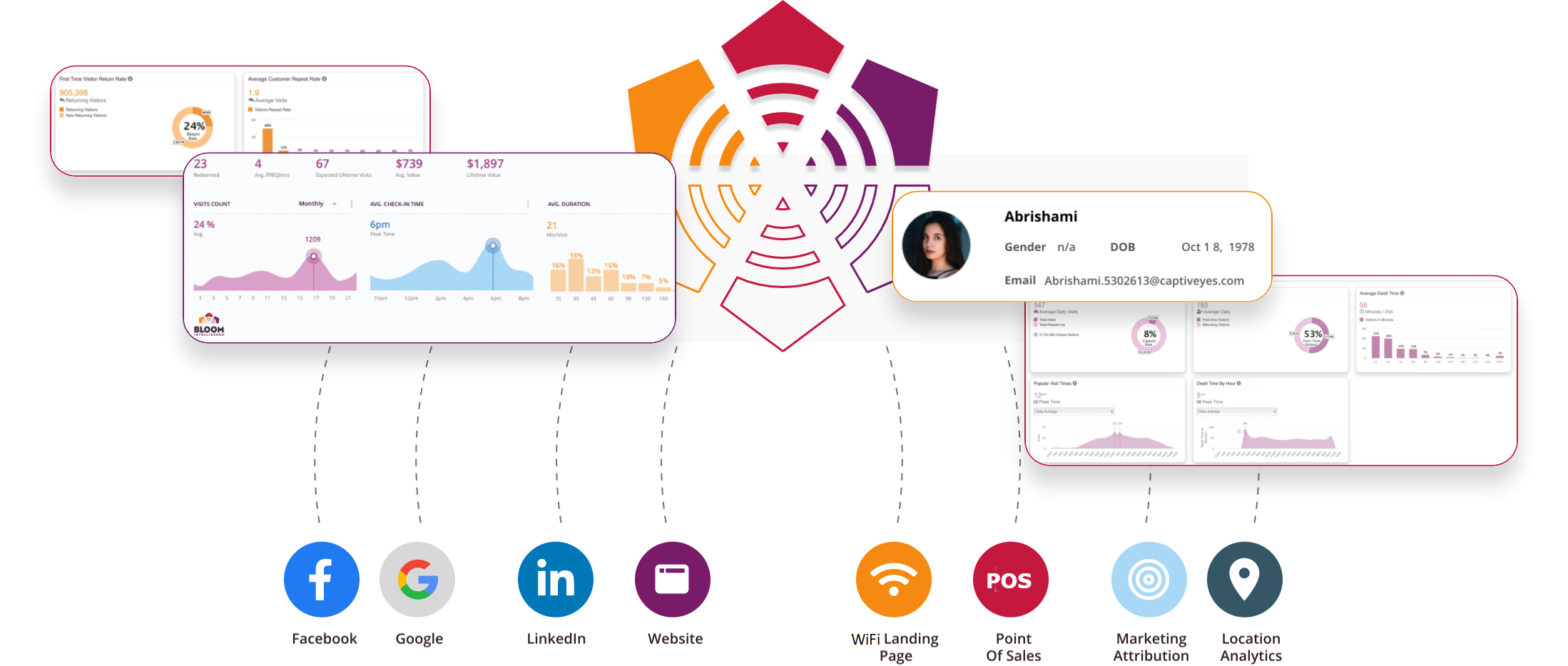
With WiFi marketing systems, we have the ability to see whether our customer has been to our location recently, regardless of whether they log in or not.
So, when it comes to recognizing and retaining customers you immediately have a distinct advantage. We only need to examine a real-case scenario to see how this applies.
Recognizing the At-Risk Customer
Even if you manage a single-location family-owned diner, you may believe you are “small enough” and have a volume manageable enough to recognize those at-risk patrons. But that may not truly be the case.
First, consider the lost revenue from one loyal customer, it can be significant. What is the lifetime value of a customer? How many meals will they purchase over the course of time and what does that mean to your establishment?
Further, if you are the owner or marketing director of a franchise restaurant chain, you have multiple locations, and losing customers results in substantial revenue loss. You may not have the luxury of being unaware of customer behavior when your competition is becoming more aware and proactive at enticing your loyal customers back to them.
Bloom Intelligence At-Risk Customer Trigger
Bloom Intelligence allows users to quickly create a beautiful message that they can send to their at-risk customers.
Then, a marketing campaign can be easily configured to send that message to any customer the system deems as being at risk of churning.
Bloom uses advanced algorithm sets to identify customers who are at risk of churning or not coming back to your restaurant or retail location. Users are seeing as much as 38% of their at-risk customers returning – many of whom they would have never realized were churning.
For a real-life case study, and more details about how to save your at-risk customers, download our free customer success story, or simply click on the banner below.
How to Attract Repeat Business from Millennials
If you have a retail store, restaurant, or other brick-and-mortar business, you depend a great deal on repeat customers. It can be particularly challenging to motivate millennials to return consistently to your business.
Millennials move at a fast pace and grabbing their attention can be difficult in today’s hyperconnected world.
This requires a well-conceived marketing strategy that understands their behavior and preferences. Here are some of the best ways to get more repeat business from millennials.
The Importance of Repeat Customers
Every business owner wants loyal customers who frequently return.
However, not everyone fully appreciates just how valuable such customers are. Research indicates that repeat customers typically account for most of a business’s total revenue.
 Once someone is in the habit of returning to your place, you no longer have to spend as much money convincing him or her to come back.
Such customers are more likely to refer their friends to your business. These are just some of the reasons that it makes sense to prioritize your returning customers.
Reach Millennials on Their Devices
The line dividing online and offline is getting thinner all the time. Today, it’s essential for brick-and-mortar businesses to have a website as well as social media pages.
If you want to attract millennials, it’s equally vital to connect with them on their smartphones with mobile apps, email, social media, and other online tactics.
Nielsen reports that 98% of millennials between 18 and 24 and 97% between 25 and 34 own smartphones. If you want to appeal to younger customers, you have to connect with them on the platforms they’re using.
Track Your Guests’ Behavior
The first step in attracting more repeat customers is to track the behavior of people who enter your business. Many businesses only know this in a casual manner, as when they recognize familiar faces.
You need a more reliable and systematic way to keep track of returning customers. One of the best ways to do this is through Wi-Fi sensor technology. Many of your customers, millennials, in particular, are likely to boot up their devices when they spend time in your space.
With wifi analytics, you can be notified whenever someone logs in using the same device more than once. This is an efficient way to measure repeat business.
Apply Triggered Marketing
Online marketers who send out emails and social media messages know the value of timing their communications. They study analytics about when people are most likely to read emails, Facebook posts, and other content.
Most marketing by brick and mortar businesses, on the other hand, doesn’t account for customers’ current locations or daily habits.
A newspaper ad, for example, is read whenever the reader happens to see it. Triggered marketing helps you increase engagement by connecting with customers at strategic moments and places.
With the help of the aforementioned Wi-Fi analytics, you can encourage your young customers to return by sending them timely offers.
For example, if someone eats dinner at your restaurant every few weeks and logs into your Wi-Fi, you can send him or her a coupon for a free entree that may entice him or her to try new dishes and return more often.
If you have a salon, you might have a customer who comes in every few weeks for hair styling. Before her next appointment, you could send a coupon promoting another service such as a manicure or massage.
Observe, Measure, and Improve
If you want your millennial customers to return to your business, make sure you’re constantly looking for ways to improve.
- Analyze your data. Track all of your results, whether from your website, social media campaigns, or emails. Always look for ways to improve your results. Split test elements such as headlines, subject lines, graphics, and layouts.
- Ask their opinion. Millennials love to tell you what they think. So ask them, whether it’s on social media or printed surveys that you hand out at your business.
- Reward and loyalty programs. These are familiar techniques but still effective, especially if you offer people discounts on products they highly value.
- Practice empathic design. While traditional analytics (which, as we just discussed, you should definitely study) focuses on the internet, empathic design is about observing customers in the real world and looking for ways to enhance their experience. Could you make the layout of your cafe or restaurant more comfortable? If you have several types of chairs, which do people prefer? Could you improve the atmosphere with a different type of lighting? These and other design elements can affect customers’ behavior and whether or not they return.
Don’t underestimate the value of repeat customers.
They are the bedrock of your business. Millennials are a fickle group, always looking for the latest, the best, and the hippest whether it’s coffee, beer, pizza, or fashion.
If you want to attract repeat business from this group, you have to be ready to constantly up your game.

Anatomy Of A Loyal Customer: Four Metrics To Look For
Why are loyal customers important? It seems like an easy question to answer, but not all companies understand how costly it is to lose–and have to replace–their customers.
Plus, companies may be doing irreparable harm to their brand if they aren’t recognizing why customers aren’t loyal to their brand.
Many marketers underestimate the importance of their loyal customers. Others recognize that importance, but struggle to find a way to track customer loyalty and reward loyal customers.
The Loyalty Landscape
Gaining and sustaining loyal customers is critical to the success of nearly every business.
Of course, it is not always easy, especially with changing customer landscapes. Marketers can’t deny the importance of capturing the hearts and wallets of millennials, whose purchasing power is expected to hit $1.4 trillion by 2020.
Yet, millennials–and those following behind them–are a new and challenging type of customer to engage.
The real trick is in customer retention. This comes down to, among others, customer service, access to information, brand recognition, and perks. According to one digital marketing company, sixty-six percent (66%) of customers switch brands because of poor customer service. Fifty-eight percent (58%) will never do business again with a company after a bad experience.
On the other hand, over seventy percent (73%) of customers will fall in love with a brand just from friendly customer service representatives. And, access to information will capture the hearts of fifty-five percent (55%) of customers.
Then, there’s the wallet factor. Many customers look for the best deal. If one company isn’t offering it, loyalty to that company isn’t going to keep them from shopping elsewhere. Of millennials aged 20-34, sixty-eight percent (68%) would switch brands to get more program rewards.
Brand recognition is also key. This may be due to people wanting to feel like the brand they love is loved by their peers. In the same way millennials turn to social media for personal reinforcement (hence, the rise of status-sharing & selfie-taking), they also look for this with regard to the brands they choose.
It’s no surprise that brand recognition is just slightly behind quality as the most important driver of brand loyalty for millennials.
Why are Loyal Customers Important?
Loyal restaurant customers provide the foundation for a profitable and successful business. They not only help a company grow fast when times are good, but they also help companies stay afloat when times are tough. Loyal customers are your best brand advocates. And, they show their loyalty through their wallets, buying more and buying more often.
A loyal customer also costs a business less. Once acquired, the company has spent what they need to spend upfront (at least for the most part). Losing that customer means replacing them, and spending the costs of client acquisition all over again.
Loyal customers will stay up to date on the brand, find answers to questions, and are willing to spend their social capital on the brands they love, such as sharing new products.
Sip on this. Coffee is ubiquitous. It’s cheap and you can find it anywhere. To many, it “all tastes the same.”
Yet, loyal customers not only will bypass a closer, more convenient shop, but they will bring their friends in, set up business meetings there, join the loyalty program, Instagram photos of their cup o’ joe, and put up with a long wait or a mixed-up order. They’ll even tote around your branded tumbler if they really love you.
Yet, because of the prevalence of quality coffee shops, with an instance or two of poor service, a rise in price, and the growing popularity of another nearby shop, a loyal customer may well be out the door.
Because the lifetime value of a customer is tied to business success, monitoring customer loyalty metrics is a good way of keeping an eye on the overall health of the business.
Here are some customer analytics metrics to which companies should pay attention.
1. Customer Return Rate
In some ways, hotels have it easy in the brick and mortar space. Each time a customer visits, they make a reservation. So, it’s fairly easy to know how many times a customer returns. For a retail store or restaurant, this isn’t so easy. However, with Wi-Fi analytics, it can be.
Every phone has a unique identifier known as a MAC address, and your Wi-Fi hotspot can use this to identify one customer from another. Every time they visit the store, those visits can be counted.
If you find that customers are not returning very frequently, you can work to address this with your marketing. Over time, you can also create buyer personas so that you better understand individual customer patterns and customize your marketing, accordingly.
2. Loyalty Program Sign-ups
Customer loyalty programs in retail are important to perk-driven millennials. Wouldn’t it be nice to know how many customers who are presented with the opportunity to join your customer loyalty program sign up? If you were to introduce the program–with a seamless sign-up process–as your guests login to your free wireless internet, you could have that data.
If you find that you’re struggling to get customers to join the program, you could survey your Wi-Fi users about what they look for in a loyalty or rewards program. All you need to do so is implement custom messaging on your Wi-Fi connection landing page. Or, offer a discount for signing in to the internet with an email. With that email address, you can invite them to join the program, reminding them of all the benefits they will receive.
3. Churn Rate
Churn rates and customer loyalty go hand-in-hand. If customer retention is low, it is indicative of a problem with the company’s ability to build and maintain loyal customers.
One way to track churn rate is to track how much traffic fails to return to the location after they visit. In tracking this metric, it is equally important to know the personas of the customers, so churn rates aren’t calculated as higher than they truly are. Having the tools to identify and understand individual shopping habits provide more accurate data.
Marketers can employ various tactics to avoid losing customers and improve customer retention. One way is to quickly and effectively manage feedback. Online reviews are becoming ever more critical to solicit and digest, as they can be a key indicator of why a company’s churn rate is higher than it should be.
Easily-deployable tools such as a Wi-Fi marketing platform can provide guests with the opportunity to give instantaneous feedback, so your team can follow up quickly on every response.
4. Net Promoter Score
A net promoter score tells a business how likely its customers are to recommend its product or service to others. This is an important component of customer analytics. If few of your customers are willing to tell others about your brand, you may lack the base of loyal customers you need.
Tracking net promoter scores can be particularly easy if you offer free Wi-Fi at your locations. When someone logs in, you can present the user with the question of “how likely are you to recommend our business to others?” You could even consider requiring that customers answer this question before they connect. With the response data, you are can start to understand one important metric of customer loyalty.
If your net promoter score is low, you can consider what next steps you need to take to boost the experience your customers have. Consider increasing opportunities for your customers to “bond” with the brand. Host “limited-space” events, dedicate time to “like” and “share” photos your customers post on Instagram and Facebook, train your employees on ways to remember customers and their “usual” order.
One cannot overemphasize the importance of finding a tool that can track these key customer loyalty metrics. Such a tool can help operators maintain a profitable and thriving business and can give marketers extra ammunition to fight brand wars. A Wi-Fi marketing and analytics platform that complements the free internet a business already offers to its guests is one tool to seriously consider.
5 Ways to Help Prevent Restaurant Customer Churn
Many restaurants and coffee shops focus mainly on increasing sales and the customers’ dining experience, giving less consideration to the importance of making sure that their customers remain their customers. Moreover, most owners and operators do not have an accurate way to measure their customer churn rate and keep it in check.
Customer churn rate refers to the overall percentage of customers who have decided to stop doing business with you. The best-case scenario for any business is to have a 0% churn rate. But this is simply not realistic – any business will experience natural attrition. There are ways, however, to keep your customer churn rate as low as possible.
Remind Your Customers You Are Giving Them the Best Product
 Your customers have plenty of options, no matter your industry. There is a fair chance that you’re not the only restaurant or retailer that can give them what they want, so don’t take your customers for granted or fail to recognize that there’s competition for your customers and their dollars.
Considering this, whenever you engage with your customers, make sure to remind them of the quality you offer with your product.
You don’t have to stuff every blog post or social media post with promotional fodder, but you do want to remind your customers that any new or recent feature you are offering provides a sense of value for them.
Also, be sure to thank your customers or clients for the chance to present your product or service to them – it will make them feel valued. As a result, should they have a negative experience with a rival company, they’ll likely come back to you and your brand.
React Swiftly to PR Mistakes and Bad Decisions
This might be easier said than done. Odds are that you won’t know you’ve made a bad decision until it has had a significant impact on your company. In this case, it’s all about how you manage the issue. The fact is that bad PR is unavoidable for most companies if they are successful and grow big enough.
A good example of a PR blunder was when Netflix increased its prices. Netflix thought it would be a good idea to split its streaming service from its DVD delivery service and raise the prices on both. Their customers did not react well, and there was a significant backlash. As a result, it’s very likely that Netflix lost some customers they may never get back.
Sometimes bad PR can be the result of a system crash, computer bugs, or flaws in the business model. Two examples are the Dropbox password debacle and the negative press regarding Airbnb. In these cases, it was the job of the company, and more specifically the CEO to find a way to manage each disaster quickly and restore brand confidence.
Understand and Fortify Your Weaknesses
Are you aware of why people might not want to dine at your restaurant or shop at your store? Are you aware of what your company frequently falls short of? In most cases, deciding that your business is flawless is a massive mistake. In this case, you have failed to really listen to your customers.
Every business has its weaknesses, and you need to know yours intimately. Also, you need to know how to fix these weaknesses quickly and how to keep them from turning into bigger problems. There are many cases of companies that failed to see a weakness coming that lost significant amounts of revenue as a result. What you need to remember is that those who try to take your customers – essentially robbing you of revenue – are trying to become the market leader by taking advantage of your weaknesses. These are your competitors, and you need to stay on top of your shortcomings to make sure they don’t capitalize on your faults.
An excellent way to identify your weaknesses is by setting up an effective system for collecting customer reviews.
Deliver on Your Promises
 Customers will become loyal to your eatery or your product because you have provided them with a unique advantage over your competition that they can’t find elsewhere.
However, if you neglect your efforts to keep promises, your customers will leave you. If Apple phones weren’t so easy to handle people would stop buying them.
The same goes for Amazon, if they suddenly failed at prompt deliveries or at having a massive stock of goods, they would lose their loyal customer. People rely on the promises companies make regarding their brands.
It is essential to the integrity and profitability of your brand, as well as to lower your customer churn rate as much as possible, that you keep your promises.
Gaining Insights from Traffic Analytics
Using a WiFi marketing & customer intelligence hub, like Bloom Intelligence, you can determine who makes up your audience of loyal visitors. You can also account for the length of time users visit and how their behavior at your location changes over time.
With this data, you’re able to get a much deeper understanding of your customers and create targeted campaigns to ensure they remain loyal to your business.
Bloom also uses intelligent algorithm sets to monitor each customer’s frequency distribution, individually and as a whole, to understand and accurately define your customer churn rate in real-time.
By analyzing individual customer frequency, Bloom can determine when a customer is at risk of churning or has churned. Then you can use the automated marketing suite of tools to send triggered messages to your at-risk and churned customers persuading them to come back.
In most cases, a high customer churn rate comes down to neutral or poor customer experiences. While you can persuade customers to give you another chance, you will still need to take the tips above into account to help keep customers from churning in the first place and to cement their loyalty when they give your business another chance.
For info on how to reduce your restaurant customer attrition using Bloom, click on the banner below!