

Marketing and business technology solutions continue to advance at a rapid pace. Today’s marketers are enjoying an excess of tools and solutions to utilize when creating, executing and measuring their multi-channel marketing campaigns.


Marketing and business technology solutions continue to advance at a rapid pace. Today’s marketers are enjoying an excess of tools and solutions to utilize when creating, executing and measuring their multi-channel marketing campaigns.

As the world navigates the COVID-19 pandemic, restaurants and retail businesses are doing everything they can to stay afloat until they can re-open their doors for on-premise dining again.
During these uncertain times, it is extremely important to continue communicating with your loyal customers and growing your customer database as quickly as possible.

In today’s connected world, positive customer ratings and reviews can be one of the most valuable and powerful customer acquisition and marketing tools for your restaurant business. If you’re currently not paying attention to your ratings and reviews, take a look at our post, Why Every Restaurant Should Care About Customer Ratings, to discover the potential revenue you’re undoubtedly leaving on the table.

Why are loyal customers important? It seems like an easy question to answer, but not all restaurant owners and operators understand how costly it is to lose, and then have to replace, their customers. Plus, companies may be doing irreparable harm to their brand if they aren’t recognizing why customers aren’t loyal to their brand.
Many restaurant marketers underestimate the importance and value of their loyal customers. Others recognize the importance, but struggle to find a way to track customer loyalty and reward their loyal customers.
Acquiring and keeping loyal customers is critical to the success of nearly every business. Of course, it is not always easy, especially with the amount of competition in the restaurant industry in 2025. Marketers can’t deny the importance of capturing the hearts and wallets of millennials, whose purchasing power is hit nearly $1.4 trillion in 2021. Yet, millennials, and those following behind them, are a new and challenging type of customer to engage.

The real trick is in customer retention. This comes down to, among other things, customer service, access to information, brand recognition and special perks for repeat customers. According to one digital marketing company, sixty-six percent (66%) of customers switch brands because of poor customer service. Likewise, fifty-eight percent (58%) will never do business again with a company after a bad experience.
Conversely, over seventy percent (73%) of customers will fall in love with a brand just from friendly customer service representatives. And, access to information will capture the hearts of fifty-five percent (55%) of customers.
Then, there’s the wallet factor. Many customers are simply looking for the best deal. If one company isn’t offering it, loyalty to that company isn’t going to keep them from shopping elsewhere. Of millennials aged 20-34, sixty-eight percent (68%) would switch brands to get more program rewards.
Brand recognition is also important in 2025. This may be due to people wanting to feel like the brand they love is loved by their peers. In the same way millennials turn to social media for personal reinforcement (hence, the popularity of status-sharing and selfie-taking), they also look for this with regards to the brands they choose to do business with. It’s no surprise that brand recognition is just slightly behind quality as the most important driver of brand loyalty for millennials.
Loyal customers provide the foundation for a profitable and successful restaurant business. These valuable customers not only help a company grow quickly when times are good, but they also help companies stay afloat when times are tough. Loyal customers are your best brand advocates. And, they show their loyalty through their wallets, buying more and buying more often.
A loyal customer also costs a business less. Once acquired, the company has spent what they need to spend upfront (at least for the most part). Losing that customer means having to replace them, and paying the costs of client acquisition all over again. Loyal customers will stay up to date on the brand, find answers to questions, and are willing to spend their social capital on the brands they love.
Sip on this. Coffee is ubiquitous. It’s cheap and you can find it anywhere. To many, it “all tastes the same.” Yet, a loyal customer will not only bypass a closer, more convenient shop, but they will bring their friends in, set up business meetings there, join the loyalty program, post Instagram photos of their cup o’ joe, and put up with a long wait or a mixed-up order. They’ll even tote around your branded tumbler if they really love you.
Yet, because of the prevalence of quality coffee shops, with an instance or two of poor service, a rise in price, or the growing popularity of another nearby shop, loyal customers may well be out the door. Because the lifetime value of a customer is tied to business success, monitoring customer loyalty metrics is a good way of keeping an eye on the overall health of the business.
Here are some customer analytics metrics to which companies should pay attention.
In some ways, hotels have it easy in the brick-and-mortar space. Each time a customer visits, they make a reservation. So, it’s fairly easy to know how many times a customer returns. For a retail store or restaurant, this isn’t so easy. However, with a quality Wi-Fi analytics platform, it can easily be done.
Every cell phone has a unique identifier known as a MAC address, and your Wi-Fi hotspot can use this to identify individual customers, whether they log into WiFi or not. Every time they visit the store, the device will be recognized and those visits can be counted. If you find that customers are not returning very frequently, you can work to address this with your marketing. Over time, you can also create buyer personas so that you better understand individual customer patterns and customize your marketing, accordingly.
Customer loyalty programs are important to perk-driven millennials. Wouldn’t it be nice to know how many customers who are presented with the opportunity to join your customer loyalty program sign up? If you were to introduce the program with a seamless sign-up process as your guests log into your free wireless internet, you could have that data.
If you find that you’re struggling to get customers to join the program, you could survey your Wi-Fi users about what they look for in a loyalty or rewards program. All you need to do so is implement custom messaging on your Wi-Fi connection landing page. Or, offer a discount for signing in to the internet with an email. With that email address, you can invite them to join the program, reminding them of all the benefits they will receive.
Churn rates and customer loyalty go hand-in-hand. If customer retention is low, it is indicative of a problem with the company’s ability to build and maintain loyal customers.
One way to track the churn rate is to track how much traffic fails to return to the location after they visit. In tracking this metric, it is equally important to know the personas of the customers, so churn rates aren’t calculated as higher than they truly are. Having the tools to identify and understand individual dining habits provides more accurate data.
Marketers can employ various tactics to avoid losing customers and improve customer retention. One way is to quickly and effectively manage feedback. Online reviews are becoming ever more critical to solicit and digest, as they can be a key indicator of why a company’s churn rate is higher than it should be.
Easily deployable tools such as a Wi-Fi marketing platform can provide guests with the opportunity to give instantaneous feedback, with the capability to send negative feedback to your customer relationship management team and positive feedback to online review websites.
A net promoter score tells a business how likely their customers are to recommend your product or service to others. This is an important component of customer analytics. If few of your customers are willing to tell others about your brand, you may lack the base of loyal customers you need.
Tracking net promoter scores can be particularly easy if you offer free Wi-Fi at your locations. When someone logs in, you can present the user with the question of “how likely are you to recommend our business to others?” You could even consider requiring that customers answer this question before they connect. With the response data, you can start to understand this important metric of customer loyalty.
If your net promoter score is low, you can consider what next steps you need to take to boost the experience your customers have. Consider increasing opportunities for your customers to “bond” with the brand. Host “limited-space” events, dedicate time to “like” and “share” photos your customers post on Instagram and Facebook, train your employees on ways to remember customers and their “usual” order.
One cannot overemphasize the importance of finding a tool that can track these key customer loyalty metrics. Such a tool can help operators maintain a profitable and thriving business and can give marketers extra ammunition to fight brand wars. A Wi-Fi marketing and analytics platform that complements the free internet a business already offers to its guests is one tool to seriously consider.

When most marketers think of content marketing, they think of the online variety. To be fair, the internet is a perfect medium for content marketing. But it’s often forgotten that this powerful marketing strategy began long before the idea of the World Wide Web was even conceived.
One of the original pioneers of content marketing was John Deere. In 1895, he published The Furrow magazine. The Furrow was not a sales-focused publication. Instead, it focused on informing and educating farmers on how to be better business owners. In fact, in the history of The Furrow magazine, which is still in publication some 125 years later, Deere & Co. have only mentioned their products and services in the magazine a handful of times.
This is a perfect example of content marketing.
What Is Content Marketing?
As it is defined today, content marketing is a strategic marketing approach focused on creating and distributing valuable, relevant, and consistent content to attract and retain a clearly defined audience and ultimately drive profitable customer action. It involves creating and sharing online and/or offline content that does not explicitly promote a brand but is intended to indirectly generate interest in its products or services.
“Traditional marketing with content means talking at someone about you. Content marketing means talking with someone about them.”
While it may be easier to run a successful content marketing campaign online, it is entirely possible to execute offline as well, as John Deere and many other companies, including restaurants, have shown us. It is also possible to create a hybrid content marketing strategy, using online and offline channels together.
The Best Tip To Get You Started – Customer Data
The first step for any successful restaurant content marketing campaign, whether online or offline, is becoming intimately familiar with your customers or intended audience. You need to know who they are, how they behave and interact with your business, and what kind of information they might be seeking.
The best way for restaurants to do this is to install and utilize a quality WiFi marketing and analytics platform, like Bloom Intelligence. Other data collection options are available, but they are very expensive and only provide a current snapshot of a small portion of your customer base.
WiFi marketing and analytics platforms, described in more detail below, can provide an ongoing, real-time view of a very large portion of your customer base – whether customers log into your WiFi or not. And WiFi analytics can be implemented at a small fraction of the cost of traditional market research solutions. You will also have the ability to collect very detailed customer information, behavior data and demographics.
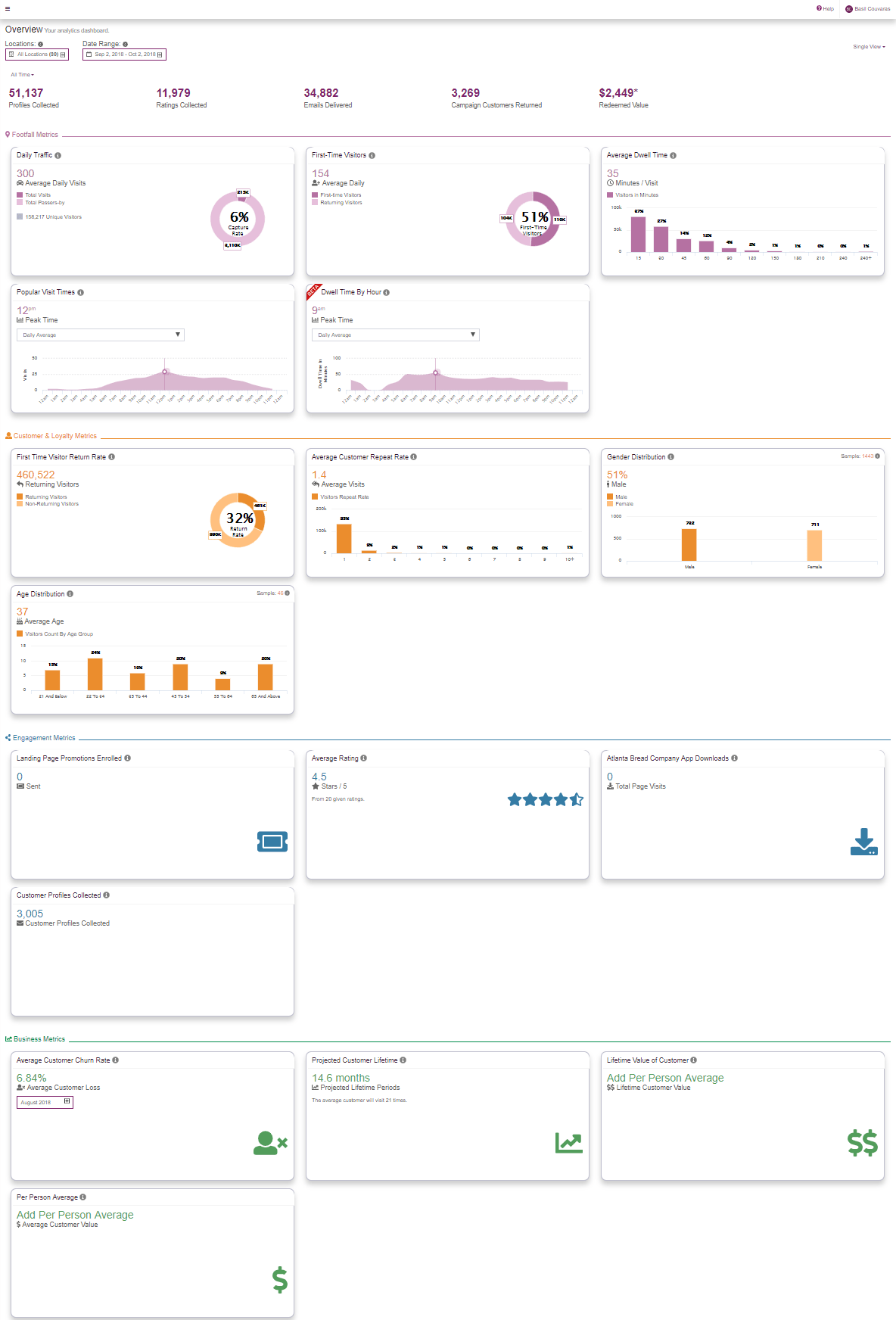
Through thorough research on the data you collect, you can begin to create your most ideal customer segments and craft the perfect strategy for each of them by finding the emotional value in the data. Remember, content marketing is not about going for the sale. It is providing each of these customer segments with information to show them, inherently, that what you offer can,and will, satisfy their needs.
At this point, your content marketing can begin to take shape. As you begin publishing and sending out your content, it is important to remember that this is just the beginning. You will want to constantly test new types of content, as well as new content topics, on each of your restaurant’s customer segments.
For optimal testing, you’ll need to be able to measure the success of each campaign. This is another reason why marketing and analytics platforms are so powerful for brick-and-mortar businesses. Solutions like Bloom Intelligence are ideal for tracking individual campaigns down to the individual customer level. You’ll be able to monitor each campaign and adjust/optimize your campaigns on an ongoing basis.
Using the definition of content marketing above, let’s examine a few of the ways that brick-and-mortar businesses and restaurants can reap the remarkable rewards of content marketing.
Blogging
Perhaps the most effective way to begin a content marketing campaign is to start a blog on your company website. Once set up, you should post to your blog on a consistent basis. You can blog every day, or once a week, or once a month, but whatever schedule you decide on, you should keep it consistent so that you’re not leaving your audience guessing when to come back for more.
Some topic ideas for content marketing for restaurants include:
Again, you won’t be selling your brand on your blog, you should simply be giving your customers the information they may be seeking. You could blog about specific types of diets, local events, holiday meals, different craft beer types or how to make a dollar go farther when dining out.
Guest Posting
Another great way of getting content out to the masses is by guest posting. This involves reaching out to related websites and offering to write content they can publish on their website. Typically, they will allow you to publish an author bio with your image and a short biography. This is where you would quickly mention your place of business.
You are essentially getting eyeballs on your content by way of the website’s loyal visitors. When they read your bio, they can make the connection between great, educational content and your place of business.
Likewise, you can usually link back to your website, which will increase your traffic and help with search engine optimization.
Podcasting
There are many great restaurant-related podcasts available today, covering anything from operations and management, to technology, to recipes, to new trends in the industry. Much like guest posting, you can reach out to these pod-casters and offer to be interviewed on a future show.
Think about what you can offer that is above and beyond the ordinary so you can showcase it in your outreach, and in the podcast as well.
You can easily query your favorite search engine to find them, but here is a short list of some of the top restaurant-related podcasts:
Content Marketing Through Email
Email has been, and continues to be, one of the best ways to reach consumers.
As you can see, collecting your customer email addresses is a crucial part of a successful offline content marketing campaign. When paired with a WiFi marketing and analytics platform, collecting email addresses becomes extremely easy. Testing various content types and topics also becomes easy while it allows you to track each individual campaign.
All you have to do is install the platform and everything is done behind the scenes. You will passively build a customer list thousands of customers without lifting a finger.
Using a WiFi Marketing and Analytics Platform
These platforms utilize your customer WiFi access points. They gather data from any mobile device with its WiFi signal turned on. Since each device broadcasts its own unique ID, the system will recognize each customer individually based on their mobile device. Specific behavior data can then be tracked on each device, including dwell times, repeat visits, days of the week or hours of the day when at your location, and much more. This data is collected by Bloom whether customers log into your WiFi or not.
When a customer logs into your WiFi, the system will capture their email address or social media profile, so you will be collecting those valuable email addresses and customer profiles passively. At this point, the system can then associate all previous activity from that device to the customer’s profile, as well as demographics such as gender, age, birthday and more.
With this kind of data, you can send content to your customer segments on a very granular level. And you’ll know each and every time they come back to your location.
With Bloom’s advanced reporting, it is easy to track the results of every campaign, all the way down to a customer coming back to your restaurant and/or redeeming an offer.
Get Started Today
One of the greatest things about content marketing is that you can get started immediately, and on a very limited budget. In some cases, it costs you nothing but the time it takes to write your content and find the perfect place for it to be published.
But the most important thing is that you get started as soon as possible. Competition is fierce in today’s marketplace and it’s up to you to stay a step ahead. Content marketing can provide you with an inexpensive and powerful way to create relationships with your customers, keep you top-of-mind, and keep them coming back again and again.
When most marketers think of content marketing, they think of the online variety. To be fair, the internet is a perfect medium for content marketing. But it’s often forgotten that this powerful marketing strategy began long before the idea of the World Wide Web was even conceived.

Every successful business relies on an effective marketing strategy, and that marketing strategy can only be effective when customer segmentation is implemented. Simply put, customer segmentation is the process in which business owners divide customers and leads into specific groups as it relates to marketing.
Essentially, customer segmentation will narrow down your target audience, allowing you to market with more precision. Additionally, you are more likely to have a business that is successful because customer segmentation helps you understand your customers’ needs and behaviors. With specific data bout your various customer groups, you can personalize your messaging and marketing for more effectiveness. Ultimately, without customer segmentation, your marketing efforts will come back void. For this reason, we’re going to show you how to use customer segmentation for your business.
Demographic: This is market segmentation based on things, such as age, race, religion, gender, ethnicity, income, and education. Demographics is integral for marketing because it helps you create a profile of your ideal customer. From there, you are able to learn important things about your customers, such as their interests and preferences. This ultimately allows you to improve your marketing efforts by marketing to potential customers in a way that interests them.
Geographical: This is market segmentation based on location. You can geographically segment by areas such as cities, states, regions, and countries. Segmenting geographically has proved to be successful for many businesses. For instance, a business selling boating gear will find the most success marketing to the southern region of the U.S. Similarly, a company that sells winter sports gear will find that marketing to the northwest region will be best suited. Essentially, customer segmentation helps business owners to understand where their ideal customers are so that they have a better chance of selling their product or service.
Psychographics: This involves dividing your market into segments based on things such as social class, lifestyle, and personality traits. Psychographic segmentation is beneficial because it is one of the more personal ways to segment your ideal customers. What this essentially means is that you can gain a competitive advantage because you are placing yourself in the mindset of the consumer, which allows you to understand important things about your customers, such as their values. Ultimately, this can be leveraged to create a powerful marketing strategy to effectively target your ideal customers.
Behavioral: This type of segmenting focuses on your ideal customer’s spending and consumption habits, product and service usage, and desired benefits. Behavioral segmentation is extremely beneficial to businesses because it helps you understand why consumers buy certain products. Additionally, it allows you to tailor your product or service to meet the needs of your customers. Behavior segmentation will reveal purchasing patterns that consumers have. Ultimately, this poses a great opportunity for businesses to advertise a campaign or schedule a promotion during the time consumers are more likely to purchase.
There are various ways to collect customer data for your business. Some of these ways include, but are not limited to:
Surveys: Running a survey on your business is an excellent way to collect valuable information on your customers. You can easily obtain a generous amount of data from a survey, such as age, gender, and location.
Form Orders: If customers purchase a product or service from your website, you can request additional information such as contact details and their birthday.
Rewards Program: Everyone loves a rewards program, which is why this poses a perfect opportunity for business owners to collect information from customers.
Wi-Fi: If you have a physical location, providing Wi-Fi to customers is going to be one of the most easiest and convenient ways to collect customer data. Essentially, customers can seamlessly give information about themselves in exchange for Wi-Fi access.
Customer segmentation gives business owners a better understanding of their consumers’ needs. This gives them a competitive advantage because they have a better idea of who is interested in their product or service. Additionally, customer segmentation gives business owners the opportunity to revise their product or service to be more attractive to customers. Furthermore, having defined segments allows businesses to have a more effective marketing message to spark the interest of potential customers. Additionally, business owners can expect to see more engagement because customer segmentation gives valuable information about consumers that can be used to their advantage. If that’s not enough, customer segmentation allows businesses to strengthen their position in the market. Ultimately, the precision of customer segmentation allows businesses to increase their customers’ experience, improve their brand, and generate more revenue as a result.
{{cta(’78d76744-3719-4adf-bd4d-ccaae98a6da7′)}}

Customer retention is a crucial factor in the success of all businesses, but particularly important in the restaurant industry. Among the KPIs restaurants need to track, repeat business is a significant indicator of customer loyalty and helps drive the lifetime value of a customer.
Loyal customers typically fall into these three categories:
These are customers who not only visit constantly, but recommend your restaurant to others, post positive reviews online, and mention you on social media. These advocates are invaluable, boosting your brand awareness and visibility, and providing unbiased referrals to everyone who they influence. Brand evangelists are key drivers of long-term success in any business: not only do they advertise your restaurant at no cost to you, but their recommendations are trusted by 92% of people, compared to the 24% of people who trust ads. In most industries, a single brand advocate generates 2.5 new customers, but in the restaurant industry that number is much higher.
These customers have made your restaurant part of their routine, whether it’s coffee every morning, or brunch every Saturday. Among a wide variety of options, they continue to choose your restaurant. In fact, psychology studies demonstrate that once a consumer has formed a habit by repeating the same choice over and over again, the behavior reinforces itself and will continue unless the brand changes so much that it prompts a new choice.
While special occasioners are sometimes slightly maligned as the compromise choice (the one restaurant the whole family can agree on, for example), these customers also have significant lifetime value. Whether it’s the family tradition, the annual birthday or anniversary, or the favorite restaurant during vacation, these customers choose to create and share some of their most special and significant moments in your restaurant, building important lifetime memories around their experience.
No matter which kind of repeat business you have, there are important reasons to track the lifetime value of your customer.
If you haven’t yet figured out the lifetime value of your customer, the folks at nextrestaurant.com have come up with a convenient calculator that allows you to calculate the lifetime value for free, anonymously. Importantly, you can even store the results and track changes over time, to see how your efforts are paying off.
In every business, customer lifetime value is an important metric to track. But in restaurants, where competition is so fierce, loyalty is key to survival, and word of mouth can make or break you, it’s more important than anywhere else. If you aren’t yet tracking the lifetime value of your customer, and using that information to inform business and marketing decisions, it’s time to begin, and know the real value of your customer.
In the “old days” people opened the phone book to find restaurants, services and products they needed. Today, they open their smart phone and search Google or their favorite review site.
In many searches, it’s the review sites that come up first. Sites like Yelp! and Tripadvisor, for example, are popular review sites that millions of people use to inform their buying decisions. Some people simply don’t purchase or use a service without consulting their favorite trusted review site. With that in mind, here are some tips to help your business get more positive reviews.
The first two tips are about creating a positive experience for your customers, which may seem obvious, but it’s a good idea to keep reviews in mind. People will often be quicker to leave a bad review than a good review. Keeping your customers happy is one of the best ways to avoid a poor review.
People expect good service. If you give them what they want, they will likely come back and do business with you again. This is wonderful, however you are looking for more. You not only want repeat business, you want your customer to sing your praises. You want them to tell their friends and family about you, and you want them to leave you a five-star review on Yelp! or Google or Zomato.
People aren’t likely to go out of their way to leave a review for “decent” or even good service. You have to find a way to set yourself apart from other businesses. When you go the extra mile or offer a unique, personal touch, you will inspire your customers to leave that glowing review.
This is the best way to avoid a poor review. People want to be heard and acknowledged, and most customers are ecstatic when a business “makes it right.” When the customer is disappointed and feels like they aren’t being heard they are motivated to leave negative reviews.
Of course, there are always those people who just seem to want to write bad reviews, but you can dramatically reduce these instances by addressing problems as they come up, making the situation right, and giving your customer the feeling that they matter and are valued. In fact, many a loyal customer has been created by the way a business handled a “bad” experience.
Review sites help you show up in searches, so it is important that you maintain your profiles with correct and current information.
Finally, make it easier for people. Let them know how they can leave you a review and where they can leave you a review. Be sure that you have active links to review sites in your email signatures, blog posts and social media. Do you have a Wifi sign-in page? This is another good place to ask for and link to a review.
Remember, it is okay to ask for a review and to let your customers know how important reviews are to your business. Too many businesses fail to do this, by simply asking for the review and making it as simple as possible to do so, you dramatically increase the number of positive reviews your business receives.
You want to integrate Wi-Fi into your restaurant. You know businesses that don’t offer free Internet often lose customers to competitors. Actually, one survey showed 70% of customers felt Wi-Fi made their restaurant experience better. You’re concerned about the cost, because the Internet will be free for your customers but not for you. As a smart business person, however, you should know it is actually possible to get your customer Wi-Fi to pay for itself. That may not make sense to you at first, but here are some of the ways it can be done to retain loyal customers and keep new customers coming back–both of which will result in more money, which can pay for the free Internet you will provide.