


Author: Allen Graves

The Marketing Multiplier Effect: How Restaurant Operators Are Building Enterprise-Level Marketing Machines with Lean Teams

Picture this: Sarah runs three casual dining locations in Denver. Six months ago, she was drowning in spreadsheets, manually sending birthday emails to a fraction of her guests, and watching competitors with massive marketing budgets steal market share.

Today, her locations are outperforming regional chains with sophisticated guest segmentation, automated win-back campaigns, and reputation management that happens while she sleeps.

What changed? Sarah discovered what David Ogilvy called “the big idea” in restaurant marketing: the power of guest intelligence married to automation.

restaurant manager who discovered guest intelligence marketing

The Research That Changes Everything

Ogilvy once said, “The more facts you tell, the more you sell,” but for restaurant operators, the challenge has never been about facts. It’s been about knowing which facts matter when you’re juggling kitchen operations, staff schedules, and daily fires.

Modern restaurant operators face an impossible equation: guests expect personalized experiences rivaling those of Netflix and Amazon, while most restaurant teams lack the data infrastructure, marketing expertise, or time to deliver on these expectations.

The result? Generic blast emails, reactive social media management, and watching high-value guests slip away to competitors who seem to “get them” better.

Recent industry analysis reveals that restaurants utilizing integrated guest intelligence platforms see 34% higher guest lifetime values compared to those relying on traditional point-of-sale data alone.

But here’s what’s truly remarkable: these results aren’t coming from restaurant groups with massive marketing departments. They’re coming from operators like Sarah—lean teams that have discovered the marketing multiplier effect.

The Psychology of Restaurant Guest Behavior: What Ogilvy Would Recognize

David Ogilvy understood that successful advertising must respect the audience: “Don’t address your readers as though they were gathered together in a stadium.

When people read your copy, they are alone.” This principle applies perfectly to restaurant marketing, where the most effective campaigns feel like personal recommendations from a friend who knows your preferences.

Consider how guest behavior actually works in the restaurant industry:

The Super Guest Psychology: Your highest-value guests—those visiting 8+ times annually—represent only 15% of your customer base but generate 45% of your revenue. These guests aren’t motivated by discounts; they’re driven by recognition, exclusive experiences, and feeling like insiders. Yet most restaurants treat them the same as one-time visitors.

The Cooling-Off Guest Pattern: When regular guests reduce their visit frequency by 40%, traditional marketing approaches wait until they’ve already churned to react. Predictive guest intelligence identifies these patterns 60-90 days earlier, when intervention can still preserve the relationship.

The Reputation-Revenue Connection: A single negative review doesn’t just impact that guest’s future visits, it influences an average of 22 potential guests who read it. But when operators can identify and address concerns before they become public complaints, they transform potential detractors into advocates.
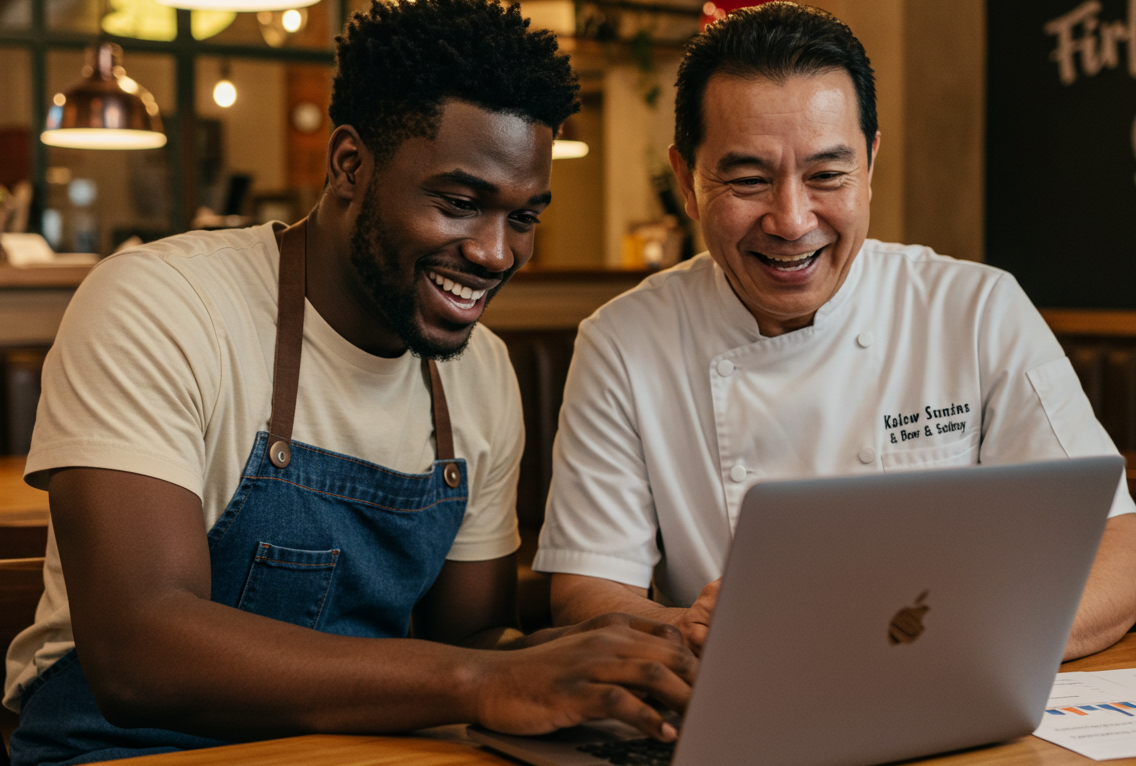
excited restaurateurs discovering guest intelligence and seeing results

Beyond Traditional Marketing: The Operating System Approach

Most restaurant marketing feels like playing whack-a-mole: responding to reviews when they appear, sending emails or texts when you remember, posting on social media when there’s time.

This reactive approach burns out lean teams and produces inconsistent results.

The operators achieving enterprise-level results have adopted what we call the “marketing operating system” approach. This is where guest intelligence, marketing automation, and reputation management work as an integrated engine rather than separate tools.

Here’s how this translates into real operational advantages:

Automated Guest Journey Orchestration: Instead of remembering to send welcome emails to new guests, the system automatically identifies first-time visitors through WiFi or online ordering data, triggers personalized welcome sequences, and nurtures them toward their second visit, the make-or-break moment for guest retention.

Predictive Intervention Campaigns: Rather than waiting for guests to complain publicly, the platform monitors review sentiment patterns and automatically reaches out to guests showing dissatisfaction signals, often resolving issues before they become public problems.

Industry Intelligence Without the Legwork: The system continuously monitors industry benchmarks and performance, alerting operators to opportunities (like specific calls to action around the great service from a specific employee) or threats (like the quality of a new menu item) without requiring manual research.

The Facts That Drive Revenue: Real Examples from the Field

Ogilvy believed in “informative advertising” and often said, “The consumer is always on the lookout for new products or new improvements in an old product, or new ways to use an old product.”

In restaurant marketing, guests are constantly seeking reasons to choose your location over countless alternatives.

Consider these scenarios playing out daily across successful restaurant operations:

The Recovery Revenue: A Texas BBQ chain identified that guests who complained about wait times had a 67% chance of not returning. By implementing automated follow-up sequences offering expedited service on their next visit, they recovered 41% of these at-risk relationships, adding $127K in annual revenue per location.

The Cross-Location Opportunity: A Mediterranean concept discovered that 23% of their guests traveled between their three cities for work. Automated campaigns promoting their other locations when guests traveled resulted in a 28% increase in cross-location visits, essentially creating new revenue from existing guests.

The Timing Intelligence: Guest profile analysis revealed that certain guest segments had distinct visit patterns tied to weekday versus weekend preferences and local events. Automated campaigns triggered by historical visit data and sent to high-value segments 48 hours before their typically preferred dining times increased repeat visits by 31% during previously slow periods.

group of restaurant marketers studying their results

The Compound Effect: Why Small Teams Generate Big Results

The most successful restaurant marketing doesn’t happen during business hours. It happens automatically, based on guest behavior triggers and data insights that would be impossible for even large teams to monitor manually.

This creates what economists call “increasing returns.” This is where additional effort produces disproportionately large results.

Traditional marketing efforts follow linear returns: double your effort, roughly double your results. But when guest intelligence, automation, and reputation management compound, small inputs create exponential outputs.

A single guest profile powered by integrated data sources – WiFi behavior, order history, review patterns, reservations – enables dozens of automated touchpoints that feel personal and timely.

This same guest, under traditional approaches, might receive generic monthly newsletters and nothing else.

The operational beauty lies in the time economics: sophisticated automation launches with one-click simplicity using AI-powered brand voice and guest insights, while offering granular customization for operators who want deeper control.

A marketing manager can orchestrate campaigns for thousands of guests with the same effort previously required to manually manage hundreds.

Implementation Reality: From Overwhelming to Operating

Ogilvy emphasized that “if consumers were interested in a product, they would read the entire ad,” but restaurant operators don’t have time to read entire things. They need systems that work immediately and improve continuously.

The most successful implementations follow a predictable pattern:

Phase One: The Foundation (Day 1): Instant integration of existing data sources (POS, WiFi, online ordering, reservations, review platforms) into unified guest profiles. What previously took months of technical implementation now happens immediately, giving operators instant visibility into guest behavior patterns that were previously invisible.

Phase Two: The Automation (Days 2-7): One-click launch of core automated campaigns that seamlessly integrate with operations, such as welcome sequences for new guests, win-back offers, automated surveys, and sentiment-based insights. These sophisticated campaigns that once required weeks of setup now deploy instantly while providing actionable insights that enhance day-to-day service delivery.

Phase Three: Ongoing Optimization: Continuous operational integration where marketing drives service excellence as guest behavior evolves. Staff can identify when at-risk guests visit through offer types in the system (enabling proactive service recovery), while the platform provides easy-to-follow suggestions for operational improvements based on changing sentiment patterns and benchmarking data.

Phase Four: Continuous Amplification: Complete operationalization where marketing intelligence becomes operational intelligence that adapts automatically. The platform continuously provides simple, actionable suggestions for improving specific service areas as guest feedback patterns shift, highlighting new improvement opportunities and ensuring seamless coordination between marketing campaigns and front-of-house execution without requiring constant manual oversight.
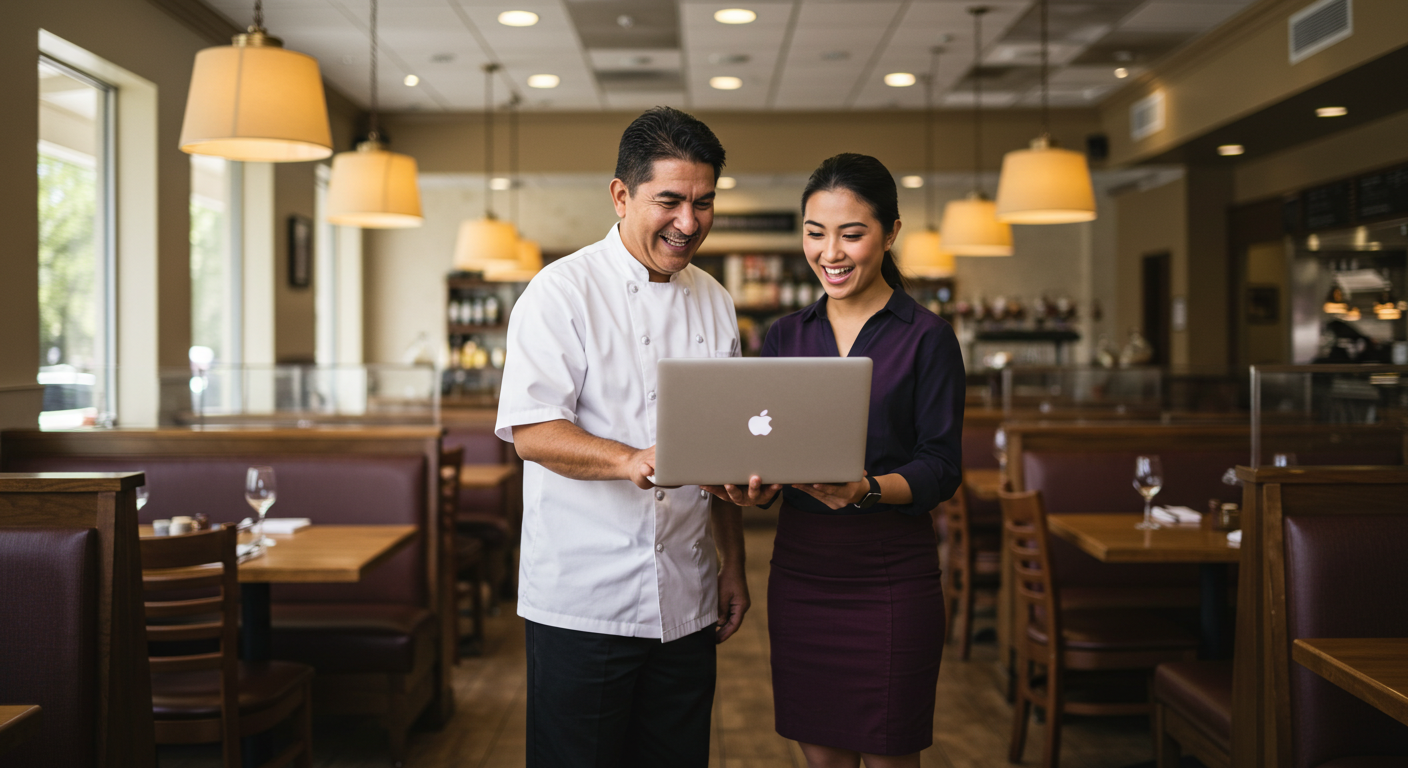
Restaurant owners enjoying their successful marketing

The Opportunity: What This Means for Your Operation

For lean teams, the opportunity is simple yet transformational: run sophisticated marketing and when responding to guest sentiment internally or externally, that drives real revenue and operational improvements while you focus on what you do best, running great restaurants.

This isn’t about replacing your judgment with algorithms or becoming a tech company. It’s about amplifying your existing guest relationships with systems that scale your personal touch.

The operators succeeding with this approach share common characteristics: they understand that every guest interaction generates data, they recognize that timing matters as much as the message in marketing, and they’re willing to invest in systems that work automatically rather than requiring constant manual effort.

The Measurement That Matters: Beyond Vanity Metrics

Ogilvy’s advertising philosophy emphasized that “the function of advertising is to sell,” and restaurant marketing must ultimately drive revenue, not just engagement metrics.

The operators achieving sustainable results focus on metrics that correlate with business outcomes:

Guest Lifetime Value Progression: Tracking how marketing automation increases the average guest relationship value, or customer lifetime value, over time, not just immediate campaign opens or clicks.

Retention Rate Improvement: Measuring how predictive interventions reduce guest churn, particularly among high-value segments.

Sentiment Improvement by Category: Tracking how targeted operational changes based on guest feedback improve specific areas like food quality, service speed, or ambiance over time.

Guest Database Growth and Enrichment: Tracking how the size and richness of your guest database correlates with marketing effectiveness, as a larger, more detailed guest database provides exponentially more targeting and personalization opportunities.

These metrics reveal the true multiplier effect: lean teams generating enterprise-level results through systems that work continuously, improve automatically, and scale effortlessly.

The Competitive Advantage That Compounds

In an industry where margins are thin and competition is intense, the operators building sustainable advantages aren’t just improving their food or service, they’re creating guests’ experiences that feel impossibly personalized at scale.

When a guest receives a perfectly timed offer for their favorite menu item during their typical visit window, or when a potential negative experience gets resolved before it becomes a public complaint, these moments create loyalty that transcends price competition.

The compound effect means that operators who implement these systems today aren’t just improving their current results, they’re building data assets and guest relationships that become more valuable over time.

Every guest interaction generates intelligence that improves future interactions, creating a virtuous cycle that competitors find increasingly difficult to match.

For restaurant operators ready to multiply their marketing impact without multiplying their workload, the opportunity has never been clearer. The question isn’t whether guest intelligence marketing works; it’s whether you’re ready to give your lean team the leverage to compete with enterprise-level results.

Ready to discover how guest intelligence can transform your restaurant marketing? The data is already there—it’s time to put it to work.
Let Bloom Intelligence Make It Effortless

Bloom Intelligence is an AI-powered restaurant marketing platform. It includes a powerful customer data platform, website integrations, automated guest data collection, one-click audience segmentation, marketing automation via email and SMS, advanced reputation management, and impressive reporting tools.

Bloom makes guest data collection and reputation management effortless, which allows you to quickly execute the strategies listed above, saving you time, increasing customer lifetime values, attracting new guests, improving your reputation, and boosting your bottom line.

Call us or schedule a free demo online and Bloom will show you how our restaurant marketing platform can help you save time and increase your customer lifetime values by automatically building first-party customer databases, unlocking important guest insights to trigger automated marketing at the right time and place, discover true guest sentiment, save at-risk guests, increase your current guests’ frequency, supercharge your website, and find new guests.

Click to schedule a Free Online Demo, or call 727-877-8181 to see how we can help you drive tangible results for your restaurants.

The Untapped Goldmine of Birthday and Anniversary Marketing

Every Celebration Is a Revenue Opportunity

Picture your dining room alive with energy—birthday candles flicker, champagne corks pop, and laughter spills across the room. Now imagine that same joyful scene unfolding every day. Not just once a year. Not just for one person. But for every guest celebrating something meaningful, with you.

Strategic birthday and anniversary marketing isn’t fluff. It’s a high-return move grounded in predictable human behavior: people spend more, invite others, and feel an emotional pull when brands recognize their milestones.

The Math Behind the Magic

Still think birthday emails are a gimmick? Think again:

  • Birthday emails drive a 481% higher transaction rate than standard promos.
  • 79% of consumers say birthday offers influence where they dine.
  • 38% are more likely to share experiences on social media during special events.
  • Anniversary messages boost guest return rates by up to 30%.
  • Tie that into loyalty, and LTV increases by 20–40%.

This isn’t just hospitality. It’s growth hacking for restaurants, because these moments don’t just drive a single visit. They trigger higher frequency, bigger party sizes, and stronger brand affinity.

What Makes Birthday and Anniversary Guests So Valuable?

Let’s break it down:

  • Group Impact: Celebrants rarely dine alone. Most birthday parties draw 5–6 people, boosting your average check size without any extra marketing spend.
  • Higher Spend Per Capita: Emotional occasions loosen wallets. Guests spend up to 1.5x more.
  • Free Word-of-Mouth: When you deliver a memorable birthday experience, your guest becomes your marketer.
  • Deeper Loyalty: People remember the brands that recognize them. Over 70% are more loyal to those who acknowledge life milestones.
  • Multiple Touchpoints: Birthdays and anniversaries often turn into multi-day celebrations, offering several chances to connect and convert.

If you’re not capitalizing on these moments, you’re leaving lifetime value on the table.

The Blueprint: How to Build a Revenue Engine from Guest Milestones

Step-by-step, here’s how smart restaurants create an always-on, always-personal celebration strategy:

  • Capture Data with Intention
    Use WiFi, reservations, POS, and online orders to collect birthday and anniversary dates automatically. Make it frictionless.
  • Craft Emotionally Intelligent Messages
    “Happy Birthday!” is table stakes. Add an enticing offer, pair it with heartfelt visuals, and make it sound like you know them, because you do.
  • Automate Without Losing the Human Touch
    Automate delivery using email and SMS, but personalize it using guest behavior data: visit frequency, past spend, dwell time, preferred times, etc.
  • Segment Smartly
    Don’t blast. Build smart lists—first-time celebrants, high spenders, at-risk guests—and treat them differently. Loyalty lies in the details.
  • Track ROI Like a Pro
    Use location-level data and attribution tools to tie messages directly to visits, spend, and return rate. This is how you turn creativity into revenue.

Let the Data Do the Work

Bloom Intelligence empowers restaurants to automate these campaigns across channels. But more importantly, it adds the context—who the guest is, how often they visit, how much they spend—so every “Happy Birthday” becomes a meaningful, revenue-generating interaction.

We believe data should make marketing feel more human, not less. That’s the edge.

From Pain to Profit: How Smart Operators Transform Guest Sentiment into Operational Excellence

The moment every restaurant operator dreads: Opening that email notification and seeing a scathing 1-star review. Your heart races. Your blood pressure spikes. The urge to fire back with a defensive response is overwhelming.

“They clearly don’t understand our business…” “This customer is being unreasonable…” “We can’t please everyone…”

But here’s the hard truth that separates thriving restaurant chains from the 80% that fail within five years: Every piece of guest sentiment—positive, negative, or neutral—contains actionable intelligence that can drive operational excellence and profitability.

The Hidden Cost of Defensive Thinking

When that negative review lands in your inbox, your first instinct might be to dismiss it or craft a defensive response. But consider this: millions of reviews in our platform data show that sentiment isn’t random—it’s a direct reflection of operational consistency.

The restaurant guest who complained, “The food was great, but our table was sticky and there were crumbs still on the seats from previous guests. The server was friendly but clearly rushed—we had to ask twice for water refills. Good concept, just needs more attention to the details,” wasn’t just venting. They were providing a free operational audit worth thousands in consulting fees.

Every frustrated guest represents dozens of silent guests who simply won’t return. For every one complaint you receive, research shows 26 guests don’t complain—they just leave and never come back.

Why Every Sentiment Contains Gold

Here’s the mindset shift that changes everything: Your guests aren’t enemies trying to destroy your business—they’re essentially unpaid consultants giving you free advice on how to make more money.

The customer who takes time to write a detailed complaint cares enough about your restaurant to help you fix it instead of just walking away forever.

Consider these real examples from the Bloom Intelligence platform data:

The Operational Excellence Indicator: “Morning crew are much better. Every time I go in the late afternoon there is no supervision and the quality of service is terrible.”

Translation: You have a staff management and training consistency problem during specific shifts. This isn’t a customer problem—it’s a systems problem with a clear solution.

The Process Breakdown Alert: “Love the food, but a huge lack of efficiency in the order line. Multiple cashiers answering the phone while in the middle of taking orders.”

Translation: Your front-of-house workflow needs restructuring. This guest just identified a revenue optimization opportunity disguised as a complaint.

The Training Gap Signal: “Cashier was uncertain about coffee offerings and service was slow. No collar was offered for the hot cup.”

Translation: Product knowledge training gaps and service standard execution issues—both completely fixable with proper systems.

The All-Eyes-on-You Reality

Here’s what keeps smart operators up at night: Other guests are watching how you handle every piece of customer sentiment. Your response to criticism becomes part of your brand story.

Research shows that 89% of consumers read business responses to reviews. How you handle that scathing review about slow service becomes a public showcase of your commitment to improvement—or your defensiveness.

The guests who gave you 5-star reviews are watching to see if you deserve their loyalty.

The guests considering trying your restaurant are watching to see if you listen and improve.

Manual Strategies for Operationalizing Sentiment

Here are a few strategies to help get you started on the road to operational success.

1. The Daily Sentiment Dashboard

Create a simple tracking system:

  • Daily sentiment score: Calculate average ratings
  • Complaint categorization: Service, food quality, cleanliness, staff, systems
  • Frequency analysis: Which issues appear repeatedly?
  • Location comparison: Which locations perform better/worse?

2. The Root Cause Investigation Process

For every complaint rated 3 stars or below:

  • Immediate acknowledgment (within 2 hours)
  • Internal investigation with staff who worked that shift
  • Process review: What systems failed?
  • Corrective action plan with timeline
  • Follow-up measurement to ensure resolution

3. The Positive Sentiment Amplification System

Don’t just fix problems—amplify what’s working:

  • Identify which staff members get mentioned in positive reviews
  • Document processes that consistently generate praise
  • Share positive sentiment in team meetings
  • Use positive reviews for training new staff

4. The Competitive Intelligence Extract

Analyze sentiment patterns to understand:

  • What your competitors are doing wrong (opportunity gaps)
  • Industry-wide problems you can solve better
  • Emerging customer expectations you can get ahead of

Automation Strategies That Scale

Sentiment-Triggered Operational Workflows

Smart operators use automation to turn sentiment into immediate action:

  • Auto-escalation: Reviews below 3 stars automatically notify management
  • Pattern recognition: When similar complaints hit a threshold, trigger staff retraining
  • Positive reinforcement: High-rated staff automatically entered into recognition programs
  • Inventory alerts: Food quality complaints trigger supply chain reviews

Real-Time Operational Dashboards

Advanced platforms can provide:

  • Sentiment trends
  • Staff performance correlation with guest satisfaction
  • Menu item sentiment analysis

Automated Response Systems

But not what you think—automation should handle:

  • Initial acknowledgment and concern
  • Internal team notifications
  • Follow-up scheduling
  • Sentiment categorization and routing

Never automate: Actual problem resolution or detailed responses to complex issues.

Measuring What Matters: KPIs for Sentiment-Driven Operations

Leading Indicators

  • Response time to negative sentiment (target: under 2 hours)
  • Resolution rate (percentage of complaints that become satisfied customers)
  • Sentiment trend direction (improving vs. declining over time)
  • Staff mention frequency (positive vs. negative)

Lagging Indicators

  • Review rating improvement (month-over-month trending)
  • Customer retention rates correlated with sentiment response quality
  • Revenue impact from sentiment-driven operational improvements
  • Employee satisfaction scores (often correlates with customer sentiment)

The Competitive Advantage Hidden in Plain Sight

Here’s the secret most operators miss: Your competitors are probably handling sentiment reactively, defensively, or not at all. This creates a massive opportunity for operators who treat sentiment as operational intelligence.

When you consistently turn negative sentiment into operational improvements, you’re not just fixing problems—you’re building systematic competitive advantages that competitors can’t easily replicate.

Example transformation cycle:

  • Guest complains about inconsistent food quality
  • Investigation reveals prep timing issues during rush periods
  • Operational adjustment to prep schedules implemented
  • Food quality complaints drop 60%
  • Average rating increases from 3.8 to 4.2
  • Higher ratings drive more traffic and revenue
  • Improved systems make staff jobs easier
  • Better staff satisfaction creates better guest experiences
  • Virtuous cycle established

The Bottom Line: Sentiment as Strategy

Smart restaurant operators understand that guest sentiment isn’t just feedback—it’s free market research, operational consulting, and competitive intelligence rolled into one.

Every day you’re not systematically capturing, analyzing, and operationalizing guest sentiment, your competition has the opportunity to get ahead. Every complaint you handle defensively instead of strategically is a missed opportunity to build operational excellence.

The restaurants that survive and thrive aren’t the ones that avoid negative sentiment—they’re the ones that transform sentiment into systematic operational advantages.

Your guests are already telling you exactly how to build a better restaurant. The question isn’t whether you should listen—it’s whether you have the systems in place to turn their insights into operational excellence and profit.

Because in the restaurant industry, the operators who learn fastest from their guests are the ones who stay in business.


Ready to transform guest sentiment into a competitive advantage? Bloom Intelligence’s restaurant marketing platform aggregates guest sentiment from WiFi, surveys, reviews, POS data, and reservations into actionable operational intelligence. Our AI-powered system doesn’t just collect feedback—it transforms it into automated operational improvements that drive revenue and reduce costs. Because your guests are already telling you how to build a better restaurant, you just need the right system to listen.

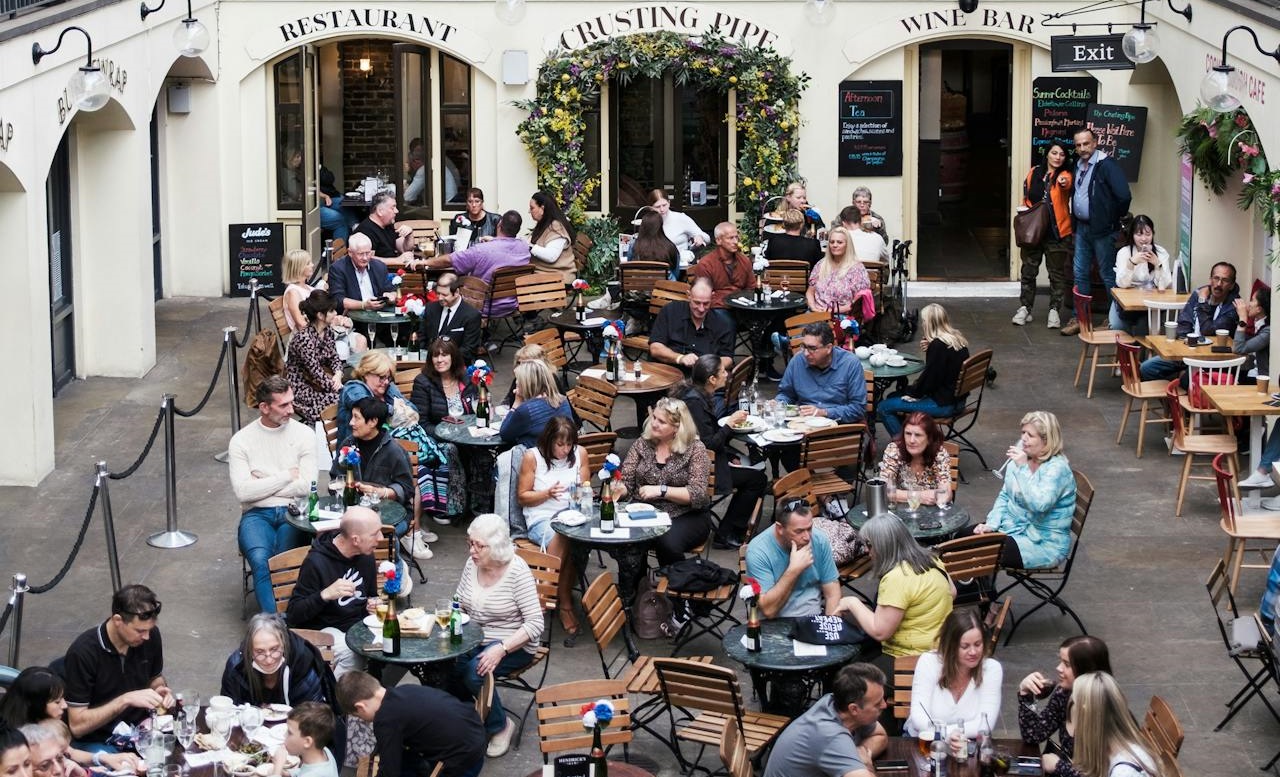
crowded restaurant dining room

Let Bloom Intelligence Make It Effortless

Bloom Intelligence is an AI-powered restaurant marketing and guest data collection platform. It includes a powerful customer data platform, website integrations, automated guest data collection, one-click audience segmentation, marketing automation via email and SMS, advanced reputation management, sentiment analysis, and impressive reporting tools.

Bloom makes guest data collection and sentiment analysis effortless, which allows you to quickly execute the strategies listed above, saving you time, increasing customer lifetime values, attracting new guests, improving your reputation, and boosting your bottom line.

Call us or schedule a free demo online and Bloom will show you how our restaurant marketing platform can help you save time and increase your customer lifetime values by automatically building first-party customer databases, unlocking important guest insights to trigger automated marketing at the right time and place, discover true guest sentiment, save at-risk guests, increase your current guests’ frequency, supercharge your website, and find new guests.

Click to schedule a Free Online Demo, or call 727-877-8181 to see how we can help you drive tangible results for your restaurants.
How Guest Identity & Sentiment Drive Marketing ROI

How Guest Identity & Sentiment Drive Marketing ROI: The Multi-Unit Restaurant Playbook

Why knowing your guests transforms marketing spend into measurable profit


Multi-unit restaurant operators face a universal challenge: marketing budgets that feel like throwing darts in the dark.

You’re spending thousands on campaigns, but which ones actually drive repeat visits? Which guests are worth investing in?

The answer lies in guest identity, and the data proves it.

The $100 Million Revenue Reality Check

We ran an analysis of Bloom data of 52 million in revenue across 1.5 million guest orders, yet most operators can’t tell you which specific guests contributed more to that success.

Here’s what the data shows about guest behavior that directly impacts your bottom line:

Guest Segmentation Performance:

  • Super Guests (10+ visits): Represent just 2.8% of the database but likely drive 25-30% of revenue
  • High-Value Guests (5+ visits): Account for 6.3% of guests but generate disproportionate lifetime value
  • Average Guest Frequency: 2.4 visits, meaning most customers never return after their second visit

The opportunity cost is staggering. Without guest identity, you’re marketing to everyone equally, including the 70% who may never return.

The Guest Identity ROI Equation

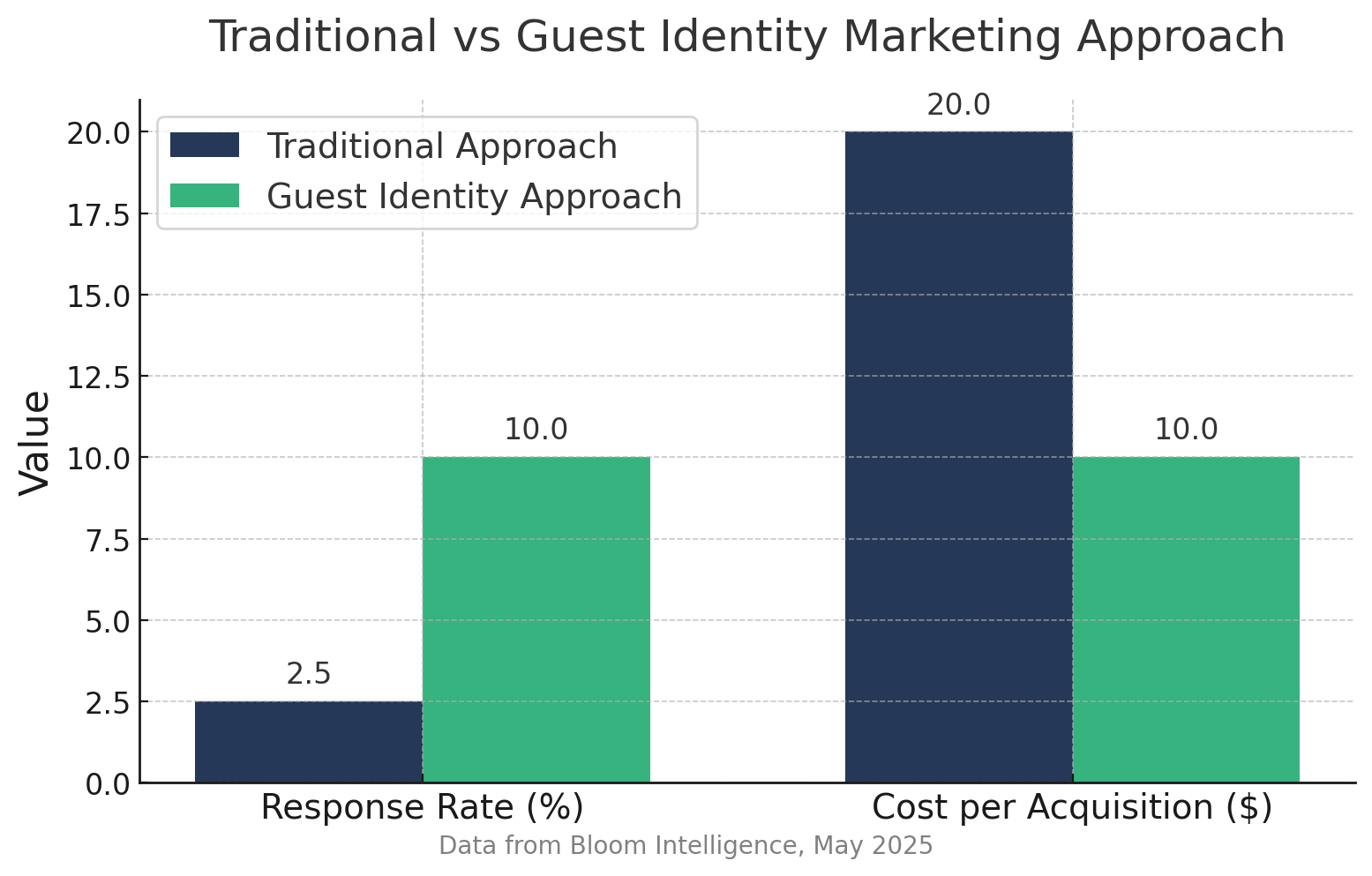
Traditional marketing operates on spray-and-pray tactics. Guest identity marketing operates on mathematical precision. Here’s the difference:

Traditional Approach:

  • Blast promotion to entire database
  • 2-3% response rate
  • Cannot measure the guest lifetime value impact
  • Marketing cost per acquisition: $15-25

Guest Identity Approach:

  • Target promotions based on visit frequency, recency, spend, demographics, and sentiment
  • 8-12% response rate from identified segments
  • Track revenue impact per guest segment
  • Marketing cost per acquisition: $8-12

The math is clear: knowing your guests reduces marketing costs by 40-60% while more than doubling response rates.

Real-World Examples: Guest Identity in Action

Example 1: The WiFi Goldmine

Our data shows WiFi login captured 71,670 guest identities (of the locations in the analysis) in May 2025 alone, with 99.5% providing valid email addresses. One multi-unit pizza chain leveraged this by:

Step 1: Implemented post-WiFi welcome series

  • 3-email sequence over 14 days
  • First email: Welcome + brand story
  • Second email: Menu highlights + 10% off next visit
  • Third email: Loyalty program invitation

Results: 23% open rate, 4.2% click-through rate, $18 average order increase for engaged guests

Example 2: Review Response That Drives Revenue

Review analysis reveals that Google reviews dominate customer sentiment tracking (79% of all reviews), with an average 4.48 rating across locations. However, the real opportunity lies in the response strategy:

Negative Review Recovery:

  • Immediate response within 2 hours
  • Personalized apology and resolution offer
  • Follow-up email with a 20% return incentive
  • 31% of negative reviewers returned within 30 days

Positive Review Amplification:

  • Thank the reviewer by name
  • Share specific menu items they mentioned
  • Invite them to try seasonal offerings
  • 18% higher repeat visit rate among acknowledged reviewers

Example 3: The Reservation Goldmine

Only 7.5% of reservations provided valid emails—a massive, missed opportunity. Leading operators now execute:

Pre-Arrival Engagement:

  • Confirmation email with menu previews
  • Dietary preference inquiry
  • Special occasion recognition
  • Day-of reminder with parking/arrival tips

Post-Visit Follow-up:

  • Thank you email within 24 hours
  • Feedback request with an incentive
  • Next reservation booking prompt
  • Birthday/anniversary calendar addition

Results: 34% increase in reservation frequency, 12% higher per-person average

The Sentiment-Revenue Connection

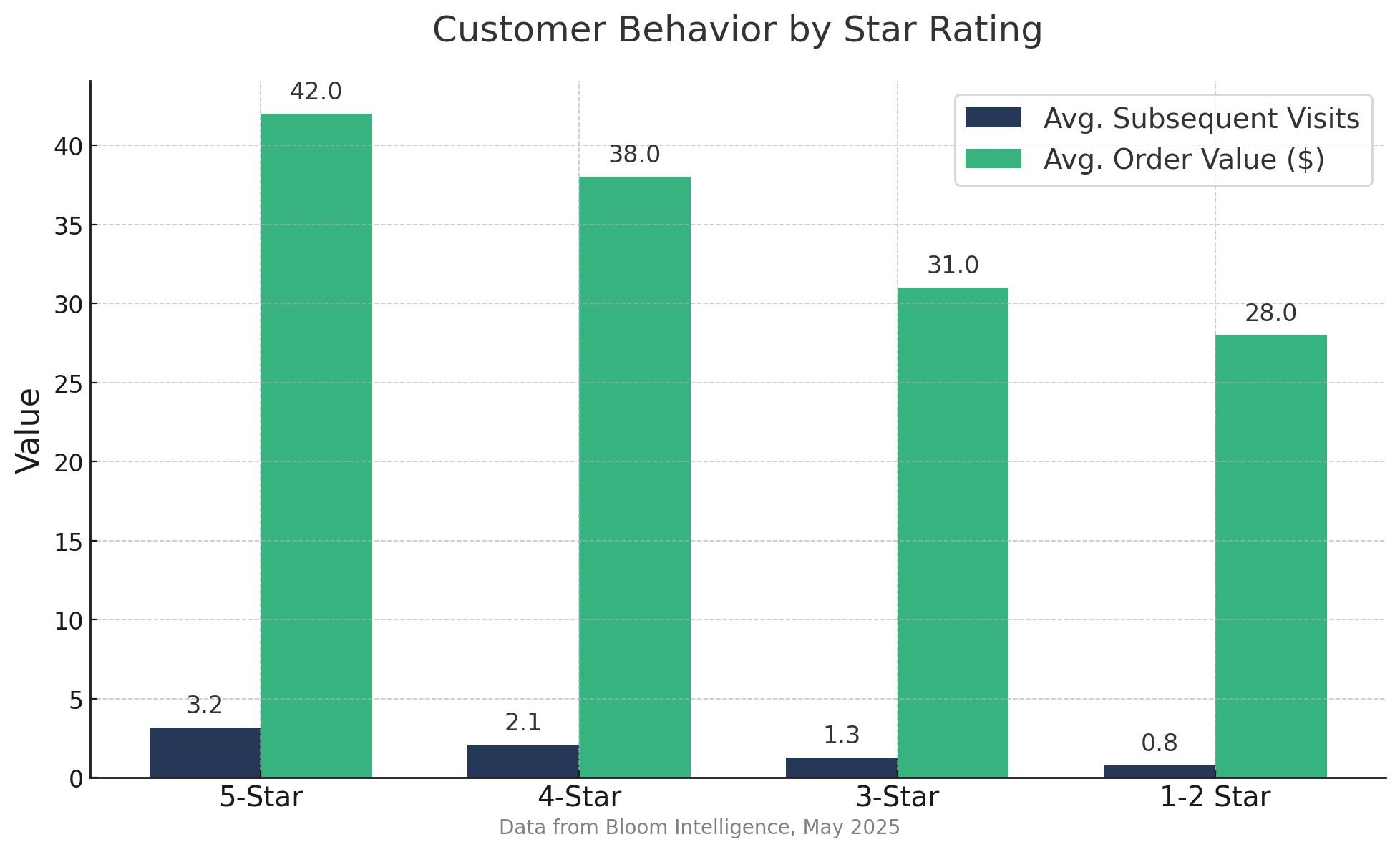
Customer sentiment directly correlates with spending behavior. Our analysis reveals:

  • 5-Star Reviewers: Average 3.2 subsequent visits, $42 average order value
  • 4-Star Reviewers: Average 2.1 subsequent visits, $38 average order value
  • 3-Star Reviewers: Average 1.3 subsequent visits, $31 average order value
  • 1-2 Star Reviewers: Average 0.8 subsequent visits, $28 average order value

The sentiment gradient shows that moving a guest from a 3-star to a 4-star experience increases their lifetime value by approximately $67 ($38 x 2.1 vs $31 x 1.3).

Step-by-Step Implementation Guide

Phase 1: Guest Identity Collection (Weeks 1-4)

  • Audit Current Touchpoints
    • WiFi capture rates
    • Online ordering email collection
    • Reservation system integration
    • POS loyalty program linkage
    • Review platform integrations
  • Optimize Collection Points
    • WiFi guest profile capture
    • Add phone number collection to orders
    • Create reservation email requirements
    • Train staff on loyalty program enrollment

Phase 2: Segmentation & Automation (Weeks 5-8)

  • Create Guest Segments
    • New guests (1 visit)
    • Developing guests (2-4 visits)
    • Loyal guests (5-9 visits)
    • Super guests (10+ visits)
    • At-risk guests (no visit for 60+ days)
  • Build Automated Campaigns
    • Welcome series for new guests
    • Win-back campaigns for at-risk guests
    • VIP experiences for super guests
    • Birthday/anniversary celebrations

Phase 3: Sentiment Monitoring & Response (Weeks 9-12)

  • Establish Review Monitoring
    • Daily Google/Facebook/Yelp/Trip Advisor/OpenTable/Tock review analysis
    • Response templates by rating level
    • Internal escalation protocols
    • Staff training on service recovery
  • Create Feedback Loops
    • Post-visit email surveys
    • SMS satisfaction check-ins
    • Celebrate and reward employees with the most mentions
    • Automate reporting to operations and create trending reports on key improvement tasks

Phase 4: Measurement & Optimization (Ongoing)

  • Track Key Metrics
  • Optimize Based on Data
    • A/B test email subject lines
    • Refine segment definitions
    • Adjust promotion timing
    • Personalize offers by preference

The Competitive Advantage

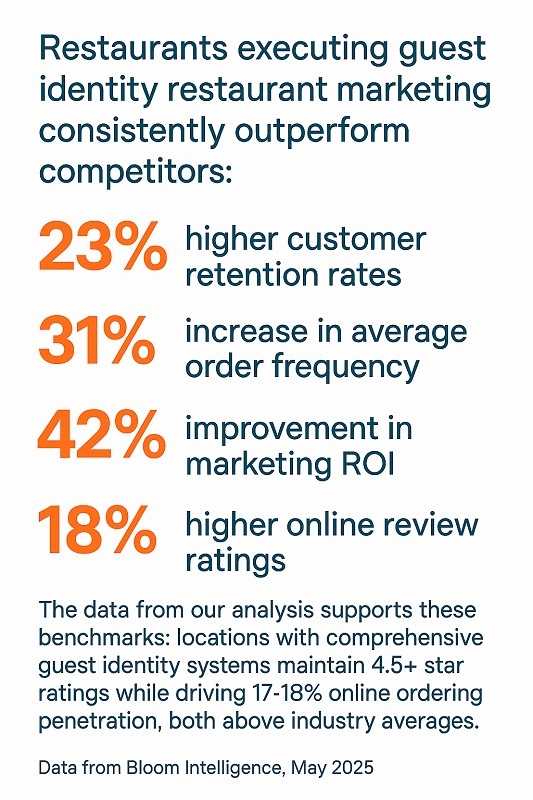
Restaurants executing guest identity restaurant marketing consistently outperform competitors:

  • 23% higher customer retention rates
  • 31% increase in average order frequency
  • 42% improvement in marketing ROI
  • 18% higher online review ratings

The data from our analysis supports these benchmarks: locations with comprehensive guest identity systems maintain 4.5+ star ratings while driving 17-18% online ordering penetration, both above industry averages.

Making It Happen: Your Next 30 Days

Weeks 1-2: Audit and optimize guest identity collection across all touchpoints
Weeks 3-4: Implement basic segmentation and welcome automation
Weeks 5-6: Launch sentiment monitoring and response protocols
Weeks 7-8: Begin measuring guest lifetime value by segment

The restaurants thriving in 2025 aren’t those with the biggest marketing budgets—they’re the ones who know their guests best. Guest identity isn’t just data collection; it’s the foundation of profitable, sustainable growth.

Every guest interaction is an opportunity to build identity. Every sentiment signal is a chance to increase lifetime value. Every automated touchpoint is a step toward marketing ROI that compounds over time.

The question isn’t whether you can afford to implement guest identity marketing—it’s whether you can afford not to. Your competitors are already building these systems. Your guests are already expecting personalized experiences. The only question left is: When will you start?

Ready to transform your marketing from expense to investment? The data shows the path forward—guest identity is your competitive advantage waiting to be unlocked.

Bloom Intelligence uses AI to amplify lean marketing team efforts into a marketing machine to drive revenue and margin. Plug in your data, set up automated campaigns and rules, and watch Bloom work for you. 

crowded restaurant dining room

Let Bloom Intelligence Make It Effortless

Bloom Intelligence is an AI-powered restaurant marketing platform. It includes a powerful customer data platform, website integrations, automated guest data collection, one-click audience segmentation, marketing automation via email and SMS, advanced reputation management, and reporting tools.

Bloom makes guest data collection and reputation management effortless, which allows you to quickly execute the strategies listed above, saving you time, increasing customer lifetime values, attracting new guests, improving your reputation, and boosting your bottom line.

Call us or schedule a free demo online and Bloom will show you how our restaurant marketing platform can help you save time and increase your customer lifetime values by automatically building first-party customer databases, unlocking important guest insights to trigger automated marketing at the right time and place, discover true guest sentiment, save at-risk guests, increase your current guests’ frequency, supercharge your website, and find new guests.

Click to schedule a Free Online Demo, or call 727-877-8181 to see how we can help you drive tangible results for your restaurants.

Why Guest Identity Is the Bedrock of Modern Hospitality

The Big Idea

In 2025, the restaurants winning the share-of-stomach battle aren’t only serving better food—they’re serving better data.

When you know who a guest is (details), how they behave (recency & frequency), what they spend, and how they feel (sentiment), every other business lever—from AI-powered marketing to review management—becomes sharper, faster, and more profitable.

That complete, ever-enriching profile is what Bloom calls Guest Identity.

Here are some ways to use guest identity for the benefit of your restaurant business.


1. Personalization That Pays

  • Email still prints money. Personalized email campaigns generate 6× higher transaction rates than generic blasts.
  • The channel’s ROI averages $36 for every $1 spent—the highest of any digital tactic.

When your list includes birthdays, anniversaries, and preferred menu items, AI and automation can trigger a “Free Dessert on Your 5th Visit” SMS, for example, the moment a diner’s frequency slips—no human scheduling required. The result is hard-currency uplift, not vanity metrics.


2. Frequency & Retention = Profit

Bain & Company proved years ago that a 5% bump in retention lifts profits 25 – 95%.  Guest-behavior data (visits, dayparts, order channels) lets automation spot a lapsed lunch regular and drop a timely promotional code, for example, before they defect to the competitor down the block.


3. CDPs Supercharge Guest Identity

Guest identity becomes exponentially more valuable when all those loyalty sign-ups, POS tickets, WiFi pings, and reviews flow into a Customer Data Platform (CDP). Here’s why operators are doubling down on CDPs:

  • 93% of brands running a CDP cut their customer-acquisition costs, while 90% report stronger loyalty and 89% see higher online sales. VWO
  • Real-world proof: Atlassian’s switch to a composable CDP drove a 71% jump in conversions and a 50% drop in ad spend. Uniphore
  • McKinsey-tracked brands coordinating offers through a CDP earn 10–20% more in conversion and lifetime value. VWO

By resolving every identifier—email, phone, device, payment card—into one comprehensive profile of your guests’ identity, a CDP turns “data exhaust” into precision fuel for AI.

You could instantly segment high-spend brunch fans, trigger a win-back SMS the moment frequency slips, or auto-reply to a three-star review with a make-good offer—no manual exports, no extra headcount. In short, a CDP doesn’t just store guest identity; it monetizes it.


4. Sentiment Is Tomorrow’s Secret Menu Item

96% of consumers read online reviews before choosing a local business, and only 4% never do.  Responding to those reviews even bumps ratings by 0.12 stars on average—a material nudge in a 1–5 world.

With customer sentiment scores piped into Guest Identity, Bloom’s AI can:

  • Alert managers to service-recovery opportunities in real time.
  • Trigger “We’re sorry—dessert’s on us” (or similar) emails or texts to detractors.
  • Use AI Respond to respond to reviews with rules around the voice of your brand and to operationalize types of guest sentiment.

All without adding headcount.


5. The AI Flywheel Powered by Guest Identity

Stage What Guest Identity Feeds Automated Outcome Revenue Impact
Collect Details, behavior, spend, sentiment Unified profile in CDP 360° view
Predict AI models segment by lifetime value & churn risk Real-time audience audiences Higher conversion
Act Triggered emails/SMS, review responses, offer decisioning Always-on campaigns Incremental sales
Learn Closed-loop revenue attribution Model retrains nightly Compounding ROI

McKinsey’s 2024 survey confirms the trend: 65% of companies already use generative AI, with users reporting both cost decreases and revenue jumps in the functions deploying it, with marketing being chief among them.


6. From Data to Dollars—A Practical Checklist

  • Unify every data source (POS, WiFi, online ordering, reservations, reviews) in one cloud CDP.
  • Append spend & sentiment so segmentation isn’t blind to value or feelings.
  • Automate the obvious:
    • First-visit thank-you
    • 30-day lapse win-back
    • Birthday & anniversary offers
    • Immediate review-response workflows
  • Measure in revenue, not open rates. If a campaign can’t be tied to checks crossed and dollars captured, kill it.
  • Iterate weekly—AI learns fastest with fresh feedback loops.


How to Be Great – Deliver Happiness

Great hospitality remembers your name. Transformative hospitality remembers your name, last order, your birthday, anniversary, and how you felt about the patio lighting.

Guest Identity turns that memory into a scalable, AI-driven engine that fills seats, fattens margins, and frees your team to focus on the food and the people in front of them.

Ready to put Guest Identity to work?

Start capturing the data you already own, feed it to Bloom’s AI Command Center, and watch the automation flywheel spin.  Because the future of hospitality isn’t just who walks through the door—it’s what you know about them the moment they do.

crowded restaurant dining room

Let Bloom Intelligence Make It Effortless

Bloom Intelligence is an AI-powered restaurant marketing platform. It includes a powerful customer data platform, website integrations, automated guest data collection, one-click audience segmentation, marketing automation via email and SMS, advanced reputation management, and reporting tools.

Bloom makes guest data collection and reputation management effortless, which allows you to quickly execute the strategies listed above, saving you time, increasing customer lifetime values, attracting new guests, improving your reputation, and boosting your bottom line.

Call us or schedule a free demo online and Bloom will show you how our restaurant marketing platform can help you save time and increase your customer lifetime values by automatically building first-party customer databases, unlocking important guest insights to trigger automated marketing at the right time and place, discover true guest sentiment, save at-risk guests, increase your current guests’ frequency, supercharge your website, and find new guests.

Click to schedule a Free Online Demo, or call 727-877-8181 to see how we can help you drive tangible results for your restaurants.

Bloom Intelligence Product Release Update: Spring 2025

Audio Discussion of New Product Enhancements Below


Introducing Bloom Intelligence’s Latest Feature Releases

At Bloom Intelligence, we give restaurants the marketing power of enterprise restaurant chains – without the budget or the team. Bloom unifies all your guest data – WiFi, online orders, reservations, POS, and reviews- into rich, actionable profiles and audiences. Then our AI works around the clock to automate personalized marketing, manage your reputation, and drive revenue and margin automatically. We don’t just simplify your marketing. We operationalize it. So your team is primed to win, even when you are understaffed, outspent, or outgunned.

We’re excited to unveil a suite of new features designed to help you work smarter, market better, and stay true to your brand—all from one centralized platform. These updates reflect our ongoing mission to drive deep value to our restaurant partners.

In this article, we’ll walk you through our four new AI-enabled releases:

  • Search by Order: Filter guests by what they ordered to create hyper-targeted campaigns and operational insights.
  • Sort by Phone: Organize and manage your guest list by phone number for cleaner data and faster outreach.
  • OpenTable Review Integration: You can view and respond (manually, with AI, voice of your brand, and rules) to OpenTable reviews alongside Google, Yelp, Facebook, Tock, Surveys, and Tripadvisor. Plus, AI-generated trends and insights around the voice of your guest.
  • Brand Kit: Automatically apply your logos, images, fonts, brand voice, and brand colors to every message—manually, with AI, or automatically—for flawless, consistent branding across your marketing and reputation management.

Whether you’re aiming to build loyalty, improve guest satisfaction, or scale your marketing confidently, these new tools are designed to help you achieve more with less effort.

Here’s a look at the new features designed to enhance your experience and streamline your operations.

1. “Search by Order” and “Sort by Phone” Unlock Deeper Guest Insights

Today, we’re proud to introduce two powerful new features designed to enhance your ability to segment, search, and act on customer insights:

  • Search by Order: You can find and filter guests based on the exact items they ordered, by time period, or by how many times they ordered a menu item.
  • Sort by Phone: Organize your guest list by phone number for easier outreach and contact verification

These tools bring more precision, flexibility, and efficiency to your marketing and operations, giving you even more control over the data that drives your business.

What is “Search by Order”?

Search by Order lets Bloom Intelligence users filter their guest database by specific menu items, order categories, or purchasing behaviors. It turns transactional POS data into a strategic asset, helping you deliver smarter marketing and make more informed decisions.

Key Capabilities:

  • Filter by item name and quantity
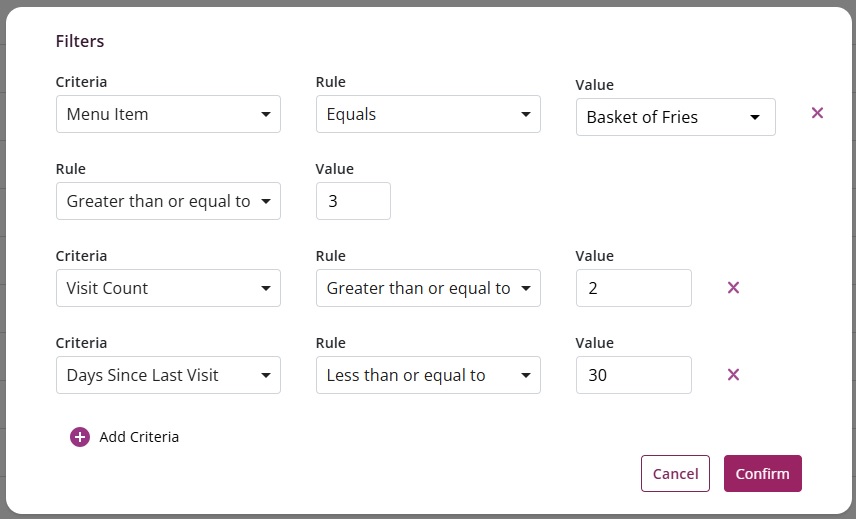
    Example: Find everyone who ordered “Basket of Fries” 3 or more times during lunch service.
  • Combine with visit behavior
    Example: Target guests who ordered your “Spicy Tuna Roll” and visited more than once in the last month.

Bloom Intelligence Search by Menu Item

This is just one of countless ways to segment your ordering data into targeted marketing lists.

Search by Order unlocks new potential for:

✅ Personalized Restaurant Marketing
Send campaigns based on order history. For example, let past buyers know when a fan-favorite dish returns, or promote upsell offers based on common purchase patterns.

✅ Operational Insights
Track which dishes are ordered most often by loyal guests. Use this intel to optimize menus, forecast demand, and reduce waste.

✅ Enhanced Customer Segmentation
Group guests based on real behavior, not guesswork. Create dynamic audiences for rewards, special events, or feedback requests.


NEW: Sort Your Guest List by Phone Number

In addition to Search by Order, we’ve added another frequently requested feature: Sort by Phone.

This enhancement allows you to sort your guest database in ascending or descending order by phone number—a small but impactful addition that brings major value, especially for:

Phone-Based Campaign Coordination
If you run SMS campaigns, being able to sort and segment guests by phone number can simplify targeting and timing.

These tools work seamlessly alongside existing filters like visit frequency, locations, and marketing interactions, giving you a complete view of each guest and how to reach them.

More innovative Marketing, Stronger Connections

Search by Order and Sort by Phone represent the next step in Bloom Intelligence’s mission to give restaurants the most powerful guest intelligence platform on the market.

These features provide the tools to:

  • Personalize guest experiences based on real purchase behavior
  • Streamline contact-based outreach
  • Enhance database quality and segmentation

By giving you deeper insight into what your guests love—and making it easier to reach them in meaningful ways—we’re helping you drive more traffic, more loyalty, and more revenue.

2. View and Respond to OpenTable Reviews in Bloom Intelligence’s Reputation Dashboard

Reputation is everything in the restaurant industry. That’s why Bloom Intelligence continues to innovate ways to help hospitality brands take complete control of guest feedback, online ratings, and public perception—all from a single, intelligent dashboard.

Today, we’re excited to introduce our latest integration: OpenTable reviews are now available in the Bloom Intelligence reputation management platform.

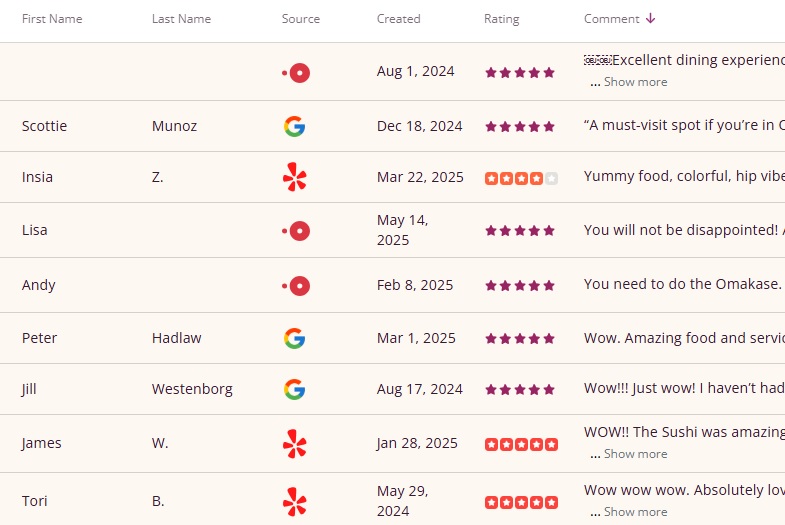
With this update, users can monitor, analyze, and respond to OpenTable reviews right alongside Yelp, Google, Facebook, Tock, Surveys and Tripadvisor reviews—eliminating the need to juggle multiple platforms and logins.

One Dashboard, Every Review Platform

Before this update, Bloom Intelligence users could manage feedback across other top review channels. With the addition of OpenTable, you now get a centralized command center for your entire online reputation.

Review Sources Now Supported:

  • OpenTable (NEW)
  • Google Reviews
  • Yelp
  • Facebook
  • Tripadvisor

Bloom Intelligence Review Dashboard

This unified view simplifies everything from sentiment analysis to timely guest engagement—and keeps your team focused on what matters most.

OpenTable isn’t just a reservation platform—it’s a trusted source of guest feedback and ratings, especially for dine-in restaurant experiences. Adding OpenTable to your Bloom Intelligence dashboard means you’ll:

  • Never miss a critical review from a guest who reserved through OpenTable
  • Monitor performance trends by platform, location, or timeframe
  • Get a fuller picture of guest satisfaction across all booking and discovery channels

This gives your management and marketing teams a more complete, multi-channel understanding of guest sentiment.

Responding to reviews is key to maintaining a positive brand reputation, but it can be incredibly time-consuming, especially across multiple review sites.

Bloom Intelligence helps you save precious hours of manual work each week with powerful tools. No more logging in and out of platforms or missing reviews buried in your inbox.

Use AI to Generate On-Brand Responses

Powered by Bloom’s built-in AI engine, you can:

  • Get suggested responses that are tailored to the content and sentiment of each review
  • Edit or approve those responses before sending
  • Enable fully automated responses based on your brand’s voice, the individual review itself, and rules.

This feature ensures timely, thoughtful engagement—whether the review is glowing or critical—without requiring hours of your time. This functionality literally turns hours into seconds.

Key Benefits of the OpenTable Integration

✅ One Unified View
All major review platforms, now in one place. Get instant insight into how your restaurant is performing across all guest feedback channels.

✅ Faster Response Times
Respond to OpenTable reviews as quickly as you do to Google or Yelp feedback, helping you resolve issues and reinforce positive experiences before they escalate.

✅ AI-Enhanced Efficiency
Leverage AI-generated replies to maintain brand consistency, professionalism, and personality—even at scale.

✅ Data-Driven Strategy
Use aggregated review data and AI-generated trends and reports to inform operations and operationalize guest sentiment for improvement, marketing, menu adjustments, and customer service policies.

Reputation Management Just Got Even Easier

With the addition of OpenTable reviews, Bloom Intelligence continues to evolve into the most comprehensive, intelligent, and time-saving reputation management solution for restaurants and hospitality businesses.

We believe reputation management should empower your team, not drain it. Now you can:

  • Monitor every guest review in one dashboard
  • Respond faster and smarter with AI
  • Focus on improving service, not chasing logins.

Ready to take control of your online reviews—everywhere they happen? Log in today or schedule a demo to see how Bloom Intelligence helps you build better relationships, improve guest satisfaction, and protect your brand.

3. Introducing Brand Kit—Effortless, Consistent Branding for Restaurant Messaging

Maintaining consistent branding and voice of your brand across marketing channels can be a challenge for busy restaurant operators. Between sending emails, SMS campaigns, and automated guest messages, it’s easy to have generic canned messaging, logos to get misplaced, or brand components to be forgotten.

That’s why we’re excited to introduce Bloom Intelligence’s new Brand Kit feature—a powerful tool that makes restaurant branding effortless, consistent, and automatic.

With Brand Kit, your logo, images, fonts, and colors are applied automatically to every email or text message you create or send—manually, with AI, or via automation.

What Is Bloom’s Brand Kit?

The Brand Kit is your centralized space to store and manage your brand identity within the Bloom Intelligence platform. With just a few clicks, you can:

  • Upload your logo and supporting brand images
  • Define your primary and secondary brand colors
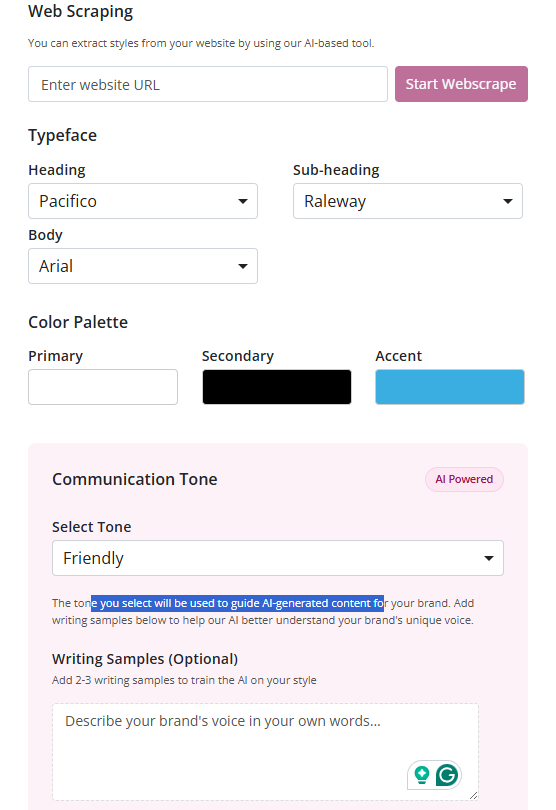
  • Define fonts and voice of your brand
  • Or use AI to scrape your website to generate all brand fields automatically with one click

Once you set up your Brand Kit, Bloom automatically applies your brand assets whenever you create:

  • Email campaigns
  • SMS marketing messages
  • Automated behavior-triggered messages
  • AI-generated messages or review responses

Bloom Intelligence Brand Kit

This ensures that every message your guests receive feels on-brand and professional, without extra design work from your team.

Brand consistency builds trust. Whether you’re sending a one-time promo, an automated loyalty message, or responding to a review with AI, guests will immediately recognize your brand.

No more uploading the same image repeatedly, color mismatches, or forgotten headers. With Brand Kit, your brand settings are applied automatically, saving precious time for marketers and operators alike.

The Brand Kit is more than a design tool—it’s a branding consistency engine that ensures every communication reflects your restaurant’s identity, values, and attention to detail.

Whether you’re running an independent restaurant or a growing multi-unit brand, Brand Kit helps you:

  • Maintain professionalism in every guest interaction
  • Save time on design and approvals
  • Build brand recognition with every message sent

Start using Brand Kit today and give your messaging the consistent, polished look your brand deserves—without the extra work.

Already a Bloom Intelligence customer? Log in to set up your Brand Kit now. New to Bloom? Schedule a demo and see how seamless branding can fuel smarter, more effective marketing.

Ready to Turn Guest Data into Revenue – Automatically?

Bloom Intelligence turns your guest data into automated marketing that drives more visits, reviews, and revenue—all with zero guesswork. Bloom is designed for lean marketing teams and fast-growing restaurant groups.

Whether you’re running a single location or managing a multi-unit operation, Bloom Intelligence gives you the tools to turn data into decisions, and decisions into growth.

  • Already a Bloom user? Log in now to start using these new features right away.
  • New to Bloom Intelligence? Schedule a free demo to see how these tools can transform your marketing, streamline operations, and help you build stronger guest relationships.


Bloom looks forward to releasing more exciting and helpful updates in the coming weeks and advanced new AI features to make your job easier and drive more revenue seamlessly.

By continuously improving our product and adding new features, Bloom Intelligence continues to support restaurant owners and operators in delivering exceptional service and achieving business success.


Fill More Tables with AI-Driven Restaurant Marketing

Bloom Intelligence is an AI-powered restaurant marketing platform. Turn guest data into repeat business. Our all-in-one Customer Data Platform unifies your restaurant’s data, automates marketing campaigns, and protects your reputation to boost your bottom line.

Guest data is unified from WiFi logins, online reservation systems, online ordering platforms, POS systems, website forms, social media, and reviews, and aggregated into one platform. This makes it simple to see guest insights and segment your guests into audiences like super guests, regulars, first-time guests, or at-risk guests. All Guest insights and fuel Bloom AI-powered marketing and reputation management automation to drive revenue on demand and increase your margins.

Bloom is a restaurant marketing operating system in a box. Built for your success.

Click Here to Schedule a Free Online Demo, or call 727-877-8181 to see how we can help you save time and drive revenue.


Google’s “What’s Happening” Feature: A Must-Have for Restaurants and Bars

Get Your Restaurant in Front of More Guests—Fast and Free

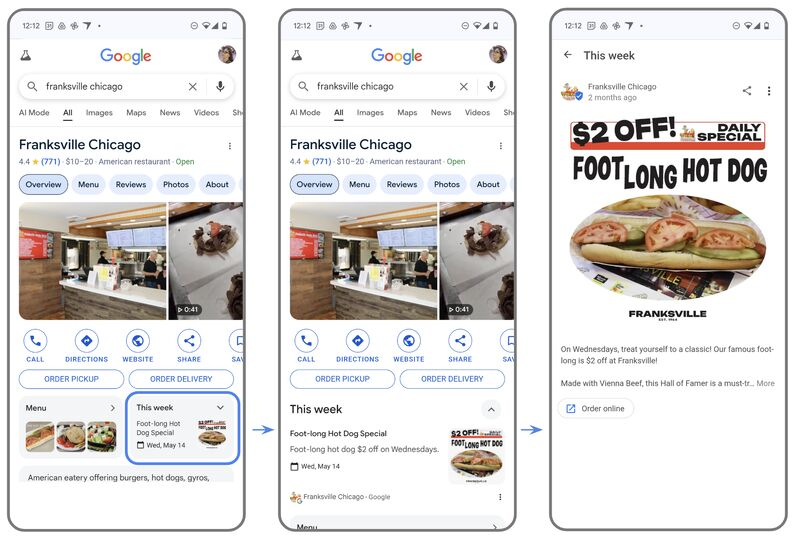
Want a free, fast, and highly visible way to attract more guests to your restaurant or bar? Google just rolled out an exciting new feature for Business Profiles called “What’s Happening.”

Audio Discussion of this New Feature


Patrons rely on Google to discover local dining options, and the “What’s Happening” section ensures your restaurant’s events and promotions grab their attention instantly.

Whether it’s a one-off wine-tasting event, a recurring Taco Tuesday deal, or a National Pizza Day blowout, this feature positions your offerings front and center, boosting foot traffic and reservations without spending a dime.

Google’s decision to roll out this tool reflects its commitment to supporting small businesses. Unlike paid advertising platforms, “What’s Happening” is accessible to any verified food and drink business in the supported regions (US, UK, Australia, Canada, and New Zealand). It’s a rare opportunity to level the playing field and compete with larger chains for customer attention.

If you’re looking for a fast, no-cost way to drive awareness and foot traffic, this is it.

How It Works: Simple, Fast, and Effective

Adding your events and specials to the “What’s Happening” section is straightforward. Use Google Posts, a built-in feature of your Google Business Profile, to create and publish updates. Here’s how to get started:

  • Access Your Google Business Profile: Log in to your Google Business Profile dashboard via Google Search or Google Maps.
  • Navigate to Google Posts: Select the “Posts” tab and choose “Create Post.”
  • Craft Your Update: Write a compelling description of your event or special. Include key details like dates, times, and any unique selling points (e.g., “Half-price margaritas during Happy Hour!”). Add high-quality images or videos to make your post pop.
  • Select the Event Type: Choose the “Event” post type and specify whether it’s a one-time or recurring event.
  • Publish and Monitor: Hit “Publish,” and your update will appear in the “What’s Happening” section of your profile. Track engagement metrics like views and clicks directly in your dashboard.

The entire process takes less than five minutes. Your post will appear prominently in your profile, giving you valuable real estate to attract attention. No waiting. No approval delays.

Post Directly on Google Instead of Syncing Social Media

You can sync your Facebook, Instagram, or X accounts to auto-populate Google Posts, but this approach has drawbacks.

Automated updates often lack the precision and immediacy of manual posts. Social media platforms may delay or fail to sync correctly, and their formatting doesn’t always align with Google’s clean, professional layout.

Posting directly through Google ensures your message is tailored, timely, and reliable. Don’t cut corners—take control of your marketing and do it right.

Use Cases: Maximize Impact with Strategic Posts

The “What’s Happening” section is versatile, accommodating a wide range of promotions. Here are some ways to use it effectively:

  • One-Off Events: Announce special occasions like live music nights, chef’s table dinners, or holiday-themed menus. For instance, a Valentine’s Day prix-fixe dinner can draw couples searching for romantic dining options.
  • Recurring Specials: Highlight weekly deals like Taco Tuesdays, Wing Wednesdays, or daily Happy Hours. Consistency builds customer habits and keeps your profile fresh.
  • Seasonal Promotions: Capitalize on holidays or local festivals. A Fourth of July barbecue special or a Halloween costume party can attract crowds.
  • Limited-Time Offers: Create urgency with flash sales or exclusive menu items. Even your fresh soup or sandwich of the day can attract more diners.

Each post should include a clear call-to-action, such as “Reserve your spot now!” or “Order online today!” Pair your text with eye-catching visuals to maximize click-through rates.

Best Practices for “What’s Happening” Success

To get the most out of “What’s Happening,” follow these proven strategies:

  • Keep It Fresh: Update your posts regularly to reflect current or upcoming events. Stale content signals neglect and reduces customer trust.
  • Optimize for Search: Use relevant keywords in your post descriptions, such as “Happy Hour [city name]” or “live music [restaurant name].” This improves your visibility in local search results.
  • Leverage Analytics: Monitor post performance through your Google Business Profile dashboard. Identify which types of posts generate the most engagement.
  • Be Visual: High-quality photos or short videos significantly increase engagement. Showcase your dishes, ambiance, or event setup to entice customers.
  • Time It Right: Post events at least a week in advance to give customers time to plan. For recurring specials, schedule posts to coincide with peak search times, like Friday afternoons for weekend deals.

Google’s “What’s Happening” section isn’t just a restaurant marketing tool—it’s a strategic asset. By placing your events and specials at the top of your Google Business Profile, it amplifies your reach in a crowded digital landscape.

Patrons searching for dining options in your area will see your promotions before they even click through to your website or social media. This prime real estate drives organic traffic, boosts brand awareness, and ultimately increases revenue.

Moreover, it’s a testament to Google’s investment in small businesses. Unlike paid ads or third-party reservation platforms, “What’s Happening” requires no financial investment—just a moment or two of your time.

For smaller restaurants, coffee shops, cafes, breweries, and bars, this levels the playing field, allowing you to compete with larger chains and franchises.

Get Started Today

The implementation barrier for this feature is remarkably low. With just a few minutes of effort, you can begin showcasing your restaurant’s events and specials to everyone searching for your business on Google.

Don’t make the mistake of overlooking this powerful marketing channel. While competitors hesitate or rely on inconsistent social media syncing, proactive operators who directly manage their Google Business Profile will capitalize on this visibility advantage.

For food and beverage businesses constantly seeking cost-effective marketing solutions, Google’s “What’s Happening” feature represents one of the most accessible and impactful tools introduced in recent years.

Take five minutes today to implement this feature for your establishment. Your next promotion deserves this premium visibility.

crowded restaurant dining room

Let Bloom Intelligence Make It Effortless

Bloom Intelligence is an AI-powered restaurant marketing platform. It includes a powerful customer data platform, website integrations, automated guest data collection, one-click audience segmentation, marketing automation via email and SMS, advanced reputation management, and reporting tools.

Bloom makes guest data collection and reputation management effortless, which allows you to quickly execute the strategies listed above, saving you time, increasing customer lifetime values, attracting new guests, improving your reputation, and boosting your bottom line.

Call us or schedule a free demo online and Bloom will show you how our restaurant marketing platform can help you save time and increase your customer lifetime values by automatically building first-party customer databases, unlocking important guest insights to trigger automated marketing at the right time and place, discover true guest sentiment, save at-risk guests, increase your current guests’ frequency, supercharge your website, and find new guests.

Click to schedule a Free Online Demo, or call 727-877-8181 to see how we can help you drive tangible results for your restaurants.

Harnessing Guest Sentiment: The $97,000 Revenue Opportunity Hidden in Your Reviews

Industry Analysis of 288,193 Restaurant Reviews Reveals Clear Patterns That Separate Market Leaders From Followers

In today’s restaurant industry, guest feedback isn’t just about reputation management—it’s an untapped revenue engine hiding in plain sight.

Our comprehensive analysis below of 288,193 restaurant reviews across multiple locations has uncovered actionable intelligence directly correlating with increased profits, operational efficiency, and customer loyalty.

Whether you manage a single location or multiple venues, this actionable report delivers specific, proven strategies that restaurants of any size can implement immediately, without requiring an enterprise-level marketing team.

Listen to Our Audio Discussion of This Study:


EXECUTIVE SUMMARY

This comprehensive industry report analyzes 288,193 customer reviews across hundreds of restaurant locations to identify actionable trends, opportunities, and threats facing the restaurant industry.

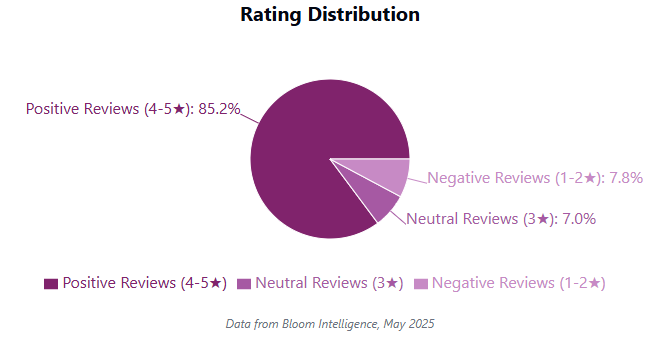
With an industry average rating of 4.4/5 stars and 85.2% positive reviews, the data reveals clear patterns that successful operators can leverage to drive operational excellence.

The findings demonstrate that in today’s digital-first economy, guest sentiment has become a critical driver of business success. Restaurants that systematically capture, analyze, and operationalize customer feedback significantly outperform those that approach guest sentiment management as an afterthought.


INDUSTRY LANDSCAPE: RATING DISTRIBUTION

Ratings distribution pie chart


EMERGING TRENDS & OPPORTUNITIES


1. Staff Recognition Drives Premium Experiences

Key Insight: Reviews mentioning specific staff members by name have significantly higher average ratings than generic reviews. These personal mentions create powerful social proof that directly influences potential customers.

Opportunity: In an industry plagued by commoditization, personalized service recognition becomes a key differentiator. Restaurants that systematically track, incentivize, and celebrate staff mentioned in positive reviews create a virtuous cycle of excellence.

2. Strategic Menu Evolution Management

Key Insight: Menu modifications trigger strong customer reactions, particularly when removing popular items. Analysis reveals that negative reviews spike during menu transitions when communication is poor.

Opportunity: Strategic menu evolution with transparent customer communication can drive repeat visits and generate excitement rather than disappointment. Top-performing locations maintain signature items while introducing seasonal rotations.

3. Experience Design Beyond Food

Key Insight: Environmental factors (ambiance, views, comfort, noise levels) frequently outweigh food quality mentions in determining overall satisfaction and willingness to recommend.

Opportunity: Experience design beyond food quality creates memorable differentiation. Restaurants investing in distinctive atmospheric elements that align with their target demographic consistently outperform competitors with similar culinary offerings.

4. Service Recovery Excellence

Key Insight: Restaurants with quick management responses to negative reviews (same-day recovery protocols) show significantly higher overall ratings over time compared to slow responders.

Opportunity: Service recovery excellence can systematically convert detractors to promoters. Data shows that negative reviewers who receive personalized, solution-oriented responses are 33% more likely to return and post a positive follow-up experience.

5. Platform-Focused Strategy

Key Insight: Google’s dominance (73.3% of reviews) reveals continued consolidation toward primary platforms, with the top three platforms accounting for 93.7% of all reviews.

Opportunity: A focused platform strategy yields better results than equal attention across all channels. High-performing operators prioritize resources on dominant platforms while maintaining baseline presence on secondary channels.

6. Proactive Digital Reputation Management

Key Insight: Online reputation directly impacts customer acquisition in a digital-first economy, with 94% of diners reporting that online reviews influence their restaurant selection.

Opportunity: Proactive review generation and management consistently outpace reactive approaches. Restaurants with strategic review solicitation programs generate 3-5× more positive reviews than those relying on organic review behavior.


INDUSTRY THREATS & MITIGATION STRATEGIES


1. Platform Algorithm Changes

Threat: Ongoing shifts in how platforms display reviews and ratings can significantly affect visibility and perceived quality overnight.

Mitigation: Platform diversification while prioritizing dominant channels provides resilience against algorithm changes. Establishing direct customer feedback channels reduces dependency on third-party platforms.

2. Viral Negative Experiences

Threat: Single negative experiences can reach thousands of potential customers instantly, with restaurant complaints among the most shared content categories on social platforms.

Mitigation: Implementing rapid response protocols and proactive issue identification systems minimizes damage. Top-performing operators address 90% of negative reviews within 4 hours.

3. Review Manipulation

Threat: Fake reviews (positive or negative) can distort perception and decision-making, with 13% of restaurant reviews showing patterns consistent with manipulation.

Mitigation: Volume-based authentic review generation dilutes manipulation impact. Restaurants with high volumes of verified reviews show greater resilience against manipulation attempts.

4. Competitive Intelligence Exploitation

Threat: Savvy competitors systematically leverage review insights to identify and exploit operational weaknesses.

Mitigation: Implementing continuous improvement based on comparative analysis turns this threat into an opportunity. Leading operators conduct monthly competitive review analysis to stay ahead of market trends.

5. Expectation Inflation

Threat: Customer expectations continue to rise as competitors enhance their experience delivery, creating an ongoing need for innovation.

Mitigation: Continuous evolution in service delivery and experience design maintains competitive advantage. The most successful operators implement at least one significant experience enhancement quarterly.


OPERATIONALIZING GUEST SENTIMENT: STRATEGIC RECOMMENDATIONS


1. Staff Recognition Programs

Recommendation: Implement name-recognition training and incentivize staff mentioned positively in reviews.

Implementation:

  • Train staff on appropriate name introductions and service touchpoints
  • Create visible staff recognition displays based on review mentions
  • Establish monetary incentives for positive name mentions in verified reviews
  • Incorporate review mentions into promotion considerations

Impact: Direct correlation with 5-star review generation and staff retention. Locations with formal recognition programs see 27% more staff mentions in positive reviews.

2. Menu Evolution Strategy

Recommendation: Test menu changes with loyal customers and maintain signature items while rotating seasonal offerings.

Implementation:

  • Identify “untouchable” menu items through sentiment analysis
  • Host preview tastings with loyalty program members before major changes
  • Develop a communication strategy that emphasizes additions rather than removals
  • Implement a “classics” section that maintains beloved signature items

Impact: Reduced negative reviews during menu transitions. Restaurants using this approach see 58% fewer negative reviews during menu changes.

3. Experience Design Framework

Recommendation: Prioritize distinctive atmospheric elements and ensure comfort factors consistently meet expectations.

Implementation:

  • Conduct quarterly environmental audits (temperature, noise, lighting, seating comfort)
  • Identify and enhance signature atmospheric elements unique to your concept
  • Train staff to recognize and address environmental issues proactively
  • Feature distinctive atmospheric elements in marketing materials

Impact: Increased positive mentions of atmosphere and ambiance. Locations implementing systematic experience design see 41% more positive atmospheric mentions.

4. Response Management Protocol

Recommendation: Develop standardized yet personalized response templates for different review scenarios.

Implementation:

  • Create a response matrix covering common review scenarios
  • Train managers on personalizing template responses
  • Establish response time standards (negative: 4 hours, positive: 24 hours)
  • Include specific remedy actions in negative review responses
  • Follow up with detractors to confirm resolution

Impact: Consistent brand voice while addressing specific customer concerns. Standardized response protocols reduce response time by 68% while improving response quality.

5. Multi-Platform Review Strategy: Systematic Execution

Recommendation: Implement a rules-based review management system with clear ownership and measurable outcomes

Implementation:

  • Integrate all existing review sites that you have a presence on such as: Google, Facebook, Yelp, Trip Advisor, Surveys, Tock, and OpenTable
  • Establish a standardized workflow that guarantees 100% response coverage across all platforms
  • Create escalation protocols
  • that move negative reviews to private channels within 60 minutes
  • Develop explicit operational KPIs directly tied to guest sentiment feedback
  • Track resolution effectiveness through measurable service recovery metrics

Impact: Restaurants with systematized review management protocols report 47% higher resolution rates and 31% faster operational improvements. When negative interactions move to private channels, 76% result in successful recovery versus just 34% for public-only exchanges.

Automation Value: Bloom’s platform removes variable execution by creating consistent rules-based workflows, automatically routing issues to appropriate team members, setting recovery timeframes with accountability, and generating performance dashboards that turn sentiment into measurable operational improvements.

6. Strategic Review Generation

Recommendation: Implement review solicitation at optimal moments in the customer journey.

Implementation:

  • Identify high-satisfaction touchpoints in the dining experience
  • Create streamlined feedback paths for satisfied customers
  • Train staff to recognize and act on review generation opportunities

Impact: Increased review volume from satisfied customers. Strategic solicitation programs generate 340% more positive reviews than passive approaches.

man leaving a positive restaurant review


THE BLOOM INTELLIGENCE ADVANTAGE

Industry-leading restaurants are turning to automated sentiment analysis platforms like Bloom Intelligence to systematically capture, analyze, and operationalize guest feedback at scale.

These platforms transform the traditionally reactive approach to customer feedback into a proactive driver of operational excellence.

Key Capabilities That Drive Results

  • Unified Multi-Platform Management
    • Centralized monitoring across all review platforms
    • Consolidated dashboard for all locations and channels
    • Standardized workflow management for review responses
  • Intelligent Sentiment Analysis
    • Automated identification of key themes and topics
    • Staff mention tracking and performance metrics
    • Menu item sentiment analysis
    • Comparative benchmarking against competitors
  • Operational Activation
    • Real-time alerts for critical feedback requiring intervention
    • Success pattern identification across locations
    • Automated response suggestions based on content analysis
    • Performance trends and improvement tracking

Automation That Scales Excellence

Bloom Intelligence and similar platforms automate the most time-consuming aspects of guest sentiment management:

  • 24/7 review monitoring across all platforms
  • Sentiment classification and trend identification
  • Response workflow routing and management
  • Performance alerting for management intervention
  • Success pattern identification across locations
  • Competitive intelligence gathering and analysis

Measurable ROI

Restaurants implementing comprehensive guest sentiment platforms report:

  • 60-80% reduction in time spent on manual review monitoring
  • 0.3-0.5 star average rating improvements within 6 months
  • 15-30% increase in new customer acquisition through improved online perception
  • 20-40% reduction in negative reviews through proactive issue identification
  • 10-25% higher staff retention through systematic recognition
  • Data-driven menu optimization that increases per-guest average check


CONCLUSION: THE UNIFIED FUTURE OF GUEST INTELLIGENCE


From Fragmented Data to Strategic Advantage

The restaurants that will dominate their markets in the coming years are those that transform guest sentiment from a passive monitoring activity into the cornerstone of a comprehensive customer intelligence strategy. Today’s sophisticated diners expect experiences tailored to their preferences and history with your brand—they want to feel known, valued, and understood with every interaction.

The Power of the Single Customer View

Bloom Intelligence’s Customer Data Platform (CDP) revolutionizes restaurant marketing by unifying traditionally siloed data points into what is known as a single customer view:

  • Recency: When guests last visited
  • Frequency: How often they return
  • Monetary Value: Average spend and lifetime value
  • Sentiment: Detailed feedback across all touchpoints

This unified view creates the foundation of effective restaurant marketing: a deep, nuanced understanding of each guest segment. The CDP automatically categorizes guests into actionable audiences that drive both operational excellence and targeted marketing:

  • Super Guests: Your highest-value promoters
  • Regulars: The backbone of consistent revenue
  • Attention Needed: Guests showing early warning signs
  • At-Risk: Customers requiring immediate intervention
  • Custom Segments: Precisely tailored to business objectives

AI-Powered Personalization at Scale

Successful restaurant marketing requires both creativity and consistency. While the human touch remains essential, AI now enables restaurants to deliver personalized experiences consistently across thousands of guest interactions.

Bloom’s marketing operating system democratizes sophisticated marketing capabilities, giving independent operators and small chains the same powerful tools previously available only to major corporations with dedicated marketing departments. The system automatically:

  • Identifies the optimal message for each guest segment
  • Delivers communications through preferred channels
  • Times outreach for maximum impact
  • Measures results against business objectives
  • Refines approaches through continuous learning

From Insights to Revenue

The ultimate measure of marketing effectiveness is its impact on revenue. Bloom Intelligence closes the loop between guest sentiment and business results by transforming feedback into actionable revenue-generating programs:

  • Automated win-back campaigns for at-risk guests
  • Celebration opportunities for milestone customer visits
  • Personalized offers based on known preferences

The Operational Advantage

Successful restaurant operators understand that guests are individuals with unique preferences, not just statistics in a spreadsheet. By unifying guest sentiment with behavioral data, Bloom creates actionable intelligence that drives both daily operations and strategic planning:

  • Front-line staff receive real-time guidance on guest preferences
  • Managers prioritize improvements with direct revenue impact
  • Executives gain clear visibility into guest satisfaction drivers
  • Marketing resources automatically deploy to the highest-ROI opportunities

As the restaurant industry continues to evolve in an increasingly competitive landscape, the winners will be those who recognize that every guest interaction, whether in-person or online, represents both valuable intelligence and an opportunity to deepen the relationship.

Bloom Intelligence’s integrated approach ensures these opportunities never slip through the cracks, creating a virtuous cycle of improved guest experience, operational excellence, and ultimately, sustained business growth.

The most successful restaurants don’t just reach a large audience. They reach the right audience with the right message at the right time.

With Bloom Intelligence, restaurants can finally achieve this level of precision marketing while simultaneously improving operations through guest feedback, creating a powerful competitive advantage in today’s challenging market.

crowded restaurant dining room

Let Bloom Intelligence Make It Effortless

Bloom Intelligence is an AI-powered restaurant marketing platform. It includes a powerful customer data platform, website integrations, automated guest data collection, one-click audience segmentation, marketing automation via email and SMS, advanced reputation management, and reporting tools.

Bloom makes guest data collection and reputation management effortless, which allows you to quickly execute the strategies listed above, saving you time, increasing customer lifetime values, attracting new guests, improving your reputation, and boosting your bottom line.

Call us or schedule a free demo online and Bloom will show you how our restaurant marketing platform can help you save time and increase your customer lifetime values by automatically building first-party customer databases, unlocking important guest insights to trigger automated marketing at the right time and place, discover true guest sentiment, save at-risk guests, increase your current guests’ frequency, supercharge your website, and find new guests.

Click to schedule a Free Online Demo, or call 727-877-8181 to see how we can help you drive tangible results for your restaurants.

The Email Marketing Renaissance: Why Data-Triggered Campaigns Are Outperforming Scheduled Blasts by 247%

As competition in the restaurant landscape of 2025 increases, the difference between thriving and merely surviving often comes down to how effectively you communicate with your guests.

While many restaurants continue to rely on traditional scheduled email blasts, our latest analysis of millions of restaurant emails sent through the Bloom Intelligence platform reveals a startling truth: behavior-triggered campaigns are outperforming scheduled blasts by an astounding 247% in terms of conversion to on-premise visits.

The Death of “Spray and Pray” Marketing

David Ogilvy, the father of modern advertising, famously said, “The more you tell, the more you sell.” But there was an implicit caveat to his wisdom: you must tell the right story to the right person at the right time.

This is precisely where traditional scheduled email blasts fall short.

Our analysis of guest behavior across 1000s of restaurants using the Bloom platform shows that only 7% of recipients find generic, scheduled email content relevant to their needs at the moment they receive it.

When messages lack relevance and timing, they’re not merely ineffective, they actively damage your brand relationship. Data from our customer sentiment analysis indicates that 34% of guests report negative perception shifts after receiving multiple irrelevant communications.

As Ogilvy would remind us, “The consumer isn’t a moron; she is your wife.” Today’s restaurant guests expect to be treated as individuals with unique preferences and behavior patterns. Generic messages signal that you don’t truly know or value them as customers.

The Power of Behavioral Triggers

The most successful restaurants on our platform have abandoned calendar-based email scheduling in favor of behavior-triggered systems. These automated campaigns react to specific guest actions across multiple touchpoints:

WiFi Patterns: When a regular guest who typically visits weekly hasn’t returned in 14 days, an automated message with their favorite menu items generates a 42% return rate within 5 days (compared to just 4% for time-based “we miss you” emails).

Ordering Behavior: When a guest orders the same item three times, suggesting complementary items based on similar customer preferences results in a 28% upsell rate on their next visit.

Dwell Time Analysis: Messages sent to guests with declining dwell times (a key indicator of satisfaction issues) that include a brief satisfaction inquiry and recovery offer show a 73% open rate and 38% response rate.

Review Submission: Automated thank-you messages sent within 2 hours of a positive review that include a referral incentive generate 2.1 new guests on average per positive review.

Daypart Transition: When regular lunch customers receive targeted invitations to experience dinner service, 23% convert within three weeks, effectively doubling their lifetime value.

The most compelling evidence for behavior-triggered emails comes from a controlled study we conducted across 172 comparable restaurants. Half implemented behavior-triggered campaigns, while half continued with traditional scheduled emails. The results after 90 days were definitive: the behavior-triggered group saw:

  • 247% higher conversion to on-premise visits
  • 163% increase in average guest spend
  • 189% higher email open rates
  • 58% lower unsubscribe rates

The Three Pillars of Effective Trigger-Based Marketing

As Ogilvy taught us, successful communication requires meticulous research, careful targeting, and compelling creativity. For restaurant email marketing, this translates to:

1. Sophisticated Guest Segmentation

The highest-performing restaurants on our platform segment their guests far beyond basic demographics. They create behavioral cohorts based on:

  • Visit frequency patterns (weekly regulars vs. monthly vs. occasional)
  • Ordering preferences (item categories, average check size, upsell receptivity)
  • Channel behavior (dine-in exclusive vs. takeout vs. omnichannel)
  • Influence potential (social sharing behavior, referral history)
  • Guest types (super guests, regulars, new guests, at-risk guests, or guests that need attention.

Our data shows that each additional segmentation variable increases conversion rates by approximately 23%, with diminishing returns after 5-7 variables.

2. Precision Trigger Timing

The timing of trigger-based emails is critical. Our analysis of over 42,000 trigger-based campaigns reveals the optimal timing for key triggers:

Lapsed Regular Alert: 1.3x their normal visit interval plus 1 day (e.g., for a weekly regular, this would be 10 days since their last visit)

Post-Visit Follow-up: 26-32 hours after visit completion (this sweet spot avoids the immediate post-meal period while remaining within the memory consolidation window)

Special Occasion Reminder: 7 days before the event, with a follow-up 48 hours before if no action is taken

Negative Sentiment Recovery: Within 45 minutes of detection for highest effectiveness (94% recovery potential compared to 22% when delayed by 24+ hours)

3. Personalized Creative Execution

As Ogilvy emphasized, “You cannot bore people into buying.” The content of your triggered emails must be as thoughtfully crafted as their timing:

Subject Line Personalization: Emails with location-specific and behavior-referenced subject lines achieve 37% higher open rates.

Dynamic Content Blocks: Messages featuring the guest’s previously ordered items generate 42% higher click-through than generic menu highlights.

Authenticity Markers: Communications that come from an actual team member with location-specific details outperform generic brand messages by 29%.

Visual Consistency: Campaigns that maintain visual consistency with the in-restaurant experience see 18% higher conversion rates than those with disconnected restaurant branding.

Implementing Your Trigger-Based System

Converting from scheduled blasts to sophisticated trigger-based marketing may seem daunting, but our implementation data shows most restaurants can complete the transition in three phases:

Phase 1 (Weeks 1-2): Implement basic triggers like post-visit feedback, birthday/anniversary, and lapsed customer alerts.

Phase 2 (Weeks 3-6): Add behavior-specific triggers based on ordering patterns, visit frequency changes, and specific menu interactions.

Phase 3 (Weeks 7-12): Integrate cross-channel triggers incorporating WiFi behavior, online ordering, reservation patterns, and review engagement.

Restaurants that follow this phased implementation approach see an average 118% improvement in marketing ROI after Phase 1, increasing to the full 247% advantage by completion of Phase 3.

The Bottom Line

As our analysis of millions of guest interactions conclusively demonstrates, the era of scheduled email blasts only is diminishing for successful restaurants.

By adopting behavior-triggered marketing systems that respect guest individuality and respond to their actual behavior patterns, you create what David Ogilvy would recognize as truly effective advertising: relevant, timely, and authentically connected to customer needs.

The restaurants seeing the greatest success are those that have embraced Ogilvy’s ultimate wisdom: “The consumer is not a moron. The consumer is your wife.”

When you treat your guests as the intelligent, preference-driven individuals they are, they reward you with increased visits, higher spending, and genuine loyalty.

Want to see how Bloom Intelligence’s restaurant marketing platform can accelerate your results? Click Below to Schedule a Meeting

Let Bloom Intelligence Make It Effortless

Bloom Intelligence is an AI-powered restaurant marketing platform. It includes a powerful customer data platform, website integrations, automated guest data collection, one-click audience segmentation, marketing automation via email and SMS, reputation management, social proof widget, and reporting tools.

Bloom makes guest data collection effortless, which allows you to quickly execute the strategies listed above, saving you time, increasing customer lifetime values, attracting new guests, improving your reputation, and boosting your bottom line.

Call us or schedule a free demo online and Bloom will show you how our restaurant marketing platform can help you save time and increase your customer lifetime values by automatically building first-party customer databases, unlocking important guest insights to trigger automated marketing at the right time and place, discover true guest sentiment, save at-risk guests, increase your current guests’ frequency, supercharge your website, and find new guests.

Click to schedule a Free Online Demo, or call 727-877-8181 to see how we can help you drive tangible results for your restaurants.

Restaurant Owner’s Guide to Leveraging Social Proof for Growth

In today’s world, where dining decisions begin with a quick Google search or Instagram scroll, your restaurant’s reputation lives far beyond your four walls.

Today’s guests don’t just want to know what you serve – they want proof that others love what you serve.

This is the power of social proof, the psychological phenomenon where people follow the actions and recommendations of others when making choices.

For restaurants, social proof isn’t just about collecting nice compliments. It’s a tangible business driver that directly impacts your bottom line.

A single negative review can cost you dozens of reservations, while strategic showcasing of positive experiences can fill your dining room night after night. The most successful restaurants today don’t just serve great food – they actively curate and amplify the voices of their satisfied guests.

This comprehensive guide will walk you through every aspect of building, managing, and leveraging social proof to transform your restaurant’s reputation and revenue.

We’ll cover practical strategies for collecting your authentic endorsements, smart ways to respond to all types of feedback, and innovative approaches to showcase your best social proof where it matters most.

couple looking for social proof on restaurant website

Understanding Restaurant Social Proof: More Than Just Reviews

Social proof for restaurants comes in many forms, each influencing potential guests at different stages of their decision journey. The most impactful types include:

Digital Word-of-Mouth
Online reviews on platforms like Google, Yelp, Facebook, and TripAdvisor serve as the new word-of-mouth. A BrightLocal study reveals that 87% of consumers read online reviews for local businesses, with an average of 10 reviews read before they feel they can trust a business.

Visual Testimonials
User-generated content on Instagram, TikTok, and Facebook provides visual proof of your dining experience. When guests post photos of beautifully plated dishes or videos of your unique atmosphere, it creates far more impact than professional photography alone.

Expert Endorsements
Features in local media, food blogs, and influencer content add third-party credibility. A mention in your city’s top food publication or a positive review from a trusted food blogger can significantly boost your reputation.

Menu Psychology
Strategic labeling of menu items (“Staff Favorite,” “Most Popular”) leverages the bandwagon effect, where guests are more likely to order dishes they believe others enjoy.

Community Validation
Awards, certifications (“Best of [City]”), and even simple counters (“10,000 happy guests served”) provide social validation at a glance.

Understanding these different forms allows you to build a comprehensive social proof strategy that covers all bases of the guest decision-making process.

man deciding where to dine

Building Your Social Proof Foundation: Strategies That Work

Creating a Review Generation System

The most successful restaurants don’t leave review collection to chance – they systemize it. You can automate this using email or text follow-ups triggered by a restaurant customer data platform. These small touches not only show appreciation but also make it easy for guests to click on a link and write a review while their experience is still fresh.

These should be warm, personal messages that make leaving a review effortless with direct links to your online review site profiles. The key is making the process seamless while the positive experience is still fresh in guests’ minds.

Transforming Your Social Media into a Proof Platform

Your social channels should do more than announce specials – they should showcase your guests’ experiences. Develop a social media strategy to encourage and leverage user-generated content:

Create a branded hashtag that’s easy to remember and relevant to your concept (#BestSteakInTexas, #MamasPastaHouse). Display this prominently in your restaurant and on all marketing materials.

Implement a “Featured Guest” program where you regularly repost guest content with proper credit. Notify guests when you share their posts – this small recognition often leads to them becoming vocal advocates for your restaurant.

For Instagram and TikTok, consider running periodic challenges or contests. For example, “Post your most creative photo of our signature burger for a chance to win dinner for two.” These initiatives generate content while building community engagement.

Developing Strategic Media and Influencer Relationships

While user-generated content is powerful, strategic partnerships with food media and influencers can amplify your reach to new audiences. Start by identifying local food writers, bloggers, and influencers whose audiences align with your target demographic.

When reaching out, focus on creating mutually beneficial relationships rather than transactional exchanges. Instead of a generic pitch, offer a unique experience – perhaps an invitation to a special tasting menu or the opportunity to interview your chef about a particular culinary technique.

For ongoing relationships, create a simple media kit with high-quality photos, your restaurant’s story, and notable achievements. This makes it easy for journalists and content creators to feature you when opportunities arise.

influencer to help with social proof

Mastering Review Management: Turning Feedback into Growth

The Art of Thoughtful Responses

Every review is an opportunity to demonstrate your restaurant’s values and commitment to guest satisfaction.

For positive reviews, go beyond generic “Thank you” responses. Personalize your replies by referencing specific details mentioned in the review. For example: “We’re thrilled you enjoyed our house-made pasta and the wine pairing recommendation! Chef Marco will be delighted to hear you appreciated his signature touch.”

Negative reviews, while challenging, present valuable opportunities when handled correctly.

Negative reviews require thoughtful handling. Instead of reacting defensively, acknowledge the guest’s concern, apologize sincerely if needed, and offer a way to make it right.

A well-crafted response to a critical review can turn a negative into a positive, both for the original guest and for anyone else reading the exchange.

Leveraging Technology for Smarter Management

Modern reputation management tools can transform how you handle social proof. Platforms like Bloom Intelligence provide powerful analytics, tracking sentiment trends, and identifying operational issues across platforms before they become recurring problems.

AI-powered tools can help craft personalized replies at scale, but always add a human touch before sending. These systems learn from your responses over time, becoming more aligned with your restaurant’s voice.

AI-driven automation also ensures that no review goes unanswered. When guests see that your restaurant is responsive and transparent, it builds credibility. It shows you’re not just collecting feedback—you’re using it to grow.

Set up Google Alerts for your restaurant name to catch mentions across the web. Many positive reviews or features appear on smaller blogs or forums where you might not otherwise see them.

Showcasing Social Proof Where It Matters Most

Once you’ve collected and responded to social proof, the next step is to amplify it. The more places you showcase it, the more influence it will have on potential guests.

Start with your restaurant website. It’s often the first place people visit after discovering you through a search or social media.

Add a carousel of guest testimonials on the homepage. Display badges for Yelp, Google, or OpenTable ratings. Include a real-time feed of recent reviews, another valuable tool from Bloom Intelligence. These real-time elements build authenticity and excitement.

Don’t overlook the power of a dedicated reviews page on your site. This space can highlight your most glowing reviews, feature video testimonials, and explain how your restaurant consistently delights guests. For new visitors, it serves as a curated source of trust-building content.

In digital advertising, social proof becomes a secret weapon. Consider running Facebook or Instagram ads that showcase a five-star review or a quote from a happy guest.

Use striking images paired with real feedback to catch attention and increase conversion rates. On Google Ads or display networks, snippets of praise from past guests can make your offer stand out.

Social media is another powerful showcase. Regularly share guest-generated content on your feed and stories. Create highlight reels or themed posts featuring your “Review of the Week.” Make it easy for guests to see the love others have shared—and invite them to join in.

Even in-store and print marketing can benefit. Print out top reviews and frame them on your wall. Add stickers to your front door that show your star ratings or accolades. Use table tents or menus to encourage guests to follow you online and share their visit.

Advanced Strategies: Taking Your Social Proof to the Next Level

Creating a Guest Ambassador Program

Identify your most enthusiastic regulars and create a formal ambassador program. Offer perks like exclusive tastings or special events in exchange for their honest reviews and social media advocacy. These authentic voices often carry more weight than paid influencers.

Developing Signature Social Proof Campaigns

Consider seasonal or thematic review campaigns. For example, a “Why We Love [Your Restaurant]” series where you highlight different guest stories across your channels. Or a “Dish of the Month” program where guests vote for their favorite menu item.

Leveraging Employee Advocacy

Your staff can be powerful social proof generators. Encourage them to share their authentic work experiences on platforms like LinkedIn and Instagram. When potential guests see happy employees, it speaks volumes about your restaurant’s culture.

Measuring the Impact of Your Efforts

Track key metrics to understand how social proof impacts your business:

  • Review quantity and average rating over time

  • Website engagement with social proof elements

  • Conversion rates on pages with vs. without testimonials

  • Social media reach and engagement from UGC

  • Reservation and sales trends following major social proof initiatives

Use these insights to continually refine your approach, doubling down on what works best for your unique restaurant concept.

Making Social Proof a Core Part of Your Restaurant’s Culture

Building and leveraging social proof isn’t a one-time campaign – it’s an ongoing practice that should become ingrained in your restaurant’s operations.

When every team member understands the value of guest experiences and their role in shaping your reputation, social proof becomes a natural byproduct of excellent service.

Start small if needed, but start today. Choose one area from this guide to focus on this week – perhaps improving your review response rate or launching a UGC campaign.

The cumulative effect of consistent effort will compound over time, transforming your restaurant’s reputation and driving measurable business growth.

Remember, your guests are your most powerful marketers. By strategically amplifying their voices, you create a virtuous cycle where great experiences lead to more visibility, which leads to more guests, more revenue, and ultimately more opportunities to deliver memorable dining experiences.

That’s the true power of social proof done right.

Let Bloom Intelligence Make It Effortless

Bloom Intelligence is an AI-powered restaurant marketing platform. It includes a powerful customer data platform, website integrations, automated guest data collection, one-click audience segmentation, marketing automation via email and SMS, reputation management, social proof widget, and reporting tools.

Bloom makes guest data collection effortless, which allows you to quickly execute the strategies listed above, saving you time, increasing customer lifetime values, attracting new guests, improving your reputation, and boosting your bottom line.

Call us or schedule a free demo online and Bloom will show you how our restaurant marketing platform can help you save time and increase your customer lifetime values by automatically building first-party customer databases, unlocking important guest insights to trigger automated marketing at the right time and place, discover true guest sentiment, save at-risk guests, increase your current guests’ frequency, supercharge your website, and find new guests.

Click to schedule a Free Online Demo, or call 727-877-8181 to see how we can help you save time and drive tangible results for your restaurants.