


Marketing is an integral part of running a successful restaurant business in today’s competitive marketplace.
Restaurant marketing strategies are vital to your success in the food industry because they allow you to promote your brand more efficiently and effectively. It keeps your place of business in the minds of your local consumers.
Here are some of the most effective ways restaurants today use to create an effective restaurant marketing plan, advertise their establishment, get new customers through their doors, increase customer satisfaction, get more repeat customers, and get them talking about how great your restaurant is.
1. Set Up Google My Business
Google My Business (GMB) is a free service that allows businesses to create and manage their online presence across Google. It offers more control over your company’s information, which can help you attract customers by making it easier for them to find you.
Setting up a GMB account is relatively easy and fast.
Once set up, Google will add your details to their search results when users search for your restaurant online. Likewise, your restaurant may also appear when users search for your type of cuisine or atmosphere (sports bars near me, Italian restaurants in New York, etc).
If you already have a GMB account set up, consider using their reservations option so your customers can make reservations online. Some restaurants see a 20% increase in online reservations when they do this simple technique.

2. Have a Functional Online Menu and Ordering System
There’s a lot of competition in the restaurant industry. It can be tough to attract customers and get them to come back for more.
But there is one way to help ensure more consistent business – taking orders online.
Online ordering for restaurants saves your guests time, but it also makes your life easier as a restaurant owner too. You don’t have to worry about hiring extra staff to take phone calls or wait on people at the counter.
Instead, that would all fall on whoever handles orders and takes payments (such as vendors like GrubHub and UberEats). Plus, when people order from home, they might add more items than they would if they were dining out, which means higher profits for you.
All in all, this is one small change that could have a big impact on your restaurant business.
The menu should be able to list the different dishes that the restaurant has to offer. The contents of the menu should also provide a photo for each dish. The dishes on the menu should also be detailed such as their ingredients, preparation process, and price.
3. Create a Seamless, Touchless Experience
In today’s post-Covid society, consumers are more aware than ever of the dangers of cross-contamination and how viruses are transmitted through touch.
Fortunately, technology has made it possible for diners to have a completely touchless experience, from online reservations to touchless menus, to touchless payments, and more.
We have already discussed online reservations, but in the touchless experience, this can be a huge plus.
If you are on a wait time, visitors will not have to stand in a crowd of people. Likewise, they will not have to touch a pager or worry about interacting with a host or hostess.
Once at their table, visitors can scan a QR code, or connect to WiFi to see a digital menu. You can create a QR code using a dynamic QR code generator available online. Then, they can use your online app or a table-top monitor to order their meal.
Once their dining experience is complete, they can pay their bill through an online app using Apple Pay or Google Pay, or a similar service.
Creating a touchless experience for your guests can streamline their dining experience and save you time and money while decreasing overall table turn times.

4. Build an Email Database for Email Marketing
Email marketing is a powerful tool for restaurants and other food establishments and one of the most powerful restaurant marketing strategies. It’s the most cost-effective marketing method because it doesn’t require any overhead or upfront costs, and can be done on your own time.
Restaurants have been using email marketing strategies to improve their business through digital communication with customers for years.
The following are just a few ways that you can use email marketing as part of your restaurant strategy:
- Create an e-newsletter to send out monthly specials or updates about upcoming events at the restaurant.
- Send out promotions such as “buy one get one free” deals.
- Announce new menu items by sending out announcements and coupons via email.
- Update existing patrons about your new menu or upcoming events that are coming up.
- Send out thank you notes to loyal customers, and ask them how they enjoyed their experience at your restaurant.
The main point is to keep your customers engaged and to keep your restaurant top-of-mind with your local consumers.
Don’t forget to keep your email marketing strategy relevant by offering coupons for favorite foods, special discounts for returning customers, or prizes for frequent diners.
5. Invest in Customer Data Collection Tools
An email marketing campaign will only work if you have a list of customer email addresses.
Without customer data collection tools, building an email list can become cumbersome and time-consuming.
Perhaps the easiest way to build a large list of customer emails is by using your WiFi captive portal, also known as a WiFi landing page.
When a customer attempts to access your WiFi, they are taken to this page where they must enter their email address to gain access to the internet. Or, they can log in using a social media account such as Facebook.
You will quickly build an email list to use for your email marketing campaigns.
Plus, using a tool like Bloom Intelligence, your customer data and email addresses are cleaned and verified in real-time, keeping you from wasting resources sending emails to unknown or non-existent addresses.
6. Use a WiFi Marketing Platform to Build Customer Databases & Profiles
In today’s competitive food & beverage industry, knowing who your customers are and how they behave is crucial for an effective marketing strategy.
Having your own first-party customer data enables you to personalize and segment your marketing campaigns for better engagement and I much higher ROI.
But how do you collect customer data when your time is so limited?
Simple. Use a WiFi marketing platform like Bloom Intelligence.
Using your WiFi access points, your customers can be tracked individually by their cell phone WiFi signal, whether they log into WiFi or not.
You’ll have immediate access to behavior data such as:
- Daily traffic
- Customer dwell times
- Dwell times by hour
- First-time customers
- Repeat customers and repeat rates
- First-time customer repeat rates
- Popular days and times
When customers log in to your WiFi, you can collect even more data about them, such as:
- Customer age and gender
- Postal code and income distribution
- Visit behavior data (visit days, times, and durations)
- Phone number
- Birthdate
Then, you can use this data to segment your customer list and market to each segment with messaging that they will more likely engage with. This increases not only engagement but ROI.
Plus, you’ll be able to track attribution all the way down to a customer walking back into your door and/or redeeming an offer.
7. Implement Remarketing and Lookalike Campaigns
With your own first-party data, you will have the ability to remarket to those customers using Google Ads or Facebook/Instagram.
These platforms allow you to upload your customer names and email addresses into their system and create ads that will be shown to them when on Google or Facebook/Instagram.
This is known as remarketing, and it is a great way to keep current customers coming back.
Likewise, you can create “lookalike” campaigns. When you upload your customer list – just as you would for a remarketing campaign – you can tell Google and/or Facebook to analyze your list and only serve ads to people who have similar characteristics and demographics as those on your list.
Knowing your target audience like this, and allowing lookalike ads to be sent to them, you can find new customers faster, without spending money on mass advertising campaigns.
8. Identify and Bring Back Lost Customers
Bloom Intelligence uses machine learning to identify when a customer is potentially churning (at risk of not coming back).
Once they are identified, the system will fire off an email to the customer with a message and, if you like, an incentive to get customers back through your door. Bloom users have seen up to 38% of lost customers return.
Saving lost customers is much less expensive than finding new customers, so this is a very powerful restaurant marketing strategy.
9. Focus on Ratings and Reviews
Now more than ever, consumers are flocking to sites like Google and Facebook to check ratings and reviews prior to making a dining decision.
It is important not only to have many positive ratings but to have new ones consistently appearing. This is crucial for successful restaurant marketing strategies.
Fortunately, with a platform like Bloom Intelligence, you can actively solicit ratings and reviews from your visiting customers. When a customer leaves your place of business, you can send them an email asking your customer to rate you on Google, Facebook, Bloom Intelligence, or if they had a bad experience to contact you directly (giving a frustrated customer the ability to vent directly to your organization rather to friends and online).
Over time, you will see your rating improve as you collect a consistent stream of new positive ratings and reviews on Facebook, Google, and Bloom.
You can also respond to all of your reviews directly from within the Bloom platform and your responses will appear on Facebook and Google in real-time. This can save you a great deal of time and show your customers – and potential customers – that you care about their experience.

10. Use Customer Sentiment to Improve Your Customer Experience
Using ratings and reviews is a great way to measure customer sentiment. They allow you to identify specific issues and spot trends over time and apply them to your restaurant marketing strategies.
Then, you can use that data to improve your business.
For instance, you may see a consistent flow of reviews saying that the lighting in your dining room is too dim during dinner service. So, you can try more lighting and then watch future reviews to see if the issue is resolved and your customers’ experiences have improved.
This is just one example of using customer sentiment to improve your business. The opportunities are truly endless.
The issue is that it can be very time-consuming to study all of your reviews on a consistent basis.
Bloom uses artificial intelligence to measure customer sentiment using all of your Google, Facebook, and Bloom reviews. It displays them in an easy-to-understand word cloud.
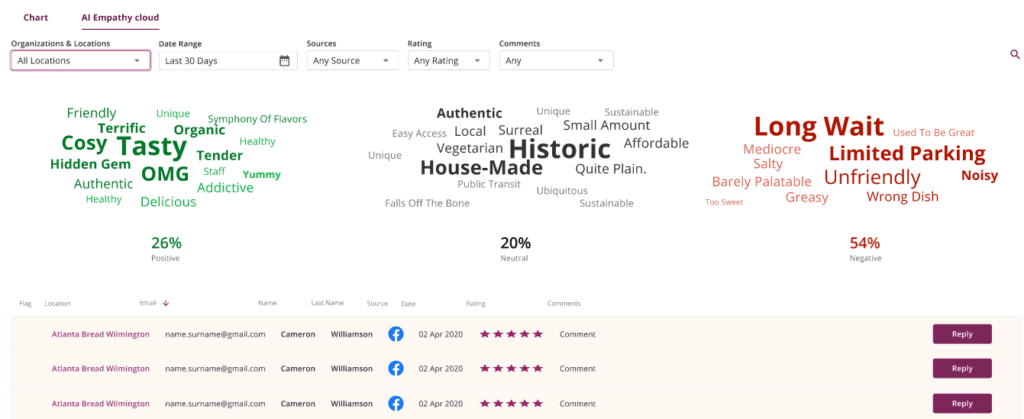
Positive sentiment is in green, neutral in grey, and negative in red. The larger the word or phrase, the more it appeared in your customer reviews.
This makes it super simple to measure customer sentiment and improve your business over time.
Discover Bloom Intelligence
Restaurant marketing strategies are a very important part of marketing your restaurant and improving the overall customer experience.
Using a WiFi marketing and customer intelligence platform like Bloom can help you execute many of these restaurant marketing strategies at a very affordable price.
Based on the list of strategies above, perhaps the most powerful way to boost revenue, improve online ratings, bring back lost customers, and improve customer lifetime values – all while saving time and money – is to invest in WiFi marketing and customer intelligence platform like Bloom Intelligence.
If you would like to see Bloom in action, and how easy it is to use, call us today to schedule a demo, or schedule a demo online here.

.svg)