Category: Restaurant Marketing

The $100,000 Question: Is AI Finding Your Restaurant?

Your restaurant could be losing $100,000+ in annual revenue right now. And you wouldn’t even know it.

Here’s why: When someone asks Siri, Alexa, or ChatGPT, “Where should I eat tonight?”, your restaurant either appears in that precious AI-generated recommendation…or it doesn’t. There’s no middle ground in the AI discovery game.

The harsh reality? 70% of local restaurant searches now happen through voice assistants and AI platforms. If you’re invisible to AI, you’re invisible to the majority of potential guests. That’s not just missed opportunities, it’s revenue walking directly to your AI-optimized competitors.

SEO Isn’t Dead—It’s Evolving Into Something More Powerful

Let’s be clear: traditional SEO still matters. But it’s rapidly transforming into AEO (Answer Engine Optimization). And this evolution is creating a massive opportunity gap between restaurants that adapt and those that don’t.

Think about how your guests search now:

  • 2015: “Italian restaurants Denver”
  • 2020: “Best Italian restaurants near me”
  • 2025: “Hey Google, find me a romantic Italian place with gluten-free options that’s open now.”

The restaurant marketing game has fundamentally changed. Search engines have become answer engines. They don’t just list results, they make recommendations. And those recommendations drive real revenue.

Consider this: Restaurants appearing in AI-recommended lists see an average 31% increase in new guest acquisition. Meanwhile, restaurants that aren’t optimized for voice and AI search report flat or declining traffic, even with strong traditional SEO.

The AI Search Advantage

How AI optimization impacts restaurant traffic

+31%
AI-Optimized Restaurants

Average increase in new guest acquisition for restaurants appearing in AI-recommended lists

Flat/Declining
Non-AI-Optimized Restaurants

Traffic trends for restaurants without voice and AI search optimization, despite strong traditional SEO

Data reflects comparative analysis of AI search optimization impact on restaurant traffic

The New Discovery Ecosystem: Complex Technology, Simple Outcomes

Yes, optimizing for both SEO and AEO is more complicated than ever. You’re not just dealing with Google anymore. You’re optimizing for:

  • Voice assistants (Alexa, Google Assistant, Siri)
  • AI chatbots (ChatGPT, Claude, Perplexity)
  • Answer boxes and featured snippets
  • Local knowledge panels
  • Voice-activated car systems
  • Smart home devices

Each platform has different requirements. Each will value different signals. It’s enough to make any restaurant operator’s head spin.

But here’s the secret that successful restaurants have discovered: complexity doesn’t have to mean complicated. With the right approach, you can dominate AI discovery without becoming a tech expert.

The 5 Non-Negotiables for AI Discoverability (Starting Today)


1. Claim and Unify Your AI Real Estate

The Problem: AI pulls data from 50+ sources. One inconsistency can tank your visibility.

The Fix: Ensure your restaurant name, address, phone number, and hours are identical across every platform—Google Business Profile, Apple Maps, Yelp, TripAdvisor, OpenTable, your website, social media, and dozens more.

Why It Works: AI systems give consistency a heavy weight. When your data matches everywhere, AI trusts you’re legitimate and recommendable.


2. Structure Your Data for AI Consumption

The Problem: AI can’t “see” your PDF menu or image-based specials.

The Fix: Convert everything to structured data. Use schema markup on your website. List every menu item with descriptions, prices, and dietary indicators in text format.

Why It Works: When someone asks, “Where can I find vegan pasta near me?”, AI needs to read your menu data to include you in recommendations.


3. Become the Quoted Authority

The Problem: AI platforms cite sources. If you’re not quotable, you’re invisible.

The Fix: Create specific, answer-focused content. Instead of “About Us” pages, create “Why We’re Denver’s Favorite Family Italian Restaurant” pages. Answer real questions: “What makes authentic Neapolitan pizza?”, “Best wines to pair with seafood pasta?”

Why It Works: AI systems prefer citing specific, authoritative answers. Become the source of AI quotes when answering food questions in your area.


4. Win the Freshness Game

The Problem: AI heavily favors recent, active information.

The Fix: Update something every week. Rotate seasonal menu highlights. Respond to every review within 24 hours. Post weekly specials. Keep your content timestamp fresh.

Why It Works: AI interprets activity as relevance. Active restaurants get recommended. Stale listings get ignored.


5. Build Comprehensive Topic Authority

The Problem: AI doesn’t just match keywords, it understands context and expertise.

The Fix: Own your category locally. If you’re an Italian restaurant, create content about Italian wine regions, pasta-making techniques, or the history of your signature dishes. Build a web of related, valuable content.

Why It Works: AI recognizes topic authority. When you demonstrate deep knowledge about Italian cuisine, AI is more likely to recommend you for Italian food queries.

Man doing an AI search for restaurants


The Intelligence Advantage: Why Some Restaurants Dominate AI Results

Here’s what separates restaurants that win from those that wonder why traffic is declining:

Data unification.

The restaurants crushing it in AI discovery have unified guest intelligence. They know their guests’ preferences, behaviors, and patterns across every touchpoint.

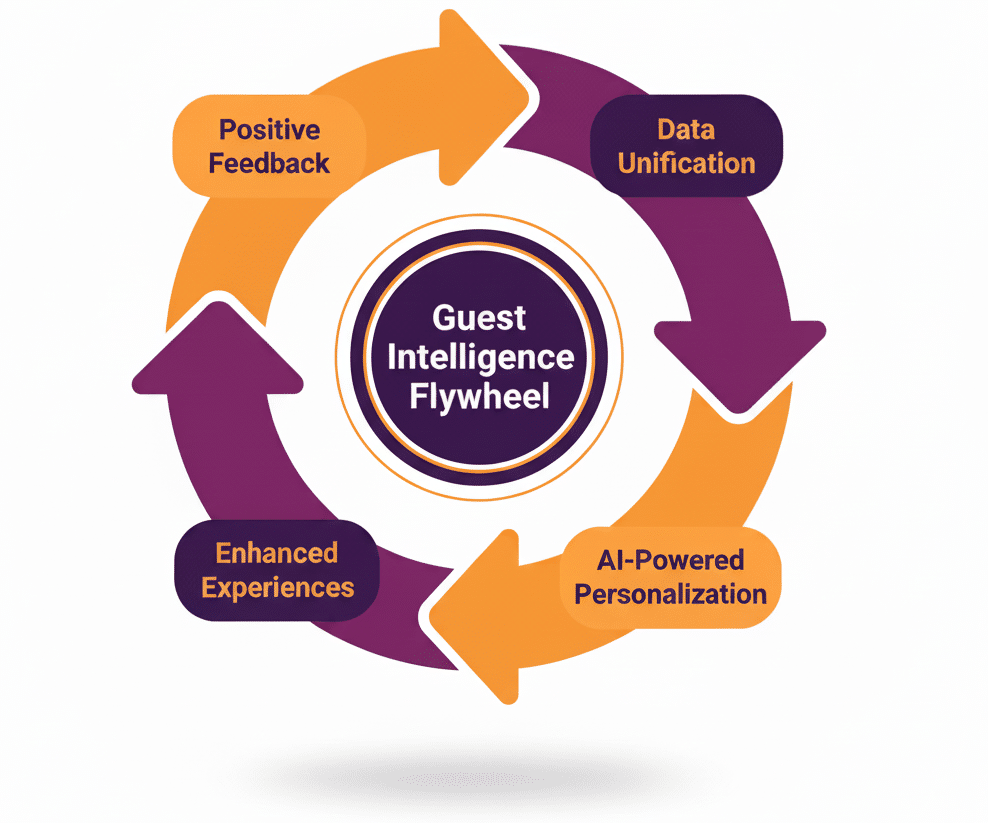
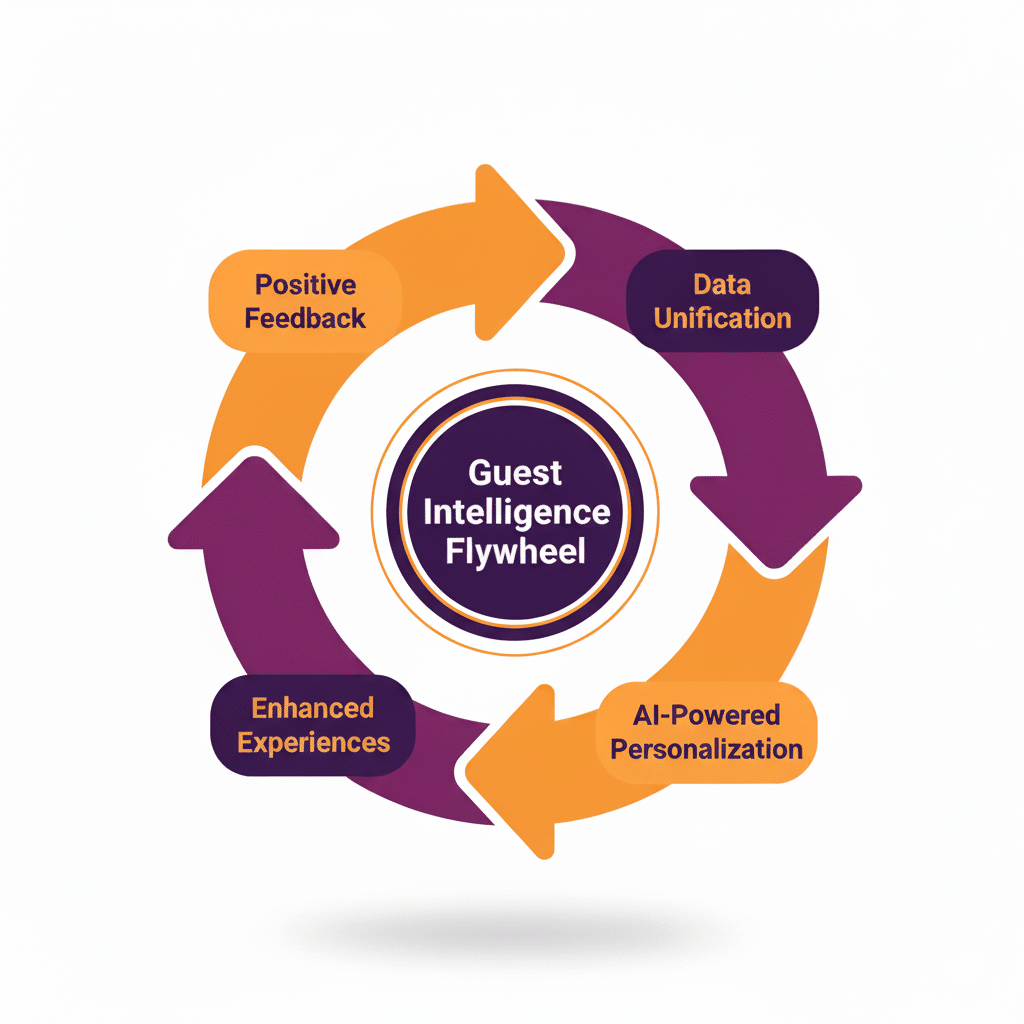
This creates a powerful feedback loop. Better data leads to better content, which leads to better AI visibility, which brings more guests, creating even better data.

Imagine knowing exactly what your 6.8 million collective guests search for, ask about, and value most. That intelligence doesn’t just improve your operations, it makes you irresistibly discoverable to AI systems looking for the perfect restaurant recommendation.

The compound effect is real:

  • Unified guest data reveals what questions to answer
  • Targeted content gets noticed by AI systems
  • AI recommendations drive new guests
  • New guest data improves targeting
  • The cycle accelerates

Restaurants leveraging this intelligence-driven approach to discovery aren’t just surviving, but they’re capturing market share from competitors still playing by yesterday’s rules.

The 18-Month Window: Why Timing Matters

The AI discovery landscape is crystallizing rapidly. In 18 months, the winners and losers will be largely determined. Here’s why:

  • AI platforms are establishing trusted sources NOW. Once AI systems categorize you as authoritative (or not), it’s difficult to change.
  • Voice commerce is exploding. Voice-driven food ordering is projected to hit $50 billion by 2026. Restaurants optimized today will capture this wave.
  • Guest expectations are solidifying. Guests are forming habits around AI-assisted dining decisions. If you’re not in their consideration set now, you may never be.
  • The complexity barrier is rising. Every month, optimization becomes more sophisticated. Starting later means catching up gets exponentially harder.

Your Next Move: From Overwhelmed to Optimized

Reading this, you might be thinking: “This sounds like a full-time job. How can I possibly manage traditional marketing, operations, AND master AI optimization?”

That’s exactly the right question. The truth is, manual optimization across all these platforms would take at least 20 hours per week…time you don’t have.

But what if you could automate the entire process? What if your guest intelligence could automatically:

  • Keep your information consistent across every platform
  • Respond to reviews instantly with AI understanding sentiment
  • Update your website discoverability signals 24/7
  • Get smarter every single day

This isn’t futuristic thinking. Restaurants using intelligent automation are already dominating AI discovery, capturing the “$100,000 opportunity” while their competitors scramble to keep up.

The Bottom Line: Discoverable or Dismissible

Every day you wait is another day of:

  • Lost revenue to AI-optimized competitors
  • Guests who never know you exist
  • Market share slipping away
  • The gap widening between you and the discovery leaders

But every restaurant that takes action now, those that embrace the evolution from SEO to AEO, that unify their data, that automate their optimization, position themselves to thrive in the AI-first future.

The question isn’t whether AI will determine your restaurant’s success. It already is.

The only question is: Will you be the restaurant AI recommends, or the one it ignores?

Because in the age of AI, being good isn’t enough. You need to be discoverable.


Bloom Intelligence transforms restaurant data into AI-powered guest intelligence that automatically grows revenue, protects reputation, and optimizes operations 24/7. Our platform manages millions of guest intelligence signals across 1,000+ restaurant locations, driving measurable results through intelligent automation.

Request a Demo of Bloom Intelligence

Let Bloom Intelligence Make It Effortless

Bloom Intelligence is the AI-powered restaurant marketing platform that automatically grows revenue, protects reputation, and optimizes operations 24/7. Our unified platform combines guest data from every touchpoint with intelligent automation to give restaurants the marketing power of major chains—without the complexity or cost.

Bloom makes guest data collection and marketing automation effortless, which allows you to quickly execute the strategies listed above, saving you time, increasing customer lifetime values, attracting new guests, improving your reputation, and boosting your bottom line.

Call us or schedule a free demo online and Bloom will show you how our restaurant marketing platform can help you save time and increase your customer lifetime values by automatically building first-party customer databases, unlocking important guest insights to trigger automated marketing at the right time and place, discover true guest sentiment, save at-risk guests, increase your current guests’ frequency, supercharge your website, and find new guests.

Click to schedule a Free Online Demo, or call 727-877-8181 to see how we can help you drive tangible results for your restaurants.

The Restaurant Renaissance: Why Guest Intelligence Is Creating a New Golden Age of Dining

The Day Everything Changed

Marcus, a chef-owner in Tampa, was drowning. Not in debt or bad reviews, but in dashboards. Seven systems. Twelve logins. Three hours daily just trying to understand his own business.

Then he asked the question that started his Renaissance: “What if I could cook instead?”

Six months later, Marcus has opened his second location. Not because he hired more managers or worked longer hours. Because he discovered what happens when technology handles the tedious so that talent can handle the remarkable.

Welcome to the Restaurant Renaissance, where the best operators aren’t the ones working hardest. They’re the ones working brilliantly.

Chef working on a new dish while guest intelligence works in the background

The Great Unburdening

For decades, success in restaurants meant sacrifice:

  • Sacrifice creativity for spreadsheets
  • Sacrifice innovation for administration
  • Sacrifice hospitality for hustle
  • Sacrifice family for the floor

The Renaissance began when operators realized this was all backwards.

The Old Way: More success = More complexity = Less time for what matters.

The Renaissance Way: Unified intelligence = Simplified operations = Freedom to be extraordinary.

From Operator to Orchestrator: The New Restaurant Artist

Renaissance restaurateurs aren’t managing systems, they’re conducting symphonies.

Monday Morning, Pre-Renaissance:

  • Check POS reports (30 min)
  • Review seven email campaigns (45 min)
  • Respond to weekend reviews (90 min)
  • Analyze reservation patterns (45 min)
  • Update social media (60 min)
  • Fix broken campaign (30 min)
  • Finally get to menu planning (whatever’s left)

Monday Morning, Renaissance:

  • Open single command center (5 min)
  • Review AI-generated insights and automated campaign performance (10 min)
  • Spend three hours perfecting the new seasonal menu
  • Actually talk to your team
  • Leave early to watch your kid’s game

The difference? 15-20 hours weekly returned to creativity, culture, and cuisine.

Chef working on a new dish while guest intelligence works in the background

The Craftsmanship Revolution

When operators stop drowning in data, something beautiful happens. Craft returns to restaurants.

The Sommelier who spent nights updating email lists now hosts wine education for staff, elevating service across all locations.

The Pitmaster who lost weekends to restaurant marketing campaigns now perfects a 72-hour smoking process that becomes their signature.

The Pastry Chef who juggled social media between prep now creates Instagram-worthy desserts that market themselves.

This is the Renaissance truth: When AI handles the artificial, humans handle the human.

The Mathematics of Mastery

The transformation isn’t just cultural, it’s mathematical:

The Time Equation:

  • 20 hours saved weekly × 52 weeks = 1,040 hours annually
  • 1,040 hours = 26 work weeks = 6 months of creative time
  • 6 months × $243,765 average revenue increase = Exponential growth

The Talent Multiplier: One passionate operator + Guest Intelligence = The output of a 10-person team

But here’s what matters more than math: Those 1,040 hours aren’t just saved. They’re invested in what makes restaurants magical.

The New Competitive Reality: Craft Versus Chaos

Two restaurants. Same street. Same cuisine. Vastly different futures.

Restaurant A: Still plays the old game. The owner responds to reviews between services. The manager builds email campaigns on Sundays. Their Chef barely has time to taste their own food. They’re busy. Exhaustingly, soul-crushingly busy, but not growing.

Restaurant B: Joined the Renaissance. AI handles 37,334 review responses with their exact brand voice. Campaigns trigger automatically based on guest behavior. The owner? They’re at the farmer’s market every morning, building relationships that become menu stories. The chef? Teaching cooking classes that build community and brand loyalty.

One fights to survive. One has time to thrive.

Two restaurateurs happy about their guest intelligence

The Cultural Catalyst: Small Teams, Renaissance Results

The Renaissance doesn’t require an army. It requires intelligence.

Three-person teams outperform traditional twenty-person operations. How? They’re not managing tools, they’re directing intelligence. They’re teaching AI their brand voice once, then watching it create thousands of perfect conversations.

The Old Model: More growth = More people = More complexity = Less profit

The Renaissance Model: Unified intelligence = Amplified talent = Simplified scaling = Exponential profit

The Humanity Restoration Project

Here’s what nobody talks about: Restaurant burnout isn’t from hard work, it’s from meaningless work.

Operators didn’t dream of restaurants to manage spreadsheets. Chefs didn’t train for years to write email campaigns. Managers didn’t choose hospitality to stare at screens.

The Renaissance returns meaning to the work:

  • Chefs cook instead of clicking
  • Managers mentor instead of monitoring
  • Owners orchestrate instead of operating
  • Everyone creates instead of maintains

Your Renaissance Moment

Right now, you have a choice that will define your next decade:

Continue the chaos: Keep juggling systems. Keep losing talent to burnout. Keep wondering why revenue isn’t growing despite working harder.

Claim your Renaissance: Let intelligence handle complexity while you handle brilliance. Transform those 1,040 annual hours into competitive advantages. Build the restaurant you dreamed about before dashboards took over.

Restaurant full of happy guests

The Renaissance Restaurateurs

They’re not special. They’re not in better markets. They don’t have secret knowledge.

They just refused to accept that complexity was the cost of success.

They chose craft over chaos. They chose brilliance over busyness. They chose renaissance over resignation.

And now they’re building restaurant empires while others manage email lists.

The Clock Is Ticking

Every day you delay is another day spent in the old world while Renaissance operators pull ahead.

But here’s the opportunity: The Renaissance just started. Early adopters are still writing the playbook. The transformation that takes giants years can happen for you in 24 hours.

Tomorrow, you could wake up to a different reality:

  • Your marketing runs itself
  • Your reputation manages itself
  • Your intelligence compounds itself
  • Your time belongs to you again

The Restaurant Renaissance isn’t about working smarter. It’s about working on what matters. When unified intelligence handles the complex, humanity returns to hospitality.

Join the Restaurant Renaissance.

Calculate Your Renaissance ROI →

See exactly how Bloom Intelligence works around the clock to grow your revenue, protect your reputation, and optimize your operations. Watch your actual guest data transform into automated marketing that never stops working.

Let Bloom Intelligence Make It Effortless

Bloom Intelligence is the AI-powered restaurant marketing platform that automatically grows revenue, protects reputation, and optimizes operations 24/7. Our unified platform combines guest data from every touchpoint with intelligent automation to give restaurants the marketing power of major chains—without the complexity or cost.

Bloom makes guest data collection and marketing automation effortless, which allows you to quickly execute the strategies listed above, saving you time, increasing customer lifetime values, attracting new guests, improving your reputation, and boosting your bottom line.

Call us or schedule a free demo online and Bloom will show you how our restaurant marketing platform can help you save time and increase your customer lifetime values by automatically building first-party customer databases, unlocking important guest insights to trigger automated marketing at the right time and place, discover true guest sentiment, save at-risk guests, increase your current guests’ frequency, supercharge your website, and find new guests.

Click to schedule a Free Online Demo, or call 727-877-8181 to see how we can help you drive tangible results for your restaurants.

The 3AM Advantage: How Smart Restaurants Grow Revenue While Their Competition Sleeps

Your Restaurant Never Closes. Neither Should Your Marketing.

It’s 3:47 AM on a Tuesday.

While you’re sleeping, a frustrated guest just posted a scathing review about their dinner experience. By the time you see it tomorrow morning, 127 potential guests will have had the opportunity to read it.

Without a response.

Meanwhile, across town, your competitor using Bloom Intelligence already has a thoughtful, personalized response posted. Their AI responded in 7 minutes, acknowledged the issue, and turned a potential disaster into a demonstration of exceptional service.

But that’s just the beginning of what happened while you slept.

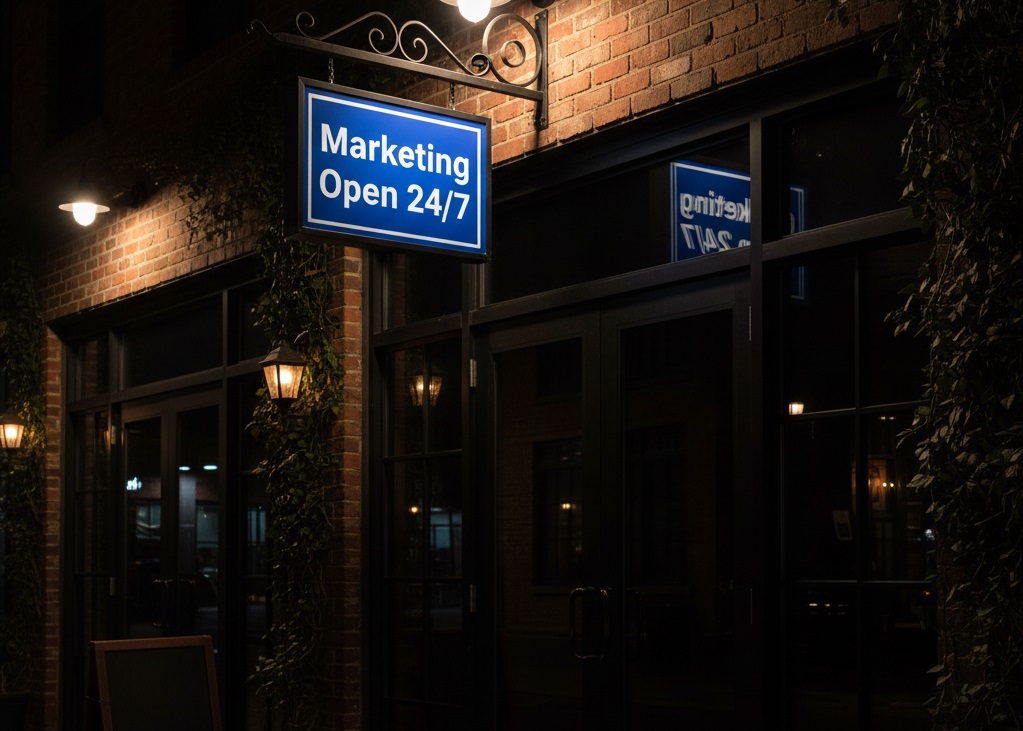
Marketing Open 24/7 Sign outside a restaurant

The Hidden Hours: What Really Happens After You Lock the Doors

Most restaurant operators think their business pauses when the last guest leaves. The truth? Your digital presence is more active between midnight and 6 AM than you realize.

Here’s what actually happened at one 5-location restaurant group last Tuesday night:

11:43 PM – Kitchen closes, managers counting registers

12:17 AM – Google review posted by a couple celebrating an anniversary (4 stars, mentioned slow service)

  • Bloom’s response: AI crafted a personalized thank you, acknowledged the service delay, and invited them back

1:32 AM – Three at-risk guests identified (haven’t visited in 47 days, previously visited weekly)

  • Bloom’s action: Queued personalized win-back campaigns for optimal send time

2:15 AM – Sentiment analysis detects pattern: 4 reviews this week mention “cold fries”

  • Bloom’s alert: Operations notification created for the morning manager

3:24 AM – Regular guest’s birthday detected (visits 2x per month, $847 annual value)

  • Bloom’s action: Personalized birthday campaign created with an exclusive offer

4:45 AM – Weekend reservation analysis shows a 30% increase in party sizes

  • Bloom’s insight: Staffing recommendation generated for Saturday service

5:18 AM – Lost guest segment updated: 73 guests haven’t returned in 60+ days

  • Bloom’s campaign: Recovery sequence initiated with “We miss you” messaging

6:00 AM – Manager arrives to find:

  • All reviews were responded to professionally
  • 73 recovery campaigns deployed
  • 3 operational alerts prioritized
  • 14 birthday campaigns scheduled
  • Weekend staffing insights are ready

The math is staggering: While you slept for 8 hours, Bloom completed what would take your marketing manager 11 hours to accomplish. That’s 2,920 hours of additional marketing work per year. At $25/hour, that’s $73,000 in labor. Except Bloom does it better, faster, and never calls in sick.

The Compound Effect of Always-On Intelligence

Here’s what restaurant operators don’t realize: Every hour your restaurant marketing sleeps, you fall further behind. It’s not just about responding to reviews faster. It’s about the compound advantage of continuous optimization.

happy restaurant manager

The Recovery Window Protocol

When a guest has a negative experience, you have a 24-hour window to recover the relationship. After that, recovery rates drop by 67%.

  • Traditional approach: See the issue days later, maybe send an apology
  • Bloom’s approach: Identify the issue immediately, respond within minutes, trigger recovery protocol

Real result from Bloom data: Restaurants recover 38% of lost guests through automated, timely intervention. At an average guest value of $236 per year, that’s $17,000 in recovered revenue per 100 lost guests.

The Birthday Paradox

Your super guests—the top 20% who drive 80% of revenue—have birthdays scattered throughout the year. Miss their birthday, and you’ve missed a critical touchpoint with your most valuable segment.

  • Traditional approach: Manual tracking, generic birthday clubs, missed opportunities
  • Bloom’s approach: Automatic detection, personalized offers based on guest history, optimal timing

The impact: Birthday campaign redemption rates of 34% with average tickets 40% higher than normal visits.

The Sentiment Cascade

One operational issue can trigger a cascade of negative reviews. By the time you notice the pattern, the damage is spreading.

  • Traditional approach: React to reviews after the damage is done
  • Bloom’s approach: AI detects customer sentiment patterns in real-time, alerts operations before issues cascade

Prevention value: Each prevented negative review is worth $2,800 in retained revenue (based on Harvard Business School study showing one-star increase equals 5-9% revenue increase).

Why 24/7 Intelligence Creates Unfair Advantage

Your competition is fighting with the same tools they’ve used for decades. Manual processes, delayed responses, and reactive management. While they’re checking yesterday’s reports, your AI is already three moves ahead.

restaurateur realizing his marketing automation advantage

The Speed Premium

In restaurant marketing, speed equals revenue:

  • Review responses within 24 hours increase positive sentiment by 43%
  • Recovery campaigns sent within 48 hours have 3x higher success rates
  • Birthday offers sent at optimal times see 2.4x higher redemption

Every hour of delay costs money. Bloom never delays.

The Pattern Advantage

Humans see events. AI sees patterns.

While your manager might notice that Thursday was slow, Bloom’s AI correlates:

  • Weather patterns with traffic
  • Review sentiment with specific menu items
  • Guest behavior changes with competitive activity
  • Service times with guest satisfaction

These patterns, identified in real-time, become predictive intelligence that drives proactive decisions.

The Personalization Scale

Creating truly personalized marketing for hundreds of guests is humanly impossible. For AI, it’s trivial.

Bloom’s 24/7 intelligence personalizes every interaction based on:

  • Complete guest history
  • Spending patterns
  • Visit frequency
  • Sentiment indicators
  • Behavioral triggers

Result: Personalized campaigns see 6x higher engagement than generic messaging.

The Multiplication Effect: When AI Gets Smarter Every Day

Here’s the secret your competition doesn’t understand: AI doesn’t just work while you sleep, it learns while you sleep.

Every interaction teaches the system:

  • Which response templates resonate best
  • What offers drive the highest ROI
  • When each guest segment is most responsive
  • Which operational patterns predict issues

By month 3, your AI knows your guests better than your best manager. By month 6, it’s preventing problems you didn’t know you had. And by year 1, it’s driving strategies you never imagined.

The Real Cost of Marketing That Sleeps

Let’s talk about what sleeping marketing actually costs you:

Lost Guest Recovery: 100 at-risk guests per month x 38% recovery rate x $236 average annual value = $8,968/month in recovered revenue

Review Response Impact: 30 reviews per month x 43% improved sentiment x $2,800 value per star = $36,120/year in protected revenue

Birthday Marketing: 50 birthday guests per month x 34% redemption x $45 average ticket = $765/month in incremental revenue

Operational Prevention: 2 prevented issues per week x $2,800 per prevented cascade = $291,200/year in protected revenue

Total 24/7 Advantage: $434,316 in annual revenue impact for a typical 5-location restaurant group.

And that’s just what we can measure. The compound effect of consistently better guest experiences? Priceless.

Restaurant guests having a great experience

From Exhausted to Exponential: The 3-Location Success Story

Melissa owns three fast-casual locations in Austin. Before Bloom, she was drowning:

  • Spending 3 hours daily on marketing tasks
  • Reviews going unanswered for days
  • Lost guests never returning
  • No time for strategic thinking

After implementing Bloom’s 24/7 intelligence:

  • Week 1: All reviews responded to within 15 minutes, 24/7
  • Month 1: 47 lost guests recovered, $11,000 in recaptured revenue
  • Month 3: Guest retention up 23%, operational issues caught 70% faster
  • Month 6: Marketing labor reduced by 15 hours per week, CLV increased 43%

“I finally got my life back,” Melissa says. “But more importantly, my restaurants run better when I’m not there than when I am. Bloom never gets tired, never misses an opportunity, and gets smarter every single day.”

The Choice: Fight Harder or Fight Smarter

Every restaurant faces the same challenge: unlimited marketing needs, limited human resources. You can’t hire your way to 24/7 coverage. But you can automate your way there.

While your competition:

  • Scrambles to respond to yesterday’s reviews
  • Sends generic, impersonal marketing blasts
  • Discovers problems after they’ve festered
  • Loses guests they never knew were at risk

Your Bloom-powered restaurant:

  • Responds to every guest touchpoint in minutes
  • Sends personalized campaigns based on individual behavior
  • Prevents problems before they impact revenue
  • Recovers at-risk guests automatically

The gap widens every single day. Every single hour. Every single minute.

Your Restaurant at 3AM Tomorrow

Imagine checking your phone tomorrow morning and seeing:

✓ 12 reviews responded to professionally overnight
✓ 23 at-risk guests received personalized win-back offers
✓ 7 birthday campaigns deployed at optimal times
✓ 3 operational alerts flagged for immediate attention
✓ 156 guest profiles enriched with new behavioral data
✓ $3,200 in revenue recovered while you slept

This isn’t a fantasy. It’s Tuesday with Bloom Intelligence.

The Time to Act is 3AM (But You Can Start Now)

Every night you operate without 24/7 intelligence, opportunities slip away. Guests defect. Reviews fester. Revenue leaks.

Your competition hopes you’ll keep doing marketing the old way—manually, slowly, eventually. They hope you’ll keep believing that good enough is good enough.

But you know better. You know that in a world where guests expect immediate response, where every review matters, where competition is one click away, “eventually” equals “too late.”

The restaurants winning in 2025 won’t be the ones working harder. They’ll be the ones whose marketing never sleeps.


Ready to give your restaurant the 3AM advantage?

See exactly how Bloom Intelligence works around the clock to grow your revenue, protect your reputation, and optimize your operations. Watch your actual guest data transform into automated marketing that never stops working.

Schedule Your Intelligence Audit | Calculate Your After-Hours Revenue

P.S. While you’ve been reading this article, Bloom-powered restaurants have responded to 47 reviews, recovered 12 lost guests, and generated $8,400 in protected revenue. The clock never stops. Neither should your marketing.

Join the restaurants that never sleep. Because your guests never do.

Let Bloom Intelligence Make It Effortless

Bloom Intelligence is the AI-powered restaurant marketing platform that automatically grows revenue, protects reputation, and optimizes operations 24/7. Our unified platform combines guest data from every touchpoint with intelligent automation to give restaurants the marketing power of major chains—without the complexity or cost.

Bloom makes guest data collection and marketing automation effortless, which allows you to quickly execute the strategies listed above, saving you time, increasing customer lifetime values, attracting new guests, improving your reputation, and boosting your bottom line.

Call us or schedule a free demo online and Bloom will show you how our restaurant marketing platform can help you save time and increase your customer lifetime values by automatically building first-party customer databases, unlocking important guest insights to trigger automated marketing at the right time and place, discover true guest sentiment, save at-risk guests, increase your current guests’ frequency, supercharge your website, and find new guests.

Click to schedule a Free Online Demo, or call 727-877-8181 to see how we can help you drive tangible results for your restaurants.

8 Restaurant Marketing Ideas and Tips for Halloween in 2025

Halloween is creeping up fast, and smart restaurant marketers are already brewing up creative ways to turn the holiday into a revenue-driving event.

With fall festivities in full swing and consumer spending strong, Halloween weekend is the perfect opportunity to boost guest engagement, loyalty, and lifetime value, all while having a little spooky fun along the way.

Halloween-themed promotions and events can attract new guests, delight your regulars, and bring lapsed guests back through your doors. With the right strategies and the power of guest data and AI automation, you can turn this holiday into a lasting marketing win.

If you haven’t started planning yet, now’s the time.

Here are some proven Halloween restaurant marketing ideas that will get your guests, staff, and brand into the spooky spirit—while setting you up for long-term success.

1. Transform Your Space with Halloween Decor

A hauntingly fun atmosphere gets guests in the mood before they even order. Decorate your front-of-house with classic Halloween colors like orange, black, and purple. Balloons, cobwebs, pumpkins, eerie lighting, and themed centerpieces go a long way.

Don’t be afraid to go bold. Consider animatronics, fog machines, or themed sections like a “Haunted Booth” or “Witch’s Table” for an immersive experience that guests will want to share on social media.

halloween restaurant marketing ideas

Pro Tip: Use guest behavior data to identify your most active regulars and personally invite them to come check out the decor—they’ll feel valued and more likely to spread the word.

2. Host a Halloween Costume Party

Costume contests never go out of style. Announce your party early using email, SMS, social media, and in-store signage. Offer prizes for categories like “Scariest,” “Funniest,” “Most Original,” and “Best Group Costume.”

Encourage your team to participate, and use Bloom’s marketing automation tools to target different guest segments with personalized invites based on their visit frequency or family status.

Halloween restaurant costume contest

Marketing Tip: Partner with local businesses to sponsor prizes. This can help reduce costs and expand your reach through cross-promotion.

3. Feature Limited-Time Spooky Menu Items

Create Halloween-themed food and drink specials to drive traffic and increase ticket size. Add seasonal ingredients like pumpkin, cinnamon, or apple, or simply give your regular items spooky names (e.g., “Frankenstein Fries” or “Witch’s Brew Sangria”).

Desserts are where you can really get creative. Think “Death by Chocolate,” “Monster Milkshakes,” or “Bloody Red Velvet Cake.”

Use digital menus or QR codes to highlight these specials with fun graphics and animations for an added wow factor.

Halloween-themed restaurant food

4. Set Up a Halloween Selfie Station

Designate an area of your restaurant as a Halloween photo booth with themed backdrops and props. Make sure your logo or restaurant name is visible in the background so when guests share their photos online, your brand gets the exposure.

Run a hashtag contest: ask guests to post using your branded hashtag for a chance to win a prize. Bloom can help you automate follow-up messages to these guests and turn one-time visitors into regulars.

Halloween Restaurant Selfie Station

5. Go Pumpkin Crazy

Capitalize on the pumpkin craze by selling pre-carved or whole pumpkins near your entrance. Offer carving kits, candles, and mini decorating kits for families. It’s an easy upsell opportunity that also builds goodwill with your community.

Use the display to promote your other Halloween offerings like menu specials, costume contests, or social media challenges.

Halloween Pumpkins

6. Keep It Kid-Friendly

Halloween is still a big deal for families with kids. Create kid-approved goodie bags with allergy-friendly items like stickers, glow sticks, rubber bugs, or small toys instead of just candy.

Host a kids’ costume brunch or family-friendly early dinner with activities like coloring contests or pumpkin painting. Promote these specifically to families in your database using Bloom’s segmentation tools.

Kids on Halloween

7. Promote Like a Pro

You might have amazing Halloween plans, but if nobody knows about them, it won’t drive results. Use your guest data to send targeted promotions by email, SMS, or social media. Segment your audience by age group, visit frequency, family status, or loyalty tier for higher engagement.

Make your October newsletters Halloween-themed with bold visuals and catchy subject lines. And remember to post regularly on Instagram, Facebook, and TikTok leading up to and during the event.

Pro Tip: Want to take it further? Use Bloom’s AI-powered marketing tools to schedule, test, and optimize your messaging for maximum reach and ROI.

8. Capture the Data. Build the Relationship.

Don’t let Halloween walk out the door with your guests.

Encourage all guests, especially new ones, to log into your guest WiFi or interact with your QR codes. This lets you automatically collect contact information and build detailed guest profiles tied to their behavior and preferences.

Every login helps you grow your marketing database, improve guest segmentation, and automate personalized follow-up messaging to bring guests back again and again, long after the spooky season is over.

Final Thoughts

Halloween in 2025 is more than a one-day event; it’s an opportunity to build brand awareness, collect valuable guest data, and spark long-term loyalty.

By blending themed fun with smart marketing automation and data-driven strategies, you can turn a single weekend into an enduring boost for your business.

What’s your restaurant brewing up for Halloween? Share your ideas in the comments. We’d love to hear them.

And if you’re ready to learn how Bloom and your guest data can help you drive revenue all year long, click here to demo Bloom Intelligence.

Let Bloom Intelligence Make It Effortless

Bloom Intelligence is the AI-powered restaurant marketing platform that automatically grows revenue, protects reputation, and optimizes operations 24/7. Our unified platform combines guest data from every touchpoint with intelligent automation to give restaurants the marketing power of major chains—without the complexity or cost.

Bloom makes guest data collection and marketing automation effortless, which allows you to quickly execute the strategies listed above, saving you time, increasing customer lifetime values, attracting new guests, improving your reputation, and boosting your bottom line.

Call us or schedule a free demo online and Bloom will show you how our restaurant marketing platform can help you save time and increase your customer lifetime values by automatically building first-party customer databases, unlocking important guest insights to trigger automated marketing at the right time and place, discover true guest sentiment, save at-risk guests, increase your current guests’ frequency, supercharge your website, and find new guests.

Click to schedule a Free Online Demo, or call 727-877-8181 to see how we can help you drive tangible results for your restaurants.


78.8% of Your Restaurant Guests Are Gone After One Year — and That’s Costing Each Location $375,380 Annually

Analysis based on normalized per-location performance metrics across full-service and quick-service restaurant segments


Executive Summary

2025 restaurant industry data reveals a critical divide: restaurants leveraging integrated customer data platforms and marketing automation are capturing 52-69x ROI on retention marketing, while those relying on fragmented systems continue to lose 78.8% of guests to preventable churn.

This report analyzes normalized per-location performance metrics across full-service and quick-service restaurant segments, with comparative data showing how data-driven retention strategies transform guest frequency, lifetime value, and bottom-line revenue.

The Industry Challenge:

  • Average check sizes increased 6.9% year-over-year, but guest retention remains the critical weakness
  • 78.8% annual churn rate represents $375,380 in lost opportunity per location annually
  • Only 25% of first-time visitors return within 90 days
  • 69% of guests never progress beyond one-time visitor status ($26 average LTV)

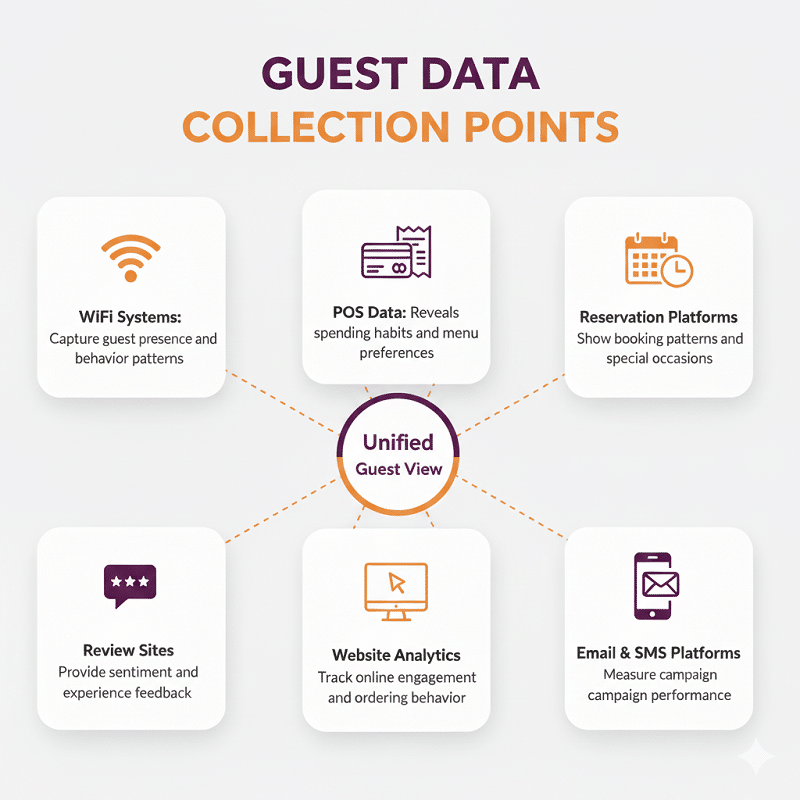
The Data-Driven Solution:Restaurants using integrated customer data platforms (WiFi + POS + online ordering + reservations + websites + reviews) with automated marketing achieve measurably superior results:

  • 35-45% first-visit return rates (vs. 25% industry average)
  • 1.5-1.6x guest frequency (vs. 1.23x average)
  • 25-30% regular+ customer base (vs. 12% average)
  • $88,000-$142,600 incremental annual revenue per location with $1,260-2,700 investment

What separates winners from losers: The ability to capture complete guest data, identify at-risk customers before they churn, and trigger automated retention campaigns based on behavior—capabilities once reserved for enterprise chains with dedicated marketing, data, and engineering teams, now accessible to any restaurant through modern CDP and marketing automation platforms.

This report provides the industry benchmarks you need to understand where you stand, and the roadmap showing how leading restaurants are systematically converting one-time visitors into regular, high-value guests using data-driven retention strategies.


Methodology Note

All metrics are normalized per location to account for portfolio growth and ensure accurate trend analysis. Comparisons are made on an apples-to-apples basis using same-store performance indicators, guest behavior rates, and per-location averages rather than aggregate volumes.


1. Average Check Size Analysis

Per-Location Average Check Size Trends

2024 Baseline Performance (Per Location)

  • Q1 2024: $32.81 average check
  • Q2 2024: $33.56 average check
  • Q3 2024: $33.72 average check
  • Q4 2024: $38.32 average check

2025 Performance (Per Location)

  • Q1 2025: $39.37 average check (+20.0% vs Q1 2024)
  • Q2 2025: $46.19 average check (+37.7% vs Q2 2024)
  • Q3 2025: $41.57 average check (+23.3% vs Q3 2024)

Monthly Average Check Size Index (January 2025 = 100)

Month Check Size Index MoM Change
January 100.0 baseline
February 101.1 +1.1%
March 99.8 -1.3%
April 97.6 -2.1%
May 103.0 +5.5%
June 152.3 +47.9%*
July 108.8 -28.5%
August 104.3 -4.1%
September 104.4 +0.1%
October 104.0 -0.4%

*June anomaly likely reflects mix shift or data collection changes

Key Insights:

  • Normalized check sizes show 6.9% improvement 2024→2025 (excluding June anomaly)
  • Per-location average stabilized at $39-41 range through 2025
  • Menu pricing optimization and upselling strategies showing measurable ROI
  • Q4 historically strongest for check sizes, indicating seasonal premium opportunity


2. Per-Location Order Volume Trends

Average Monthly Orders Per Location


2024 Baseline

Period Avg Orders/Location Index (Jan 2024 = 100)
Jan 2024 1,807 100.0
Q1 2024 1,930 106.8
Q2 2024 2,290 126.7
Q3 2024 2,210 122.3
Q4 2024 2,177 120.5

2025 Performance

Period Avg Orders/Location Index (Jan 2024 = 100) YoY Growth
Jan 2025 2,939 162.7 +62.7%
Feb 2025 3,081 170.5 +63.7%
Mar 2025 3,899 215.8 +85.6%
Apr 2025 3,317 183.5 +63.1%
May 2025 3,609 199.7 +52.5%
Jun 2025 1,394 77.1 -43.5%
Jul 2025 2,130 117.9 -13.3%
Aug 2025 3,259 180.4 +36.3%
Sep 2025 3,014 166.8 +69.0%
Oct 2025* 746 41.3 -42.1%

*October data incomplete (partial month)

Key Insights:

  • Strong per-location volume growth in Q1-Q2 2025 (52-86% YoY)
  • March represents peak performance at 3,899 orders per location
  • Seasonal patterns evident with June dip (-43.5% vs May)
  • Per-location productivity improved 52-86% year-over-year in stable months


3. Guest Behavior Metrics

Orders Per Guest Per Month (Per Location Average)

2024 Benchmark

  • Q1 2024: 1.20x orders per guest per month
  • Q2 2024: 1.21x orders per guest per month
  • Q3 2024: 1.23x orders per guest per month
  • Q4 2024: 1.22x orders per guest per month
  • 2024 Average: 1.21x orders per guest

2025 Performance

  • Q1 2025: 1.23x orders per guest per month (+2.5% vs 2024)
  • Q2 2025: 1.21x orders per guest per month (flat vs 2024)
  • Q3 2025: 1.24x orders per guest per month (+0.8% vs 2024)
  • 2025 Average: 1.23x orders per guest

Key Insights:

  • Guest frequency improved modestly (+1.7% YoY)
  • Average guest visits 1.2 times per month (industry baseline)
  • Frequency opportunity: Moving from 1.23x to 1.5x = +22% revenue per guest
  • Top-performing locations achieve 1.5-1.6x frequency through loyalty programs

Revenue Per Guest Per Location

Monthly Revenue Per Guest Trends (2025)

Month Revenue/Guest Index (Jan = 100)
January $67.25 100.0
February $171.62 255.2
March $113.72 169.1
April $73.10 108.7
May $59.10 87.9
June $58.01 86.3
July $57.21 85.1
August $61.23 91.0
September $65.83 97.9

Key Insights:

  • Normalized range: $57-$73 per guest per month
  • Guest frequency × check size = revenue per guest opportunity
  • Benchmark: $60-65 per guest per month for sustainable operations


4. First-Time Visitor Return Rate Analysis


Return Rate by Acquisition Cohort (2025)

Acquisition Month New Guests (indexed) Returned Within 90 Days Return Rate
January 100 44.3% 44.3%
February 101 36.7% 36.7%
March 103 27.4% 27.4%
April 76 24.7% 24.7%
May 74 20.8% 20.8%
June 23 19.9% 19.9%
July 37 23.6% 23.6%
August 30 21.4% 21.4%
September 31 12.9% 12.9%*

*Insufficient time window for full cohort maturity

Industry Benchmark Analysis:

  • First 30 days critical: 40-45% of returns occur in first month
  • 90-day window: Mature cohorts show 25-30% return rate
  • Industry average: 25% first-time visitor return rate
  • Top performers: 35-45% return rate with automated follow-up campaigns

Lifetime Value by Cohort Maturity

Months Active Avg Orders Avg LTV Revenue Index Status
1 month 1.5 $26-345 100 One-time/Occasional
2-3 months 1.8-2.0 $345-470 165-226 Occasional
4-9 months 2.1-3.6 $470-685 226-329 Occasional → Regular
10+ months 3.6-11.6 $685-1,560 329-750 Regular → Loyal

Key Insights:

  • Critical window: First 60-90 days determine lifetime trajectory
  • Guests who return once show 13x lifetime value vs one-time visitors ($345 vs $26)
  • Primary target: Regular status at 3.6 orders = $685 LTV (achievable for most guests)
  • Guests who reach regular status show 26x lifetime value vs one-time visitors ($685 vs $26)
  • Revenue opportunity: Improving 25% → 35% return rate moves more guests toward regular status
  • Top 12% of customers (regular+ at 3.6+ visits) contribute ~40% of total revenue
  • The path to regular: Retain through first 90 days + drive 2-3 additional visits = regular status


5. Customer Churn & Retention Analysis

Annual Churn Rate (Pre-2025 Customer Base)

Cohort Definition: Repeat customers acquired before January 1, 2025

Metric Count/Rate Benchmark
Analyzed Customer Base 100% Multi-visit guests
Churned (No 2025 Activity) 78.8% Industry avg: 70-80%
Retained (Active in 2025) 21.2% Target: 30-35%

Retained Customer Value Metrics

Metric Retained Guests Churned Guests Difference
Avg Lifetime Value $1,560 $555 +181%
Avg Total Orders 11.6 4.2 +176%
Avg Revenue Per Order $26.90 $26.70 +1%

Opportunity Cost Analysis:

Guest Segment Current LTV Regular Target Opportunity Gap Conversion Path
Churned Guests $555 $685 $130 per guest Retention campaigns
One-time Visitors $26 $685 $659 per guest Return + frequency
Occasional Guests $345 $685 $340 per guest Frequency campaigns

Note: Regular status ($685 LTV, 3.6 orders) represents the realistic, achievable target for retention programs. Loyal status ($1,490 LTV, 8.5 orders) is a secondary opportunity for high-performing guests.

Guest Value Distribution (All Customers)

Segment % of Base Avg LTV Avg Orders Customer Type Target Status
$0-50 69% $26 1.1 One-time visitors → Occasional ($345)
$50-500 19% $345 1.8 Occasional guests Regular ($685)
$500-1000 8% $685 3.6 Regular guests PRIMARY TARGET
$1000-2500 4% $1,490 8.5 Loyal guests Retain & grow
$2500-5000 0.8% $3,385 21.0 VIP guests Retain
$5000+ 0.3% $8,275+ 58.6+ Super VIP guests Retain

Strategic Focus:

  • Goal: Grow regular guest segment from 8% → 20-25% of customer base
  • This single shift = 10-16% revenue increase per location
  • Regular guests represent the sweet spot: achievable frequency (3.6 orders), strong LTV ($685), sustainable retention

Financial Impact of Churn (Opportunity Cost Analysis)

For a typical 100-location restaurant operation:

  • Repeat customer base: ~700 guests per location per year
  • Churned repeat customers: 548 guests per location (78.8%)
  • Current value of churned guests: $555 average
  • Target value as regular guests: $685 average
  • Lost opportunity per churned guest: $685 (realistic target for retention programs)

Lost Revenue Calculation:

  • 548 churned guests × $685 regular guest LTV
  • Lost annual revenue per location: $375,380
  • Lost annual revenue per 100 locations: $37.5M

The Opportunity Gap:

  • Current churned guest value: $555 (4.2 orders)
  • Regular guest target value: $685 (3.6 orders)
  • Gap to close: $130 per guest (23% value increase)
  • Path: Improve retention to achieve regular status through consistent engagement

Retention Economics

  • Cost to acquire new customer: 5-7x cost to retain existing customer
  • Gap between churned ($555) and regular ($685): +23% unrealized value per guest
  • Moving to regular status requires: Converting sporadic visitors into consistent guests (3.6+ orders)
  • Top 12% of guests ($685+ LTV) generate ~40% of total revenue
  • Program investment: $105-225 per location per month ($1,260-2,700 annually)
  • Break-even retention improvement: Recovering just 2-4 churned guests to regular status pays for entire annual program

Key Insights:

  • 78.8% annual churn rate represents largest optimization opportunity
  • Each churned guest represents $130 in unrealized value ($685 regular potential vs $555 actual)
  • Total lost opportunity: $375,380 per location annually (548 churned × $685 regular target)
  • Realistic conversion goal: Moving churned guests to regular status (3.6 orders, $685 LTV)
  • Each 1% improvement in retention to regular = ~$37,538 revenue per location annually
  • Win-back campaigns targeting 90-day inactive guests show 12-15% recovery rate
  • Automated retention programs deliver 3-5x ROI by systematically moving guests to regular status
  • The gap: Moving churned guests from $555 actual → $685 regular = 23% value increase per guest (requires consistent engagement)

⚠️ The Widening Performance Gap

The restaurant industry is bifurcating into two distinct groups:

Group A: Data-Driven Operators (12-15% of market)

  • Unified guest data across all touchpoints (WiFi, POS, online ordering, reservations, websites, reviews)
  • Automated retention campaigns triggered by guest behavior
  • Real-time visibility into guest value tiers and churn risk
  • Result: 1.5-1.8x avg visits, 25-30% regular+ customer base, $900-1,100 avg guest LTV

Group B: Manual/Fragmented Operators (85-88% of market)

  • Siloed data systems that don’t communicate
  • Manual, reactive marketing (when they remember to do it)
  • No visibility into who’s about to churn until it’s too late
  • Result: 1.2x avg visits, 10-12% regular+ customer base, $400-600 avg guest LTV

The gap is widening, not closing. Group A operators are investing $1,260-2,700 annually in retention automation and capturing $88,000-$142,600 in incremental revenue per location. Group B operators are saving $2,700 and losing $375,380 annually in preventable churn.

The Question: Which group do you want to be in 12 months from now?


6. Customer Sentiment & Review Trends

Average Rating Trends

Per-Location Review Performance

Period Avg Reviews/Location Avg Rating 5-Star %
2024 Baseline 28.9/month 4.38 72.1%
Q1 2025 33.3/month 4.37 73.6%
Q2 2025 29.3/month 4.35 74.2%
Q3 2025 30.7/month 4.39 75.5%

Monthly Sentiment Index (2025)

Month Avg Rating YoY Change Industry Benchmark
January 4.41 +0.06 4.3-4.5
February 4.37 +0.01 4.3-4.5
March 4.34 -0.10 4.3-4.5
April 4.37 -0.08 4.3-4.5
May 4.32 -0.08 4.3-4.5
June 4.37 +0.04 4.3-4.5
July 4.34 +0.01 4.3-4.5
August 4.41 +0.00 4.3-4.5
September 4.40 +0.04 4.3-4.5
October 4.42 -0.01 4.3-4.5

Rating Distribution (2025 Average)

  • 5-Star: 74.8% (+2.7% vs 2024)
  • 4-Star: 13.5%
  • 3-Star: 5.8%
  • 2-Star: 2.6%
  • 1-Star: 4.3% (-0.8% vs 2024)

Key Insights:

  • Consistent 4.35-4.42 rating demonstrates operational excellence
  • 5-star reviews increased 2.7% YoY (positive sentiment shift)
  • 1-star reviews decreased, indicating service improvement
  • Review generation rate: 29-33 per location per month (industry benchmark)
  • Opportunity: 75% 5-star rate positions for premium pricing strategies


7. Order Channel Distribution

Online vs. In-House Ordering Mix

2025 Channel Performance

Quarter In-House % Online % Channel Stability
Q1 2025 82.6% 17.4% Stable
Q2 2025 83.1% 16.9% Stable
Q3 2025 83.2% 16.8% Stable

Monthly Channel Distribution (2025)

  • Consistent 82-83% in-house dining across all months
  • Stable 17-18% online ordering throughout year
  • No significant channel shift, indicating mature omnichannel operations

Key Insights:

  • Channel mix has stabilized post-pandemic
  • 17-18% online is industry equilibrium for full-service restaurants
  • No evidence of continued channel shift toward delivery/takeout
  • In-house dining remains core revenue driver


8. Year-Over-Year Performance Summary


Key Metrics Comparison (Normalized Per Location)

Metric 2024 2025 Change
Avg Check Size $33.60 $41.38* +23.1%
Orders/Guest/Month 1.21x 1.23x +1.7%
Guest Return Rate 28.5% 25.0%** -3.5pp
Customer Churn 76.2% 78.7% +2.5pp
Sentiment Score 4.38 4.37 -0.01
Reviews/Location 28.9 31.1 +7.6%

*Excluding June anomaly **Based on mature cohorts only

Strategic Performance Indicators

Strengths:

  • ✅ Check size optimization showing strong results (+23%)
  • ✅ Customer sentiment remains excellent (4.37/5.0)
  • ✅ Review generation improving (+7.6%)
  • ✅ Online/offline channel mix stabilized

Opportunities:

  • ⚠️ Guest frequency flat (1.23x needs improvement to 1.5x)
  • ⚠️ First-time return rate declining (25% → target 35%)
  • ⚠️ Churn rate increasing (78.7% → target <70%)
  • ⚠️ Seasonal volatility (June -43.5%) needs mitigation


Strategic Recommendations & ROI Projections

Note on Financial Projections: All ROI calculations represent opportunity cost recovery—the value gained by moving guests from their current tier to the next value tier (e.g., one-time → occasional, occasional → regular, regular → loyal). Lost revenue figures represent what guests could be worth at regular/loyal status, not just their historical spend.

Investment Framework: At $105-225 per location monthly ($1,260-2,700 annually), the retention marketing program delivers industry-leading returns of 5,200-6,900% ROI. Break-even occurs with just 2-4 guest recoveries per year, making this one of the highest-return investments available to restaurant operators.


Priority 1: Address Customer Churn (Highest ROI)

Current State:

  • 78.8% annual churn rate among repeat customers
  • 548 churned guests per location annually
  • Current average churned guest value: $555 (4.2 orders)
  • Opportunity cost: These guests could be worth $685+ as regulars
  • Lost opportunity: $375,380 per location annually (548 × $685)

The Retention Opportunity:

  • Retained customer value: $1,560 (11.6 orders)
  • Regular customer value: $685 (3.6 orders)
  • Current churned customer value: $555 (4.2 orders)
  • Value gap to close: $130-1,005 per guest depending on target segment

Intervention:

  • Automated 30-60-90 day inactive guest campaigns
  • Personalized win-back offers based on past behavior
  • Re-engagement sequences with compelling CTAs
  • Segment-specific messaging (win back to occasional vs regular tier)

Expected Impact:

  • Reduce churn from 78.8% → 70% (8.8pp improvement)
  • Recover 10-15% of at-risk guests (55-82 guests per location)
  • Move recovered guests from $555 → $685+ LTV (regular status)
  • ROI: $46,500-$82,000 per location annually
  • Payback period: < 45 days

Conservative ROI Calculation:

  • Recover 55 guests × ($685 – $555) = $7,150 incremental value
  • PLUS: Prevent 61 guests from churning × $685 = $41,785 preserved value
  • Total: $48,935 per location annually


Priority 2: Improve First-Visit Return Rate

Current State:

  • 25% of first-time visitors return within 90 days
  • 75% never return (immediate churn)
  • One-time visitor value: $26 average
  • Returning visitor value: $345-685 average (13-26x higher)

Intervention:

  • 7-day post-visit automated email sequence
  • First-visit incentive for return (15-20% off)
  • SMS follow-up for high-value first visits

Expected Impact:

  • Improve return rate 25% → 35% (+40% lift)
  • Convert 75% one-timers to 65% one-timers
  • Increase lifetime value by 13x for converted guests
  • ROI: $21,000-$31,500 per location annually
  • Payback period: < 90 days


Priority 3: Increase Guest Frequency (Move Guests Up Value Ladder)

Current State:

  • 69% of guests are one-time visitors ($26 LTV)
  • 19% are occasional visitors ($345 LTV)
  • Only 12% are regular+ customers ($685+ LTV)
  • 1.23x orders per guest per month average
  • Primary goal: Move guests to regular status ($685 LTV = 3.6 orders)

Intervention:

  • Points-based loyalty program (earn & burn model)
  • Frequency bonuses (every 3rd visit bonus)
  • Behavior-triggered campaigns (based on visit cadence)
  • Milestone recognition at regular status threshold (3+ visits)

Expected Impact:

  • Move 10% of occasional guests → regular guests ($345 → $685)
  • Move 5% of one-time visitors → occasional guests ($26 → $345)
  • Increase average frequency 1.23x → 1.45x (+18% lift)
  • Shift guest mix from 69% one-timers to 60% one-timers
  • ROI: $19,000-$27,000 per location annually
  • Payback period: 4-6 months

Value Upgrade Economics:

  • 70 occasional guests × ($685-$345) = $23,800 annual value gain
  • 35 one-time guests × ($345-$26) = $11,165 annual value gain
  • Total: $34,965 per location annually


Priority 4: Mitigate Seasonal Volatility

Current State:

  • June shows 43% decline vs May in orders per location
  • Revenue predictability impacted by sharp monthly swings
  • Seasonal patterns create cash flow challenges

Intervention:

  • Pre-season promotional campaigns (May → June bridge)
  • Weather-triggered messaging and offers
  • Seasonal menu optimization with limited-time offers

Expected Impact:

  • Reduce June volatility by 15-20%
  • Improve cash flow predictability
  • ROI: $1,500-$2,100 per location (June-August period)


Combined Impact: Full Retention Strategy

Implementing all four priorities simultaneously:

Initiative Annual ROI/Location Payback Period
Churn Reduction $46,500-$82,000 45 days
First-Visit Returns $21,000-$31,500 90 days
Frequency Increase $19,000-$27,000 4-6 months
Seasonal Mitigation $1,500-$2,100 Immediate
TOTAL IMPACT $88,000-$142,600 3-6 months

Per-Location Economics:

  • Program cost: $105-225/month
  • Total annual investment: $1,260-2,700
  • Total annual return: $88,000-142,600
  • Net ROI: 5,200-6,900%
  • Revenue lift: 15-25% per location
  • For every $1 invested: $52-69 return

What This Represents:

  • Converting churned guests into regular customers ($555 → $685 LTV)
  • Converting first-time visitors into occasional customers ($26 → $345 LTV)
  • Converting occasional guests into regular customers ($345 → $685 LTV)
  • Primary focus: Building a base of regular customers (3.6 orders, $685 LTV)

The Value Ladder (Focus on Regular Status):

Each tier upgrade creates measurable value, with regular status as the primary goal:

  • One-time → Occasional: 13x value increase ($26 → $345)
  • Occasional → Regular: 2x value increase ($345 → $685)
  • Regular → Loyal: 2.2x value increase ($685 → $1,490) – secondary opportunity

The Key Transition: Occasional to Regular

  • Represents the highest-volume opportunity (19% of guest base)
  • Most achievable conversion (requires 1.8 orders → 3.6 orders)
  • Generates $340 incremental value per guest
  • Moving 10% of occasional guests to regular = $23,800 per location annually

Customer Base Transformation Goal:

  • Current mix: 69% one-time, 19% occasional, 12% regular+
  • Target mix: 60% one-time, 15% occasional, 25% regular+
  • This shift alone = 15-25% revenue increase per location


Implementation Roadmap: What High-Performing Locations Achieve

Quick-Service Coffee Chain Example (Case Study A):

Current State:

  • 91,946 one-time visitors worth $24.49 each = $2.25M captured value
  • 11,220 occasional visitors worth $52.20 each = $585,684 captured value
  • Total addressable opportunity: 103,166 guests in sub-optimal value tiers

12-Month Transformation Goals:

  • Move 15% of one-timers to occasional (13,792 guests)
    • Value increase: $24.49 → $52.20 = +$382,665 annually
  • Move 20% of occasionals to regular (2,244 guests)
    • Value increase: $52.20 → $110.24 = +$130,225 annually
  • Prevent 10% of churn to regular tier (recovery of 9,195 guests)
    • Value preservation: 9,195 × $110.24 = +$1,013,556 annually

Total 12-Month Impact: $1.53M incremental revenue

Program Components:

  • 3-7-30 day automated post-visit campaigns
  • Frequency-based rewards (free item at visit 3, 5, 7)
  • 60-90 day win-back campaigns for at-risk guests
  • Behavioral segmentation (morning vs afternoon visitors, weekday vs weekend)
  • SMS + Email multi-channel delivery

Investment: $2,700 annually per location
First-Year Return: $1,526,446
ROI: 56,500%

Timeline:

  • Month 1-2: Campaign setup and automation implementation
  • Month 3-6: First measurable lift (5-7% improvement in repeat rate)
  • Month 6-12: Full program maturity (15-20% improvement vs. baseline)
  • Month 12+: Compounding effect as guests move up value tiers

Premium Dining Example (Case Study B):

Current State:

  • 2,472 one-time visitors worth $63.16 each = $156,096 captured
  • 552 occasional visitors worth $128.23 each = $70,783 captured
  • Higher check size amplifies retention ROI

6-Month Transformation Goals:

  • Move 20% of one-timers to occasional (494 guests)
    • Value increase: $63.16 → $128.23 = +$32,135 annually
  • Move 25% of occasionals to regular (138 guests)
    • Value increase: $128.23 → $278.93 = +$20,797 annually

Total 6-Month Impact: $52,932 incremental revenue

Investment: $2,700 annually
ROI: 1,860% in first 6 months
Full-Year Projection: 3,900% ROI

Why premium concepts see faster ROI:

  • Higher check sizes ($63 vs $24) mean each recovered guest is worth 2.6x more
  • A smaller guest base allows for more personalized outreach
  • Customer expectations align with automated follow-up (“white-glove service”)


Conclusion

The 2025 restaurant industry demonstrates strong performance fundamentals with notable improvements in per-location check sizes (+23%) and consistent high customer sentiment (4.37/5.0). However, the data reveals critical retention challenges representing a significant revenue opportunity:

The Retention Gap:

  • 78.8% annual churn rate costs each location ~$375,380 annually in lost opportunity (using regular guest LTV as benchmark)
  • This represents guests who could have been worth $685 (regular status) but averaged only $555
  • Only 25% of first-time visitors return (75% immediate churn at $26 LTV, never reaching regular status)
  • 69% of guests are one-time visitors; only 8% achieve regular status ($685 LTV)
  • The core challenge: Growing regular guest segment from 8% → 20-25% of base
  • Guest frequency remains below industry leaders (1.23x vs 1.5x target)

The Value Concentration:

  • Top 12% of guests (regular+ customers) generate ~40% of revenue
  • Retained customers are worth $1,560 LTV vs $555 for churned (2.8x difference)
  • The critical transition: Occasional ($345) → Regular ($685) = 2.0x value increase
  • The target: Building a 25-30% regular+ customer base (vs current 12%)
  • Each 1% improvement in retention to regular status = $37,538 per location annually

The Realistic Path: Focus on Regular Status

  • Regular guests ($685 LTV, 3.6 orders) represent the achievable, sustainable target
  • Converting occasional to regular requires just 1.8 additional visits
  • Converting churned to regular requires improving retention by $130 per guest
  • The 19% opportunity: Moving occasional guests to regular generates $340 per guest
  • Transforming customer base from 12% regular → 25% regular = $88,000-$142,600 per location

The Technology Advantage: What Was Complex Is Now Simple

Five years ago, achieving these results required:

  • A dedicated marketing team (3-5 FTEs at $200K-400K annually)
  • A data engineering team to integrate systems ($300K-500K annually)
  • Custom-built automation platforms ($150K-300K to build)
  • Total cost: $650K-1.2M annually – accessible only to large chains

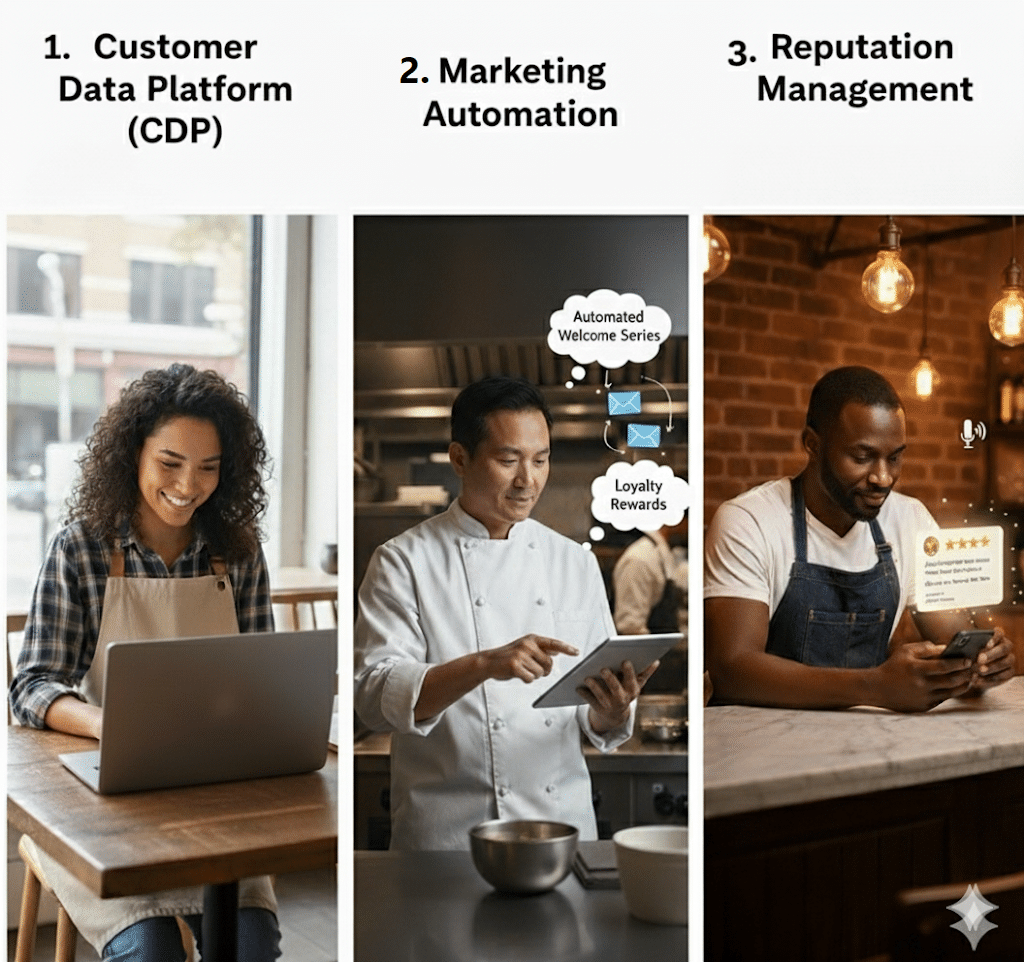
Today, modern restaurant CDP and marketing automation platforms deliver the same capabilities:

  • Turnkey integration with existing POS, WiFi, online ordering, reservations, websites, and review systems (setup in days, not months)
  • Pre-built automation campaigns that trigger based on guest behavior (no marketing expertise required)
  • AI-powered segmentation that automatically identifies at-risk guests and high-value opportunities
  • Self-service platform that any restaurant manager can use without technical training
  • Total cost: $1,260-2,700 per location annually – a 99.7% cost reduction vs. building in-house

Restaurants using these modern “marketing-in-a-box” platforms achieve:

  • 35-45% first-visit return rates (vs 25% industry average) through automated 3-7-30 day follow-up sequences
  • 65-70% retention rates (vs 21% industry average) via behavior-triggered win-back campaigns
  • 1.5-1.6x guest frequency (vs 1.23x industry average) using automated frequency rewards and milestone recognition
  • 52-69x ROI on retention marketing investments with break-even at just 2-4 recovered guests per year
  • 20-30% regular+ customer base (vs 12% industry average) by systematically moving guests up the value ladder
  • Program payback in 45-90 days with fully automated execution requiring <30 minutes per week of operator time

The key insight: These results aren’t achieved by working harder. They’re achieved by working smarter—letting automation handle the 1,000+ micro-decisions required to convert one-time visitors into regular guests, while operators focus on delivering great food and service.

What makes this possible:

  • Unified Guest Data Platform – Automatically captures 95%+ of guests across WiFi, POS, online ordering, reservations, websites, and reviews (vs. 15-25% with standalone systems). Every interaction builds a complete guest profile without manual data entry.
  • Behavioral Marketing Automation – Pre-configured campaigns trigger automatically based on guest actions: first visit, second visit milestone, 30/60/90 day inactivity, frequency achievements, and spending tiers. No manual campaign management required.
  • Predictive Churn Detection – AI identifies guests at risk of churning 30-45 days before they typically would, triggering intervention campaigns automatically. Prevents churn rather than reacting to it.
  • Guest Sentiment Analysis with Smart Alerts – Automated monitoring of review sentiment, ordering patterns, and visit behavior triggers real-time alerts when guests show negative sentiment or satisfaction decline. The system automatically routes recovery campaigns or manager outreach based on sentiment scores and behavioral signals. Measurable feedback loops close the gap between guest experience issues and operational response—often within hours rather than weeks—turning potential detractors into advocates before they churn or leave negative reviews.
  • One-Person Marketing Team Power – A single restaurant manager with no marketing background can now execute retention strategies that previously required a 5-person marketing department. The platform does the thinking, the automation does the execution.

restaurant manager working on guest retention with a CDP and AI

The restaurants that master these capabilities by adopting modern CDP and automation platforms will capture the $375,380+ per location currently lost to preventable churn. Those that don’t will continue to operate in the 85-88% of restaurants watching guests walk away, wondering why their competitors seem to have all the regulars.

The window is narrowing. As more restaurants adopt these platforms, the competitive advantage shifts from “differentiator” to “table stakes.” The question isn’t whether you’ll need these capabilities—it’s whether you’ll adopt them while they still provide a competitive advantage, or after they become required just to keep up.

The Path Forward:

Success in 2025 and beyond depends on four capabilities:

  • Unified guest data across all touchpoints (WiFi, POS, online ordering, reservations, websites, reviews)
  • Automated retention marketing that triggers based on guest behavior and value tier
  • Predictive analytics that identify at-risk guests before they churn and opportunities to move guests up the value ladder
  • Guest sentiment analysis with smart alerts that identify and resolve issues before they damage reputation or revenue, with closed-loop tracking of improvement

The restaurants that master these capabilities will capture the $375,380+ per location currently lost to preventable churn, while simultaneously building more valuable, more frequent, and more loyal customer relationships. The data clearly shows that retention marketing delivers the highest ROI, with programs delivering 5,200-6,900% returns (52-69x invested capital) by systematically moving guests up the value ladder—with regular status ($685 LTV, 3.6 orders) as the primary target.

At just $105-225 per location monthly, the program breaks even with 2-4 recovered guests and pays for itself within 45-90 days. The winning strategy focuses on converting churned guests ($555) to regular ($685), occasional guests ($345) to regular ($685), and one-time visitors ($26) to occasional ($345)—creating a compounding effect that transforms the customer base composition from 69% one-timers to a healthier, more profitable mix with 25-30% regular+ customers generating sustainable, predictable revenue.


Analysis Methodology: Multi-location restaurant performance data normalized per location to ensure accurate trend analysis. All metrics calculated using same-store methodologies and rate-based comparisons. LTV calculations filtered for valid transaction data ($5-500 order range, verified customer records) and projected over 5-year customer lifetime based on observed annual spending patterns. Lost revenue opportunity calculated using regular guest LTV ($685) as the benchmark for what churned guests could be worth with proper retention strategies. Sample represents full-service and quick-service restaurant segments across multiple geographic markets.

Data collection period: January 2024 – October 2025

Let Bloom Intelligence Make It Effortless

Bloom Intelligence is the AI-powered restaurant marketing platform that automatically grows revenue, protects reputation, and optimizes operations 24/7. Our unified platform combines guest data from every touchpoint with intelligent automation to give restaurants the marketing power of major chains—without the complexity or cost.

Bloom makes guest data collection and marketing automation effortless, which allows you to quickly execute the strategies listed above, saving you time, increasing customer lifetime values, attracting new guests, improving your reputation, and boosting your bottom line.

Call us or schedule a free demo online and Bloom will show you how our restaurant marketing platform can help you save time and increase your customer lifetime values by automatically building first-party customer databases, unlocking important guest insights to trigger automated marketing at the right time and place, discover true guest sentiment, save at-risk guests, increase your current guests’ frequency, supercharge your website, and find new guests.

Click to schedule a Free Online Demo, or call 727-877-8181 to see how we can help you drive tangible results for your restaurants.

The Marketing Multiplier: How Multi-Location Chains Are Outperforming 100+ Unit Competitors with Lean Teams

The Paradox of Modern Restaurant Marketing

Sarah runs marketing for a 15-location fast-casual concept. Her CEO has just returned from a conference where a 200-location chain presented its guest retention strategy: a dedicated CDP specialist, an email marketing manager, a reputation management coordinator, a data analyst, and a loyalty program director.

Her CEO asked: “Why can’t we do this?”

Sarah’s answer surprised him: “We already are. And we’re doing it better.”

Here’s what he didn’t know: Sarah’s team of two is now operating with the strategic capabilities of a 5-7 person department, not by working harder, but by transforming their role from campaign executors to revenue strategists.

The secret? She turned marketing from a cost center into a central intelligence hub that powers decisions across operations, finance, and guest experience.

This is the new competitive advantage for emerging chains.


The Two Realities of Growing Restaurant Chains

When you’re scaling from 2 to 50 locations, you face what we call the “enterprise capability trap.”

You know what enterprise restaurant brands have: sophisticated guest intelligence, predictive analytics, automated marketing that runs 24/7, reputation management that catches issues before they spread, and operational insights that flow from unified guest data.

You also know they have teams of specialists managing it all.

What you might not know is the actual cost of building that capability the traditional way.

The Traditional Math That Doesn’t Work for Growing Chains:

Fragmented Marketing Stack:

  • Customer data platform: $50K+/year
  • Email marketing platform: $15-25K/year
  • Reputation management tool: $20-30K/year
  • Analytics suite: $30K+/year
  • Operational intelligence platform: $18-25K/year

Total software investment: $153-180K+ annually

Plus Growing Headcount Needs:

  • Data/CDP Manager: $75-95K
  • Email Marketing Specialist: $55-70K
  • Reputation Manager: $50-65K
  • Marketing Analyst: $60-75K

Total salary investment: $240-305K annually

Grand Total: $393-485K annual investment just to match enterprise marketing capabilities.

And here’s the scaling problem that kills growing chains: These platforms charge per-contact, per-send, or per-user. As you grow from 15 to 30 locations, your software costs often double. Your ROI doesn’t.

You’re stuck in a terrible position: You need enterprise capabilities to compete, but you can’t afford enterprise costs. And even if you could, you’d spend the next 18 months hiring, training, and dealing with turnover instead of focusing on growth.

There is a better path.

The Bloom-Powered Math (That Scales With You):

Unified Platform Investment:

  • 15 locations: $2,550/month ($170 per location)
  • Annual investment: $30,600
  • No per-contact fees
  • No per-email-send charges
  • No database size limits
  • Your costs are predictable, even as your guest database grows from 50K to 500K contacts

Lean Team That Scales:

  • Start with 1-2 marketers elevated to strategic roles
  • As you grow and hire specialists, they inherit a tech foundation that amplifies their expertise instead of requiring them to manage tool integration
  • Your new hires focus on strategy from day one, not platform management

Total First-Year Investment: ~$170K-210K (salary + platform) versus $393-485K traditional approach.

Savings: 55-65% with 3x faster execution and a foundation built for your next 50 locations.

But here’s what matters more than cost savings…

The Foundation That Grows With You

Most growing chains face this painful reality:

Year 1: You cobble together affordable point solutions that “work for now”
Year 3: Those tools can’t scale, so you rip-and-replace everything
Year 5: You’re migrating systems again as you hit new growth thresholds

The Real Cost: Disruption, data loss, team frustration, and lost momentum during your most critical growth phases.

Bloom Intelligence is different.

Whether you have 2 locations or 200, you’re operating on the same platform that:

  • Handles unlimited guest profiles (no database caps that trigger surprise pricing tiers)
  • Sends unlimited emails (no per-send fees that penalize engagement)
  • Integrates with enterprise POS, reservation, and ordering systems
  • Powers both single-marketer operations and future specialized teams

When you do hire that email specialist or data analyst? They’re not learning new platforms or spending six months on system integration. They’re leveraging the foundation you’ve already built, focusing their expertise on strategy instead of systems management.

And as you scale, your per-location cost decreases:

  • 15 locations: $170/location
  • 30 locations: ~$160/location
  • 50+ locations: $135-150/location

You’re actually getting more affordable as you grow, while other platforms get more expensive.

This is how you scale like an enterprise without the enterprise pain.
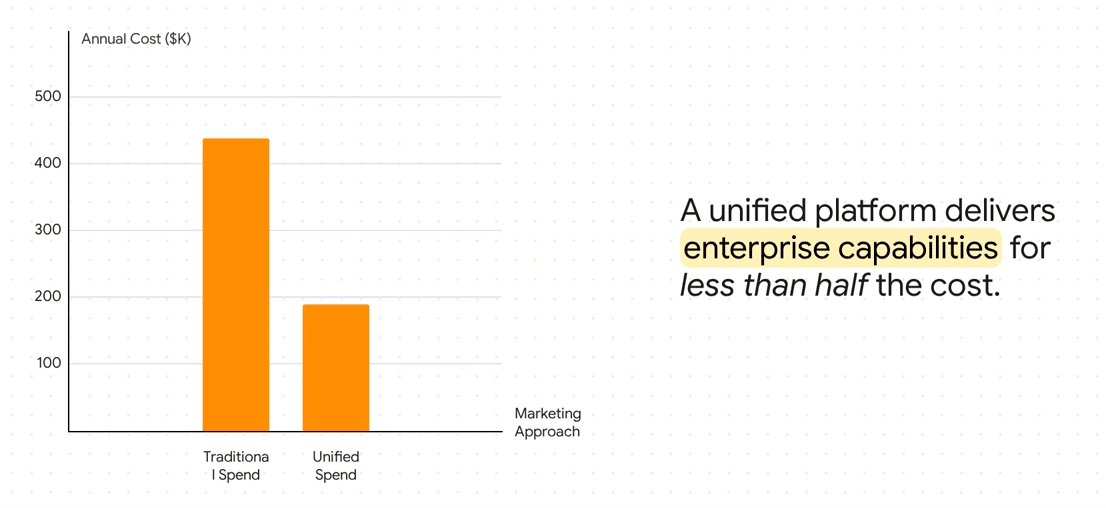
benefits of a unified platform

For the Marketer: From Tactical Executor to Strategic Asset

Let’s be honest about what the traditional marketing role looks like at a growing restaurant chain.

The Old Role: Campaign Manager

Your typical week:

  • “Send this month’s email blast.”
  • “Respond to reviews when you have time.”
  • “Pull a report for the monthly meeting.”
  • Scramble to justify your marketing spend with open rates and impressions

Value to organization: Execution of directives
Career trajectory: Lateral movement at best (you have a replaceable skillset)

Now imagine a different reality.

The New Role: Revenue Intelligence Officer

Your typical week:

  • “Here’s why we’re losing guests in the 35-44 demographic—and here’s the automated campaign I’m launching Monday to recover them”
  • “Operations team: Guest sentiment from reviews and surveys shows your new menu item is underperforming with regulars but crushing with new guests, here’s the retention strategy I’m implementing.”
  • “Finance: I can predict next quarter’s revenue within 3% accuracy based on current guest behavior trends. Here’s the data.”

Value to organization: Strategic insights that drive company-wide decisions
Career trajectory: Upward trajectory to VP or CMO (you’re becoming an indispensable C-suite partner)

This is the marketing multiplier effect.

Your team doesn’t just execute better, you become the strategic engine for the entire business.

The difference isn’t talent. It’s not working harder. It’s not even about experience.

The difference is unified guest intelligence that transforms marketing from a tactical function into a strategic capability.

Let’s look at exactly how this works.

The Five Intelligence Capabilities That Change Everything


Capability 1: Predictive Guest Intelligence → Proactive Revenue Protection


What the CEO Sees:

“We recovered $87,000 in at-risk guest revenue last quarter that would have walked out the door.”

Traditional marketing is reactive. A guest stops visiting, and weeks or months later, you might notice they’re gone. By then, they’ve already chosen a competitor and formed new habits.

Predictive guest intelligence flips this model entirely. The system identifies guests before they leave based on behavior patterns, such as visit frequency changes, spending shifts, engagement drops, and automatically triggers win-back campaigns while there’s still time to recover them.

As you scale from 15 to 50 locations, this same intelligence works across every location without additional complexity. You’re protecting revenue systematically, not hoping your marketing manager happens to notice the trends.

What the Marketer Does:

Instead of: Spending hours manually analyzing POS data, trying to spot trends in guest behavior

Now: You receive automated “Guest at Risk” alerts with pre-built win-back campaigns based on actual behavior patterns. You review, refine if needed, and approve with one click.

Time Saved: 8-10 hours per week of data analysis
New Strategic Role: You become the “early warning system” for revenue threats across the organization

When you walk into a leadership meeting and say, “We have 247 high-value guests showing early churn signals. I’ve already launched recovery campaigns, and we’re tracking a 34% recovery rate,” you’re no longer the person who sends emails.

You’re the person protecting the business.

The Multiplier: Marketing becomes a profit protection center, not just a customer acquisition function.


Capability 2: Operational Intelligence Through Guest Sentiment → Closing the Feedback Loop


What the CEO Sees:

“We’re identifying operational issues from unified guest sentiment – across review sites, surveys, reservation platforms, and POS data – before they become systemic problems.”

Here’s the reality that keeps restaurant operators up at night: Your guests are telling you what’s wrong. Every day. Across dozens of channels.

But their feedback is scattered, some on Google reviews, some on reservation notes, some buried in survey responses, some visible only in changed behavior patterns in your POS data. By the time you manually piece together the signals, the problem has already cost you guests.

Unified operational intelligence changes this equation entirely.

When sentiment analysis notices increasing complaints about service speed at your highest-volume location, it doesn’t stop there. The system automatically layers in POS data, reservation notes, and survey responses to show you the complete picture.

Maybe ticket times are actually faster than other locations (it’s not a kitchen problem). But reservation platform notes reveal guests are waiting 10+ minutes for tables despite confirmed reservations. Now you know it’s a host stand process issue, not a food quality issue.

You fix the right problem. Guest sentiment improves, and repeat visits recover. All before the issue spreads to other locations.

As you scale, every location is monitored across all feedback channels. Operational insights don’t require linear headcount growth.

What the Marketer Does:

Instead of: Logging into six different review sites daily, trying to manually connect feedback dots, and responding reactively to complaints.

Now: You have unified sentiment analysis that combines review feedback, survey responses, reservation notes, and actual guest behavior from your POS. You receive AI-drafted review responses for approval, automated alerts when sentiment dips by location or category, and cross-platform intelligence that shows the real story.

Time Saved: 6-8 hours per week of monitoring and manual sentiment tracking.
New Strategic Role: You become the “operational intelligence hub”, the person who tells operations what’s really happening based on unified guest signals, not fragmented anecdotes.

How This Works in Practice:

Sentiment analysis flags increasing complaints about service speed at a high-volume location. Traditional approach: respond to reviews, maybe notify the general manager.

Unified intelligence approach: You pull up the complete view. POS data shows ticket times are actually faster than at other locations. But reservation platform notes show guests waiting for tables despite confirmed reservations. It’s a host stand bottleneck, not a kitchen problem.

You present this to operations with specifics: “Here’s the pattern, here’s the data, here’s the root cause.” Operations fixes the seating flow. Within three weeks, review sentiment improves 23% and repeat visit rates recover.

Traditional approach: Marketing responds to reviews after the fact.
Bloom approach: Marketing identifies the operational root cause and drives the fix before more guests are lost.

The Multiplier: Marketing becomes the feedback loop that connects guest voice to operational action, driving continuous improvement across all locations.


Capability 3: Unified Guest Data → Cross-Departmental Intelligence Hub


What the CEO Sees:

“Marketing can now tell us which menu items drive repeat visits, which promotions actually work, and which locations have guest retention problems—in real-time.”

Most restaurant chains have guest data everywhere: POS systems, WiFi logins, reservation platforms, online ordering, review sites, email engagement, and survey responses. The problem isn’t a lack of data; it’s that the data lives in silos that never talk to each other.

Your operations team sees transaction data. Your marketing team sees email metrics. Your GM sees reservation notes. Nobody sees the complete guest journey.

Unified guest data creates something that didn’t exist before: a single, comprehensive view of each guest across every interaction with your brand.

You can finally answer questions like:

  • Do guests who use WiFi have higher lifetime values than those who don’t?
  • Which menu items drive repeat visits versus one-time trials?
  • How does review sentiment correlate with actual spending behavior?
  • Which locations have retention problems that aren’t visible in transaction data alone?

As you scale and add new locations, new POS systems, and new integrations, they all plug into the same unified view. No data silos. No fragmented reporting. No “let me check with IT and get back to you.”

What the Marketer Does:

Instead of: Requesting data exports from operations, waiting for IT to merge spreadsheets, building manual reports, and discovering the data doesn’t line up

Now: You have instant access to unified guest profiles showing the complete journey, from first WiFi login to latest review, from order history to survey feedback. You can build segments, run analyses, and answer strategic questions in minutes instead of weeks.

Time Saved: 5-7 hours per week of data gathering and reconciliation.
New Strategic Role: You become the central intelligence source that operations, finance, and leadership rely on for guest insights.

When the CFO asks, “What’s driving the revenue difference between our top-performing and average locations?” you don’t say, “I’ll need to pull some reports.” You open the dashboard and show them in real-time: “Top locations have 23% higher WiFi engagement, 2.1x more repeat visits within 30 days, and 12% higher average check from guests who engage with email campaigns.”

You’re no longer reporting what happened. You’re explaining why it happened and what to do about it.

The Multiplier: Marketing becomes the data nerve center for the entire organization—not just the email department.


Capability 4: Campaign Automation + AI Suggestions → Strategic Execution at Scale


What the CEO Sees:

“We’re running 10-15 automated campaigns simultaneously that used to require manual planning and execution. Our email engagement rates are 40-50% higher because AI optimizes send times and personalization.”

Here’s the traditional bottleneck: Even with good intentions and a solid strategy, manual campaign execution creates a throughput problem.

Your marketer can realistically plan, build, segment, schedule, and analyze maybe 4-5 campaigns per month. That’s working hard. But it’s not enough to drive systematic guest engagement across multiple segments, locations, and campaign types.

Meanwhile, enterprise brands are running dozens of campaigns simultaneously because they have specialized teams. Birthday campaigns, win-back sequences, new guest onboarding, VIP recognition, location-specific promotions, behavior-triggered messages, all running in parallel.

You can’t compete with 4 batch-and-blast emails per month.

Campaign automation changes the game entirely. The AI analyzes guest behavior patterns, identifies opportunities, suggests campaigns with pre-optimized audiences and timing, and executes them automatically once approved.

Your marketer shifts from campaign builder to campaign strategist. Instead of spending all week creating one email, they spend 30 minutes reviewing and approving five AI-suggested campaigns, then invest the rest of their time on higher-level strategy.

And here’s the cost advantage: no per-send fees means you can increase email frequency to optimal levels without watching costs explode. When your traditional email platform charges per send, you agonize over whether to send that extra campaign. With Bloom, you optimize for engagement and revenue, not platform costs.

What the Marketer Does:

Instead of: Spending Monday mornings planning the week’s campaigns, Tuesday and Wednesday building them, Thursday testing, and Friday analyzing last week’s results

Now: You spend 20-30 minutes on Monday morning reviewing AI-suggested campaigns. The system has already identified the optimal audience (based on behavior patterns), determined the best send time (based on historical engagement), and drafted personalized messaging. You review, refine if needed, approve, and move on to strategic priorities.

Time Saved: 12-15 hours per week of campaign planning, segmentation, and scheduling.
New Strategic Role: You become the strategic curator, focusing on what to communicate, not how to execute.

You’re no longer judged by how many campaigns you can manually build. You’re judged by revenue impact, which means you can finally focus on strategy, testing, and optimization instead of execution mechanics.

The Multiplier: Marketing becomes a continuous engagement engine—not a batch-and-blast operation.


Capability 5: Attribution + ROI Intelligence → CFO’s Favorite Department


What the CEO Sees:

“Every campaign now shows direct revenue attribution. We know exactly what’s working. Marketing can forecast guest lifetime value by segment with 95%+ accuracy.”

Let’s talk about the conversation every marketer dreads: the budget meeting.

Traditional scenario: You present your marketing plan. Finance asks, “What’s the ROI on these campaigns?” You show open rates, click rates, maybe some correlation with revenue if you’re lucky. Finance looks unimpressed. Your budget gets cut or flat-lined.

Why? Because you can’t connect marketing activity to revenue with certainty. You’re asking for investment based on marketing metrics that don’t speak the language of business results.

Attribution and ROI intelligence change this conversation completely.

Every campaign now shows:

  • Direct revenue generated
  • Cost per acquired/retained guest
  • Lifetime value impact by segment
  • Predictive revenue modeling

You can finally connect guest sentiment across all platforms to actual revenue impact. When review sentiment improves, you can show exactly how it translates to repeat visits and revenue growth.

When you walk into budget meetings, you’re speaking the CFO’s language: dollars in, dollars out, forecasted return, proven ROI.

What the Marketer Does:

Instead of: Defending marketing spend with vanity metrics (open rates, impressions, “brand awareness”) and hoping leadership sees the value.

Now: You walk into budget meetings with revenue-per-campaign data, predictive LTV models, and operational impact metrics showing how sentiment improvements drove visit frequency and revenue growth.

Time Saved: 4-6 hours per week of manual reporting and spreadsheet acrobatics.
New Strategic Role: You become the ROI storyteller, speaking the language of finance and proving marketing’s revenue impact.

When leadership asks, “Should we invest more in marketing or open another location?” you can actually answer with data: “Based on current guest behavior and recovery rates, investing $50K more in marketing will generate an estimated $280K in retained revenue over 12 months with 90%+ confidence. That’s a 5.6x return delivered faster and with less risk than a new location.”

You’re no longer defending your department. You’re presenting investment opportunities.

The Multiplier: Marketing becomes a measurable profit center, earning budget increases instead of defending against cuts.
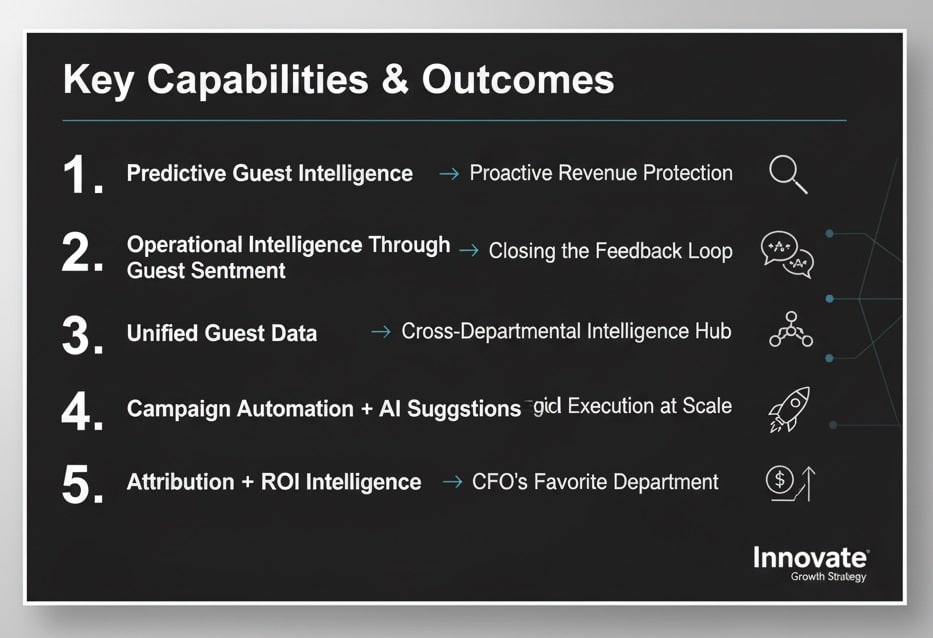
key capabilities with a unified system

The Compound Effect: Why This Matters More Than Your Next Location

For the CEO: The Real ROI Math

Opening a new location costs $500K-2M in capital and adds 15-25 employees. It’s a massive bet with 12-18 month payback periods if everything goes right.

Elevating your marketing team to a strategic intelligence hub costs $30,600 annually for 15 locations—and impacts every existing location immediately.

Let’s run the numbers:

If each location improves guest retention by just 5% through better intelligence:

  • Average guest LTV: $1,890 (industry benchmark)
  • 15 locations × 200 active guests per location × 5% retention lift × $1,890 LTV
  • = $283,500 in recovered annual revenue

ROI: 9.3x in year one

That’s the revenue impact of a new location without the real estate, buildout, hiring, training, or operational complexity.

And unlike a new location, this foundation scales with you:

  • At 30 locations: per-location cost drops to ~$160/month
  • At 50+ locations: per-location cost approaches $135/month

Your per-location cost decreases as you grow. Your competitors’ costs increase.

The Scaling Math That Changes Everything:

At 15 locations, you’re saving $94K annually versus the traditional approach.
At 30 locations, you’re saving $180K+ annually.
At 50 locations, you’re saving $280K+ annually.

Those savings alone could fund multiple new hires as you scale—or flow straight to the bottom line.

More importantly, you’re building institutional intelligence that compounds. Every guest interaction feeds the system. Every campaign improves the AI. Every sentiment signal strengthens the operational feedback loops.

Year one, you’re recovering at-risk guests. Year two, you’re predicting trends before they happen. Year three, you’re optimizing operations based on unified intelligence that competitors can’t match even with larger teams.

This is the compound effect that transforms marketing from a cost center into a competitive advantage.

For the Marketer: Breaking the Tactical Loop

Most restaurant marketers are stuck in what we call the “tactical loop”:

Monday: Build this month’s campaign
Wednesday: Report last month’s results
Friday: Start planning next month
Repeat.

You’re judged by execution speed, not strategic impact. When the company scales, they hire specialists around you – an email person, a social person, a review person – and your role becomes narrower, not broader.

The Bloom-powered marketer operates in a completely different loop:

Week 1: Identify revenue opportunities from unified guest intelligence (at-risk segments, underperforming locations, sentiment trends)
Week 2: Launch automated campaigns while focusing on strategic testing (the AI handles execution; you focus on optimization)
Week 3: Present predictive insights and operational intelligence that drive company-wide decisions
Week 4: Refine strategy based on real-time attribution data

Your value proposition transforms:

From: “I can execute campaigns efficiently.”
To: “I can predict revenue trends, prevent churn, identify operational issues before they scale, prove ROI, and create feedback loops between guests and operations, all while running more campaigns than a 5-person team.”

This is the shift from marketing manager to VP or CMO.

When your CEO says, “We need to hire a data analyst,” your response is:

“Great, here’s the 3 years of unified guest intelligence, complete operational sentiment analysis, and closed feedback loops they’ll inherit on day one. They can focus on predictive modeling and advanced segmentation instead of spending 6 months integrating systems and trying to connect fragmented data sources.”

You’re not defending your role. You’re building the department that grows around you.

You become the person operations calls when they need to understand guest sentiment.
You become the person finance trusts for revenue forecasting.
You become the person the CEO relies on for strategic insights.

This is how you go from “the marketing person” to “the person we built the department around.”

Tale of Two 15-Location Chains

Let’s look at two real scenarios playing out right now in the restaurant industry.

Chain A: Traditional Fragmented Approach

The Setup:

  • Team: 3 marketers (Email Specialist, Reputation Manager, Coordinator)
  • Tools: Separate platforms for email, reputation monitoring, analytics, customer data, operational feedback – each with per-contact/per-send pricing
  • Annual Cost: $180K salary + $85K tools = $265K

What Daily Life Looks Like:

Monday morning: Email specialist logs into the email platform, exports data from the POS, tries to reconcile guest lists, builds this week’s campaign targeting. 3 hours gone.

Tuesday: Reputation manager checks Google, Yelp, Facebook, reservation platforms for reviews. Drafts responses. 4 hours gone.

Wednesday: Coordinator requests report from operations on promotional performance. Waits. Follows up. Gets partial data Thursday.

Friday: Team meeting to discuss results. Data doesn’t match across platforms. “We’ll dig into this next week.”

Monthly Output:

  • 4 email campaigns (takes all month to plan, build, execute, analyze)
  • Reactive review responses (when they have time)
  • Quarterly reports (that are outdated by the time they’re finished)
  • Fragmented guest sentiment that never connects to operations

CEO View: “Marketing does campaigns and responds to reviews. I wish they could give me better insights.”

Marketer Experience: Tactical execution, limited strategic influence, always chasing the next fire. When the company grows, leadership talks about “restructuring the marketing team” (code for: we need to hire around you).

The Scaling Problem: Adding 15 more locations means:

  • Email platform costs double (per-contact pricing)
  • Reputation monitoring costs double (per-location pricing)
  • Need to hire 2 more people to manage the chaos
  • Still no unified intelligence, still no operational insights

Total scaling cost: $180K+ in additional annual investment for marginal improvement

Chain B: Bloom-Powered Integrated Approach

The Setup:

  • Team: 2 marketers (Strategic Marketing Manager + Coordinator)
  • Tools: Bloom Intelligence (unified CDP, automation, reputation management, operational intelligence, predictive analytics)
    • 15 locations: $2,550/month = $30,600/year
    • No per-contact fees (database grows from 45K to 200K guests—same price)
    • No per-send fees (increased email frequency 3x—same price)
    • Unified sentiment analysis across review sites, surveys, reservations, and POS
  • Annual Cost: $140K salary + $30.6K Bloom = $170.6K

What Daily Life Looks Like:

Monday morning: Marketing manager logs in, reviews AI-suggested campaigns for the week (audiences pre-built based on behavior, timing optimized, messaging drafted). Approves three campaigns. 20 minutes.

Spends rest of morning analyzing unified dashboard: notices sentiment dipping at Location 7, cross-references with POS data, identifies root cause (new menu item getting complaints), alerts operations with specific data. 45 minutes.

Tuesday: Reviews AI-drafted review responses, approves or refines. 15 minutes. Spends rest of day building strategic plan for Q4 based on predictive LTV models.

Wednesday: Leadership meeting. Presents guest intelligence: “We have 340 guests showing early churn signals, I’ve launched recovery campaigns, current recovery rate is 38%. Also, here’s why Location 12 is outperforming—their guests have 2.4x higher WiFi engagement. We should replicate that.”

Thursday: Coordinator handles campaign approvals and routine monitoring. Marketing manager focuses on testing strategy, menu item optimization based on guest behavior data, and preparing board presentation.

Friday: Reviews week’s results. All campaigns show direct revenue attribution. Prepares summary for CEO showing $47K in recovered revenue this week from automated campaigns.

Monthly Output:

  • 15+ automated campaigns running in parallel
  • Proactive reputation management with AI-drafted responses (95% response rate within 2 hours)
  • Real-time operational intelligence dashboards accessible to entire leadership team
  • Predictive insights that drive company-wide decisions

CEO View: “Marketing is our operational intelligence hub that drives decisions across ops, finance, and guest experience. Best investment we’ve made.”

Marketer Experience: Strategic leadership, boardroom influence, career acceleration, and respected as an operational partner. When the company grows, leadership says, “Let’s build the team around Sarah—she owns the guest intelligence infrastructure.”

The Scaling Advantage: Adding 15 more locations means:

  • Bloom cost increases by ~$2,400/month
  • The same 2-person team can manage operational intelligence at scale
  • OR hire specialists who inherit the complete infrastructure and focus on strategy from day one
  • Unified intelligence gets smarter with more data
  • Per-location cost decreases to ~$160/month

Total scaling cost: $28,800 in additional annual investment for dramatically better results
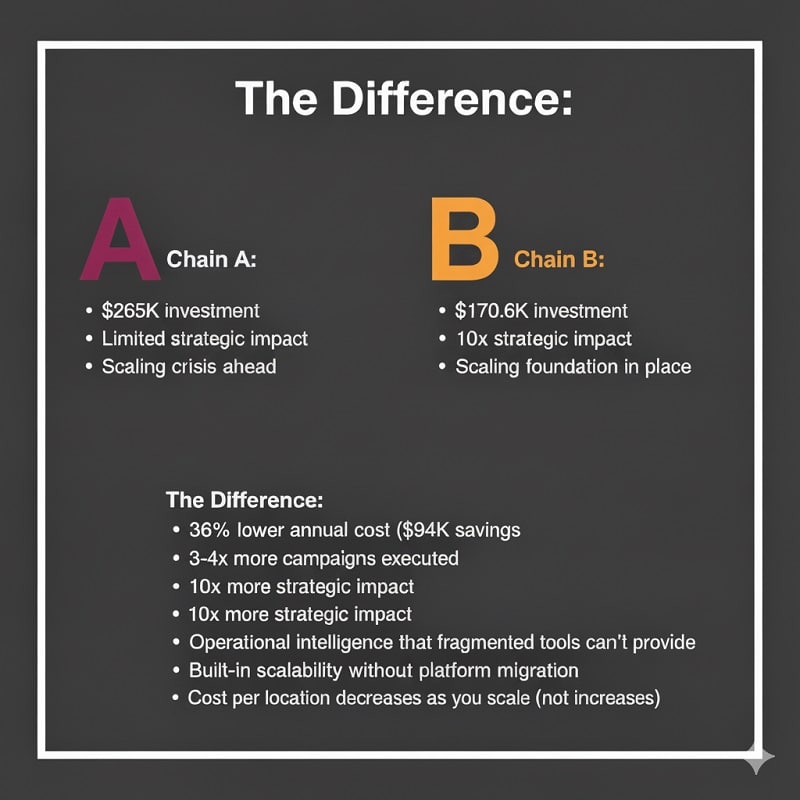
Difference between traditional and unified systems

The Gap That Matters

Chain A: $265K investment, limited strategic impact, scaling crisis ahead
Chain B: $170.6K investment, 10x strategic impact, scaling foundation in place

The difference:

  • 36% lower annual cost ($94K savings)
  • 3-4x more campaigns executed
  • 10x more strategic impact
  • Operational intelligence that fragmented tools can’t provide
  • Built-in scalability without platform migration
  • Cost per location decreases as you scale (not increases)

The math is clear. But the real difference is this:

Chain A’s marketer is thinking about next month’s campaigns.
Chain B’s marketer is thinking about how to scale to 50 locations with the infrastructure they’re building today.

One is a job. The other is a career.

The Scaling Reality: Why Your Future Team Will Thank You

Let’s address the question every CEO is thinking: “This sounds great for 15 locations, but what happens when we grow to 50? Will I need to rip this out and start over?”

This is the right question. Because you’ve been burned before by tools that worked at 5 locations but broke at 15. By platforms that promised to scale but hit hard limits that forced expensive migrations.

Here’s the Bloom difference at each growth stage:

Today (15 Locations)

What You Have:

  • Your solo marketer or small team operates the same platform that 100-location chains use
  • Cost: $2,550/month ($170/location)
  • Capability: Full customer data platform, unlimited email sends, automated campaigns, reputation management, operational intelligence, predictive analytics

What You Don’t Have:

  • Multiple systems to integrate
  • Per-contact fees that create surprise bills
  • Database size limits that trigger pricing tiers
  • Platform complexity that requires specialists

Tomorrow (30 Locations)

What Changes:

  • Same platform, more locations
  • Cost: ~$4,800/month ($160/location)
  • Your per-location cost decreased by 6%

What Stays the Same:

  • Same login, same workflows, same infrastructure
  • Marketing team can still manage effectively (or you’ve hired one specialist who inherits complete infrastructure instead of learning new systems)

What Gets Better:

  • Unified intelligence gets smarter with more guest data
  • AI recommendations improve with more behavior patterns
  • Operational insights span more locations for pattern recognition

Year 3 (50 Locations)

What Changes:

  • You’ve hired specialists (Email Marketing Manager, Reputation Coordinator, Data Analyst)
  • Cost: ~$7,500/month ($150/location)
  • Your per-location cost decreased by 12% from day one

What Your New Hires Inherit:

  • A proven foundation with 3+ years of unified guest data
  • Complete operational feedback loops already built
  • Institutional intelligence that can’t be replicated quickly

What Your New Hires DON’T Inherit:

  • Six months of system integration projects
  • Data migration headaches
  • The need to rebuild everything from scratch
  • Multiple platform logins and fragmented workflows

What Your New Hires Focus On:

  • Advanced predictive modeling (the data infrastructure is done)
  • Strategic campaign optimization (the automation handles execution)
  • Cross-location intelligence patterns (the unified view is already there)
  • Revenue maximization (not system management)

The Hidden ROI That Makes CFOs Smile

Zero platform migration costs

  • No consultants ($50-150K saved)
  • No data loss from migration
  • No 6-month disruption during the critical growth phase

New hires are productive from week 1

  • Not in month 6 after learning fragmented systems
  • Not month 12 after fixing integration issues
  • Week 1. Really.

Institutional knowledge compounds

  • Your guest intelligence database is 5 years deep with complete operational feedback loops
  • Not reset to zero every time you outgrow tools
  • Gets more valuable every year, creating a defensible competitive advantage

Your costs scale favorably

  • Decreasing per-location cost as you grow
  • While competitors face increasing costs with traditional platforms
  • The savings alone fund additional hiring

This is how you build a marketing organization that scales with your ambition, not one that constantly plays catch-up with rip-and-replace cycles.

For the Marketer: The Choice That Defines Your Career

If you’re the marketer reading this, you’re probably in one of two situations:

Situation 1: You’re overwhelmed. You’re managing multiple platforms, manually building every campaign, logging into six different systems to piece together guest insights, and barely keeping up with reactive tasks. Leadership keeps asking for “better data” but you’re drowning in execution. You know there’s a better way, but you’re not sure how to get there.

Situation 2: You’re ambitious. You’re executing well, but you can feel the ceiling. You want to deliver more strategic value, but the tools and processes keep you stuck in tactical mode. You see what enterprise brands are doing with guest intelligence, and you want to bring those capabilities to your growing chain, but you don’t know how to make the business case.

Here’s what you need to understand:

Without unified intelligence, you’re on a path to obsolescence.

When the company scales and hires specialists, they’ll hire around you. Your role becomes narrower. You become the “email person” or “review responder”, execution-only roles that are increasingly commoditized.

With unified operational intelligence, you’re on a path to leadership.

You become the guest intelligence expert who connects guest voice to operational action. When the company scales and hires specialists, they hire under you. You become the strategic leader of a growing department and a critical partner to operations and finance.

The marketers who own the unified data foundation and operational feedback loops become the ones who lead the team.

restaurant marketers using a unified system to scale

How to Make This Happen

Step 1: Understand the business case

You’re not pitching “new marketing software.” You’re pitching strategic infrastructure that:

  • Reduces costs by 36% compared to fragmented tools ($94K annual savings for 15 locations)
  • Delivers 9.3x ROI through guest retention improvements
  • Creates operational intelligence that drives company-wide decisions
  • Scales without requiring platform migration

Step 2: Speak to outcomes, not features

Don’t lead with “this platform has campaign automation.” Lead with “I can recover $87K in at-risk guest revenue that we’re currently losing.”

Don’t say “unified data.” Say “I can tell you exactly which menu items drive repeat visits and which promotions actually work—in real-time.”

Don’t pitch “AI-drafted review responses.” Pitch “I can identify operational issues from guest sentiment before they become systemic problems.”

Step 3: Connect to strategic priorities

Your CEO cares about growth, profitability, and competitive advantage. Show them how unified guest intelligence:

  • Supports growth: Scales from 15 to 50 locations without platform migration
  • Drives profitability: $94K+ annual savings plus 9.3x ROI from retention
  • Creates an advantage: Operational intelligence competitors can’t match with fragmented tools

Step 4: Position yourself as the strategic owner

This isn’t about making your job easier (even though it does). This is about elevating your role from tactical executor to strategic asset.

“I want to build the guest intelligence infrastructure that will take us from 15 to 50 locations. This foundation will let me deliver predictive insights, operational intelligence, and proven ROI while also creating the infrastructure that future team members will build on. I’m not just asking for a better tool. I’m proposing we build a strategic capability.”

Step 5: Address the objections before they’re raised

“Is this going to be another system that sits on the shelf?” “This is designed for time-starved teams. Setup takes days, not months. I’ll be productive in the first week, not the sixth month. And unlike our current fragmented tools, this actually saves me 25-30 hours per week that I can redirect to strategic priorities.”

“What if we outgrow it?” “This is the same platform 100-location chains use. As we scale from 15 to 50 locations, our per-location cost actually decreases while our capabilities increase. No migration, no disruption, no starting over.”

“Can we afford it?” “Compared to our current annual spend of $85K on fragmented tools, this is $30.6K. We save $54K immediately, plus another $40K in reduced headcount needs. And the ROI from guest retention alone is 9.3x in year one.”

The Internal Pitch Email Template

Here’s how to position this to your CEO or leadership team:


Subject: Strategic Infrastructure Proposal: Building Marketing Capabilities That Scale to 50+ Locations

[CEO Name],

I want to propose an investment in marketing infrastructure that will:

  • Reduce our current marketing technology costs by 36% ($54K annual savings)
  • Deliver 9.3x ROI through predictive guest retention
  • Create operational intelligence that drives decisions across ops and finance
  • Scale from 15 to 50+ locations without platform migration

The Current Reality:

We’re spending $85K annually on fragmented marketing tools (email platform, reputation management, analytics, etc.), and these costs will double as we scale to 30 locations due to per-contact/per-send pricing models.

More importantly, our current tools keep marketing siloed from operations. I can respond to reviews, but I can’t connect sentiment patterns to operational issues. I can see email metrics, but I can’t prove revenue attribution. I can run campaigns, but I’m limited to 4-5 per month due to manual execution.

The Opportunity:

Unified guest intelligence would allow us to:

  1. Proactively protect revenue – Identify at-risk guests before they leave and automatically trigger recovery campaigns (estimated $87K+ recovery per quarter)
  2. Close the operational feedback loop – Connect guest sentiment across reviews, surveys, reservations, and POS to identify operational issues before they become systemic
  3. Scale campaign execution 3-4x – AI-powered automation allows us to run 10-15 campaigns simultaneously instead of 4-5 per month
  4. Prove marketing ROI – Direct revenue attribution for every campaign, plus predictive LTV modeling that speaks the language of finance
  5. Build infrastructure that scales – Same platform works at 15 or 50 locations, with decreasing per-location costs as we grow

The Investment:

  • Cost: $30,600 annually for 15 locations ($2,550/month)
  • Savings vs. current tools: $54K annually
  • Net savings: $23K in year one
  • Projected ROI from retention improvements: 9.3x
  • Scaling advantage: Per-location cost decreases as we grow (vs. current tools that double in cost)

The Ask:

I’d like to schedule 30 minutes to walk through:

  • How this transforms marketing from a cost center to a strategic intelligence hub
  • The specific revenue impact based on our current guest data
  • How this scales as we grow to 50+ locations without disruption
  • What this means for our ability to compete with larger chains

I believe this is one of those foundational decisions that will define our competitive advantage as we scale. Happy to discuss.

[Your Name]


What Happens Next?

If you position this correctly, you’re not asking for approval to buy software. You’re proposing to build strategic infrastructure that makes you indispensable.

When leadership approves this, you become:

  • The owner of the guest intelligence foundation
  • The person who built the infrastructure that scales to 50+ locations
  • The strategic partner to operations and finance
  • The marketer who proved marketing’s revenue impact

When you’re eventually hiring team members, your pitch to candidates is: “You’ll inherit 3 years of unified guest intelligence with complete operational feedback loops. You can focus on strategy and optimization from day one instead of spending months on system integration. This is a chance to do high-level work immediately.”

This is how you go from “the marketing person” to “the person we built the department around.”

The Strategic Unlock: Three Paths Forward

Whether you’re the CEO evaluating this decision or the marketer building the business case, there are only three realistic paths:

restaurant marketer choosing the unified path

Path 1: Keep the Status Quo

What This Looks Like:

  • Continue with fragmented marketing tools
  • Limited marketing execution (4-5 campaigns per month)
  • Reactive decisions based on incomplete data
  • No competitive advantage in guest intelligence
  • Fragmented guest feedback that never drives operational improvement
  • Inevitable scaling crisis when current tools can’t handle growth

The Real Cost:

  • Losing high-value guests you never knew were at risk
  • Missing operational issues until they’ve already damaged your brand
  • Marketing that can’t prove ROI, leading to budget cuts or stagnation
  • Platform migration crisis every 2-3 years as you outgrow tools
  • Building on a foundation that won’t support your growth ambitions

Who Chooses This Path: Organizations that are comfortable with incremental improvement and don’t see marketing as a strategic capability.

Path 2: Build an Enterprise Team First

What This Looks Like:

  • Invest $393-485K annually in fragmented tools plus specialized headcount
  • Spend 12-18 months hiring, training, and dealing with turnover
  • Accept that costs will increase (not decrease) as you scale
  • Hope that specialists can somehow integrate fragmented systems
  • Still never close the loop between guest sentiment and operational action

The Real Cost:

  • $200K+ annual premium vs. unified intelligence approach
  • 12-18 months to full productivity (vs. immediate impact)
  • High turnover risk in specialized roles (average tenure: 2-3 years)
  • Platform costs that increase as you scale
  • Team spends more time managing systems than driving strategy

Who Chooses This Path: Organizations with deep pockets who believe the traditional enterprise approach is the only way—and don’t realize there’s a better option.

Path 3: Build the Foundation, Then Scale the Team

What This Looks Like:

  • Invest $30.6K annually (15 locations) in unified guest intelligence
  • Empower 1-2 marketers with enterprise capabilities immediately
  • Create infrastructure that amplifies future hires instead of burdening them
  • Unify guest intelligence across all platforms
  • Close the feedback loop between marketing and operations
  • Scale predictably with decreasing per-location costs

The Real Impact:

  • $94K annual savings vs. traditional approach (15 locations)
  • 9.3x ROI from guest retention improvements
  • Marketing team delivers strategic insights, not just campaign execution
  • Operational intelligence that drives company-wide decisions
  • New hires inherit proven infrastructure and focus on strategy from day one
  • Platform scales from 15 to 50+ locations without migration

Who Chooses This Path: Organizations that understand marketing can be a strategic capability, and that the right infrastructure is the foundation for everything else.

The Question Isn’t Whether You Can Afford It

For CEOs, the question isn’t whether you can afford Bloom Intelligence.

The question is whether you can afford to build your growth strategy on tools that:

  • Won’t scale with you (requiring expensive migrations every 2-3 years)
  • Get more expensive as you grow (not less expensive)
  • Keep marketing siloed from operations (losing the operational intelligence advantage)
  • Never close the loop between guest feedback and operational improvement
  • Force your team to spend more time managing systems than driving revenue

At 15 locations: You’re saving $94K annually vs. the traditional approach
At 30 locations: You’re saving $180K+ annually
At 50 locations: You’re saving $280K+ annually

Those savings alone could fund multiple new hires as you scale—or flow straight to the bottom line.

But the real question is strategic: Are you building a marketing organization that scales with your ambition, or one that constantly plays catch-up?

For marketers, the question isn’t whether this will make your job easier (though it will).

The question is whether you want to be the tactical executor or the strategic architect.

Tactical executors are valuable until they’re not. When the company scales, it hires specialists around you. Your role narrows. Your career stalls.

Strategic architects become indispensable. When the company scales, it hires specialists under you. Your role expands. Your career accelerates.

The difference isn’t talent. It’s not hustle. It’s not even experience.

The difference is whether you own the guest intelligence infrastructure that the entire organization depends on.

The Bottom Line

The restaurant industry is consolidating. Smaller chains are getting acquired or squeezed out. Mid-sized chains are getting outmaneuvered by enterprise brands with sophisticated guest intelligence.

The competitive advantage of the next decade won’t be location count or menu innovation or even operational excellence (though all of those matter).

The competitive advantage will be guest intelligence.

Who knows their guests better? Who predicts churn before it happens? Who connects guest sentiment to operational action? Who proves marketing ROI in the language of business results? Who builds the infrastructure that scales without disruption?

That’s the game now.

You can play it with fragmented tools, limited insights, and teams that spend more time managing systems than driving strategy.

Or you can play it with unified guest intelligence, operational feedback loops, and teams that deliver strategic value from day one.

The choice isn’t whether to invest in marketing capabilities.
The choice is whether to build them the old way or the smart way.

We built Bloom Intelligence for operators and marketers who are done with the old way.

Ready to see the smart way?


Bloom Intelligence
The AI-powered restaurant marketing platform that transforms guest data into revenue, reputation, and operational intelligence. Built for lean teams with big ambitions.

Schedule a Strategy Call


P.S. – If you’re still wondering whether this is right for your situation, here’s the simplest test: Open your current marketing dashboard right now. Can you answer these three questions in under 60 seconds?

  1. How many high-value guests are showing early churn signals this week?
  2. What operational issues are emerging from unified guest sentiment across all platforms?
  3. What’s the direct revenue attribution for your last five marketing campaigns?

If you can’t answer all three immediately, you don’t have the guest intelligence infrastructure you need to compete. Let’s fix that.
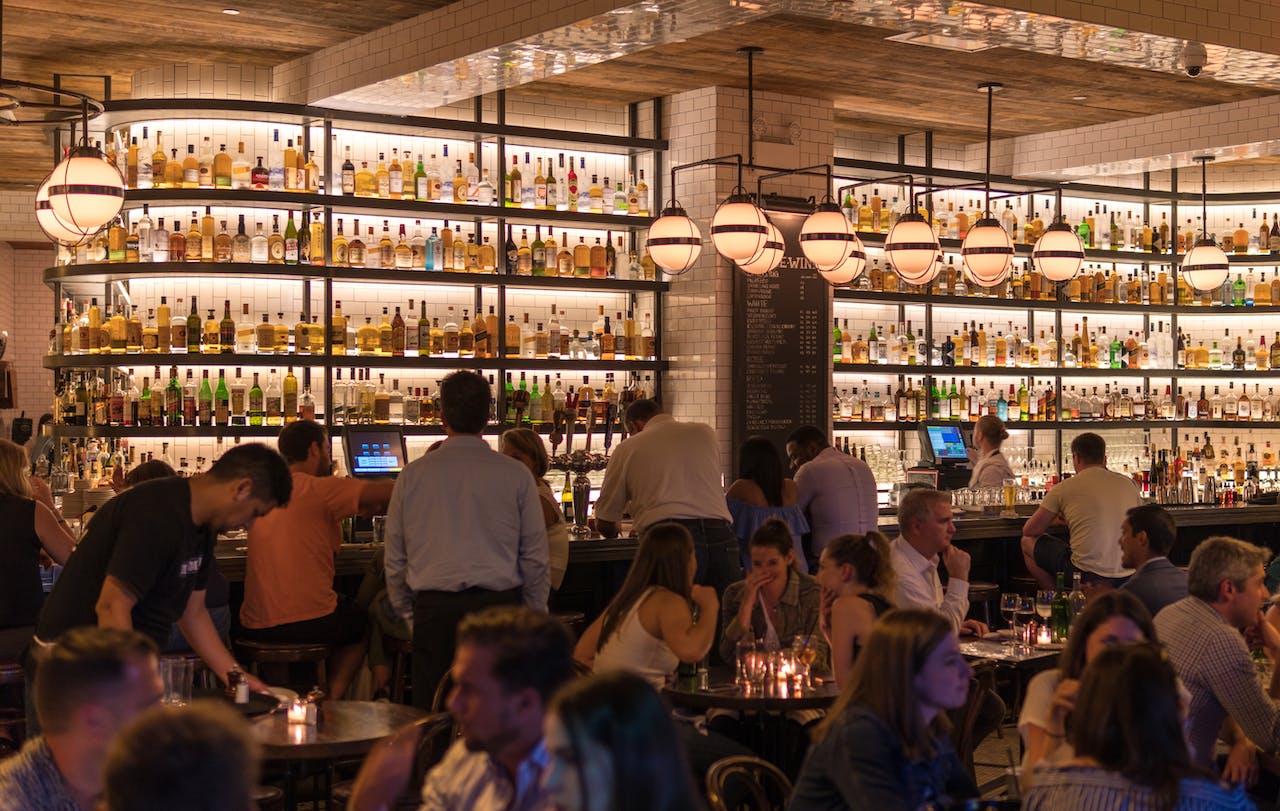
Let Bloom Intelligence Make It Effortless

Bloom Intelligence is the AI-powered restaurant marketing platform that automatically grows revenue, protects reputation, and optimizes operations 24/7. Our unified platform combines guest data from every touchpoint with intelligent automation to give restaurants the marketing power of major chains—without the complexity or cost.

Bloom makes guest data collection and marketing automation effortless, which allows you to quickly execute the strategies listed above, saving you time, increasing customer lifetime values, attracting new guests, improving your reputation, and boosting your bottom line.

Call us or schedule a free demo online and Bloom will show you how our restaurant marketing platform can help you save time and increase your customer lifetime values by automatically building first-party customer databases, unlocking important guest insights to trigger automated marketing at the right time and place, discover true guest sentiment, save at-risk guests, increase your current guests’ frequency, supercharge your website, and find new guests.

Click to schedule a Free Online Demo, or call 727-877-8181 to see how we can help you drive tangible results for your restaurants.

The $1,890 Question: Why Your First-Time Guests Never Return (And How AI Fixes It)


Every restaurant operator knows the feeling. A busy Friday night, new faces at every table, first-time guests discovering your concept. You’re thinking about expansion, about growth, about all those new customers becoming regulars.

Then reality hits.

Seventy percent of those first-time guests will never walk through your doors again.

Let that sink in. Seven out of ten new customers—gone forever. And each one takes $1,890 in lifetime value with them.

The Hidden Revenue Hemorrhage

Here’s the math that keeps restaurant CEOs awake at night:

  • Average guest lifetime value: $1,890
  • Monthly new guests (typical location): 100
  • Industry average return rate: 30%
  • Lost guests monthly: 70

That’s $132,300 in potential lifetime value walking out your door every single month.

Annually? $1,587,600 per location.

For a 5-location chain, that’s nearly $8 million in lost revenue every year. Not from poor service or bad food, but from guests who simply don’t return after their first visit.

The cruel irony? Most of these guests had a perfectly fine experience. They just got busy, forgot, or fell back into old habits. Without a systematic approach to bring them back, they’re gone forever.

first-time guests who will not return

The 72-Hour Window of Opportunity

Here’s what guest intelligence reveals: while we know 70% of first-time guests won’t return, we also know that immediate action dramatically improves those odds.

The window to influence a new guest’s return decision is incredibly short. Within 72 hours, they’ve either planned their next visit or moved on to other dining options. That’s why timing matters more than perfect targeting.

The key is capturing guest contact information and behavioral data from that very first visit:

Essential guest data:

  • Name, email, and phone number (captured through WiFi, POS, online ordering, or reservations)
  • Contact preferences (email vs. SMS engagement patterns)

Behavioral intelligence:

  • Dwell time patterns (did they linger or rush?)
  • Spend behavior (baseline order or adventurous?)
  • Digital engagement (WiFi usage, email opens, social interaction)
  • Visit timing (convenience visit or intentional dining?)

Without contact information, all the behavioral insights in the world won’t help you reach at-risk guests. But when you combine guest identity with rich behavioral data, AI can automatically segment new guests and deploy personalized campaigns designed to improve overall return rates.

The guest who spent 90 minutes at lunch, ordered wine, and connected to WiFi gets VIP recognition and menu recommendations sent to their preferred channel. The grab-and-go customer gets convenience-focused SMS about quick ordering options.

You’re not predicting who will return—you’re systematically improving the chances that more guests will choose to return by reaching them with the right message at the right time.

Examples of guest segmentation based on behavior

Real Results: From Industry Average to Revenue Gold

One of our multi-location restaurant partners was hemorrhaging first-time guests like every other operator. Despite excellent food and service, only 28% of new guests returned for a second visit.

Here’s what changed with AI-powered guest intelligence:

Before Bloom Intelligence:

  • New guest return rate: 28%
  • Monthly lost guests: 72 (out of 100 new)
  • Annual lost lifetime value: $1,368,240

After implementing automated guest intelligence:

  • New guest return rate: 43%
  • Monthly lost guests: 57 (out of 100 new)
  • Annual lost lifetime value: $1,081,080
  • Annual revenue recovery: $287,160 per location

But here’s where it gets interesting. Those additional returning guests don’t just visit twice—they become part of your regular base. Some become super guests worth 5x more than average customers.

The real transformation? This restaurant chain recovered 38% of its at-risk guests through automated, personalized campaigns that launched without any manual work from its team.

The Automation Advantage

The old way of retaining first-time guests was manual, generic, and expensive:

  • Mass email blasts with 2% open rates
  • One-size-fits-all discount offers
  • No way to identify truly at-risk guests
  • Marketing staff spend hours on campaigns that barely move the needle

AI-powered guest intelligence flips this equation:

Automatic guest scoring identifies return probability within hours of the first visit.

Triggered campaigns launch personalized messages based on guest behavior, not calendar dates.

Dynamic segmentation creates audiences of super guests, regulars, new guests, and at-risk guests automatically.

Intelligent timing sends messages when guests are most likely to engage, not when it’s convenient for your marketing calendar.

The result? Marketing that works like you have an expert team running sophisticated campaigns 24/7, but requires zero manual effort from your staff.

restaurateurs happy with marketing automation

The Compound Effect of Recovery

Here’s what most operators miss: converting just 10 additional first-time guests monthly creates a compound effect that transforms your business.

  • 10 additional returning guests × $1,890 LTV = $18,900 monthly
  • Annual impact: $226,800 per location
  • 5-location chain annual impact: $1,134,000

Those recovered guests don’t just contribute their customer lifetime value—they become advocates, bring friends, leave positive reviews, and create the virtuous cycle that drives sustainable growth.

Meanwhile, your competitors continue losing 70% of their first-time guests because they’re treating symptoms instead of solving the core problem: they don’t know who’s at risk until it’s too late.

The New Reality: Marketing Like the Big Chains

Major restaurant chains spend millions on customer data platforms, predictive analytics, and personalized marketing automation. They can afford teams of data scientists and marketing technologists.

Independent and regional chains couldn’t compete—until now.

AI-powered restaurant marketing platforms like Bloom Intelligence democratize these capabilities, giving lean teams the marketing power of enterprise operations at a fraction of the cost.

You get:

  • Real-time guest intelligence from WiFi, POS, reservations, reviews, and online ordering
  • Automatic audience creation based on visit patterns, spending behavior, and sentiment
  • Triggered campaigns that launch based on guest actions, not your marketing calendar
  • Operational excellence alerts that notify you of issues based on guest sentiment, orders, and behavior
  • Revenue attribution that shows exactly which campaigns drive visits and sales

All without adding marketing staff, learning complex systems, or changing your daily operations.

It’s time to win back those first-time guests.

First-time guests coming back to your restaurant

The Choice: Evolution or Extinction

Every day you wait to implement intelligent guest marketing, you’re losing $1,890 in lifetime value for every first-time guest who doesn’t return.

For a typical restaurant, that’s over $4,000 daily in lost potential revenue. Per location.

The restaurants that thrive in the next decade won’t be those with the best food or service, though both matter. They’ll be the ones that use guest intelligence to create personalized experiences that turn one-time visitors into lifetime customers.

Your competitors are still sending generic email blasts and hoping for the best. You can be using AI to automatically identify at-risk guests, recover lost customers, and systematically grow lifetime values while they’re wondering why their marketing doesn’t work.

The technology exists. The results are proven. The only question is: how much more revenue are you willing to lose to indecision?


Ready to stop losing first-time guests forever? See how AI-powered guest intelligence can recover your at-risk customers and turn every new visitor into potential revenue gold. Request a demo to see your guest data transformed into automatic revenue growth.


Related Reading:

Let Bloom Intelligence Make It Effortless

Bloom Intelligence is the AI-powered restaurant marketing platform that automatically grows revenue, protects reputation, and optimizes operations 24/7. Our unified platform combines guest data from every touchpoint with intelligent automation to give restaurants the marketing power of major chains—without the complexity or cost.

Bloom makes guest data collection and marketing automation effortless, which allows you to quickly execute the strategies listed above, saving you time, increasing customer lifetime values, attracting new guests, improving your reputation, and boosting your bottom line.

Call us or schedule a free demo online and Bloom will show you how our restaurant marketing platform can help you save time and increase your customer lifetime values by automatically building first-party customer databases, unlocking important guest insights to trigger automated marketing at the right time and place, discover true guest sentiment, save at-risk guests, increase your current guests’ frequency, supercharge your website, and find new guests.

Click to schedule a Free Online Demo, or call 727-877-8181 to see how we can help you drive tangible results for your restaurants.

The Operations-Marketing Bridge: How Smart Alerts Transform Guest Intelligence Into Real-Time Action

Transform scattered restaurant data into proactive operational intelligence that prevents problems before they impact your bottom line


The Hidden Cost of Operating Blind

Picture this: It’s 7:30 PM on a busy Friday night. Your kitchen is backed up, guests are waiting longer than usual, and somewhere in your dining room, frustration is building. Three tables are already typing negative reviews on their phones.

By tomorrow morning, you’ll see the damage—but by then, it’s too late.

Your restaurant’s most profitable guests could be walking out disappointed right now—and you’d never know.

Most restaurants operate reactively, discovering problems only after they’ve already damaged the guest experience.

But what if your operations team received intelligent alerts that let them identify and address emerging patterns before they impact your entire guest base?

The answer lies in building a bridge between your restaurant marketing data and operational execution—creating smart alerts that make your restaurant as proactive as your most experienced manager.

The Intelligence Gap That’s Costing You Revenue

Restaurant operators collect more guest data than ever before. WiFi analytics, transaction insights, online ordering patterns, reservation behaviors, review sentiment—the information is there. Yet most restaurants still operate blind to emerging issues because this data lives in silos.

The problem isn’t lack of data—it’s lack of actionable intelligence.

Consider what happens when problems develop:

  • Food quality issues spread across multiple orders before kitchen staff notices
  • Service slowdowns frustrate dozens of guests before managers realize there’s a problem
  • Cleanliness concerns mentioned in reviews could have been caught and addressed proactively
  • Staff performance patterns that impact guest satisfaction go undetected until complaints pile up

Without unified guest intelligence, you’re always one step behind. Your team spends time fighting fires instead of preventing them.

restaurant staff without guest intelligence

How Smart Operational Alerts Work

Bloom Intelligence transforms scattered restaurant data into a unified guest intelligence system that actively monitors for patterns and identifies emerging issues before they spread. Here’s how smart alerts bridge the gap between data and action:

Cross-Platform Intelligence Monitoring

Instead of checking multiple different systems, managers receive unified alerts from:

Predictive Issue Detection

The system analyzes patterns across all touchpoints to identify emerging issues before they become widespread problems:

Early Warning Example: When multiple guests show decreased dwell times, combined with slower transaction processing and increased negative sentiment around “wait times,” the system flags this pattern for management investigation before more guests are impacted.

Behavioral Pattern Recognition

Smart alerts identify trends that require immediate operational attention:

  • Food Quality Patterns: When order modifications or returns increase for specific items
  • Service Speed Issues: When transaction times extend beyond normal patterns during peak periods
  • Environmental Concerns: When guest behavior indicates potential cleanliness or comfort issues
  • Staff Performance Indicators: When guest satisfaction metrics correlate with specific shifts or sections

Real-World Applications: From Alert to Action

Operational Pattern Detection in Action

The Alert: System detects that guests ordering your signature pasta dish have 40% higher modification rates this week compared to normal patterns.

The Intelligence: Cross-referencing with review sentiment shows recent mentions of “too salty” and order data reveals increased sauce-on-the-side requests.

The Action: Kitchen manager receives notification to investigate seasoning consistency and discovers a new prep cook has been over-salting the sauce.

The Result: Issue identified and resolved before it impacts more guests or generates additional negative reviews.

The Learning: System now monitors seasoning-related modification patterns for early detection of similar prep issues.

Smart Offer Attribution for Guest Recognition

The Setup: You create a targeted campaign for at-risk guests (those showing decreased visit frequency) with a “We miss you” offer.

The Intelligence: When guests redeem this specific offer, staff alerts managers that this is an at-risk guest requiring special attention.

The Action: Servers recognize this as an at-risk guest offer and provide extra care, perhaps checking in mid-meal or offering a complimentary dessert.

The Result: At-risk guests receive elevated service during their critical return visit, improving retention likelihood.

The Learning: System tracks which at-risk guests return and measures the success of recovery efforts.

Cross-Channel Behavior Analysis

The Pattern: Guests who typically dine in twice per week are increasingly shifting to online ordering only.

The Intelligence: System correlates this shift with recent review mentions of “crowded dining room” and WiFi data showing shorter dwell times.

The Action: Management investigates dining room capacity and comfort levels during peak periods.

The Result: Operational adjustments to seating flow and atmosphere restore the dine-in experience.

restaurant with guest intelligence running smoothly with happy guests

The Manager Dashboard: Intelligence Made Simple

Busy restaurant managers don’t need complex analytics—they need clear, actionable alerts they can act on immediately. Bloom’s intelligent alerts are designed for real-world restaurant operations:

Performance-Based Alert System

Attention Required: Issues that need immediate focus to prevent guest impact
Making Progress: Trends showing improvement but requiring continued monitoring
Average: Performance meeting baseline expectations
Best In Class: Exceptional performance indicators and guest satisfaction patterns

One-Click Actions

Each alert includes suggested immediate actions:

  • “Check Kitchen Station 3 – increased order modifications detected”
  • “Review employee performance – negative sentiment mentions increasing for specific staff members”
  • “Investigate cleaning protocols – multiple cleanliness mentions in recent feedback”

Success Tracking

The system doesn’t just alert—it tracks whether actions were taken and measures the results, helping managers understand which interventions work best.

guest intelligence sentiment dashboard

Measuring the Impact: ROI of Proactive Operations

Restaurants using Bloom’s smart alert system see measurable improvements across key metrics:

Guest Satisfaction Metrics

  • Review ratings increase as issues are caught before they impact multiple guests
  • Complaint resolution time decreases through early detection and prevention
  • Guest retention improves as operational consistency increases

Operational Efficiency Gains

  • Staff productivity increases when managers can focus on prevention rather than reaction
  • Food waste decreases as quality issues are identified before batch preparation
  • Service flow is optimized through real-time capacity and timing insights

Revenue Protection and Growth

  • Lost guest prevention: Early intervention keeps at-risk guests engaged
  • Upsell optimization: Understanding guest preferences enables better recommendations
  • Operational cost reduction: Preventing problems costs less than fixing them

Implementation: Building Your Intelligence Bridge

Phase 1: Data Integration (Week 1)

  • Connect existing systems (WiFi, online ordering, reservations, transaction data)
  • Establish baseline patterns and guest profiles
  • Begin receiving intelligent alerts based on industry benchmarks

Phase 2: Alert Calibration (Weeks 2-3)

  • Fine-tune alert sensitivity to match operational needs
  • Train the management team on alert interpretation and response
  • Establish action protocols for different alert types

Phase 3: Optimization (Ongoing)

  • Monitor alert accuracy and adjust thresholds
  • Track intervention success rates
  • Expand smart offer attribution campaigns

the guest intelligence flywheel

Beyond Alerts: Building Competitive Advantage

The restaurants winning in 2025 aren’t just using technology—they’re using intelligence.

While competitors manually analyze data, you proactively respond to emerging patterns. While others send generic campaigns, your system creates targeted interventions. As they react to problems, your intelligent alerts help prevent issues before they impact more guests.

The compounding advantage: Each alert acted upon makes your system smarter. The AI learns from successful interventions, becoming more accurate at predicting and preventing operational issues.

The Choice: Reactive or Proactive Operations

Every day you operate without unified guest intelligence, you’re leaving revenue on the table and risking guest relationships. The data to prevent problems exists—you just need the right system to turn that data into action.

Smart alerts don’t just notify you of problems—they prevent problems from becoming bigger issues. They don’t just tell you what happened—they help you influence what happens next.

Your guests are already telling you everything you need to know. The question is: Are you listening intelligently enough to act?

Ready to Transform Your Operations?

See how Bloom Intelligence turns your guest data into proactive operational intelligence. Watch smart alerts identify issues before they impact your bottom line.

Schedule a Demo to see live operational alerts in action, or learn more about building the marketing capabilities of enterprise chains with the simplicity your lean team needs.

Bloom Intelligence: The AI-powered restaurant marketing platform that generates guest intelligence to automatically grow revenue, protect your reputation, and optimize operations 24/7—built for lean teams.


Related Reading:

Let Bloom Intelligence Make It Effortless

Bloom Intelligence is the AI-powered restaurant marketing platform that automatically grows revenue, protects reputation, and optimizes operations 24/7. Our unified platform combines guest data from every touchpoint with intelligent automation to give restaurants the marketing power of major chains—without the complexity or cost.

Bloom makes guest data collection and marketing automation effortless, which allows you to quickly execute the strategies listed above, saving you time, increasing customer lifetime values, attracting new guests, improving your reputation, and boosting your bottom line.

Call us or schedule a free demo online and Bloom will show you how our restaurant marketing platform can help you save time and increase your customer lifetime values by automatically building first-party customer databases, unlocking important guest insights to trigger automated marketing at the right time and place, discover true guest sentiment, save at-risk guests, increase your current guests’ frequency, supercharge your website, and find new guests.

Click to schedule a Free Online Demo, or call 727-877-8181 to see how we can help you drive tangible results for your restaurants.

The Guest Intelligence Flywheel: How Smart Data Creates Self-Improving Restaurants

How unified guest data creates a self-reinforcing cycle that automatically improves guest experience, drives revenue, and optimizes operations 24/7.


In the restaurant industry, most operators are trapped in a reactive cycle. A guest has a poor experience, leaves a bad review, and you scramble to respond. A regular customer stops coming, and you only notice when it’s too late.

You run restaurant marketing campaigns based on gut feelings rather than guest intelligence.

But what if your restaurant could learn and improve automatically, without constant manual intervention?

The most successful restaurants in 2025 aren’t just serving great food. They’re operating guest intelligence flywheels that create compounding returns on every interaction.

Unlike traditional marketing campaigns that require constant fuel, a properly built flywheel generates momentum that builds energy over time.

The Traditional Restaurant Data Problem

Most restaurants collect data from multiple sources but fail to unify it into actionable intelligence:

Guest data collection points for guest intelligence

The problem? These systems operate in isolation (silos), creating data silos that prevent restaurants from seeing the complete guest story. Without unified intelligence, operators miss critical patterns and opportunities for improvement.

The Guest Intelligence Flywheel: A Self-Reinforcing System

A guest intelligence flywheel transforms scattered data into a unified system where each interaction strengthens the entire operation. Here’s how the cycle works:

Stage 1: Data Unification Creates Guest Intelligence

Every touchpoint feeds into a centralized Restaurant Customer Data Platform (CDP) that creates comprehensive guest profiles:

  • Sarah visits monthly, always orders salmon, prefers table 12, and celebrates anniversaries in March
  • Marcus is a new guest who found you through Google, ordered takeout twice, and hasn’t dined in yet
  • The Johnson family books for 6 people quarterly, and always requests the private dining area

This unified intelligence powers the next stage of the flywheel.

Stage 2: AI-Powered Personalization Enhances Every Interaction

With complete guest profiles, marketing automation delivers precisely timed, personalized experiences:

  • Sarah receives an anniversary reminder in February with her preferred table pre-reserved
  • Marcus gets a “try dining in” campaign with a complimentary appetizer offer
  • The Johnsons see a private dining special for their next quarterly gathering

Personalized experiences dramatically increase guest satisfaction and engagement.

The guest intelligence flywheel

Stage 3: Enhanced Experiences Drive Better Outcomes

Personalized interactions create measurable improvements:

  • 43% increase in guest lifetime values through targeted offers
  • 38% recovery rate for at-risk guests via automated win-back campaigns
  • 67% improvement in review ratings when issues are addressed proactively
  • 23% increase in visit frequency through relevant communications

Better outcomes generate more positive reviews and repeat visits.

Stage 4: Positive Feedback Strengthens the Intelligence System

Each successful interaction provides new data that enhances the AI:

  • Higher review scores improve online visibility and attract new guests
  • Increased visit frequency provides more behavioral data for pattern recognition
  • Successful campaign responses train the AI on optimal timing and messaging
  • Positive sentiment creates lookalike models for guest acquisition

This enhanced intelligence makes the next cycle even more effective, creating a compounding effect.

The Three-Pillar Foundation: CDP + Marketing Automation + Reputation Management

The flywheel requires three integrated systems working in harmony:

3 tools for restaurants to use with guest intelligence

Customer Data Platform (CDP): The Intelligence Engine

The CDP serves as the central nervous system, unifying data from all sources:

  • Real-time data processing from WiFi, POS, reservations, and digital touchpoints
  • AI-powered guest segmentation identifying Super Guests, Regulars, New Guests, and At-Risk customers
  • Predictive analytics forecasting guest behavior and preferences
  • Single customer view providing complete guest context for every interaction

Marketing Automation: The Execution Engine

Automated marketing campaigns respond instantly to guest behavior triggers:

  • Welcome sequences for new guests with onboarding experiences
  • Loyalty programs that automatically reward frequent visitors
  • Win-back campaigns that trigger when guest frequency declines
  • Special occasion marketing based on past celebration patterns

Reputation Management: The Feedback Engine

AI-powered reputation management creates a continuous improvement loop:

  • Automated review monitoring across all platforms
  • Sentiment analysis identifying trends before they become problems
  • Intelligent response systems that address concerns promptly
  • Feedback integration that turns criticism into operational improvements

Real-World Flywheel Examples

Example 1: The At-Risk Guest Recovery

The Trigger: John, a regular who visits twice monthly, hasn’t been in for 6 weeks.

The Intelligence: CDP identifies a declining visit frequency pattern.

The Action: Marketing automation sends a personalized “We miss you” campaign with his favorite dish featured.

The Result: John returns, mentions he appreciated the personal touch, and leaves a 5-star review.

The Learning: AI notes the successful recovery pattern and applies it to similar guest profiles.

Example 2: The New Guest Conversion

The Trigger: Lisa orders takeout for the third time but hasn’t dined in.

The Intelligence: CDP recognizes a conversion opportunity based on ordering behavior.

The Action: Automated campaign offers a complimentary appetizer for the first dine-in experience.

The Result: Lisa dines in, has an excellent experience, and becomes a regular customer.

The Learning: System identifies takeout-to-dine-in conversion patterns for future targeting.

Example 3: The Reputation Enhancement

The Trigger: Sentiment analysis detects declining satisfaction scores related to wait times.

The Intelligence: System correlates review sentiment with operational data.

The Action: Automated alerts notify management; proactive communications are sent to recent guests.

The Result: Quick operational adjustments and guest outreach prevent a negative review cycle.

The Learning: AI develops early warning systems for operational issues.

Measuring Flywheel Velocity: Key Performance Indicators

A healthy guest intelligence flywheel shows improvement across multiple metrics:

Guest Intelligence Flywheel metrics to track

Revenue Metrics

  • Guest lifetime value increases as personalization improves retention
  • Average check growth through intelligent upselling and recommendations
  • Visit frequency improvement via relevant, timely communications

Operational Metrics

  • Review rating improvements through proactive issue resolution
  • Marketing efficiency gains as AI optimization reduces waste
  • Labor optimization based on predictive guest traffic patterns

Intelligence Metrics

  • Data completeness scores measuring profile richness over time
  • Prediction accuracy rates for guest behavior and preferences
  • Campaign performance improvements showing AI learning effectiveness

Building Your Guest Intelligence Flywheel: Days, Not Months

Creating a self-improving restaurant traditionally requires months of complex implementation. Most operators attempting to build unified guest intelligence systems face significant challenges:

The Traditional DIY Approach (6-18 Months)

Phase 1: Data Foundation (Months 1-6)

  • Research and procure separate CDP, marketing, and reputation management vendors
  • Navigate complex technical integrations between siloed systems
  • Hire specialized data engineers and marketing technologists
  • Build custom APIs and data connectors for each platform
  • Establish baseline metrics while managing multiple vendor relationships

Phase 2: Intelligence Activation (Months 6-12)

  • Train staff on multiple platforms with different interfaces and workflows
  • Manually configure automation rules across disconnected systems
  • Troubleshoot data sync issues and platform conflicts
  • Launch basic campaigns while learning multiple software platforms

Phase 3: Optimization & Maintenance (Months 12-18)

  • Continuously manage vendor relationships and platform updates
  • Manually analyze data across multiple dashboards
  • Coordinate improvements across siloed systems
  • Scale team to handle increasing complexity

The Hidden Costs: $50,000+ in software licenses, $75,000+ in implementation costs, and 6-18 months before seeing meaningful results.

The Bloom Intelligence Approach (24 Hours to Launch)

Day 1: Instant Integration

  • Connect all platforms in minutes through pre-built integrations
  • Automatic data unification begins immediately with AI-powered guest profile creation
  • Instant baseline metrics with a real-time dashboard showing current guest intelligence

Week 1: Intelligence Activation

  • Pre-configured campaigns launch automatically based on industry best practices
  • AI-powered segmentation identifies Super Guests, Regulars, and At-Risk customers from day one
  • Automated reputation management begins monitoring and responding across all platforms

Month 1: Flywheel Optimization

  • AI continuously optimizes campaign performance
  • Predictive triggers automatically improve based on your specific guest behavior patterns
  • Performance analytics show measurable flywheel velocity improvements

The Bloom Advantage: Single platform, unified interface, expert-configured automation, and quantifiable results in days—not months.

restaurateurs seeing benefits of using guest intelligence

Why Speed Matters: The Cost of Waiting

Every month without unified guest intelligence costs restaurants:

  • Lost revenue from missed personalization opportunities
  • Decreased efficiency from manual, reactive operations
  • Competitive disadvantage as guests choose restaurants with better experiences
  • Increased marketing waste from untargeted campaigns

Restaurants using Bloom’s unified platform see results immediately:

  • 24-hour setup with instant guest intelligence
  • Week 1 campaigns driving measurable engagement
  • Month 1 optimization showing improved guest satisfaction and revenue

The Competitive Advantage of Self-Improvement

Restaurants operating guest intelligence flywheels gain sustainable competitive advantages:

While competitors manually analyze data, you automatically respond to guest behavior.

While others send generic campaigns, your AI delivers personalized experiences.

While they react to problems, your system prevents issues before they impact guests.

While their marketing requires constant management, your flywheel builds momentum independently.

The flywheel effect means that the longer you operate this system, the stronger your competitive position becomes. Each guest interaction makes your restaurant smarter, more responsive, and more profitable.

The Future Is Self-Improving Operations

The restaurant industry is evolving toward intelligent operations where data drives decisions and systems learn from every interaction. Operators who build guest intelligence flywheels today will dominate tomorrow’s competitive landscape.

The question isn’t whether unified guest data will become standard, it’s whether you’ll be ahead of the curve or struggling to catch up.

Ready to build your guest intelligence flywheel?

Bloom Intelligence’s unified restaurant marketing platform combines CDP, marketing automation, and reputation management into a single system designed to create self-improving restaurant operations. Our AI-powered platform has processed millions of guest interactions across thousands of restaurants, creating flywheel effects that deliver measurable results:

  • 43% increase in guest lifetime values
  • 38% recovery rate for at-risk guests
  • 247% improvement in campaign performance
  • 89% reduction in manual marketing tasks

Not yet using Bloom Intelligence? Transform scattered data into a sustainable competitive advantage. Build your flywheel today.
See how the platform can transform your guest relationships and drive revenue growth.

Schedule a Free Demo to see how we can exponentially accelerate your restaurant’s competitive advantage.

Let Bloom Intelligence Make It Effortless

Bloom Intelligence is the AI-powered restaurant marketing platform that automatically grows revenue, protects reputation, and optimizes operations 24/7. Our unified platform combines guest data from every touchpoint with intelligent automation to give restaurants the marketing power of major chains—without the complexity or cost.

Bloom makes guest data collection and marketing automation effortless, which allows you to quickly execute the strategies listed above, saving you time, increasing customer lifetime values, attracting new guests, improving your reputation, and boosting your bottom line.

Call us or schedule a free demo online and Bloom will show you how our restaurant marketing platform can help you save time and increase your customer lifetime values by automatically building first-party customer databases, unlocking important guest insights to trigger automated marketing at the right time and place, discover true guest sentiment, save at-risk guests, increase your current guests’ frequency, supercharge your website, and find new guests.

Click to schedule a Free Online Demo, or call 727-877-8181 to see how we can help you drive tangible results for your restaurants.
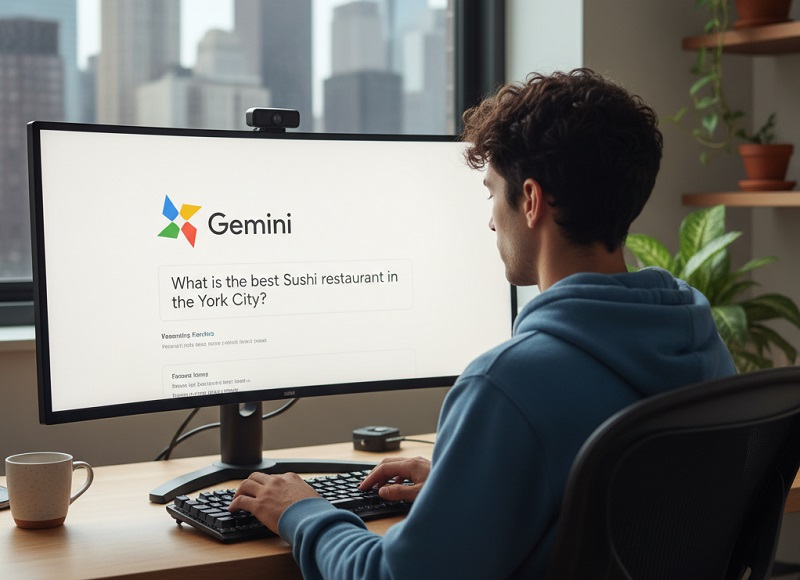
From Guest Data to Marketing Gold: How Smart Restaurants Turn Sentiment Into Revenue

Loyal guests are the foundation of long-term restaurant success. Regulars not only provide steady revenue but also become advocates who recommend your brand to others.

But what exactly turns a first-time diner into a loyal guest who keeps coming back?

Recent data from Toast POS offers some clear insights into what drives guest loyalty:

  • 60% of respondents consider themselves to be regulars at a restaurant.
  • 67% of respondents are more likely to return if the restaurant consistently remembers their dining preferences.
  • 33% of respondents return at least once a week to restaurants where they feel like a regular.
  • Over 49% of respondents tip staff more generously when they view themselves as regulars.
  • 35% of respondents say faster service would improve their experience as repeat guests.
  • 48% of respondents point to food and drink quality as the number one factor that makes them want to become regulars.

These numbers reveal an important truth: guests want more than a meal—they want recognition, consistency, and experiences tailored to their preferences.

That’s where guest sentiment analysis comes in. By understanding not only what your guests say but also how they feel, you can create hyper-personalized interactions that transform casual visitors into loyal regulars and turn your regulars into $uper Guests.


Why Guest Sentiment Is the Key to Restaurant Loyalty

Restaurant loyalty doesn’t just happen. It’s built over time through positive experiences, emotional connections, and consistent recognition.

Guests want to feel valued, and their feedback is often the most direct path to understanding what matters most to them.

This is why guest sentiment analysis is such a powerful tool: it bridges the gap between raw data and meaningful action.

Loyalty Is Emotional, Not Just Transactional

While discounts and rewards programs can encourage repeat visits, they don’t create the emotional bond that makes a guest feel like a true regular.

Loyalty is rooted in recognition and personalization, not just promotions. Sentiment analysis helps uncover these emotional drivers by showing how guests feel about food, service, atmosphere, and other details that shape their experience.

Surface-level feedback like star ratings or short reviews often misses the “why” behind guest behavior. Sentiment analysis dives deeper, detecting patterns across thousands of reviews, surveys, and comments.
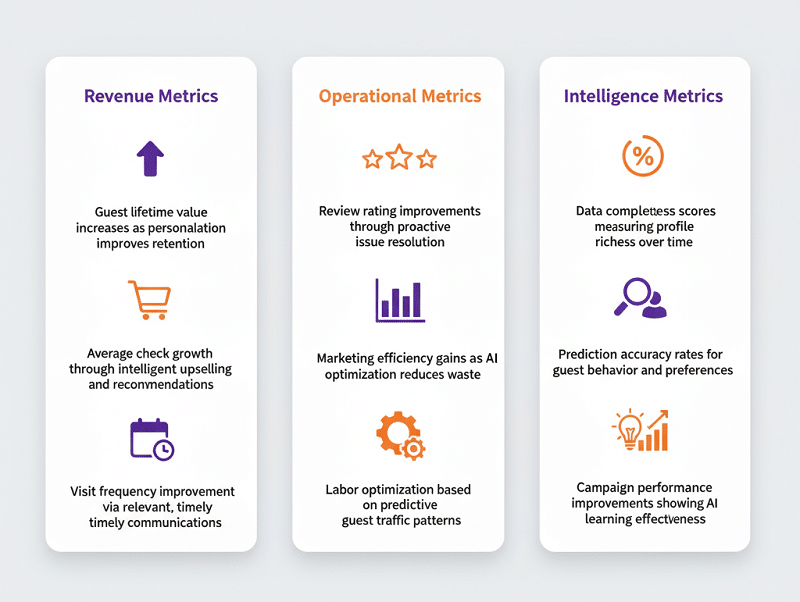
For example:

  • If multiple guests mention slow service, that points to a training or staffing issue.
  • If guests praise the seasonal menu, that’s a signal to expand it or promote it further.
  • If sentiment trends downward in cleanliness, leadership can intervene before it impacts reputation and repeat visits.
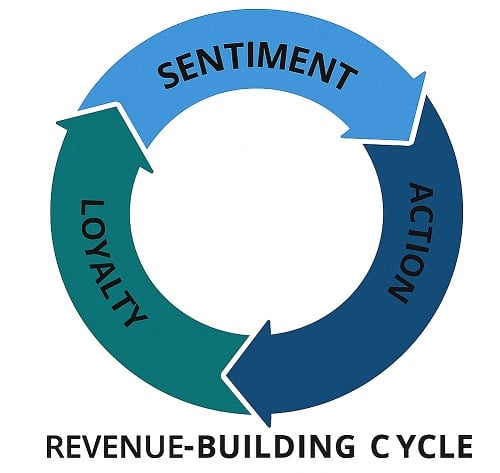
By uncovering these insights, operators can take precise action to improve guest satisfaction and loyalty.

Connecting Sentiment to Guest Segments

Sentiment is most powerful when combined with behavioral and demographic segmentation. Imagine being able to see how Super Guests versus At-Risk Guests feel about food quality or staff friendliness.

That context transforms sentiment from a passive measurement into a loyalty-building strategy.

For instance:

  • If Super Guests are consistently praising a bartender by name, you can spotlight that staff member and keep them engaged.
  • If At-Risk Guests frequently mention long wait times, you can target them with campaigns that highlight faster service or off-peak dining.

Loyalty as a Revenue Multiplier

Sentiment doesn’t just build warm feelings, it directly impacts revenue. Since Super Guests and Regulars have a higher lifetime value, addressing their sentiment creates a ripple effect: more repeat visits, higher average check sizes, and stronger word-of-mouth referrals.

In short, sentiment analysis is the foundation of loyalty because it tells you not just what guests do, but why they do it.

With that knowledge, restaurants can take smarter actions that turn casual guests into regulars and regulars into true brand advocates.

Server laughing with Super Guests, collecting sentiment

Guest Segments with Actionable Insights

Every restaurant has different types of guests, and knowing who they are is essential for growth. Bloom Intelligence automatically sorts your guest audiences into smart segments such as Super Guests, Regulars, New Guests, Needs Attention, and At-Risk Guests.

Each segment includes critical demographic and behavioral insights like gender, age range, frequency of visits, and potential lifetime value.

This helps you understand which guests contribute the most to your business and which ones may need more attention to keep them engaged.

And soon, you’ll be able to launch one–click suggested campaigns directly from Bloom. These campaigns will automatically adapt to your brand kit, guest data, and AI-driven marketing models, ensuring that every message feels personal and on-brand.

Better yet, they’ll continuously improve over time, as you learn what works best for each guest segment, and optimize.

Understand Guest Sentiment at a Glance

Turning feedback into action can be overwhelming—but Bloom makes it simple. Our AI-powered sentiment analysis turns every piece of guest feedback into clear, actionable insights.

The Bloom Command Center organizes sentiment into categories like Food, Service, Cleanliness, and Employees, so you immediately see where your business excels and where improvements are needed. You can also create custom categories to track what matters most to your concept—like ambiance, drinks, or delivery.

Each category includes:

  • Your average ratings
  • Industry benchmarks
  • Historical trends
  • AI-generated calls to action tailored to your operations

Operators can instantly email feedback to staff, pin recurring issues, or dismiss irrelevant items. When you pin an action, Bloom shows whether guest sentiment is improving or declining over time, so you always know if your changes are paying off.

Guest Sentiment report with details about restaurant guests

Track the Guest Experiences That Matter Most

Restaurants aren’t one-size-fits-all, and neither is guest sentiment. With custom sentiment analysis, you can monitor unique aspects of your business like music, seasonal menus, staff performance, or off-premises experiences.

Bloom’s AI will analyze the data and deliver weekly summaries that highlight strengths and flag potential risks, helping you stay ahead of problems before they escalate.

This means you can double down on what delights your guests while addressing concerns proactively.

From First-Time Guests to Super Guests

The statistics above make it clear: guests who feel valued, remembered, and consistently delighted are far more likely to become regulars, and even tip more generously.

But creating that sense of recognition at scale is nearly impossible without the right tools.

By combining guest segmentation, sentiment analysis, and AI-powered campaign automation, Bloom Intelligence gives you the ability to:

  • Recognize and reward your Super Guests
  • Build loyalty among your Regulars
  • Re-engage New and At-Risk Guests with timely campaigns
  • Improve guest experiences where it matters most for your restaurant

Continuous cycle of revenue building using guest sentiment

The result is a continuous cycle of improvement where sentiment drives action, action creates loyalty, and loyalty builds revenue.

The Future of Guest Experience Is Personal

Loyalty isn’t built overnight. Iit’s earned through personalized recognition, consistent quality, and meaningful engagement.

Restaurant marketing is evolving from spray-and-pray tactics to precision engagement strategies. The operators who embrace comprehensive guest intelligence today will build the customer relationships that sustain them through every market cycle.

The data is already there. The question is whether you’ll use it to transform one-time visitors into lifelong advocates, or continue hoping for the best while your competitors capture the customers you could have kept.

Smart restaurants don’t just serve great food. They use every interaction to build deeper relationships that drive sustainable growth.

In an industry where margins matter and competition is constantly chasing you, that intelligence advantage can be the difference between thriving and just surviving.


Not yet using Bloom Intelligence? See how the platform can transform your guest relationships and drive revenue growth.

Schedule a Free Demo to see how we can exponentially accelerate your restaurant’s competitive advantage.

Let Bloom Intelligence Make It Effortless

Bloom Intelligence is the AI-powered restaurant marketing platform that automatically grows revenue, protects reputation, and optimizes operations 24/7. Our unified platform combines guest data from every touchpoint with intelligent automation to give restaurants the marketing power of major chains—without the complexity or cost.

Bloom makes guest data collection and marketing automation effortless, which allows you to quickly execute the strategies listed above, saving you time, increasing customer lifetime values, attracting new guests, improving your reputation, and boosting your bottom line.

Call us or schedule a free demo online and Bloom will show you how our restaurant marketing platform can help you save time and increase your customer lifetime values by automatically building first-party customer databases, unlocking important guest insights to trigger automated marketing at the right time and place, discover true guest sentiment, save at-risk guests, increase your current guests’ frequency, supercharge your website, and find new guests.

Click to schedule a Free Online Demo, or call 727-877-8181 to see how we can help you drive tangible results for your restaurants.