If you’re like most restaurant operators, you didn’t get into this business to become a data analyst or a full-time marketer. You got into it to create amazing food and experiences.
But in today’s digital-first world, marketing is no longer a nice-to-have—it’s make or break. And the brands that are winning? They’re not necessarily spending more. They’re just working smarter.
Guest Intelligence: Your Most Valuable Ingredient
What if your guest data—those WiFi check-ins, online orders, POS transactions, reservations, website activity, and reviews—wasn’t just sitting there in different silos?
What if it could quietly power a restaurant marketing system behind the scenes, helping you understand each guest, what they love, when they visit, and why they return?
That’s what we call guest intelligence—and it’s not just for the big guys anymore.
What You Can Do Without Any Tools
You don’t need a fancy platform to start turning guest data into action if you are collecting guest data in your siloed platforms. Here are some low-hanging fruits:
Segment Your Email List: Look at recent purchases, recency of visits, or types of orders. Even a basic spreadsheet can reveal patterns, like which guests haven’t returned in 30 days.
Respond to Reviews Strategically: Don’t just thank everyone—look for themes. Are multiple guests mentioning wait times or specific dishes? That’s free insight you can act on to improve your operations.
Use Reservation Notes or Order Comments: Start tagging regulars, allergies, preferences, or VIPs. Even basic personalization in a follow-up email (“Hope you enjoyed the truffle risotto again!”) goes a long way.
Create Triggers Manually: See a lull in visits after three weeks? Send a bounce-back offer or loyalty reminder.
These steps are time-consuming, sure—but effective. Now imagine if they happened automatically.
Now Imagine This—Without the Manual Work
Here’s the truth: most restaurants want to do better marketing. They just don’t have the time or staff.
Every guest touchpoint—from reviews to reservations to WiFi—is automatically captured and unified.
Your system knows who’s new, who’s loyal, and who needs a nudge—and messages them automatically.
Your marketing suddenly acts like a full team of experts, guided by AI, without lifting a finger.
Sounds far-fetched? It’s not.
With Bloom, you’re essentially plugging your siloed data into the same kind of intelligence and automation that the largest restaurant chains use—but at a fraction of the cost and complexity.
What Happens When You Have a Real System in Place
When you centralize your guest data, a few magical things happen:
You Get a Clear View of Your Guests: Who they are, how often they visit, what they spend, and how they feel. Also known as a single customer view (SCV).
You Can Act Smarter, Not Harder: Automate personalized emails, SMS messages, and even review responses based on real-time behavior.
You Stop Guessing: AI helps identify what’s working, what’s not, and what to do next—whether it’s promoting an event, responding to reviews, or targeting at-risk guests.
In short, you market like a pro, even if you’re a one-person team.
Don’t Let Data Collect Dust—Put It to Work
Data is only valuable if you can use it. That’s the beauty of guest intelligence, it turns noise into insights, and insights into action. Whether you’re flying solo or leading a small team, you can compete with chains 10x your size by working smarter.
And if you’re ready to explore what a true marketing operating system looks like, Bloom Intelligence can show you how easy it is to get started.
Final Thought: Your Future Self Will Thank You
You don’t need to overhaul your tech stack overnight. Just start by thinking about how you can automate what you’re already doing manually. Then, imagine multiplying that effort by AI-powered systems working 24/7.
Whether or not you use Bloom, that shift in mindset—from reactive to proactive, from manual to intelligent—is the difference between a good brand and a great one.
And you don’t have to go it alone.
Let Bloom Intelligence Make It Effortless
Restaurant marketing doesn’t have to be a tedious manual process. With Bloom Intelligence, restaurants can automatically collect guest data, build segmented audiences, trigger personalized email and SMS campaigns, and give staff the tools to respond – all in real time.
From first-time guests to your most loyal fans, Bloom Intelligence helps you turn raw data into real loyalty.
Bloom Intelligence is an AI-powered restaurant marketing platform. It includes a powerful customer data platform, website integrations, automated guest data collection, one-click audience segmentation, marketing automation via email and SMS, reputation management, and reporting tools.
Bloom makes guest data collection effortless, which allows you to quickly execute the strategies listed above, saving you time, increasing customer lifetime values, attracting new guests, improving your reputation, and boosting your bottom line.
Call us or schedule a free demo online and Bloom will show you how our restaurant marketing platform can help you save time and increase your customer lifetime values by automatically building first-party customer databases, unlocking important guest insights to trigger automated marketing at the right time and place, discover true guest sentiment, save at-risk guests, increase your current guests’ frequency, supercharge your website, and find new guests.
Click to schedule a Free Online Demo, or call 727-877-8181 to see how we can help you save time and drive tangible results for your restaurants.
Alex was exhausted. As the CEO of an eight-location restaurant group, each day felt like an endless race, juggling escalating food and labor costs, tightening guest budgets, and the perpetual uncertainty of maintaining his restaurants’ stellar reputation.
He wasn’t alone. In fact, a recent industry survey revealed that 80% of restaurant operators have seen labor and food costs rise significantly and guest budgets tighten, with more than half witnessing cost increases of up to 14% in food alone.
Every month, Alex watched margins tighten and profits erode, feeling increasingly frustrated.
Alex had tried the usual manual solutions: spreadsheets for tracking costs, random marketing emails hoping to lure back customers, and frequent manual checks of online reviews—often late at night. Usually, he does not even have time to respond to all reviews.
The scattered, manual processes cost him valuable time and, worse yet, rarely moved the needle in meaningful ways.
Then, Alex discovered Bloom Intelligence—a platform designed specifically for restaurant leaders. With Bloom, Alex quickly integrated guest data from his Wifi networks, POS, website, online ordering platforms, reservations, and review sites into one powerful platform.
Suddenly, Alex had something he never imagined possible: a clear, single view of his customers across all locations. He could effortlessly see audiences such as super guests, frequent visitors, first-timers, and even customers at risk of slipping away.
Instead of manually guessing which marketing strategies might resonate, Bloom’s AI-powered marketing automation allowed him to automatically deliver personalized, timely messages tailored to each unique guest segment.
It was like having an entire advanced marketing team quietly working behind the scenes—except it required no hiring, training, or management on his part.
Alex also discovered that managing his online reputation became dramatically simpler. Bloom automatically aggregated and analyzed reviews, giving him and his operations immediate insights into customer sentiment across all locations.
The AI-driven reputation management features made responding to feedback easy and swift. They automated responses around his brand voice and guest sentiment of every review, elevating his brand’s online presence and drawing back customers who might otherwise drift away silently.
For the first time in years, Alex felt truly in control. His operational headaches—unable to measure and improve guest sentiment, unpredictable customer visits, and a patchy online presence—were no more protracted crises but manageable, actionable insights.
Bloom Intelligence didn’t just provide data—it offered clarity, direction, action, and tangible results.
And Alex wasn’t unique. Restaurateurs leveraging Bloom’s platform see measurable improvements—lower marketing expenses, increased repeat visits, and boosted customer satisfaction.
Running restaurants will always be challenging. But, as Alex discovered, restaurant marketing and building meaningful and lasting guest experiences don’t have to be overwhelming. With Bloom Intelligence, what once felt chaotic and unpredictable now feels strategic, precise, and incredibly manageable.
Better yet, Alex consolidated his marketing technology, saving money, automating tedious tasks, and boosting revenue effortlessly. The platform quickly paid for itself.
If you relate to Alex’s challenges, discover how easy it can transform complexity into clarity.
Bloom Intelligence isn’t just technology or AI; it’s a system and team that focuses on your success.
Ease the burden. Uncover the opportunity. Thrive with Bloom.
Let Bloom Intelligence Make It Effortless
Restaurant marketing doesn’t have to be a tedious manual process. With Bloom Intelligence, restaurants can automatically collect guest data, build segmented audiences, trigger personalized email and SMS campaigns, and give staff the tools to respond – all in real time.
From first-time guests to your most loyal fans, Bloom Intelligence helps you turn raw data into real loyalty.
Bloom Intelligence is an AI-powered restaurant marketing platform. It includes a powerful customer data platform, website integrations, automated guest data collection, one-click audience segmentation, marketing automation via email and SMS, reputation management, and reporting tools.
Data is collected from sources like WiFi logins, online reservation systems, online ordering platforms, POS systems, website forms, social media, and more. This makes it simple to analyze and segment your guest personas for your restaurant’s digital marketing and operations decisions. And it makes it very easy to showcase social proof on your website.
Bloom makes guest data collection effortless, which allows you to quickly execute the strategies listed above, saving you time, increasing customer lifetime values, attracting new guests, improving your reputation, and boosting your bottom line.
Call us or schedule a free demo online and Bloom will show you how our restaurant marketing platform can help you save time and increase your customer lifetime values by automatically building first-party customer databases, unlocking important guest insights to trigger automated marketing at the right time and place, discover true guest sentiment, save at-risk guests, increase your current guests’ frequency, supercharge your website, and find new guests.
Click to schedule a Free Online Demo, or call 727-877-8181 to see how we can help you save time and drive tangible results for your restaurants.
How AI-Powered Restaurant Marketing Platforms Help Restaurants Thrive When Disposable Income Shrinks
As disposable incomes tighten, restaurants face significant challenges. Diners have become more discerning, carefully considering every dollar spent.
To succeed in this environment, restaurants need more than traditional marketing—they require the power of artificial intelligence (AI).
AI-powered restaurant marketing platforms enhance guest experiences and boost operational efficiency, helping restaurants thrive even when consumer spending shrinks.
Understanding Economic Shifts with AI
During economic downturns, consumers naturally become cautious.
Diners may visit restaurants less frequently, spend less per visit, and prioritize value over luxury. AI-powered platforms help restaurants understand these shifts by analyzing vast data sets, enabling proactive and strategic responses to changing consumer behaviors.
By anticipating trends, restaurants can adjust their strategies to align more closely with guest expectations and behaviors, turning challenges into opportunities.
Deepening Guest Relationships with Smart AI Segmentation
At the heart of successful restaurant marketing is understanding who your guests truly are. Fortunately, all this crucial guest data is readily available and easily captured through integrations with WiFi, websites, online ordering systems, Point-of-Sale (POS) systems, review sites, and social media platforms with restaurant marketing platforms like Bloom Intelligence.
Restaurant marketing platforms unify guest identities by aggregating these powerful data points—names, contact information, demographics, sentiment, visit frequency, spending patterns, birthdays, and anniversaries.
This comprehensive profile allows restaurants to segment guests into meaningful groups like super guests, regulars, new guests, guests needing attention, and at-risk guests.
For example, an at-risk guest who hasn’t visited recently can receive a personalized promotion that brings them back through your doors. On the other hand, a super guest might receive special loyalty rewards or an offer to get a friend to bring a new possible regular to your establishment.
These targeted strategies significantly boost guest retention and loyalty, which is crucial during economic uncertainty.
Personalized Communication Through AI-Powered Email and SMS
Email and SMS remain among the most effective and economical channels for restaurant marketing. When powered by AI, these communications become highly personalized, relevant, and timely, dramatically increasing their effectiveness.
Statistics consistently show that personalized email and SMS marketing campaigns powered by AI deliver significantly higher returns on investment than generic campaigns.
Restaurants can effortlessly send automated birthday or anniversary specials, retention offers for at-risk guests, or personalized loyalty rewards for regular customers, greatly enhancing guest engagement and satisfaction.
Eliminate Time-Consuming Marketing Tasks with AI and Automation
Manual marketing tasks and campaigns are often time-consuming, resource-intensive, and error-prone. AI-powered marketing automation transforms this, drastically reducing the time and cost involved.
Tasks traditionally taking weeks or months—including data collection, audience segmentation, campaign creation, and performance analysis—can now be completed within minutes, with remarkable precision and efficiency using best-in-class proven marketing models.
AI ensures consistency in your marketing efforts, continuously engaging guests at key moments, maintaining their interest and loyalty, and driving consistent, measurable revenue growth.
Comparative analytics confirm that AI-driven campaigns are more efficient and yield higher results than traditional manual approaches.
AI-Driven Measurement and Actionable Insights
Understanding the success of marketing campaigns is critical, especially when budgets are tight.
AI-powered platforms directly integrate with where your guests interact with your brand, enabling restaurants to track key metrics such as repeat visits, average spend per guest, redemption rates, conversion rates, and guest sentiment.
This real-time data is then translated into actionable insights, allowing restaurants to swiftly adapt and refine their marketing strategies for maximum impact.
By linking marketing efforts to measurable results, restaurants can confidently allocate resources to the strategies that deliver the highest return.
The Comprehensive AI-Powered Restaurant Marketing Operating System
Today’s AI-powered marketing platforms are revolutionary—they function like an entire marketing team in a single system. Tasks that once required extensive teams and weeks of effort are now streamlined into simple, intuitive processes that deliver rapid, profitable outcomes.
Marketing efforts should always be operationalized. An example tactic is creating specific offers tied to a guest’s identity or current status, such as an “at-risk” offer. When a server or cashier recognizes this type of offer during the guest’s interaction, they can immediately notify the manager.
This proactive approach ensures that the guest receives exceptional service, making them feel valued and special.
By integrating such personalized promotions into daily operations, restaurants can effectively enhance the guest experience and foster loyalty.
With AI automation, guest insights, campaign creation, segmentation, and performance measurement become seamlessly integrated. Managers and operators gain immediate clarity on campaign effectiveness and guest experiences, enabling precise, impactful operational decisions.
Thriving with AI: The Future of Restaurant Marketing
AI-driven restaurant marketing platforms offer restaurants unmatched advantages by comprehensively operationalizing marketing tasks—from precise segmentation and personalization to real-time performance tracking.
By leveraging AI, restaurants dramatically reduce marketing complexity and expense, achieving greater guest loyalty and improved profitability.
Platforms such as Bloom Intelligence make advanced marketing as easy as integrating your data sources and setting up suggested campaigns.
As guest disposable incomes shrink and competition increases, proactively adopting AI-powered restaurant marketing platforms becomes advantageous and essential. Embracing technology ensures that restaurants survive and thrive by delivering memorable guest experiences.
Let Bloom Intelligence Make It Effortless
Restaurant marketing doesn’t have to be a tedious manual process. With Bloom Intelligence, restaurants can automatically collect guest data, build segmented audiences, trigger personalized email and SMS campaigns, and give staff the tools to respond – all in real time.
From first-time guests to your most loyal fans, Bloom Intelligence helps you turn raw data into real loyalty.
Bloom Intelligence is an AI-powered restaurant marketing platform. It includes a powerful customer data platform, website integrations, automated guest data collection, one-click audience segmentation, marketing automation via email and SMS, reputation management, and reporting tools.
Data is collected from sources like WiFi logins, online reservation systems, online ordering platforms, POS systems, website forms, social media, and more. This makes it simple to analyze and segment your guest personas for your restaurant’s digital marketing and operations decisions. And it makes it very easy to showcase social proof on your website.
Bloom makes guest data collection effortless, which allows you to quickly execute the strategies listed above, saving you time, increasing customer lifetime values, attracting new guests, improving your reputation, and boosting your bottom line.
Call us or schedule a free demo online and Bloom will show you how our restaurant marketing platform can help you save time and increase your customer lifetime values by automatically building first-party customer databases, unlocking important guest insights to trigger automated marketing at the right time and place, discover true guest sentiment, save at-risk guests, increase your current guests’ frequency, supercharge your website, and find new guests.
Click to schedule a Free Online Demo, or call 727-877-8181 to see how we can help you save time and drive tangible results for your restaurants.
Imagine a bustling restaurant on a Friday night. A guest walks in, shows a digital coupon on their phone, and the staff instantly knows how to treat them—whether it’s a warm welcome back, a little extra love to win them over, or a VIP flourish for a loyal fan.
This isn’t fiction. It’s the power of operationalizing guest personas.
In an industry where increasing guest retention by just 5% can skyrocket profits by 25% to 95%, returning guests represent a goldmine. They spend more, tip generously, and cost far less to keep than getting new faces through the door.
Beyond the numbers, loyal guests weave an emotional thread—turning into advocates who sing your praises to friends and family.
In today’s cutthroat restaurant landscape, personalization reigns supreme, and operationalizing guest personas like first-time returning guests, churning guests, regulars, on-the-fence guests, and super guests through targeted email and SMS marketing, paired with staff training, unlocks that potential.
Let’s dive into how to make it happen—and why it pays off.
A returning guest is one of the most valuable assets a restaurant can have. Not only do they spend more, but they require less effort to bring back. In fact, studies show that returning guests spend 67% more than first-time visitors. Yet, too many restaurants focus exclusively on new guest acquisition while overlooking the immense value of nurturing the guests they’ve already won over.
To truly maximize the lifetime value of every guest, modern restaurants must go beyond broad loyalty programs and generic marketing blasts.
The real opportunity lies in segmenting your guest base into actionable personas and operationalizing those personas across your restaurant marketing and in-store experience.
By doing so, restaurants can deliver more personalized service, timely offers, and elevated experiences that drive frequency, loyalty, and revenue.
The Foundation: Collecting Guest Data and Segmenting with a CDP
The foundation of any persona-driven strategy is data. To identify different types of guests and target them effectively, restaurants must first collect the right data points. These can include visit frequency, average spend, online reviews, online reservations, WiFi logins, order history, and even churn behavior.
A Restaurant Customer Data Platform (CDP) makes it possible to centralize all of this data in one place. Instead of living in siloed systems like your POS, email tool, or review management dashboard, guest data is unified and attached to individual profiles – all in one place.
From there, you can automatically segment guests based on behavior. For example, a guest who hasn’t returned in their normal time frame may be tagged as “churning,” while someone who visits weekly and leaves glowing reviews becomes a “super guest.”
The system categorizes guests based on clear metrics, creating segmented lists ready for targeted campaigns. With this foundation, restaurants send the right message to the right guest at the right time—and train staff to deliver tailored experiences when those guests arrive.
By creating detailed guest profiles, restaurants can move beyond one-size-fits-all marketing to highly targeted, individualized approaches.
The result? A seamless strategy that turns data into dollars.
First-Time Returning Guests: Laying the Groundwork for Loyalty
The first visit is critical. It sets the tone for how likely someone is to return. Restaurants can use data to identify first-time guests through WiFi logins, reservation systems, or online ordering platforms.
Once tagged, these guests should receive a follow-up message within 24 hours. A simple “Thanks for visiting! Come back this week and get a free appetizer” can dramatically improve conversion to a second visit.
Operationally, the guest might present the offer on their phone when they return. That’s the cue for your staff to know they’re a first-time visitor coming back.
Train staff to treat these guests like VIPs with personalized greetings, attentive service, and a memorable experience. This extra warmth cements a positive impression, boosting the odds they’ll return again.
Restaurants that nail this step can turn hesitant newcomers into regulars, laying the groundwork for long-term loyalty.
Regulars: Nurturing the Backbone of Your Business
Restaurant regulars form the heartbeat of any restaurant. They show up consistently, order with confidence, and keep revenue flowing.
Smart operators nurture them with personalized marketing. A monthly email or SMS lands in their inbox: “As a valued regular, enjoy a free dessert this week!” Alternatively, the system ties rewards to milestones—say, every fifth visit—keeping the appreciation steady and meaningful.
Staff can amplify this effort, as well. Training equips them to recognize regulars. They should acknowledge past visits and offer personalized recommendations. Proactive problem-solving ensures that any potential issues are addressed promptly, solidifying the guest’s trust.
This familiarity deepens their bond with the restaurant, encouraging higher spending and reinforcing their loyalty.
Remember, regulars don’t just sustain your business—they anchor it.
Churning Guests: Intervening Before It’s Too Late
Not every guest will become a regular, but that doesn’t mean lost connections are permanent.
Identifying early warning signs of disengagement allows restaurants to implement targeted win-back campaigns. A CDP like Bloom Intelligence can automatically reveal guests who haven’t visited in a specific timeframe or missed their next expected visit date, triggering personalized re-engagement offers.
The CDP can detect these gaps in visit frequency and flag these guests as “churning.” A well-timed win-back message can make the difference between a lost guest and a loyal one: “We miss you! Come back this week and take 20% off your check.”
A well-crafted win-back email that acknowledges their absence, offers a compelling incentive, and demonstrates that you’ve missed their presence can reignite a dormant relationship. The key is authenticity, as guests can quickly detect generic marketing attempts.
The offer not only drives return visits but also provides insight for your staff.
When a guest redeems a win-back offer, managers can step in with extra hospitality: a warm welcome, a complimentary item, or a simple, “Thanks for coming back. We really appreciate it.”
On-the-Fence Guests: Turning Hesitation into Habit
Some guests don’t churn, but they also don’t quite become regulars. They may visit once a month, leave neutral reviews, and open your emails but rarely act on them. These “on-the-fence” guests are prime candidates for a nudge.
They’ve visited a handful of times but lack the rhythm of regulars, teetering between drifting away and committing.
These on-the-fence guests need a push. A targeted campaign steps in: “We’d love to see you more often—try us again with 15% off!” Adding a quick feedback request—“What could we do better?”—uncovers their hesitations, offering insights to refine the experience.
When they return, staff seize the opportunity. Training ensures servers identify these guests via their offer and deliver standout service.
A little extra attentiveness, perhaps a surprise sample appetizer, and a personal “Hope to see you soon!” tilt the scales.
By addressing pain points and dazzling them with care, restaurants can guide on-the-fence guests toward regular status, securing their allegiance one visit at a time.
Super Guests: Celebrate and Empower Your Champions
Super guests are your brand evangelists. They visit frequently, leave great reviews, bring friends, and rave about your food online.
These guests deserve special treatment. Recognize them with exclusive invites, early access to new menus, birthday gifts, or secret menu items.
When staff know a guest is a VIP based on the offer or data in your system, they can take the experience up a notch. A manager greeting them by name, offering their favorite drink, or simply saying, “You’re one of our favorite guests” can make their day.
These moments inspire word-of-mouth marketing that you simply can’t buy.
Exclusive events, early access to new menu items, personal interactions with the chef, and a loyalty program with meaningful rewards can transform these guests into powerful brand advocates.
Their social media posts, word-of-mouth recommendations, and enthusiastic referrals become invaluable marketing assets.
Bringing It All Together: Marketing Meets Operations
It’s one thing to send segmented emails. It’s another to align those campaigns with your in-store experience. That’s where operationalizing your audiences becomes so valuable.
Operationalizing these personas requires a seamless integration of marketing and staff training. Technology plays a crucial role in automating and personalizing the guest experience. A CDP, coupled with SMS and email marketing, allows restaurants to deliver these valuable targeted messages and offers.
Consistent staff training ensures that servers recognize and respond appropriately to each guest persona. Providing the server with an offer on arrival that correlates to the guest persona allows them to know how to treat that guest.
This creates a powerful signal that the guest is known and valued.
But to make it work, front-of-house teams need basic training on how to respond. Simple cheat sheets or POS notes can help them recognize what each offer means and what behavior to follow.
The result is a loop where data-driven marketing drives visits, and staff behavior reinforces the connection. Guests feel known, appreciated, and rewarded—and they come back more often because of it.
Let Bloom Intelligence Make It Effortless
Operationalizing guest personas doesn’t have to be a tedious manual process. With Bloom Intelligence, restaurants can automatically collect guest data, build segmented audiences, trigger personalized email and SMS campaigns, and give staff the tools to respond – all in real time.
From first-time guests to your most loyal fans, Bloom Intelligence helps you turn raw data into real loyalty.
Bloom Intelligence is an AI-powered restaurant marketing platform. It includes a powerful customer data platform, website integrations, automated guest data collection, one-click audience segmentation, marketing automation via email and SMS, reputation management, and reporting tools.
Data is collected from sources like WiFi logins, online reservation systems, online ordering platforms, POS systems, website forms, social media, and more. This makes it simple to analyze and segment your guest personas for your restaurant’s digital marketing and operations decisions. And it makes it very easy to showcase social proof on your website.
Bloom makes guest data collection effortless, which allows you to quickly execute the strategies listed above, saving you time, increasing customer lifetime values, attracting new guests, improving your reputation, and boosting your bottom line.
Call us or schedule a free demo online and Bloom will show you how our restaurant marketing platform can help you save time and increase your customer lifetime values by automatically building first-party customer databases, unlocking important guest insights to trigger automated marketing at the right time and place, discover true guest sentiment, save at-risk guests, increase your current guests’ frequency, supercharge your website, and find new guests.
Click Here to Schedule a Free Online Demo, or call 727-877-8181 to see how we can help you save time and drive tangible results for your restaurants.
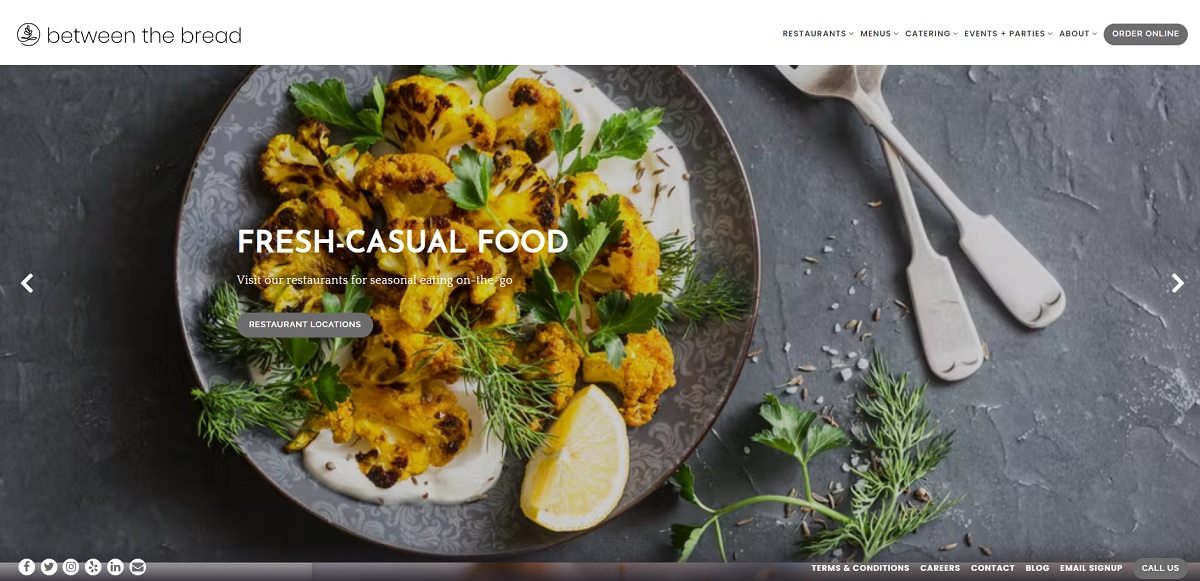
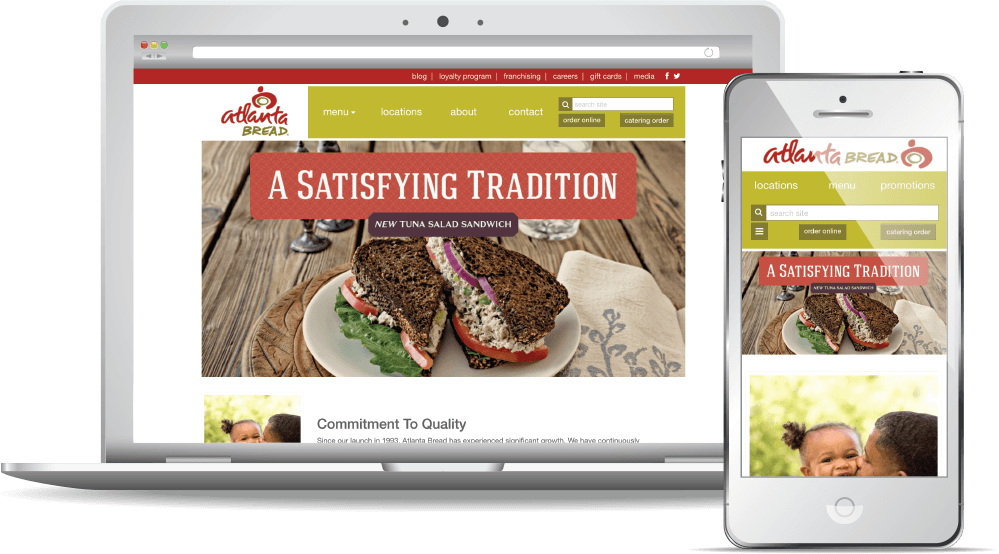
A restaurant’s website is more than just an online menu—it’s a powerful tool for attracting new guests and keeping them coming back.
Your website represents your restaurant when you’re not there to do it yourself. It tells your story, showcases your food and atmosphere, and creates the first impression for potential guests to ultimately decide whether to visit.
It also serves as a central platform that connects all your restaurant marketing efforts—from social media and email campaigns to online reviews and local search visibility.
A well-crafted, optimized, and consistently updated website transforms casual browsers into devoted patrons, significantly boosting your restaurant’s discoverability and fostering long-term customer loyalty.
It should load quickly, function seamlessly on mobile devices, and include compelling content that engages visitors. Optimizing for search engines, including AI-powered search tools, ensures that your restaurant appears when potential guests are searching for dining options. Social proof in the form of guest reviews and testimonials builds trust, while email sign-ups and event updates keep guests engaged.
Your website isn’t just a digital brochure—it’s an active marketing tool that, when optimized properly, continuously brings in new guests and nurtures relationships with existing ones.
Designing a Website That Attracts Guests
Mobile-Friendly and User-Centric Design
With mobile devices accounting for over 70% of online searches for restaurants (Hitwise, 2023), a restaurant website must prioritize mobile optimization. Guests often search for nearby restaurants while on the go, meaning a clunky, slow-loading website can turn them away before they even step through the door.
Large, easy-to-read fonts, simple menus, and clickable call-to-action buttons—such as “Reserve a Table” or “Order Now”—create a frictionless experience.
A well-structured website ensures that visitors can find what they need quickly, whether it’s your address, phone number, menu, or business hours.
Optimized for Search Engines and AI-Powered Search
Ranking high in search engine results is critical for restaurant visibility. Google’s algorithm prioritizes websites that load quickly, offer a good user experience, and include relevant keywords.
Optimizing your site for search engines (SEO) ensures that potential guests find your restaurant when searching for “best Italian restaurant near me” or “brunch spots in [city].”
But as technology evolves, so do search habits. Voice search and AI-powered tools like ChatGPT are becoming increasingly popular. Optimizing for these trends means focusing on natural language and conversational queries.
By incorporating long-tail keywords and answering common questions on your website, you can position your restaurant to appear in these results.
Tools like ChatGPT, Claude, and Siri process natural language queries, meaning your website should contain well-structured, conversational content.
Instead of listing only “handmade pasta,” include phrasing such as “We make our pasta fresh every morning using locally sourced ingredients.” These details help AI-powered searches deliver better results, increasing your chances of appearing in recommendations.
Enhancing Local Search Visibility
Since most restaurant searches are local, ensuring that your website appears in local results is essential.
Google Business Profile integration helps potential guests find your restaurant easily. Keeping business details updated—such as your name, address, phone number, and operating hours—ensures accuracy across search engines and maps.
Embedding an interactive map and click-to-call phone number on your website also makes it easier for guests to reach you.
The goal is to eliminate any barriers between a visitor discovering your restaurant and walking through your doors.
Building Trust with Social Proof
Showcasing Guest Reviews and Testimonials
Building trust and credibility is essential for converting visitors into customers. Leverage social proof by prominently displaying guest reviews and testimonials.
Online reviews heavily influence dining decisions. According to BrightLocal’s 2023 Consumer Review Survey, 87% of consumers read online reviews before visiting a business.
A restaurant website should prominently feature guest testimonials, Google reviews, and/or Yelp ratings to build credibility.
Instead of relying solely on third-party platforms, integrating real-time review feeds directly on your website keeps potential guests engaged. Highlighting reviews with images of happy guests enjoying their meals adds authenticity.
Bloom Intelligence can provide this for you, aggregating and displaying reviews from Google, Facebook, TripAdvisor, Yelp, and the Bloom platform. This is part of its restaurant reputation management tools which use AI to respond automatically to all guest reviews.
Restaurants can also include short video testimonials or user-generated content from social media to further establish trust.
High-Quality Imagery and an Engaging Menu
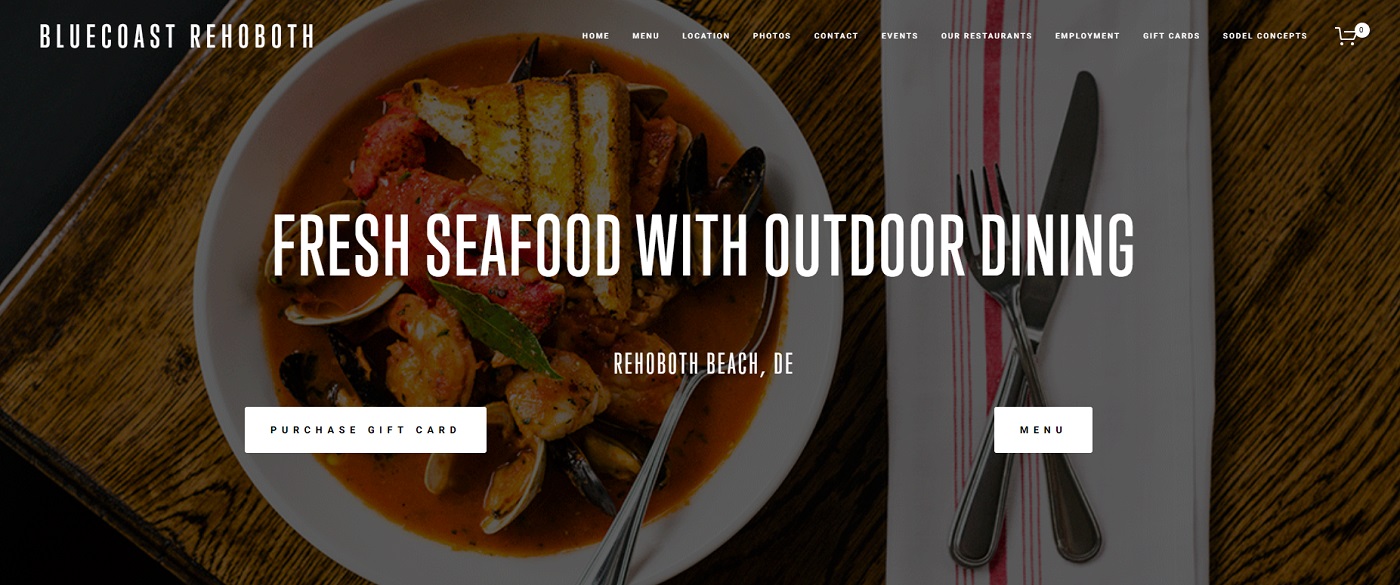
A restaurant’s website should make visitors hungry. High-quality food photography plays a crucial role in enticing potential guests.
Dimly lit or poorly shot images fail to showcase the quality of the food, while professional, well-lit photos highlight textures, colors, and presentation.
Menus should be easy to access and regularly updated. Avoid forcing guests to download PDFs, as they often load slowly and create frustration.
Instead, display menu items with descriptions and pricing in an interactive format. Highlighting bestsellers, seasonal specials, and dietary options can help guide guests toward making a reservation.
Turning Visitors into Returning Guests
Attracting new guests marks only half the battle; you want them to return again and again. Your website plays a pivotal role in nurturing that loyalty.
Encouraging Email Sign-Ups and Loyalty Program Enrollment
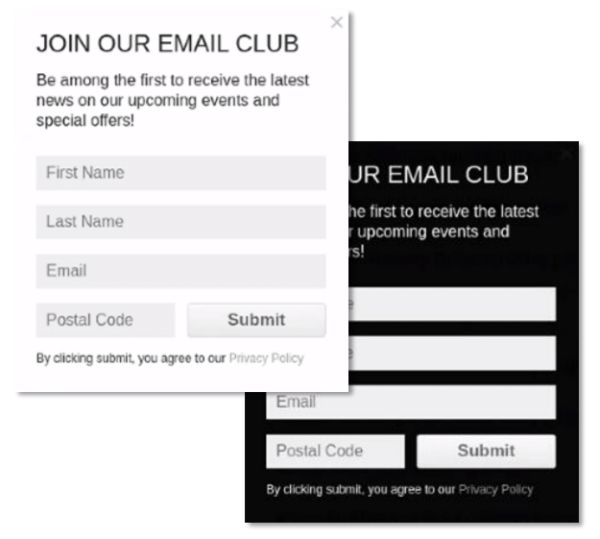
A restaurant’s website should do more than just attract visitors—it should convert them into long-term guests. An easy-to-find email sign-up form helps capture guest information, allowing restaurants to nurture relationships through promotions, event announcements, and exclusive offers.
In addition, adding website sign-ups to a Restaurant Customer Data Platform (CDP), like Bloom Intelligence, ensures that guest data is collected, organized, and used effectively.
A CDP enables restaurants to track dining preferences, behavior data, and demographic data, allowing for highly personalized marketing campaigns. Guests who receive tailored offers—such as a free appetizer on their birthday/anniversary or a discount on their favorite dish—are much more likely to return.
In fact, according to HubSpot (2023), personalized email campaigns generate 6 times higher transaction rates than generic ones.
With website data collection like email signups, your website becomes a gateway to those connections.
Keeping Content Fresh with Events and Blog Updates
A static website won’t keep guests engaged. Regularly updating content with events, blog posts, and seasonal specials gives visitors a reason to return.
For instance, if your restaurant hosts live music, wine tastings, or holiday dinners, promote these events on the homepage and create a dedicated event calendar.
A restaurant blog can also boost SEO while keeping guests informed. Writing about behind-the-scenes stories, local sourcing partnerships, or chef interviews adds personality to the brand.
Content that provides value—such as “5 Perfect Wine Pairings for Steak” or “How We Make Our Signature Sauce”—establishes the restaurant as an authority in the industry and builds guest loyalty.
These updates give guests a reason to check back frequently, reinforcing their bond with your brand.
Seamless Reservation and Online Ordering Integration
Online ordering and restaurant reservations should be simple and intuitive. Integrate a reservation platform like OpenTable, Resy, or Tock directly into your website and make this option prominent on every page.
If you offer takeout or delivery, integrate a restaurant online ordering system directly into your website rather than relying solely on third-party platforms. This keeps more revenue in-house and helps populate your CDP.
Clear calls-to-action (CTAs) guide visitors toward the next step. A prominent “Reserve a Table” button or “Order Online” link removes friction, making it easy for guests to commit.
A restaurant’s website should connect effortlessly with social media platforms. Embedding Instagram feeds, TikTok videos, or Facebook event links encourages engagement and provides more social proof.
Guests are more likely to visit a restaurant when they see real diners enjoying their meals and sharing their experiences.
Summing It Up
A well-optimized website serves as a restaurant’s digital hub, continuously attracting new guests while keeping regulars engaged.
By ensuring mobile-friendliness, optimizing for both traditional and AI-powered search, and integrating local SEO strategies, restaurants can maximize online visibility.
Trust-building elements such as guest reviews, high-quality images, and engaging content encourage visitors to dine in. Email sign-ups, event updates, and loyalty programs foster long-term relationships, ensuring that guests return time and time again.
Investing in a dynamic, user-friendly website isn’t just about having an online presence—it’s about driving real-world results. A restaurant that prioritizes its digital experience will not only attract more guests but will also keep them coming back for years to come.
Your restaurant’s website holds immense potential to grow your business. Think of it as more than a digital brochure. It’s your 24/7 ambassador, working tirelessly to fill your tables.
When a guest lands on your site and books a reservation, then returns a month later for a special event they saw announced there, you’ve won.
In an industry where cutthroat competition lurks around every corner, a well-crafted website doesn’t just keep you in the game—it puts you ahead. Invest in it wisely, and you’ll reap the rewards for years to come.
Discover Bloom Intelligence
Bloom Intelligence is an AI-powered restaurant marketing platform. It includes a powerful customer data platform, website integrations, automated guest data collection, one-click audience segmentation, marketing automation via email and SMS, reputation management, and reporting tools.
Data is collected from sources like WiFi logins, online reservation systems, online ordering platforms, POS systems, website forms, social media, and more. This makes it simple to analyze and segment your guest personas for your restaurant’s digital marketing and operations decisions. And it makes it very easy to showcase social proof on your website.
Bloom makes guest data collection effortless, which allows you to quickly execute the strategies listed above, saving you time, increasing customer lifetime values, attracting new guests, improving your reputation, and boosting your bottom line.
Call us or schedule a free demo online and Bloom will show you how our restaurant marketing platform can help you save time and increase your customer lifetime values by automatically building first-party customer databases, unlocking important guest insights to trigger automated marketing at the right time and place, discover true guest sentiment, save at-risk guests, increase your current guests’ frequency, supercharge your website, and find new guests.
Click Here to Schedule a Free Online Demo, or call 727-877-8181 to see how we can help you save time and drive tangible results for your restaurants.
Understanding guest sentiment is critical for restaurants aiming to foster loyalty, improve customer experience, and drive revenue.
Every day, diners share their opinions through reviews, social media posts, and direct feedback, creating a wealth of sentiment data that savvy restaurateurs can transform into actionable intelligence.
With 86% of consumers willing to pay more for a better customer experience, according to a PwC report, restaurants must go beyond serving great food to create meaningful, personalized interactions.
The key to achieving this lies in understanding guest sentiment—the emotions, opinions, and attitudes that guests express about their dining experiences. By analyzing sentiment trends, restaurants can identify the “voice of the guest” and craft tailored messaging strategies that resonate with different audience segments, ultimately driving engagement, loyalty, and revenue.
Understanding Guest Sentiment Analysis
Guest sentiment analysis is the process of evaluating the emotions and opinions expressed by guests about their dining experiences. This analysis can be derived from explicit feedback, such as online reviews and surveys, or implicit signals, such as behavioral data.
Understanding sentiment is crucial because it provides a window into how guests truly feel about your restaurant, allowing you to address pain points, amplify strengths, and message them with the right message at the right time.
Explicit feedback, such as survey responses, provides direct insight into customer experiences, while implicit behavioral signals—such as order frequency, dwell time, and menu item preferences—offer indirect clues about guest satisfaction.
Identifying the “Voice of the Guest”
The “voice of the guest” represents the collective opinions, preferences, and expectations of your customers.
Aggregating sentiment data involves collecting feedback from various sources, analyzing common themes, and categorizing responses based on tone and sentiment polarity (positive, neutral, or negative).
It’s about understanding what your guests love, what they dislike, and what they wish you would improve. Identifying this voice requires aggregating and categorizing sentiment data from multiple sources, such as online reviews, surveys, and social media.
One effective method is to use AI-powered tools like Bloom Intelligence to automatically identify recurring themes and keywords. For example, if the word “wait time” appears frequently in negative reviews, it’s a clear indicator that this is a pain point for guests. Similarly, if “friendly staff” is a common theme in positive reviews, it highlights a strength to build upon.
Segmenting Your Audience Based on Sentiment
Once you’ve identified the voice of the guest, the next step is to segment your audience based on sentiment. Common sentiment-based segments include advocates (regulars, super-guests), detractors (unhappy guests, at-risk guests), and neutral guests (those who are neither highly satisfied nor dissatisfied).
Advocates: Guests who leave highly positive reviews, recommend the restaurant, and frequently return.
Detractors: Guests who have had negative experiences and may leave poor reviews, complain to management, or simply not come back.
Neutral Guests: Those who neither strongly endorse nor criticize the restaurant but may be swayed by personalized engagement.
Creating meaningful segments allows you to tailor your restaurant marketing strategy to each group’s unique needs and preferences. For example, advocates can be targeted with loyalty programs and referral incentives, while detractors may benefit from personalized apologies and offers to win them back.
Micro-segments, such as health-conscious diners or families with young children, can also be identified and catered to with specific messaging. However, it’s important to avoid over-segmentation, which can dilute your messaging and make it less impactful. Striking the right balance between relevance and simplicity is key.
Personalizing Messaging Strategies
Personalized messaging is about more than just using a guest’s name in an email. It’s about tailoring the tone, content, and delivery of your communication to align with the sentiment and preferences of each segment.
For example, a guest who frequently complains about slow service may appreciate a message highlighting your new expedited seating options, while a health-conscious diner may respond well to a campaign promoting your low-calorie menu items.
Personalization can take several forms:
Tone and Content Adaptation: Messaging for detractors should focus on service recovery and reassurance, while advocates may respond well to exclusive offers and loyalty rewards.
Creating Segment-Specific Value Propositions: A guest who frequently orders vegetarian dishes may receive promotions related to plant-based menu additions, while a repeat brunch customer might get early access to a new weekend menu.
Channel-Specific Engagement: Social media interactions should be dynamic and conversational, while email campaigns may offer in-depth storytelling about menu innovations or chef features.
Maintaining Brand Consistency: While personalization is crucial, the messaging must remain aligned with the restaurant’s core values and brand identity to ensure a cohesive customer experience.
In summary, developing a sentiment-driven messaging framework involves a structured approach:
Data Collection and Analysis: Gather guest feedback from reviews, surveys, and on-/offline interactions, then use AI-powered tools to analyze sentiment trends.
Segment Creation: Define clear customer segments based on sentiment insights and behavioral data.
Messaging Development: Create templates for different customer groups, ensuring tone and content align with their experiences and expectations.
Testing and Optimization: A/B test different messages to determine what resonates best with each segment.
Performance Measurement: Track engagement rates, repeat visits, and sentiment shifts over time to refine messaging strategies continuously.
AI-Powered Sentiment Analysis: The Bloom Intelligence Approach
Advanced AI tools like Bloom Intelligence are transforming how restaurants identify, process, and act upon guest sentiment.
These platforms leverage natural language processing to analyze thousands of reviews and survey responses, extracting meaningful patterns that human analysis frankly might miss. Unlike manual monitoring, AI systems can process data from multiple sources simultaneously, creating a real-time comprehensive view of guest sentiment.
The technology works by scanning text for sentiment indicators, categorizing feedback into operational areas (food quality, service speed, ambiance, value perception), and quantifying the emotional intensity behind each comment.
This automated analysis transforms unstructured feedback into structured data that can be tracked and measured over time.
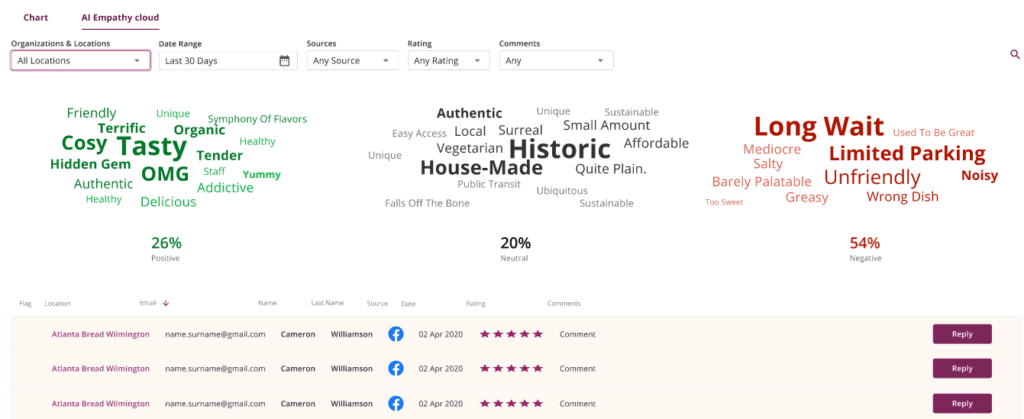
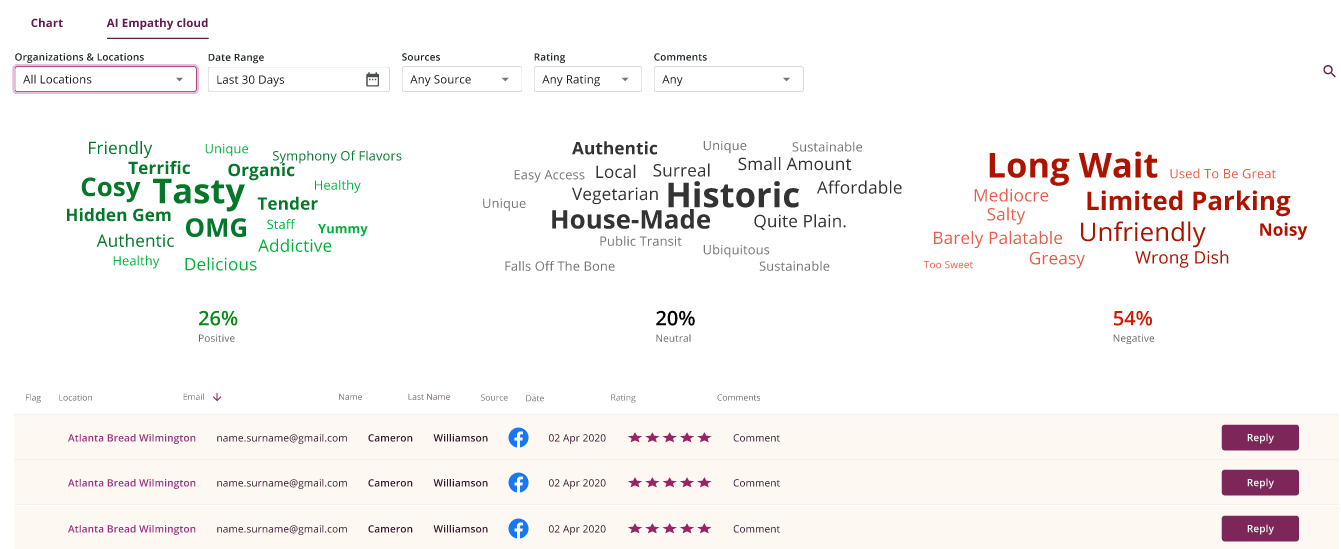
Bloom’s platform, for example, aggregates sentiment data from online reviews and first-party surveys into a unified dashboard, visualizing trends through intuitive word clouds that highlight recurring themes. If terms like “slow service” or “cold food” appear prominently, managers instantly know where to focus improvement efforts.
Another significant advantage of AI sentiment analysis is its ability to provide actionable insights. Instead of manually sifting through thousands of reviews, restaurant managers can access AI-generated recommendations to improve specific operational areas.
For example, if multiple guests mention “slow service” in online reviews, the system can flag this as a priority issue and suggest staffing adjustments during peak hours.
The system creates a continuous improvement loop: sentiment data informs operational changes, which generates new sentiment data, which refines future recommendations. This iterative process ensures that restaurants don’t just fix problems but continuously optimize the guest experience.
Likewise, this valuable data can be used to supercharge your restaurant email and SMS marketing campaign with data-driven segmentation and personalization.
Measuring Improvement Over Time
To determine whether sentiment-driven strategies are effective, restaurants need to measure key performance indicators over time.
Trend analysis allows restaurants to verify whether implemented changes are having the desired effect. If complaints about noise levels decrease following acoustic improvements, managers have concrete evidence that their investment paid off. If negative comments about portion sizes persist despite menu adjustments, it signals that further changes may be needed.
At the same time, you’ll have the ability to measure the effectiveness of your targeted personalized messaging by watching open rates, message engagement, and redemption rates.
Restaurants can use AI platforms to compare historical and real-time data, assessing whether implemented changes have led to a noticeable improvement.
By leveraging AI-powered sentiment analysis tools like Bloom Intelligence, restaurants can transform scattered feedback into actionable intelligence that drives measurable improvements in both operations and marketing effectiveness.
The most powerful aspect of modern sentiment analysis is its ability to create a virtuous cycle: better understanding leads to targeted improvements, which generate more positive sentiment, which attracts more guests, which provides more data for further refinement. Restaurants that implement these comprehensive sentiment analysis systems aren’t just responding to guests—they’re anticipating needs and personalizing experiences in ways that build lasting loyalty.
In an industry where margins are tight and competition is fierce, the competitive advantage goes to those who truly understand their guests. By transforming the voice of your guests into personalized messaging strategies, you’re not just marketing more effectively, you’re creating connections that turn first-time visitors into lifelong advocates.
Bloom Intelligence is an AI-powered restaurant marketing platform. It includes a powerful customer data platform, automated guest data collection, one-click audience segmentation, marketing automation via email and SMS, reputation management, and reporting tools.
Data is collected from sources like WiFi logins, online reservation systems, online ordering platforms, POS systems, website forms, social media, and more. This makes it simple to analyze and segment your guest personas for your restaurant’s digital marketing and operations decisions.
Bloom makes guest data collection effortless, which allows you to quickly execute the strategies listed above, saving you time, increasing customer lifetime values, attracting new guests, improving your reputation, and boosting your bottom line.
Call us or schedule a free demo online and Bloom will show you how our restaurant marketing platform can help you save time and increase your customer lifetime values by automatically building first-party customer databases, unlocking important guest insights to trigger automated marketing at the right time and place, discover true guest sentiment, save at-risk guests, increase your current guests’ frequency, and find new guests.
Click Here to Schedule a Free Online Demo, or call 727-877-8181 to see how we can help you save time and drive tangible results for your restaurants.
Guest feedback is more influential than ever, with 88% of consumers trusting online reviews as much as personal recommendations (BrightLocal). For restaurants, managing hundreds—sometimes thousands—of reviews across platforms like Yelp, Google, Facebook, and TripAdvisor can be overwhelming.
Imagine this: a bustling Italian restaurant serves hundreds of plates of pasta Bolognese each month, earning rave reviews for its excellent service and cozy ambiance. Yet, buried within the sea of praise, a few guests quietly grumble, “There’s not enough sauce in the pasta Bolognese.” These whispers of discontent could easily drown in the noise of hundreds of monthly reviews. However, left unchecked, they might fester into a trend that damages the restaurant’s reputation and drives loyal customers away.
For restaurateurs with reviews pouring in from multiple platforms, identifying negative sentiment—like insufficient sauce in a beloved dish—becomes a daunting task. Manually combing through hundreds of comments each month is inefficient, and missing critical patterns can cost a business dearly.
This article explores how restaurants traditionally tackle these challenges, and then dives into how AI tools revolutionize the process by pinpointing issues, alerting management, and tracking improvements over time.
The Traditional Approach: Manual and Reactive
Traditionally, restaurants identify these issues by manually scanning reviews, relying on anecdotal feedback from servers, or waiting for repeated customer complaints. This reactive approach often means that problems persist for months before being addressed, leading to lost revenue and dissatisfied guests.
Negative guest sentiment often hides in plain sight. Take the pasta Bolognese example: out of 300 reviews in a month, four mention a lack of sauce. That’s just 1.3% of feedback—easy to overlook amid glowing praise for the tiramisu or friendly service. Yet, if this complaint doubles to eight mentions the next month, it signals a brewing issue.
These isolated gripes might seem minor, but they’re needles in the haystack—small, sharp, and capable of puncturing a restaurant’s reputation if ignored.
And once an issue is identified, the communication process is typically inconsistent. Some managers relay feedback verbally, others document complaints in logs, and a few may send emails to the kitchen. However, these methods often lack structure and accountability.
In smaller establishments, it might be as simple as a server shouting, “Hey, Chef, ease up on the sauce!” during a busy shift. More formal setups lean on daily pre-shift meetings, where managers share feedback like, “Three reviews this week mentioned the Bolognese was dry—let’s adjust.” Some use digital tools like Slack messages or emailed reports listing top complaints for the kitchen to tackle.
This process has gaps. Verbal updates can get lost in the chaos of service, while written reports might sit unread in a chef’s inbox. Without a direct, actionable link, the “not enough sauce” issue lingers, frustrating diners and staff alike.
Measuring improvement is also a challenge. Many rely on a mix of anecdotal evidence and basic metrics. Managers might ask servers, “Are customers still complaining about the Bolognese?” or eyeball star ratings on Google for a bump. Some track review volume and sentiment manually, noting if sauce-related gripes drop from four to two mentions monthly.
While restaurants might monitor reviews informally, most lack a systematic way to track whether specific complaints decrease over time. And without clear benchmarks—say, reducing sauce complaints by 50% in three months—progress remains fuzzy, and recurring issues can fester.
How AI and Bloom Intelligence Revolutionize Guest Sentiment Analysis
AI tools like Bloom Intelligence flip this script.
These platforms don’t just aggregate reviews; they analyze them with surgical precision, identifying negative customer sentiment across multiple sites in real time.
Using natural language processing (NLP), Bloom scans your reviews to detect patterns humans might miss. For instance, it flags those four “not enough sauce” comments and alerts management to a potential recipe flaw—all in real time.
How AI Streamlines the Process:
Automated Sentiment Analysis – AI scans and categorizes reviews, identifying specific complaints before they escalate.
Real-Time Alerts – When a pattern emerges (e.g., multiple guests mentioning undercooked salmon), it can be seen immediately.
Actionable Reports – Insights are compiled into easy-to-read word clouds, helping teams prioritize improvements.
Immediate Action – AI-driven platforms allow managers to communicate issues to the kitchen team instantly.
Performance Tracking – AI tracks whether targeted improvements (e.g., adjusting pasta sauce portions) reduce negative feedback over time, providing clear metrics on success.
Operationalizing and Measuring Improvement
Operationalizing AI insights means implementing a structured process to address and measure guest feedback improvements. Once AI identifies recurring issues, management must ensure that corrective actions are taken efficiently.
This involves:
Assigning Accountability – Designate team members responsible for reviewing AI insights and implementing changes. Whether it’s the kitchen, front-of-house staff, or managers, each issue should have an owner ensuring follow-through.
Developing Actionable Solutions – Address complaints with clear, measurable adjustments. If guests frequently mention under-seasoned dishes, chefs can modify recipes or introduce new quality control measures. If slow service is a concern, staffing adjustments or workflow optimizations may be required.
Communicating Changes Effectively – AI-driven insights must be relayed to teams in a structured manner, whether through scheduled team meetings, internal dashboards, or automated reports.
Setting KPIs for Success – Establish key performance indicators (KPIs) to track improvement. For example:
Reduce complaints about portion sizes by 20% in 3 months
Increase positive sentiment in reviews by 15%
Achieve a higher Google rating by addressing common negative themes
Monitoring Progress with AI – AI platforms like Bloom continuously track sentiment trends, allowing managers to see if interventions are working. If issues persist, further adjustments can be made based on real-time data.
Celebrating Wins and Reinforcing Positive Changes – Recognizing improvements and reinforcing successful initiatives help maintain momentum and motivate staff. Sharing positive guest feedback with the team fosters a culture of continuous improvement.
By using AI to surface these “needles in the haystack” and ensuring continuous improvement, restaurants can enhance guest satisfaction, increase repeat business, and protect their online reputation.
Platforms like Bloom Intelligence make it easier than ever to operationalize guest feedback and turn insights into action.
Bloom Intelligence is an AI-powered restaurant marketing platform. It includes a powerful customer data platform, automated guest data collection, one-click audience segmentation, marketing automation via email and SMS, reputation management, and reporting tools.
Data is collected from sources like WiFi logins, online reservation systems, online ordering platforms, POS systems, website forms, social media, and more. This makes it simple to analyze and segment your guest personas for your restaurant’s digital marketing and operations decisions.
Bloom makes guest data collection effortless, which allows you to quickly execute the strategies listed above, saving you time, increasing customer lifetime values, attracting new guests, improving your reputation, and boosting your bottom line.
Call us or schedule a free demo online and Bloom will show you how our restaurant marketing platform can help you save time and increase your customer lifetime values by automatically building first-party customer databases, unlocking important guest insights to trigger automated marketing at the right time and place, discover true guest sentiment, save at-risk guests, increase your current guests’ frequency, and find new guests.
Click Here to Schedule a Free Online Demo, or call 727-877-8181 to see how we can help you save time and drive tangible results for your restaurants.
In today’s uncertain restaurant industry landscape, turning first-time visitors into loyal regulars represents one of the most profitable strategies for sustainable growth.
While acquiring new guests is essential, the transformation of these guests into regular patrons who return time and again delivers substantially higher value to your bottom line.
Industry data consistently shows that regular guests spend about 67% more than new ones, and increasing customer retention rates by just 5% can boost profits anywhere from 25% to 95%.
Yet many restaurants continue to underinvest in strategies specifically designed to convert new guests into regulars who form the backbone of a thriving establishment.
The Vital Role of New Guests as Future Regulars
First, let’s discuss more about why turning new guests into regulars is so important for your business.
Most experts agree that a new guest needs to visit a restaurant at least 3-5 times within a reasonable timeframe to be considered a true regular. This visitation pattern demonstrates consistent patronage and loyalty that goes beyond occasional visits.
New guests represent potential. They are opportunities to expand your customer base, increase revenue, and build a thriving community around your restaurant.
And each new guest brings with them the possibility of becoming a regular, contributing to a stable and predictable income stream.
These regulars aren’t just reliable revenue sources – they become ambassadors for your brand.
Regular guests provide multiple streams of value that extend far beyond their individual spending:
They create predictable revenue, allowing for better inventory management and staffing decisions.
They tend to be more forgiving of occasional service issues or pricing adjustments, having built a relationship with your establishment.
Perhaps most valuably, they become authentic advocates, recommending your restaurant to friends, family, and colleagues – essentially providing free marketing that carries more credibility than any paid advertising could possibly achieve.
Identifying New Visitors: The Critical First Step
You can’t create regulars without first identifying who’s new to your establishment.
This crucial step is overlooked surprisingly often, with many restaurants failing to distinguish between first-timers and returning guests.
Bloom Intelligence excels here, leveraging its restaurant customer data platform (CDP) to automatically identify first-time visitors the moment they interact with your restaurant—whether through a Wi-Fi login, an online order, a reservation, or various other touchpoints. Once identified, the platform creates a detailed profile, capturing data like their name, contact info, and visit details that become increasingly detailed with each visit.
Bloom’s system flags new guests automatically, allowing you to segment them from your broader customer base for targeted email and SMS campaigns.
At the same time, the identification of new guests should trigger specific operational protocols among your staff. Front-of-house teams should be trained to subtly determine if a guest is new and to provide appropriate welcome experiences. This might include a tableside visit from a manager, a complimentary appetizer, or simply enhanced attention to service quality.
The First Visit Experience: Setting the Foundation
Turning a new guest into a regular doesn’t happen by accident—it demands a deliberate approach that combines exceptional experiences with smart follow-up.
The initial visit to your restaurant represents a critical window of opportunity. It’s your chance to make a lasting impression and set the foundation for a long-term relationship.
Creating a memorable first experience involves several key elements:
Service excellence must be non-negotiable, with staff trained to recognize the heightened importance of flawless execution for first-time guests.
The dining environment – from cleanliness to ambiance to noise levels – must align with or exceed expectations set by your marketing and online presence.
Food quality and consistency remain paramount, as no amount of excellent service can overcome disappointing cuisine.
Beyond these fundamentals, consider implementing new guest enhancements such as a welcome card at the table, a visit from the chef for special occasions, or a small complimentary taste of a signature dish.
These gestures signal that you value their business and want to build a relationship.
Strategic Follow-Up: The Bridge to Visit Two
The period immediately following a first visit represents a critical opportunity to encourage a return.
Without a strategic follow-up plan, many potentially loyal guests simply drift away, despite having had a positive initial experience.
Bloom Intelligence’s CDP capabilities facilitate sophisticated follow-up communication by capturing contact information and visit data. This enables automated yet personalized restaurant email marketing and SMS marketing campaigns specifically designed for first-time visitors.
Once you’ve identified and segmented your first-time guests, you can leverage marketing automation tools to engage them with personalized email and SMS campaigns.
A well-crafted welcome email or text, sent shortly after their first visit, can express your gratitude and encourage them to return.
For instance, give them a bounce-back coupon—say, 10% off their next visit within two weeks. This creates urgency and gives them a reason to come back sooner rather than later, nudging them toward that three-to-five-visit threshold.
Other effective return incentives might include an invitation to an upcoming special event or a complimentary menu item. The key is creating a sense of time sensitivity without being overly promotional.
Building Momentum: Visits Two Through Five
As guests make their second, third, and subsequent visits, your strategy should evolve from acquisition to relationship-building. During this critical phase, work toward recognition and personalization.
Staff should be equipped to recognize returning guests, ideally greeting them by name and acknowledging their return. This requires systems that discreetly alert staff to returning patrons.
Progressive data collection by a CDP during these visits enables increasingly personalized experiences.
Restaurant marketing automation should parallel this progression, with communications becoming more tailored based on observed preferences and behaviors.
Segmented campaigns delivered through Bloom Intelligence’s platform can address specific guest categories with relevant offers and information.
Create targeted campaigns for regulars, super guests, cooling-off guests, at-risk churning guests, and more, such as building loyalty campaigns for birthdays and wedding anniversaries.
Imagine a first-time guest receiving a personalized email or SMS the next day: “Thanks for dining with us last night! Come back within 10 days for a free appetizer on us.”
This kind of timely, tailored outreach keeps your restaurant top-of-mind and builds momentum toward regular status.
Creating the Regular Customer Mindset
The psychological transition from occasional visitor to self-identified “regular” involves both behavioral and emotional components. They will typically make this transition when they feel a sense of belonging and recognition at your establishment.
This is especially true in today’s experience-driven economy, where consumers crave authenticity and meaningful interactions.
This transition can be accelerated through structured loyalty programs that provide tangible benefits while also symbolizing the relationship.
Modern loyalty programs have evolved beyond simple punch cards to sophisticated digital experiences that reward not just frequency but also advocacy and engagement.
Membership tiers that provide escalating benefits create aspirational targets and reinforce the value of the relationship. Exclusive access to special events, menu previews, or chef’s table experiences can create powerful incentives for continued patronage.
To build emotional connections, focus on creating a unique and memorable dining experience. Share the story behind your restaurant, highlight the origins of your ingredients, or showcase the talents of your chefs.
Encourage your staff to share their own stories and connect with guests on a personal level.
When guests feel emotionally invested in your brand, they are far more likely to become regulars.
Leveraging Technology for Retention Success
Today’s restaurant operators have powerful technological tools at their disposal for customer retention.
Data is one of the most powerful tools at your disposal for converting new guests into regulars. By analyzing customer behavior and preferences, you can identify patterns and tailor your restaurant marketing efforts accordingly.
Platforms like Bloom Intelligence combine customer data collection and management, and automated email and SMS communication in an integrated system designed specifically for the restaurant industry.
These platforms enable precise tracking of visit frequency, spending patterns, and responses to various marketing initiatives.
For example, by identifying guests who haven’t returned within their typical visitation window, it can automatically trigger re-engagement campaigns before they churn entirely.
The automation capabilities eliminate the operational burden and human error that would otherwise make such personalized marketing impossible for busy restaurant teams. Setting up triggered email or SMS campaigns based on visit patterns ensures no potential regular falls through the cracks.
A Strategic Imperative
In an industry where margins are always under pressure, turning new guests into regular guests represents one of the most accessible paths to sustainable profitability.
For restaurant owners and operators, the stakes couldn’t be higher. New guests who become regulars after three to five visits don’t just boost your bottom line—they become the backbone of your business.
They’re less price-sensitive, more likely to tip generously, and prone to spreading the word, reducing your reliance on expensive acquisition channels.
Achieving this requires a blend of exceptional in-house experiences and savvy, tech-driven follow-up.
Recognizing first-timers with tools like Bloom Intelligence’s CDP and targeting them with automated, personalized marketing isn’t optional—it’s essential.
In an industry where competition is relentless and guest expectations are sky-high, turning new faces into familiar ones is your ticket to sustained success. While menu innovation and operational excellence remain important, the deliberate conversion of first-time visitors into loyal regulars should be elevated to a strategic priority.
By implementing identification systems for new guests, creating memorable first experiences, executing strategic follow-up, building momentum through critical early visits, fostering a sense of belonging, and leveraging modern technology like Bloom’s CDP and marketing automation platform, restaurants can easily and systematically increase their regular customer base.
The resulting benefits – higher average checks, increased visit frequency, improved word-of-mouth marketing, and enhanced customer lifetime value – create a virtuous cycle of growth that benefits every aspect of your operation.
In today’s restaurant industry landscape, turning first-time visitors into regulars isn’t just good business – it’s essential for long-term success.
Discover Bloom Intelligence
Bloom Intelligence is an AI-powered restaurant marketing platform. It includes a powerful customer data platform, automated guest data collection, one-click audience segmentation, marketing automation via email and SMS, reputation management, and reporting tools.
Data is collected from sources like WiFi logins, online reservation systems, online ordering platforms, POS systems, website forms, social media, and more. This makes it simple to analyze and segment your guest personas for your restaurant’s digital marketing and operations decisions.
Bloom makes guest data collection effortless, which allows you to quickly execute the strategies listed above, saving you time, increasing customer lifetime values, attracting new guests, improving your reputation, and boosting your bottom line.
Call us or schedule a free demo online and Bloom will show you how our restaurant marketing platform can help you save time and increase your customer lifetime values by automatically building first-party customer databases, unlocking important guest insights to trigger automated marketing at the right time and place, discover true guest sentiment, save at-risk guests, increase your current guests’ frequency, and find new guests.
Click Here to Schedule a Free Online Demo, or call 727-877-8181 to see how we can help you save time and drive tangible results for your restaurants.
We all know that maintaining a loyal customer base is critical to sustaining and growing your restaurant’s revenue. However, even the most loyal guests can sometimes “cool off,” reducing their visit frequency or spending.
This cooling-off period can stem from various factors, such as changes in personal circumstances, increased competition, or simply the natural ebb and flow of consumer behavior.
While some guests may be on the verge of churning entirely, others might just be dining out or ordering online less frequently.
Regardless of the reason, identifying and re-engaging these guests is essential to recapturing lost revenue and fostering long-term loyalty.
The good news is that cooling-off guests are not lost causes. With the right strategies, restaurants can nudge these guests back into their previous habits, reigniting their enthusiasm for dining in or ordering from your establishment.
By doing so, restaurants can boost revenue, strengthen customer relationships, and create a more predictable stream of income.
Here, we’ll provide actionable tactics to re-engage cooling-off guests, discuss the benefits of doing so, and how technology like Bloom Intelligence can completely automate and personalize these efforts for maximum impact.
Understanding Cooling-Off Guests
Cooling-off guests fall into a unique category. They are not first-time visitors who need to be convinced of your restaurant’s value, nor are they fully churned customers who have stopped engaging altogether.
Instead, they are individuals who have demonstrated loyalty in the past but have recently reduced their engagement. This reduction could manifest as fewer visits, smaller orders, or longer gaps between purchases.
Guests who cool off typically fall into distinct categories, each requiring a tailored approach:
The Frequency Reducer maintains their per-visit spending but visits less often. These guests might be experimenting with other restaurants or dealing with schedule changes that affect their dining patterns. They represent a prime opportunity for re-engagement since their fundamental appreciation for your restaurant remains intact.
The Spend Reducer continues visiting at a similar frequency but orders less per visit. These guests might be responding to economic pressures or testing lower-priced menu items. Their continued presence shows loyalty, making them excellent candidates for special offers that encourage higher spending.
The Gradual Churner shows declining patterns in both frequency and spending. Without intervention, these guests might eventually stop visiting altogether. However, their past loyalty suggests they can be won back with the right approach.
Understanding the nuances of these behaviors is key to crafting effective re-engagement strategies.
For example, a guest who used to dine in twice a month might now visit only once every six weeks. Another guest who frequently ordered delivery might have shifted to cooking at home more often.
These changes can be subtle, but they represent a significant opportunity for restaurants to intervene and re-establish stronger connections.
Tracking these behaviors can be challenging without the right data insights, but advanced customer data platforms, like Bloom Intelligence, can automate this process and provide clear visibility into guest patterns.
Why Focus on Cooling-Off Guests?
Losing a once-loyal guest means not only a drop in revenue but also the loss of future opportunities for referrals and advocacy. According to research, acquiring a new customer can cost five times more than retaining an existing one.
Furthermore, a guest who has dined at your restaurant before is significantly more likely to return than gaining a completely new visitor.
Immediate Revenue Boost: Successfully re-engaging just one cooling-off guest who previously visited twice monthly with a $50 average check can recover $1,200 in annual revenue. Multiply this across dozens or hundreds of recovered guests, and the impact becomes significant.
Marketing Efficiency: Reengaging existing guests typically costs 5-25 times less than acquiring new ones. These guests already know your brand and have demonstrated past interest, making them more likely to respond to outreach.
Lifetime Value Protection: Every recovered guest preserves their customer lifetime value potential. A guest spending $1,200 annually over five years represents $6,000 in protected revenue, not counting potential increases in spending or word-of-mouth referrals.
The Revenue Impact of Re-Engaging Cooling-Off Guests
Re-engaging cooling-off guests is not just about restoring lost revenue. It’s about unlocking the potential for increased profitability.
Loyal patrons are often more valuable than new ones because they already know and trust your brand. By reigniting their interest, you can bring them back with minimal acquisition costs.
Additionally, these guests are more likely to respond positively to personalized offers and incentives, making them a high-return segment to target.
Consider this: if a single guest who previously spent $50 per visit starts coming in twice a month instead of once, that’s an extra $600 in annual revenue from just one customer. Again, multiply that by dozens or hundreds of cooling-off guests, and the financial impact becomes clear.
Furthermore, re-engaged guests are more likely to recommend your restaurant to friends and family, creating a ripple effect that drives even more revenue.
Keep reading. Below we will show you how you can completely automate the process and effortlessly begin seeing this revenue walk through the doors.
Strategies to Nudge Cooling-Off Guests Back
To effectively re-engage cooling-off guests, restaurants must employ a combination of personalized outreach, compelling incentives, and exceptional service.
Here are some proven strategies to achieve this:
1. Send Targeted Offers with Special Redemption Codes
One of the most effective ways to re-engage cooling-off guests is by sending them personalized offers via email marketing or SMS marketing.
These offers should include a special redemption code that not only provides a discount or bonus but also serves as a signal to your staff that this guest is a priority.
For example, you could offer a free appetizer, a percentage off their total bill, or a bonus loyalty points multiplier.
When the guest arrives and presents the code, your staff should be trained to recognize it and provide extra special service. This could include greeting the guest by name, offering a complimentary drink, or ensuring their meal is prepared with extra care.
This combination of a tangible incentive and personalized attention can make the guests feel valued – and remind them why they loved your restaurant in the first place.
2. Leverage Loyalty Programs
Loyalty programs are a powerful tool for re-engaging cooling-off guests. If a guest has accumulated points or rewards but hasn’t visited in a while, send them a reminder about their unused benefits.
You could even offer a bonus incentive, such as double points on their next visit or a free item after their next purchase.
This not only encourages them to return but also reinforces the value of your loyalty program.
3. Create a Sense of Urgency
Sometimes, all it takes to re-engage a cooling-off guest is a gentle nudge. Limited-time offers, flash sales, or exclusive events can create a sense of urgency that motivates guests to act.
For example, you could send an email with the subject line, “We Miss You! Enjoy 20% Off This Weekend Only.”
This type of messaging taps into the fear of missing out (FOMO) and can drive immediate visits.
4. Personalize Communication
Generic messages are easy to ignore, but personalized communication grabs attention.
Use guest data to tailor your outreach. For instance, if a guest frequently visits during lunch service, mention it in your email: “We’ve been missing you at lunch!”
Personalization shows that you value the guest as an individual, not just as a source of revenue.
5. Ask for Feedback
Sometimes, guests cool off because of a specific issue, such as a disappointing experience or a lack of menu variety. Perhaps they left a less-than-stellar review online.
Sending a polite request for feedback can uncover these pain points and give you an opportunity to address them. For example, you could say, “We noticed you haven’t visited in a while. We’d love to hear how we can improve!”
This not only provides valuable insights but also shows the guest that you care about their opinion.
The Role of Tech in Automating Re-Engagement
While the strategies above are effective, manually identifying and reaching out to cooling-off guests can be time-consuming and resource-intensive.
This is where technology like Bloom Intelligence comes into play. Bloom Intelligence is a powerful customer data platform designed specifically for restaurants. It uses advanced data analytics to automatically identify guests who are cooling off and sends personalized emails or SMS messages to re-engage them.
For example, Bloom Intelligence can detect when a guest’s visit frequency or spending has declined and trigger an automated campaign with a special offer tailored to that guest’s preferences.
The platform also tracks the effectiveness of these campaigns, allowing you to refine your approach over time.
Bloom Intelligence’s automated system ensures no cooling-off guest goes unnoticed, enabling proactive intervention before significant revenue is lost. The platform’s ability to send personalized communications automatically saves valuable time while maintaining the personal touch that guests appreciate.
The Long-Term Benefits of Re-Engaging Cooling-Off Guests
Re-engaging cooling-off guests is not just a short-term revenue boost—it’s an investment in the long-term success of your restaurant.
By bringing these guests back, you strengthen their loyalty and increase their customer lifetime value. Additionally, satisfied guests are more likely to become brand advocates, spreading positive word-of-mouth and attracting new customers.
Moreover, a proactive approach to re-engagement helps you stay ahead of the competition. In an industry where customer preferences can shift quickly, maintaining strong relationships with your existing guests is a key differentiator.
By consistently delivering value and exceptional experiences, you can turn cooling-off guests into your most loyal patrons.
Summing It Up
Cooling-off guests represent a significant opportunity for restaurants to recapture lost revenue and build stronger customer relationships.
By employing targeted strategies such as personalized offers, loyalty program incentives, and exceptional service, you can nudge these guests back into their previous visit frequency and spending habits.
Tools like Bloom Intelligence further enhance these efforts by completely automating the identification and re-engagement process, ensuring that no guest is left behind while freeing up your time to concentrate on other important things.
Ultimately, re-engaging cooling-off guests is a win-win for both your restaurant and your customers. It drives positive revenue growth while reminding guests why they fell in love with your establishment in the first place.
By prioritizing these efforts, you can create a thriving, loyal customer base that supports your restaurant’s success for years to come.
Discover Bloom Intelligence
Bloom Intelligence is an AI-powered restaurant marketing platform. It includes a powerful customer data platform, automated guest data collection, one-click segmentation, marketing automation via email and SMS, reputation management, and reporting tools.
Data is collected from sources like WiFi logins, online reservation systems, online ordering platforms, POS systems, website forms, social media, and more. This makes it simple to analyze and segment your guest personas for your restaurant’s digital marketing and operations decisions.
Bloom makes guest data collection effortless, which allows you to quickly execute the strategies listed above, saving you time, increasing customer lifetime values, attracting new guests, improving your reputation, and boosting your bottom line.
Call us or schedule a free demo online and Bloom will show you how our restaurant marketing platform can help you save time and increase your customer lifetime values by automatically building first-party customer databases, unlocking important guest insights to trigger automated marketing at the right time and place, discover true guest sentiment, save at-risk guests, increase your current guests’ frequency, and find new guests.
Click Here to Schedule a Free Online Demo, or call 727-877-8181 to see how we can help you save time and drive tangible results for your restaurants.
The restaurant industry isn’t just about food—it’s about relationships. In an era where competition is fierce, guest retention is the lifeline of success.
Restaurants must move beyond one-time transactions and focus on building loyalty through data-driven audience segmentation.
That’s where Bloom Intelligence comes in. Our platform combines a Customer Data Platform (CDP), AI-driven marketing automation, and reputation management into one powerful stack. We aggregate guest data from multiple sources—WiFi, POS, reservations, online orders, and reviews—to create actionable insights that drive revenue and cut costs.
This article explores key restaurant audiences, how to identify behavioral shifts, and how to seamlessly move guests from one segment to another using automation – ultimately becoming part of your Super Guest audience.
Understanding Restaurant Audiences
Knowing your restaurant audiences is key for delivering personalized experiences, optimizing marketing efforts, and maximizing guest lifetime value.
By understanding how guests interact with your business, you can tailor promotions, improve customer service, and ensure long-term loyalty. Effective audience segmentation allows you to make data-driven decisions, helping you allocate resources where they will have the greatest impact.
Let’s explore the key guest segments and their significance:
First-Time Guests
These are patrons visiting your restaurant for the first time. They may have discovered your establishment through online searches, recommendations, or marketing efforts. Capturing their data through WiFi sign-ins, POS transactions, reservations, and online ordering allows you to follow up with personalized offers to encourage a return visit.
Regulars
These guests visit your restaurant consistently. They are engaged and appreciate your food, ambiance, and service. Tracking visit frequency through Bloom Intelligence’s platform ensures you can reward their loyalty with exclusive promotions or VIP experiences.
Super Guests
This audience consists of your most valuable patrons who visit frequently and spend more per visit. They are likely your brand advocates, leaving positive reviews and referring friends. Identifying these guests through spending patterns and engagement metrics allows you to cultivate and reward their loyalty with tailored offers, priority reservations, and special events.
Churning Guests
Churning or at-risk guests are those whose visit frequency has declined. A guest who once visited weekly but hasn’t returned in 30-60 days may be slipping away. Detecting these patterns early through automated tracking helps you re-engage them before they are lost. Bloom users are reporting up to 38% of lost guests return.
Identifying Audience Shifts and Preventing Guest Churn
Restaurants must monitor guest behaviors to detect shifts between audience segments. A regular guest who stops visiting for a month may be at risk of churning, while a first-time guest who returns within a short period might be on their way to becoming a regular.
Bloom Intelligence captures these trends in real time, giving restaurants powerful actionable insights.
Understanding the reasons behind these shifts is equally important. Changes in guest behavior can result from various factors, such as service issues, seasonal habits, economic conditions, or new competition.
Identifying patterns and root causes allows restaurant operators to implement the right strategies to keep their guests engaged.
Re-engaging these guests requires timely interventions:
Email and SMS marketing: Automated messages with incentives like discounts, personalized menu recommendations, or exclusive events can reignite interest.
Loyalty rewards: A free appetizer or bonus loyalty points can entice a return visit.
Personalized outreach: A thank-you message from the restaurant owner or manager can make a lasting impact.
Guest feedback collection: Sending surveys or requesting feedback through SMS or email can help identify concerns and resolve them before the guest is lost permanently.
Special promotions and re-engagement campaigns: Hosting targeted events, happy hours, or exclusive experiences for guests who haven’t visited in a while can encourage them to return.
By continuously analyzing guest data and taking a proactive approach, restaurants can prevent churn, turn first-time guests into super guests, and maintain a healthy, engaged audience.
Moving Guests from One Audience to Another
Increasing guest lifetime value involves strategically moving guests from one segment to the next:
From First-Time Guest to Regular: Follow up with a personalized email or SMS campaign thanking them for their visit and offering a discount for their next meal. Additionally, sending recommendations based on their previous order can help create a connection. Providing loyalty program enrollment opportunities at this stage can also encourage long-term engagement.
From Regular to Super Guest: Encourage increased engagement by offering exclusive loyalty rewards, such as personalized discounts, VIP perks, or invitations to private events. Recognizing and rewarding their frequent visits strengthens their bond with your brand. Exclusive behind-the-scenes experiences, chef’s table events, or early access to new menu items can make them feel valued.
From Churning Guest to Active Guest: Use AI-driven automated marketing to detect disengaged guests and send tailored incentives to win them back. Personalized promotions, such as a special offer based on their past favorite dish, can increase the likelihood of their return. Offering time-sensitive discounts or bundling promotions with special events can create urgency.
Encouraging Advocacy and Referrals: Convert satisfied regulars and super guests into brand ambassadors by providing incentives for referring friends. Offer loyalty points, discounts, or exclusive experiences to those who bring in new customers, further growing your guest base. Social media engagement campaigns, referral bonuses, and user-generated content initiatives can help amplify your brand’s reach.
By implementing targeted marketing strategies and using real-time data insights, restaurants can smoothly transition guests from one audience category to another, increasing retention and long-term engagement.
The Power of Super Guests: The More, The Better
Super guests are the backbone of a restaurant’s long-term success and should be the ultimate goal when nurturing each audience. They don’t just visit frequently—they spend more per visit, bring friends, leave glowing reviews, and serve as brand advocates.
The more super guests you cultivate, the more stable and predictable your revenue becomes.
Here’s why growing your super guest base should be a top priority:
Higher Spend Per Visit – Super guests don’t just order a meal—they order appetizers, drinks, and desserts. Their check sizes are consistently larger.
Loyalty & Repeat Visits – They return time and again, creating a reliable revenue stream for your restaurant.
Organic Marketing – Super guests are your best advertisers. They leave positive online reviews, post about their experiences on social media, and bring in new customers.
Resilience Against Market Shifts – A strong base of super guests protects your business against seasonal slumps and economic downturns.
Better Guest Relationships – They appreciate personalized attention and exclusive perks, deepening their emotional connection with your brand.
By using Bloom Intelligence to identify potential super guests and nurture them through targeted offers, loyalty incentives, and VIP experiences, you can steadily increase the number of high-value patrons at your restaurant.
Automate Audience Segmentation and Marketing with Bloom Intelligence
Manually tracking and engaging guests at scale is a challenge. Bloom simplifies this process by automatically collecting guest data, segmenting audiences, and executing AI-powered marketing campaigns.
Once configured, all you have to do is watch the results! The time saved alone will free you up to give more focus to other critical factors of growing your business.
Its user-friendly interface allows restaurant operators to effortlessly manage guest engagement, saving valuable time and resources. It’s like an entire marketing team in a box.
By automating these critical marketing functions, Bloom not only reduces manual workload but also ensures that personalized campaigns reach the right audience at the right time.
This seamless automation leads to increased guest retention, higher revenue, and a more loyal customer base.
With Bloom Intelligence, restaurant owners can focus on delivering exceptional dining experiences while the platform works in the background to optimize guest engagement and maximize profitability.
Let data-driven automation transform your restaurant’s marketing strategy.
Discover Bloom Intelligence
Bloom Intelligence is an AI-powered restaurant marketing platform. It includes a powerful customer data platform, automated guest data collection, one-click segmentation, marketing automation via email and SMS, reputation management, and reporting tools.
Data is collected from sources like WiFi logins, online reservation systems, online ordering platforms, POS systems, website forms, social media, and more. This makes it simple to analyze and segment your guest personas for your restaurant’s digital marketing and operations decisions.
Bloom makes guest data collection effortless, which allows you to quickly execute the strategies listed above, saving you time, increasing customer lifetime values, attracting new guests, improving your reputation, and boosting your bottom line.
Call us or schedule a free demo online and Bloom will show you how our restaurant marketing platform can help you save time and increase your customer lifetime values by automatically building first-party customer databases, unlocking important guest insights to trigger automated marketing at the right time and place, discover true guest sentiment, save at-risk guests, increase your current guests’ frequency, and find new guests.
Click Here to Schedule a Free Online Demo, or call 727-877-8181 to see how we can help you save time and drive tangible results for your restaurants.
Do you want more guests?
With Bloom Intelligence, you can quickly build a large customer database that unlocks guest insights, foster guest loyalty, improve online reviews, and win back lost guests.
About Bloom Intelligence
Restaurant marketing & guest intelligence tools for restaurant and retail chains to measure offline customer behavior, build clean customer databases, re-market to customers & track offline attribution.