

Author: Allen Graves

The Ultimate Guide to Restaurant Marketing Tools in 2026

What are restaurant marketing tools?

Restaurant marketing tools are software platforms and technologies that help restaurants attract new guests, retain existing customers, and increase revenue. These include websites optimized for discovery, customer data platforms (CDPs), email and SMS marketing systems, reputation management software, WiFi marketing, loyalty programs, social media management tools, and AI-powered marketing automation. Modern platforms integrate multiple capabilities to provide unified guest intelligence and automated marketing campaigns that run 24/7.

Introduction: Why Restaurant Marketing Tools Matter in 2026

The U.S. restaurant industry is projected to exceed $1.5 trillion in sales in 2026, according to the National Restaurant Association. With over 749,000 restaurant locations competing for customers, effective marketing has never been more critical to survival and growth.

Yet the data reveals a sobering reality: the average restaurant retention rate is just 55%, well below the 75% global benchmark. Industry research shows that 70% of first-time diners never return, representing massive lost revenue potential for restaurants that fail to implement effective marketing strategies.

This comprehensive guide examines every category of restaurant marketing tool available in 2026, providing real statistics, implementation strategies, and guidance on building an integrated marketing technology stack that drives measurable results.

$1.5T+
Projected U.S. restaurant industry sales in 2026
90%
Of diners research restaurants online before visiting
55%
Average restaurant customer retention rate (vs 75% benchmark)
73%
Of restaurant operators increased technology investments in 2024

What You Will Learn

  1. Restaurant Websites — Your digital front door for discovery and guest capture
  2. Customer Data Platforms (CDPs) — The foundation of data-driven marketing
  3. Email Marketing — High-ROI guest communication and automation
  4. SMS Marketing — Direct mobile engagement with 98% open rates
  5. Reputation Management — Online reviews and brand protection
  6. WiFi Marketing — First-party data collection and guest capture
  7. Marketing Automation — Triggered campaigns that run 24/7
  8. Loyalty Programs — Reward systems that increase visit frequency
  9. Social Media Marketing — Platform strategies and content approaches
  10. AI-Powered Marketing Tools — Predictive analytics and personalization
  11. The Restaurant Marketing Flywheel — Building an integrated system

1. Restaurant Websites: Your Digital Front Door

Why is a restaurant website important for marketing?

Your restaurant website is the foundation of all digital marketing efforts and often the first interaction potential guests have with your brand. With 90% of diners researching restaurants online before visiting, your website serves as both a discovery engine and a conversion tool. An optimized website attracts new guests through search engines and AI assistants, captures visitor data for future marketing, and builds trust through social proof elements like reviews and photos.

In 2026, your restaurant website is no longer just an online brochure. It is your most powerful tool for attracting new guests at the top of the marketing funnel. With the rise of AI-powered search through tools like ChatGPT, Perplexity, and Google AI Overviews, how your website is structured and optimized directly determines whether potential guests discover your restaurant.

The Discovery Opportunity

Search engines and AI assistants have become the primary way diners discover new restaurants. Industry research indicates that over 50% of restaurant searches now involve AI-powered responses, and this percentage is growing rapidly. Restaurants that optimize their websites for these new discovery channels gain a significant competitive advantage.

90%
Of diners research restaurants online before visiting
50%+
Of searches now involve AI-powered responses
46%
Of all Google searches have local intent
76%
Of local searchers visit a business within 24 hours

Three Pillars of Website Optimization

Modern restaurant websites must excel in three areas to maximize guest acquisition: search engine optimization (SEO), answer engine optimization (AEO), and voice search readiness. Together, these ensure your restaurant appears wherever potential guests are looking.

  1. Search Engine Optimization (SEO): Ensures your website ranks highly in traditional Google searches for terms like “best Italian restaurant near me” or “romantic dinner [city name].” Strong SEO drives consistent organic traffic without ongoing advertising costs.
  2. Answer Engine Optimization (AEO): Structures your content so AI assistants like ChatGPT, Perplexity, and Google AI Overviews can easily cite and recommend your restaurant. This includes clear definitions, FAQ content, and structured data markup.
  3. Voice Search Optimization: Formats content to match how people speak when using Siri, Alexa, or Google Assistant. Voice searches are typically longer and more conversational, such as “Where can I get great tacos open late tonight?”

The Value of Optimization

Restaurants that invest in comprehensive website optimization report 40-60% increases in organic traffic within 6-12 months. More importantly, this traffic converts at higher rates because these visitors have specifically searched for what you offer. Unlike paid advertising, organic traffic compounds over time, delivering ongoing value from a one-time optimization investment.

Capturing Guest Data from Your Website

Your website should not just attract visitors but convert them into known contacts you can market to. Every anonymous visitor represents a missed opportunity for future engagement. Effective websites incorporate multiple data capture mechanisms:

  • Email signup forms with compelling offers (exclusive menus, birthday rewards, early event access)
  • Online reservation systems that collect guest contact information
  • Online ordering platforms integrated with your customer database
  • WiFi landing pages that capture data when guests visit your physical location
  • Contest and promotion entry forms that build your marketing list

Building Trust Through Social Proof

Potential guests make dining decisions based on what others say about your restaurant. Your website should prominently feature trust-building elements that reassure visitors and encourage them to choose you over competitors:

  • Aggregated review scores from Google, Yelp, and TripAdvisor displayed prominently
  • Recent positive review excerpts that highlight your strengths
  • Professional food photography and authentic guest photos
  • Awards, press mentions, and industry recognition
  • Chef credentials and restaurant story that builds emotional connection

Restaurants that display review aggregations and testimonials on their websites see conversion rates 20-30% higher than those that do not incorporate social proof elements.

2. Customer Data Platforms (CDPs)

What is a restaurant customer data platform?

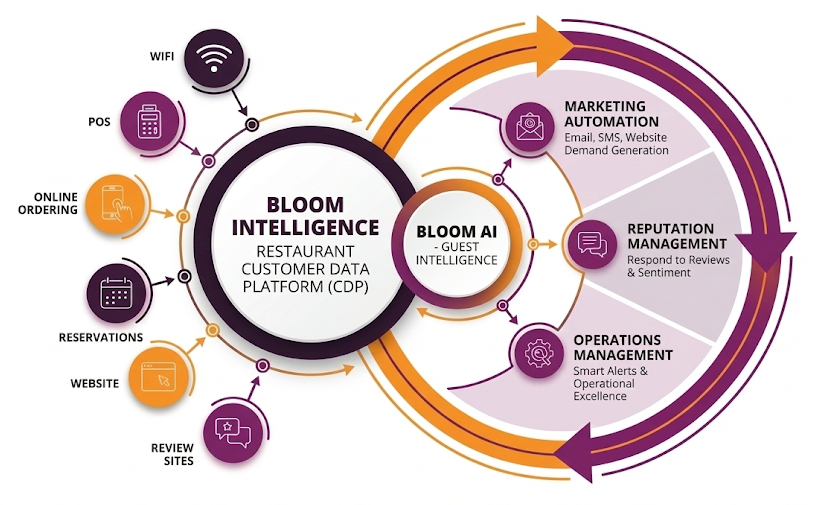
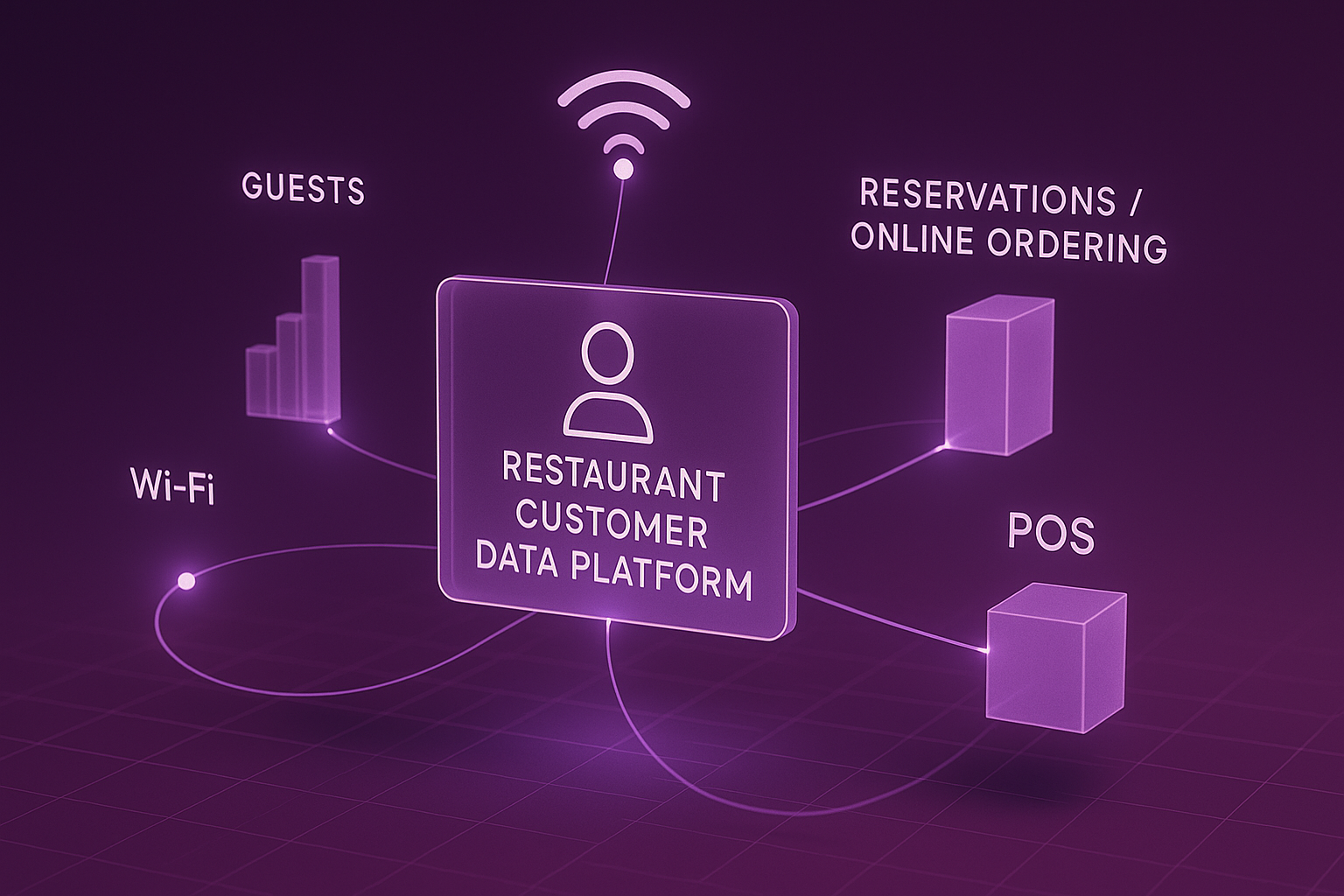
A restaurant customer data platform (CDP) is a unified software system that collects, consolidates, and activates guest data from multiple sources including WiFi networks, POS systems, online ordering platforms, reservation systems, websites, loyalty programs, and review sites. CDPs create comprehensive guest profiles that enable personalized marketing, predictive analytics, and measurable ROI tracking across all customer touchpoints.

Customer data platforms represent the foundation of modern restaurant marketing. By unifying data from disparate sources, CDPs enable restaurants to understand guest behavior, preferences, and value at an individual level, then act on those insights through targeted marketing campaigns.

The Business Impact of CDPs

Research from Aberdeen Group demonstrates the transformative impact of customer data platforms on restaurant performance:

Metric CDP Users vs. Non-Users Impact
Guest Satisfaction 9.1x higher Improved through personalization
Year-over-Year Revenue 2.9x greater growth Data-driven decision making
Average Customer Spend 5.7x increase Targeted upselling and offers
Up-sell Revenue 4.9x growth Predictive recommendations
Time to ROI 79% within 12 months Fast implementation payback

The global CDP market is projected to grow from $2.65 billion in 2024 to $12.96 billion by 2032, representing a 21.7% compound annual growth rate, according to Fortune Business Insights. This growth reflects the increasing recognition that unified customer data is essential for competitive restaurant marketing.

Key CDP Capabilities for Restaurants

  1. Data Unification: Aggregate guest data from POS, WiFi, reservations, online ordering, and reviews into single customer profiles
  2. Identity Resolution: Match anonymous interactions to known guests across devices and touchpoints
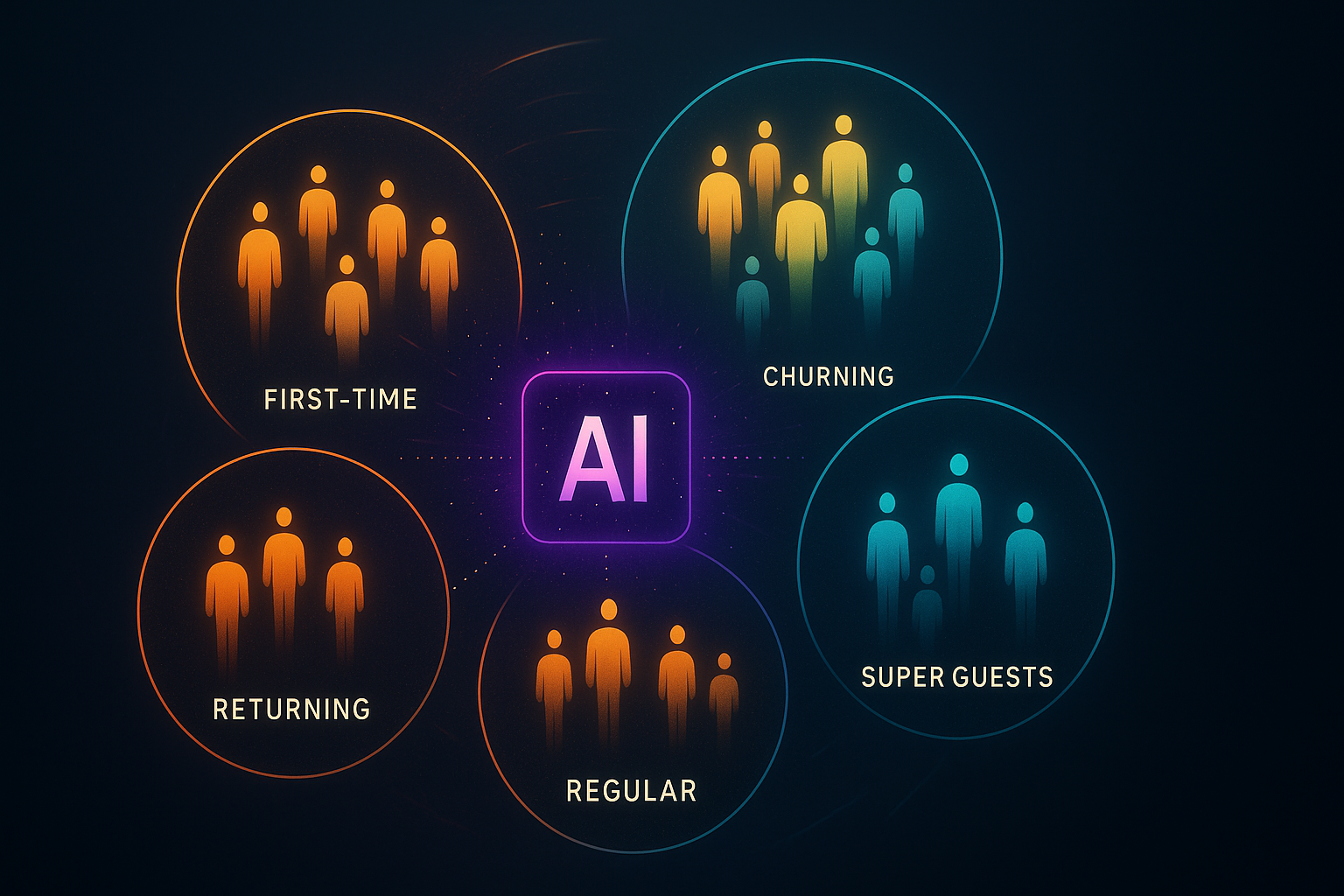
  3. Audience Segmentation: Create dynamic segments like regulars, at-risk guests, high-value customers, and new visitors
  4. Behavioral Analytics: Track visit frequency, spending patterns, menu preferences, and lifetime value
  5. Campaign Attribution: Measure the ROI of marketing campaigns down to individual guest visits and revenue

3. Email Marketing

What is the ROI of email marketing for restaurants?

Email marketing delivers an average return of $36-42 for every $1 spent in the restaurant industry, making it one of the highest-ROI marketing channels available. Restaurant email campaigns achieve open rates of 40-44% compared to the 26.8% cross-industry average, with click-through rates of 1.13-2%. Automated email campaigns drove 37% of all email-generated sales in 2024.

Email marketing remains one of the most effective and cost-efficient channels for restaurant marketing. The combination of high deliverability, personalization capabilities, and automation makes email an essential component of any restaurant marketing strategy.

Restaurant Email Performance Benchmarks

Metric Restaurant Industry All Industries Average
Open Rate 40-44% 26.8%
Click-Through Rate 1.13-2% 2.5%
Bounce Rate 0.37% 0.7%
ROI per $1 Spent $36-42 $36
Automated Email Sales Share 37% 29%

According to industry research, 64% of restaurateurs now send personalized offers to their email subscribers, up from 55% in 2023. This shift toward personalization reflects the growing understanding that generic promotional emails underperform targeted messages based on guest behavior and preferences.

Essential Email Campaigns for Restaurants

  1. Welcome Series: Automated sequence introducing new subscribers to your restaurant, menu highlights, and special offers
  2. Birthday and Anniversary: Personalized celebration messages with exclusive offers that drive visits on special occasions
  3. Win-Back Campaigns: Re-engagement emails targeting guests who have not visited within their typical frequency
  4. VIP Recognition: Exclusive communications for high-value guests acknowledging their loyalty and offering premium experiences
  5. Feedback Requests: Post-visit emails requesting reviews and providing channels for private feedback resolution

4. SMS Marketing

How effective is SMS marketing for restaurants?

SMS marketing achieves a 98% open rate with 90% of messages read within 3 minutes. Restaurant SMS campaigns see click-through rates of 18-36%, compared to just 2.5% for email. The response rate for SMS is 45% versus 6% for email. Restaurants using SMS marketing are 5.89 times more likely to report success with their digital marketing efforts.

SMS marketing has emerged as one of the most powerful direct communication channels for restaurants. The immediacy and high engagement rates make SMS ideal for time-sensitive promotions, reservation confirmations, and personalized offers that drive immediate action.

SMS vs. Email Marketing Comparison

Metric SMS Marketing Email Marketing
Open Rate 98% 40-44%
Time to Read 90% within 3 minutes Hours to days
Click-Through Rate 18-36% 1.13-2%
Response Rate 45% 6%
Best Use Case Time-sensitive offers Detailed content

The hospitality industry has embraced SMS marketing at an 80% adoption rate. Research shows that 32% of SMS messages are read within 60 seconds of delivery, making this channel uniquely effective for flash promotions, last-minute table availability, and day-of event communications.

High-Impact SMS Use Cases for Restaurants

  1. Flash Promotions: Send limited-time offers during slow periods to drive immediate traffic and fill empty tables
  2. Reservation Confirmations: Reduce no-shows with automated SMS reminders 24 hours and 2 hours before reservations
  3. Order Updates: Keep online ordering and delivery customers informed with real-time status notifications
  4. VIP Alerts: Notify high-value guests about exclusive menu items, events, or reservation availability
  5. Win-Back Messages: Re-engage lapsed guests with personalized offers based on their previous ordering history

5. Reputation Management

How do online reviews impact restaurant revenue?

A one-star increase in Yelp rating correlates with a 5-9% increase in restaurant revenue. Research shows that 87% of consumers read online reviews for local businesses, with 94% avoiding businesses after reading negative reviews. Restaurants that respond to all reviews are 90% more likely to be visited than those that do not respond.

Online reputation has become one of the most important factors in restaurant success. With 90% of diners researching restaurants online before visiting and 75% always reading reviews before making a dining decision, reputation management tools are essential for protecting and growing your business.

The Business Impact of Online Reviews

5-9%
Revenue increase per additional Yelp star
87%
Of consumers read online reviews
94%
Avoid businesses with negative reviews
84%
Trust reviews like personal recommendations

Review signals now account for approximately 16% of the factors that determine Google Local 3-Pack rankings, making reputation management a critical component of local SEO strategy. Restaurants with higher ratings and more reviews consistently outperform competitors in local search visibility.

Key Reputation Management Features

  1. Review Monitoring: Aggregate reviews from Google, Yelp, TripAdvisor, and other platforms into a single dashboard
  2. Response Management: Respond to reviews efficiently with templates and AI-assisted response suggestions
  3. Review Generation: Automated systems that request reviews from satisfied guests at optimal moments
  4. Sentiment Analysis: Track trends in guest feedback to identify operational improvements and menu opportunities
  5. Alert Systems: Real-time notifications for negative reviews enabling rapid response and recovery

6. WiFi Marketing

What is WiFi marketing for restaurants?

WiFi marketing is a technique that uses guest WiFi access to collect and clean customer data including names, emails, phone numbers, visit behavior, and demographics. This first-party data is used to personalize marketing campaigns, increase customer loyalty, build online reviews, and recover at-risk guests. Unlike third-party cookies, WiFi data is owned by the restaurant and is not affected by privacy regulations limiting tracking.

With the deprecation of third-party cookies and increasing privacy regulations, WiFi marketing has become an essential tool for restaurants to collect first-party customer data. Guests willingly exchange their contact information for WiFi access, creating an opt-in database of real customers.

The Value of First-Party Data

Research demonstrates the dramatic impact of personalized marketing enabled by WiFi-captured guest data:

  • Guests receiving 1:1 personalized marketing delivered 5x the sales compared to those receiving non-personalized communications
  • 92% of first-time guests without targeted outreach never returned, representing massive lost revenue potential
  • Guest WiFi increases customer dwell time by 9-18%, leading to higher average check sizes
  • WiFi-captured data enables precise visit tracking and attribution of marketing campaign ROI

WiFi Marketing Capabilities

  1. Data Capture: Collect guest contact information through branded WiFi login portal
  2. Visit Tracking: Automatically record guest visits, duration, and frequency without manual check-ins
  3. Behavior Analysis: Identify visit patterns and segment guests by engagement level
  4. Campaign Attribution: Track which marketing messages drove guests back to your location
  5. Data Enrichment: Enhance profiles with demographic data and social information from login methods

7. Marketing Automation

What is restaurant marketing automation?

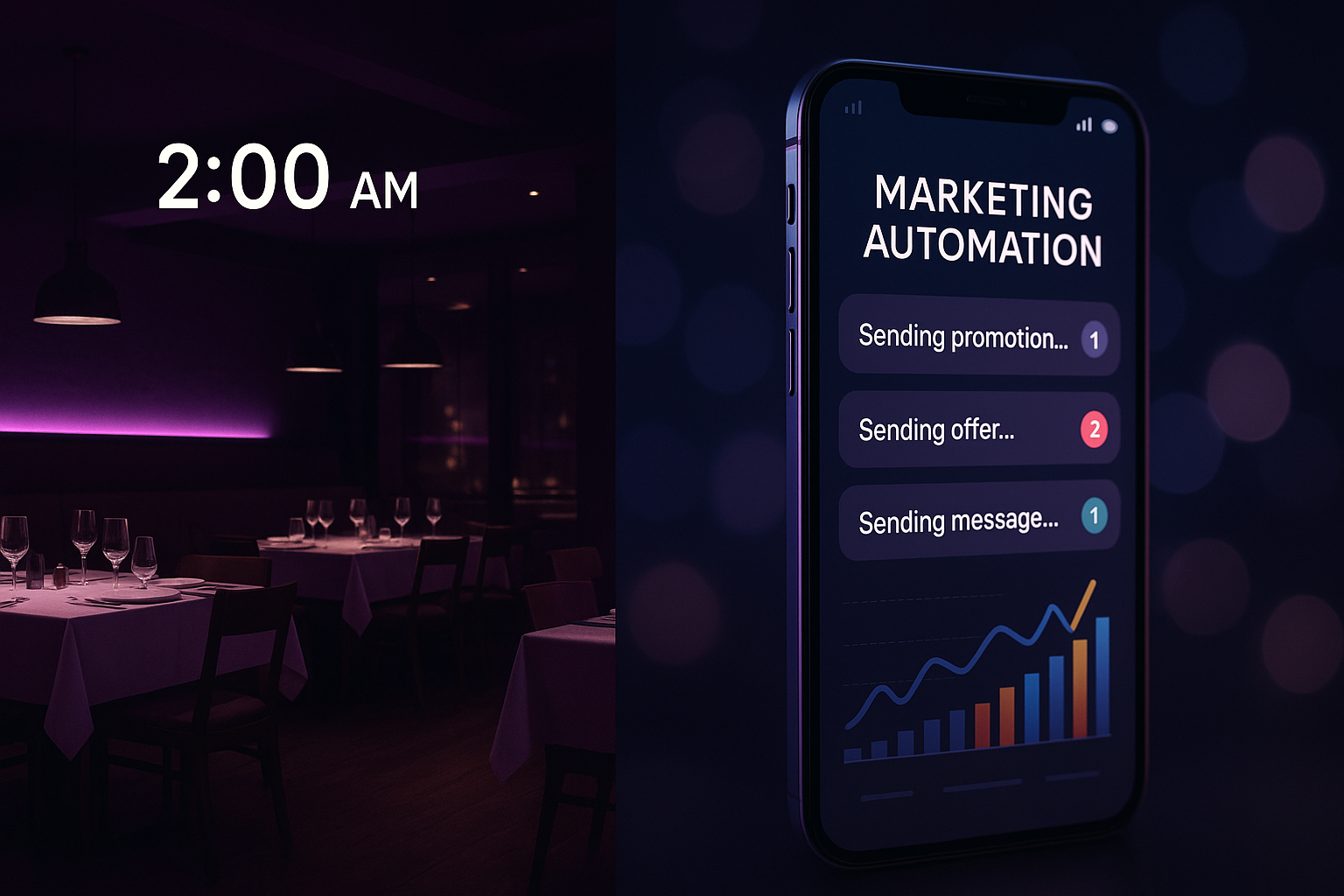
Restaurant marketing automation uses software to execute marketing campaigns automatically based on guest behavior triggers, time-based schedules, or data conditions. Automation enables restaurants to deliver personalized messages at scale, including welcome sequences, win-back campaigns, birthday offers, and review requests, without manual intervention for each guest interaction.

Marketing automation transforms restaurant marketing from reactive, manual campaigns into proactive, always-on systems that engage guests at the right moment with the right message. Automated campaigns drove 37% of all email-generated sales in 2024, demonstrating the revenue impact of trigger-based marketing.

Essential Automated Workflows for Restaurants

  1. New Guest Welcome: Trigger a welcome email series when a guest provides their contact information for the first time, introducing your restaurant and incentivizing a return visit
  2. At-Risk Guest Recovery: Automatically identify guests whose visit frequency has declined and send personalized win-back offers before they churn completely
  3. Birthday and Anniversary: Schedule celebratory messages with special offers to arrive before guest birthdays and dining anniversaries
  4. Post-Visit Feedback: Send automated requests for reviews and feedback after dining experiences, routing positive guests to public review sites
  5. VIP Recognition: Trigger special communications when guests reach loyalty milestones or spending thresholds
  6. Seasonal Re-Engagement: Automatically reach out to lapsed guests during holidays and special events with targeted offers

Automation Performance Metrics

According to Bloom Intelligence data, restaurants implementing comprehensive marketing automation achieve significant results: automated at-risk guest campaigns recover 38% of guests who would otherwise churn, birthday campaigns achieve redemption rates of 25-35%, and welcome sequences increase second-visit rates by 40% compared to guests receiving no automated outreach.

8. Loyalty Programs

How effective are restaurant loyalty programs?

Restaurant loyalty programs deliver measurable results: members visit 20% more frequently and spend 20% more per visit than non-members. Programs generate 12-18% incremental revenue, with 81% of consumers saying they would join a loyalty program if offered. A 5% increase in customer retention correlates with a 25-95% increase in profits.

Loyalty programs have become standard in the restaurant industry, with 68% of full-service restaurants and 71% of quick-service restaurants now offering programs. Industry analysts project 80% adoption by the end of 2026 as restaurants recognize the revenue impact of structured reward systems.

Loyalty Program Statistics

Metric Statistic Source
Member Visit Frequency 20% more visits Industry Research
Member Spend Increase 20% higher per visit Industry Research
Consumer Interest 81% would join if offered Survey Data
Spend to Maximize Points 64% spend more Consumer Research
Incremental Revenue 12-18% from members Performance Data

Types of Loyalty Programs

  1. Points-Based Programs: Guests earn points on purchases redeemable for rewards, encouraging increased spending to reach thresholds
  2. Tiered Programs: Multiple reward levels that unlock progressively better benefits, motivating guests to increase visit frequency
  3. Visit-Based Programs: Rewards based on visit frequency rather than spend, ideal for casual dining concepts
  4. Subscription Programs: Monthly or annual fee-based programs offering exclusive benefits and discounts to committed guests
  5. Coalition Programs: Partnerships with other brands allowing guests to earn and redeem across multiple businesses

9. Social Media Marketing

How important is social media for restaurant marketing?

Social media has become essential for restaurant discovery and engagement: 72% of diners use social media to research restaurants, 68% check social accounts before visiting, and 60% use Instagram specifically to discover new restaurants. TikTok drives significant action, with 38% of users reporting they have visited a restaurant after seeing it on the platform.

Social media serves dual purposes for restaurants: it influences discovery and decision-making for potential guests while building community and loyalty among existing customers. With 80% of restaurants now using Instagram, social media has become a baseline expectation rather than a competitive advantage.

Social Media Platform Statistics for Restaurants

Platform Key Statistic Best Use Case
Instagram 60% use to discover restaurants Visual content, food photography
TikTok 38% visited after seeing content Viral moments, behind-scenes
Facebook Largest user base Community, events, local reach
Google Business 90% research before visiting Reviews, photos, information

Video content has become increasingly important, with restaurant video posts seeing 33% higher engagement than static images. Short-form video on platforms like TikTok and Instagram Reels offers restaurants the opportunity to showcase personality, behind-the-scenes moments, and menu items in engaging formats.

Social Media Best Practices for Restaurants

  1. Post Consistently: Maintain regular posting schedules to stay visible in follower feeds and algorithm recommendations
  2. Prioritize Video: Create short-form video content showcasing food preparation, ambiance, and team personality
  3. Engage Actively: Respond to comments, share user-generated content, and interact with local community accounts
  4. Leverage User Content: Encourage guests to share their experiences and repost high-quality user-generated content
  5. Track Performance: Monitor engagement metrics, reach, and referral traffic to optimize content strategy

10. AI-Powered Marketing Tools

How are restaurants using AI for marketing?

AI adoption in restaurant marketing is accelerating: 53% of restaurants now use AI for sales prediction, 33% use it for personalized recommendations, and 81% of businesses report AI has improved their SMS marketing success. AI enables predictive analytics, automated content generation, intelligent segmentation, and real-time personalization at scale.

Artificial intelligence is transforming restaurant marketing from reactive to predictive, enabling restaurants to anticipate guest behavior and deliver personalized experiences automatically. AI-powered tools can analyze vast amounts of customer data to identify patterns, predict churn, and optimize campaign timing and messaging.

Key AI Marketing Capabilities

  1. Predictive Analytics: Forecast which guests are likely to churn, enabling proactive retention campaigns before guests are lost
  2. Intelligent Segmentation: Automatically group guests based on behavior patterns, value, and preferences for targeted campaigns
  3. Personalized Recommendations: Generate individualized offers based on past ordering behavior and predicted preferences
  4. Content Generation: Create marketing copy, email subject lines, and social media content using AI writing assistants
  5. Send Time Optimization: Determine optimal times to send emails and SMS based on individual guest engagement patterns
  6. Sentiment Analysis: Analyze review and feedback text to identify operational improvements and track brand perception

AI Marketing Implementation Considerations

While AI offers powerful capabilities, successful implementation requires clean, comprehensive customer data. Restaurants should prioritize building a unified customer data foundation through CDPs and WiFi marketing before layering on advanced AI capabilities. The combination of quality first-party data and AI-powered analysis creates a sustainable competitive advantage.

11. The Restaurant Marketing Flywheel: Building an Integrated System

Throughout this guide, we have examined individual marketing tools as separate categories. In practice, the most successful restaurants do not deploy these as isolated point solutions. Instead, they build integrated systems where each component amplifies the others, creating a self-reinforcing marketing flywheel that accelerates growth over time.

The Flywheel Effect

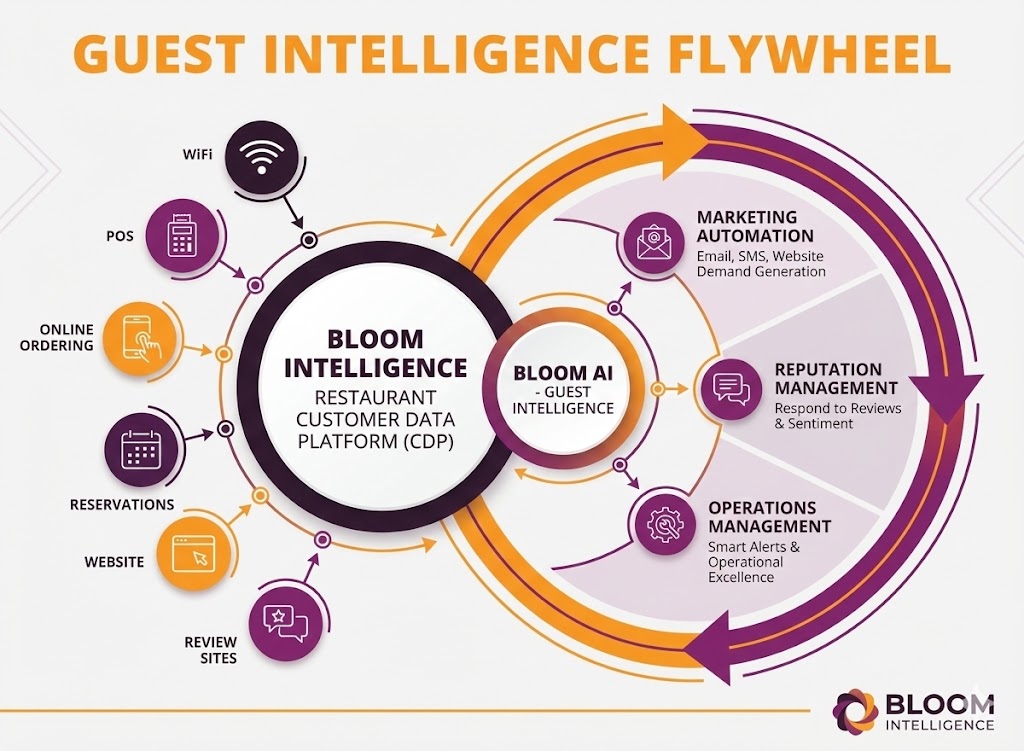
A restaurant marketing flywheel works like this: your optimized website attracts new guests through search and AI discovery. WiFi marketing captures their data when they visit. Your CDP unifies this data with POS transactions and creates rich guest profiles. Marketing automation uses these profiles to send personalized email and SMS campaigns that drive return visits. Reputation management turns satisfied guests into public advocates. Each component feeds the next, and the entire system gains momentum with every cycle.

The AI-Powered Restaurant Marketing Flywheel
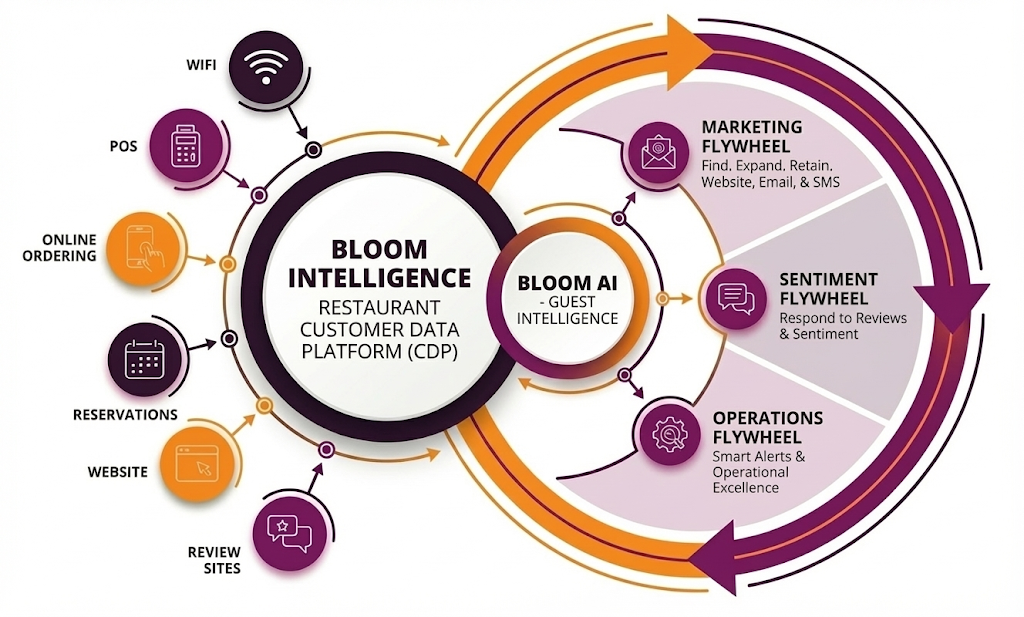
↻ Each cycle compounds, accelerating growth

The Problem with Point Solutions

Many restaurants attempt to build this flywheel using separate vendors for each function: one platform for email, another for SMS, a different tool for reputation management, separate software for WiFi, and yet another for analytics. This fragmented approach creates several critical problems:

  • Data Silos: Guest information trapped in separate systems cannot be unified for personalization
  • Integration Complexity: Connecting multiple platforms requires ongoing technical maintenance
  • Attribution Gaps: Measuring ROI across disconnected tools is nearly impossible
  • Operational Overhead: Managing multiple vendor relationships, contracts, and interfaces drains resources
  • Inconsistent Experiences: Guests receive disjointed communications that do not reflect their full relationship with your restaurant

The Unified Platform Advantage

The alternative is a unified platform that integrates all flywheel components into a single system. When your CDP, WiFi marketing, email, SMS, reputation management, and AI analytics share a common foundation, the flywheel spins faster because:

  • Every guest interaction enriches a single customer profile, enabling deeper personalization over time
  • Automated workflows can span multiple channels based on unified behavioral triggers
  • Attribution is automatic because all touchpoints connect to the same guest record
  • AI has access to complete data, enabling more accurate predictions and recommendations
  • Your team manages one platform instead of coordinating across many

Bloom Intelligence: The AI-Powered Restaurant Marketing Flywheel

Bloom Intelligence was purpose-built to deliver the integrated marketing flywheel that multi-location restaurants need. Our unified platform combines:

  • Customer Data Platform that unifies guest data from WiFi, POS, online ordering, reservations, and reviews
  • WiFi Marketing that automatically captures first-party guest data with every visit
  • Email & SMS Automation with AI-powered campaigns that run 24/7
  • Reputation Management that builds reviews and protects your brand automatically
  • AI-Powered Intelligence that predicts churn, optimizes campaigns, and maximizes guest lifetime value

The result: restaurants using Bloom achieve 5,200-6,900% ROI on their marketing investment, recover 38% of at-risk guests automatically, and gain the marketing capabilities of expert teams at a fraction of the cost.

Key Takeaways

Building an effective restaurant marketing technology stack in 2026 requires understanding both the individual tools available and how they work together as an integrated system. Here are the essential insights from this guide:

  1. Start with Discovery: Your website is the top of the funnel. Optimize for SEO, AEO, and voice search to ensure potential guests find you when they are actively looking.
  2. Capture Every Guest: Use WiFi marketing and website forms to convert anonymous visitors into known contacts you can market to repeatedly.
  3. Unify Your Data: A customer data platform is the foundation that makes personalization possible. Without unified data, every other tool underperforms.
  4. Automate Relentlessly: Marketing automation enables consistent execution at scale. The 37% of email revenue from automated campaigns proves the value.
  5. Protect Your Reputation: With 94% of consumers avoiding businesses with negative reviews, reputation management is not optional.
  6. Prioritize Retention: The 70% of first-time guests who never return represent your biggest revenue opportunity. Win-back campaigns deliver immediate ROI.
  7. Embrace AI: Predictive analytics and intelligent automation separate leaders from followers in 2026.
  8. Build the Flywheel: Integrated platforms outperform point solutions because every component amplifies the others.

Sources and Citations

Statistics and data in this guide are sourced from: National Restaurant Association (2026 State of the Industry Report), Forbes, Aberdeen Group, Tealium, BrightLocal, Fortune Business Insights, McKinsey, TouchBistro, SimpleTexting, MailerLite, Omnisend, Business.com, Restaurant Dive, and Bloom Intelligence proprietary research (2025-2026).

Click to schedule a Free Online Demo, or call 727-877-8181 to see how guest intelligence can transform your restaurant’s retention strategy.
The Operator’s Almanac: How Data-Driven Restaurants Are Turning Guest Intelligence Into Operational Excellence

Your guests are already telling you what’s wrong.

They’re leaving signals everywhere. In reviews mentioning “slow service during peak hours.” In foot traffic patterns showing inexplicable Tuesday lunch dips. In behavioral data, revealing your highest-margin dishes aren’t being ordered by first-time guests. In the subtle shift from weekly visits to monthly ones that precedes a loyal customer’s quiet departure.

The question isn’t whether this intelligence exists. It’s whether you’re listening.

In 2026, the divide between thriving restaurant operations and struggling ones isn’t about who has adopted AI and who hasn’t. That’s yesterday’s conversation.

The real separation is between restaurants using data as operational intelligence. Fuel for daily decisions versus those treating data as a reporting afterthought, something to review at the end of the month when it’s already too late to matter.

The winners aren’t just collecting guest data. They’re operationalizing it.

From Dashboards to Daily Decisions

For years, restaurant operators have been drowning in dashboards. Weekly sales reports. Monthly P&L reviews. Quarterly guest satisfaction surveys. The data arrives in neat packages, gets filed away, and occasionally informs a decision that should have been made weeks earlier.

This approach made sense when data collection was expensive, and analysis required specialized expertise. But the economics have shifted dramatically. Guest data now flows continuously from WiFi logins, online ordering, POS transactions, reservations, and dozens of review platforms. The bottleneck is no longer collection, it’s activation.

The shift happening in data-driven restaurant management is fundamental: from looking at reports monthly to receiving real-time alerts that drive same-day operational changes.

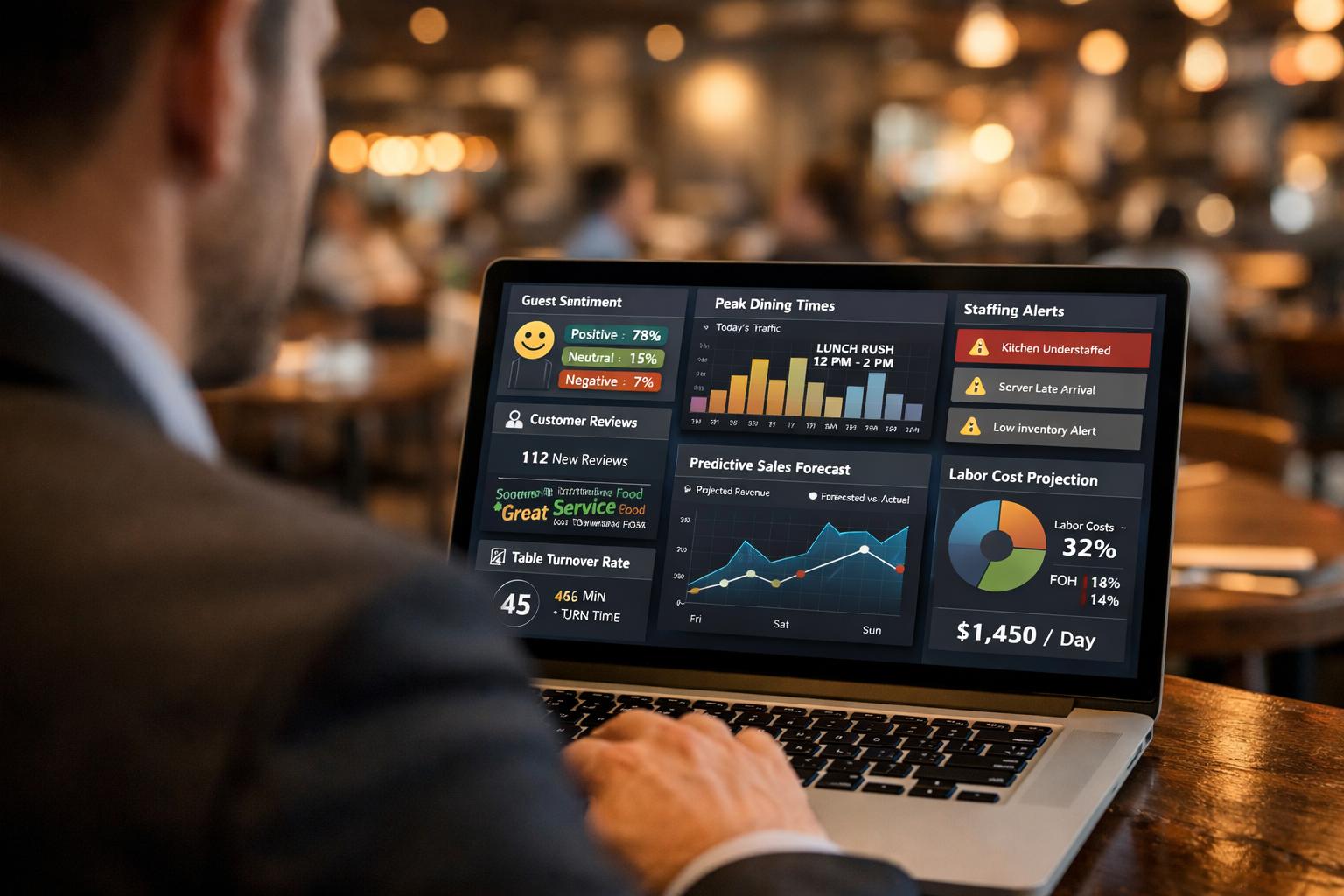
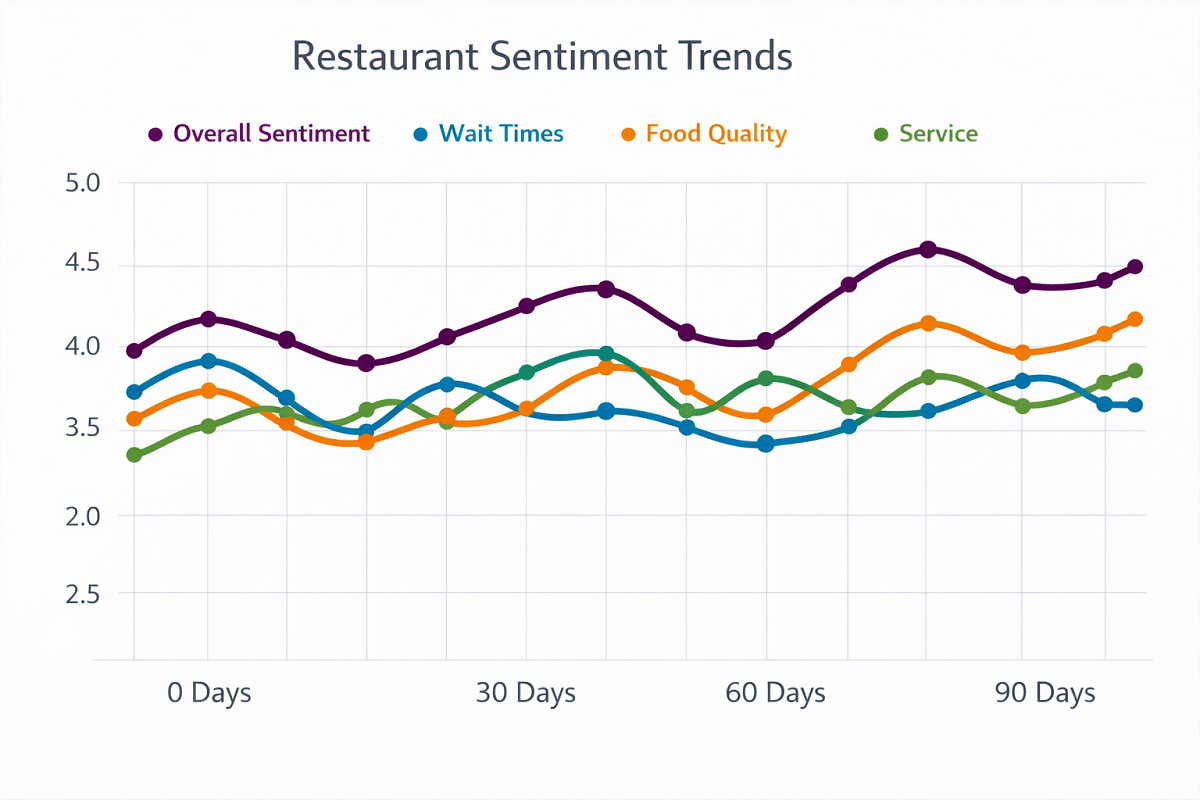
Imagine your morning routine includes not just checking yesterday’s sales, but receiving an automated brief: negative sentiment around wait times spiked 34% last week, concentrated on Friday and Saturday evenings between 7-8 PM. Three reviews mentioned “cold food” in the past 48 hours, all referencing dishes from station two. Your at-risk guest segment grew by 12%, with the common thread being visits during your understaffed Tuesday lunch shift.

This isn’t hypothetical. Restaurant AI dashboards now synthesize data from across your operation – POS, reviews, guest WiFi, reservations – into a unified command center. Rather than logging into six different platforms and mentally stitching together insights, operators see the complete picture: KPIs trending in real-time, sentiment analysis highlighting emerging issues, and suggested actions based on the patterns.

The mental model shift is significant. Data stops being something you look at and becomes something that works for you. The dashboard becomes less a rearview mirror and more a navigation system, alerting you to conditions ahead rather than documenting where you’ve already been.

Custom Keyword Tracking: Your Early Warning System

Reviews have always contained operational intelligence. The problem was extracting it at scale. A single negative review about “sticky floors” is easy to dismiss as one person’s bad day. But when restaurant sentiment analysis tracks that phrase across all review platforms over time, patterns emerge that human reviewers simply cannot catch.

This is where AI keyword tracking transforms reputation management into operational intelligence.

The approach is straightforward: identify the specific operational keywords that matter to your business and track them systematically. Food temperature. Wait times. Cleanliness. Staff attitude. Portion sizes. Parking availability. Background noise levels. Each restaurant has its own vocabulary of operational concerns, and tracking the right keywords creates an early warning system that surfaces problems before they metastasize.

Categories emerge naturally: “Sticky Floors” appearing three times in a month triggers a facilities review. “Staff Overworked” clustering around weekend evenings reveals a scheduling problem. “Food Freshness” concerns concentrated on specific menu items points to supply chain or prep issues worth investigating.

The power isn’t just in tracking individual keywords, it’s in seeing how they interact. A spike in “long wait” mentions coinciding with “great food” sentiment tells a different story than “long wait” combined with “not worth it.” The first suggests an operational fix that preserves a loyal customer base. The second signals a more fundamental value proposition problem.

What previously required a dedicated analyst spending hours reading reviews now happens automatically. And crucially, it happens in time to act. Knowing that food temperature complaints spiked last month is useful for a quarterly review. Knowing they spiked yesterday, concentrated during the dinner rush when your expediter called in sick, is actionable intelligence.

The Guest Mapping Advantage

Where do your guests come from? Not metaphorically, literally. What’s their average drive time? What’s the income distribution of the postal codes they call home? How does this differ between your lunch crowd and dinner guests?

Restaurant guest analytics has evolved to answer these questions with precision, and the operational implications run deeper than most operators realize.

Understanding your trade area isn’t just about marketing spend optimization, though that matters. Knowing that 62% of your guests travel less than 10 minutes, while your top-spending 15% average 25-minute drives reveals distinct guest segments with different expectations and tolerances.

The local regulars expect consistency, quick service, and value that justifies frequent visits. The destination diners traveling further expect an experience worth the trip, and they’re more likely to leave reviews, both positive and negative, because the stakes of their decision feel higher.

This geographic intelligence informs operational decisions at every level. Menu pricing can reflect the income distribution of your actual trade area rather than assumptions. Promotional timing can align with when destination diners are most likely to travel. Even parking and accessibility decisions gain clarity when you understand how your guests actually arrive.

For multi-location operators, guest mapping becomes even more powerful. Overlapping trade areas between locations reveal cannibalization concerns. Gaps in coverage suggest expansion opportunities. Income distribution shifts between locations explain why the same menu performs differently across the portfolio.

New location decisions, historically driven by intuition and real estate availability, can now incorporate actual guest behavior data. Where do your current loyal guests live that’s underserved by your existing footprint? Which demographic profiles drive the highest lifetime value, and where are those populations concentrated?

Traffic Patterns Meet Staffing Intelligence

Every restaurant operator understands, at a gut level, the relationship between traffic patterns and staffing needs. Friday nights are busier than Tuesday lunches. Summer patio season differs from winter. These rhythms become instinctive over time.

But instinct often misses the second-order patterns that data reveals clearly.

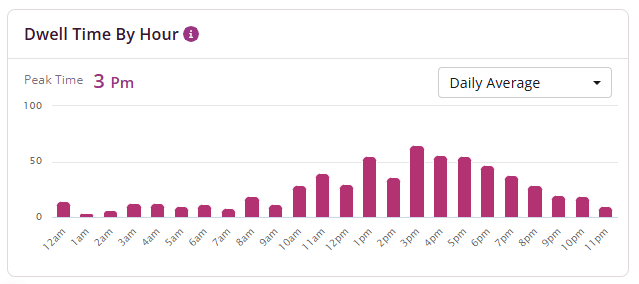
Average dwell time analysis offers a window into the guest experience that pure transaction data obscures. A 29-minute average visit during lunch tells a different operational story than a 47-minute average at dinner. But more importantly, variation around those averages surfaces opportunities.

When dwell time increases during historically fast periods, something’s creating friction, whether that’s a kitchen bottleneck, service delays, or simply guests lingering because they’re enjoying themselves. When dwell time decreases during periods meant to be leisurely, guests may be feeling rushed or underwhelmed.

Peak visit time data at scale reveals patterns that individual shifts obscure. That 7 PM dinner rush might actually be two distinct waves, early-bird diners arriving at 5:30 who’ve cleared out by 7, and prime-time diners arriving at 7:15. Staffing for “dinner rush” as a single block misses the lull between waves where labor costs accumulate without revenue.

Day-of-week patterns interact with seasonal trends in ways that quarters of data reveal, but weeks cannot. Your Tuesday lunch dip might be structural, driven by the office park down the street that shifted to remote Tuesdays – or seasonal, reflecting school schedules or weather patterns.

This is where restaurant performance metrics evolve from reporting into operational intelligence. The goal isn’t just knowing that Friday at 7 PM is busy. It’s understanding precisely how busy, compared to historical patterns, adjusted for seasonality, and forecasted forward so staffing decisions can be made with confidence rather than guesswork.

The operational efficiency gains compound. Accurate traffic forecasting reduces both understaffing (which damages guest experience) and overstaffing (which damages margins). Neither requires perfect precision. Even modest improvements in forecasting accuracy translate directly to the bottom line.

Closing the Loop: From Insight to Action to Measurement

The greatest frustration with traditional restaurant analytics was the gap between insight and action. A monthly report might surface that guest satisfaction with wait times had declined. But by the time the insight reached operators, through layers of data processing and reporting cycles, the moment for intervention had passed.

Data-driven restaurant management in 2026 closes this loop through automation.

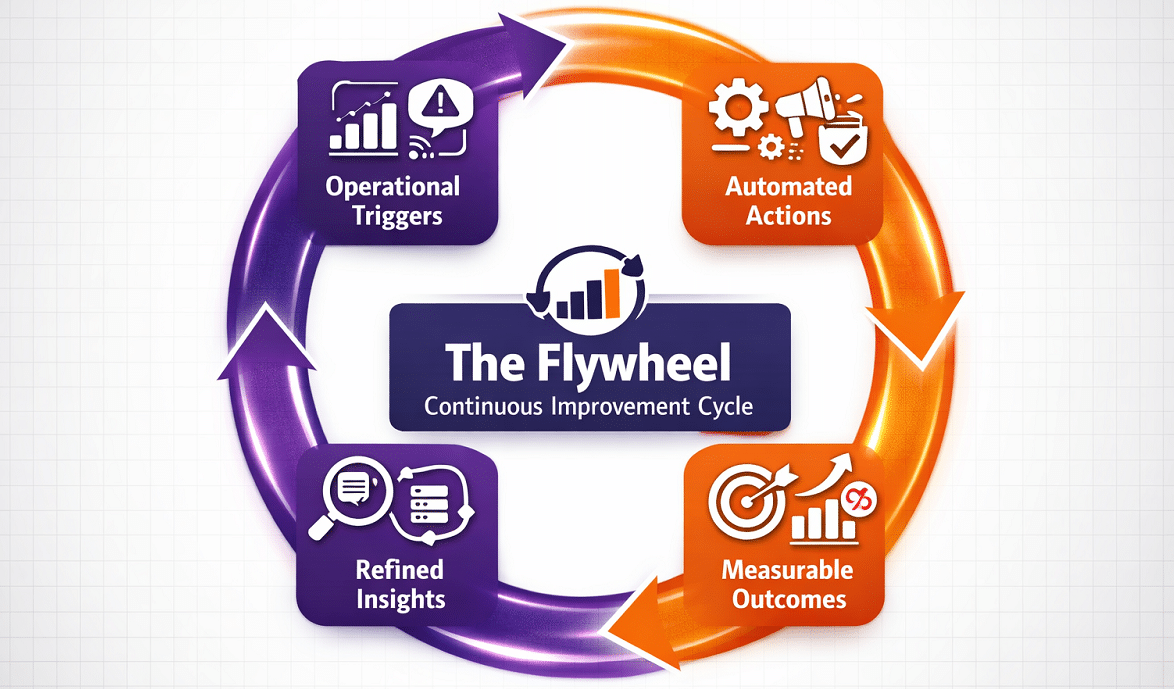
The pattern looks like this: operational triggers—guest behavior changes, sentiment shifts, traffic pattern anomalies—automatically initiate appropriate responses. A guest flagged as “cooling off” based on declining visit frequency receives a personalized win-back campaign. A spike in negative wait time sentiment triggers a staffing review alert. A dip in new guest acquisition in a specific postal code prompts a targeted awareness campaign.

Critically, each automated action connects back to measurable outcomes. The win-back campaign either succeeds in reactivating the cooling-off guest or it doesn’t. And that result informs future campaign refinement. The staffing adjustment either resolves the wait time sentiment issue or reveals a deeper problem. The targeted campaign either moves acquisition metrics in the underperforming area or suggests the issue lies elsewhere.

This creates accountability that manual processes rarely achieve. When insights, actions, and outcomes are systematically connected, operators can answer questions that previously required guesswork: What’s the actual ROI of our guest recovery efforts? How quickly do operational fixes translate to sentiment improvement? Which marketing investments drive sustainable guest behavior changes versus temporary bumps?

The restaurants pulling ahead in 2026 aren’t just collecting better data. They’re building operational systems where insights automatically trigger appropriate actions, and those actions generate measurement data that feeds back into refined insights. The flywheel accelerates.

The Operational Intelligence Imperative

Here’s the uncomfortable truth for restaurant operators: your competitors are building these capabilities. Not all of them, and not all at once, but the trajectory is clear. AI restaurant operations aren’t a future consideration; they’re a present reality, creating separation between operators who embrace operational intelligence and those who don’t.

The good news is that access to these capabilities has democratized rapidly. What once required dedicated data teams, custom analytics infrastructure, and significant ongoing investment now comes packaged in platforms designed for lean operations teams.

Platforms delivering AI-powered sentiment analysis, automated alerts, and operational suggestions give a one-person marketing team the insights that previously required dedicated analysts. A regional chain with 15 locations can now operate with the guest intelligence sophistication that was once the exclusive province of enterprise brands with seven-figure analytics budgets.

But the technology is only as valuable as the operational commitment to use it. Data-driven restaurant management isn’t a tool you buy, it’s a discipline you build. The operators thriving in this environment share common characteristics: they’ve moved from monthly reporting cycles to continuous monitoring, from reactive problem-solving to proactive pattern recognition, from gut-feel decision-making to evidence-based operational choices.

Your guests are still telling you what’s working and what isn’t. The signals are more abundant than ever – in every review, every visit pattern, every behavioral shift across your guest database.

The question remains the same one it’s always been: Are you listening?


Restaurant operators exploring data-driven approaches to guest intelligence should evaluate platforms offering unified dashboards, automated sentiment analysis, and operational alerting capabilities—tools that transform scattered data into daily actionable insights.

👉 Request your free demo here!

crowded restaurant dining room

Related Articles

Click to schedule a Free Online Demo, or call 727-877-8181 to see how guest intelligence can transform your restaurant’s retention strategy.
Predictive Guest Scoring: The Next Frontier in Restaurant Growth (And How to Use It)

What Is Predictive Guest Scoring in Restaurants?

Predictive guest scoring uses artificial intelligence and historical guest data to forecast future diner behavior, including visit likelihood, churn risk, lifetime value, and offer responsiveness.

Instead of reacting after guests stop coming, predictive guest scoring allows restaurants to act before revenue is lost.

Simply put, it identifies who will matter most tomorrow, not just who mattered yesterday.

Why Traditional Guest Segmentation Is No Longer Enough

Most restaurants rely on static guest segments, such as regulars, at-risk, lapsed, or new. While helpful, these segments are backward-looking. They describe what already happened, not what’s about to happen.

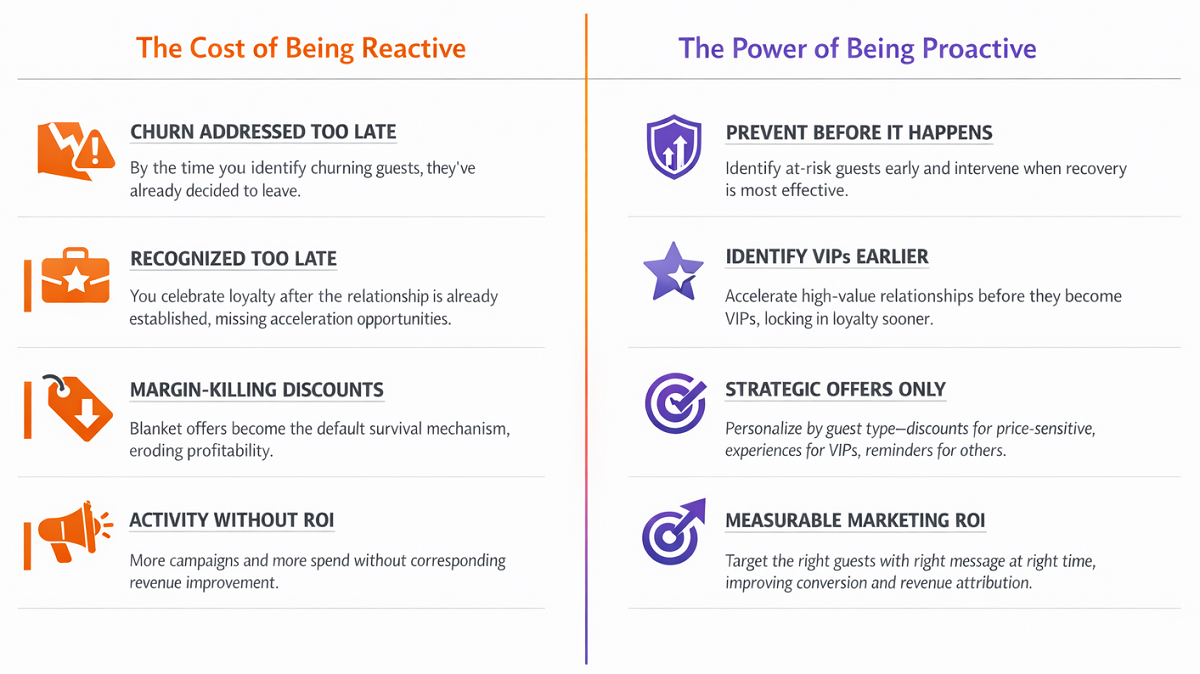
The downside of reactive segmentation:

  • Churn is addressed too late
  • High-value guests are recognized after the opportunity window
  • Discounts are overused to compensate for poor targeting
  • Marketing activity increases without improving ROI

In today’s margin-tight environment, reactive marketing is expensive marketing.

How Predictive Guest Scoring Works

Predictive guest scoring uses machine learning models trained on historical guest behavior to calculate a dynamic score for every guest.

These models analyze signals such as:

  • Visit frequency and recency
  • Spend patterns and average check size
  • Behavior across WiFi, POS, online ordering, and reservations
  • Engagement with marketing campaigns
  • Guest sentiment from reviews and feedback
  • Behavioral trends over time

The output is a continuously updated probability score that predicts future actions, including likelihood to return, likelihood to churn, and potential lifetime value.

This moves marketing from automation to decision intelligence.

Predictive Guest Scoring vs. Traditional Guest Segmentation

Traditional Segmentation Predictive Guest Scoring
Based on past behavior Based on future probability
Static or manual Continuously updated
Rule-based AI-driven
Broad targeting Precision targeting
Reactive Proactive

The difference is the difference between reporting and forecasting.

Why Predictive Guest Scoring Matters Now

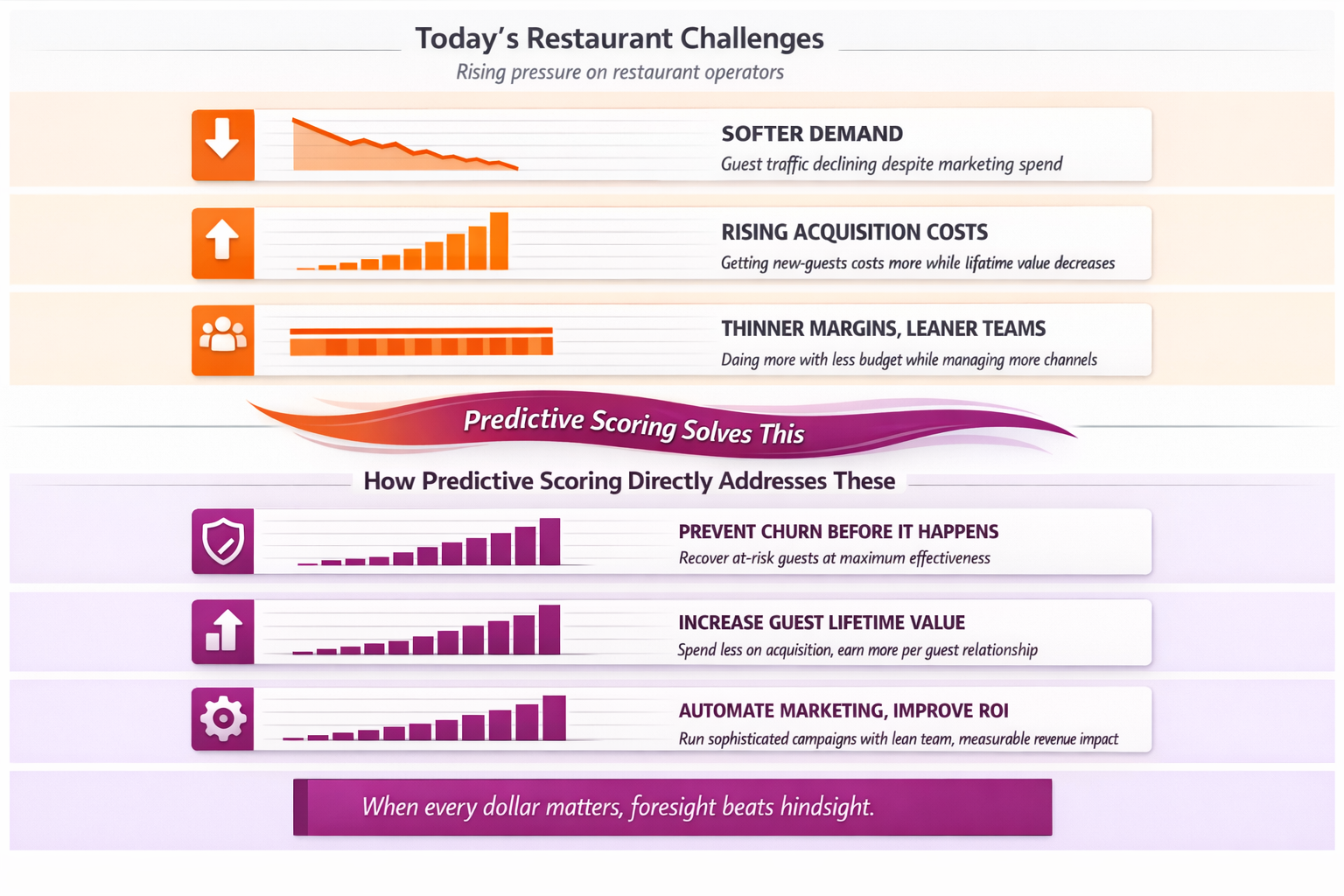
Restaurant operators are facing softer demand, rising acquisition costs, and thinner margins — all while managing more channels with leaner teams.

Predictive guest scoring directly addresses these challenges by:

  • Preventing churn before it happens
  • Increasing guest lifetime value
  • Improving campaign conversion rates
  • Reducing unnecessary discounting
  • Driving measurable marketing ROI

When every dollar matters, foresight beats hindsight.

How Restaurants Use Predictive Guest Scoring to Drive Revenue

Identify Future VIPs Earlier

Predictive models flag guests who are trending toward high lifetime value before they become VIPs. Restaurants can accelerate loyalty and lock in high-value relationships sooner.

Intervene Before Guests Churn

Predictive scores surface early warning signs of disengagement, allowing restaurants to trigger personalized save campaigns at the right moment — when recovery is most effective.

Personalize Offers Without Killing Margin

Not every guest needs a discount. Predictive scoring helps determine who needs an incentive, who needs a reminder, and who responds best to exclusivity or experience-based messaging.

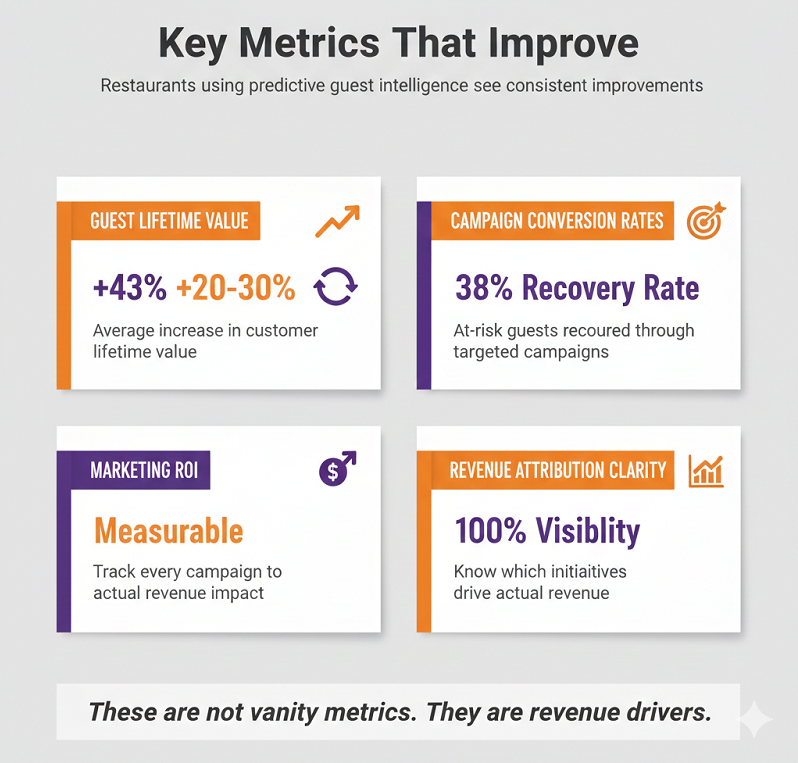
Key Metrics Predictive Guest Scoring Improves

Restaurants using predictive guest intelligence consistently improve:

  • Guest lifetime value
  • Repeat visit frequency
  • Campaign conversion rates
  • Marketing ROI
  • Revenue attribution clarity

These are not vanity metrics. They are revenue drivers.

How Bloom Intelligence Enables Predictive Guest Scoring

Bloom Intelligence unifies guest data across WiFi, POS, online ordering, reservations, websites, and reviews into a single guest profile.

That data powers AI models that:

  • Continuously score guests
  • Automatically trigger personalized campaigns
  • Tie marketing and operational actions directly to revenue

The result is always-on, predictive marketing that runs without adding complexity or headcount.

Frequently Asked Questions about Restaurant Predictive Analytics

What is predictive analytics in restaurant marketing?

Predictive analytics uses AI and historical guest data to forecast future behaviors like visit likelihood, churn risk, and spending potential.

How does predictive guest scoring increase restaurant revenue?

It enables earlier intervention, smarter personalization, fewer wasted discounts, and higher guest lifetime value.

Is predictive guest scoring only for large restaurant chains?

No. Small and mid-size restaurant groups often see the biggest gains because predictive intelligence replaces manual analysis and guesswork.

How often are guest scores updated?

In advanced platforms like Bloom Intelligence, guest scores update continuously as new data is collected.

The Bottom Line

The future of restaurant marketing isn’t more campaigns or deeper discounts.

It’s smarter decisions, made earlier.

Predictive guest scoring turns guest data into foresight — and foresight into sustainable revenue growth.

Ready to See Predictive Guest Scoring in Action?

If you want to stop guessing and start predicting guest behavior, it’s time to see Bloom Intelligence in action.

Book a personalized demo today and see how predictive guest scoring, automated marketing, and unified guest data can help you increase revenue, reduce churn, and make smarter decisions — automatically.

👉 Request your free demo here!

crowded restaurant dining room

Related Articles

Click to schedule a Free Online Demo, or call 727-877-8181 to see how guest intelligence can transform your restaurant’s retention strategy.
How AI is Changing the Restaurant Guest Relationship: Research, Realities, and the 2026 Opportunity

The restaurant industry is witnessing a fundamental shift in how operators connect with their guests.

Not a technological shift. A relationship shift.

For decades, the hospitality industry operated on a simple premise: know your regulars, treat them well, and they will return. This worked when a restaurant served a neighborhood. It breaks down when a restaurant serves thousands of guests across multiple locations, channels, and touchpoints.

AI is not replacing the restaurant-guest relationship. AI is making it possible to have a real relationship with tens of thousands of guests simultaneously.

The restaurants that understand this distinction will capture market share in 2026 and beyond. Those who see AI as just another marketing tool will continue to wonder why their guests feel like strangers.

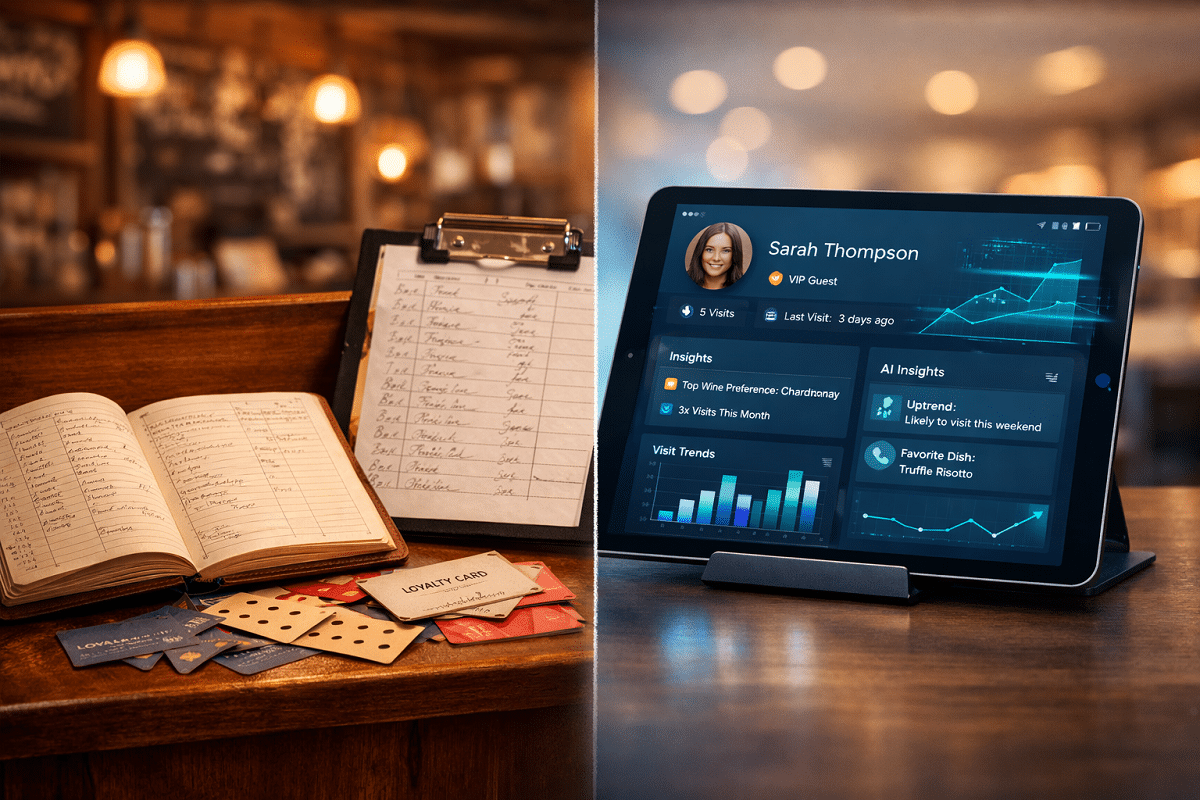
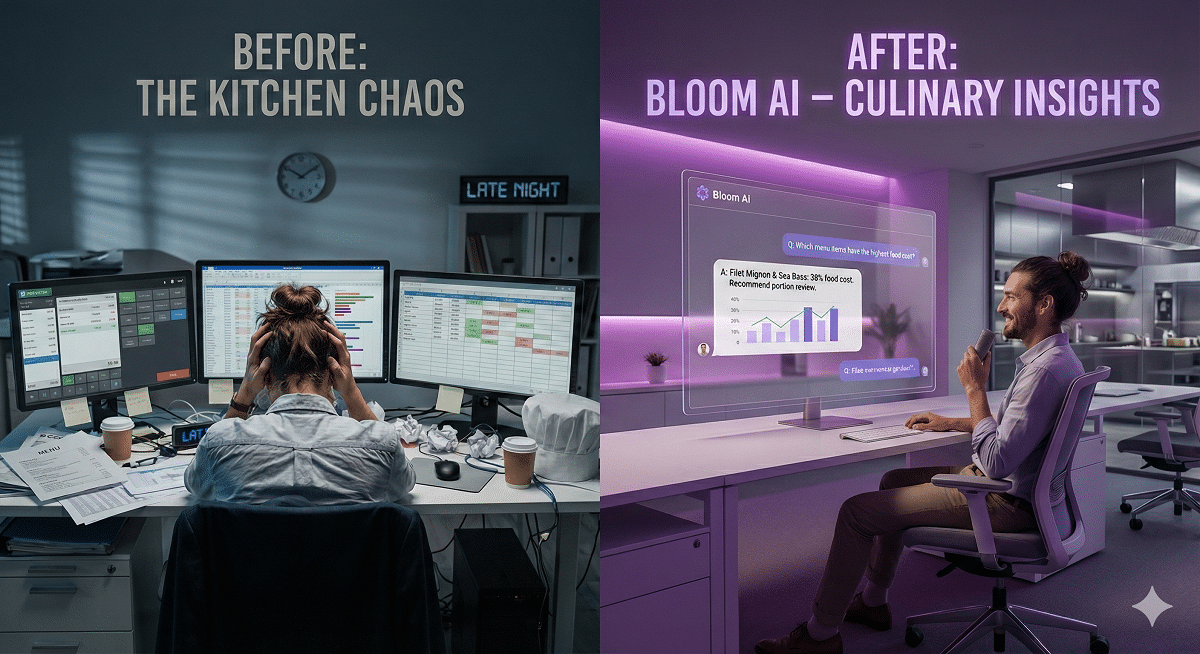
Before/after image of restaurant guest intelligence then and now, using AI

The Attention Economy Shift

Restaurant operators are competing in an attention economy that grows more crowded each year. The average consumer now interacts with dozens of restaurant brands annually through delivery apps, social media, online ordering, and physical visits. Yet research consistently shows that true loyalty, the kind that drives repeat visits and higher check averages, extends to only a handful of brands per consumer.

This creates both a challenge and an opportunity.

The challenge is that traditional broadcast marketing treats every guest the same. The same email to your Super Guest who visits weekly and spends generously goes to the first-time visitor who ordered once through DoorDash six months ago.

This approach wastes resources and, worse, dilutes the relationship with guests who actually matter to your business.

The opportunity lies in AI-powered guest intelligence that identifies which guests have genuine loyalty potential and concentrates communication where it creates value. Instead of marketing to everyone, intelligent systems recognize who matters and respond accordingly.

The 2026 winner is not the restaurant that markets to everyone. It is the restaurant that recognizes who matters and treats them accordingly.

The Rise of Invisible Loyalty

Traditional loyalty programs are showing their age. The punch card model, whether physical or digital, requires guests to actively participate in tracking their own relationship with your brand.

Each additional card in a wallet or app on a phone competes for limited consumer attention.

The data tells a clear story: program enrollment rates may look healthy, but active redemption rates continue to decline across the industry. Guests sign up, forget, and never engage. The loyalty program becomes a database of email addresses rather than a driver of behavior.

AI-powered loyalty works differently. Instead of asking guests to track points, behavior recognition systems identify loyalty patterns automatically.

The guest who visits every Tuesday at 6 PM, always orders the same appetizer, and consistently brings friends, does not need to carry a card. The system recognizes this pattern and responds with relevance.

This is invisible loyalty. No cards to carry. No apps to download. No points to track. Just recognition.

Your best guests do not want another card. They want to feel known when they walk in or place an order. They want the hostess to remember their favorite table. They want the server to mention that the special tonight pairs perfectly with the wine they ordered last time. They want the marketing email to acknowledge their preferences rather than blast generic promotions.

AI makes this recognition possible at scale. The technology that once required a veteran server with decades of experience and perfect memory now extends across every location, every channel, and every touchpoint.

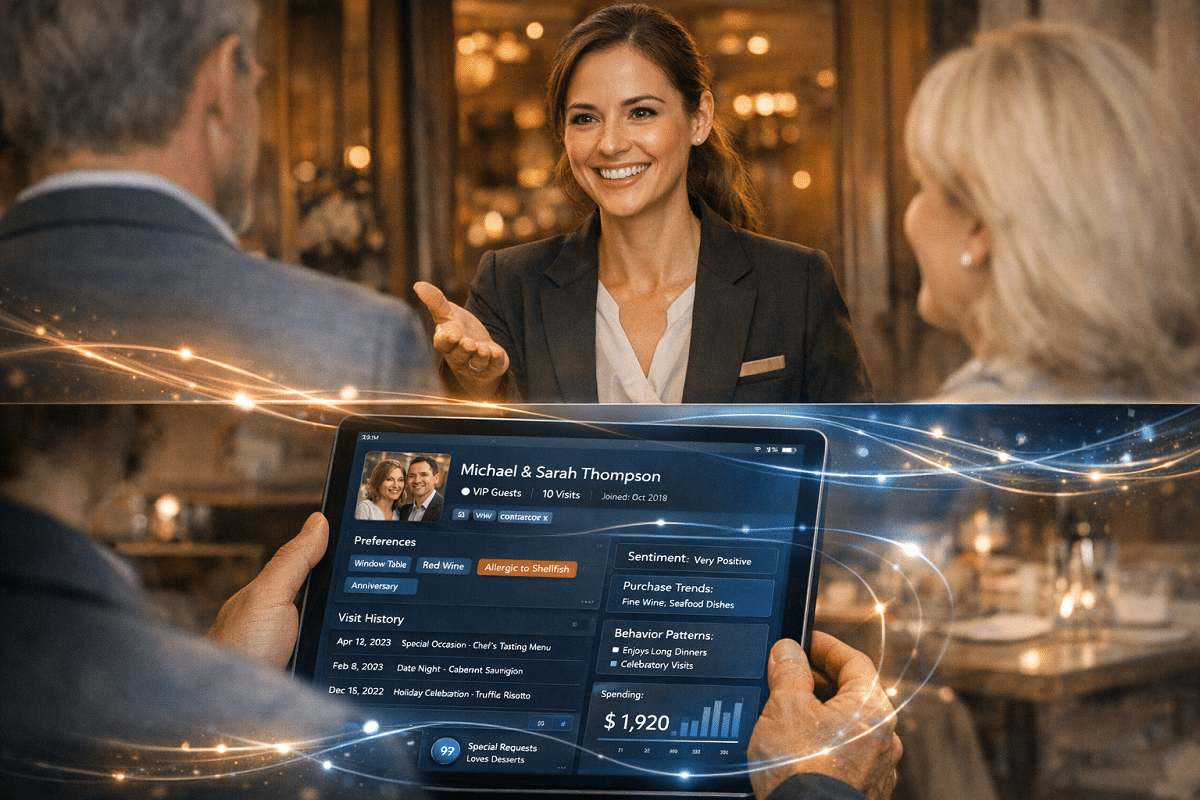
Hostess using guest intelligence to greet guests personally

Sentiment as the New Metric

Restaurant operators have long relied on star ratings as a primary measure of guest satisfaction. A 4.5-star average on Google means you are doing well. A drop to 4.2 signals trouble. Simple, clear, actionable.

But star ratings are lagging indicators. By the time enough reviews accumulate to shift your average, the underlying problems have been affecting guests for weeks or months. You are looking in the rearview mirror while driving forward.

Sentiment analysis changes this equation entirely.

Modern AI systems analyze not just the star rating but the language within every review, survey response, and behavioral signal. They identify patterns that predict future problems before they manifest in aggregate ratings.

Consider the difference: a review might award four stars while containing language that signals growing frustration with wait times. The star rating looks fine. The sentiment tells a different story.

Sophisticated guest intelligence platforms create what amounts to a real-time health score for your guest relationships. This score incorporates review sentiment across platforms, identifies trending concerns, and highlights operational issues requiring attention.

A 4.2-star rating tells you where you were. Guest sentiment intelligence tells you where you are going.

For restaurant operators managing multiple locations, this predictive capability transforms how you allocate management attention. Instead of waiting for a location to accumulate poor reviews, you can identify emerging issues while they remain addressable. Instead of reacting to problems, you can prevent them.

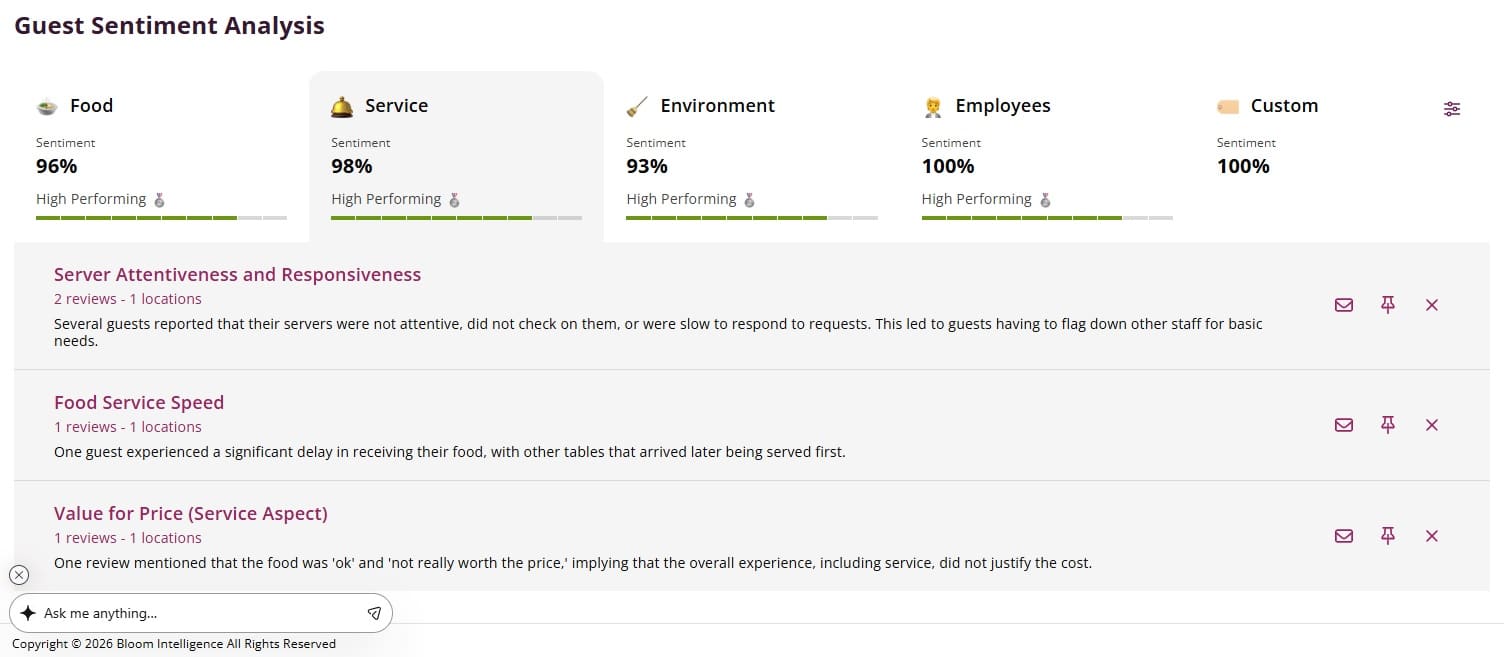
Screenshot of AI guest intelligence platform

The Staff Augmentation Reality

Restaurant labor costs continue climbing while marketing team sizes remain flat or shrink. The economics are unsustainable for traditional approaches to guest engagement.

Consider what a proper guest intelligence program requires without AI:

Someone must compile guest data from multiple sources. Someone must identify patterns in that data. Someone must segment audiences based on behavior. Someone must craft personalized campaigns for each segment. Someone must monitor review sites daily and respond thoughtfully. Someone must analyze which campaigns drove results. Someone must update the strategy based on those results.

A restaurant chain with twenty locations might need a team of four or five people dedicated solely to these tasks. Few operators can justify that expense. So the work goes undone, or worse, it gets done poorly with mass-blast emails and generic responses.

AI changes the staffing equation entirely.

Intelligent systems handle the data work automatically. They compile guest profiles from every touchpoint. They identify behavioral patterns. They segment audiences in real time. They trigger personalized campaigns based on individual guest behavior. They monitor reviews and draft responses. They attribute revenue to specific campaigns. They learn and improve continuously.

This does not eliminate the need for human judgment. It eliminates the need for humans to do data entry, list management, and repetitive analysis.

The question is not “AI or humans.” The question is “What can AI do so humans can be more human?”

When your marketing person spends less time pulling reports and more time developing creative campaigns, your marketing improves. When your managers spend less time monitoring review sites and more time coaching staff, your operations improve. When your operators spend less time wondering what the data shows and more time acting on clear insights, your business grows.

AI handles the mechanics so hospitality professionals can focus on hospitality.

restaurant manager training staff while AI runs in the background

The 2026 Opportunity Window

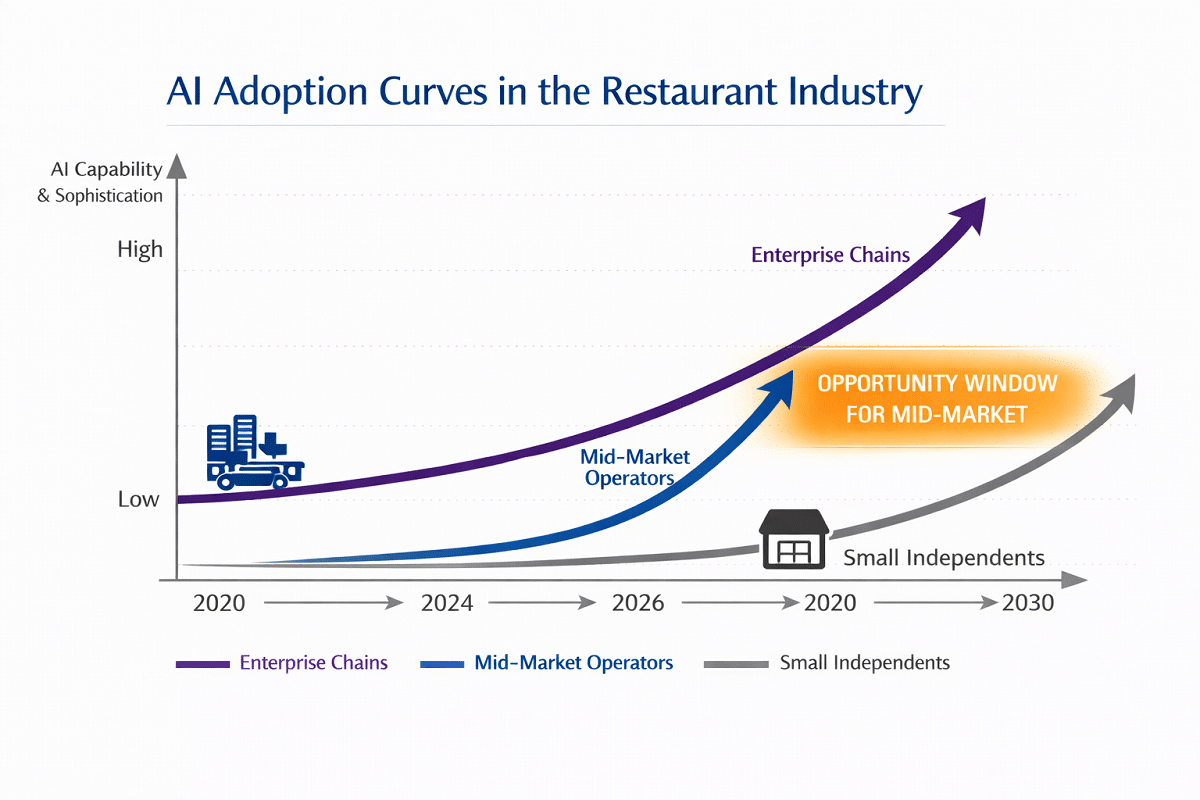
The current state of AI adoption in the restaurant industry creates a significant opportunity for mid-market operators.

Large enterprise chains, the brands with hundreds or thousands of locations, have invested heavily in custom AI and data infrastructure over the past decade. They built proprietary systems, hired data science teams, and created competitive advantages through guest intelligence.

Small independent restaurants, single locations with limited budgets, often rely on intuition and manual processes. They may never invest in sophisticated guest intelligence.

The middle market, restaurant groups with two to one hundred locations, occupies an interesting position. These operators have enough scale to benefit substantially from AI-powered guest intelligence. They have enough data to train meaningful models. They have enough guests to justify personalized engagement.

Yet many of these operators have assumed that enterprise-grade guest intelligence remains beyond their reach. They saw what larger competitors built and concluded that similar capabilities required similar resources.

That assumption was accurate five years ago. It is no longer accurate today.

The technology that Fortune 500 restaurant chains spent millions building is now accessible through platforms designed specifically for mid-market operators. The AI capabilities that required dedicated data science teams now operate through intuitive interfaces. The guest intelligence that seemed reserved for industry giants now fits the budget and operational reality of growing restaurant groups.

This creates a window of opportunity.

Mid-market operators who adopt AI-powered guest intelligence now can leapfrog competitors who continue relying on traditional methods. They can deliver the personalized guest experience that larger chains pioneered while maintaining the operational flexibility that small operators enjoy.

The window exists because the technology matured faster than awareness of that maturity. Many operators still think AI means expensive custom development. Many still believe guest intelligence requires technical staff they cannot afford. Many are waiting for prices to drop further or capabilities to improve.

Those assumptions will catch up with market reality eventually. When they do, the operators who moved early will have accumulated data advantages, learned what works for their specific guests, and built competitive moats that late adopters will struggle to breach.

Restaurant AI Adoption Curve Graph Showing Opportunity for Mid-Market Restaurant Operators

What This Means for Your Restaurant

The transformation in restaurant-guest relationships is not coming. It is here.

Guests increasingly expect recognition and relevance from the brands they patronize. They receive personalized experiences from airlines, retailers, and streaming services. They notice when their favorite restaurant treats them like a stranger.

AI does not make restaurants less personal. It makes it possible to be personal at scale.

The best operators have always known their guests. The server who remembers that Mrs. Johnson prefers booth seating and her water with extra lemon. The manager who recognizes that the

Tuesday night crowd includes a group of nurses who always order family style after their shift. The owner who notices when a regular has not visited in a few weeks and reaches out personally.

This hospitality has always defined great restaurants. What has changed is the ability to extend that same recognition to every guest, at every location, across every channel.

The restaurant that knows you ordered the salmon last time can suggest the new preparation. The restaurant that notices you always celebrate birthdays there can reach out before your anniversary. The restaurant that recognizes declining visit frequency can re-engage before you become a lost guest.

None of this requires replacing human hospitality with artificial substitutes. All of it requires augmenting human capabilities with intelligent systems that handle what humans cannot: remembering everything about thousands of guests simultaneously.

The question for 2026 is not whether AI will transform the restaurant-guest relationship. That transformation is already underway. The question is whether your restaurant will be among those defining what that transformation looks like, or among those reacting to competitors who moved first.

Discover how Bloom Intelligence helps restaurant operators build deeper guest relationships through AI-powered guest intelligence.

Request a free demo to see how the platform transforms guest data into actionable insights that drive revenue and loyalty.

crowded restaurant dining room

Related Articles

Click to schedule a Free Online Demo, or call 727-877-8181 to see how guest intelligence can transform your restaurant’s retention strategy.
The Invisible Exodus: 847 Guests Left Your Restaurant Last Month—And You Never Said Goodbye

The Night 847 Guests Decided to Leave


Last month, 847 guests quietly decided never to return to your restaurant.

They didn’t complain to your manager. They didn’t post a scathing review. They didn’t cause a scene. They just… stopped coming.

You didn’t know Maria’s name. She’d been visiting your Midtown location every Tuesday for 18 months. Her usual order: the house salad with salmon, dressing on the side, sparkling water with lemon. Sixty-seven visits. $4,200 in lifetime spending. An average ticket of $63 that always included dessert when her daughter joined her.

Then one Tuesday, she didn’t come.

And the next Tuesday.

And the next.

After 18 months of loyalty, Maria vanished without a word.

The worst part? You had 47 days to save her. You had the data. You just couldn’t see it.

restaurant guests leaving who may never come back

The Hidden Cost of Silent Departures

Here’s the math that should keep every restaurant operator awake at night:
847 guests × $236 average annual value = $199,892 in annual revenue walking out silently

That’s not a marketing problem. That’s a silent crisis bleeding your restaurant dry—one unnoticed departure at a time.

Why Customers Leave Without Warning

According to recent industry research, 70% of first-time restaurant diners never return for a second visit. But what about your loyal regulars? The ones like Maria?

They leave for reasons you’ll never hear:

  • A single disappointing experience they didn’t bother mentioning
  • Life changes (new job, moved neighborhoods, changed routines)
  • A competitor’s offer that caught their attention at the right moment
  • Feeling forgotten—no birthday acknowledgment, no “we miss you” after weeks of absence

The data shows that 89% of customers say service quality influences their decision to return, but they won’t tell you when that quality slips. They’ll simply redirect their Tuesday nights elsewhere.

The $83 Question: Why Acquisition Costs Make Retention Essential

Let’s talk about what it actually costs to replace Maria.

According to industry data, the customer acquisition cost (CAC) for a fast-casual restaurant is approximately $83. That’s $83 in marketing spend, promotions, and advertising just to get someone through the door once.

Meanwhile, acquiring a new customer costs 5-7 times more than retaining an existing one.

And here’s the multiplier effect: existing customers spend an average of 67% more per order than first-time guests.

Maria’s $63 average ticket? A first-time guest at your restaurant averages $38.

When you do the math:

Metric Lost Guest (Maria) Replacement Guest
Acquisition Cost $0 (already acquired) $83
Average Ticket $63 $38
Annual Visits 52 (weekly) 3-4 (average)
Annual Value $3,276 $114-$152
3-Year Value $9,828 Churned after year 1

Replacing Maria isn’t replacing value. It’s trading a $9,828 relationship for a $114 transaction.

The 47-Day Window: When At-Risk Becomes Lost

Here’s what nobody tells you about restaurant customer churn: there’s a window.

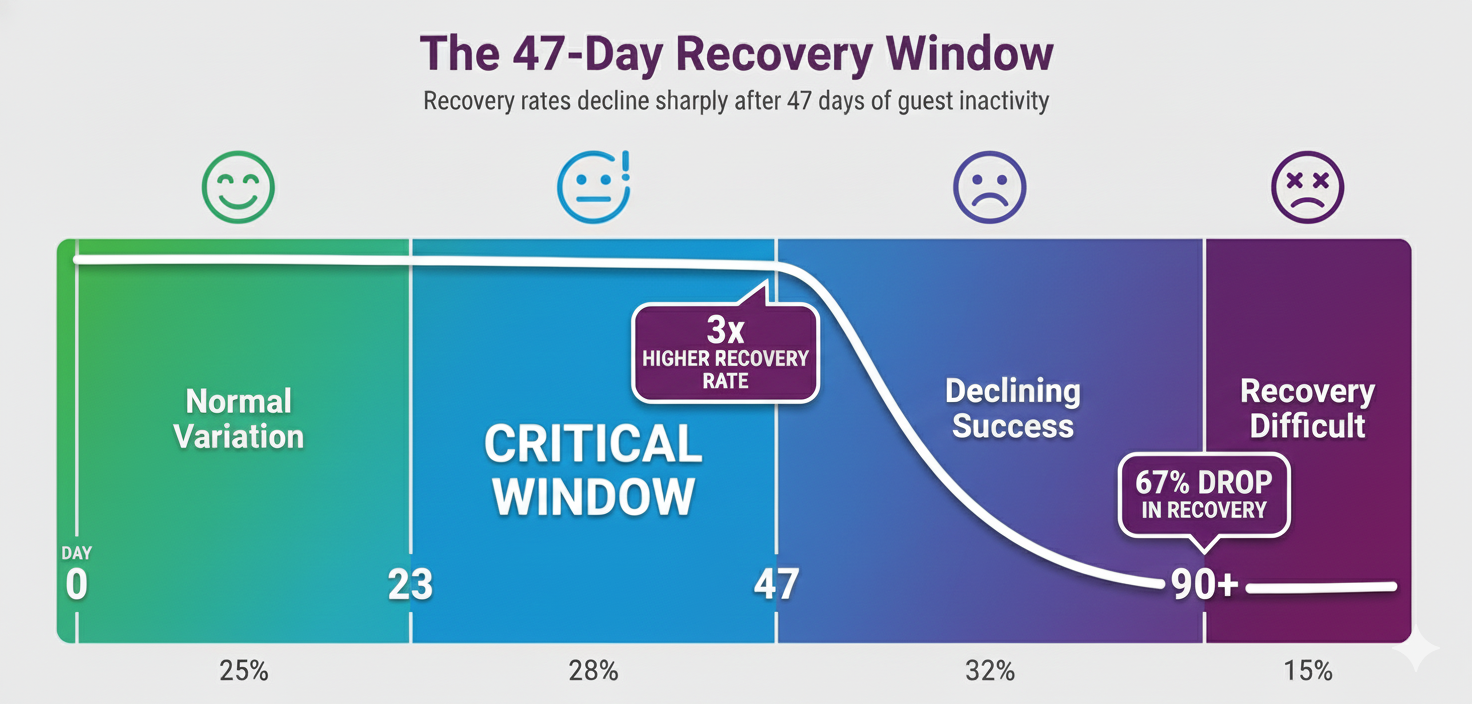
Maria didn’t wake up on Day 67 and decide she was done with your restaurant. The decision began forming on Day 23 when her server seemed rushed. It solidified on Day 31 when her online order arrived cold. By Day 47, when she should have been on her sixth consecutive Tuesday visit, she was already mentally gone.

The 47-day window is your chance to intervene.

Research shows that win-back campaigns sent within 30-45 days of behavioral change have a 3x higher success rate than those sent after 60+ days. After 90 days? Recovery rates drop by 67%.

But here’s the challenge: How do you know Maria missed Day 23? How do you know the pattern changed?

If you’re manually tracking 2,000, 5,000, or 10,000 guests across multiple locations, you don’t. You can’t. The human brain isn’t built to notice when guest #4,847 breaks her Tuesday pattern.

Maria’s Invisible Journey: What Should Have Happened

Let’s rewind Maria’s story. Same circumstances, different outcome.

Day 0: Maria’s visit frequency data shows she visits every Tuesday, averaging $63 per visit.

Day 7: Maria doesn’t visit on Tuesday. AI flags this as a single missed visit within normal variation.

Day 14: Maria misses her second consecutive Tuesday. AI updates her status from “Regular” to “Needs Attention.”

Day 15 (8:00 AM): An automated message reaches Maria:
“Hi Maria, it’s been a while since we’ve seen you! We wanted you to know your table is waiting. Here’s 15% off your next visit. We’d love to welcome you back soon. – The [Restaurant Name] Team”

Day 16: Maria reads the message. She’d honestly forgotten about the restaurant after a busy two weeks at work. The reminder, and the fact that someone noticed her absence, brings a smile.

Day 17 (Tuesday): Maria returns. Her server, alerted by the system that Maria is a high-value returning guest, greets her by name. The experience feels personal.

Day 47: Maria has visited four more times. Her lifetime value has increased to $4,452.

Day 365: Maria’s annual value: $3,276. Her total lifetime value (projected 5 years): $16,380.

The difference between lost Maria and retained Maria: one automated message sent on Day 15.

The recovery window for at-risk restaurant guests

Why Traditional Win-Back Campaigns Fail

You might be thinking, “We already do win-back campaigns.”

Most restaurants do. And most win-back campaigns fail spectacularly.

Here’s why:

Problem #1: Manual List Building Is Always Too Late

By the time your marketing manager pulls a list of “guests who haven’t visited in 90 days,” compiles an email, writes copy, gets approval, and hits send, you’re targeting guests who left 120+ days ago.

The 47-day window? Long gone.

Problem #2: Generic Messaging Feels Like Spam

“We miss you! Come back for 10% off!”

Maria receives this same message from her gym, her dry cleaner, her hair salon, and three other restaurants. It doesn’t feel personal because it isn’t.

She doesn’t know you noticed her specifically. She doesn’t feel seen; she feels marketed to.

The difference with behavioral triggers? Maria receives her message because her pattern changed, not because she landed on an arbitrary “90 days inactive” list. That timing precision, combined with your authentic brand voice, transforms generic outreach into relevant communication.

Problem #3: No Connection to Actual Behavior

Traditional campaigns target everyone who hasn’t visited in X days. But Maria (67 visits, $4,200 lifetime value) gets the same message as someone who visited once, ordered a coffee, and never returned.

One deserves a rescue mission. One deserves a basic re-engagement nudge. Treating them identically wastes resources and insults your best guests.

The Results?

Industry data shows traditional win-back campaigns recover 3-5% of lapsed guests.

That means 95-97% of your at-risk guests continue their silent exodus, untouched by your marketing efforts.

What Happens When AI Sees What You Can’t

A modern restaurant customer data platform (CDP) with AI-powered guest intelligence changes the equation entirely.

Instead of manual lists and generic blasts, here’s what intelligent automation does:

Real-Time Behavioral Monitoring

Every guest’s visit pattern is tracked automatically. When Maria misses her expected Tuesday visit, the system knows within 24 hours—not 90 days.

Predictive Churn Identification

Machine learning algorithms don’t just see who has churned. They identify who is about to churn before the final visit happens.

The signals are subtle:

  • Visit frequency decline (weekly → bi-weekly → monthly)
  • Ticket size reduction (trading $63 dinners for $28 lunches)
  • Time-of-day shifts (dinner regular now only visits for coffee)
  • Ordering pattern changes (stopped adding dessert, skipping appetizers)

Any single signal might mean nothing. Combined with sentiment analysis from reviews and survey responses, these patterns predict churn with remarkable accuracy.

Automated, Personalized Intervention

When an at-risk guest is identified, personalized campaigns launch automatically within the critical 47-day window.

Not “We miss you!”

Instead: “Hi Maria, it’s been a while since we’ve seen you! We wanted you to know your table is waiting. Here’s 20% off your next visit, we’d love to welcome you back soon.”

The message acknowledges:

  • Her name
  • That her absence was specifically noticed
  • A genuine, on-brand invitation to return

And because Bloom learns your brand voice, every message sounds like you, not a generic marketing platform.

Coming soon: Even deeper personalization that incorporates individual guest preferences, favorite menu items, and visit patterns directly into campaign messaging. The foundation is already built (your guest data is captured and unified). The next evolution simply surfaces that intelligence into the messages themselves.

Even at current capability, the difference is transformative: campaigns that trigger automatically based on actual behavior, sent at the right time, to the right guests, not a batch-and-blast to everyone who hasn’t visited in 90 days.

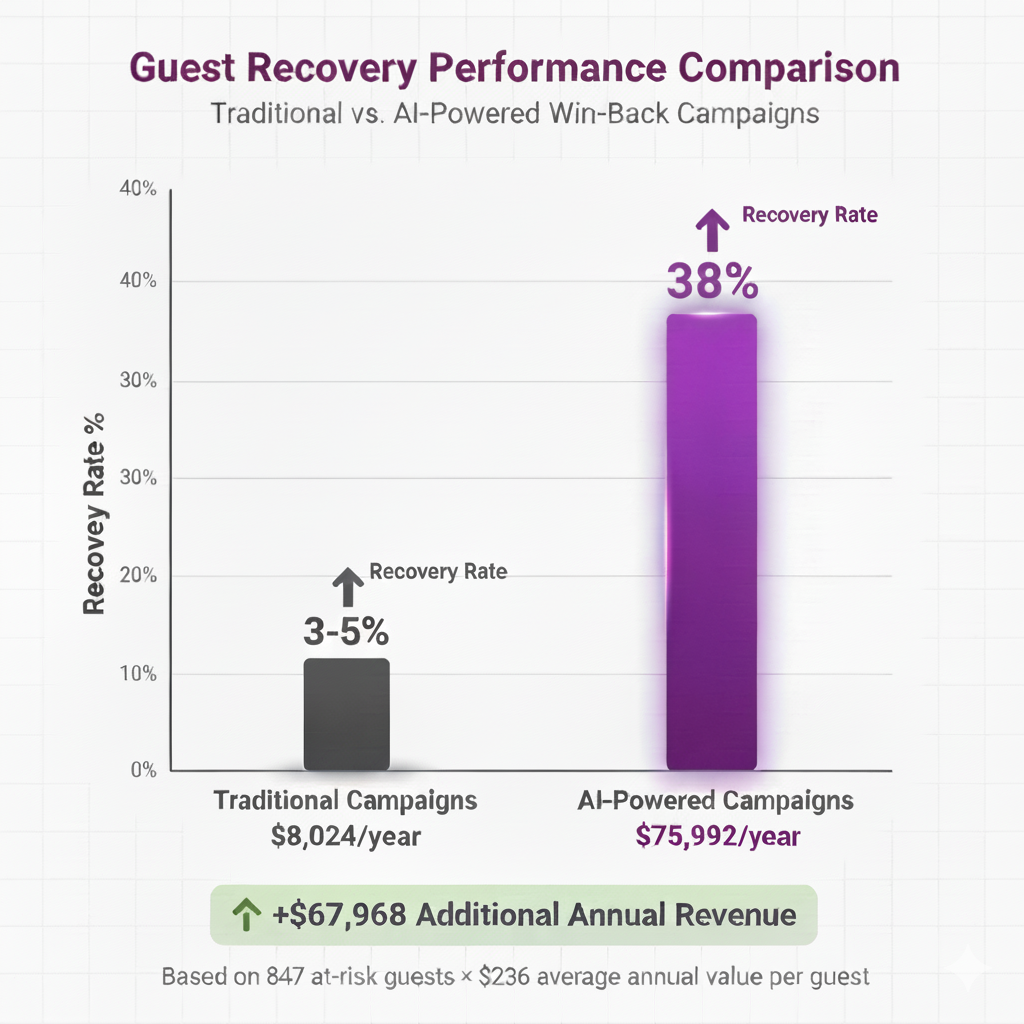
That behavioral precision is what separates 38% recovery rates from the 3-5% that traditional campaigns achieve.

Guest recovery comparison, AI vs. traditional

The 38% Recovery Rate: What’s Actually Possible

When restaurant customer retention is powered by AI-driven guest intelligence, the numbers transform.

Restaurants using automated, behaviorally-triggered win-back campaigns recover an average of 38% of at-risk guests, compared to the 3-5% recovery rate of traditional campaigns.

That’s not a marginal improvement. That’s a 7-12x performance increase.

What Does 38% Recovery Mean in Real Dollars?

Let’s return to those 847 guests who left silently last month.

Metric Traditional Approach AI-Powered Recovery
At-Risk Guests 847 847
Recovery Rate 4% 38%
Guests Recovered 34 322
Average Annual Value $236 $236
Revenue Recovered $8,024/year $75,992/year

Difference: $67,968 in additional annual revenue from guests you would have lost without ever knowing they were leaving.

And here’s the compounding effect: recovered guests don’t just return once. With continued personalized engagement, their lifetime value increases by an average of 43% compared to guests who weren’t flagged and re-engaged.

David’s Story: Caught at Day 32

Maria was the one who got away. Let’s talk about David, the one who didn’t.

David is a 41-year-old account manager who discovered your restaurant during a client lunch 14 months ago. He became a regular: Wednesday happy hours with colleagues, occasional Friday dinners with his wife, and a birthday celebration for his father-in-law.

32 visits. $2,847 lifetime value. Growing.

Then his company shifted to remote work. His Wednesday happy hours evaporated. His Friday dinners moved to restaurants closer to his new home in the suburbs.

David didn’t have a complaint. He didn’t have a bad experience. Life just… changed.

Day 18: David misses his usual Wednesday happy hour. System notes the deviation but doesn’t act because he’s visited on non-Wednesday dates before.

Day 25: Second missed Wednesday. His rolling 30-day visit frequency drops from 2.3 visits/week to 0.7 visits/week. System flags David as “Cooling Off.”

Day 32: An automated campaign triggers—not a generic “come back” message, but one written in your brand voice, sent because the system detected his specific behavior change.
“Hey David, it’s been a while! We’ve missed having you. Whether it’s a weeknight dinner or a weekend celebration, here’s 25% off your next visit. Bring the crew, bring the family, your table’s ready whenever you are.”

Day 38: David forwards the email to his wife. “Remember this place? We should go back.”

Day 41 (Friday): David returns with his wife. Different day, different occasion, but the relationship is restored.

Month 6: David has established a new pattern: monthly Friday date nights. Different frequency, same loyalty. Lifetime value, month 14: $3,294 and climbing.

The system didn’t just win back a customer. It adapted to his life change and retained him in a new capacity.

The Five Signals That Predict Churn

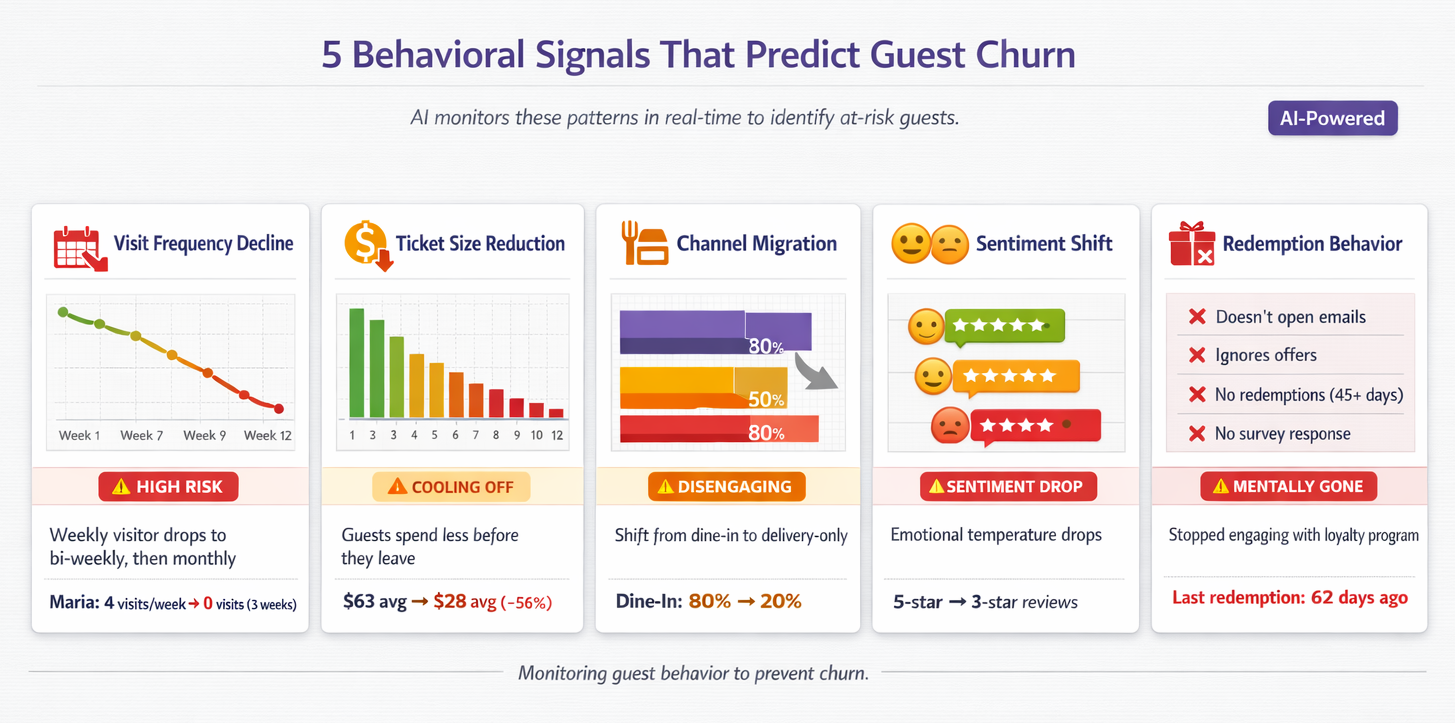
How do you know who’s about to leave before they’re gone? AI models identify these five behavioral signals:

1. Visit Frequency Decline

The most obvious signal, but only meaningful in context. A weekly visitor dropping to bi-weekly is concerning. A monthly visitor dropping to bi-monthly might be a normal seasonal variation.
AI tracks each guest’s individual baseline and flags deviations from their pattern, not a universal standard.

2. Ticket Size Reduction

When guests start spending less per visit, it often precedes complete departure. They’re testing the relationship before ending it, trading dinner for lunch, entrées for appetizers, wine bottles for glasses.

3. Channel Migration

Dine-in regulars who shift to delivery-only are showing reduced engagement. Delivery-only guests who stop ordering entirely are further along the churn journey.

4. Sentiment Shift

Review language and survey responses reveal emotional temperature. Guests who shift from “love it!” to “it’s fine” are cooling off, even if they’re still visiting.

5. Redemption Behavior Change

Loyal guests who stop redeeming offers or engaging with loyalty programs have mentally disengaged. They’re still being counted in your database, but they’ve already moved on.

Signs that a guest is about to churn

How Multi-Location Restaurants Scale Guest Recovery

For single-location operators, tracking regulars is challenging but possible. A great host might remember Maria’s Tuesday pattern, might notice when she’s absent for a few weeks.

For multi-location restaurant groups? Manual tracking is mathematically impossible.

A 10-location restaurant group with 15,000 active guests has 15,000 individual behavior patterns to monitor. No marketing team, regardless of size, can track that manually and respond within the 47-day window.

This is where AI-powered customer data platforms become essential infrastructure, not optional technology.

The Automated Guest Recovery Workflow

Here’s how modern restaurant marketing automation handles at-risk guest recovery at scale:

Step 1: Unified Data

CollectionGuest data flows in automatically from every touchpoint:

  • WiFi login data
  • POS transaction history
  • Online ordering platforms
  • Reservation systems
  • Review sites
  • Website behavior

Each data source adds dimension to the guest profile. Maria isn’t just “Tuesday salmon lady”—she’s a composite of 67 visits, 4 reviews, 3 reservation requests, 12 online orders, and every other interaction.

Step 2: AI-Powered Segmentation

Machine learning continuously categorizes guests:

  • Super Guests: Top 20% driving 80% of revenue
  • Regulars: Consistent, predictable visit patterns
  • New Guests: First or second visit, potential to develop
  • Cooling Off: Recent behavior suggests declining engagement
  • At-Risk: Significant deviation from established patterns
  • Lost: Exceeded recovery window without intervention

Segments update in real-time. When Maria misses her second Tuesday, she moves from “Regular” to “Cooling Off” automatically.

Step 3: Triggered Campaigns

Each segment has associated automated campaigns:

  • Cooling Off: Gentle check-in after first missed expected visit
  • At-Risk: Personalized win-back offer with urgency
  • Lost: Long-term re-engagement sequence

Campaigns are written in your brand voice and personalized with guest names—triggered by actual behavioral data, not arbitrary time windows.

Step 4: Optimal Timing

AI determines when each guest is most likely to engage. Maria checks email on Tuesday mornings. David responds better to Friday afternoon messages. The system sends at the right time for each individual.

Step 5: Revenue Attribution

When Maria returns after receiving the Day 15 message, the system tracks:

  • Which campaign drove the return
  • What she ordered on her return visit
  • Her subsequent visit pattern
  • Her updated lifetime value projection

This closes the loop. Every recovered guest is measured, and every campaign is optimized.

Restaurant guests returning

Implementation: From Silent Exodus to Recovered Revenue

What does it take to transform guest recovery from reactive guesswork to proactive automation?

Timeline to Impact

Days 1-3: Data Connection – Connect existing systems—POS, WiFi, online ordering, reservations, review sites—to the unified platform. Most integrations are automatic or require minimal technical setup.

Days 4-7: Historical Analysis – AI analyzes existing guest data to establish behavior baselines, identify current at-risk guests, and surface immediate opportunities.

Week 2: Campaign Activation – Automated win-back sequences go live. Guests flagged as at-risk during the historical analysis receive first recovery campaigns.

Week 3-4: Recovery Begins – First wave of recovered guests returns. Revenue attribution tracks each campaign’s performance.

Month 2+: Continuous Optimization – AI learns from campaign results, refining timing, messaging, and offer strategies. Recovery rates improve over time as the system learns your guests’ unique patterns.

Time Investment

Traditional manual win-back process: 15-20 hours per week (list building, campaign creation, analysis)

AI-automated guest recovery: 1-2 hours per week (reviewing results, strategic adjustments)

The time savings alone often justify the investment. The recovered revenue makes it transformative.

The Question You Should Be Asking

Right now, in your guest database, there are guests in the middle of their invisible exit.

They visited regularly. They spent meaningfully. They were on track to become lifetime customers.

And they’re leaving without saying goodbye.

The question isn’t whether you can afford AI-powered guest intelligence. The question is: How many Marias are walking away this month while you’re not watching?

What Happens Next

Every restaurant operator has two choices:

Option 1: Keep operating blind. Accept that 70% of first-time guests will never return. Accept that an unknown number of regulars are silently departing. Hope that new customer acquisition will outpace the invisible exodus.

Option 2: Start seeing. Deploy guest intelligence that monitors every behavior pattern, flags every at-risk guest, and automatically intervenes within the window where recovery is still possible.

The restaurants winning in 2025 aren’t working harder on acquisition. They’re getting smarter about retention.

Because the most expensive customer you’ll ever lose is the one you never knew was leaving.

Ready to stop losing guests forever?

See exactly how AI-powered guest intelligence identifies at-risk customers and recovers revenue automatically—before they become tomorrow’s lost guests.

Schedule Your Free Demo →
Calculate Your Recovery Potential →

P.S. While you were reading this article, somewhere in your guest database, a regular just became at-risk. The clock is ticking. Will you see them in time?

Related Articles

Click to schedule a Free Online Demo, or call 727-877-8181 to see how guest intelligence can transform your restaurant’s retention strategy.
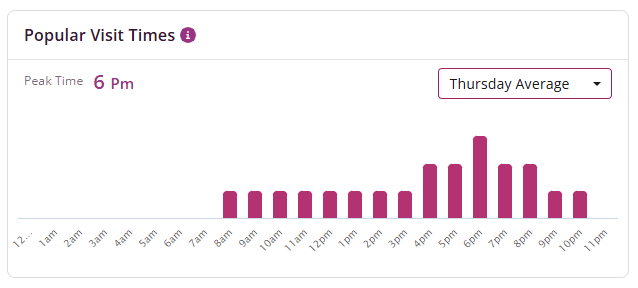
The Restaurant AI That Runs While You Sleep

Your restaurant never stops. Neither should your marketing.

It’s 2 AM. Your dining room is dark. Your team is home.

But somewhere across town, a guest who hasn’t visited in three weeks just received a personalized message, written in your voice, inviting them back.

A negative review that was posted an hour ago already has a thoughtful, on-brand response.

And when someone asks their phone or searches in any AI chat, “where’s the best brunch spot downtown?,” tomorrow morning you have a new guest.

This is what happens when intelligence meets automation. This is Bloom AI.

AI restaurant marketing automation that works 24/7

The Problem No One Talks About

Here’s the truth about restaurant marketing: it’s not one job. It’s a hundred jobs happening simultaneously.

Getting discovered. Capturing guest data. Turning first-timers into regulars. Keeping regulars coming back. Responding to reviews. Proving what actually works.

No human team can do all of this well. Not at scale. Not while also running a restaurant.

The chains pulling ahead right now aren’t working harder. They’re just working with better intelligence.

One System. Every Stage. Always On.

We built Bloom AI to power what we call the flywheel, a continuous cycle where every stage of your guest journey feeds the next.

Discoverability. When potential guests search—on Google, through AI assistants, by voice—your restaurant shows up. Not because of luck. Because your digital presence speaks the language these platforms understand.

Capture. Every guest who walks through your door becomes known. WiFi. Website. Online ordering. Reservations. Every touchpoint builds a profile. No more anonymous visits that vanish.

Land. First-time guests don’t drift away. Personalized welcome sequences engage them before they forget you existed. Trial becomes habit.

Expand. Frequency increases. Spend grows. Your best guests become even better guests through intelligent upsells and milestone recognition.

Engage. Birthday messages. New menu announcements. Seasonal offers. All timed perfectly. All written in your voice. All automated.

Retain. At-risk guests get reached before they’re gone. Not after. The system sees patterns you’d never catch manually.

Each stage feeds the next. Momentum compounds. The flywheel accelerates.

Bloom Intelligence Flywheel

Your Voice. Your Rules. Always.

Here’s what separates Bloom AI from generic automation: it sounds like you.

Upload your brand guidelines. Define your tone – friendly, sophisticated, playful, professional. Share writing samples. Set your rules.

Every email. Every SMS. Every review response. It all passes through your brand filter.

The AI doesn’t override your personality. It amplifies it. At scale. Around the clock.

You stay in control. You set the strategy. Bloom AI handles the mechanics.
What 24/7 Intelligence Actually Looks Like

Tuesday, 2:05 PM: The system detects Sarah hasn’t visited in 21 days. Her average is 7. She’s at risk.

Tuesday, 2:10 PM: A win-back message, written in your warm, conversational style, lands in her inbox with an exclusive offer.

Wednesday, 6 PM: Sarah returns.

You didn’t lift a finger.


Saturday, 11:47 PM: A 2-star review posts on Google. Cold food complaint.

Saturday, 11:52 PM: A thoughtful response, matching exactly how your team actually talks, goes live.

Sunday, 8 AM: Your operations manager gets an alert flagging a food temperature issue that needs attention.

The problem was addressed before you woke up.

The Lean Team Advantage

National chains have been running sophisticated guest intelligence for years. Massive teams. Massive budgets. Massive data infrastructure.

Bloom brings those same capabilities to all restaurants.

One marketer with Bloom operates like a five-person department. Campaigns launch automatically based on behavior, not calendar reminders. Reviews get responses within hours, not days. At-risk guests receive outreach before they’re lost.

The math speaks for itself:

  • 38% of lost guests recovered automatically.
  • 43% increase in guest lifetime value.
  • 15+ hours saved weekly per location.

Revenue attribution that proves what’s actually working.

Example of AI marketing automation with Bloom AI

The Foundation: Guest Intelligence

Everything starts with data.

Guest information flows in from WiFi, POS, online ordering, reservations, your website, and review sites. Bloom’s restaurant customer data platform unifies it all into individual guest profiles.

Not fragments. Not silos. One complete picture of every guest.

Behavioral insights. Spending patterns. Sentiment analysis. Visit frequency. Risk indicators.

This is the foundation the flywheel spins on.

The Restaurants That Win

The chains pulling ahead aren’t guessing anymore.

They’re capturing guests their competitors miss. They’re retaining regulars while others lose. They’re responding to reviews while others sleep. They’re proving ROI while others hope.

They’re not working harder. They’re working with better intelligence.

Your Guests Are Already Telling You Everything

Through their visits. Their orders. Their reviews. Their behavior.

The question is whether you’re listening.

Bloom AI makes listening automatic. And acting on what they say? That becomes automatic, too.

See the flywheel in action. Request your demo.

Or call 727-877-8181 to speak with one of our restaurant marketing specialists.


Bloom Intelligence is the AI-powered restaurant marketing platform that unifies guest data, automates marketing, and manages reputation—all in your brand voice, all around the clock.

Schedule a demo to experience how conversational AI transforms restaurant marketing intelligence.

Let Bloom Intelligence Make It Effortless

Bloom Intelligence is the AI-powered restaurant marketing platform that automatically grows revenue, protects reputation, and optimizes operations 24/7. Our unified platform combines guest data from every touchpoint with intelligent automation to give restaurants the marketing power of major chains—without the complexity or cost.

Bloom makes guest data collection and marketing automation effortless, which allows you to quickly execute the strategies listed above, saving you time, increasing customer lifetime values, attracting new guests, improving your reputation, and boosting your bottom line.

Call us or schedule a free demo online and Bloom will show you how our restaurant marketing platform can help you save time and increase your customer lifetime values by automatically building first-party customer databases, unlocking important guest insights to trigger automated marketing at the right time and place, discover true guest sentiment, save at-risk guests, increase your current guests’ frequency, supercharge your website, and find new guests.

Click to schedule a Free Online Demo, or call 727-877-8181 to see how we can help you drive tangible results for your restaurants.

Introducing Bloom AI: The First AI Marketing Assistant Built Exclusively for Restaurant Intelligence

How restaurant chains are using conversational AI to unlock instant insights from their own guest data and automate personalized marketing at scale

What Is Bloom AI and Why Does It Matter for Restaurant Marketing?

Imagine asking your marketing platform a simple question: “What are my top-performing menu items this month?” and receiving an instant, data-backed answer. No spreadsheets. No analyst is required. No waiting.

This is Bloom AI.

Bloom AI is the first artificial intelligence assistant purpose-built for restaurant marketing intelligence. It transforms the way restaurant operators, marketers, and executives interact with their guest data by enabling natural language conversations with your own unified guest intelligence across millions of guest data signals from profiles, orders, reviews, surveys, websites, WiFi, and guest behavior.

For restaurant chains of all sizes, this represents a fundamental shift in how marketing and operational decisions get made. Instead of spending hours pulling reports or waiting for your analytics team to surface insights, you simply ask.

How Does Bloom AI Work for Restaurants?

Bloom AI sits on top of your unified guest data collected from WiFi networks, POS systems, online ordering platforms, reservations, reviews, surveys, loyalty, and website interactions. When you ask a question, the AI instantly queries your specific data and delivers actionable answers tailored to your restaurant group.

The difference between Bloom AI and generic AI tools is profound. ChatGPT knows about restaurants in general. Bloom AI knows about your restaurants specifically. It understands your brand voice, your guest segments, your campaign history, and your operational benchmarks.

Natural Language Queries Replace Complex Analytics

Restaurant marketers can now access insights through simple questions:

Guest Intelligence Questions: “Summarize key guest behavior patterns from the past 30 days.” “What trends are emerging among first-time vs. repeat guests this month?” “Which guest segments show the highest drop-off after the second visit?”

Location Performance Questions: “Compare foot traffic across all locations for the past quarter.” “Which store had the highest guest retention rate this week?” “Summarize underperforming locations based on visit frequency.”

Marketing Campaign Questions: “Evaluate last week’s email campaign performance by segment.” “What campaign had the highest conversion among dormant guests?” “Summarize campaign results by gender and visit time.”

WiFi Analytics Questions: “Summarize new guest WiFi signups vs. returning users this week.” “What time periods saw the longest average dwell time?” “Highlight changes in peak hours based on WiFi data.”

Each question returns specific insights from your restaurant’s actual performance data, not industry averages or generic recommendations.

The AI Restaurant Marketing Command Center

Bloom AI extends far beyond simple data queries. It powers the entire marketing intelligence ecosystem that drives automated revenue growth for restaurant chains.

Brand Voice Training

Every restaurant brand has a distinct personality. Bloom AI learns your communication style, tone preferences, and messaging guidelines. When the platform generates email campaigns, SMS messages, review responses, or survey follow-ups, the output sounds authentically like your brand.

This training happens automatically as you use the platform. The AI analyzes your existing communications, approved templates, and brand rules to ensure consistency across every guest touchpoint.

Guest Sentiment Intelligence

With over millions of reviews analyzed across the platform, Bloom AI understands what guests are saying about your restaurants. It identifies recurring themes in positive feedback to amplify, surfaces operational issues before they become systemic problems, and helps you understand the voice of your guest at scale.

When a guest mentions “cold food” or “slow service” in a review, the AI doesn’t just flag the negative sentiment. It connects that feedback to your operational dashboard, suggests appropriate response templates, and identifies whether this represents an isolated incident or an emerging pattern.

Expert Marketing Models

Bloom AI incorporates proven restaurant marketing models that have generated measurable results across 1,000+ partners. These aren’t theoretical frameworks; they’re battle-tested approaches refined through millions of guest interactions.

The platform knows which campaign types work best for different guest segments:

  • At-Risk Guest Recovery: Automated campaigns targeting guests whose visit frequency is declining before they become fully lost.
  • New Guest Conversion: Campaigns designed to convert first-time visitors into repeat guests during the critical window after their initial visit.
  • Super Guest Nurturing: High-touch communications that increase lifetime value among your most valuable guests.
  • Milestone Campaigns: Birthday, anniversary, and loyalty card triggers that drive incremental visits.

AI-Powered Marketing Automation That Operates 24/7

The true power of Bloom AI emerges when it connects intelligence to action. Understanding your data is valuable. Automatically acting on that understanding generates revenue.

Personalized Email and SMS Marketing

Bloom AI doesn’t just segment your audiences; it crafts personalized messages for each segment based on their specific behavior patterns, preferences, and engagement history. A super guest receives different messaging than a cooling-off guest, and both receive different treatment than a new guest on their second visit. And it ties every campaign directly to revenue attribution, so you know exactly what worked.

Intelligent Review Response Automation

Responding to reviews across Google, Yelp, Facebook, TripAdvisor, OpenTable, Tock, and surveys consumes hours of staff time weekly. Bloom AI automates this process with responses that acknowledge guest feedback, match your brand voice, and address specific points raised in each review.

The platform applies rules based on rating, location, and review content. A 5-star review might receive a quick thank-you response. A 3-star review triggers a longer response addressing concerns. Critical reviews can be flagged for human review before any automated response.

Website Optimization for AI and Search Discovery

Restaurant websites increasingly compete not just for search rankings, but for visibility in AI platforms like ChatGPT, Google’s AI Overviews, and voice assistants. Bloom AI helps optimize your web presence for both traditional SEO and emerging answer engine optimization (AEO).

The platform identifies which questions potential guests ask about restaurants like yours and helps structure your website content to provide direct answers. Smart data structure recommendations ensure search engines and AI platforms understand your menu, locations, hours, and offerings.

The Marketing Flywheel: How AI Creates Compounding Results

Restaurant marketing with Bloom AI operates as a flywheel rather than a series of disconnected campaigns. Each guest interaction generates data that improves future marketing effectiveness.

Guest Visits → Data Collection: WiFi, POS, online ordering, reviews, surveys, and reservation data flow into unified guest profiles.

Unified Profiles → AI Analysis: Bloom AI identifies patterns, segments audiences, and surfaces opportunities.

AI Analysis → Automated Action: Personalized campaigns launch automatically based on behavioral triggers and sentiment.

Campaigns → Guest Response: Guests engage, visit, purchase, and provide feedback.

Online Discovery → New Guest Response: New guests explore, discover, visit, purchase, and provide feedback.

Guest Response → More Data: New interactions enrich profiles and improve future targeting.

This flywheel accelerates over time. The more data your restaurants generate, the smarter Bloom AI becomes at identifying opportunities and personalizing outreach, and driving online discovery. Early adopters stake a claim in the AI landscape and compounding benefits as their guest intelligence matures.

Operational Excellence Through Guest Intelligence

Bloom AI isn’t limited to marketing applications. The same unified guest intelligence that powers personalized campaigns also drives operational improvements.

Staffing Optimization

By analyzing WiFi foot traffic patterns, ticket data, and visit timing data, Bloom AI identifies when your restaurants are busiest and when guest volume drops. This intelligence helps operations teams optimize staffing schedules to match actual demand rather than historical assumptions.

Menu Intelligence

Order data reveals which menu items drive revenue, which items guests frequently order together, and which items appear in orders from your highest-value guests. This intelligence informs menu engineering decisions and promotional strategies.

Location Benchmarking

Multi-location operators can compare performance across their restaurant group using standardized metrics. Bloom AI surfaces which locations outperform on guest retention, which struggle with review ratings, and which show unusual patterns that warrant investigation.

Who Benefits Most from AI Restaurant Marketing?

Bloom AI delivers the greatest impact for all businesses but is optimized for restaurant chains. While large operators have significant resources Bloom is also optimize for operators that face a unique challenge: they’re large enough that fragmented data creates real operational complexity, but lean enough that they can’t afford dedicated data science teams.

Restaurant CEOs and Founders

Executives gain instant visibility into performance across their entire restaurant group without waiting for weekly or monthly reports. Strategic questions get answered in seconds, not days.

Marketing Teams

Marketing teams gain enterprise-level capabilities without enterprise-level headcount. A single marketer with Bloom AI produces the output of a five-person department and measures precise ROI on every campaign.

Operations Leaders

Operations teams translate guest intelligence into actionable improvements. Review sentiment analysis identifies service issues. Traffic patterns inform staffing. Guest feedback guides training priorities.

Roka Akor

New Case Study: Roka Akor

#1 AI-recommended Japanese Steakhouse in Chicago, San Francisco & Scottsdale

Read Now

Getting Started with AI Restaurant Marketing

Implementing Bloom AI doesn’t require lengthy integration projects or technical expertise. The platform connects to your existing data sources through pre-built integrations with major POS systems, online ordering platforms, reservation systems, and review sites.

Most restaurant chains are fully operational within 24 hours of setup. Guest data begins flowing immediately, profiles start building automatically, and AI insights become available as soon as data populates.

The onboarding process includes configuring your brand voice settings, establishing automation rules for campaigns and review responses, and setting up the dashboard views most relevant to your role.

The Future of Restaurant Marketing Is Conversational

Restaurant marketing has evolved from mass mailers to email lists to segmented campaigns. The next evolution is conversational intelligence, where operators interact with their data through natural language and AI handles the complexity of personalization at scale.

Bloom AI represents this future, available today.

Your competitors are already adopting AI-powered marketing platforms. The question isn’t whether conversational intelligence will transform restaurant marketing. The question is whether you’ll lead that transformation or respond to it.

Ready to see Bloom AI in action?

Schedule a demo to experience how conversational AI transforms restaurant marketing intelligence.

Schedule Your Free Demo

Or call 727-877-8181 to speak with one of our restaurant marketing specialists.


Ready to give your restaurant the advantage?

See exactly how Bloom Intelligence works around the clock to grow your revenue, protect your reputation, and optimize your operations. Watch your actual guest data transform into automated marketing that never stops working.

Schedule Your Intelligence Audit | Calculate Your After-Hours Revenue

P.S. While you’ve been reading this article, Bloom-powered restaurants have responded to 47 reviews, recovered 12 lost guests, and generated $8,400 in protected revenue. The clock never stops. Neither should your marketing.

Join the restaurants that never sleep. Because your guests never do.

Let Bloom Intelligence Make It Effortless

Bloom Intelligence is the AI-powered restaurant marketing platform that automatically grows revenue, protects reputation, and optimizes operations 24/7. Our unified platform combines guest data from every touchpoint with intelligent automation to give restaurants the marketing power of major chains—without the complexity or cost.

Bloom makes guest data collection and marketing automation effortless, which allows you to quickly execute the strategies listed above, saving you time, increasing customer lifetime values, attracting new guests, improving your reputation, and boosting your bottom line.

Call us or schedule a free demo online and Bloom will show you how our restaurant marketing platform can help you save time and increase your customer lifetime values by automatically building first-party customer databases, unlocking important guest insights to trigger automated marketing at the right time and place, discover true guest sentiment, save at-risk guests, increase your current guests’ frequency, supercharge your website, and find new guests.

Click to schedule a Free Online Demo, or call 727-877-8181 to see how we can help you drive tangible results for your restaurants.

Holiday Restaurant Marketing That Turns Seasonal Guests Into Year-Round Revenue

The holiday season represents the single biggest revenue opportunity of the year for restaurants. Based on industry data, November through January accounts for 40% of annual dining spend, with guests visiting 2.3 times more frequently and spending 34% more per visit than any other quarter.

Yet most restaurants treat holiday marketing like a one-time event. They push promotions in December that disappear with the Christmas decorations. The result? They capture short-term revenue but lose the long-term value.

Those holiday guests who could become regulars worth $1,890 in lifetime value (according to Bloom Intelligence customer data) simply vanish after New Year’s.

Here are the stakes:

  • Average restaurant sees 150 to 200 first-time guests during the holiday season
  • Industry average: 70% never return after January
  • Lost lifetime value per location: $197,190 to $262,920 annually
  • For a 5-location chain: nearly $1 million in lost revenue

The restaurants that win don’t just market for the holidays. They utilize the holiday season as a strategic period for data collection and relationship building. With the right guest intelligence infrastructure, every holiday visitor becomes an opportunity for 365-day revenue growth.

holiday season restaurant guests

The Foundation: Building Your Holiday Guest Intelligence System

Why the Holidays Are Perfect for Data Collection

Holiday guests are more receptive to engagement. They stay longer for celebrations, which means higher WiFi connection rates. They book more reservations, capturing data at the point of booking. They order more catering and takeout online. They engage more on social media and leave more reviews.

This creates the perfect environment to collect the data you need to market to them throughout the year.

What to Collect:

Your holiday data collection should focus on four categories:

Essential contact data includes name, email, phone number, and contact preferences. This is your foundation. Without it, you can’t reach guests after they leave.

Behavioral intelligence reveals visit timing, dwell time, spend patterns, and dining occasion. This tells you who they are as diners.

Holiday-specific signals capture party size, special occasion indicators, and gift card purchases. This context helps you understand their relationship with your restaurant.

Digital engagement tracks email opens, SMS responses, and online ordering behavior. This shows you how they prefer to communicate.

holiday guest data collection sources

The Customer Data Platform (CDP) Advantage

A restaurant CDP doesn’t just collect data. It creates comprehensive guest profiles that unify information from every touchpoint.

WiFi marketing captures first-time visitors at the door. POS integration tracks ordering behavior and spend. Reservation systems provide booking patterns and party size. Online ordering reveals convenience preferences. Review platforms surface sentiment and satisfaction.

This creates a unified intelligence hub where every piece of data works together to build a complete picture of each guest.

Real-Time Profile Building:

From first contact, your CDP begins building intelligence. The Thompson family books a table for 8 on December 23rd, orders three bottles of wine, connects to WiFi, and stays for 2.5 hours. Your system knows this isn’t a quick casual meal. They’re celebrating something important.

Sarah orders holiday catering for 20 people, picks up during lunch rush, and joins your email list. Your system identifies her as a potential corporate client or frequent entertainer.

Marcus visits alone twice in one week during the lunch rush, always orders the same burger, and leaves 5-star reviews. Your system recognizes him as a convenience-focused regular in the making.

Without a CDP, these are just transactions. With one, they’re opportunities for targeted, personalized marketing that dramatically increases return rates.

AI-Powered Segmentation: Turning Data Into Actionable Audiences

Manual segmentation based on gut feelings doesn’t work at scale. You need AI-powered segmentation that automatically groups guests based on their behavior, not your assumptions.

The Five Critical Holiday Segments:

First-Time Holiday Guests represent your biggest opportunity. These visitors discovered you during the holiday rush. Without intervention, 70% will never return. They’re prime candidates for post-holiday nurture campaigns.

Returning Holiday Guests are building momentum. They’ve made their second or third visit during the holidays. They’re in the critical conversion window where they could become regulars or churn. They need frequency-building campaigns in Q1.

Regular Guests form your steady base. They visit monthly or more often throughout the year. Use holidays as an upsell opportunity for private parties and catering. Reward their loyalty with VIP experiences.

Churning Guests haven’t visited in 60+ days but could be recovered. Holiday nostalgia is a powerful trigger. Personalized win-back campaigns work three times better during holidays.

Super Guests are your VIPs. The top 20% of guests drive 80% of revenue. Holidays are their celebration season. Give them early access, special experiences, and recognition to deepen loyalty.

AI powered guest segmentation

Why Manual Segmentation Fails:

Without a CDP, you’re guessing at segments based on incomplete data. You might know Sarah ordered catering, but you don’t know she’s also dined in twice, left a 4-star review, and hasn’t opened your last three emails. That context changes everything about how you market to her.

Strategic Holiday Marketing By Guest Segment

First-Time Holiday Guests: The 72-Hour Recovery Window

These guests came for the holidays. Family was in town. Office parties needed venues. Special occasions required celebration. Post-January, they have no reason to return unless you give them one.

The window to influence a new guest’s return decision is incredibly short. Within 72 hours, they’ve either planned their next visit or moved on to other dining options. That’s why timing matters more than perfect targeting.

The Strategy:

Immediate Welcome (Within 24 hours):

Send an automated thank-you message acknowledging their first visit. Keep the tone warm and appreciative, not salesy. Include a link to join your loyalty program, follow you on social media, or leave a review.

This isn’t about pushing them to return immediately. It’s about establishing the relationship while your restaurant is fresh in their mind.

The Hook Campaign (Days 3 to 7):

Deploy personalized messaging based on visit behavior. The high-spend table service guest gets menu recommendations and information about upcoming special events. The quick casual lunch visitor gets convenience messaging about online ordering. The large party booking gets private dining and catering options.

You’re matching your message to how they already use your restaurant.

The January Bridge (Weeks 2 to 4):

Combat the post-holiday dining slump with compelling reasons to return. Launch “New Year, New Menu” items. Offer resolution-friendly options without being preachy. Create value-focused offers that don’t train discount behavior.

January is when most restaurants lose first-time holiday guests. Your goal is to keep the conversation alive.

The Conversion Play (Month 2 to 3):

Segment by engagement level. Guests who opened emails get more content, recipe features, and behind-the-scenes stories. Guests who didn’t engage get an SMS touchpoint with a time-sensitive offer. Your goal is to secure the second visit before the 90-day window closes.

After 90 days without contact, recovery rates plummet.

Real Results:

Restaurants using AI-powered recovery campaigns convert 43% of first-time holiday guests into returning guests versus the 30% industry average. That’s a difference of $24,570 in lifetime value per 100 new guests. (https://bloomintelligence.com/blog/why-first-time-guests-never-return/)

Returning Holiday Guests: Building Frequency Before Q1 Slump

These guests have visited two or three times total. They’re in the critical “on-the-fence” phase where they could become regulars or disappear forever. Research shows that guests who visit four or more times in the first six months are five times more likely to become long-term regulars.

Your goal is to push returning guests past this threshold before spring.

The Strategy:

Momentum Campaigns (January to February):

Leverage recency while you have it. Send messages like “Since you loved the lamb chops, you have to try our new rosemary ribeye.” Create frequency incentives such as “Visit three times in January, get a complimentary appetizer.”

You’re creating habit formation during the slow season when you have capacity and guests have fewer competing options.

Preference Learning:

Use early visits to understand their patterns. Does this guest always order wine? Send them wine pairing events and new bottle launches. Do they bring kids every time? Send family night promotions. Are they weekend brunch regulars? Send weekend-specific campaigns.

Every interaction teaches you how to market to them more effectively.

Relationship Deepening:

Invite them to join your loyalty program with an immediate benefit. Survey them about their preferences and actually use the data. Capture birthdays and anniversaries for future campaigns.

The goal isn’t just to get them back. It’s to learn enough about them that you can market to them intelligently for years.

Regular Guests: Holiday Upsell and VIP Recognition

Your regulars are already coming. Don’t lose them in the holiday chaos or take them for granted. They represent your most valuable asset, and the holidays create unique opportunities to deepen these relationships and increase their value.

holiday season VIP restaurant guests

The Strategy:

Pre-Holiday VIP Access:

Give regulars early reservation booking for popular holiday dates. Offer them a first look at your holiday menu or special offerings. Allow private event booking before public announcement.

This makes them feel valued and ensures they don’t get frustrated trying to book during peak times when availability is limited.

Upsell Opportunities:

The holidays create natural upsell moments. Market catering for their holiday parties. Promote gift card purchases with incentives like “Spend $100, get a $20 bonus card.” Offer wine bottle sales for holiday entertaining. Push takeout and delivery options for busy holiday hosts.

Your regulars already trust you. They’re the easiest audience for upsells because they know your quality.

Recognition and Appreciation:

Send personalized holiday greetings from management, not automated corporate messages. Surprise and delight them with an unexpected appetizer, upgrade, or discount. Host an exclusive “regulars only” event in January to combat the post-holiday slump.

These gestures cost little but build enormous loyalty.

The Retention Insurance:

During busy holiday periods, service can slip and waits can increase. Proactive communication with regulars prevents frustration. A simple message like “We know it’s busier than usual. Your patience means everything to us, and we’ve saved your favorite table” acknowledges reality and shows respect.

This prevents the service degradation that drives away even loyal guests during peak periods.

Churning Guests: The Holiday Win-Back Window

These guests haven’t visited in 60 to 90+ days. They’re nearly lost, but the holidays create a unique emotional opening. People are more nostalgic, more social, and more willing to try places they used to love.

The Strategy:

Nostalgia Triggers:

Lead with “We miss seeing you” messaging with a genuine, personal tone. Reference their past favorites: “Your usual table is ready” or “Remember that short rib you loved?” Use their name, their history, and their preferences to make it personal.

Generic “We want you back” messages get ignored. Personal messages that show you actually remember them get responses.

Holiday-Specific Hooks:

Position your restaurant as perfect for situations where they need one. “Hosting out-of-town guests this year?” creates urgency. “Our cranberry pork tenderloin is only here through January” adds scarcity. “We’ve added online ordering” or “We now take reservations” removes barriers that might have caused them to leave.

The holidays give you multiple angles to reach churning guests.

The Right Incentive:

Avoid generic discounts. They train price sensitivity and attract the wrong behavior. Instead, use personalized offers based on past behavior.

High spenders get a complimentary appetizer or dessert, not 20% off. Price-sensitive guests get targeted value offers like “Lunch special: $12 for your choice of entree and drink.” Guests who loved specific items get “Chef’s bringing back your favorite dish for a limited time.”

The incentive should remove friction, not become the primary reason to visit.

Segmented Urgency:

Guests who lapsed for 60 days get a soft, friendly check-in. Guests who lapsed for 90 days get a stronger incentive and clearer ask. Guests who lapsed for 120+ days get a last-chance campaign before you archive them.

Different levels of churn require different intensities of effort.

Win-Back Success Rate:

AI-powered win-back campaigns during the holidays recover 38% of at-risk guests versus 12% with generic email blasts. That’s a difference of $48,672 in recovered lifetime value per 100 lapsed guests. (https://bloomintelligence.com/blog/why-first-time-guests-never-return/)

Super Guests: Deepening the Most Valuable Relationships

Your top 20% of guests drive 80% of revenue. Losing even one super guest costs you $9,450 in lifetime value. The holidays are your chance to strengthen these relationships so they never consider going anywhere else.

The Strategy:

White Glove Treatment:

Make personal phone calls, not send emails, for holiday reservation assistance. Guarantee seating even on the busiest nights. Offer menu customization for dietary needs or special requests. Provide a dedicated point of contact like a manager or owner direct line.

Super guests should never wonder if they’ll get a table or if you’ll accommodate their needs.

Exclusive Experiences:

Host chef’s table events with limited seating. Offer first taste of new menu items before public launch. Provide behind-the-scenes kitchen tours or cooking classes. Give private dining room access with custom menus.

These experiences can’t be bought. They’re reserved for your most valuable guests, which makes them even more valuable.

Strategic Gifting:

End the year with appreciation gifts, not discounts. Send personalized wine bottles, a cookbook from your chef, or branded merchandise. Mail holiday cards signed by the owner or GM with a personal note. Make surprise deliveries: “We know you love our braised lamb, so we brought it to you.”

These gestures cost less than the discount campaigns you’d run for other segments, and they build far more loyalty.

Investment in Relationship:

Conduct quarterly check-ins from ownership. Solicit feedback and actually implement it. Name a dish after them, even jokingly on a special occasion menu. Introduce them to other super guests to create community.

Super guests don’t just want good food and service. They want to feel like insiders, like they’re part of something special.

The Math:

If you have 50 super guests each worth $9,450 in lifetime value, a 10% attrition rate costs you $47,250 annually per location. White-glove holiday experiences reduce super guest churn from 10% to 2%, saving $37,800 per location.

That’s a massive ROI for relatively small investments in relationship building.

Bloom Intelligence Dashboard

Automation: The Secret to Executing at Scale

Even with perfect segmentation, most restaurants can’t execute these strategies. They require constant monitoring of guest behavior, precise timing of message deployment, personalization at scale across hundreds of guests, coordination across email, SMS, and in-restaurant touchpoints, and performance tracking and optimization.

You’d need a full-time marketing team. Or you need automation.

Triggered Campaigns That Launch Automatically

No Calendar Management Required:

First-time guest welcome series trigger within 24 hours of a visit. Frequency-building campaigns launch when returning guests hit specific visit counts. Win-back campaigns deploy when a regular’s visit frequency declines. Super guest VIP communications send at predetermined touchpoints.

You set the rules once. The system executes forever.

Behavioral Triggers, Not Calendar Dates:

Sarah books a large party. A catering offer triggers automatically. Marcus hasn’t visited in 45 days. A “We miss you” campaign launches. The Thompson family leaves a 5-star review. A “Thank you plus refer a friend” message sends.

The system responds to what guests do, not what date it is.

Dynamic Personalization Without Manual Work

AI Writes the Message:

The system pulls guest name, visit history, order preferences, and sentiment. It generates personalized subject lines and message content. It adapts tone based on guest segment, whether VIP, churning, or new. It tests variations and optimizes based on response rates.

You’re not writing hundreds of individual emails. AI does it for you based on the data you’ve collected.

Channel Intelligence:

The system automatically selects email versus SMS based on past engagement. It determines optimal send time based on when a guest typically opens messages. It applies frequency capping to prevent over-communication.

Guests get messages through the channel they prefer, at the time they’re most likely to engage.

Reputation Management at Scale

Automated Review Generation:

Post-visit rating requests go out with smart timing, not too immediate and not too late. Sentiment-based routing sends happy guests to public review platforms and unhappy guests to direct feedback. AI-powered response suggestions appear for every review. Trend identification alerts you when you’re getting negative mentions of wait times or specific dishes.

You stay on top of your reputation without manually monitoring six different review sites.

Performance Intelligence You Can Actually Use

Real-Time Dashboards:

See campaign performance by segment. Track guest lifetime value trending. Monitor visit frequency and spend patterns. View attribution showing which campaigns drive actual visits and revenue.

You know what’s working and what’s not, so you can double down on success.

Actionable Alerts:

The system tells you when 10 regulars haven’t visited in 60 days. It notifies you when first-time guest return rate drops 15% this month. It warns you when negative sentiment increases around a specific issue.

You’re not digging through data to find problems. Problems surface themselves so you can fix them.

The Holiday-to-365 Transformation

The difference between restaurants that simply have a good holiday season and those that transform holiday success into year-round growth comes down to one thing: data infrastructure and automation.

The Traditional Cycle (Reactive):

You run a busy November and December with promotions and holiday menus. Revenue spikes in Q4. January brings a slump as holiday guests disappear. You scramble in February and March to drive traffic. You repeat this next year.

The Guest Intelligence Cycle (Proactive):

You run a strategic holiday season focused on data collection and relationship building. Automated nurture campaigns launch in January. First-time guests convert to returning guests at 43% versus the 30% industry average. Returning guests hit the four-visit threshold and become regulars. Q1 revenue stays strong as holiday guests remain engaged. Year-round frequency increases drive compound growth. (https://bloomintelligence.com/blog/guest-intelligence-flywheel/)

turning holiday traffic into lifelong regulars

The Numbers:

A typical single-location restaurant that implements holiday guest intelligence captures 175 new guests during the November to December holiday season. It converts 75 to returning guests at a 43% rate versus 53 with typical marketing at a 30% rate. Those 22 additional returning guests multiplied by $1,890 lifetime value equals $41,580 per location. That compounds across five locations to equal $207,900 annual impact.

This is from just one holiday season’s guest recovery.

Let Bloom Intelligence Automate Your Holiday Success

You now understand the strategy. You see the opportunity. You know the value of recovering first-time guests, building frequency with returning visitors, and creating VIP experiences for super guests.

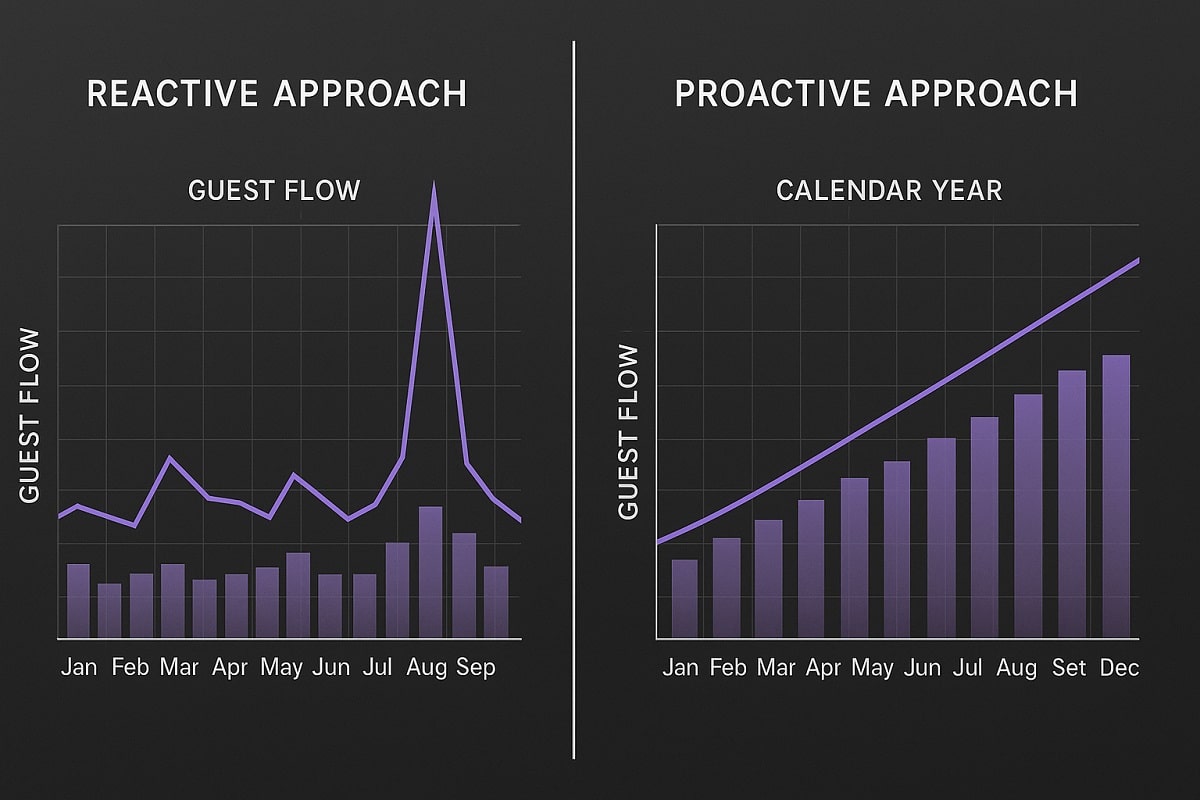
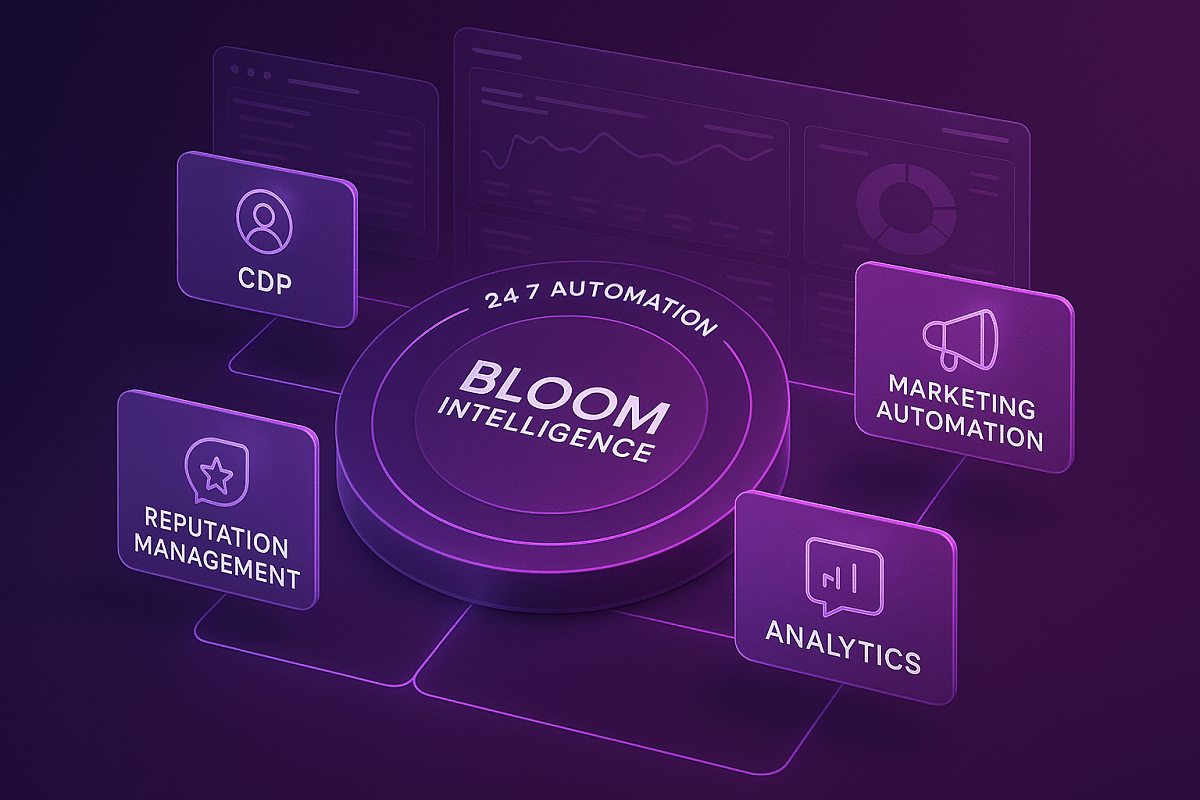
But here’s the truth: executing this manually is nearly impossible.

You’d need a CDP to unify guest data from WiFi, POS, reservations, reviews, and ordering. You’d need marketing automation to segment audiences and trigger personalized campaigns. You’d need reputation management to monitor sentiment and respond to reviews. You’d need analytics to track performance and optimize results. You’d need a marketing team to manage all of it.

Or you need Bloom Intelligence.

What Bloom Does Automatically

Instant Guest Intelligence:

Bloom captures guest data from the first WiFi connection, reservation, or online order. It creates comprehensive profiles with behavioral and preference data. AI-powered segmentation identifies first-time, returning, regular, churning, and super guests. Real-time updates occur as guests interact with your restaurant.

You don’t build profiles manually. The system builds them automatically from day one.

Campaign Automation That Works While You Sleep:

Bloom includes pre-built holiday campaigns for every guest segment. Behavioral triggers launch personalized messages at optimal times. Dynamic content adapts to each guest’s history and preferences. Multi-channel delivery uses email and SMS based on engagement patterns.

You set your strategy once. The system executes it 24/7 without your involvement.

Reputation Protection on Autopilot:

Bloom sends automated review requests with sentiment routing. It provides AI-generated review response suggestions. It identifies trends and sends operational alerts. Five-star reviews increase 67% on average.

Your reputation improves without you manually monitoring review sites every day.

Results You Can Measure:

Bloom users see a 43% first-time guest return rate versus the 30% industry average. They achieve a 38% recovery rate for at-risk guests. They gain $18,900 monthly increase in lifetime value capture for just 10 recovered guests. They experience 247% improvement in campaign performance. They enjoy an 89% reduction in manual marketing tasks. (https://bloomintelligence.com/blog/guest-intelligence-flywheel/)

Bloom Intelligence features

Don’t Forget AI Search and Voice – How Guests Are Finding Restaurants This Holiday Season

The way guests discover restaurants is changing fast. Traditional search engines like Google are still important, but now AI-based tools like ChatGPT, Google’s AI Overviews, and Perplexity.ai are influencing how guests get recommendations—especially during the holidays when people ask questions like:

  • “What’s the best place for a holiday dinner near me?”

  • “Where can I buy a restaurant gift card for my boss?”

  • “Which restaurants offer holiday catering in [city]?”

At the same time, voice search through assistants like Siri, Alexa, and Google Assistant is rising. Many guests now speak their searches, especially when driving or multitasking. These queries are often more conversational and specific, which means your restaurant’s online presence needs to align with how real people talk and search.

If your website isn’t structured and optimized correctly, you risk missing out—even if your food, service, and atmosphere are exceptional.

How Bloom Helps Restaurants Get Found by AI and Voice Search

Bloom Intelligence doesn’t just help you personalize marketing and automate retention. It also optimizes your website content and structure to ensure that modern AI search tools can understand and recommend your restaurant. With Bloom, your site content is:

  • Structured for voice and AI-friendly questions like “best date-night restaurant with gluten-free options”

  • Optimized with schema and metadata that search engines use to categorize your restaurant properly

  • Built to surface location, menus, hours, and promotions clearly so voice assistants and AI bots can access it quickly

  • Regularly updated to reflect your holiday events, menus, and booking availability, so AI tools can share current, accurate info with guests

This isn’t just SEO—it’s guest discovery optimization for how people search in 2025. And it matters more during the holidays when guests make fast decisions about where to dine, celebrate, or gift.

The Bloom Advantage

Single Platform. Zero Complexity. Immediate Results.

While competitors piece together separate vendors for CDP, marketing automation, and reputation management, Bloom gives you everything in one unified platform. You get a 24-hour setup with instant guest intelligence. You see week one campaigns driving measurable engagement. You experience month one optimization showing improved satisfaction and revenue. You work with an expert support team that acts as your marketing partner.

This Holiday Season, Stop Losing Guests Forever

The technology exists. The results are proven. The only question is: how much more revenue are you willing to lose to indecision?

Transform your holiday season from a temporary spike into a sustainable growth engine. Turn seasonal guests into year-round regulars. Recover the $132,300 in lifetime value that walks out your door every month.

Schedule a free demo and see how Bloom Intelligence can turn your guest data into automatic revenue growth this holiday season.

Schedule Your Free Demo

Or call 727-877-8181 to speak with one of our restaurant marketing specialists.


Ready to give your restaurant the advantage?

See exactly how Bloom Intelligence works around the clock to grow your revenue, protect your reputation, and optimize your operations. Watch your actual guest data transform into automated marketing that never stops working.

Schedule Your Intelligence Audit | Calculate Your After-Hours Revenue

P.S. While you’ve been reading this article, Bloom-powered restaurants have responded to 47 reviews, recovered 12 lost guests, and generated $8,400 in protected revenue. The clock never stops. Neither should your marketing.

Join the restaurants that never sleep. Because your guests never do.

Let Bloom Intelligence Make It Effortless

Bloom Intelligence is the AI-powered restaurant marketing platform that automatically grows revenue, protects reputation, and optimizes operations 24/7. Our unified platform combines guest data from every touchpoint with intelligent automation to give restaurants the marketing power of major chains—without the complexity or cost.

Bloom makes guest data collection and marketing automation effortless, which allows you to quickly execute the strategies listed above, saving you time, increasing customer lifetime values, attracting new guests, improving your reputation, and boosting your bottom line.

Call us or schedule a free demo online and Bloom will show you how our restaurant marketing platform can help you save time and increase your customer lifetime values by automatically building first-party customer databases, unlocking important guest insights to trigger automated marketing at the right time and place, discover true guest sentiment, save at-risk guests, increase your current guests’ frequency, supercharge your website, and find new guests.

Click to schedule a Free Online Demo, or call 727-877-8181 to see how we can help you drive tangible results for your restaurants.

Bloom Fall 2025 Release: Three AI Features That Turn Your Marketing Team into Revenue-Generating Superhumans

Restaurant AI That Actually Works While You Sleep

Right now, your competitors are drowning in data they can’t understand, burning hours on manual tasks that should be automated, and watching potential customers choose other restaurants because they can’t be found online.

Today, that changes.

Bloom Intelligence’s Fall 2025 release introduces three transformative AI-powered features that don’t just streamline your restaurant marketing, but fundamentally reimagine what a lean team can accomplish. These aren’t incremental improvements. They’re force multipliers that give one-person marketing teams the output of entire departments, while multi-location chains gain capabilities previously reserved for Fortune 500 brands.

1. Bloom AI: Your Private Restaurant Intelligence Expert That Never Sleeps

Query Your Entire Restaurant Empire with Natural Language

Imagine having a data scientist, marketing strategist, and operations expert available 24/7, one who knows every guest, every order, every review, and every pattern across your entire restaurant group. That’s Bloom AI.

What It Actually Does: Bloom AI is your private AI assistant that instantly analyzes millions of data points across your entire Bloom platform. Guest profiles, ordering patterns, behavioral trends, sentiment analysis, and operational metrics deliver expert insights through simple conversation. Ask questions in plain English. Get answers that drive revenue.

Real-World Power:

  • “Which of my regular guests haven’t visited in 3 weeks?” → Instant list with automated recovery campaigns ready to launch
  • “What menu items do my high-value Tuesday lunch guests prefer?” → Data-driven menu optimization insights
  • “Show me negative sentiment trends by location this month” → Proactive issue identification before problems spread
  • “Which marketing campaigns generated the highest guest lifetime value?” → ROI-driven strategy recommendations

Your data stops being a burden and becomes your competitive weapon. While competitors pull reports, you’re already acting on intelligence.

2. Bloom Website Optimization: Become the Only Restaurant AI and Humans Can Find

40% to 300% Traffic Increases Without Touching Your Website

Here’s an uncomfortable truth: If AI can’t find your restaurant, you don’t exist. ChatGPT, Perplexity, Claude, Google’s AI Overview – these platforms now control how hungry guests discover restaurants. And 90% of restaurant websites are invisible to them.

What It Actually Does: Bloom Website Optimization either builds you an expert restaurant website from scratch or dynamically optimizes your existing site using real guest intelligence. Your website automatically adapts its content, structure, and data to rank #1 in AI engines (AEO), traditional search (SEO), and voice search, all powered by what your actual guests want.

Proven Results Our Partners Are Seeing:

  • 40-300% increase in website traffic within 60 days
  • Top positions in AI search results for “[cuisine type] in [city]” queries
  • Voice search dominance when customers ask, “What’s the best [restaurant type] near me?”
  • Zero manual work—optimization runs 24/7 based on real guest behavior

Your website transforms from a digital brochure into an intelligent revenue machine that brings customers through your doors while you sleep.

3. Brand Kit: AI That Writes Like You, Thinks Like Your Guests

End Generic Blasts. Start Conversations That Convert.

Marketing messages that sound like robots wrote them for robots? That ends today. Brand Kit ensures every email, every SMS, every communication sounds exactly like you while speaking directly to what each guest actually wants.

What It Actually Does: Select your brand once. Every message automatically configures to your exact brand voice, style, and visual identity based upon your rules. But here’s the intelligence: Brand Kit doesn’t just match your tone—it leverages voice-of-guest data from reviews and restaurant-specific AI models to craft personalized messages that resonate with what your guests actually care about.

The Multiplication Effect:

  • Write once, perfect everywhere: Your brand voice remains consistent across 100 locations or 1,000 campaigns
  • Guest psychology built in: Messages incorporate actual guest language patterns from reviews and feedback
  • Restaurant-specific intelligence: AI trained on millions of restaurant interactions knows what drives action
  • 10x output, 1/10th the time: Create a month of campaigns in minutes, not days

Stop writing emails. Start launching revenue campaigns that sound like you wrote them personally for each guest.

The Uncomfortable Reality About Restaurant AI

Let’s be direct: Restaurant AI isn’t coming, it’s here. Your competitors are already using it. The question isn’t whether you’ll adopt AI-powered restaurant marketing. The question is whether you’ll lead or follow.

These three features aren’t just tools. They’re your unfair advantage. While others debate AI’s role in restaurants, you’ll already be:

  • Recovering up to 38% of lost guests automatically
  • Increase guest lifetime values by up to 43%
  • Dominating local search results in AI engines, search engines, and voice search.
  • Sending personalized campaigns that generate measurable revenue
  • Answering strategic questions with data, not guesses

The math is simple: One marketer with Bloom Intelligence accomplishes what traditionally required a team of five and months to achieve, done in seconds not months. Five locations operate with the sophistication of fifty. Fifty locations gain enterprise capabilities without enterprise complexity.

Your Next Three Minutes Will Define Your Next Three Years

Every day you operate without AI-powered restaurant intelligence is a day of:

  • Lost guests you’ll never recover
  • No ability to identify your super guests, regulars, new guests, or cooling off guests
  • Invisible search presence that your competitors dominate
  • Generic messages that get deleted
  • Data insights buried in spreadsheets
  • Revenue opportunities that expire silently

The elite restaurant chains already using these features aren’t waiting for you to catch up. They’re pulling further ahead with every automated campaign, every AI-optimized search result, every data-driven decision.

The choice is binary: Transform your restaurant marketing with AI that works 24/7 or continue losing ground to competitors who already have.


See Your Restaurant’s AI Transformation in 30 Minutes

Watch how Bloom AI analyzes your data in real-time. See your website visibility score. Experience Brand Kit creating perfect campaigns in seconds.

This isn’t a sales pitch. It’s a demonstration of your restaurant’s future revenue potential.

Schedule Your AI Demo Now →

Limited slots available for Fall 2025 implementation. First demos get priority activation.


P.S. – While you’re reading this, restaurants using Bloom AI are recovering lost guests, dominating search results, and sending revenue-generating campaigns, all automatically. Every minute matters.


Let Bloom Intelligence Make It Effortless

Bloom Intelligence is the AI-powered restaurant marketing platform that automatically grows revenue, protects reputation, and optimizes operations 24/7. Our unified platform combines guest data from every touchpoint with intelligent automation to give restaurants the marketing power of major chains—without the complexity or cost.

Bloom makes guest data collection and marketing automation effortless, which allows you to quickly execute the strategies listed above, saving you time, increasing customer lifetime values, attracting new guests, improving your reputation, and boosting your bottom line.

Call us or schedule a free demo online and Bloom will show you how our restaurant marketing platform can help you save time and increase your customer lifetime values by automatically building first-party customer databases, unlocking important guest insights to trigger automated marketing at the right time and place, discover true guest sentiment, save at-risk guests, increase your current guests’ frequency, supercharge your website, and find new guests.

Click to schedule a Free Online Demo, or call 727-877-8181 to see how we can help you drive tangible results for your restaurants.

Your Guest Database Isn’t Just Data, It’s Your Restaurant’s Life Support System

How 6.8 million guest profiles reveal why elite restaurant chains treat their database like oxygen, while struggling restaurants treat it like paperwork

The $47,000 Guest Nobody Saw Coming

Sarah has visited your restaurant 47 times in two years.

Your POS knows she spent $2,340 on Tuesday lunches. But your POS doesn’t know Sarah connects to your WiFi 15 minutes before she orders…every single time. It doesn’t know she left a 5-star review calling your Caesar salad “the best in the city.” It doesn’t know she visits your website every Monday morning, probably planning her weekly visit. And it definitely doesn’t know she hasn’t been back in three weeks, her longest absence in 24 months.

Here’s what elite restaurant chains know that you don’t: Sarah isn’t a $2,340 guest. She’s a $47,000 asset over her lifetime. And she just started slipping away.

While your POS records transactions, your competitors’ guest intelligence platforms are predicting behavior, preventing churn, and multiplying lifetime value. The difference? They built a database. You collected receipts.

The Uncomfortable Truth About Restaurant Data in 2025

Across 1,000+ restaurant locations running unified guest intelligence platforms, the data tells a story most operators don’t want to hear:

The average restaurant loses 38% of recoverable guests every year. Not because the food got worse, not because competitors got better, but because nobody noticed they were leaving.

Your guest database isn’t just a marketing nice-to-have. It’s the difference between restaurants that grow and restaurants that bleed revenue in silence.

Think about it: You spend thousands on Google Ads to attract new guests. You agonize over menu pricing. You pour resources into ambiance and service. But when Sarah, your 47-visit regular who’s worth $47,000 in lifetime value, quietly stops coming back, you don’t even know until it’s too late.

Elite chains don’t have this problem. They built a system. And it starts with understanding what a guest database actually is.

restaurateurs reviewing their guest database

What Elite Chains Know That You Don’t: The Guest Database Revolution

Here’s the hard truth: Most restaurants don’t have a guest database. They have fragments.

Your WiFi network captures behavioral patterns from millions of unique devices, showing who visits, when they visit, how long they stay, and how often they return.

Your POS records millions of transactions – what guests bought, how much they spent, and which menu items they prefer.

The review and survey platforms collect millions of pieces of sentiment data, revealing how guests actually feel about your operation.

But these systems don’t talk to each other. You have three different stories about Sarah, but you don’t know it’s the same person.

Elite restaurant chains solved this problem by building unified guest databases that transform fragments into actionable intelligence. The result? They see what you miss:

  • The Tuesday regular whose visit frequency is declining before they disappear completely
  • The first-time guest who connected to WiFi three times before ordering—signaling high intent
  • A 5-star reviewer who just left a 3-star review—indicating experience degradation worth immediate attention
  • The weekend warrior who spends 3x more than your average guest but never receives targeted communications

Your database isn’t just contact information. It’s a living, breathing intelligence system that predicts behavior, prevents losses, and multiplies value.


The Math Nobody Wants to Talk About: What Your Guests Are Actually Worth

Let’s do the math elite chains obsess over.

Guest Lifetime Value Calculation:

  • Average guest visits 4.2 times per year
  • Average check: $32
  • The average guest relationship: 3.7 years
  • Guest lifetime value: $497

But here’s where it gets interesting. That $497 assumes zero strategic intervention. Elite chains using unified guest intelligence increase that number by 43% to $711 per guest through:

  • Behavioral trigger campaigns that activate when visit frequency changes
  • Personalized communications based on actual preferences and behavior
  • Predictive recovery that identifies at-risk guests before they defect
  • Strategic upsell campaigns targeting high-propensity audiences at optimal times

Now multiply that $214 difference by your guest count. For a 5-location restaurant group with 12,500 unique guests annually, that’s $2.67 million in additional lifetime value sitting untapped in your existing guest base.

This isn’t theoretical. This is happening right now at 1,000 + locations running unified guest intelligence.

example of how a guest database utilizes reviews

Why Location-Specific Data Changes Everything

Here’s what most operators miss: Not all guests are created equal. Not all locations are created equal. And treating them the same is costing you money.

Location A has high foot traffic, low return rates, and declining sentiment scores. Location B has lower traffic, higher loyalty, and exceptional reviews. Without location-specific guest intelligence, you wouldn’t know this. With it, you discover:

Location A’s problem: New guests aren’t returning because service speed is 23% slower during peak hours. Your guest database reveals this by correlating WiFi dwell time, transaction timing, and review sentiment. Fix the operational issue, launch targeted second-visit campaigns, and recovery rates jump 34%.

Location B’s opportunity: You have 247 “super guests” at this location—top 20% spenders generating 58% of revenue. They deserve recognition campaigns, VIP experiences, and strategic communications. Your competitors are already targeting them.

Elite chains don’t operate restaurants. They operate data-powered revenue engines that happen to serve food. Location-specific intelligence reveals opportunities invisible to operators managing by gut feel.


The Power Combination: Guest Data + Location Intelligence + Domain-Specific AI

Now here’s where this gets exponentially more powerful.

You have guest data. You have location data. But what if you combined them with AI trained specifically on restaurant operations? And not generic marketing AI, but intelligence built from millions of restaurant orders, millions of reviews, and millions of guest profiles?

This is what elite chains run while you’re manually pulling reports:

Predictive Guest Intelligence:

  • AI identifies which first-time guests have an 87% probability of becoming regulars based on behavioral patterns
  • Algorithms predict optimal campaign timing for different segments—breakfast guests respond 3.4x better on Sunday evenings
  • Machine learning spots declining sentiment before guests leave negative reviews
  • Pattern recognition reveals which menu items drive repeat visits versus one-time trials

Autonomous Operation:

  • When a regular hasn’t visited in 21 days, recovery campaigns launch automatically
  • When first-time guests return within 7 days, loyalty campaigns activate
  • If survey sentiment declines for high-value guests, personalized outreach triggers
  • When transaction patterns change, strategic interventions are deployed

The platform operates 24/7. It gets smarter every day. And it doesn’t need a marketing team. It amplifies the one person you have into a five-person department’s output.

one restaurant marketer doing the work of an entire team

How Your Guest Database Fuels Marketing Automation That Actually Works

Let’s talk about email marketing the way elite chains do it versus the way most restaurants waste time and money.

How most restaurants do email marketing:

  • Export a CSV from POS
  • Upload to an email platform
  • Send “Come back for 20% off!” to everyone
  • Hope something happens

How elite chains do email marketing:

  • The guest database identifies specific behavioral segments automatically
  • AI generates personalized campaigns based on actual guest patterns
  • Behavioral triggers launch the right message at the optimal time
  • Revenue attribution ties specific dollar amounts to every campaign

Here’s the difference:

Generic blast email: 2.3% open rate, 0.4% conversion, $847 in attributed revenue

Behaviorally-triggered campaign: 38.7% open rate, 12.3% conversion, $23,400 in attributed revenue

The difference isn’t better subject lines. It’s better data. Your guest database knows:

  • Who hasn’t visited in exactly 21 days (optimal intervention timing for recovery)
  • Which guests visit consistently on Tuesdays (perfect for Tuesday specials)
  • Which first-time guests returned within 7 days (high-propensity loyalty targets)

SMS marketing becomes even more powerful. When your database knows Sarah visits every Tuesday at 12:30 PM, a Monday morning SMS saying “Your favorite table is reserved tomorrow, Sarah” hits different than “Come get 20% off today!”

Across 1,000 + locations, behaviorally-triggered SMS campaigns generate 5.7x more revenue per send than generic broadcasts. The data doesn’t lie.


Your Guest Database: The Reputation Management Weapon Nobody Talks About

Here’s something elite chains won’t tell you: Their exceptional online ratings aren’t accidental. They’re engineered.

Thousands of reviews monitored through unified guest intelligence reveal patterns that change everything:

Pattern #1: Your super guests (top 20% spenders) leave 5-star reviews 73% of the time when asked within 24 hours of exceptional experiences.

Pattern #2: First-time guests who don’t return leave 1-star reviews 34% of the time, three weeks after their visit, when intervention is impossible.

Pattern #3: Regular guests experiencing service issues show declining sentiment in behavioral data before they ever leave a review.

Elite chains use their guest database to:

  • Intervene early with high-value guests showing sentiment decline before they leave negative reviews
  • Respond automatically to reviews with AI-generated responses that match brand voice and guest history
  • Track sentiment trends across locations to identify operational issues before they become systemic

Your guest database knows which guests are promoters, which are detractors, and which are on the fence. Manual review management is time-consuming and does not have the full context around the guest. Strategic review management uses intelligence to maximize positive sentiment and minimize negative experiences.

The result? Locations using unified guest intelligence maintain 4.5+ star averages while competitors slip below 4.0 and struggle to recover.

how elite chains use guest database data

How Guest Intelligence Transforms Operations (Not Just Marketing)

Most operators think guest databases are marketing tools. Elite chains know better. They’re operational intelligence systems that happen to power marketing.

WiFi foot traffic data reveals:

  • Peak guest arrival patterns by location, day, and hour
  • Optimal staffing times that reduce labor costs while improving service
  • Dwell time patterns that indicate service speed issues
  • Traffic anomalies that signal marketing campaign effectiveness

Review sentiment analysis exposes:

  • Operational issues before they become systemic (cold food mentions up 34% this month)
  • Service problems at specific dayparts (slow service complaints concentrate between 6-7 PM Fridays)
  • Menu items generating unexpected negative feedback
  • Staff members mentioned positively who deserve recognition

Transaction pattern analysis uncovers:

  • Inventory needs based on actual guest preferences
  • Menu item performance by location, season, and guest segment
  • Price sensitivity indicators for strategic menu engineering
  • Category trends revealing changing guest preferences

Your guest database isn’t just for sending emails. It’s the central nervous system of your entire operation, revealing what’s working, what’s breaking, and what’s costing you money in real time.

Elite chains save 15+ hours per week per location by having this intelligence automatically surfaced instead of being manually discovered. For a 5-location group, that’s 3,900 hours annually redirected from report-pulling to guest experience.


Guest Relations and Engagement: Where Data Becomes Human Connection

Here’s the paradox: The more data you have, the more personal you can be.

Elite chains with large databases of guest profiles aren’t more impersonal; they’re more connected. They know:

  • Which guests celebrate birthdays at your restaurant (automatic surprise campaigns)
  • What regulars bring large groups (VIP treatment and reservation priority)
  • Which guests are slipping away (win back campaigns)
  • What sentiment and behavior is impacting operations (operational alerts)

This isn’t creepy. It’s attentive. It’s the difference between a restaurant that knows your name and one that reads it off a credit card.

Real example from actual guest intelligence:

Marcus visits every Friday at 6:30 PM with his daughter. Always orders the salmon. Always connects to WiFi. And always leaves exactly 20% tips. His guest profile reveals he hasn’t missed a Friday in 47 weeks.

On week 48, Marcus doesn’t show.

Generic restaurant response: Nothing happens.

Elite chain response: Automated concern outreach triggers on Monday morning. “Marcus, we missed you! Here is a free appetizer on your next visit.”

Marcus responds: He was traveling for work. He’s back this Friday. He’s touched that someone noticed. He just became a lifetime evangelist for your brand.

This is what guest databases actually do. They let you operate at scale while feeling like a neighborhood spot that knows everyone’s name.

Building Your Database: The Brutal Truth About Starting Today

Here’s what nobody wants to tell you: Every day you wait to build a unified guest database is money you’ll never recover.

Sarah slipped away this week. You didn’t notice. Your competitor’s guest intelligence platform did notice. And it launched a recovery campaign inviting her to try their location. She went. She liked it. She’s not coming back.

Your database today: Sarah visited 47 times and spent $2,340. That’s your sunken cost.

Your database tomorrow: Sarah might have generated $47,000 in lifetime value. That’s your opportunity cost.

Elite restaurant chains treat their guest database like oxygen – essential, always flowing, powering everything they do. Struggling restaurants treat it like paperwork – important someday, easy to postpone, fine to ignore.

The difference shows in the numbers:

Chains with unified guest intelligence:

  • Recover 38% of at-risk guests automatically
  • Increase lifetime value by 43% through behavioral targeting
  • Save 15+ hours weekly per location through automation
  • Attribute specific revenue to every marketing dollar
  • Identify operational issues before they become crises

Chains without unified guest intelligence:

  • Lose guests in silence
  • Send generic campaigns that underperform
  • Pull reports manually while competitors operate autonomously
  • Guess at marketing ROI
  • React to problems after damage is done


The Lifeblood Metaphor Isn’t Hyperbole, It’s Biology

Your restaurant operates like a living organism:

Your guests are the blood cells, delivering oxygen (revenue) to every part of your operation

The database is the circulatory system, ensuring every cell reaches where it’s needed

AI is the autonomic nervous system, keeping everything running without conscious thought

When the circulatory system fails, cells die. When your guest database fragments, guests leave. And when you operate without intelligence, revenue bleeds out silently.

Elite chains built this system. They operate 24/7 with autonomous intelligence identifying opportunities, preventing losses, and multiplying value. They’re not working harder; they’re working smarter with data infrastructure that transforms scattered information into predictive revenue engines.

restaurateurs realizing the power of a guest database at their restaurant

The Choice That Defines Your Next Five Years

Right now, you’re at a fork in the road.

Path A: Continue collecting fragments. Keep your WiFi, POS, reviews, reservations, and ordering data in silos. Pull reports manually. Send generic campaigns. Watch guests slip away without warning. Wonder why competitors are growing while you’re fighting for every customer.

Path B: Build the database. Unify your guest intelligence. Let AI identify opportunities autonomously. Launch behaviorally-triggered campaigns. Recover at-risk guests automatically. Operate with the efficiency of chains 10x your size.

The math is simple:

  • Guest profiles reveal patterns invisible to human analysis
  • Transactions provide behavioral blueprints for predictive marketing
  • Reviews expose operational intelligence that most operators never access

Your database isn’t just data. It’s the difference between restaurants that multiply value and restaurants that leak revenue. It’s the difference between operators who spot Sarah leaving and operators who notice three months too late. It is the difference between building a brand people evangelize and running a location people forget.

Elite chains already made this choice. They’re operating at a level you’re competing against without the tools to win.

The question isn’t whether you need a unified guest database. The question is how much more revenue you’ll lose before you build it.


Start Building Your Database Today

Every day you wait is a day your competitors get smarter, your guests slip away unnoticed, and your opportunity cost compounds.

The good news? This isn’t a multi-year IT project anymore. Modern guest intelligence platforms unify your data, activate autonomous marketing, and deliver measurable results within 30 days.

Request a demo to see how unified guest intelligence turns scattered data into automatic revenue growth.

The Bottom Line: Your guest database isn’t paperwork. It’s not a nice-to-have marketing tool. It’s the central intelligence system separating restaurants that thrive from restaurants that survive. Elite chains already know this. Now you do too.


Bloom Intelligence transforms restaurant data into AI-powered guest intelligence that automatically grows revenue, protects reputation, and optimizes operations 24/7. Our platform manages millions of guest intelligence signals across 1,000+ restaurant locations, driving measurable results through intelligent automation.

Request a Demo of Bloom Intelligence

Let Bloom Intelligence Make It Effortless

Bloom Intelligence is the AI-powered restaurant marketing platform that automatically grows revenue, protects reputation, and optimizes operations 24/7. Our unified platform combines guest data from every touchpoint with intelligent automation to give restaurants the marketing power of major chains—without the complexity or cost.

Bloom makes guest data collection and marketing automation effortless, which allows you to quickly execute the strategies listed above, saving you time, increasing customer lifetime values, attracting new guests, improving your reputation, and boosting your bottom line.

Call us or schedule a free demo online and Bloom will show you how our restaurant marketing platform can help you save time and increase your customer lifetime values by automatically building first-party customer databases, unlocking important guest insights to trigger automated marketing at the right time and place, discover true guest sentiment, save at-risk guests, increase your current guests’ frequency, supercharge your website, and find new guests.

Click to schedule a Free Online Demo, or call 727-877-8181 to see how we can help you drive tangible results for your restaurants.