


The Email Marketing Renaissance: Why Data-Triggered Campaigns Are Outperforming Scheduled Blasts by 247%
As competition in the restaurant landscape of 2025 increases, the difference between thriving and merely surviving often comes down to how effectively you communicate with your guests.
While many restaurants continue to rely on traditional scheduled email blasts, our latest analysis of millions of restaurant emails sent through the Bloom Intelligence platform reveals a startling truth: behavior-triggered campaigns are outperforming scheduled blasts by an astounding 247% in terms of conversion to on-premise visits.
The Death of “Spray and Pray” Marketing
David Ogilvy, the father of modern advertising, famously said, “The more you tell, the more you sell.” But there was an implicit caveat to his wisdom: you must tell the right story to the right person at the right time.
This is precisely where traditional scheduled email blasts fall short.
Our analysis of guest behavior across 1000s of restaurants using the Bloom platform shows that only 7% of recipients find generic, scheduled email content relevant to their needs at the moment they receive it.
When messages lack relevance and timing, they’re not merely ineffective, they actively damage your brand relationship. Data from our customer sentiment analysis indicates that 34% of guests report negative perception shifts after receiving multiple irrelevant communications.
As Ogilvy would remind us, “The consumer isn’t a moron; she is your wife.” Today’s restaurant guests expect to be treated as individuals with unique preferences and behavior patterns. Generic messages signal that you don’t truly know or value them as customers.

The Power of Behavioral Triggers
The most successful restaurants on our platform have abandoned calendar-based email scheduling in favor of behavior-triggered systems. These automated campaigns react to specific guest actions across multiple touchpoints:
WiFi Patterns: When a regular guest who typically visits weekly hasn’t returned in 14 days, an automated message with their favorite menu items generates a 42% return rate within 5 days (compared to just 4% for time-based “we miss you” emails).
Ordering Behavior: When a guest orders the same item three times, suggesting complementary items based on similar customer preferences results in a 28% upsell rate on their next visit.
Dwell Time Analysis: Messages sent to guests with declining dwell times (a key indicator of satisfaction issues) that include a brief satisfaction inquiry and recovery offer show a 73% open rate and 38% response rate.
Review Submission: Automated thank-you messages sent within 2 hours of a positive review that include a referral incentive generate 2.1 new guests on average per positive review.
Daypart Transition: When regular lunch customers receive targeted invitations to experience dinner service, 23% convert within three weeks, effectively doubling their lifetime value.
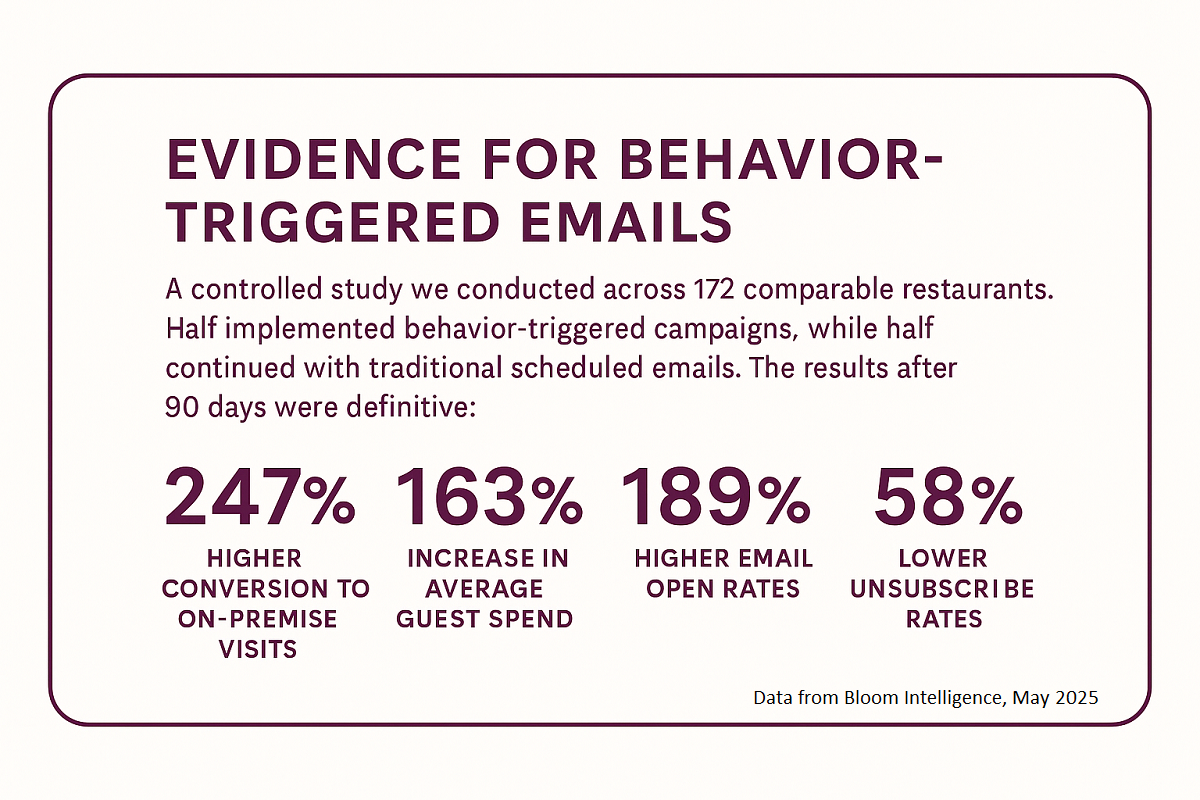
The most compelling evidence for behavior-triggered emails comes from a controlled study we conducted across 172 comparable restaurants. Half implemented behavior-triggered campaigns, while half continued with traditional scheduled emails. The results after 90 days were definitive: the behavior-triggered group saw:
- 247% higher conversion to on-premise visits
- 163% increase in average guest spend
- 189% higher email open rates
- 58% lower unsubscribe rates
The Three Pillars of Effective Trigger-Based Marketing
As Ogilvy taught us, successful communication requires meticulous research, careful targeting, and compelling creativity. For restaurant email marketing, this translates to:
1. Sophisticated Guest Segmentation
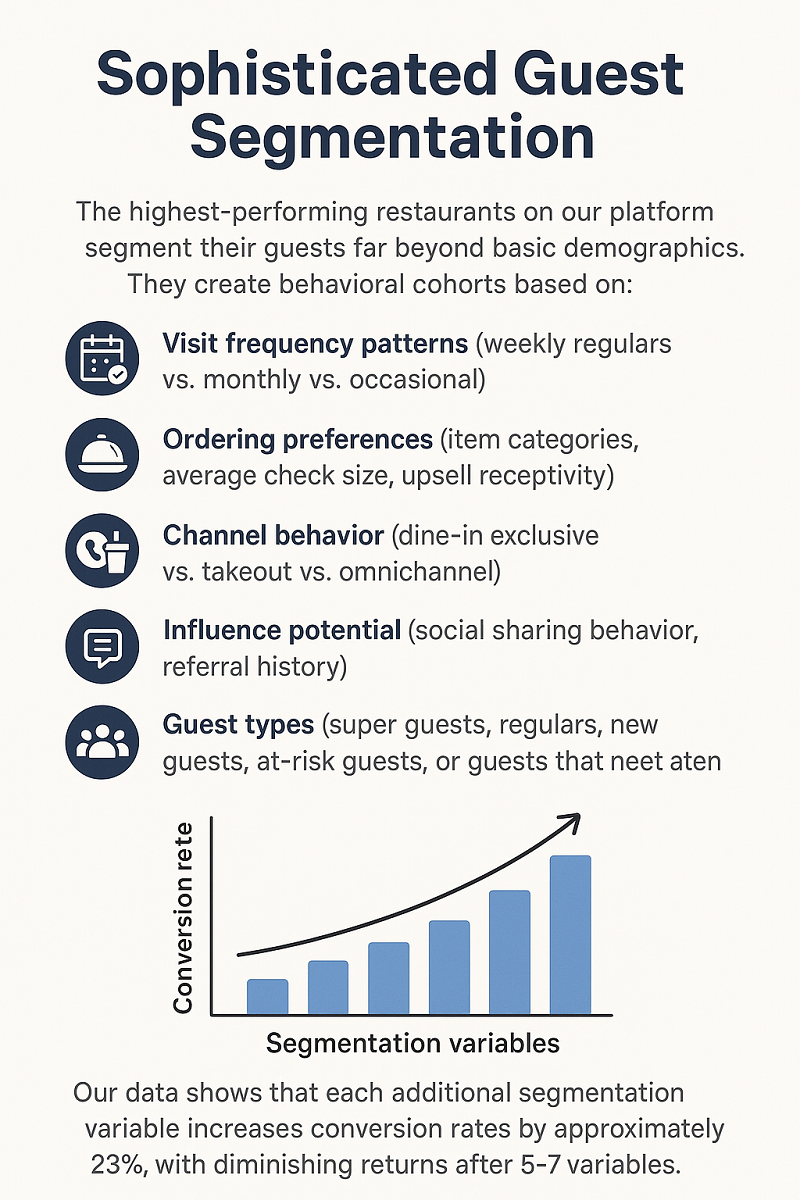
The highest-performing restaurants on our platform segment their guests far beyond basic demographics. They create behavioral cohorts based on:
- Visit frequency patterns (weekly regulars vs. monthly vs. occasional)
- Ordering preferences (item categories, average check size, upsell receptivity)
- Channel behavior (dine-in exclusive vs. takeout vs. omnichannel)
- Influence potential (social sharing behavior, referral history)
- Guest types (super guests, regulars, new guests, at-risk guests, or guests that need attention.
Our data shows that each additional segmentation variable increases conversion rates by approximately 23%, with diminishing returns after 5-7 variables.
2. Precision Trigger Timing
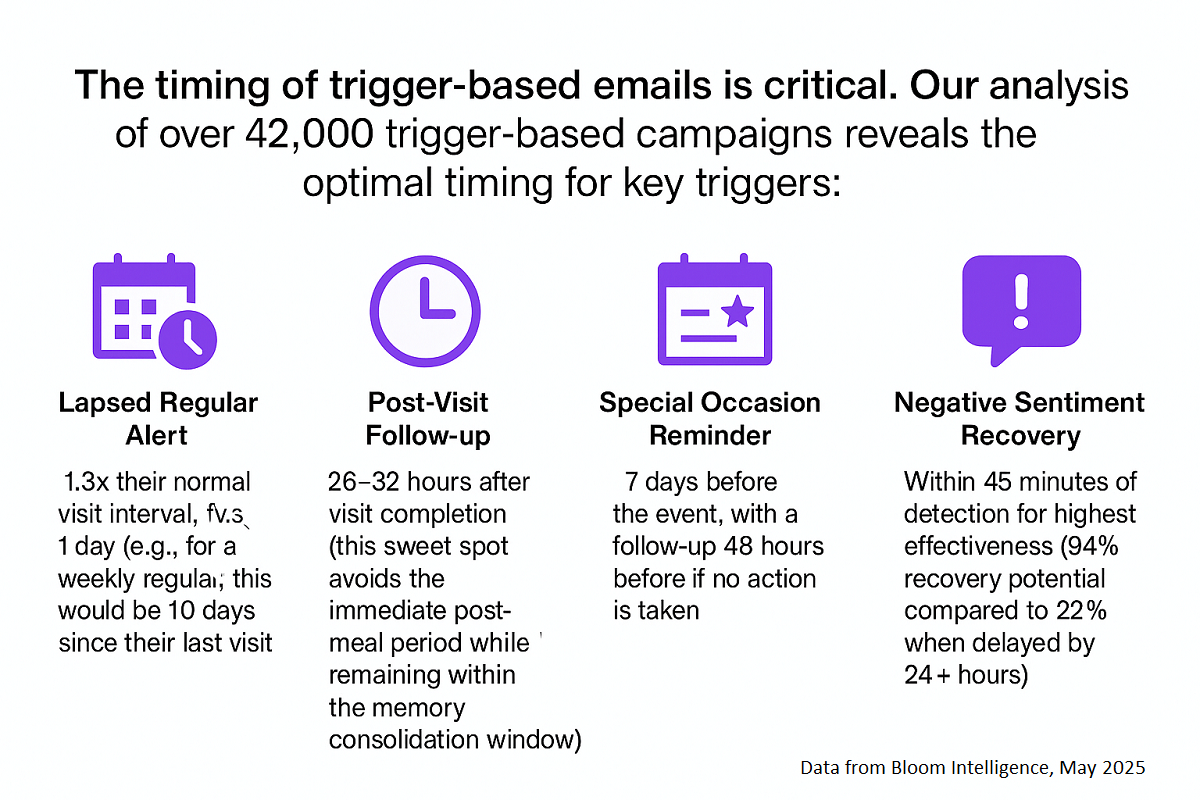
The timing of trigger-based emails is critical. Our analysis of over 42,000 trigger-based campaigns reveals the optimal timing for key triggers:
Lapsed Regular Alert: 1.3x their normal visit interval plus 1 day (e.g., for a weekly regular, this would be 10 days since their last visit)
Post-Visit Follow-up: 26-32 hours after visit completion (this sweet spot avoids the immediate post-meal period while remaining within the memory consolidation window)
Special Occasion Reminder: 7 days before the event, with a follow-up 48 hours before if no action is taken
Negative Sentiment Recovery: Within 45 minutes of detection for highest effectiveness (94% recovery potential compared to 22% when delayed by 24+ hours)
3. Personalized Creative Execution
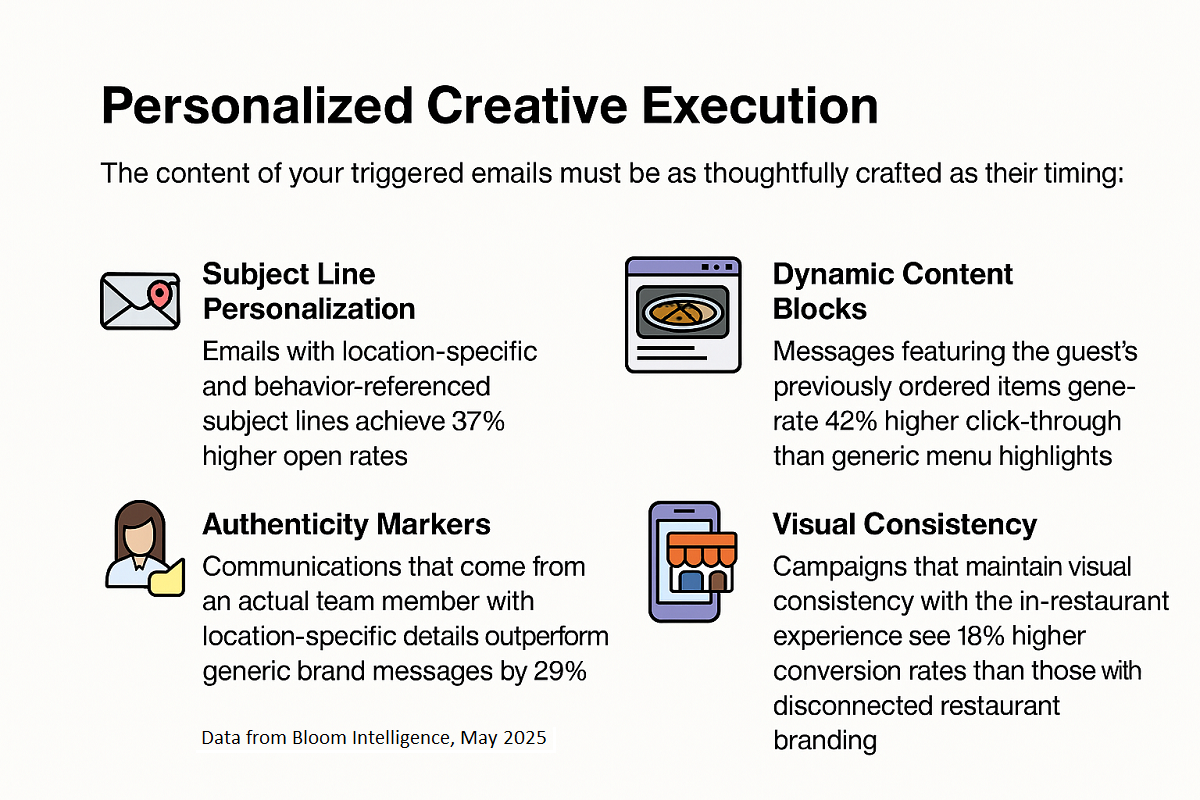
As Ogilvy emphasized, “You cannot bore people into buying.” The content of your triggered emails must be as thoughtfully crafted as their timing:
Subject Line Personalization: Emails with location-specific and behavior-referenced subject lines achieve 37% higher open rates.
Dynamic Content Blocks: Messages featuring the guest’s previously ordered items generate 42% higher click-through than generic menu highlights.
Authenticity Markers: Communications that come from an actual team member with location-specific details outperform generic brand messages by 29%.
Visual Consistency: Campaigns that maintain visual consistency with the in-restaurant experience see 18% higher conversion rates than those with disconnected restaurant branding.
Implementing Your Trigger-Based System
Converting from scheduled blasts to sophisticated trigger-based marketing may seem daunting, but our implementation data shows most restaurants can complete the transition in three phases:
Phase 1 (Weeks 1-2): Implement basic triggers like post-visit feedback, birthday/anniversary, and lapsed customer alerts.
Phase 2 (Weeks 3-6): Add behavior-specific triggers based on ordering patterns, visit frequency changes, and specific menu interactions.
Phase 3 (Weeks 7-12): Integrate cross-channel triggers incorporating WiFi behavior, online ordering, reservation patterns, and review engagement.
Restaurants that follow this phased implementation approach see an average 118% improvement in marketing ROI after Phase 1, increasing to the full 247% advantage by completion of Phase 3.
The Bottom Line
As our analysis of millions of guest interactions conclusively demonstrates, the era of scheduled email blasts only is diminishing for successful restaurants.
By adopting behavior-triggered marketing systems that respect guest individuality and respond to their actual behavior patterns, you create what David Ogilvy would recognize as truly effective advertising: relevant, timely, and authentically connected to customer needs.
The restaurants seeing the greatest success are those that have embraced Ogilvy’s ultimate wisdom: “The consumer is not a moron. The consumer is your wife.”
When you treat your guests as the intelligent, preference-driven individuals they are, they reward you with increased visits, higher spending, and genuine loyalty.
Want to see how Bloom Intelligence’s restaurant marketing platform can accelerate your results? Click Below to Schedule a Meeting
Let Bloom Intelligence Make It Effortless
Bloom Intelligence is an AI-powered restaurant marketing platform. It includes a powerful customer data platform, website integrations, automated guest data collection, one-click audience segmentation, marketing automation via email and SMS, reputation management, social proof widget, and reporting tools.
Bloom makes guest data collection effortless, which allows you to quickly execute the strategies listed above, saving you time, increasing customer lifetime values, attracting new guests, improving your reputation, and boosting your bottom line.
Call us or schedule a free demo online and Bloom will show you how our restaurant marketing platform can help you save time and increase your customer lifetime values by automatically building first-party customer databases, unlocking important guest insights to trigger automated marketing at the right time and place, discover true guest sentiment, save at-risk guests, increase your current guests’ frequency, supercharge your website, and find new guests.
Click to schedule a Free Online Demo, or call 727-877-8181 to see how we can help you drive tangible results for your restaurants.
FREQUENTLY ASKED QUESTIONS
Common Questions About Restaurant Marketing
Restaurant marketing is the process of getting people to visit your restaurants. Restaurant marketing creates loyalty, provides data to research, analytics, and allows restaurants to gain a better understanding of their ideal customer profile. It utilizes all customer channels: guest WiFi, website, social, rating sites, mobile apps, email, text, and advertising.
WiFi marketing is a marketing technique that uses guest WiFi to collect & clean customer data such as names, emails, phone numbers, customer behavior, and demographics. This data is used to personalize marketing campaigns to increase customer loyalty, build online reviews, and save at-risk customers. The performance of every campaign can be tracked down to the tangible ROI of a customer walking back in your door.
Restaurant reputation management is the process for restaurants to manage customer feedback and creating systems to improve customer experiences, passively build positive online reviews, and save at-risk customers. It is a very important aspect of running a successful restaurant business.
A restaurant customer data platform (CDP) is a unified software system that collects, consolidates, and activates guest data from multiple sources including WiFi networks, POS systems, online ordering platforms, reservation systems, websites, loyalty platforns, event platforms, and review sites. Unlike generic CDPs built for e-commerce or SaaS companies, restaurant CDPs are purpose-built to handle restaurant-specific data sources and create actionable guest intelligence that drives personalized marketing, operational improvements, and revenue growth automatically.
Bloom Intelligence uses machine learning to identify at-risk customers. When one is recognized, the system will send them a message with an incentive to get them to return and re-establish their visit pattern. Bloom users are seeing up to 37% of churning customers return.
Ready to Turn Your Guest Data Into Revenue?
Join 1,000+ restaurant locations using Bloom Intelligence to recover lost guests, automate marketing, and drive measurable revenue growth.
Keep Reading
View All Posts →8 in 10 Restaurant Guests Never Come Back. Here’s What That’s Costing You.
Key Takeaway Eight in ten restaurant guests who have ever visited your location have never returned, creating a measurable revenue...
Your Restaurant Reputation Management Software Only Does 10% of the Job. Here’s What It’s Missing.
Key Takeaway Most restaurant reputation management software only handles review responses. That's just 10% of the value your guest sentiment...
The 13x Guest: How Restaurant Data Analytics Reveals Your Most Valuable Customers
Key Takeaway Your most loyal restaurant guests spend 13 times more than first-time visitors — but most restaurants can't identify,...