


The Ultimate Guide to Restaurant Marketing Tools in 2026
What are restaurant marketing tools?
Restaurant marketing tools are software platforms and technologies that help restaurants attract new guests, retain existing customers, and increase revenue. These include websites optimized for discovery, customer data platforms (CDPs), email and SMS marketing systems, reputation management software, WiFi marketing, loyalty programs, social media management tools, and AI-powered marketing automation. Modern platforms integrate multiple capabilities to provide unified guest intelligence and automated marketing campaigns that run 24/7.
Introduction: Why Restaurant Marketing Tools Matter in 2026
The U.S. restaurant industry is projected to exceed $1.5 trillion in sales in 2026, according to the National Restaurant Association. With over 749,000 restaurant locations competing for customers, effective marketing has never been more critical to survival and growth.
Yet the data reveals a sobering reality: the average restaurant retention rate is just 55%, well below the 75% global benchmark. Industry research shows that 70% of first-time diners never return, representing massive lost revenue potential for restaurants that fail to implement effective marketing strategies.
This comprehensive guide examines every category of restaurant marketing tool available in 2026, providing real statistics, implementation strategies, and guidance on building an integrated marketing technology stack that drives measurable results.
Projected U.S. restaurant industry sales in 2026
Of diners research restaurants online before visiting
Average restaurant customer retention rate (vs 75% benchmark)
Of restaurant operators increased technology investments in 2024
What You Will Learn
- Restaurant Websites — Your digital front door for discovery and guest capture
- Customer Data Platforms (CDPs) — The foundation of data-driven marketing
- Email Marketing — High-ROI guest communication and automation
- SMS Marketing — Direct mobile engagement with 98% open rates
- Reputation Management — Online reviews and brand protection
- WiFi Marketing — First-party data collection and guest capture
- Marketing Automation — Triggered campaigns that run 24/7
- Loyalty Programs — Reward systems that increase visit frequency
- Social Media Marketing — Platform strategies and content approaches
- AI-Powered Marketing Tools — Predictive analytics and personalization
- The Restaurant Marketing Flywheel — Building an integrated system
1. Restaurant Websites: Your Digital Front Door
Why is a restaurant website important for marketing?
Your restaurant website is the foundation of all digital marketing efforts and often the first interaction potential guests have with your brand. With 90% of diners researching restaurants online before visiting, your website serves as both a discovery engine and a conversion tool. An optimized website attracts new guests through search engines and AI assistants, captures visitor data for future marketing, and builds trust through social proof elements like reviews and photos.
In 2026, your restaurant website is no longer just an online brochure. It is your most powerful tool for attracting new guests at the top of the marketing funnel. With the rise of AI-powered search through tools like ChatGPT, Perplexity, and Google AI Overviews, how your website is structured and optimized directly determines whether potential guests discover your restaurant.
The Discovery Opportunity
Search engines and AI assistants have become the primary way diners discover new restaurants. Industry research indicates that over 50% of restaurant searches now involve AI-powered responses, and this percentage is growing rapidly. Restaurants that optimize their websites for these new discovery channels gain a significant competitive advantage.
Of diners research restaurants online before visiting
Of searches now involve AI-powered responses
Of all Google searches have local intent
Of local searchers visit a business within 24 hours
Three Pillars of Website Optimization
Modern restaurant websites must excel in three areas to maximize guest acquisition: search engine optimization (SEO), answer engine optimization (AEO), and voice search readiness. Together, these ensure your restaurant appears wherever potential guests are looking.
- Search Engine Optimization (SEO): Ensures your website ranks highly in traditional Google searches for terms like “best Italian restaurant near me” or “romantic dinner [city name].” Strong SEO drives consistent organic traffic without ongoing advertising costs.
- Answer Engine Optimization (AEO): Structures your content so AI assistants like ChatGPT, Perplexity, and Google AI Overviews can easily cite and recommend your restaurant. This includes clear definitions, FAQ content, and structured data markup.
- Voice Search Optimization: Formats content to match how people speak when using Siri, Alexa, or Google Assistant. Voice searches are typically longer and more conversational, such as “Where can I get great tacos open late tonight?”
The Value of Optimization
Restaurants that invest in comprehensive website optimization report 40-60% increases in organic traffic within 6-12 months. More importantly, this traffic converts at higher rates because these visitors have specifically searched for what you offer. Unlike paid advertising, organic traffic compounds over time, delivering ongoing value from a one-time optimization investment.
Capturing Guest Data from Your Website
Your website should not just attract visitors but convert them into known contacts you can market to. Every anonymous visitor represents a missed opportunity for future engagement. Effective websites incorporate multiple data capture mechanisms:
- Email signup forms with compelling offers (exclusive menus, birthday rewards, early event access)
- Online reservation systems that collect guest contact information
- Online ordering platforms integrated with your customer database
- WiFi landing pages that capture data when guests visit your physical location
- Contest and promotion entry forms that build your marketing list
Building Trust Through Social Proof
Potential guests make dining decisions based on what others say about your restaurant. Your website should prominently feature trust-building elements that reassure visitors and encourage them to choose you over competitors:
- Aggregated review scores from Google, Yelp, and TripAdvisor displayed prominently
- Recent positive review excerpts that highlight your strengths
- Professional food photography and authentic guest photos
- Awards, press mentions, and industry recognition
- Chef credentials and restaurant story that builds emotional connection
Restaurants that display review aggregations and testimonials on their websites see conversion rates 20-30% higher than those that do not incorporate social proof elements.
2. Customer Data Platforms (CDPs)
What is a restaurant customer data platform?
A restaurant customer data platform (CDP) is a unified software system that collects, consolidates, and activates guest data from multiple sources including WiFi networks, POS systems, online ordering platforms, reservation systems, websites, loyalty programs, and review sites. CDPs create comprehensive guest profiles that enable personalized marketing, predictive analytics, and measurable ROI tracking across all customer touchpoints.
Customer data platforms represent the foundation of modern restaurant marketing. By unifying data from disparate sources, CDPs enable restaurants to understand guest behavior, preferences, and value at an individual level, then act on those insights through targeted marketing campaigns.
The Business Impact of CDPs
Research from Aberdeen Group demonstrates the transformative impact of customer data platforms on restaurant performance:
| Metric | CDP Users vs. Non-Users | Impact |
|---|---|---|
| Guest Satisfaction | 9.1x higher | Improved through personalization |
| Year-over-Year Revenue | 2.9x greater growth | Data-driven decision making |
| Average Customer Spend | 5.7x increase | Targeted upselling and offers |
| Up-sell Revenue | 4.9x growth | Predictive recommendations |
| Time to ROI | 79% within 12 months | Fast implementation payback |
The global CDP market is projected to grow from $2.65 billion in 2024 to $12.96 billion by 2032, representing a 21.7% compound annual growth rate, according to Fortune Business Insights. This growth reflects the increasing recognition that unified customer data is essential for competitive restaurant marketing.
Key CDP Capabilities for Restaurants
- Data Unification: Aggregate guest data from POS, WiFi, reservations, online ordering, and reviews into single customer profiles
- Identity Resolution: Match anonymous interactions to known guests across devices and touchpoints
- Audience Segmentation: Create dynamic segments like regulars, at-risk guests, high-value customers, and new visitors
- Behavioral Analytics: Track visit frequency, spending patterns, menu preferences, and lifetime value
- Campaign Attribution: Measure the ROI of marketing campaigns down to individual guest visits and revenue
3. Email Marketing
What is the ROI of email marketing for restaurants?
Email marketing delivers an average return of $36-42 for every $1 spent in the restaurant industry, making it one of the highest-ROI marketing channels available. Restaurant email campaigns achieve open rates of 40-44% compared to the 26.8% cross-industry average, with click-through rates of 1.13-2%. Automated email campaigns drove 37% of all email-generated sales in 2024.
Email marketing remains one of the most effective and cost-efficient channels for restaurant marketing. The combination of high deliverability, personalization capabilities, and automation makes email an essential component of any restaurant marketing strategy.
Restaurant Email Performance Benchmarks
| Metric | Restaurant Industry | All Industries Average |
|---|---|---|
| Open Rate | 40-44% | 26.8% |
| Click-Through Rate | 1.13-2% | 2.5% |
| Bounce Rate | 0.37% | 0.7% |
| ROI per $1 Spent | $36-42 | $36 |
| Automated Email Sales Share | 37% | 29% |
According to industry research, 64% of restaurateurs now send personalized offers to their email subscribers, up from 55% in 2023. This shift toward personalization reflects the growing understanding that generic promotional emails underperform targeted messages based on guest behavior and preferences.
Essential Email Campaigns for Restaurants
- Welcome Series: Automated sequence introducing new subscribers to your restaurant, menu highlights, and special offers
- Birthday and Anniversary: Personalized celebration messages with exclusive offers that drive visits on special occasions
- Win-Back Campaigns: Re-engagement emails targeting guests who have not visited within their typical frequency
- VIP Recognition: Exclusive communications for high-value guests acknowledging their loyalty and offering premium experiences
- Feedback Requests: Post-visit emails requesting reviews and providing channels for private feedback resolution
4. SMS Marketing
How effective is SMS marketing for restaurants?
SMS marketing achieves a 98% open rate with 90% of messages read within 3 minutes. Restaurant SMS campaigns see click-through rates of 18-36%, compared to just 2.5% for email. The response rate for SMS is 45% versus 6% for email. Restaurants using SMS marketing are 5.89 times more likely to report success with their digital marketing efforts.
SMS marketing has emerged as one of the most powerful direct communication channels for restaurants. The immediacy and high engagement rates make SMS ideal for time-sensitive promotions, reservation confirmations, and personalized offers that drive immediate action.
SMS vs. Email Marketing Comparison
| Metric | SMS Marketing | Email Marketing |
|---|---|---|
| Open Rate | 98% | 40-44% |
| Time to Read | 90% within 3 minutes | Hours to days |
| Click-Through Rate | 18-36% | 1.13-2% |
| Response Rate | 45% | 6% |
| Best Use Case | Time-sensitive offers | Detailed content |
The hospitality industry has embraced SMS marketing at an 80% adoption rate. Research shows that 32% of SMS messages are read within 60 seconds of delivery, making this channel uniquely effective for flash promotions, last-minute table availability, and day-of event communications.
High-Impact SMS Use Cases for Restaurants
- Flash Promotions: Send limited-time offers during slow periods to drive immediate traffic and fill empty tables
- Reservation Confirmations: Reduce no-shows with automated SMS reminders 24 hours and 2 hours before reservations
- Order Updates: Keep online ordering and delivery customers informed with real-time status notifications
- VIP Alerts: Notify high-value guests about exclusive menu items, events, or reservation availability
- Win-Back Messages: Re-engage lapsed guests with personalized offers based on their previous ordering history
5. Reputation Management
How do online reviews impact restaurant revenue?
A one-star increase in Yelp rating correlates with a 5-9% increase in restaurant revenue. Research shows that 87% of consumers read online reviews for local businesses, with 94% avoiding businesses after reading negative reviews. Restaurants that respond to all reviews are 90% more likely to be visited than those that do not respond.
Online reputation has become one of the most important factors in restaurant success. With 90% of diners researching restaurants online before visiting and 75% always reading reviews before making a dining decision, reputation management tools are essential for protecting and growing your business.
The Business Impact of Online Reviews
Revenue increase per additional Yelp star
Of consumers read online reviews
Avoid businesses with negative reviews
Trust reviews like personal recommendations
Review signals now account for approximately 16% of the factors that determine Google Local 3-Pack rankings, making reputation management a critical component of local SEO strategy. Restaurants with higher ratings and more reviews consistently outperform competitors in local search visibility.
Key Reputation Management Features
- Review Monitoring: Aggregate reviews from Google, Yelp, TripAdvisor, and other platforms into a single dashboard
- Response Management: Respond to reviews efficiently with templates and AI-assisted response suggestions
- Review Generation: Automated systems that request reviews from satisfied guests at optimal moments
- Sentiment Analysis: Track trends in guest feedback to identify operational improvements and menu opportunities
- Alert Systems: Real-time notifications for negative reviews enabling rapid response and recovery
6. WiFi Marketing
What is WiFi marketing for restaurants?
WiFi marketing is a technique that uses guest WiFi access to collect and clean customer data including names, emails, phone numbers, visit behavior, and demographics. This first-party data is used to personalize marketing campaigns, increase customer loyalty, build online reviews, and recover at-risk guests. Unlike third-party cookies, WiFi data is owned by the restaurant and is not affected by privacy regulations limiting tracking.
With the deprecation of third-party cookies and increasing privacy regulations, WiFi marketing has become an essential tool for restaurants to collect first-party customer data. Guests willingly exchange their contact information for WiFi access, creating an opt-in database of real customers.
The Value of First-Party Data
Research demonstrates the dramatic impact of personalized marketing enabled by WiFi-captured guest data:
- Guests receiving 1:1 personalized marketing delivered 5x the sales compared to those receiving non-personalized communications
- 92% of first-time guests without targeted outreach never returned, representing massive lost revenue potential
- Guest WiFi increases customer dwell time by 9-18%, leading to higher average check sizes
- WiFi-captured data enables precise visit tracking and attribution of marketing campaign ROI
WiFi Marketing Capabilities
- Data Capture: Collect guest contact information through branded WiFi login portal
- Visit Tracking: Automatically record guest visits, duration, and frequency without manual check-ins
- Behavior Analysis: Identify visit patterns and segment guests by engagement level
- Campaign Attribution: Track which marketing messages drove guests back to your location
- Data Enrichment: Enhance profiles with demographic data and social information from login methods
7. Marketing Automation
What is restaurant marketing automation?
Restaurant marketing automation uses software to execute marketing campaigns automatically based on guest behavior triggers, time-based schedules, or data conditions. Automation enables restaurants to deliver personalized messages at scale, including welcome sequences, win-back campaigns, birthday offers, and review requests, without manual intervention for each guest interaction.
Marketing automation transforms restaurant marketing from reactive, manual campaigns into proactive, always-on systems that engage guests at the right moment with the right message. Automated campaigns drove 37% of all email-generated sales in 2024, demonstrating the revenue impact of trigger-based marketing.
Essential Automated Workflows for Restaurants
- New Guest Welcome: Trigger a welcome email series when a guest provides their contact information for the first time, introducing your restaurant and incentivizing a return visit
- At-Risk Guest Recovery: Automatically identify guests whose visit frequency has declined and send personalized win-back offers before they churn completely
- Birthday and Anniversary: Schedule celebratory messages with special offers to arrive before guest birthdays and dining anniversaries
- Post-Visit Feedback: Send automated requests for reviews and feedback after dining experiences, routing positive guests to public review sites
- VIP Recognition: Trigger special communications when guests reach loyalty milestones or spending thresholds
- Seasonal Re-Engagement: Automatically reach out to lapsed guests during holidays and special events with targeted offers
Automation Performance Metrics
According to Bloom Intelligence data, restaurants implementing comprehensive marketing automation achieve significant results: automated at-risk guest campaigns recover 38% of guests who would otherwise churn, birthday campaigns achieve redemption rates of 25-35%, and welcome sequences increase second-visit rates by 40% compared to guests receiving no automated outreach.
8. Loyalty Programs
How effective are restaurant loyalty programs?
Restaurant loyalty programs deliver measurable results: members visit 20% more frequently and spend 20% more per visit than non-members. Programs generate 12-18% incremental revenue, with 81% of consumers saying they would join a loyalty program if offered. A 5% increase in customer retention correlates with a 25-95% increase in profits.
Loyalty programs have become standard in the restaurant industry, with 68% of full-service restaurants and 71% of quick-service restaurants now offering programs. Industry analysts project 80% adoption by the end of 2026 as restaurants recognize the revenue impact of structured reward systems.
Loyalty Program Statistics
| Metric | Statistic | Source |
|---|---|---|
| Member Visit Frequency | 20% more visits | Industry Research |
| Member Spend Increase | 20% higher per visit | Industry Research |
| Consumer Interest | 81% would join if offered | Survey Data |
| Spend to Maximize Points | 64% spend more | Consumer Research |
| Incremental Revenue | 12-18% from members | Performance Data |
Types of Loyalty Programs
- Points-Based Programs: Guests earn points on purchases redeemable for rewards, encouraging increased spending to reach thresholds
- Tiered Programs: Multiple reward levels that unlock progressively better benefits, motivating guests to increase visit frequency
- Visit-Based Programs: Rewards based on visit frequency rather than spend, ideal for casual dining concepts
- Subscription Programs: Monthly or annual fee-based programs offering exclusive benefits and discounts to committed guests
- Coalition Programs: Partnerships with other brands allowing guests to earn and redeem across multiple businesses
9. Social Media Marketing
How important is social media for restaurant marketing?
Social media has become essential for restaurant discovery and engagement: 72% of diners use social media to research restaurants, 68% check social accounts before visiting, and 60% use Instagram specifically to discover new restaurants. TikTok drives significant action, with 38% of users reporting they have visited a restaurant after seeing it on the platform.
Social media serves dual purposes for restaurants: it influences discovery and decision-making for potential guests while building community and loyalty among existing customers. With 80% of restaurants now using Instagram, social media has become a baseline expectation rather than a competitive advantage.
Social Media Platform Statistics for Restaurants
| Platform | Key Statistic | Best Use Case |
|---|---|---|
| 60% use to discover restaurants | Visual content, food photography | |
| TikTok | 38% visited after seeing content | Viral moments, behind-scenes |
| Largest user base | Community, events, local reach | |
| Google Business | 90% research before visiting | Reviews, photos, information |
Video content has become increasingly important, with restaurant video posts seeing 33% higher engagement than static images. Short-form video on platforms like TikTok and Instagram Reels offers restaurants the opportunity to showcase personality, behind-the-scenes moments, and menu items in engaging formats.
Social Media Best Practices for Restaurants
- Post Consistently: Maintain regular posting schedules to stay visible in follower feeds and algorithm recommendations
- Prioritize Video: Create short-form video content showcasing food preparation, ambiance, and team personality
- Engage Actively: Respond to comments, share user-generated content, and interact with local community accounts
- Leverage User Content: Encourage guests to share their experiences and repost high-quality user-generated content
- Track Performance: Monitor engagement metrics, reach, and referral traffic to optimize content strategy
10. AI-Powered Marketing Tools
How are restaurants using AI for marketing?
AI adoption in restaurant marketing is accelerating: 53% of restaurants now use AI for sales prediction, 33% use it for personalized recommendations, and 81% of businesses report AI has improved their SMS marketing success. AI enables predictive analytics, automated content generation, intelligent segmentation, and real-time personalization at scale.
Artificial intelligence is transforming restaurant marketing from reactive to predictive, enabling restaurants to anticipate guest behavior and deliver personalized experiences automatically. AI-powered tools can analyze vast amounts of customer data to identify patterns, predict churn, and optimize campaign timing and messaging.
Key AI Marketing Capabilities
- Predictive Analytics: Forecast which guests are likely to churn, enabling proactive retention campaigns before guests are lost
- Intelligent Segmentation: Automatically group guests based on behavior patterns, value, and preferences for targeted campaigns
- Personalized Recommendations: Generate individualized offers based on past ordering behavior and predicted preferences
- Content Generation: Create marketing copy, email subject lines, and social media content using AI writing assistants
- Send Time Optimization: Determine optimal times to send emails and SMS based on individual guest engagement patterns
- Sentiment Analysis: Analyze review and feedback text to identify operational improvements and track brand perception
AI Marketing Implementation Considerations
While AI offers powerful capabilities, successful implementation requires clean, comprehensive customer data. Restaurants should prioritize building a unified customer data foundation through CDPs and WiFi marketing before layering on advanced AI capabilities. The combination of quality first-party data and AI-powered analysis creates a sustainable competitive advantage.
11. The Restaurant Marketing Flywheel: Building an Integrated System
Throughout this guide, we have examined individual marketing tools as separate categories. In practice, the most successful restaurants do not deploy these as isolated point solutions. Instead, they build integrated systems where each component amplifies the others, creating a self-reinforcing marketing flywheel that accelerates growth over time.
The Flywheel Effect
A restaurant marketing flywheel works like this: your optimized website attracts new guests through search and AI discovery. WiFi marketing captures their data when they visit. Your CDP unifies this data with POS transactions and creates rich guest profiles. Marketing automation uses these profiles to send personalized email and SMS campaigns that drive return visits. Reputation management turns satisfied guests into public advocates. Each component feeds the next, and the entire system gains momentum with every cycle.
The AI-Powered Restaurant Marketing Flywheel
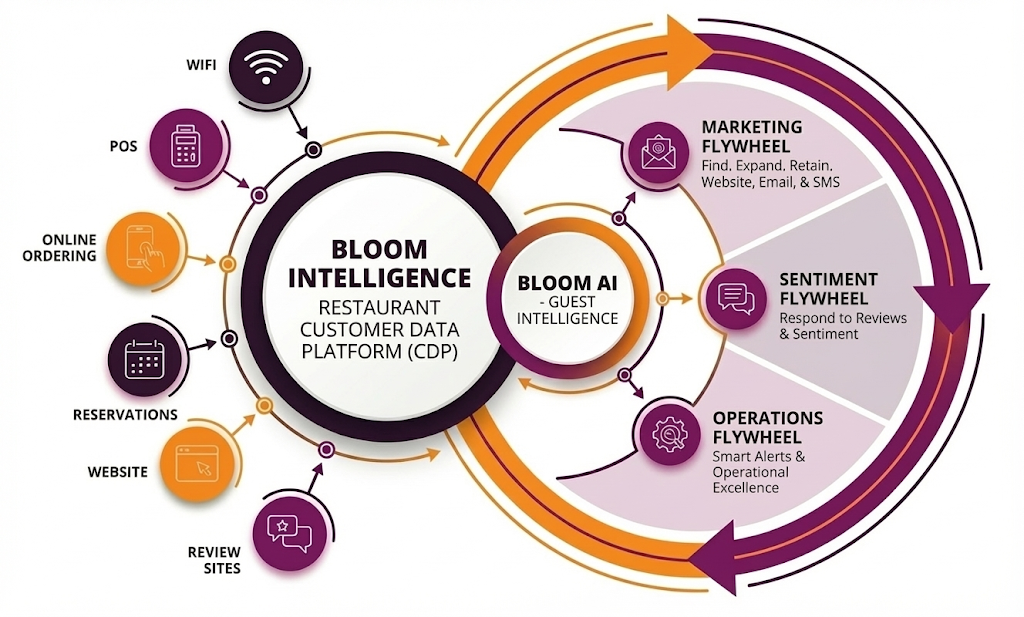
↻ Each cycle compounds, accelerating growth
The Problem with Point Solutions
Many restaurants attempt to build this flywheel using separate vendors for each function: one platform for email, another for SMS, a different tool for reputation management, separate software for WiFi, and yet another for analytics. This fragmented approach creates several critical problems:
- Data Silos: Guest information trapped in separate systems cannot be unified for personalization
- Integration Complexity: Connecting multiple platforms requires ongoing technical maintenance
- Attribution Gaps: Measuring ROI across disconnected tools is nearly impossible
- Operational Overhead: Managing multiple vendor relationships, contracts, and interfaces drains resources
- Inconsistent Experiences: Guests receive disjointed communications that do not reflect their full relationship with your restaurant
The Unified Platform Advantage
The alternative is a unified platform that integrates all flywheel components into a single system. When your CDP, WiFi marketing, email, SMS, reputation management, and AI analytics share a common foundation, the flywheel spins faster because:
- Every guest interaction enriches a single customer profile, enabling deeper personalization over time
- Automated workflows can span multiple channels based on unified behavioral triggers
- Attribution is automatic because all touchpoints connect to the same guest record
- AI has access to complete data, enabling more accurate predictions and recommendations
- Your team manages one platform instead of coordinating across many
Bloom Intelligence: The AI-Powered Restaurant Marketing Flywheel
Bloom Intelligence was purpose-built to deliver the integrated marketing flywheel that multi-location restaurants need. Our unified platform combines:
- Customer Data Platform that unifies guest data from WiFi, POS, online ordering, reservations, and reviews
- WiFi Marketing that automatically captures first-party guest data with every visit
- Email & SMS Automation with AI-powered campaigns that run 24/7
- Reputation Management that builds reviews and protects your brand automatically
- AI-Powered Intelligence that predicts churn, optimizes campaigns, and maximizes guest lifetime value
The result: restaurants using Bloom achieve 5,200-6,900% ROI on their marketing investment, recover 38% of at-risk guests automatically, and gain the marketing capabilities of expert teams at a fraction of the cost.
Key Takeaways
Building an effective restaurant marketing technology stack in 2026 requires understanding both the individual tools available and how they work together as an integrated system. Here are the essential insights from this guide:
- Start with Discovery: Your website is the top of the funnel. Optimize for SEO, AEO, and voice search to ensure potential guests find you when they are actively looking.
- Capture Every Guest: Use WiFi marketing and website forms to convert anonymous visitors into known contacts you can market to repeatedly.
- Unify Your Data: A customer data platform is the foundation that makes personalization possible. Without unified data, every other tool underperforms.
- Automate Relentlessly: Marketing automation enables consistent execution at scale. The 37% of email revenue from automated campaigns proves the value.
- Protect Your Reputation: With 94% of consumers avoiding businesses with negative reviews, reputation management is not optional.
- Prioritize Retention: The 70% of first-time guests who never return represent your biggest revenue opportunity. Win-back campaigns deliver immediate ROI.
- Embrace AI: Predictive analytics and intelligent automation separate leaders from followers in 2026.
- Build the Flywheel: Integrated platforms outperform point solutions because every component amplifies the others.
Sources and Citations
Statistics and data in this guide are sourced from: National Restaurant Association (2026 State of the Industry Report), Forbes, Aberdeen Group, Tealium, BrightLocal, Fortune Business Insights, McKinsey, TouchBistro, SimpleTexting, MailerLite, Omnisend, Business.com, Restaurant Dive, and Bloom Intelligence proprietary research (2025-2026).
Click to schedule a Free Online Demo, or call 727-877-8181 to see how guest intelligence can transform your restaurant’s retention strategy.
FREQUENTLY ASKED QUESTIONS
Common Questions About Restaurant Marketing
Restaurant marketing is the process of getting people to visit your restaurants. Restaurant marketing creates loyalty, provides data to research, analytics, and allows restaurants to gain a better understanding of their ideal customer profile. It utilizes all customer channels: guest WiFi, website, social, rating sites, mobile apps, email, text, and advertising.
WiFi marketing is a marketing technique that uses guest WiFi to collect & clean customer data such as names, emails, phone numbers, customer behavior, and demographics. This data is used to personalize marketing campaigns to increase customer loyalty, build online reviews, and save at-risk customers. The performance of every campaign can be tracked down to the tangible ROI of a customer walking back in your door.
Restaurant reputation management is the process for restaurants to manage customer feedback and creating systems to improve customer experiences, passively build positive online reviews, and save at-risk customers. It is a very important aspect of running a successful restaurant business.
A restaurant customer data platform (CDP) is a unified software system that collects, consolidates, and activates guest data from multiple sources including WiFi networks, POS systems, online ordering platforms, reservation systems, websites, loyalty platforns, event platforms, and review sites. Unlike generic CDPs built for e-commerce or SaaS companies, restaurant CDPs are purpose-built to handle restaurant-specific data sources and create actionable guest intelligence that drives personalized marketing, operational improvements, and revenue growth automatically.
Bloom Intelligence uses machine learning to identify at-risk customers. When one is recognized, the system will send them a message with an incentive to get them to return and re-establish their visit pattern. Bloom users are seeing up to 37% of churning customers return.
Ready to Turn Your Guest Data Into Revenue?
Join 1,000+ restaurant locations using Bloom Intelligence to recover lost guests, automate marketing, and drive measurable revenue growth.
Keep Reading
View All Posts →8 in 10 Restaurant Guests Never Come Back. Here’s What That’s Costing You.
Key Takeaway Eight in ten restaurant guests who have ever visited your location have never returned, creating a measurable revenue...
Your Restaurant Reputation Management Software Only Does 10% of the Job. Here’s What It’s Missing.
Key Takeaway Most restaurant reputation management software only handles review responses. That's just 10% of the value your guest sentiment...
The 13x Guest: How Restaurant Data Analytics Reveals Your Most Valuable Customers
Key Takeaway Your most loyal restaurant guests spend 13 times more than first-time visitors — but most restaurants can't identify,...