


The Invisible Exodus: 847 Guests Left Your Restaurant Last Month—And You Never Said Goodbye
The Night 847 Guests Decided to Leave
Last month, 847 guests quietly decided never to return to your restaurant.
They didn’t complain to your manager. They didn’t post a scathing review. They didn’t cause a scene. They just… stopped coming.
You didn’t know Maria’s name. She’d been visiting your Midtown location every Tuesday for 18 months. Her usual order: the house salad with salmon, dressing on the side, sparkling water with lemon. Sixty-seven visits. $4,200 in lifetime spending. An average ticket of $63 that always included dessert when her daughter joined her.
Then one Tuesday, she didn’t come.
And the next Tuesday.
And the next.
After 18 months of loyalty, Maria vanished without a word.
The worst part? You had 47 days to save her. You had the data. You just couldn’t see it.

The Hidden Cost of Silent Departures
Here’s the math that should keep every restaurant operator awake at night:
847 guests × $236 average annual value = $199,892 in annual revenue walking out silently
That’s not a marketing problem. That’s a silent crisis bleeding your restaurant dry—one unnoticed departure at a time.
Why Customers Leave Without Warning
According to recent industry research, 70% of first-time restaurant diners never return for a second visit. But what about your loyal regulars? The ones like Maria?
They leave for reasons you’ll never hear:
- A single disappointing experience they didn’t bother mentioning
- Life changes (new job, moved neighborhoods, changed routines)
- A competitor’s offer that caught their attention at the right moment
- Feeling forgotten—no birthday acknowledgment, no “we miss you” after weeks of absence
The data shows that 89% of customers say service quality influences their decision to return, but they won’t tell you when that quality slips. They’ll simply redirect their Tuesday nights elsewhere.
The $83 Question: Why Acquisition Costs Make Retention Essential
Let’s talk about what it actually costs to replace Maria.
According to industry data, the customer acquisition cost (CAC) for a fast-casual restaurant is approximately $83. That’s $83 in marketing spend, promotions, and advertising just to get someone through the door once.
Meanwhile, acquiring a new customer costs 5-7 times more than retaining an existing one.
And here’s the multiplier effect: existing customers spend an average of 67% more per order than first-time guests.
Maria’s $63 average ticket? A first-time guest at your restaurant averages $38.
When you do the math:
| Metric | Lost Guest (Maria) | Replacement Guest |
|---|---|---|
| Acquisition Cost | $0 (already acquired) | $83 |
| Average Ticket | $63 | $38 |
| Annual Visits | 52 (weekly) | 3-4 (average) |
| Annual Value | $3,276 | $114-$152 |
| 3-Year Value | $9,828 | Churned after year 1 |
Replacing Maria isn’t replacing value. It’s trading a $9,828 relationship for a $114 transaction.
The 47-Day Window: When At-Risk Becomes Lost
Here’s what nobody tells you about restaurant customer churn: there’s a window.
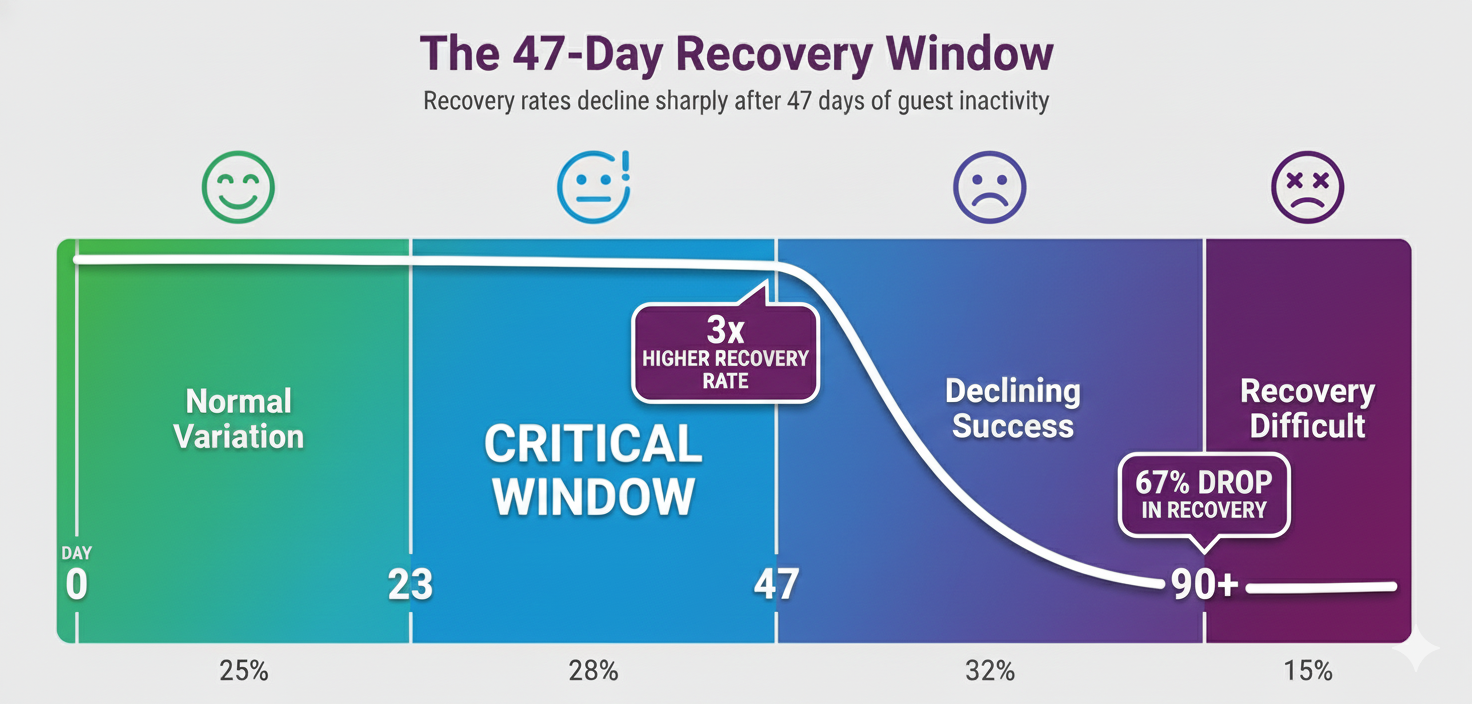
Maria didn’t wake up on Day 67 and decide she was done with your restaurant. The decision began forming on Day 23 when her server seemed rushed. It solidified on Day 31 when her online order arrived cold. By Day 47, when she should have been on her sixth consecutive Tuesday visit, she was already mentally gone.
The 47-day window is your chance to intervene.
Research shows that win-back campaigns sent within 30-45 days of behavioral change have a 3x higher success rate than those sent after 60+ days. After 90 days? Recovery rates drop by 67%.
But here’s the challenge: How do you know Maria missed Day 23? How do you know the pattern changed?
If you’re manually tracking 2,000, 5,000, or 10,000 guests across multiple locations, you don’t. You can’t. The human brain isn’t built to notice when guest #4,847 breaks her Tuesday pattern.
Maria’s Invisible Journey: What Should Have Happened
Let’s rewind Maria’s story. Same circumstances, different outcome.
Day 0: Maria’s visit frequency data shows she visits every Tuesday, averaging $63 per visit.
Day 7: Maria doesn’t visit on Tuesday. AI flags this as a single missed visit within normal variation.
Day 14: Maria misses her second consecutive Tuesday. AI updates her status from “Regular” to “Needs Attention.”
Day 15 (8:00 AM): An automated message reaches Maria:
“Hi Maria, it’s been a while since we’ve seen you! We wanted you to know your table is waiting. Here’s 15% off your next visit. We’d love to welcome you back soon. – The [Restaurant Name] Team”
Day 16: Maria reads the message. She’d honestly forgotten about the restaurant after a busy two weeks at work. The reminder, and the fact that someone noticed her absence, brings a smile.
Day 17 (Tuesday): Maria returns. Her server, alerted by the system that Maria is a high-value returning guest, greets her by name. The experience feels personal.
Day 47: Maria has visited four more times. Her lifetime value has increased to $4,452.
Day 365: Maria’s annual value: $3,276. Her total lifetime value (projected 5 years): $16,380.
The difference between lost Maria and retained Maria: one automated message sent on Day 15.
Why Traditional Win-Back Campaigns Fail
You might be thinking, “We already do win-back campaigns.”
Most restaurants do. And most win-back campaigns fail spectacularly.
Here’s why:
Problem #1: Manual List Building Is Always Too Late
By the time your marketing manager pulls a list of “guests who haven’t visited in 90 days,” compiles an email, writes copy, gets approval, and hits send, you’re targeting guests who left 120+ days ago.
The 47-day window? Long gone.
Problem #2: Generic Messaging Feels Like Spam
“We miss you! Come back for 10% off!”
Maria receives this same message from her gym, her dry cleaner, her hair salon, and three other restaurants. It doesn’t feel personal because it isn’t.
She doesn’t know you noticed her specifically. She doesn’t feel seen; she feels marketed to.
The difference with behavioral triggers? Maria receives her message because her pattern changed, not because she landed on an arbitrary “90 days inactive” list. That timing precision, combined with your authentic brand voice, transforms generic outreach into relevant communication.
Problem #3: No Connection to Actual Behavior
Traditional campaigns target everyone who hasn’t visited in X days. But Maria (67 visits, $4,200 lifetime value) gets the same message as someone who visited once, ordered a coffee, and never returned.
One deserves a rescue mission. One deserves a basic re-engagement nudge. Treating them identically wastes resources and insults your best guests.
The Results?
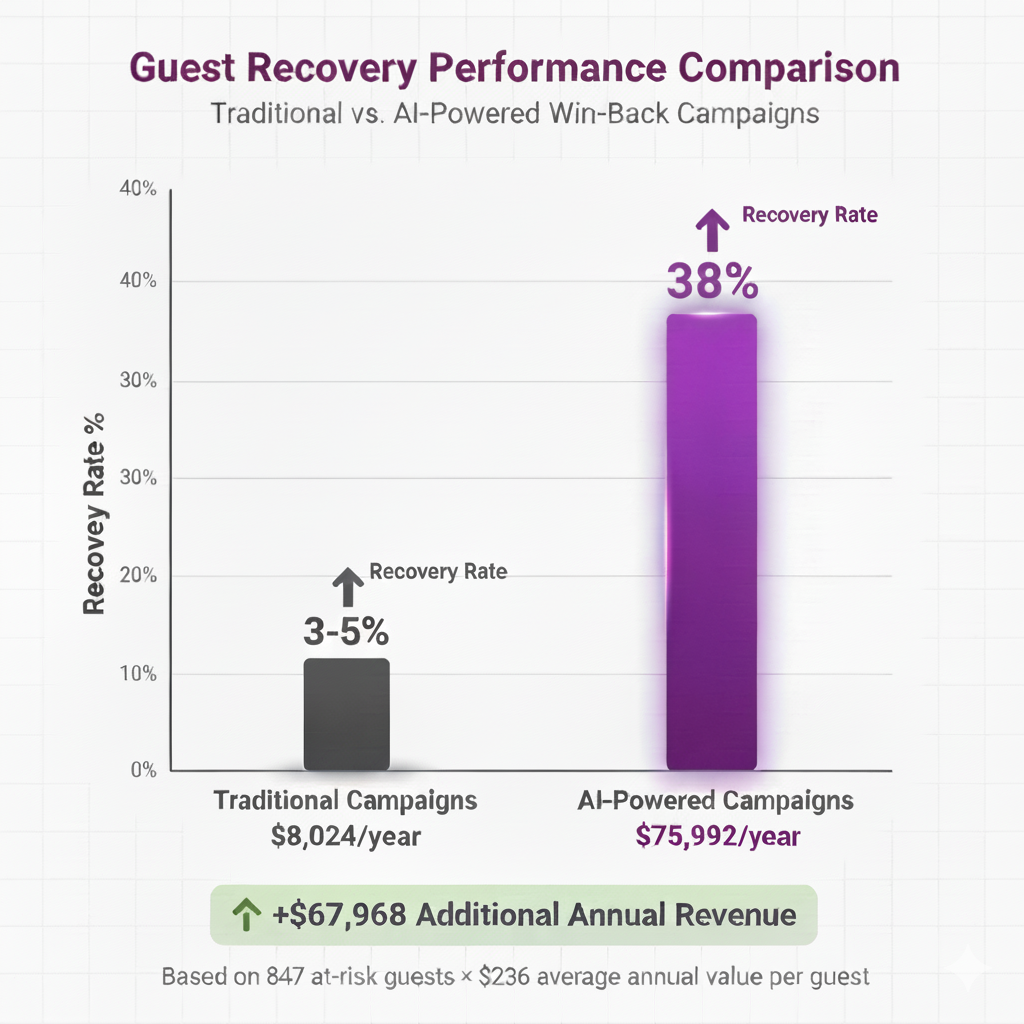
Industry data shows traditional win-back campaigns recover 3-5% of lapsed guests.
That means 95-97% of your at-risk guests continue their silent exodus, untouched by your marketing efforts.
What Happens When AI Sees What You Can’t
A modern restaurant customer data platform (CDP) with AI-powered guest intelligence changes the equation entirely.
Instead of manual lists and generic blasts, here’s what intelligent automation does:
Real-Time Behavioral Monitoring
Every guest’s visit pattern is tracked automatically. When Maria misses her expected Tuesday visit, the system knows within 24 hours—not 90 days.
Predictive Churn Identification
Machine learning algorithms don’t just see who has churned. They identify who is about to churn before the final visit happens.
The signals are subtle:
- Visit frequency decline (weekly → bi-weekly → monthly)
- Ticket size reduction (trading $63 dinners for $28 lunches)
- Time-of-day shifts (dinner regular now only visits for coffee)
- Ordering pattern changes (stopped adding dessert, skipping appetizers)
Any single signal might mean nothing. Combined with sentiment analysis from reviews and survey responses, these patterns predict churn with remarkable accuracy.
Automated, Personalized Intervention
When an at-risk guest is identified, personalized campaigns launch automatically within the critical 47-day window.
Not “We miss you!”
Instead: “Hi Maria, it’s been a while since we’ve seen you! We wanted you to know your table is waiting. Here’s 20% off your next visit, we’d love to welcome you back soon.”
The message acknowledges:
- Her name
- That her absence was specifically noticed
- A genuine, on-brand invitation to return
And because Bloom learns your brand voice, every message sounds like you, not a generic marketing platform.
Coming soon: Even deeper personalization that incorporates individual guest preferences, favorite menu items, and visit patterns directly into campaign messaging. The foundation is already built (your guest data is captured and unified). The next evolution simply surfaces that intelligence into the messages themselves.
Even at current capability, the difference is transformative: campaigns that trigger automatically based on actual behavior, sent at the right time, to the right guests, not a batch-and-blast to everyone who hasn’t visited in 90 days.
That behavioral precision is what separates 38% recovery rates from the 3-5% that traditional campaigns achieve.
The 38% Recovery Rate: What’s Actually Possible
When restaurant customer retention is powered by AI-driven guest intelligence, the numbers transform.
Restaurants using automated, behaviorally-triggered win-back campaigns recover an average of 38% of at-risk guests, compared to the 3-5% recovery rate of traditional campaigns.
That’s not a marginal improvement. That’s a 7-12x performance increase.
What Does 38% Recovery Mean in Real Dollars?
Let’s return to those 847 guests who left silently last month.
| Metric | Traditional Approach | AI-Powered Recovery |
|---|---|---|
| At-Risk Guests | 847 | 847 |
| Recovery Rate | 4% | 38% |
| Guests Recovered | 34 | 322 |
| Average Annual Value | $236 | $236 |
| Revenue Recovered | $8,024/year | $75,992/year |
Difference: $67,968 in additional annual revenue from guests you would have lost without ever knowing they were leaving.
And here’s the compounding effect: recovered guests don’t just return once. With continued personalized engagement, their lifetime value increases by an average of 43% compared to guests who weren’t flagged and re-engaged.
David’s Story: Caught at Day 32
Maria was the one who got away. Let’s talk about David, the one who didn’t.
David is a 41-year-old account manager who discovered your restaurant during a client lunch 14 months ago. He became a regular: Wednesday happy hours with colleagues, occasional Friday dinners with his wife, and a birthday celebration for his father-in-law.
32 visits. $2,847 lifetime value. Growing.
Then his company shifted to remote work. His Wednesday happy hours evaporated. His Friday dinners moved to restaurants closer to his new home in the suburbs.
David didn’t have a complaint. He didn’t have a bad experience. Life just… changed.
Day 18: David misses his usual Wednesday happy hour. System notes the deviation but doesn’t act because he’s visited on non-Wednesday dates before.
Day 25: Second missed Wednesday. His rolling 30-day visit frequency drops from 2.3 visits/week to 0.7 visits/week. System flags David as “Cooling Off.”
Day 32: An automated campaign triggers—not a generic “come back” message, but one written in your brand voice, sent because the system detected his specific behavior change.
“Hey David, it’s been a while! We’ve missed having you. Whether it’s a weeknight dinner or a weekend celebration, here’s 25% off your next visit. Bring the crew, bring the family, your table’s ready whenever you are.”
Day 38: David forwards the email to his wife. “Remember this place? We should go back.”
Day 41 (Friday): David returns with his wife. Different day, different occasion, but the relationship is restored.
Month 6: David has established a new pattern: monthly Friday date nights. Different frequency, same loyalty. Lifetime value, month 14: $3,294 and climbing.
The system didn’t just win back a customer. It adapted to his life change and retained him in a new capacity.
The Five Signals That Predict Churn
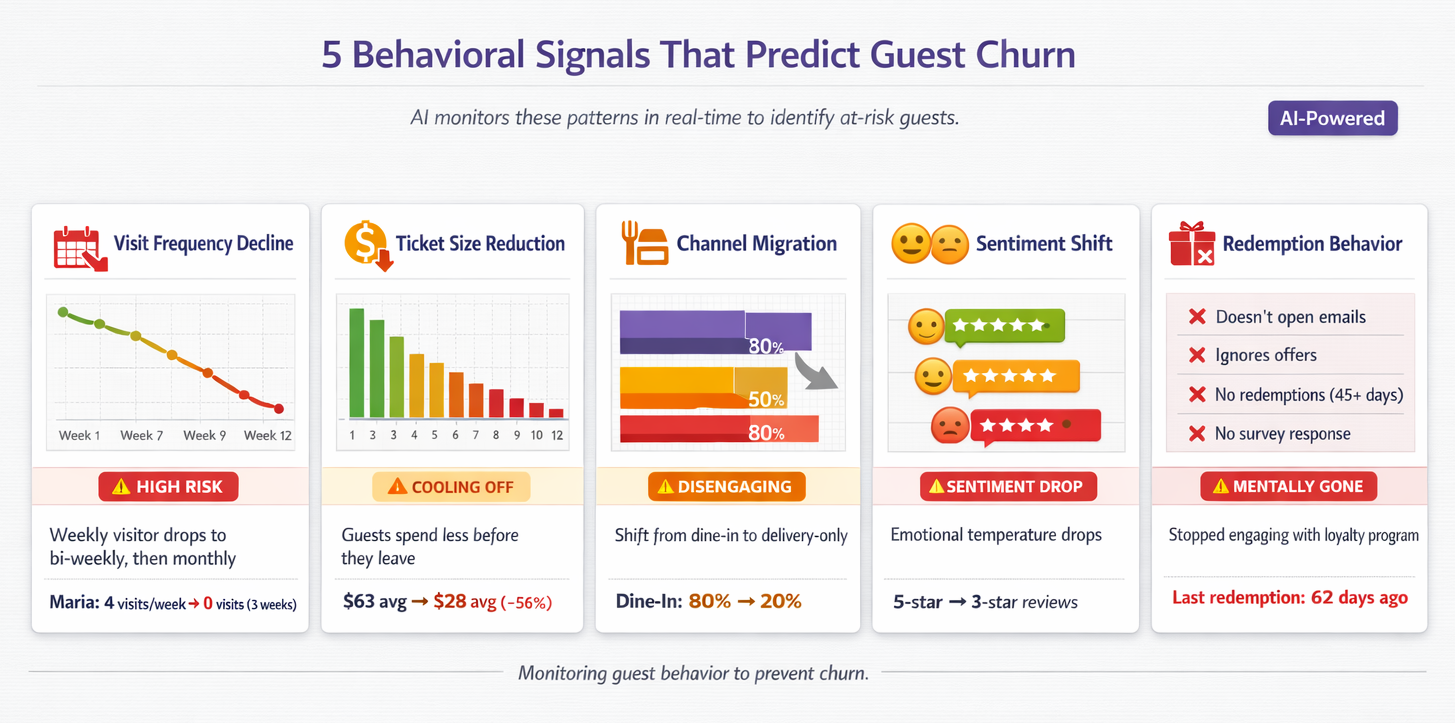
How do you know who’s about to leave before they’re gone? AI models identify these five behavioral signals:
1. Visit Frequency Decline
The most obvious signal, but only meaningful in context. A weekly visitor dropping to bi-weekly is concerning. A monthly visitor dropping to bi-monthly might be a normal seasonal variation.
AI tracks each guest’s individual baseline and flags deviations from their pattern, not a universal standard.
2. Ticket Size Reduction
When guests start spending less per visit, it often precedes complete departure. They’re testing the relationship before ending it, trading dinner for lunch, entrées for appetizers, wine bottles for glasses.
3. Channel Migration
Dine-in regulars who shift to delivery-only are showing reduced engagement. Delivery-only guests who stop ordering entirely are further along the churn journey.
4. Sentiment Shift
Review language and survey responses reveal emotional temperature. Guests who shift from “love it!” to “it’s fine” are cooling off, even if they’re still visiting.
5. Redemption Behavior Change
Loyal guests who stop redeeming offers or engaging with loyalty programs have mentally disengaged. They’re still being counted in your database, but they’ve already moved on.
How Multi-Location Restaurants Scale Guest Recovery
For single-location operators, tracking regulars is challenging but possible. A great host might remember Maria’s Tuesday pattern, might notice when she’s absent for a few weeks.
For multi-location restaurant groups? Manual tracking is mathematically impossible.
A 10-location restaurant group with 15,000 active guests has 15,000 individual behavior patterns to monitor. No marketing team, regardless of size, can track that manually and respond within the 47-day window.
This is where AI-powered customer data platforms become essential infrastructure, not optional technology.
The Automated Guest Recovery Workflow
Here’s how modern restaurant marketing automation handles at-risk guest recovery at scale:
Step 1: Unified Data
CollectionGuest data flows in automatically from every touchpoint:
- WiFi login data
- POS transaction history
- Online ordering platforms
- Reservation systems
- Review sites
- Website behavior
Each data source adds dimension to the guest profile. Maria isn’t just “Tuesday salmon lady”—she’s a composite of 67 visits, 4 reviews, 3 reservation requests, 12 online orders, and every other interaction.
Step 2: AI-Powered Segmentation
Machine learning continuously categorizes guests:
- Super Guests: Top 20% driving 80% of revenue
- Regulars: Consistent, predictable visit patterns
- New Guests: First or second visit, potential to develop
- Cooling Off: Recent behavior suggests declining engagement
- At-Risk: Significant deviation from established patterns
- Lost: Exceeded recovery window without intervention
Segments update in real-time. When Maria misses her second Tuesday, she moves from “Regular” to “Cooling Off” automatically.
Step 3: Triggered Campaigns
Each segment has associated automated campaigns:
- Cooling Off: Gentle check-in after first missed expected visit
- At-Risk: Personalized win-back offer with urgency
- Lost: Long-term re-engagement sequence
Campaigns are written in your brand voice and personalized with guest names—triggered by actual behavioral data, not arbitrary time windows.
Step 4: Optimal Timing
AI determines when each guest is most likely to engage. Maria checks email on Tuesday mornings. David responds better to Friday afternoon messages. The system sends at the right time for each individual.
Step 5: Revenue Attribution
When Maria returns after receiving the Day 15 message, the system tracks:
- Which campaign drove the return
- What she ordered on her return visit
- Her subsequent visit pattern
- Her updated lifetime value projection
This closes the loop. Every recovered guest is measured, and every campaign is optimized.
Implementation: From Silent Exodus to Recovered Revenue
What does it take to transform guest recovery from reactive guesswork to proactive automation?
Timeline to Impact
Days 1-3: Data Connection – Connect existing systems—POS, WiFi, online ordering, reservations, review sites—to the unified platform. Most integrations are automatic or require minimal technical setup.
Days 4-7: Historical Analysis – AI analyzes existing guest data to establish behavior baselines, identify current at-risk guests, and surface immediate opportunities.
Week 2: Campaign Activation – Automated win-back sequences go live. Guests flagged as at-risk during the historical analysis receive first recovery campaigns.
Week 3-4: Recovery Begins – First wave of recovered guests returns. Revenue attribution tracks each campaign’s performance.
Month 2+: Continuous Optimization – AI learns from campaign results, refining timing, messaging, and offer strategies. Recovery rates improve over time as the system learns your guests’ unique patterns.
Time Investment
Traditional manual win-back process: 15-20 hours per week (list building, campaign creation, analysis)
AI-automated guest recovery: 1-2 hours per week (reviewing results, strategic adjustments)
The time savings alone often justify the investment. The recovered revenue makes it transformative.
The Question You Should Be Asking
Right now, in your guest database, there are guests in the middle of their invisible exit.
They visited regularly. They spent meaningfully. They were on track to become lifetime customers.
And they’re leaving without saying goodbye.
The question isn’t whether you can afford AI-powered guest intelligence. The question is: How many Marias are walking away this month while you’re not watching?
What Happens Next
Every restaurant operator has two choices:
Option 1: Keep operating blind. Accept that 70% of first-time guests will never return. Accept that an unknown number of regulars are silently departing. Hope that new customer acquisition will outpace the invisible exodus.
Option 2: Start seeing. Deploy guest intelligence that monitors every behavior pattern, flags every at-risk guest, and automatically intervenes within the window where recovery is still possible.
The restaurants winning in 2025 aren’t working harder on acquisition. They’re getting smarter about retention.
Because the most expensive customer you’ll ever lose is the one you never knew was leaving.
Ready to stop losing guests forever?
See exactly how AI-powered guest intelligence identifies at-risk customers and recovers revenue automatically—before they become tomorrow’s lost guests.
Schedule Your Free Demo →
Calculate Your Recovery Potential →
P.S. While you were reading this article, somewhere in your guest database, a regular just became at-risk. The clock is ticking. Will you see them in time?
Related Articles
- The 3AM Advantage: How Smart Restaurants Grow Revenue While Their Competition Sleeps
- Your Guest Database Isn’t Just Data, It’s Your Restaurant’s Life Support System
- Why Your First-Time Guests Never Return (And How AI Fixes It)
- The Guest Intelligence Revolution: How Unified Data Creates Restaurant Marketing That Never Sleeps
Click to schedule a Free Online Demo, or call 727-877-8181 to see how guest intelligence can transform your restaurant’s retention strategy.
FREQUENTLY ASKED QUESTIONS
Common Questions About Restaurant Marketing
Restaurant marketing is the process of getting people to visit your restaurants. Restaurant marketing creates loyalty, provides data to research, analytics, and allows restaurants to gain a better understanding of their ideal customer profile. It utilizes all customer channels: guest WiFi, website, social, rating sites, mobile apps, email, text, and advertising.
WiFi marketing is a marketing technique that uses guest WiFi to collect & clean customer data such as names, emails, phone numbers, customer behavior, and demographics. This data is used to personalize marketing campaigns to increase customer loyalty, build online reviews, and save at-risk customers. The performance of every campaign can be tracked down to the tangible ROI of a customer walking back in your door.
Restaurant reputation management is the process for restaurants to manage customer feedback and creating systems to improve customer experiences, passively build positive online reviews, and save at-risk customers. It is a very important aspect of running a successful restaurant business.
A restaurant customer data platform (CDP) is a unified software system that collects, consolidates, and activates guest data from multiple sources including WiFi networks, POS systems, online ordering platforms, reservation systems, websites, loyalty platforns, event platforms, and review sites. Unlike generic CDPs built for e-commerce or SaaS companies, restaurant CDPs are purpose-built to handle restaurant-specific data sources and create actionable guest intelligence that drives personalized marketing, operational improvements, and revenue growth automatically.
Bloom Intelligence uses machine learning to identify at-risk customers. When one is recognized, the system will send them a message with an incentive to get them to return and re-establish their visit pattern. Bloom users are seeing up to 37% of churning customers return.
Ready to Turn Your Guest Data Into Revenue?
Join 1,000+ restaurant locations using Bloom Intelligence to recover lost guests, automate marketing, and drive measurable revenue growth.
Keep Reading
View All Posts →Every Guest Who Walks Through Your Door Makes You Easier to Find Online
In This Article What Each Guest Interaction Generates The Four Touchpoints Mapped The Broken Loop Explained The Discovery Flywheel What...
Why AI Engines Recommend Some Restaurants and Ignore Others
ChatGPT, Google AI Overviews, and Perplexity are recommending restaurants right now. The question isn't whether your restaurant should be optimized...
The Best Restaurant Guest Experience Software Doesn’t Manage Experiences. It Builds the Intelligence That Creates Them.
The Best Restaurant Guest Experience Software Doesn't Manage Experiences. It Builds the Intelligence That Creates Them. Bloom Intelligence unifies guest...