


The $1M Guest Journey: Mapping and Optimizing Every Touchpoint for Maximum Lifetime Value
The Restaurant That Cracked the Guest Journey Code
Maria owns a 45-seat Italian restaurant in Denver. Two years ago, she was struggling with inconsistent revenue and couldn’t understand why some guests became regulars while others never returned.
Today, she has increased her guests’ lifetime value by 43% and created sustainable revenue growth.
Her secret? Understanding that every guest follows a predictable path from discovery to advocacy, and that each stage requires different touchpoints and strategies to maximize lifetime value.
The difference between restaurants that thrive and those that merely survive often comes down to one critical factor: how well they understand and optimize the complete guest journey.
Why the Guest Journey Matters More Than Ever
In today’s restaurant landscape, competition abounds, and acquiring a new guest costs 5 to 7 times more than retaining an existing one. Yet most restaurants focus their energy on attracting new patrons rather than maximizing the value of guests they already have.
Consider this: A guest who visits once and spends $35 generates $35 in customer lifetime value. But a guest who becomes a regular, visiting twice monthly for three years, generates over $2,500 in lifetime value. That’s a 7,000% difference in value from the same initial guest.
The restaurants winning in 2025 understand that every touchpoint in the guest journey is an opportunity to increase lifetime value.
From the moment a potential guest discovers your restaurant to the day they become a vocal advocate, each interaction either moves them closer to or further from maximum value.
The Five-Stage Guest Journey Framework
Every restaurant guest follows a predictable journey through five distinct stages. Understanding these stages—and optimizing the touchpoints within each—is the key to transforming your restaurant into a guest loyalty machine.
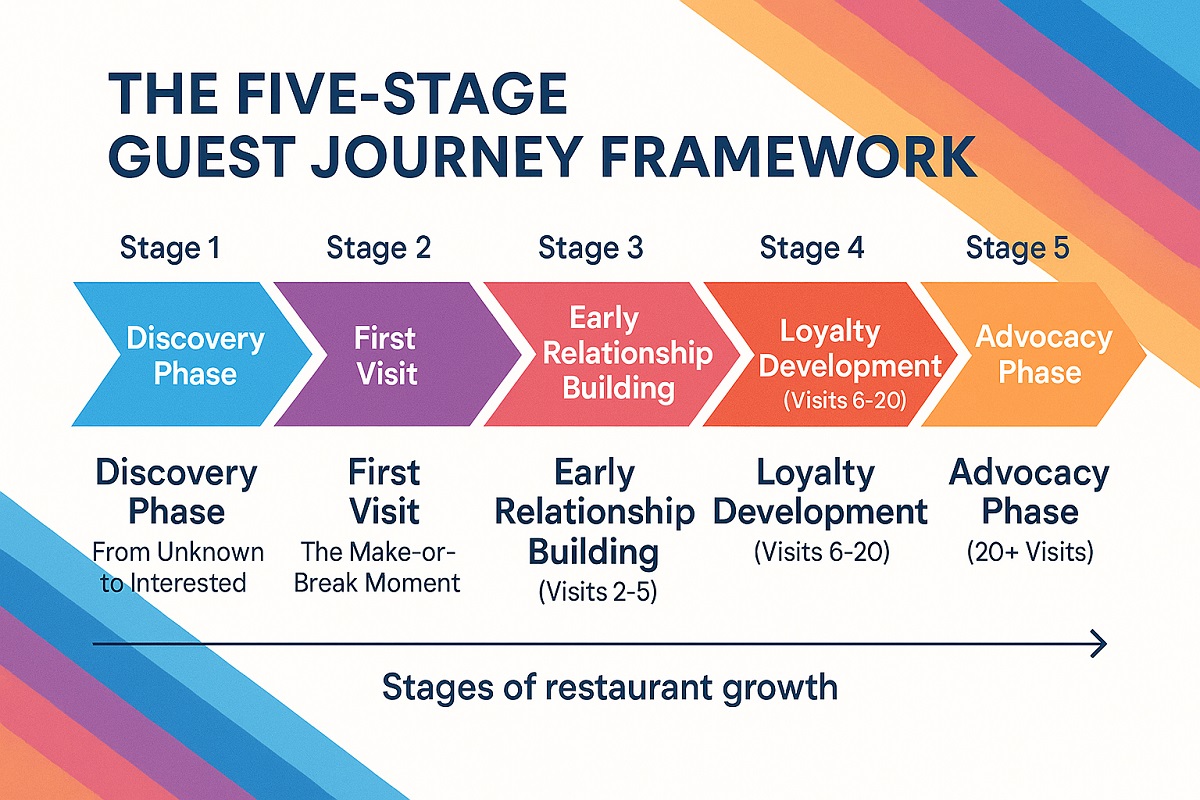
Stage 1: Discovery Phase – From Unknown to Interested
Revenue Impact: $0 → First Visit Potential
This is where potential guests first encounter your restaurant. They’re researching dining options, reading reviews, and evaluating whether you’re worth their time and money.
Critical Touchpoints:
- Online Reviews and Ratings: 94% of diners check reviews before visiting
- Social Media Presence: Instagram posts, Facebook reviews, TikTok videos
- Website Experience: Menu accessibility, reservation ease, contact information
- Google My Business: Hours, photos, recent reviews, response to feedback
- Word-of-Mouth: Recommendations from friends, family, colleagues
Optimization Strategies:
- Maintain a 4.3+ star average across all review platforms
- Post fresh, appetizing food photos at least 3 times per week
- Ensure your website loads in under 3 seconds on mobile
- Respond to all reviews within 24 hours with personalized messages
- Create shareable moments that encourage organic word-of-mouth
Stage 2: First Visit – The Make-or-Break Moment
Revenue Impact: $35 → $2,500+ Potential Lifetime Value
Here’s the harsh reality: 70% of first-time guests never return after their initial visit. This statistic represents millions of dollars in lost lifetime value across the restaurant industry.
Your first impression doesn’t just determine satisfaction—it determines whether a first-time guest returns to your restaurant or joins the 70% who disappear forever.
The operator’s primary goal is simple: get that new guest to visit number two. Research shows that guests who return for a second visit within 30 days have an 85% likelihood of becoming regular customers.
This makes the first visit the most critical revenue moment in your entire operation.
The stakes couldn’t be higher. That $35 first-time guest represents either $35 in total lifetime value or $2,500+ in potential returns. The difference lies entirely in the experience you create during those crucial first moments.
Critical Touchpoints:
- Guest Identification & Data Capture: WiFi login, POS integration, reservation details
- First Impression Moments: Greeting, wait time, ambiance assessment
- Service Quality Delivery: Server knowledge, attentiveness, problem resolution
- Food Experience Excellence: Taste, presentation, timing, temperature
- Digital Experience Integration: WiFi quality, online ordering ease, pay-at-table ease
- Departure & Follow-up: Payment process, farewell, post-visit engagement
Optimization Strategies:
- Capture guest identity: Use multiple touchpoints to collect name, email, and phone number from every first-time visitor—WiFi login, online reservations, pay-at-table systems, online ordering platforms, and data entry into guest reservation details.
- Track visit behavior automatically: Monitor dwell time, order preferences, and spending patterns through POS integration
- Create personalized wow moments: Use captured data for ongoing personalization (birthday recognition, anniversary, names, items ordered, dietary preference acknowledgment)
- Build guest preference profiles: Note seating preferences, favorite dishes, and special requests in real-time
- Trigger automated follow-up sequences: Send personalized thank-you emails within 24 hours with return incentives based on their order history or send an automated exit survey.
- Monitor satisfaction signals: Track sentiment from reviews and surveys that can be attributed to the guest and used for further personalization or operational improvements.
Revenue Attribution: Track first-visit visitor return rate. This metric directly predicts lifetime value.
Stage 3: Early Relationship Building (Visits 2-5)
Revenue Impact: Building toward Regular Status
This is where New Guests either graduate to second time and start the journey to become a Regular and then a Super Guest, or become Guests That Need Attention. The goal is to establish consistent visit patterns and increase emotional connection to your restaurant while improving your restaurant marketing ROI.
Critical Touchpoints:
- Personalized Recognition: Remembering preferences, special occasions
- Consistent Quality: Meeting or exceeding first-visit expectations
- Menu Exploration: Encouraging guests to try new items
- Loyalty Program Introduction: Enrolling guests in rewards systems
- Targeted Communications: Relevant offers based on visit history
Optimization Strategies:
- Create guest preference profiles, noting favorite dishes, dietary restrictions, and seating preferences
- Send targeted offers based on previous orders (vegetarian specials for plant-based diners)
- Implement a “second visit guarantee” to encourage return within two weeks
- Use email and SMS automation to send relevant content between visits
Revenue Attribution: Measure the progression rate from New Guest to Regular. Track the average spend increase between visits 1-5.
Stage 4: Loyalty Development (Visits 6-20)
Revenue Impact: Transitioning to High-Value Regular Status
At this stage, Regulars are forming deep emotional connections with your restaurant. The focus shifts to increasing visit frequency, average spending, and creating brand advocates to become a Super Guest.
Critical Touchpoints:
- VIP Treatment: Special seating, early access to new menu items
- Community Building: Events, chef’s table experiences, cooking classes
- Referral Encouragement: Formal and informal referral programs
- Feedback Integration: Actively seeking and implementing guest suggestions
- Milestone Recognition: Anniversary of first visit, Anniversary celebrations and birthday celebrations
Optimization Strategies:
- Create an exclusive “VIP Menu” with off-menu items
- Host monthly wine tastings or chef’s table events for loyal guests
- Implement a referral program offering rewards for both referrer and referee
- Send quarterly surveys asking for improvement suggestions
- Remember and celebrate guest milestones automatically
Revenue Attribution: Track average monthly spend per Regular. Monitor referral generation rates.
Stage 5: Advocacy Phase (20+ Visits)
Revenue Impact: Maximum Lifetime Value + Referral Multiplication
Super Guests are your restaurant’s most valuable assets. They generate the highest lifetime value while actively promoting your restaurant to others. At this stage, they’re essentially unpaid marketing ambassadors.
Critical Touchpoints:
- Exclusive Experiences: Private dining, chef interactions, first taste of new dishes
- Co-Creation Opportunities: Menu feedback, event planning input
- Social Amplification: Encouraging social media posts, review generation
- Community Leadership: Making them feel like restaurant family members
- Long-term Relationship Management: Maintaining connection through changes
Optimization Strategies:
- Create an exclusive “Inner Circle” with advance notice of menu changes
- Invite Super Guests to preview new dishes before public launch
- Feature loyal guests on social media with their permission
- Send handwritten thank-you notes from ownership
- Provide exclusive contact information for special requests
Revenue Attribution: Super Guests typically generate 10-15x the lifetime value of average guests. Track their referral impact—each Super Guest should generate 3-5 new customer referrals annually.

Understanding Guest Movement and Intervention Points
Not every guest follows a linear path through these stages. Understanding how guests move between Bloom’s predefined audience segments helps you intervene at critical moments:
New Guests → Regulars
- Success Indicator: 3+ visits within 60 days
- Intervention Strategy: Targeted “welcome series” emails with menu highlights.
- Revenue Impact: 340% increase in lifetime value
Regulars → Guests That Need Attention
- Warning Signs: 20% decrease in visit frequency, lower average spend
- Intervention Strategy: Personalized outreach asking for feedback
- Revenue Recovery: 67% of addressed concerns result in returned loyalty
Any Segment → At-Risk Guests
- Critical Indicators: leverage technology to identify and target guests who significantly move outside their visit patterns.
- Intervention Strategy: Immediate win-back campaign with compelling offer
- Success Rate: 38% of At-Risk guests can be recovered with proper intervention
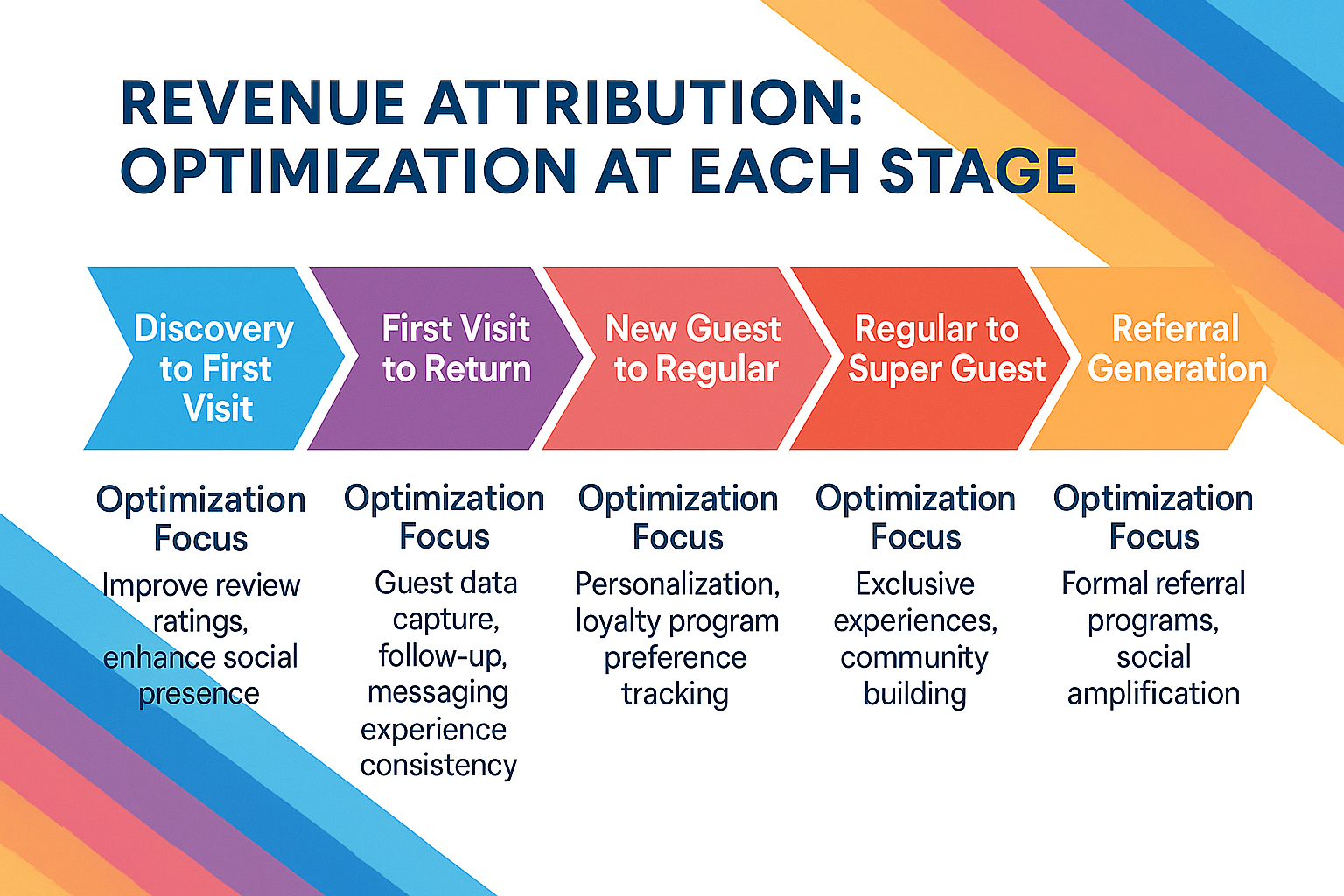
Revenue Attribution: Tracking Dollar Value at Each Stage
Understanding the financial impact of journey optimization requires tracking specific metrics at each stage:
Discovery to First Visit
- Metric: Conversion rate by discovery channel
- Revenue Impact: $45 average first visit spend
- Optimization Focus: Improve review ratings, enhance social presence
First Visit to Return
- Metric: 30-day return rate
- Revenue Impact: $280 average second-visit value (includes future visit prediction)
- Optimization Focus: Guest data capture, follow-up messaging, experience consistency
New Guest to Regular
- Metric: Progression rate and timeline
- Revenue Impact: $1,200 average annual value for Regulars
- Optimization Focus: Personalization, loyalty program, preference tracking
Regular to Super Guest
- Metric: Visit frequency and advocacy behaviors
- Revenue Impact: $2,500+ annual value plus referral multiplication
- Optimization Focus: Exclusive experiences, community building
Referral Generation
- Metric: New guests attributed to existing guest referrals
- Revenue Impact: $340 average first-year value per referred guest
- Optimization Focus: Formal referral programs, social amplification
How Bloom Intelligence Automates Guest Journey Optimization
Managing this complex guest journey manually is impossible for most restaurant operators. This is where Bloom Intelligence transforms theory into practice.
Automatic Guest Segmentation
Bloom automatically categorizes every guest into the appropriate audience segment based on visit frequency, recency, sentiment, and spending patterns. No manual tracking required.
Triggered Journey Communications
- New Guests: Automatic welcome series with menu highlights and return incentives
- Regulars: Personalized offers based on order history and preferences
- Guests That Need Attention: Immediate alerts and intervention campaigns
- At-Risk Guests: Automated win-back sequences with compelling offers
- Super Guests: Exclusive communications and VIP treatment triggers
Cross-Platform Data Unification
Bloom unifies data from WiFi, POS, online ordering, reservations, websites, and review sites to create comprehensive guest profiles that track guest behavior and sentiment automatically.
Predictive Journey Intelligence
AI-powered insights predict which guests are likely to move between segments, enabling proactive intervention rather than reactive responses.
Revenue Attribution Tracking
Bloom tracks the financial impact of every journey touchpoint, from first discovery through referral generation, providing clear ROI measurement for optimization efforts.
Automated Personalization
Every communication is automatically personalized based on guest preferences, visit history, and journey stage without manual effort from restaurant staff.
The Million-Dollar Impact
Restaurants using Bloom’s guest journey optimization see average improvements of:
- 43% increase in their guest lifetime value through better journey management
- 38% recovery rate for At-Risk guests through automated win-back campaigns
Maria’s success story isn’t unique. When restaurants understand and optimize every touchpoint in the guest journey, they transform from service providers into relationship builders—and the financial results speak for themselves.
The guest journey isn’t just about hospitality; it’s about creating a systematic approach to building lasting relationships that generate sustainable revenue growth. With the right strategy and technology, every restaurant can build its own million-dollar guest journey.
Ready to map and optimize your guest journey for maximum lifetime value? Bloom Intelligence allows you to easily integrate your data sources, and then Bloom automatically benchmarks, highlights, suggests, and implements marketing and operational excellence campaigns to turn your New Guests into Super Guests. Bloom is built to support and amplify lean teams. Schedule a demo now to learn more.
Schedule a Free Demo to see how we can exponentially accelerate your restaurant’s competitive advantage.
Let Bloom Intelligence Make It Effortless
Bloom Intelligence is an AI-powered restaurant marketing platform. It includes a powerful customer data platform, website integrations, automated guest data collection, one-click audience segmentation, marketing automation via email and SMS, advanced reputation management, and impressive reporting tools.
Bloom makes guest data collection and marketing automation effortless, which allows you to quickly execute the strategies listed above, saving you time, increasing customer lifetime values, attracting new guests, improving your reputation, and boosting your bottom line.
Call us or schedule a free demo online and Bloom will show you how our restaurant marketing platform can help you save time and increase your customer lifetime values by automatically building first-party customer databases, unlocking important guest insights to trigger automated marketing at the right time and place, discover true guest sentiment, save at-risk guests, increase your current guests’ frequency, supercharge your website, and find new guests.
Click to schedule a Free Online Demo, or call 727-877-8181 to see how we can help you drive tangible results for your restaurants.
FREQUENTLY ASKED QUESTIONS
Common Questions About Restaurant Marketing
Restaurant marketing is the process of getting people to visit your restaurants. Restaurant marketing creates loyalty, provides data to research, analytics, and allows restaurants to gain a better understanding of their ideal customer profile. It utilizes all customer channels: guest WiFi, website, social, rating sites, mobile apps, email, text, and advertising.
WiFi marketing is a marketing technique that uses guest WiFi to collect & clean customer data such as names, emails, phone numbers, customer behavior, and demographics. This data is used to personalize marketing campaigns to increase customer loyalty, build online reviews, and save at-risk customers. The performance of every campaign can be tracked down to the tangible ROI of a customer walking back in your door.
Restaurant reputation management is the process for restaurants to manage customer feedback and creating systems to improve customer experiences, passively build positive online reviews, and save at-risk customers. It is a very important aspect of running a successful restaurant business.
A restaurant customer data platform (CDP) is a unified software system that collects, consolidates, and activates guest data from multiple sources including WiFi networks, POS systems, online ordering platforms, reservation systems, websites, loyalty platforns, event platforms, and review sites. Unlike generic CDPs built for e-commerce or SaaS companies, restaurant CDPs are purpose-built to handle restaurant-specific data sources and create actionable guest intelligence that drives personalized marketing, operational improvements, and revenue growth automatically.
Bloom Intelligence uses machine learning to identify at-risk customers. When one is recognized, the system will send them a message with an incentive to get them to return and re-establish their visit pattern. Bloom users are seeing up to 37% of churning customers return.
Ready to Turn Your Guest Data Into Revenue?
Join 1,000+ restaurant locations using Bloom Intelligence to recover lost guests, automate marketing, and drive measurable revenue growth.
Keep Reading
View All Posts →8 in 10 Restaurant Guests Never Come Back. Here’s What That’s Costing You.
Key Takeaway Eight in ten restaurant guests who have ever visited your location have never returned, creating a measurable revenue...
Your Restaurant Reputation Management Software Only Does 10% of the Job. Here’s What It’s Missing.
Key Takeaway Most restaurant reputation management software only handles review responses. That's just 10% of the value your guest sentiment...
The 13x Guest: How Restaurant Data Analytics Reveals Your Most Valuable Customers
Key Takeaway Your most loyal restaurant guests spend 13 times more than first-time visitors — but most restaurants can't identify,...