


Predictive Guest Scoring: The Next Frontier in Restaurant Growth (And How to Use It)
What Is Predictive Guest Scoring in Restaurants?
Predictive guest scoring uses artificial intelligence and historical guest data to forecast future diner behavior, including visit likelihood, churn risk, lifetime value, and offer responsiveness.
Instead of reacting after guests stop coming, predictive guest scoring allows restaurants to act before revenue is lost.
Simply put, it identifies who will matter most tomorrow, not just who mattered yesterday.
Why Traditional Guest Segmentation Is No Longer Enough
Most restaurants rely on static guest segments, such as regulars, at-risk, lapsed, or new. While helpful, these segments are backward-looking. They describe what already happened, not what’s about to happen.
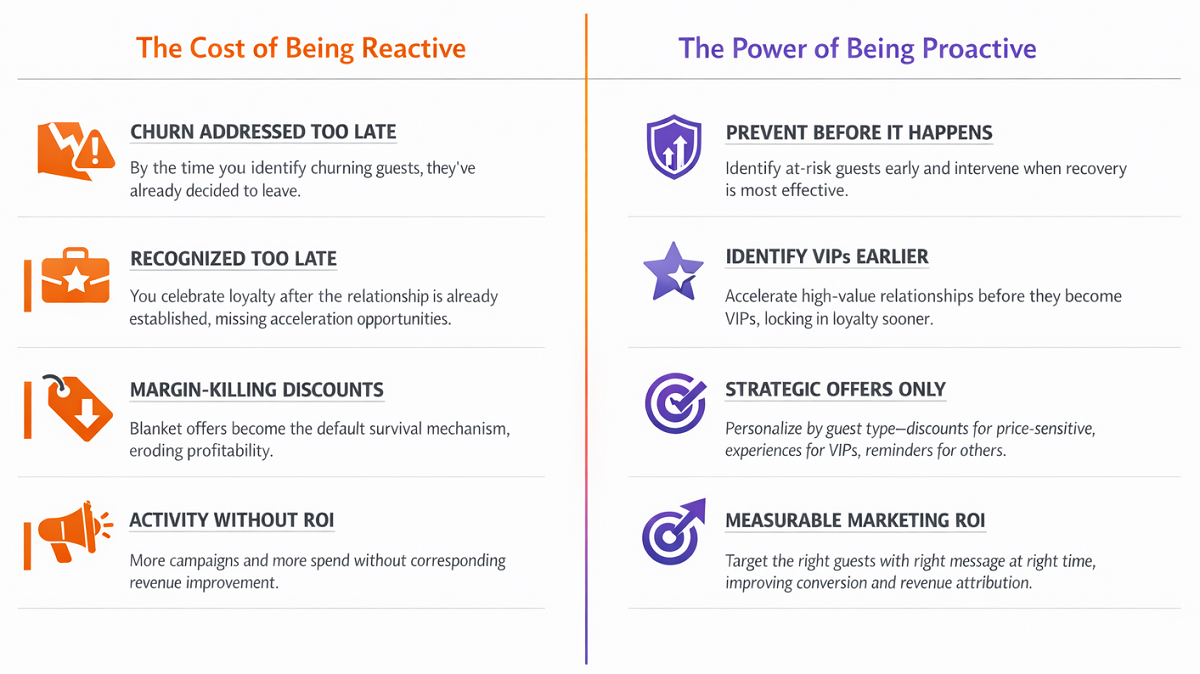
The downside of reactive segmentation:
- Churn is addressed too late
- High-value guests are recognized after the opportunity window
- Discounts are overused to compensate for poor targeting
- Marketing activity increases without improving ROI
In today’s margin-tight environment, reactive marketing is expensive marketing.
How Predictive Guest Scoring Works
Predictive guest scoring uses machine learning models trained on historical guest behavior to calculate a dynamic score for every guest.
These models analyze signals such as:
- Visit frequency and recency
- Spend patterns and average check size
- Behavior across WiFi, POS, online ordering, and reservations
- Engagement with marketing campaigns
- Guest sentiment from reviews and feedback
- Behavioral trends over time
The output is a continuously updated probability score that predicts future actions, including likelihood to return, likelihood to churn, and potential lifetime value.
This moves marketing from automation to decision intelligence.
Predictive Guest Scoring vs. Traditional Guest Segmentation
| Traditional Segmentation | Predictive Guest Scoring |
|---|---|
| Based on past behavior | Based on future probability |
| Static or manual | Continuously updated |
| Rule-based | AI-driven |
| Broad targeting | Precision targeting |
| Reactive | Proactive |
The difference is the difference between reporting and forecasting.
Why Predictive Guest Scoring Matters Now
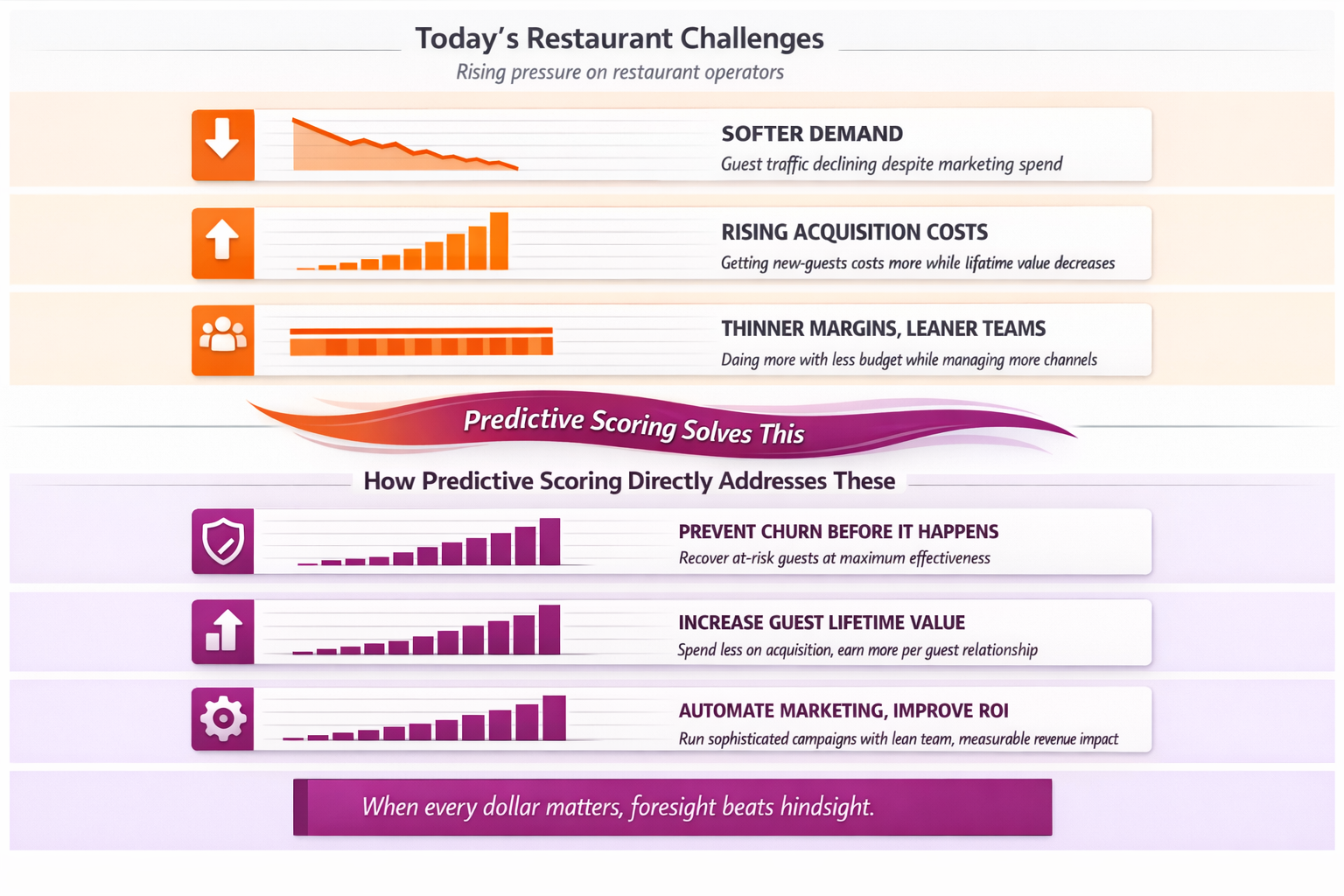
Restaurant operators are facing softer demand, rising acquisition costs, and thinner margins — all while managing more channels with leaner teams.
Predictive guest scoring directly addresses these challenges by:
- Preventing churn before it happens
- Increasing guest lifetime value
- Improving campaign conversion rates
- Reducing unnecessary discounting
- Driving measurable marketing ROI
When every dollar matters, foresight beats hindsight.
How Restaurants Use Predictive Guest Scoring to Drive Revenue
Identify Future VIPs Earlier
Predictive models flag guests who are trending toward high lifetime value before they become VIPs. Restaurants can accelerate loyalty and lock in high-value relationships sooner.
Intervene Before Guests Churn
Predictive scores surface early warning signs of disengagement, allowing restaurants to trigger personalized save campaigns at the right moment — when recovery is most effective.
Personalize Offers Without Killing Margin
Not every guest needs a discount. Predictive scoring helps determine who needs an incentive, who needs a reminder, and who responds best to exclusivity or experience-based messaging.
Key Metrics Predictive Guest Scoring Improves
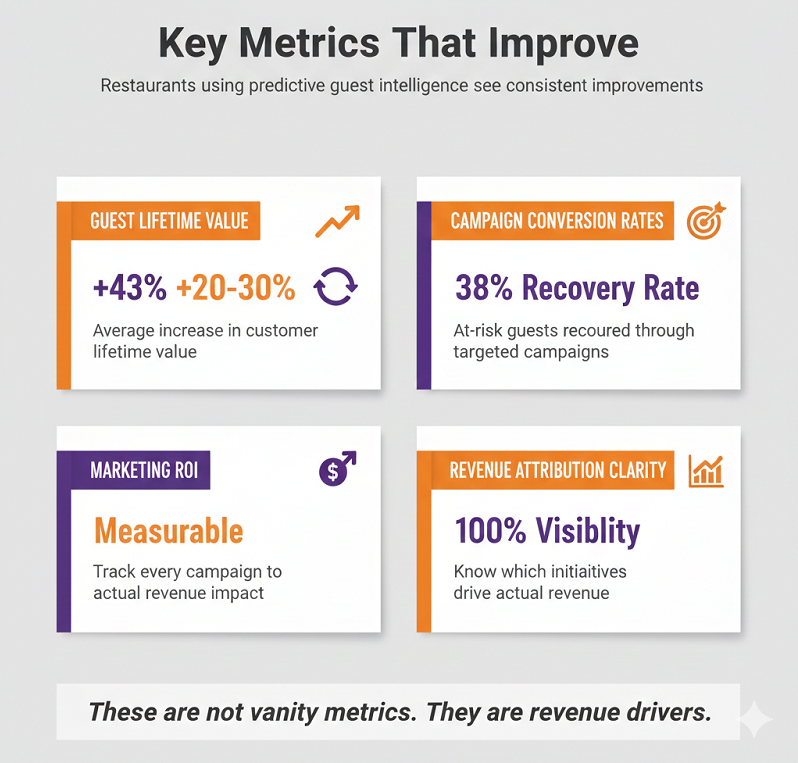
Restaurants using predictive guest intelligence consistently improve:
- Guest lifetime value
- Repeat visit frequency
- Campaign conversion rates
- Marketing ROI
- Revenue attribution clarity
These are not vanity metrics. They are revenue drivers.
How Bloom Intelligence Enables Predictive Guest Scoring
Bloom Intelligence unifies guest data across WiFi, POS, online ordering, reservations, websites, and reviews into a single guest profile.
That data powers AI models that:
- Continuously score guests
- Automatically trigger personalized campaigns
- Tie marketing and operational actions directly to revenue
The result is always-on, predictive marketing that runs without adding complexity or headcount.
Frequently Asked Questions about Restaurant Predictive Analytics
What is predictive analytics in restaurant marketing?
Predictive analytics uses AI and historical guest data to forecast future behaviors like visit likelihood, churn risk, and spending potential.
How does predictive guest scoring increase restaurant revenue?
It enables earlier intervention, smarter personalization, fewer wasted discounts, and higher guest lifetime value.
Is predictive guest scoring only for large restaurant chains?
No. Small and mid-size restaurant groups often see the biggest gains because predictive intelligence replaces manual analysis and guesswork.
How often are guest scores updated?
In advanced platforms like Bloom Intelligence, guest scores update continuously as new data is collected.
The Bottom Line
The future of restaurant marketing isn’t more campaigns or deeper discounts.
It’s smarter decisions, made earlier.
Predictive guest scoring turns guest data into foresight — and foresight into sustainable revenue growth.
Ready to See Predictive Guest Scoring in Action?
If you want to stop guessing and start predicting guest behavior, it’s time to see Bloom Intelligence in action.
Book a personalized demo today and see how predictive guest scoring, automated marketing, and unified guest data can help you increase revenue, reduce churn, and make smarter decisions — automatically.
👉 Request your free demo here!
Related Articles
- The 3AM Advantage: How Smart Restaurants Grow Revenue While Their Competition Sleeps
- Your Guest Database Isn’t Just Data, It’s Your Restaurant’s Life Support System
- Why Your First-Time Guests Never Return (And How AI Fixes It)
- The Guest Intelligence Revolution: How Unified Data Creates Restaurant Marketing That Never Sleeps
Click to schedule a Free Online Demo, or call 727-877-8181 to see how guest intelligence can transform your restaurant’s retention strategy.
FREQUENTLY ASKED QUESTIONS
Common Questions About Restaurant Marketing
Restaurant marketing is the process of getting people to visit your restaurants. Restaurant marketing creates loyalty, provides data to research, analytics, and allows restaurants to gain a better understanding of their ideal customer profile. It utilizes all customer channels: guest WiFi, website, social, rating sites, mobile apps, email, text, and advertising.
WiFi marketing is a marketing technique that uses guest WiFi to collect & clean customer data such as names, emails, phone numbers, customer behavior, and demographics. This data is used to personalize marketing campaigns to increase customer loyalty, build online reviews, and save at-risk customers. The performance of every campaign can be tracked down to the tangible ROI of a customer walking back in your door.
Restaurant reputation management is the process for restaurants to manage customer feedback and creating systems to improve customer experiences, passively build positive online reviews, and save at-risk customers. It is a very important aspect of running a successful restaurant business.
A restaurant customer data platform (CDP) is a unified software system that collects, consolidates, and activates guest data from multiple sources including WiFi networks, POS systems, online ordering platforms, reservation systems, websites, loyalty platforns, event platforms, and review sites. Unlike generic CDPs built for e-commerce or SaaS companies, restaurant CDPs are purpose-built to handle restaurant-specific data sources and create actionable guest intelligence that drives personalized marketing, operational improvements, and revenue growth automatically.
Bloom Intelligence uses machine learning to identify at-risk customers. When one is recognized, the system will send them a message with an incentive to get them to return and re-establish their visit pattern. Bloom users are seeing up to 37% of churning customers return.
Ready to Turn Your Guest Data Into Revenue?
Join 1,000+ restaurant locations using Bloom Intelligence to recover lost guests, automate marketing, and drive measurable revenue growth.
Keep Reading
View All Posts →8 in 10 Restaurant Guests Never Come Back. Here’s What That’s Costing You.
Key Takeaway Eight in ten restaurant guests who have ever visited your location have never returned, creating a measurable revenue...
Your Restaurant Reputation Management Software Only Does 10% of the Job. Here’s What It’s Missing.
Key Takeaway Most restaurant reputation management software only handles review responses. That's just 10% of the value your guest sentiment...
The 13x Guest: How Restaurant Data Analytics Reveals Your Most Valuable Customers
Key Takeaway Your most loyal restaurant guests spend 13 times more than first-time visitors — but most restaurants can't identify,...