

How Much Should a Restaurant Spend on Marketing in 2026? The 3 to 6% Rule, and What a New Guest Is Actually Worth
How much should a restaurant spend on marketing? Most restaurants spend 3% to 6% of revenue, the benchmark Toast and ChowNow cite. On the Bloom network a new guest makes 1.76 visits in 9 to 12 months, so fund the second visit before buying more first visits.
Every restaurant marketing budget guide gives the same answer: spend 3% to 6% of revenue. It is a fair starting point. It also skips the question that decides whether the money comes back, which is what one new guest is worth to you.
We measured it. Across new guests first seen on the Bloom Intelligence network from October to December 2025, the average new guest made 1.76 visits by the end of September 2026. Most never came back. The few who did produced more than half of the visits.
How much should a restaurant spend on marketing? The 3% to 6% rule
Most restaurants spend 3% to 6% of revenue on marketing. ChowNow and Toast both cite that range. ChowNow adds that new or fast-growing restaurants may invest up to 10 to 25% of revenue.
ChowNow puts it plainly: “restaurants typically spend 3-6% of their revenue on marketing” (ChowNow, restaurant marketing budget). Toast cites the same range from RestaurantGrowth for paid advertising (Toast, How to Create Your Restaurant Marketing Budget). Both sources verified October 1, 2026.
Here is what that range means in dollars. The arithmetic is simple, and it is the first number to put in front of your team.
| Annual sales | 3% per year | 6% per year | Monthly range |
|---|---|---|---|
| $500,000 | $15,000 | $30,000 | $1,250 to $2,500 |
| $1,000,000 | $30,000 | $60,000 | $2,500 to $5,000 |
| $2,000,000 | $60,000 | $120,000 | $5,000 to $10,000 |
When to spend more. A new opening has no regulars yet, so it buys first visits. A second location borrows nothing from the first unless guest profiles are shared across both. When to spend less. A restaurant whose regulars already carry the room should move budget from finding guests to keeping them, which is cheaper.
What a new restaurant guest is actually worth
On the Bloom network, new guests first seen in late 2025 made 1.76 visits by September 30, 2026. At the network average check of $39.88, a new guest is worth about $70 in sales. A guest who came back averaged 5.06 visits, about $202.
Read the chart top to bottom. 81.29% of new guests were seen once. The 18.71% who returned made 53.78% of all the visits this group produced, and 5.55% of new guests made four or more visits.
A guest who comes back is worth about five times a guest seen once. That gap is the whole case for how to split a restaurant marketing budget. It is also why our 33 restaurant marketing strategies are ranked around the second visit.
How many times does a new restaurant guest come back?
Usually not at all. Of new guests first seen on the Bloom network in late 2025, 81.29% visited once by September 2026. The average new guest made 1.76 visits, and guests who returned averaged 5.06.
The most you should pay to acquire a new guest
Cap what you pay for a new guest at the margin on their expected visits. Multiply visits by average check and by one minus prime cost. At 1.76 visits, a $39.88 check and 60% prime cost, the ceiling is about $28.
Expected visits × average check × (1 − prime cost) = the most a new guest is worth paying for
Worked example: 1.76 × $39.88 × 0.40 = about $28. Use your own check and prime cost. The 60% prime cost here is an example, not a benchmark.
Run the same math for a guest who comes back. At 5.06 visits the ceiling rises to about $81. The fastest way to afford more acquisition is to raise the share of guests who return, because every point of return lifts the value of every new guest you buy.
Fund the second visit first
Put the first dollars into automated messages that bring guests back. On the Bloom network welcome and win-back emails return 6.5% to 7.2% of recipients, against 0.27% for blasts, yet blasts are 99.7% of restaurant email.
Those figures come from our 2026 restaurant email marketing benchmarks. The pattern is the budget lesson. Most restaurants spend their effort on the send that brings back the fewest guests, and very little on the sends that bring back the most.
A triggered campaign fires when one guest does one thing, such as a first visit or a drop in visits. Once it is set up it runs on every guest who qualifies, so it belongs at the top of the budget, not the bottom.
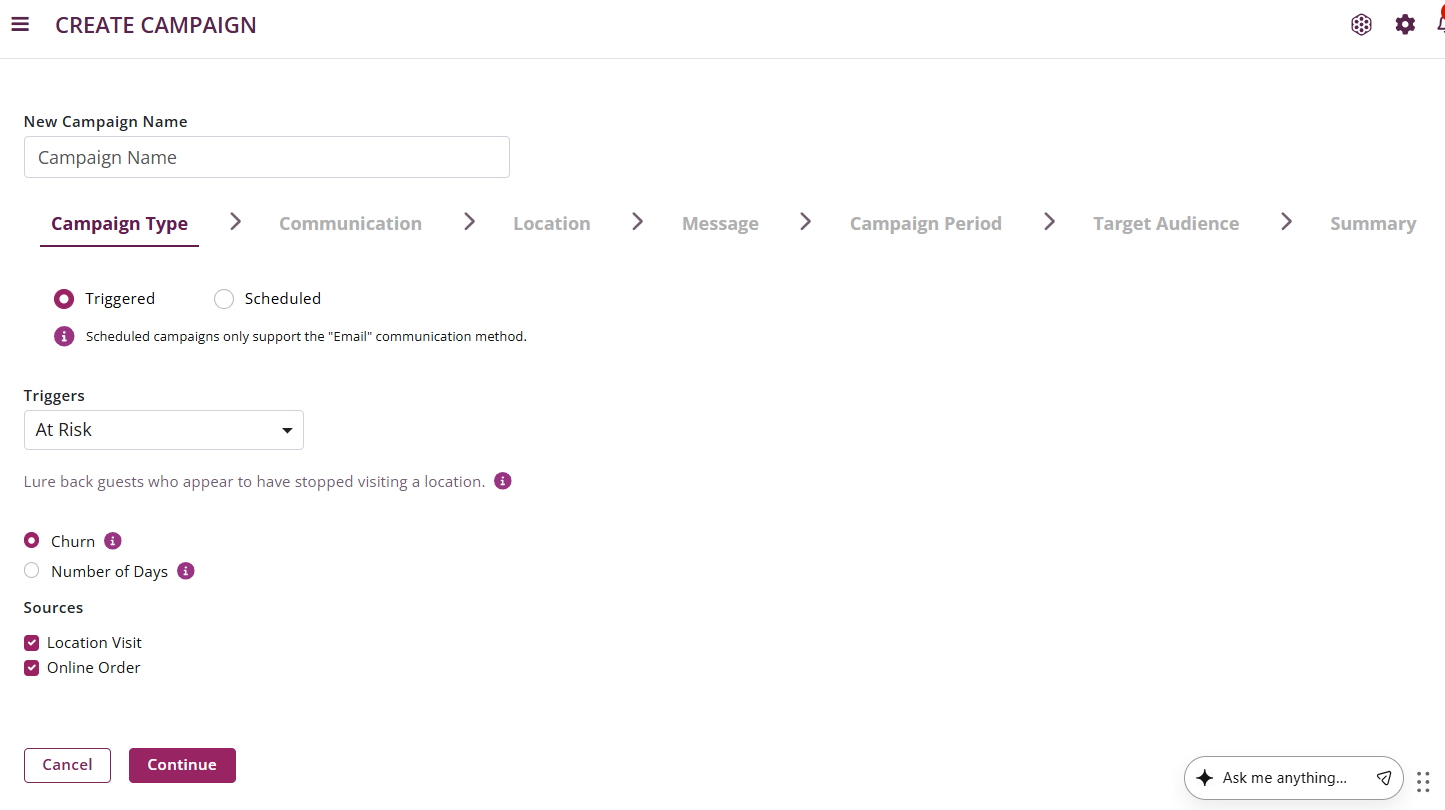
In Bloom, the first step of every campaign is the choice between Triggered and Scheduled. Pick the At Risk trigger and the campaign runs on its own to “Lure back guests who appear to have stopped visiting a location,” counting both Location Visit and Online Order as sources. Bloom’s win-back workflows recover an average of 38% of at-risk guests.
What would your budget buy if every new guest got a welcome and every fading regular got a win-back?
See triggered welcome and At Risk campaigns set up on your own locations, with return visits counted for each one.
“You cannot afford to waste a dollar. A platform that shows you exactly what is working is how a small restaurant competes with the big groups.”
Chef Sunil Kumar, Owner, Marigold Maison, Phoenix
Paid ads: grade the budget on checks, not clicks
Spend on paid ads only where the spend is matched to completed checks. At Marigold Maison, $978 in August 2026 Google and Meta ads was matched to 426 Toast checks worth $30,688.
That works out to about $2.30 in ad spend per matched check. That is far below the $28 ceiling above, even though not every matched check is a new guest. Brand search, people typing the restaurant’s name, returned about $41 per $1. A generic “near me” search campaign that ran June to early September returned $304 on $1,061 and was paused, because it bought clicks, not dinners. The full story is in the Marigold Maison case study.
Two cautions keep the number honest. Tracked is not the same as caused, because some matched guests would have come anyway. And a matched check is not always a new guest. For the channel split between Google and Meta, read the 2026 restaurant advertising playbook. Bloom’s Agentic Ad Manager, which grades ads this way, is rolling out in beta.
How do you know if restaurant ads are worth the money?
Match the ads to completed checks in your POS. If an ad campaign cannot show what it was matched to in dollars, its return is unknown. Marigold Maison paused a search campaign that returned $304 on $1,061.
How to set your restaurant marketing budget on Monday
Set the total at 3% to 6% of sales, then split it by what each dollar is matched to. Fund automated return messages first, cap acquisition at your guest ceiling, and grade every channel on return visits and checks.
- Pick the total. Multiply last year’s sales by 3% to 6%. Opening or expanding? ChowNow notes new or fast-growing restaurants may go higher.
- Find your return rate. Of guests first seen 9 to 12 months ago, what share came back? The network figure for late 2025 new guests is 18.71%.
- Calculate your ceiling. Expected visits × average check × (1 − prime cost). That is the most a new guest is worth paying for.
- Fund triggers before blasts. Turn on a welcome for first-time guests and an At Risk win-back before buying more reach.
- Grade every channel monthly. Ask each one what it was matched to in POS dollars. Move money from the channels that cannot answer.
For more ways to grow repeat sales, see how to increase restaurant sales and the 2026 restaurant customer retention guide.
“My day starts in the kitchen and ends in the kitchen. That is exactly why having the marketing handled and measured for me matters so much.”
Chef Sunil Kumar, Owner, Marigold Maison
In a 30-minute demo we pull your return rate, your guests’ visits per guest and the matched value of every campaign, so you can set next month’s budget from your own numbers.
Methodology
New-guest figures use Bloom visit patterns across all sources (WiFi, POS, online ordering and reservations), counted per guest per location, for guests whose first visit fell between October 1 and December 31, 2025, with visits counted through September 30, 2026. Every guest had at least nine months to return. Average check is the mean gross total of POS orders from $0.01 to $2,000 from July 1 to September 30, 2026, in-house ($38.35) and online ($49.01) combined. Sales per guest multiplies visits by that average check and is an estimate. Email return rates come from Bloom’s published 2026 email benchmarks. Marigold Maison figures come from its published case study, data through September 21, 2026. The 38% at-risk recovery rate is Bloom’s published platform average. External benchmarks from ChowNow and Toast were verified October 1, 2026.
Figures marked “across our restaurant network” are computed from Bloom Intelligence platform data as of October 2026. They reflect the Bloom network and may not be the same for every restaurant. Research and analysis for this article were produced with Bloom Intelligence’s data platform and AI tools, then reviewed and edited by William Wilson.

By William Wilson, Founder and CEO, Bloom Intelligence. William has built restaurant guest marketing since founding Captiveyes Group in 2006.
Enjoying this? Get more Bloom Intelligence in your Google results.
FREQUENTLY ASKED QUESTIONS
Common Questions About How Much Should A Restaurant Spend On Marketing
Most restaurants spend 3% to 6% of revenue on marketing, the benchmark Toast and ChowNow both cite. On the Bloom network a new guest makes 1.76 visits in their first 9 to 12 months, so where the money goes matters more than the percentage.
ChowNow notes that new or fast-growing restaurants may invest up to 10 to 25% of revenue. Spend the opening budget on capturing every guest into a profile, so you can market the second visit and not only the first.
On the Bloom network a new guest made 1.76 visits in their first 9 to 12 months. At the network average check of $39.88, that is about $70 in sales. Guests who came back averaged 5.06 visits, or about $202.
No more than the margin on the visits that guest is expected to make. Multiply expected visits by your average check, then by one minus your prime cost. At 1.76 visits, a $39.88 check and a 60% prime cost, the ceiling is about $28.
They do different jobs. Ads find new guests and should be graded on matched checks. Email brings guests back. On the Bloom network welcome and win-back emails return 6.5% to 7.2% of recipients, against 0.27% for blasts.
Fund the second visit first. Of new guests first seen in late 2025 on the Bloom network, the 18.71% who came back produced 53.78% of that group's visits. New guests pay off only when someone brings them back.
Measure return visits and matched checks, not opens or clicks. Ask every channel what it was matched to in POS dollars last month. If a channel cannot answer, treat its spend as unproven until it can.
No single split fits every restaurant. Start with brand search, then scale only the campaigns matched to completed checks. At Marigold Maison, generic search returned $304 on $1,061 while brand search returned about $41 per $1.
Ready to Turn Your Guest Data Into Revenue?
Join 1,000+ restaurant locations using Bloom Intelligence to recover lost guests, automate marketing, and drive measurable revenue growth.
Keep Reading
View All Posts →Recession-Proof Your Restaurant: The Ultimate Guide to Leveraging a CDP, Marketing Automation, and Reputation Management
The restaurant industry is facing unprecedented challenges. Soaring inflation, rising costs of goods sold, and consumer pullback have created the...
How New Guests Find Restaurants in 2026: 88% of Ad-Driven Orders Came From Strangers
Key TakeawayNew restaurant guests come from strangers: people who had never searched the restaurant's name. In verified Bloom Intelligence data,...
Restaurant Sentiment Analysis: Guests Warn You Two Months Before Revenue Drops. Here Is What They Say First.
Original research · Voice of the Guest · Restaurant sentiment analysis Two months before a restaurant's revenue dipped, its guests...