


The Operator’s Almanac: How Data-Driven Restaurants Are Turning Guest Intelligence Into Operational Excellence
Your guests are already telling you what’s wrong.
They’re leaving signals everywhere. In reviews mentioning “slow service during peak hours.” In foot traffic patterns showing inexplicable Tuesday lunch dips. In behavioral data, revealing your highest-margin dishes aren’t being ordered by first-time guests. In the subtle shift from weekly visits to monthly ones that precedes a loyal customer’s quiet departure.
The question isn’t whether this intelligence exists. It’s whether you’re listening.
In 2026, the divide between thriving restaurant operations and struggling ones isn’t about who has adopted AI and who hasn’t. That’s yesterday’s conversation.
The real separation is between restaurants using data as operational intelligence. Fuel for daily decisions versus those treating data as a reporting afterthought, something to review at the end of the month when it’s already too late to matter.
The winners aren’t just collecting guest data. They’re operationalizing it.
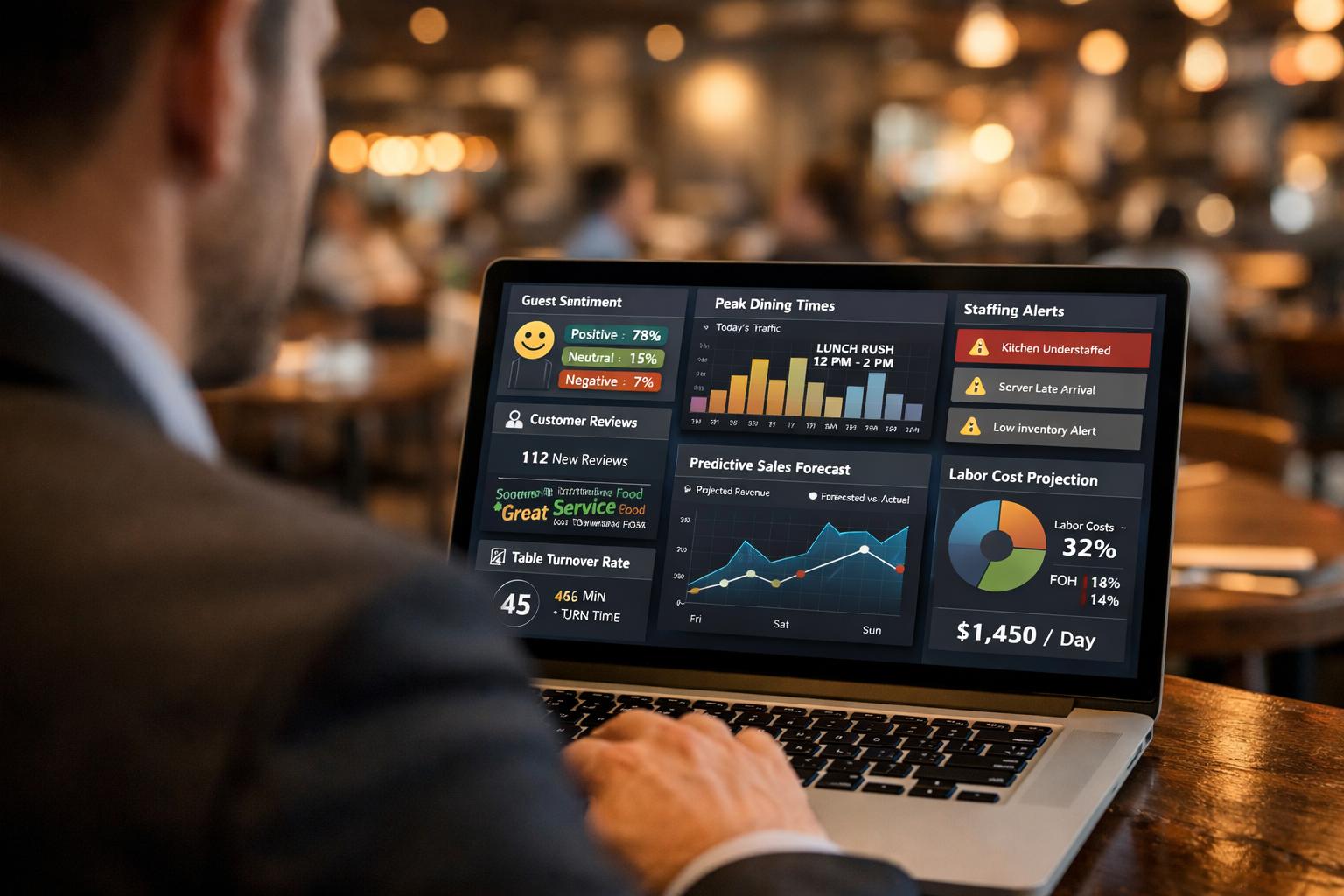
From Dashboards to Daily Decisions
For years, restaurant operators have been drowning in dashboards. Weekly sales reports. Monthly P&L reviews. Quarterly guest satisfaction surveys. The data arrives in neat packages, gets filed away, and occasionally informs a decision that should have been made weeks earlier.
This approach made sense when data collection was expensive, and analysis required specialized expertise. But the economics have shifted dramatically. Guest data now flows continuously from WiFi logins, online ordering, POS transactions, reservations, and dozens of review platforms. The bottleneck is no longer collection, it’s activation.
The shift happening in data-driven restaurant management is fundamental: from looking at reports monthly to receiving real-time alerts that drive same-day operational changes.
Imagine your morning routine includes not just checking yesterday’s sales, but receiving an automated brief: negative sentiment around wait times spiked 34% last week, concentrated on Friday and Saturday evenings between 7-8 PM. Three reviews mentioned “cold food” in the past 48 hours, all referencing dishes from station two. Your at-risk guest segment grew by 12%, with the common thread being visits during your understaffed Tuesday lunch shift.
This isn’t hypothetical. Restaurant AI dashboards now synthesize data from across your operation – POS, reviews, guest WiFi, reservations – into a unified command center. Rather than logging into six different platforms and mentally stitching together insights, operators see the complete picture: KPIs trending in real-time, sentiment analysis highlighting emerging issues, and suggested actions based on the patterns.
The mental model shift is significant. Data stops being something you look at and becomes something that works for you. The dashboard becomes less a rearview mirror and more a navigation system, alerting you to conditions ahead rather than documenting where you’ve already been.
Custom Keyword Tracking: Your Early Warning System
Reviews have always contained operational intelligence. The problem was extracting it at scale. A single negative review about “sticky floors” is easy to dismiss as one person’s bad day. But when restaurant sentiment analysis tracks that phrase across all review platforms over time, patterns emerge that human reviewers simply cannot catch.
This is where AI keyword tracking transforms reputation management into operational intelligence.
The approach is straightforward: identify the specific operational keywords that matter to your business and track them systematically. Food temperature. Wait times. Cleanliness. Staff attitude. Portion sizes. Parking availability. Background noise levels. Each restaurant has its own vocabulary of operational concerns, and tracking the right keywords creates an early warning system that surfaces problems before they metastasize.
Categories emerge naturally: “Sticky Floors” appearing three times in a month triggers a facilities review. “Staff Overworked” clustering around weekend evenings reveals a scheduling problem. “Food Freshness” concerns concentrated on specific menu items points to supply chain or prep issues worth investigating.
The power isn’t just in tracking individual keywords, it’s in seeing how they interact. A spike in “long wait” mentions coinciding with “great food” sentiment tells a different story than “long wait” combined with “not worth it.” The first suggests an operational fix that preserves a loyal customer base. The second signals a more fundamental value proposition problem.
What previously required a dedicated analyst spending hours reading reviews now happens automatically. And crucially, it happens in time to act. Knowing that food temperature complaints spiked last month is useful for a quarterly review. Knowing they spiked yesterday, concentrated during the dinner rush when your expediter called in sick, is actionable intelligence.

The Guest Mapping Advantage
Where do your guests come from? Not metaphorically, literally. What’s their average drive time? What’s the income distribution of the postal codes they call home? How does this differ between your lunch crowd and dinner guests?
Restaurant guest analytics has evolved to answer these questions with precision, and the operational implications run deeper than most operators realize.
Understanding your trade area isn’t just about marketing spend optimization, though that matters. Knowing that 62% of your guests travel less than 10 minutes, while your top-spending 15% average 25-minute drives reveals distinct guest segments with different expectations and tolerances.
The local regulars expect consistency, quick service, and value that justifies frequent visits. The destination diners traveling further expect an experience worth the trip, and they’re more likely to leave reviews, both positive and negative, because the stakes of their decision feel higher.
This geographic intelligence informs operational decisions at every level. Menu pricing can reflect the income distribution of your actual trade area rather than assumptions. Promotional timing can align with when destination diners are most likely to travel. Even parking and accessibility decisions gain clarity when you understand how your guests actually arrive.
For multi-location operators, guest mapping becomes even more powerful. Overlapping trade areas between locations reveal cannibalization concerns. Gaps in coverage suggest expansion opportunities. Income distribution shifts between locations explain why the same menu performs differently across the portfolio.
New location decisions, historically driven by intuition and real estate availability, can now incorporate actual guest behavior data. Where do your current loyal guests live that’s underserved by your existing footprint? Which demographic profiles drive the highest lifetime value, and where are those populations concentrated?
Traffic Patterns Meet Staffing Intelligence
Every restaurant operator understands, at a gut level, the relationship between traffic patterns and staffing needs. Friday nights are busier than Tuesday lunches. Summer patio season differs from winter. These rhythms become instinctive over time.
But instinct often misses the second-order patterns that data reveals clearly.
Average dwell time analysis offers a window into the guest experience that pure transaction data obscures. A 29-minute average visit during lunch tells a different operational story than a 47-minute average at dinner. But more importantly, variation around those averages surfaces opportunities.
When dwell time increases during historically fast periods, something’s creating friction, whether that’s a kitchen bottleneck, service delays, or simply guests lingering because they’re enjoying themselves. When dwell time decreases during periods meant to be leisurely, guests may be feeling rushed or underwhelmed.

Peak visit time data at scale reveals patterns that individual shifts obscure. That 7 PM dinner rush might actually be two distinct waves, early-bird diners arriving at 5:30 who’ve cleared out by 7, and prime-time diners arriving at 7:15. Staffing for “dinner rush” as a single block misses the lull between waves where labor costs accumulate without revenue.
Day-of-week patterns interact with seasonal trends in ways that quarters of data reveal, but weeks cannot. Your Tuesday lunch dip might be structural, driven by the office park down the street that shifted to remote Tuesdays – or seasonal, reflecting school schedules or weather patterns.
This is where restaurant performance metrics evolve from reporting into operational intelligence. The goal isn’t just knowing that Friday at 7 PM is busy. It’s understanding precisely how busy, compared to historical patterns, adjusted for seasonality, and forecasted forward so staffing decisions can be made with confidence rather than guesswork.

The operational efficiency gains compound. Accurate traffic forecasting reduces both understaffing (which damages guest experience) and overstaffing (which damages margins). Neither requires perfect precision. Even modest improvements in forecasting accuracy translate directly to the bottom line.
Closing the Loop: From Insight to Action to Measurement
The greatest frustration with traditional restaurant analytics was the gap between insight and action. A monthly report might surface that guest satisfaction with wait times had declined. But by the time the insight reached operators, through layers of data processing and reporting cycles, the moment for intervention had passed.
Data-driven restaurant management in 2026 closes this loop through automation.
The pattern looks like this: operational triggers—guest behavior changes, sentiment shifts, traffic pattern anomalies—automatically initiate appropriate responses. A guest flagged as “cooling off” based on declining visit frequency receives a personalized win-back campaign. A spike in negative wait time sentiment triggers a staffing review alert. A dip in new guest acquisition in a specific postal code prompts a targeted awareness campaign.
Critically, each automated action connects back to measurable outcomes. The win-back campaign either succeeds in reactivating the cooling-off guest or it doesn’t. And that result informs future campaign refinement. The staffing adjustment either resolves the wait time sentiment issue or reveals a deeper problem. The targeted campaign either moves acquisition metrics in the underperforming area or suggests the issue lies elsewhere.
This creates accountability that manual processes rarely achieve. When insights, actions, and outcomes are systematically connected, operators can answer questions that previously required guesswork: What’s the actual ROI of our guest recovery efforts? How quickly do operational fixes translate to sentiment improvement? Which marketing investments drive sustainable guest behavior changes versus temporary bumps?
The restaurants pulling ahead in 2026 aren’t just collecting better data. They’re building operational systems where insights automatically trigger appropriate actions, and those actions generate measurement data that feeds back into refined insights. The flywheel accelerates.

The Operational Intelligence Imperative
Here’s the uncomfortable truth for restaurant operators: your competitors are building these capabilities. Not all of them, and not all at once, but the trajectory is clear. AI restaurant operations aren’t a future consideration; they’re a present reality, creating separation between operators who embrace operational intelligence and those who don’t.
The good news is that access to these capabilities has democratized rapidly. What once required dedicated data teams, custom analytics infrastructure, and significant ongoing investment now comes packaged in platforms designed for lean operations teams.
Platforms delivering AI-powered sentiment analysis, automated alerts, and operational suggestions give a one-person marketing team the insights that previously required dedicated analysts. A regional chain with 15 locations can now operate with the guest intelligence sophistication that was once the exclusive province of enterprise brands with seven-figure analytics budgets.
But the technology is only as valuable as the operational commitment to use it. Data-driven restaurant management isn’t a tool you buy, it’s a discipline you build. The operators thriving in this environment share common characteristics: they’ve moved from monthly reporting cycles to continuous monitoring, from reactive problem-solving to proactive pattern recognition, from gut-feel decision-making to evidence-based operational choices.
Your guests are still telling you what’s working and what isn’t. The signals are more abundant than ever – in every review, every visit pattern, every behavioral shift across your guest database.
The question remains the same one it’s always been: Are you listening?
Restaurant operators exploring data-driven approaches to guest intelligence should evaluate platforms offering unified dashboards, automated sentiment analysis, and operational alerting capabilities—tools that transform scattered data into daily actionable insights.
👉 Request your free demo here!
Related Articles
- The 3AM Advantage: How Smart Restaurants Grow Revenue While Their Competition Sleeps
- Your Guest Database Isn’t Just Data, It’s Your Restaurant’s Life Support System
- Why Your First-Time Guests Never Return (And How AI Fixes It)
- The Guest Intelligence Revolution: How Unified Data Creates Restaurant Marketing That Never Sleeps
Click to schedule a Free Online Demo, or call 727-877-8181 to see how guest intelligence can transform your restaurant’s retention strategy.
FREQUENTLY ASKED QUESTIONS
Common Questions About Restaurant Marketing
Restaurant marketing is the process of getting people to visit your restaurants. Restaurant marketing creates loyalty, provides data to research, analytics, and allows restaurants to gain a better understanding of their ideal customer profile. It utilizes all customer channels: guest WiFi, website, social, rating sites, mobile apps, email, text, and advertising.
WiFi marketing is a marketing technique that uses guest WiFi to collect & clean customer data such as names, emails, phone numbers, customer behavior, and demographics. This data is used to personalize marketing campaigns to increase customer loyalty, build online reviews, and save at-risk customers. The performance of every campaign can be tracked down to the tangible ROI of a customer walking back in your door.
Restaurant reputation management is the process for restaurants to manage customer feedback and creating systems to improve customer experiences, passively build positive online reviews, and save at-risk customers. It is a very important aspect of running a successful restaurant business.
A restaurant customer data platform (CDP) is a unified software system that collects, consolidates, and activates guest data from multiple sources including WiFi networks, POS systems, online ordering platforms, reservation systems, websites, loyalty platforns, event platforms, and review sites. Unlike generic CDPs built for e-commerce or SaaS companies, restaurant CDPs are purpose-built to handle restaurant-specific data sources and create actionable guest intelligence that drives personalized marketing, operational improvements, and revenue growth automatically.
Bloom Intelligence uses machine learning to identify at-risk customers. When one is recognized, the system will send them a message with an incentive to get them to return and re-establish their visit pattern. Bloom users are seeing up to 37% of churning customers return.
Ready to Turn Your Guest Data Into Revenue?
Join 1,000+ restaurant locations using Bloom Intelligence to recover lost guests, automate marketing, and drive measurable revenue growth.
Keep Reading
View All Posts →8 in 10 Restaurant Guests Never Come Back. Here’s What That’s Costing You.
Key Takeaway Eight in ten restaurant guests who have ever visited your location have never returned, creating a measurable revenue...
Your Restaurant Reputation Management Software Only Does 10% of the Job. Here’s What It’s Missing.
Key Takeaway Most restaurant reputation management software only handles review responses. That's just 10% of the value your guest sentiment...
The 13x Guest: How Restaurant Data Analytics Reveals Your Most Valuable Customers
Key Takeaway Your most loyal restaurant guests spend 13 times more than first-time visitors — but most restaurants can't identify,...