

Top 10 Ways That Restaurants Use Bloom Intelligence
Significantly, data acquisition is an opportunity for agile restaurants in 2021. In another case, a threat to restaurants that are slow to change. Of course, many restaurant professionals appreciate data analytics, but have difficulties acquiring data. Indeed, this is ironic, considering the wealth of data that is available to restaurants through both foot traffic and online traffic.
Data acquisition is essential in order to capitalize on:
- Inventory (suppliers, food inventory, unit prices)
- Financials (recurring items, revenues, raw material costs, items sold, cost per item, total food costs, cash flow projections, costs)
- Kitchen data (cook time, server time)
- Guest management (wait times, average party sizes, table turn times, seating capacity usages, capacities)
- Customer data (names, postal codes, phone numbers, birthdays, emails, anniversaries, favorite menu items, purchasing habits)
- Social media (number of followers, average reach, average engagement rate, best times of day to post)
- Email (Open rates, click through rates, delivery rates)
- Digital advertising (Cost per clicks, click through rates)
“It is a capital mistake to theorize before one has data.”-Sherlock Holmes, “A Study in Scarlett”
Bloom Intelligence has WiFi data that allows restaurants to:
{{cta(‘ac7d1763-a04e-4286-98bc-4ed7de046f8b’,’justifyright’)}}
Bloom Intelligence is more than just a data platform. It allows you to put a name to the face of every customer that logs into WiFi. This automatically creates a CRM to help restaurants build relationships and increase interactions.
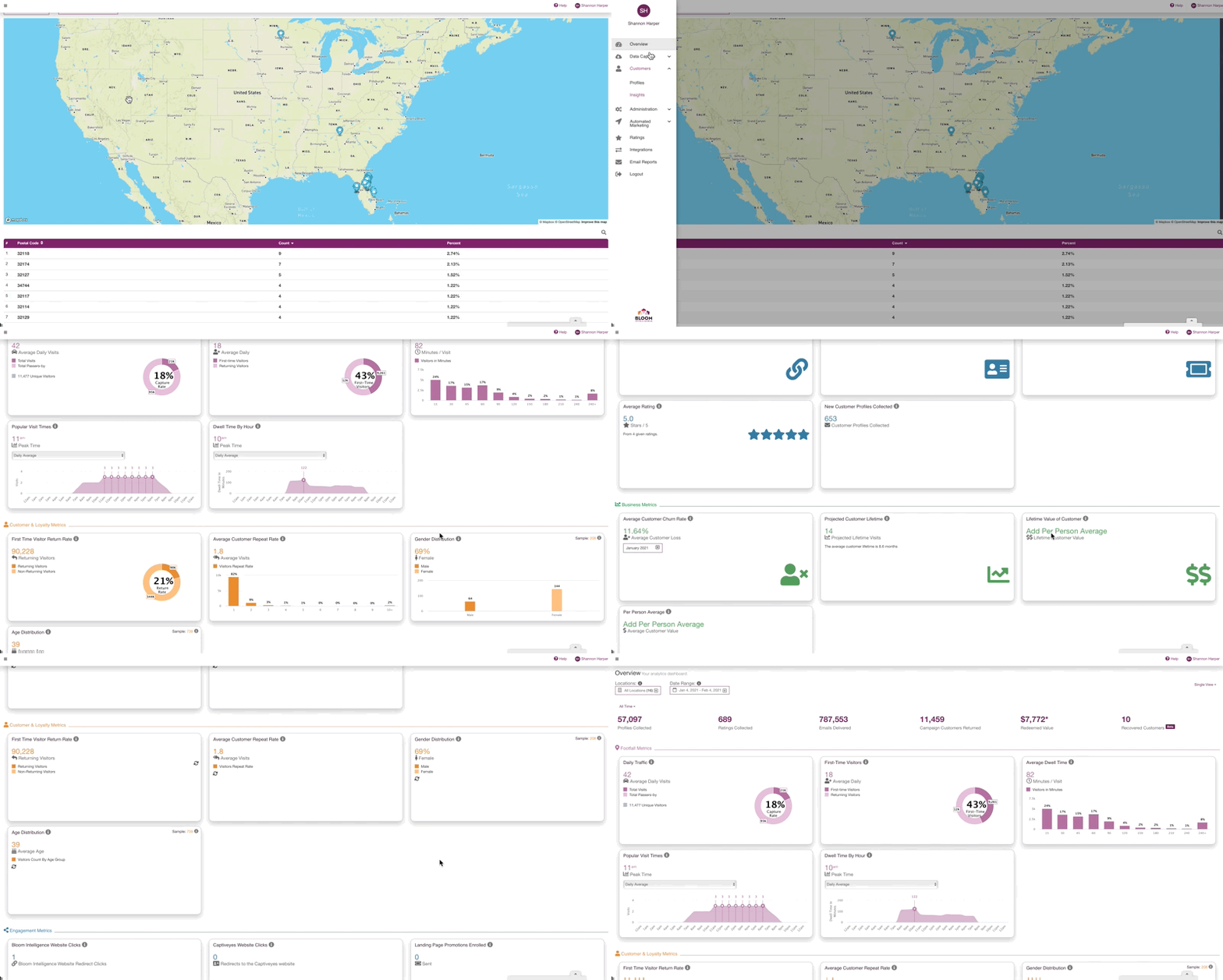
It’s never been more crucial for restaurants to focus on all-in-one third party cloud and SaaS application data capture. Evolution and ROI are now hand-in-hand.
Enjoying this? Get more Bloom Intelligence in your Google results.
FREQUENTLY ASKED QUESTIONS
Common Questions About Restaurant Marketing
Restaurant marketing is the process of getting people to visit your restaurants. Restaurant marketing creates loyalty, provides data to research, analytics, and allows restaurants to gain a better understanding of their ideal customer profile. It utilizes all customer channels: guest WiFi, website, social, rating sites, mobile apps, email, text, and advertising.
WiFi marketing is a marketing technique that uses guest WiFi to collect & clean customer data such as names, emails, phone numbers, customer behavior, and demographics. This data is used to personalize marketing campaigns to increase customer loyalty, build online reviews, and save at-risk customers. The performance of every campaign can be tracked down to the tangible ROI of a customer walking back in your door.
Restaurant reputation management is the process for restaurants to manage customer feedback and creating systems to improve customer experiences, passively build positive online reviews, and save at-risk customers. It is a very important aspect of running a successful restaurant business.
A restaurant customer data platform (CDP) is a unified software system that collects, consolidates, and activates guest data from multiple sources including WiFi networks, POS systems, online ordering platforms, reservation systems, websites, loyalty platforns, event platforms, and review sites. Unlike generic CDPs built for e-commerce or SaaS companies, restaurant CDPs are purpose-built to handle restaurant-specific data sources and create actionable guest intelligence that drives personalized marketing, operational improvements, and revenue growth automatically.
Bloom Intelligence uses machine learning to identify at-risk customers. When one is recognized, the system will send them a message with an incentive to get them to return and re-establish their visit pattern. Bloom users are seeing up to 37% of churning customers return.
Ready to Turn Your Guest Data Into Revenue?
Join 1,000+ restaurant locations using Bloom Intelligence to recover lost guests, automate marketing, and drive measurable revenue growth.
Keep Reading
View All Posts →Restaurant Sentiment Analysis: Guests Warn You Two Months Before Revenue Drops. Here Is What They Say First.
A doubling of 1 and 2 star reviews preceded a 7 percent median revenue dip two months later on the...
Restaurant Email Marketing Benchmarks 2026: The Emails That Actually Bring Guests Back
Restaurants send 99.7% of their email as blasts. Blasts return 0.27% of recipients. Welcome and win-back emails return 6.5% to...
Restaurant Guest Segmentation in 2026: From Five Buckets to Infinite Segments
Legacy RFM segments are the map, but modern restaurant segmentation is combinatorial: layer menu affinity, interaction events, and location onto...