


The $100,000 Question: Is AI Finding Your Restaurant?
Your restaurant could be losing $100,000+ in annual revenue right now. And you wouldn’t even know it.
Here’s why: When someone asks Siri, Alexa, or ChatGPT, “Where should I eat tonight?”, your restaurant either appears in that precious AI-generated recommendation…or it doesn’t. There’s no middle ground in the AI discovery game.
The harsh reality? 70% of local restaurant searches now happen through voice assistants and AI platforms. If you’re invisible to AI, you’re invisible to the majority of potential guests. That’s not just missed opportunities, it’s revenue walking directly to your AI-optimized competitors.
SEO Isn’t Dead—It’s Evolving Into Something More Powerful
Let’s be clear: traditional SEO still matters. But it’s rapidly transforming into AEO (Answer Engine Optimization). And this evolution is creating a massive opportunity gap between restaurants that adapt and those that don’t.
Think about how your guests search now:
- 2015: “Italian restaurants Denver”
- 2020: “Best Italian restaurants near me”
- 2025: “Hey Google, find me a romantic Italian place with gluten-free options that’s open now.”
The restaurant marketing game has fundamentally changed. Search engines have become answer engines. They don’t just list results, they make recommendations. And those recommendations drive real revenue.
Consider this: Restaurants appearing in AI-recommended lists see an average 31% increase in new guest acquisition. Meanwhile, restaurants that aren’t optimized for voice and AI search report flat or declining traffic, even with strong traditional SEO.
The AI Search Advantage
How AI optimization impacts restaurant traffic
Average increase in new guest acquisition for restaurants appearing in AI-recommended lists
Traffic trends for restaurants without voice and AI search optimization, despite strong traditional SEO
Data reflects comparative analysis of AI search optimization impact on restaurant traffic
The New Discovery Ecosystem: Complex Technology, Simple Outcomes
Yes, optimizing for both SEO and AEO is more complicated than ever. You’re not just dealing with Google anymore. You’re optimizing for:
- Voice assistants (Alexa, Google Assistant, Siri)
- AI chatbots (ChatGPT, Claude, Perplexity)
- Answer boxes and featured snippets
- Local knowledge panels
- Voice-activated car systems
- Smart home devices
Each platform has different requirements. Each will value different signals. It’s enough to make any restaurant operator’s head spin.
But here’s the secret that successful restaurants have discovered: complexity doesn’t have to mean complicated. With the right approach, you can dominate AI discovery without becoming a tech expert.
The 5 Non-Negotiables for AI Discoverability (Starting Today)
1. Claim and Unify Your AI Real Estate
The Problem: AI pulls data from 50+ sources. One inconsistency can tank your visibility.
The Fix: Ensure your restaurant name, address, phone number, and hours are identical across every platform—Google Business Profile, Apple Maps, Yelp, TripAdvisor, OpenTable, your website, social media, and dozens more.
Why It Works: AI systems give consistency a heavy weight. When your data matches everywhere, AI trusts you’re legitimate and recommendable.
2. Structure Your Data for AI Consumption
The Problem: AI can’t “see” your PDF menu or image-based specials.
The Fix: Convert everything to structured data. Use schema markup on your website. List every menu item with descriptions, prices, and dietary indicators in text format.
Why It Works: When someone asks, “Where can I find vegan pasta near me?”, AI needs to read your menu data to include you in recommendations.
3. Become the Quoted Authority
The Problem: AI platforms cite sources. If you’re not quotable, you’re invisible.
The Fix: Create specific, answer-focused content. Instead of “About Us” pages, create “Why We’re Denver’s Favorite Family Italian Restaurant” pages. Answer real questions: “What makes authentic Neapolitan pizza?”, “Best wines to pair with seafood pasta?”
Why It Works: AI systems prefer citing specific, authoritative answers. Become the source of AI quotes when answering food questions in your area.
4. Win the Freshness Game
The Problem: AI heavily favors recent, active information.
The Fix: Update something every week. Rotate seasonal menu highlights. Respond to every review within 24 hours. Post weekly specials. Keep your content timestamp fresh.
Why It Works: AI interprets activity as relevance. Active restaurants get recommended. Stale listings get ignored.
5. Build Comprehensive Topic Authority
The Problem: AI doesn’t just match keywords, it understands context and expertise.
The Fix: Own your category locally. If you’re an Italian restaurant, create content about Italian wine regions, pasta-making techniques, or the history of your signature dishes. Build a web of related, valuable content.
Why It Works: AI recognizes topic authority. When you demonstrate deep knowledge about Italian cuisine, AI is more likely to recommend you for Italian food queries.
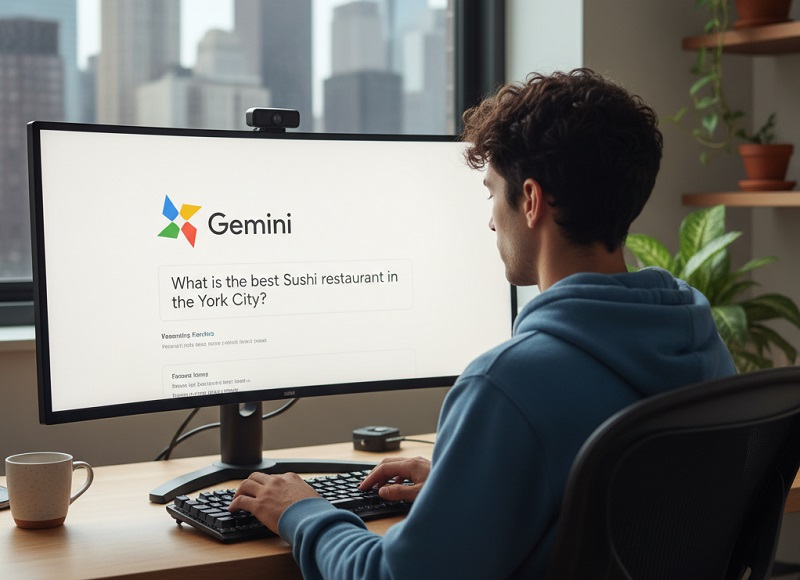
The Intelligence Advantage: Why Some Restaurants Dominate AI Results
Here’s what separates restaurants that win from those that wonder why traffic is declining:
Data unification.
The restaurants crushing it in AI discovery have unified guest intelligence. They know their guests’ preferences, behaviors, and patterns across every touchpoint.
This creates a powerful feedback loop. Better data leads to better content, which leads to better AI visibility, which brings more guests, creating even better data.
Imagine knowing exactly what your 6.8 million collective guests search for, ask about, and value most. That intelligence doesn’t just improve your operations, it makes you irresistibly discoverable to AI systems looking for the perfect restaurant recommendation.
The compound effect is real:
- Unified guest data reveals what questions to answer
- Targeted content gets noticed by AI systems
- AI recommendations drive new guests
- New guest data improves targeting
- The cycle accelerates
Restaurants leveraging this intelligence-driven approach to discovery aren’t just surviving, but they’re capturing market share from competitors still playing by yesterday’s rules.
The 18-Month Window: Why Timing Matters
The AI discovery landscape is crystallizing rapidly. In 18 months, the winners and losers will be largely determined. Here’s why:
- AI platforms are establishing trusted sources NOW. Once AI systems categorize you as authoritative (or not), it’s difficult to change.
- Voice commerce is exploding. Voice-driven food ordering is projected to hit $50 billion by 2026. Restaurants optimized today will capture this wave.
- Guest expectations are solidifying. Guests are forming habits around AI-assisted dining decisions. If you’re not in their consideration set now, you may never be.
- The complexity barrier is rising. Every month, optimization becomes more sophisticated. Starting later means catching up gets exponentially harder.
Your Next Move: From Overwhelmed to Optimized
Reading this, you might be thinking: “This sounds like a full-time job. How can I possibly manage traditional marketing, operations, AND master AI optimization?”
That’s exactly the right question. The truth is, manual optimization across all these platforms would take at least 20 hours per week…time you don’t have.
But what if you could automate the entire process? What if your guest intelligence could automatically:
- Keep your information consistent across every platform
- Respond to reviews instantly with AI understanding sentiment
- Update your website discoverability signals 24/7
- Get smarter every single day
This isn’t futuristic thinking. Restaurants using intelligent automation are already dominating AI discovery, capturing the “$100,000 opportunity” while their competitors scramble to keep up.

The Bottom Line: Discoverable or Dismissible
Every day you wait is another day of:
- Lost revenue to AI-optimized competitors
- Guests who never know you exist
- Market share slipping away
- The gap widening between you and the discovery leaders
But every restaurant that takes action now, those that embrace the evolution from SEO to AEO, that unify their data, that automate their optimization, position themselves to thrive in the AI-first future.
The question isn’t whether AI will determine your restaurant’s success. It already is.
The only question is: Will you be the restaurant AI recommends, or the one it ignores?
Because in the age of AI, being good isn’t enough. You need to be discoverable.
Bloom Intelligence transforms restaurant data into AI-powered guest intelligence that automatically grows revenue, protects reputation, and optimizes operations 24/7. Our platform manages millions of guest intelligence signals across 1,000+ restaurant locations, driving measurable results through intelligent automation.
Request a Demo of Bloom Intelligence
Let Bloom Intelligence Make It Effortless
Bloom Intelligence is the AI-powered restaurant marketing platform that automatically grows revenue, protects reputation, and optimizes operations 24/7. Our unified platform combines guest data from every touchpoint with intelligent automation to give restaurants the marketing power of major chains—without the complexity or cost.
Bloom makes guest data collection and marketing automation effortless, which allows you to quickly execute the strategies listed above, saving you time, increasing customer lifetime values, attracting new guests, improving your reputation, and boosting your bottom line.
Call us or schedule a free demo online and Bloom will show you how our restaurant marketing platform can help you save time and increase your customer lifetime values by automatically building first-party customer databases, unlocking important guest insights to trigger automated marketing at the right time and place, discover true guest sentiment, save at-risk guests, increase your current guests’ frequency, supercharge your website, and find new guests.
Click to schedule a Free Online Demo, or call 727-877-8181 to see how we can help you drive tangible results for your restaurants.
FREQUENTLY ASKED QUESTIONS
Common Questions About Restaurant Marketing
Restaurant marketing is the process of getting people to visit your restaurants. Restaurant marketing creates loyalty, provides data to research, analytics, and allows restaurants to gain a better understanding of their ideal customer profile. It utilizes all customer channels: guest WiFi, website, social, rating sites, mobile apps, email, text, and advertising.
WiFi marketing is a marketing technique that uses guest WiFi to collect & clean customer data such as names, emails, phone numbers, customer behavior, and demographics. This data is used to personalize marketing campaigns to increase customer loyalty, build online reviews, and save at-risk customers. The performance of every campaign can be tracked down to the tangible ROI of a customer walking back in your door.
Restaurant reputation management is the process for restaurants to manage customer feedback and creating systems to improve customer experiences, passively build positive online reviews, and save at-risk customers. It is a very important aspect of running a successful restaurant business.
A restaurant customer data platform (CDP) is a unified software system that collects, consolidates, and activates guest data from multiple sources including WiFi networks, POS systems, online ordering platforms, reservation systems, websites, loyalty platforns, event platforms, and review sites. Unlike generic CDPs built for e-commerce or SaaS companies, restaurant CDPs are purpose-built to handle restaurant-specific data sources and create actionable guest intelligence that drives personalized marketing, operational improvements, and revenue growth automatically.
Bloom Intelligence uses machine learning to identify at-risk customers. When one is recognized, the system will send them a message with an incentive to get them to return and re-establish their visit pattern. Bloom users are seeing up to 37% of churning customers return.
Ready to Turn Your Guest Data Into Revenue?
Join 1,000+ restaurant locations using Bloom Intelligence to recover lost guests, automate marketing, and drive measurable revenue growth.
Keep Reading
View All Posts →8 in 10 Restaurant Guests Never Come Back. Here’s What That’s Costing You.
Key Takeaway Eight in ten restaurant guests who have ever visited your location have never returned, creating a measurable revenue...
Your Restaurant Reputation Management Software Only Does 10% of the Job. Here’s What It’s Missing.
Key Takeaway Most restaurant reputation management software only handles review responses. That's just 10% of the value your guest sentiment...
The 13x Guest: How Restaurant Data Analytics Reveals Your Most Valuable Customers
Key Takeaway Your most loyal restaurant guests spend 13 times more than first-time visitors — but most restaurants can't identify,...