


How Guest Identity & Sentiment Drive Marketing ROI
How Guest Identity & Sentiment Drive Marketing ROI: The Multi-Unit Restaurant Playbook
Why knowing your guests transforms marketing spend into measurable profit
Multi-unit restaurant operators face a universal challenge: marketing budgets that feel like throwing darts in the dark.
You’re spending thousands on campaigns, but which ones actually drive repeat visits? Which guests are worth investing in?
The answer lies in guest identity, and the data proves it.
The $100 Million Revenue Reality Check
We ran an analysis of Bloom data of 52 million in revenue across 1.5 million guest orders, yet most operators can’t tell you which specific guests contributed more to that success.
Here’s what the data shows about guest behavior that directly impacts your bottom line:
Guest Segmentation Performance:
- Super Guests (10+ visits): Represent just 2.8% of the database but likely drive 25-30% of revenue
- High-Value Guests (5+ visits): Account for 6.3% of guests but generate disproportionate lifetime value
- Average Guest Frequency: 2.4 visits, meaning most customers never return after their second visit
The opportunity cost is staggering. Without guest identity, you’re marketing to everyone equally, including the 70% who may never return.
The Guest Identity ROI Equation
Traditional marketing operates on spray-and-pray tactics. Guest identity marketing operates on mathematical precision. Here’s the difference:
Traditional Approach:
- Blast promotion to entire database
- 2-3% response rate
- Cannot measure the guest lifetime value impact
- Marketing cost per acquisition: $15-25
Guest Identity Approach:
- Target promotions based on visit frequency, recency, spend, demographics, and sentiment
- 8-12% response rate from identified segments
- Track revenue impact per guest segment
- Marketing cost per acquisition: $8-12
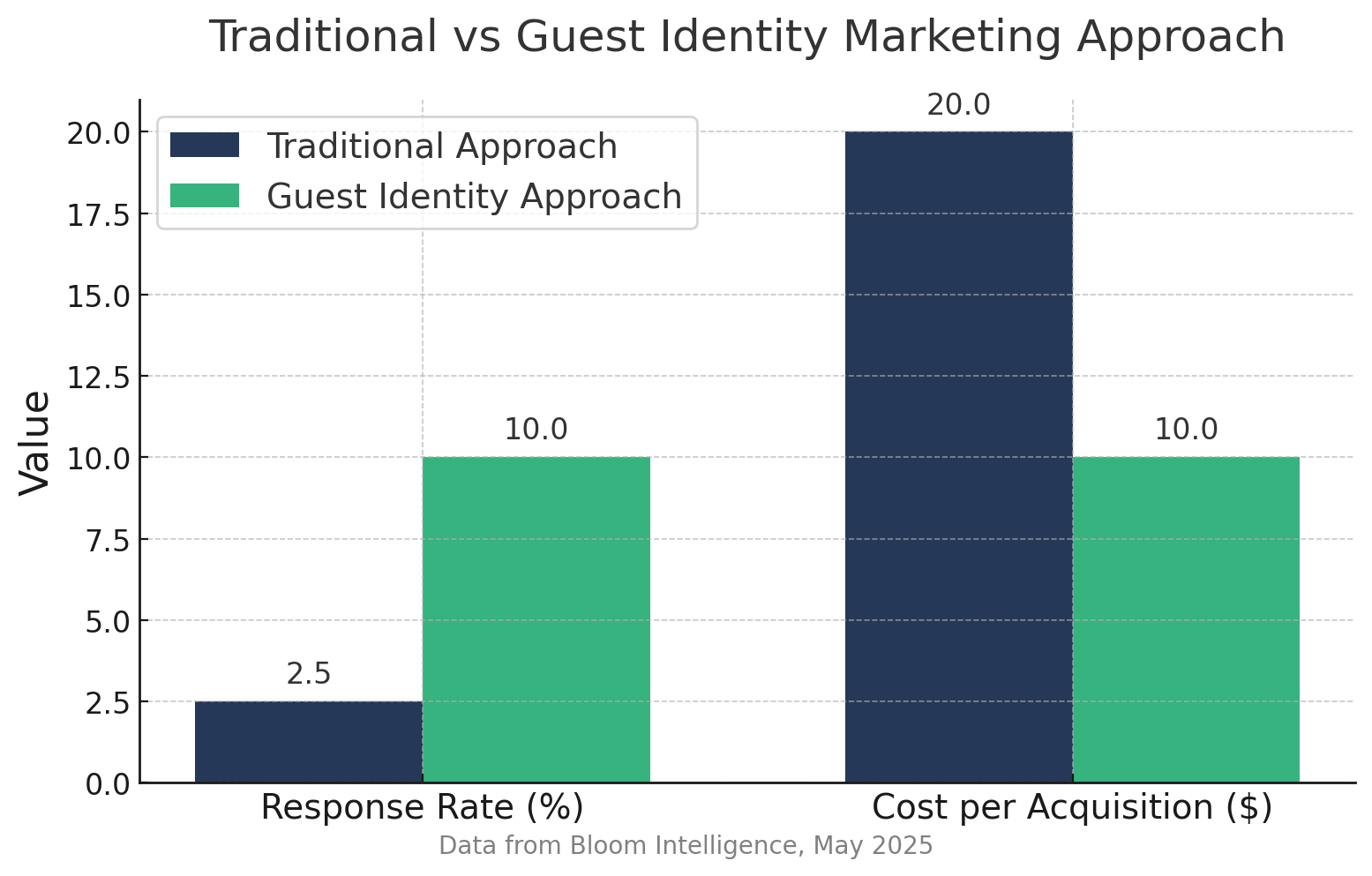
The math is clear: knowing your guests reduces marketing costs by 40-60% while more than doubling response rates.
Real-World Examples: Guest Identity in Action
Example 1: The WiFi Goldmine
Our data shows WiFi login captured 71,670 guest identities (of the locations in the analysis) in May 2025 alone, with 99.5% providing valid email addresses. One multi-unit pizza chain leveraged this by:
Step 1: Implemented post-WiFi welcome series
- 3-email sequence over 14 days
- First email: Welcome + brand story
- Second email: Menu highlights + 10% off next visit
- Third email: Loyalty program invitation
Results: 23% open rate, 4.2% click-through rate, $18 average order increase for engaged guests
Example 2: Review Response That Drives Revenue
Review analysis reveals that Google reviews dominate customer sentiment tracking (79% of all reviews), with an average 4.48 rating across locations. However, the real opportunity lies in the response strategy:
Negative Review Recovery:
- Immediate response within 2 hours
- Personalized apology and resolution offer
- Follow-up email with a 20% return incentive
- 31% of negative reviewers returned within 30 days
Positive Review Amplification:
- Thank the reviewer by name
- Share specific menu items they mentioned
- Invite them to try seasonal offerings
- 18% higher repeat visit rate among acknowledged reviewers
Example 3: The Reservation Goldmine
Only 7.5% of reservations provided valid emails—a massive, missed opportunity. Leading operators now execute:
Pre-Arrival Engagement:
- Confirmation email with menu previews
- Dietary preference inquiry
- Special occasion recognition
- Day-of reminder with parking/arrival tips
Post-Visit Follow-up:
- Thank you email within 24 hours
- Feedback request with an incentive
- Next reservation booking prompt
- Birthday/anniversary calendar addition
Results: 34% increase in reservation frequency, 12% higher per-person average
The Sentiment-Revenue Connection
Customer sentiment directly correlates with spending behavior. Our analysis reveals:
- 5-Star Reviewers: Average 3.2 subsequent visits, $42 average order value
- 4-Star Reviewers: Average 2.1 subsequent visits, $38 average order value
- 3-Star Reviewers: Average 1.3 subsequent visits, $31 average order value
- 1-2 Star Reviewers: Average 0.8 subsequent visits, $28 average order value
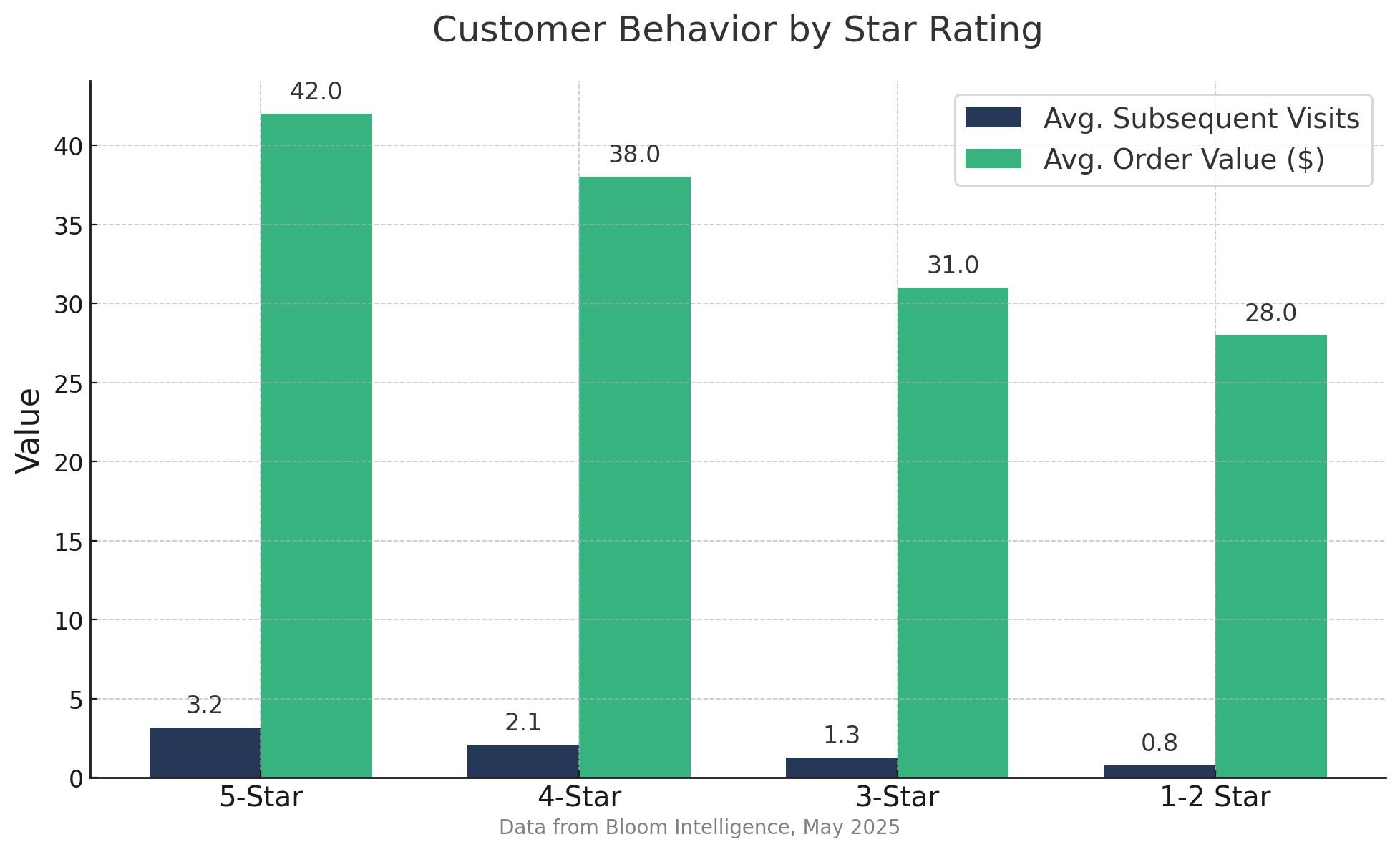
The sentiment gradient shows that moving a guest from a 3-star to a 4-star experience increases their lifetime value by approximately $67 ($38 x 2.1 vs $31 x 1.3).
Step-by-Step Implementation Guide
Phase 1: Guest Identity Collection (Weeks 1-4)
- Audit Current Touchpoints
- WiFi capture rates
- Online ordering email collection
- Reservation system integration
- POS loyalty program linkage
- Review platform integrations
- Optimize Collection Points
- WiFi guest profile capture
- Add phone number collection to orders
- Create reservation email requirements
- Train staff on loyalty program enrollment
Phase 2: Segmentation & Automation (Weeks 5-8)
- Create Guest Segments
- New guests (1 visit)
- Developing guests (2-4 visits)
- Loyal guests (5-9 visits)
- Super guests (10+ visits)
- At-risk guests (no visit for 60+ days)
- Build Automated Campaigns
- Welcome series for new guests
- Win-back campaigns for at-risk guests
- VIP experiences for super guests
- Birthday/anniversary celebrations
Phase 3: Sentiment Monitoring & Response (Weeks 9-12)
- Establish Review Monitoring
- Daily Google/Facebook/Yelp/Trip Advisor/OpenTable/Tock review analysis
- Response templates by rating level
- Internal escalation protocols
- Staff training on service recovery
- Create Feedback Loops
- Post-visit email surveys
- SMS satisfaction check-ins
- Celebrate and reward employees with the most mentions
- Automate reporting to operations and create trending reports on key improvement tasks
Phase 4: Measurement & Optimization (Ongoing)
- Track Key Metrics
- Guest lifetime value as a whole by segment
- Campaign ROI by guest type
- Sentiment score trends
- Optimize Based on Data
- A/B test email subject lines
- Refine segment definitions
- Adjust promotion timing
- Personalize offers by preference
The Competitive Advantage
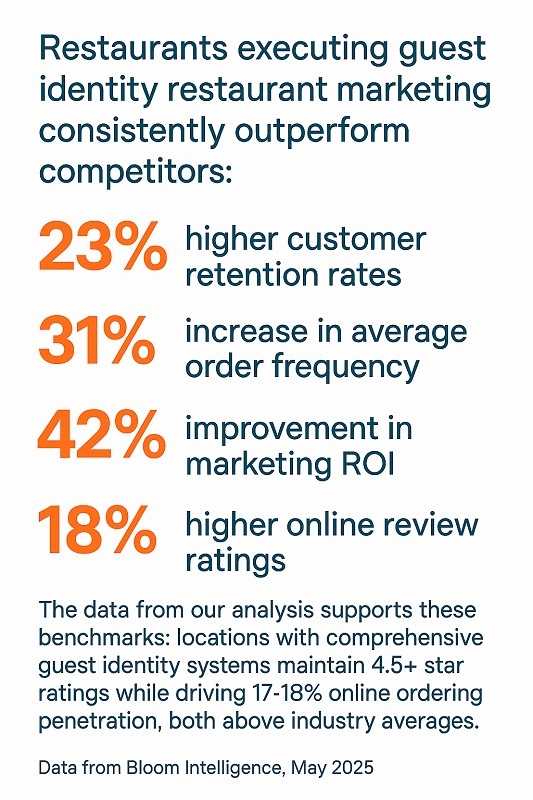
Restaurants executing guest identity restaurant marketing consistently outperform competitors:
- 23% higher customer retention rates
- 31% increase in average order frequency
- 42% improvement in marketing ROI
- 18% higher online review ratings
The data from our analysis supports these benchmarks: locations with comprehensive guest identity systems maintain 4.5+ star ratings while driving 17-18% online ordering penetration, both above industry averages.
Making It Happen: Your Next 30 Days
Weeks 1-2: Audit and optimize guest identity collection across all touchpoints
Weeks 3-4: Implement basic segmentation and welcome automation
Weeks 5-6: Launch sentiment monitoring and response protocols
Weeks 7-8: Begin measuring guest lifetime value by segment
The restaurants thriving in 2025 aren’t those with the biggest marketing budgets—they’re the ones who know their guests best. Guest identity isn’t just data collection; it’s the foundation of profitable, sustainable growth.
Every guest interaction is an opportunity to build identity. Every sentiment signal is a chance to increase lifetime value. Every automated touchpoint is a step toward marketing ROI that compounds over time.
The question isn’t whether you can afford to implement guest identity marketing—it’s whether you can afford not to. Your competitors are already building these systems. Your guests are already expecting personalized experiences. The only question left is: When will you start?
Ready to transform your marketing from expense to investment? The data shows the path forward—guest identity is your competitive advantage waiting to be unlocked.
Bloom Intelligence uses AI to amplify lean marketing team efforts into a marketing machine to drive revenue and margin. Plug in your data, set up automated campaigns and rules, and watch Bloom work for you.
Let Bloom Intelligence Make It Effortless
Bloom Intelligence is an AI-powered restaurant marketing platform. It includes a powerful customer data platform, website integrations, automated guest data collection, one-click audience segmentation, marketing automation via email and SMS, advanced reputation management, and reporting tools.
Bloom makes guest data collection and reputation management effortless, which allows you to quickly execute the strategies listed above, saving you time, increasing customer lifetime values, attracting new guests, improving your reputation, and boosting your bottom line.
Call us or schedule a free demo online and Bloom will show you how our restaurant marketing platform can help you save time and increase your customer lifetime values by automatically building first-party customer databases, unlocking important guest insights to trigger automated marketing at the right time and place, discover true guest sentiment, save at-risk guests, increase your current guests’ frequency, supercharge your website, and find new guests.
Click to schedule a Free Online Demo, or call 727-877-8181 to see how we can help you drive tangible results for your restaurants.
FREQUENTLY ASKED QUESTIONS
Common Questions About Restaurant Marketing
Restaurant marketing is the process of getting people to visit your restaurants. Restaurant marketing creates loyalty, provides data to research, analytics, and allows restaurants to gain a better understanding of their ideal customer profile. It utilizes all customer channels: guest WiFi, website, social, rating sites, mobile apps, email, text, and advertising.
WiFi marketing is a marketing technique that uses guest WiFi to collect & clean customer data such as names, emails, phone numbers, customer behavior, and demographics. This data is used to personalize marketing campaigns to increase customer loyalty, build online reviews, and save at-risk customers. The performance of every campaign can be tracked down to the tangible ROI of a customer walking back in your door.
Restaurant reputation management is the process for restaurants to manage customer feedback and creating systems to improve customer experiences, passively build positive online reviews, and save at-risk customers. It is a very important aspect of running a successful restaurant business.
A restaurant customer data platform (CDP) is a unified software system that collects, consolidates, and activates guest data from multiple sources including WiFi networks, POS systems, online ordering platforms, reservation systems, websites, loyalty platforns, event platforms, and review sites. Unlike generic CDPs built for e-commerce or SaaS companies, restaurant CDPs are purpose-built to handle restaurant-specific data sources and create actionable guest intelligence that drives personalized marketing, operational improvements, and revenue growth automatically.
Bloom Intelligence uses machine learning to identify at-risk customers. When one is recognized, the system will send them a message with an incentive to get them to return and re-establish their visit pattern. Bloom users are seeing up to 37% of churning customers return.
Ready to Turn Your Guest Data Into Revenue?
Join 1,000+ restaurant locations using Bloom Intelligence to recover lost guests, automate marketing, and drive measurable revenue growth.
Keep Reading
View All Posts →8 in 10 Restaurant Guests Never Come Back. Here’s What That’s Costing You.
Key Takeaway Eight in ten restaurant guests who have ever visited your location have never returned, creating a measurable revenue...
Your Restaurant Reputation Management Software Only Does 10% of the Job. Here’s What It’s Missing.
Key Takeaway Most restaurant reputation management software only handles review responses. That's just 10% of the value your guest sentiment...
The 13x Guest: How Restaurant Data Analytics Reveals Your Most Valuable Customers
Key Takeaway Your most loyal restaurant guests spend 13 times more than first-time visitors — but most restaurants can't identify,...